#NCTE18: Taking Action To Establish Cultural Competence In The ELA Classroom

“Cultural competence is having an awareness of one’s own cultural identity and views about difference, and the ability to learn and build on the varying cultural and community norms of students and their families. It is the ability to understand the within-group differences that make each student unique, while celebrating the between-group variations that make our country a tapestry. This understanding informs and expands teaching practices in the culturally competent educator’s classroom.”

-National Education Association

Part of being a culturally responsive and competent teacher includes learning how to cultivate critical conversations. However, competence also includes taking a long, hard look in the mirror to figure out how our OWN individual identities impact our pedagogy.

Working together with students means modeling how to explore the ways in which our identities impact how we view the world. Creating classroom environments and cultures that encourage self-discovery through critical perspectives are vital to culturally responsive teaching. It is not enough to be AWARE that issues exist, we have to foster COMPETENCE among ourselves and our students enough to be critical voices in these conversations.

This Saturday, please join me at NCTE as I engage with my colleagues across the nation to discuss the importance of taking action to develop cultural competence among teachers and students in today’s ELA Classrooms.

Can’t make it? Start a conversation in the comments! What are ways you actively engage in cultural competence with your students? What are ways that YOU are looking to become culturally competence in your classrooms? I would love to hear your feedback as to how we can start a plan of action for ALL educators!
NCTE 2018- shared slides

Gena Mendoza teaches High School English in San Antonio, Texas. Her most salient identities include female, Chicana, feminist, mother, wife, educator, dog mom, and self-proclaimed advocate for social justice and equality. In between managing her career and grad school, she enjoys making paper flowers and spending quality time with her family. She invites you to connect with her on Twitter at @Mrs_Mendoza3 and looks forward to collaborating with you at #NCTE18!


#NCTE18 –Ready, Set, Talk: An Action Plan for More Critical Conversations

“There can be no settlement of a great cause without discussion, and people will not discuss a cause until their attention is drawn to it.”  William Jennings Bryan

We’ve written quite a lot about the importance of talk on this blog. Too often, classrooms remain quiet as teachers impart their wisdom instead of helping students discover their own. Listening and speaking often get short shrift in our classrooms; however, with concerted team effort, we can change this.

At NCTE this Saturday, Lisa Dennis, ELAR teacher, and Alejandra Ovalle-Krolick, World Languages teacher, will share how they had a meeting of the minds and began shaping opportunities for learners to read and discuss culturally relevant texts across disciplines.

Opening windows and inviting critical conversations that explore our shared humanity is one way we become allies and advocates who instigate positive change.

NCTE 2018- shared slides

#NCTE18 We’ve Got Some Action Plans to Talk About

It’s cold. Not to be a whiner, but . . . We moved into a new house during the hot Texas summer. The air conditioner worked. We thought we were good. Then, this month, finally, cool weather. Cooler and cooler. The temperature drops, drops, drops. “Guess what?” he says, “Uh, about the heater. We never turned the gas on.”

I sit here with my hot herbal tea steaming beside me and the electric blanket warming my feet as a portable space heater I found in the garage radiates from across the room. One call and the heater will toast up the house in no time.

I know others aren’t so lucky. So fortunate. So blessed. Shall we say — so privileged?

Perhaps that’s simplifying it. I know.

I’ve spent my career teaching in Title 1 schools. A warm place to write is often not even on my students’ lists of worries. I’ve thought about my privilege, a white woman educator, helping children of color grow as readers and writers. I’ve rewritten and revised countless lessons all with the earnest desire to give my students what I have always taken for granted.

I know that is not enough. Not enough if I want systemic change for all children everywhere. The more I learn the more I learn how little I know.

This tweet was pivotal to my understanding:

privilege intersections

What does this mean for me as an educator? What does this mean for the approach I take to selecting texts, to engaging readers, to fostering writers, to facilitating classroom discussion, to advocating for students in my realm of influence?

At NCTE this year, some of us on this blog team will present on how we are Raising Student Voice: Speaking Out for Equity and Justice.

NCTE 2018- shared slides

I am still working on my 10 minutes. (I know. I know! NCTE starts on Thursday!) But here’s what I am thinking —

For those of us who advocate for choice independent reading, we often quote Rudine Sims Bishop’s thoughts on books being mirrors, windows, and sliding glass doors. (I quote her in this post I wrote last week.) I wonder how often we think about our students’ writing with a similar lens.

Do we empower writers the same way we hope choice empowers them as readers?

We should. We can.

I think I have a little of it figured out. If you will be at NCTE, I hope you will come join the conversation.


Amy Rasmussen loves her work with teachers and teenagers. She binge watches a lot of Netflix originals with her best-friend husband and reads a lot of YA lit. Her recent reading favorites: The Poet X by Elizabeth Acevedo, The Doubt Factory by Paolo Bacilagupi, and Swing by Kwame Alexander. And the teaching book she’s most excited to dig into if it ever comes in the mail:  We Got This by Cornelius Minor. (We are honored to have Mr. Minor chair our session!)


From Victim to Validated

lit is good for youIn RWW, we aren’t teachers of literature per se.  Still, the spectre of the literary ideal can show itself in our workshop classrooms for reasons from the pedagogical (as mentor texts) to the administrative (curricular requirements).

In Advanced Writing, an elective class for seniors, Mariana and I are taking students through a fiction-writing unit. As we blithely assembled a set of short stories as mentor texts, it dawned on us — more slowly than I am proud of — that with minimal exception, our short-story mentors were all writing about women in peril.

In an effort to ground what has in the past been a scurrilous unit, both teaching-wise for us and writing-wise for students, we required students to ground their stories in some real-world element. We read an excerpt from Black Water, Joyce Carol Oates’s retelling of the Chappaquiddick incident from Mary Jo Kopechne’s viewpoint. Then, because they are exquisite examples of the form — and because Mariana and I love them so much — we read “Where Are You Going, Where Have You Been?” by JCO and “Victory Lap” by George Saunders, for plot/characterization and character/p-o-v, respectively.

Lo and behold, a young woman is preyed upon in each of these three unconnected stories. Ha ha, we laughed. How art imitates life, we laughed. We then went about the business of selecting short-story material for students to “read like writers” while we are at NCTE later this week, intending to offer an oeuvre of stories representative of sex- and region- and race-diverse viewpoints.

Here’s what we came up with in our initial brainstorm:

  • “Hairball” by Margaret Atwood
  • “Brownies” by ZZ Packer
  • “Welcome to the Monkey House” by Kurt Vonnegut
  • “A Good Man Is Hard to Find” by Flannery O’Connor

In “Hairball,” a woman undergoes surgery to remove an ovarian cyst and then has her Peril job stolen from her by her married lover. The little girls in ZZ Packer’s Brownie troop suffer both racial and disability slurs. Kurt Vonnegut’s 6-foot asexual heroine is abducted and raped inside a futuristic museum of the Kennedy Compound. And in “A Good Man is Hard to Find,” the grandmother “would of been a good woman if it had been somebody there to shoot her every minute of her life.”

How much of what we teach — in English and other curriculum — reminds students of the perils of patriarchy but without the empowerment? How do we balance our content to provide windows, mirrors, sliding glass doors, AND those heavy doors that take effort, will, discomfort to open, as Amy writes about so eloquently here.

I face a similar struggle in my class of sophomores. Our curriculum calls for a literary analysis, yet the suggested texts typically depict the great suffering endured by a variety of marginalized groups. (It just occurred to me in writing this why so many high school students still prefer to read about superheroes.)

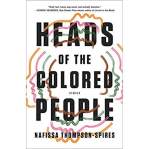
In oHeads of the Colored Peopleur persistent efforts to give voice to the voiceless without beating the same very-much-alive patriarchal horse, we turned to some more recent fiction by writers of color. Heads of the Colored People by Nafissa Thompson-Spires includes a story called “Fatima, the Biloquist: a Transformation Story,” in which a young Black woman who attends a mostly-white private school seeks to embrace her Blackness. The title story in Nana Kwame Adjei-Brenyah’s debut collection Friday Black exposes the grave danger inherent in American consumerism from the perspective of a retail clerk who, literally, is above it all. I also love to use Lucille Clifton’s “won’t you celebrate with me” as a quick write prompt.

Alas, if art needs must imitate life, we can find ways for students to see triumph and celebration without oversimplifying their experience. Or putting them in even more peril.


When Workshop Hits the Struggle Bus…

One of my favorite new terms this year is the struggle bus. My kids say it when they’re having a rough morning or when they don’t understand something or when they’re just generally having a difficult time in life–“I’m on the struggle bus today, Mrs. T.” It seems that hardly a day goes by without someone mentioning that phrase, so maybe that’s why it seems resonant to me today.

struggle-bus

Actually, that’s not why at all. My workshop work has hit the struggle bus a bit this year in my grade level classes–that’s the truth of the matter. If you’re in this field at all for any length of time, you’re bound to hit it. That big old bright yellow school bus of a struggle bus is sometimes hard to avoid–is it those long tough early months of school? Struggle bus. Is it a gaggle of girls who just can’t seem to settle in to what you’re working on? Struggle bus. Is it game day and a classroom full of giant man boys who are so hopped up on adrenaline that reading and writing in the last period of the day is the last thing on their mind? Struggle bus.

So what do you do when you hit the struggle bus? Well, you find a way to mix things up and shake things up. I’ve hit some struggles this year with a couple of my classes that I haven’t experienced before. You see, I’ve always been pretty good at figuring out how to get kids interested in reading, and I’ve gotten to be pretty good at putting the right book with the right kid. I pride myself on it. I think back glowingly to the number of kids in the past few years who came in as avowed non-readers or who proclaimed themselves to be “over” reading since it was something that they did in elementary school with AR. Almost all of them left my room having read more than the year before and many of them have reignited a reading habit that I hope will only grow as they mature. I see them in the halls and they update me about their latest book or the new series that I should try. They reach out to me from college to ask for book suggestions or to mention to tour that they took in a college class of Flannery O’Connor’s home (and I was JEALOUS!). We formed bonds over those books and those conferences and those shared experiences, and those bonds haven’t ended just because they’re not currently enrolled in my classes.

This year, though, I’ve got a tough crowd. Oh, they’re the typical crowd I usually get–mostly super sweet, lots who are quite smart and interested in the world around them, some who are struggling in a variety of ways, some who like to act big and bad but are soft and squishy on the inside–teenagers are teenagers, after all. There are lots in this group, though, who seem to be particularly immune to my charm and reading connection magic. Some of my favorite “go to” books have fallen flatter than Tom Brady’s football in Deflate Gate. Some kids are serial quitters, picking up a different book every day. We just finished reading The Great Gatsby as a core text in my grade level class, with them reading Gatsby outside class and us working on connected texts during class…except I think very few were actually reading Gatsby outside of class.

I had my year all planned out based on some tweaks that I wanted to do from last year, but after Gatsby, I decided that what we needed was a major overhaul. Out go the window with my plans and carefully designed goals. I can teach many of the same standards with almost any piece of text–do I have to be tied to a plan that I made over the summer without a full understanding of the people in my room who would be most affected by those plans? Nope. What I’ve come to realize is that my year doesn’t have to be in exact lockstep to the plan I laid out for it. I work in a small private school, and I’m the only one who teachers Junior English, so I do have some autonomy that may not be available in other settings, but I intend to make full use of that opportunity.

Since I’m having trouble getting them to connect with longer texts, I decided that we’d spend the rest of the semester reading and writing poetry. Rather than having them dig into Farewell to Arms (for now, anyway) or jive our way into the Harlem Renaissance, we’re going to spend some time reading lots of poetry and trying our hands at doing some writing as well. I figure that I can pull in traditional beloved poetry and help my kids to see the connections to the new things that are being written today and even to the songs that they’re listening to on their phones.

That, for me, is the beauty of workshop. Because I tend to work with these texts as mentor texts, I have more freedom to tweak and adjust as I go and as I see needs in a classroom. If I have a group that responds particularly well to rhythm and rhyme, then maybe I pull some poetry that I can compare and contrast with some of Tupac Shakur’s pieces from A Rose that Grew from Concrete. (I also have to confess that they’re often shocked when I, a 45 year old white lady who I’m sure they think has no clue about such things, pulls out something from Tupac or references Biggie’s artistry. 🙂 I was in college in the ’90s–Tupac and Biggie were staples in the music scene. 🙂 ) Or maybe I’ll pull some silly pieces from Ogden Nash. Nothing gets a room full of teenage boys giggling than some of his silly poetry. But the magic happens when I hand the reins to them and have them enter the playground and try to work on their own versions of these texts, inspired by the style or by the content of one of these mentors. I love nothing more than seeing the big bad dude rush excitedly to his friend to share the phrase in a poem that he has just come up with or when the quiet kid decides to do her own parody poem of the “Johnny Johnny” meme and stands up to perform for the class and gets cheers and ovations.

The struggle bus will always be around, I suppose, but instead of getting run over by that big looming sense of doubt and uncertainty (or just of tiredness!), think about changing things up and switching them around, and invite kids into the playground that can be poetry. It doesn’t all have to be old stuffy boring pieces that make their eyes glaze over with boredom; it can be bright and vibrant and relevant and can reinvigorate your classroom.

What do you do when you hit the struggle bus in your classroom (or when the struggle bus is hitting you)? Let me know in the comments section!

Stick to It: Reading Goals with Staying Power

In the world of Readers Workshop, I am still working to strike a balance between the promotion of reading for the sake of enjoyment, and my capacity to hold students accountable for that reading on any consistent and meaningful basis.

In the past, I tried (and liked) Google Forms to have students reflect on and make reading goals, the use of their writer’s notebooks to track current and past reading throughout the year, and of course conferences with students to see who and where they are as readers.

However, my capacity to consistently track the reading lives of 142 students (which is far fewer even than many of my colleagues) often feels daunting, if not completely crippling. I rarely feel like I’m giving enough attention to, or celebration of, the ever-evolving reading lives of my students, at least early in the year. As the year progresses, regardless of the method, we get to know our students well enough that their reading lives come into focus, but the before Thanksgiving days are far too murky for my taste.

My goal this year was to figure out a way early in the year that I could take manageable snapshots of my students’ goal progress in order to both celebrate the success that would fuel reading momentum and to get a handle on who among my students would need the most encouragement.

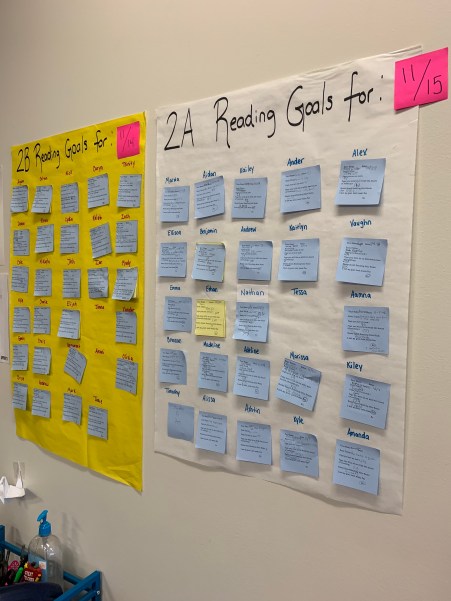
For this purpose, I’ve worked to make our goals more visible, easy to check in on, hard to ignore, and readily accessible for quick conferences.

img_0031

  1. I started the year with my Reading Goal posters prominently displayed for my 9th grade classes. Each week, students would set a goal after calculating their reading rate, let me know the progress they would be working to make in their books, and how long they had spent reading. Not surprisingly, for the first few weeks of 9th grade, my projected sample of a Post-It didn’t necessarily (consistently) get us a clear picture of what we were looking for. Numbers weren’t labeled, titles weren’t always included, etc.
  2. I decided to take out the guesswork and use a Post-It template I found and photocopy quick reflections each week that would make it easy for both students and teacher to see:
  • What book are you reading?
  • What page are you on now?
  • What page will you be on based on your current calculation of reading rate?
  • How long have you been with this text?
  • Did you meet your goal for last week?

As I hand back slips to each child each week, I can do a quick check-in to see how on target, or not, my students are. This quickly prioritizes conferences for later in the week.

How do you keep track of students’ reading goals? Please leave a comment below!

Lisa Dennis spends her school days teaching AP Language and English 9, while also leading the fearless English department at Franklin High School, just outside Milwaukee, Wisconsin where she lives with her husband Nick, daughter Ellie, and beagle Scout.  She is a firm believer that a youthful spirit, a kind heart, a big smile, and a good book can ease most of life’s more troublesome quarrels. Follow Lisa on Twitter @LDennibaum.

It’s a Good Day to Talk about Talk

Many of us are on edge. You may feel it, too.

I woke today thinking about something I heard in the first professional development session I attended as a new teacher:  We read literature to learn what it means to be human. It provokes a seemingly simple question, and one that’s prompted rich discussion with my students:  What does it mean to be human?

Maybe we don’t talk about our shared humanity enough. Maybe we should do that a little more.

For those of us who embrace choice reading, we often refer to the words of Rudine Sims Bishop:

Books are sometimes windows, offering views of worlds that may be real or imagined, familiar or strange. These windows are also sliding glass doors, and readers have only to walk through in imagination to become part of whatever world has been created or recreated by the author. When lighting conditions are just right, however, a window can also be a mirror. Literature transforms human experience and reflects it back to us, and in that reflection we can see our own lives and experiences as part of the larger human experience. Reading, then, becomes a means of self-affirmation, and readers often seek their mirrors in books.

Let’s think about this line:  “When lighting conditions are just right, however, a window can also be a mirror.” Shared humanity.

Last year at NCTE, Lisa, Jessica, and I had the chance to sit down and chat with Cornelius Minor. We were three white women educators working to listen and learn and do more to advocate for equity and social justice in our classrooms. We knew Cornelius could help. He did.

“We start by focusing on what we have in common. Our humanity,” Mr. Minor told us. Then he highlighted the difference between diversity and inclusivity:  Diversity is everyone sitting at the table. Inclusivity is everyone sharing equal power at the table.

daiga-ellaby-718861-unsplash

Photo by Daiga Ellaby on Unsplash

So what does this mean for me as a teacher, a facilitator of professional development, a writer, a mother, and a grandmother — someone who desperately cares about not just my family, but others’ families, about my country and the interactions we have with one another, about the future and all that entails?

What does it mean for you?

Sure, getting students reading and talking about books is a great starting place. But we also have to open spaces for talk. Cultivating risk-rich safe spaces where readers and writers can share their ideas, struggles, and successes about topics and issues that matter to them is vital to cultivating a civil society. I’ve long thought that our classrooms represent a microcosm of our society. If we can facilitate critical conversations where students respect and truly listen to one another, maybe we have a chance at changing conversations on the street or in courtrooms or press conferences or Congress.

Idealistic? Sure. But that’s the nature of hope.

In her article “Mirrors, Windows, and Sliding Glass Doors,” Bishop concludes with these lines:

Those of us who are children’s literature enthusiasts tend to be somewhat idealistic, believing that some book, some story, some poem can speak to each individual child, and that if we have the time and resources, we can find that book and help to change that child’s life, if only for a brief time, and only for a tiny bit. One the other hand, we are realistic enough to know that literature, no matter how powerful, has its limits. It won’t take the homeless off our streets; it won’t feed the starving of the world; it won’t stop people from attacking each other because of our racial differences; it won’t stamp out the scourge of drugs. It could, however, help us to understand each other better by helping to change our attitudes towards difference. When there are enough books available that can act as both mirrors and windows for all our children, they will see that we can celebrate both our differences and our similarities, because together they are what makes us all human.

We come to understand each other better, yes, through wide reading, curating libraries with diverse, vibrant, engaging titles by authors of diverse heritage and backgrounds. Reading more matters. Couple Bishop’s thoughts with these by Lois Bridges:

Reading engagement is nothing short of miraculous—engaged readers spend 500% more time reading than do their peers who aren’t turned on by books—and all those extra hours inside books they love gives them a leg up in everything that leads to a happy, productive life:  deep conceptual understanding about a wide range of topics, expanded vocabulary, strategic reading ability, critical literacy skills, and engagement with the world that’s more likely to make them dynamic citizens drawn into full civic participation.

Yes, wide voluminous reading matters. A lot.

But so does talk.

I believe it’s through talking about their books, discussing their similarities and differences, their characters, conflicts, and resolutions; talking about their writing, helping each other see angles they might not have seen, validating ideas and challenging others — all in safe spaces of shared respect — that we fast track students’ abilities to engage with each other and with their world. Our world.

So on this election day, I would ask you, dear reader, one favor:  Between now and the next election, can we all do a little more to open spaces in our instruction to facilitate more meaningful discussions? Let’s amplify our shared humanity.


Amy Rasmussen has no middle name, but if she did, it would be “Idealist”. She believes everyone is a child of God and should be loved as such. She’s excited to attend NCTE this month and hopes you will attend her session at 4:15 on Saturday as this blog team presents “Accomplice”-ing Great Things: An Action Plan for Equity, Inclusivity, and Allied Partnerships in ELA Classrooms. 

Humans of League City

I work with a team of freshman teachers who are experienced, passionate, knowledgeable and, luckily for me, functional.  We collaborate in the creation of lesson plans, lesson cycles, the unending search for mentor texts, and grade calibration. Our collaboration doesn’t just benefit the teaching team; the students are the true beneficiaries of our functionality.

Consider the following:

Our goal was to take the hard work and struggle that our kids overcame as they learned about expository writing and literary analysis and have them turn that lens back onto themselves.

We spent the last forever working on pulling issues, claims, and evidence from the writing of others, how could we do turn that around and invest it in ourselves?

Enter: Humans of New York, an idea brought up by colleague, Austin,  at our team planning day. The idea was that we would work through the exploration of expository writing by having students interview and then write about a human in their life.

Lesson Cycle 1

Lesson Focus: I want you to know that writers use specifically selected issues to support their claim.

  1. Reading
  2. Dear World Video
  3. Respond to the video- Write for three minutes. I wanted them to get the emotional response out and onto the page because it’s important, but not the focus of our lesson.
  4. Question 1 – Why do issues matter?
    • Take one lap around your group sharing your response.
    • Write for three minutes, sharing your response.
  5. Question 2 – Why is it important that we identify issues important to us?
    • Take one lap around your group sharing your response.
    • Write for three minutes, sharing your response.
  6. Seed writing: Tell me about issue you care about enough to write on your skin. This is an extending time for writing, something in which I strongly believe.

Lesson Cycle 2

Lesson Focus: I want you to know that writers use craft to strengthen their expository argument.

  1. Reading
  2. Poet moment, I wanted to get their minds set.
  3. Read two HONY examples, look for issues, claims, and evidence and think about how those the author expresses those ideas.
  4. Seed Writing – Tell me about a human you know along the same lines as what you saw in the Humans of New York mentor texts.

Lesson Cycle 3

Lesson Focus: I want you to know that writers use stories to advocate.

  1. Reading
  2. Euripides Excerpt (7 minutes total)
    • Read and show your thinking.
    • Respond using the sentence stem: This piece is really about…
  3. Read two more HONY examples, look for issues, claims, and evidence.
  4. Seed Writing – Tell me about: A different human than yesterday, a different story about the same human as yesterday, or yourself.

Honestly, these lessons look a lot like most of the lessons that find their way into my classroom.  These are the structures with which my students have become accustomed.  If you look closely, in three days, the kids wrote for over an hour, experienced five mentor texts (and a video) and talked… a lot!

Oh, and throughout these three days, I hardly sat down.  I made it around to every student at least once and worked beside them through the process.

This doesn’t just happen “sometimes” in my classroom.  Truthfully, the functionality of the team I get to be a part of promotes this level of complexity because none of us are going at this alone.  We work together, and as a result, the kids win.  I love watching kids win.

Charles Moore likes learning about humans, even if they don’t love the Dallas Cowboys.  He loves moving students through moves that unveil their literacy. He’s pretty worn out from the multiple Robotics practices he helps supervise, but he’s learned exactly how much work he can complete in three hours. He’s excited to co-present at NCTE and to receive his first solo invitation to present at TCTELA in 2019.

Incorporating Drawing into the Workshop Model so that Students can Show their Thinking

Teachers are adaptive. We are always ready, even when we feel never ready, and we approach new challenges with willingness and enthusiasm.

Even when the changes come as a surprise!

For the first time in many years, I am teaching middle school. I’ve taught high school exclusively for at least fifteen years, so it was quite a change to approach these students. I have been giving it my best attitude, attention, and effort, but somehow I knew it wasn’t enough. A few weeks ago I realized why: I was trying to teach my seventh grade students the same way as I was teaching my high school students, only changing the content.

While I realized that I have to approach middle school students differently, I wasn’t sure how. They aren’t just little high schoolers. They are in a different developmental stage, and I have to be attentive to that.

One of my classroom mantras has been don’t share your answers; share your thinking, and when it comes to talking to high school students about it, it seems like they “get it.” That’s not to say they always value the thinking and don’t look for the “right answers,” but they do seem to mostly understand what it means. share-your-thinking

With middle school students, I don’t always get that same feeling. I’ve experienced that they aren’t always sure how to show their thinking, but instead sometimes tend to want to parrot back my thinking, or the thinking of others.

When we’ve worked in our readers/writers notebooks, I’ve also seen that middle school students often ask if they can doodle and draw. I love it when my students get creative in their notebooks, no matter what grade they are in. I just noticed that my middle school students seem to especially enjoy this activity.

That led me to realize that middle school students can show their thinking through drawing, sketching, and illustrating, in addition to talking and writing.

I am introducing the Notice and Note fiction signposts this week, and instead of asking students to write about them, I’ve asked them to sketch and illustrate them.

middle school drawing

The buzz in the room while students were drawing, illustrating, and processing the different sign posts was fantastic. While circulating the room, I was able to interact with students in a fun and academic way. I learned that middle school students love to be creative, and I was able to get a window into their thinking. That was before I even saw their finished products.

Students have illustrated a couple of the signposts now, and I feel like I am on to something. Students are able to express their thinking through drawing, and even think about things more deeply than if they were only doing the discussing and writing. The illustrating has increased their processing, and I’ll keep using this strategy alongside the writing, reading, and discussing. Perhaps every other middle school teacher on the planet already understood this, but now I do, too.

I’m going to add more illustrating and drawing components to all of my classes now, no matter what level they are, from grade seven to AP Lang.

I’d love to hear how others have reached students who are in different grades and levels. How do your students show their thinking?

Julie has been teaching secondary language arts for twenty years, spending the first fifteen in rural Central Oregon, and the last four in Amman, Jordan. She’s thrilled to report that she and her family have moved across the world to Managua, Nicaragua this year, where a new adventure has begun.

Follow her on twitter @SwinehartJulie

15 Reasons to Read as Written by High School Seniors

You, dear Three Teachers Talk reader, are about to enter another dimension. A dimension not only of Readers Writers Workshop, but of very strange Halloween happenings. A journey into a wondrous land of…a post returned from the dead. 

A few days back, Lauren Zucker, fellow educational blogger, reached out to ask about a post I had written back in 2017 detailing the insights of her awesome blogging seniors. The post, it seemed, had…DISAPPEARED. Diving into the bowels of Word Press, I too came up empty. It wasn’t until my husband took me to the eerie depths of the Way Back Machine that I found my deleted post, and can run it here for Lauren to link to, and hopefully for you to enjoy if you missed it the first time around. Happy Halloween to all! 


I was giving my thumb a workout last week on Twitter, scrolling past political fallacies and pundit reports, quips from Ellen about cats, and sad attempts by the Packers organization to distract themselves from their lack of big plans this Super Bowl Weekend (single tear running down my cheek) and I came across an irresistible link: 15 Reasons Why You Should Read.

Aaaaaaand, I’m hooked.
Click.
Scroll.

And what to my wondering eyes should appear, but 15 reasons to read, linked in individual blog posts (wait for it!), written by students for their Senior English Seminar class blog and inspired by Kelly Gallagher’s Reading Reasons: Motivational Mini-Lessons for Middle and High School.

A little investigation had me scrolling (no wonder my right eye has been twitching for two months…I may need an eyepatch soon) through the class blog of, English educator and doctoral candidate at Fordham University, Lauren Zucker’s third period students, whose sweet smiles look just like the seniors in my own classroom: five parts confidence, fifteen parts senioritis, three parts fear, two parts energy drink, and boundless potential.

fifteenreasons


The possibilities with these blogs are endless:

  • Have your students read through them and reflect on one that stands out to investigate further.
  • Put just the rules up on the board and generate some discussion on initial impressions, connections, etc.
  • Comment on the student posts with personal experiences to connect student blogger to students in your classroom.
  • Have students write their own blog posts about the benefits of reading.
  • Challenge students to synthesize some of the logos from these blog posts into an oral defense of the endless beauty that is reading.

Below, brief explorations of each reason to read. I loved diving into this student thinking and connecting their ideas to my classroom.

  1. Reading Improves Your Social Understanding by Andrew Zayas 

    Andrew speaks to a common theme in high schools across America: We live and work in bubbles. As I suggest to my students, reading affords you the opportunity to live lives, solve problems, and meet people you may not have even considered before. Those experiences can provide, as Andrew suggests, “an unlimited source of social knowledge,” that is invaluable in a time when people need to understand one another better if we ever hope to overcome all that divides us.

  2. Reading Reduces Your Stress by Avery Semkow


    Avery explores a study by the University of Sussex in which test subjects were taken through several activities to elevate their stress levels. Reading silently for only six minutes slowed the subjects’ heart rate and relaxed muscles to a level of stress that was even lower than before they started. SIX MINUTES! When student sit in our classrooms and read for ten minutes, a veritable spa service with those four extra minutes, we are helping them to calm, focus, center. Namaste, fellow readers. Let’s do our hearts some good.

  3. Reading Helps You Sleep Better by Ben Tyler

    Similar to the study above, Ben’s piece suggests that reading, again for as few as six minutes, can help you fall asleep much faster. I’m not sure I love what this means for my classroom (at 7:20 a.m.), but I know it to be true in my own life. Or maybe that’s the full-time job and a preschooler at home. But seriously, our students need more and better sleep. According to the Sleep Foundation, only 15% of high school students get the recommended eight hours of sleep each night. If we can’t get them to bed sooner, at least we can help them fall asleep faster (and without glowing phones in their faces). Challenge your students to start small and commit to heading to bed with their books to read for even five minutes. It’s like a certain snack crisp that comes in a tube…bet you can’t read for just five minutes.

  4. Reading Develops Empathy by Skylar Giarusso

    If there is one thing our world needs right this very minute, it’s more empathy. Not sympathy, not apathy, but empathy. The words of Atticus Finch ring more and more true each time I read them. If we could all just “climb into someone’s skin and walk around in it,”  I think we could benefit from the shared perspectives that promote more patience, tolerance, and civil discourse.

  5. Audiobooks Are Another Great Option by Thomas Hamrah

    Let’s get this out of the way – I have never listened to an audiobook. Not because I don’t want to, but mostly because I haven’t broken my longstanding addiction to NPR, so most of my car time is either spent listening to Morning Edition or, if Ellie is in the car, “Let it Go” from Frozen. What’s interesting to me is that Thomas explores the idea that students think listening to an audiobook is cheating, but like most things, it’s only cheating if you don’t do the actual work. Attentive listening is a necessary life skill, one we promote in the classroom as it is often underdeveloped in our students (Let’s get real. Many adults need more work at listening too. Listen first. Think of a response and talk later). Stories are meant to be heard. Listening isn’t cheating.

  6. Reading Shapes Your Personality by Tori Murry

    Tory takes her self-described “fascination with psychology” and uses the same study as Skylar but moves her conclusions in another direction. The class discussed which parts of your personality are genetically linked to relatives and which parts you can craft. I know that adolescence finds our students at the prime point in their lives to become independent thinkers, and thereby, independent people. I’d like to believe that I’m equal parts Elizabeth Bennett, Mary Anne Spier, Jo March (though I’m probably more of a Meg, so room to grow in spirit there), Offred, and the Lorax. I think it would be a blast to have students help support elements of their personalities with book characters.

  7. Reading is Fun by John Miele

    I loved that John explored how reading can challenge you to solve a mystery, allow you to escape reality, and be a “part of something” all at the same time. I’ve seen it happen in my room. I gushed so long and hard about A Monster Calls, that I now have a group of about 25 students that want to meet on a Saturday at the movie theater to see it together. “We can go to the movie and then get coffee. You know…be collegiate and talk about whether or not the movie does the book justice.” Fun! In addition, that social element can be defining. “Everyone” read R.L. Stine when I was a kid. Our students “all” read Harry Potter. Books promote belonging and genuine belonging promotes positive feelings. This is at the heart of my classroom and I may be biased, but it is fun.

  8. Reading Will Make You Live Longer by Maeson Nolan

    I’m going to need extra years in my life to read all the books on my “next up” list, that’s for sure, so if a study from Yale is telling me that reading 3.5 hours per week will add two years to my life, I’ll dismiss my misgivings about sample size, variables, and math in general (never been my strong suit anyway). 730 days is a lot of reading. Now, I just need to get Yale to do a study on beach reading.

  9. Choice Encourages Reading by Nicole Kudelka

    Choice is nothing new to 3TT, but what struck me about this perspective was the way one of Nicole’s classmates phrased her insights on why choice matters: “Assigned books become more of an obstacle, and shortcuts are taken because the grade is more important than the actual book.” Amy’s post on choice yesterday, shared this same sentiment: When we “make kids read a book,” we might as well mandate that they enjoy it while we’re at it. My honors kids, by and large, didn’t read more when I assigned nine whole class novels, they just got better at convincing me they read nine books. Cultural literacy and choice can coexist, they need not be mutually exclusive, so we must work to increase choice to build volume and then push for complexities (classic or not). Penny Kittle says that we must first engage in order to build volume, then complexity can follow.

  10. Reading Doubles Your Vocabulary by Brian Sayre

    A voluminous lexicon can be procured through bibliophilic tendencies. Win.

  11. Reading Preserves Your Memory by Claire Blass

    If I am going to live two years longer, I’d like to remember those years, and all that came before. No surprise, that stimulating your brain with books can help sharpen brain function. In fact, I told my classes today before silent reading that I was presenting them with an opportunity to not only be smarter but think smarter. Seriously, will my benevolence ever cease?

  12. Just Ten Minutes of Reading Yields Better Reading by Griffen Klauser

    Griffen explores the idea that 10 minutes of reading per day (again, classes, you are welcome) is a stepping stone. In his own small experiment over Thanksgiving break, he challenged himself to read just ten minutes per day. By the end of the break, he read 90 minutes in one day because he was so “into” his book. As the brain is a muscle, it needs training. I’m never going to make it through a sixty-minute spin class if I haven’t exercised in months. I’m never going to finish 601 pages in East of Eden if I don’t keep after it in small chunks. And if I could give two hoots about what I’m reading, I’m not even going to make ten minutes a day for it. So, please see #9.

  13. More Reading = Better Writing by Nick Frasco

    “Reading molds your writing style.” Preach, Nick. Preach.

  14. Reading Changes Your Perspective by Noah Slakter

    I love that Noah’s insights run completely contrary to my piece Books Can’t Be Bullied. He argues that the text means nothing without a reader to understand it, and that understanding can vary from person to person (Transactional Theory), anyone?. I think back to my earliest days of teaching. Five sections of freshmen per day. Five days per week. It’s the year I developed my saying about supporting an opinion on a text with text evidence: “As long as you don’t tell me it’s about a giraffe (as I have never read something solely about a giraffe), you’re right.” Their opinions varied as widely as their converse shoe color, so we learned to synthesize those perspectives to get at meaning. Did opinions change? Certainly. Did students grow in hearing the varying perspectives of their classmates? Certainly.

  15. Reading Gives Your Brain a Workout by Samantha Bernstein

    Reading these 15 pieces certainly gave my brain a workout! I’m proof that it’s true. I also loved Samantha’s voice when she said, “The mental task of reading words on a page, processing them, hearing the voice in your head, creating a picture in your mind, and following a plot is not only a mouthful but a nice stretch for your noggin.” She encourages us all to show our brains “some love.” I love it.

If you’d like to read the student blogs in their entirety or pass along the readings to colleagues and students, take a look at each of the pieces here. And don’t forget to follow Lauren @LGZreader for more great ideas and insights. If you want to take a look at how she’s having her students promote their work on Twitter, take a look at #SESNH.


Lisa Dennis spends her school days teaching AP Language and Honors/Pre-AP Sophomores, while also leading the fearless English department at Franklin High School, just outside Milwaukee, Wisconsin where she lives with her husband Nick, daughter Ellie, and beagle Scout.  She is a firm believer that a youthful spirit, a kind heart, a big smile, and a good book can ease most of life’s more troublesome quarrels. Follow Lisa on Twitter @LDennibaum.