Using Workshop as an Opportunity to Listen, Connect, and Grow

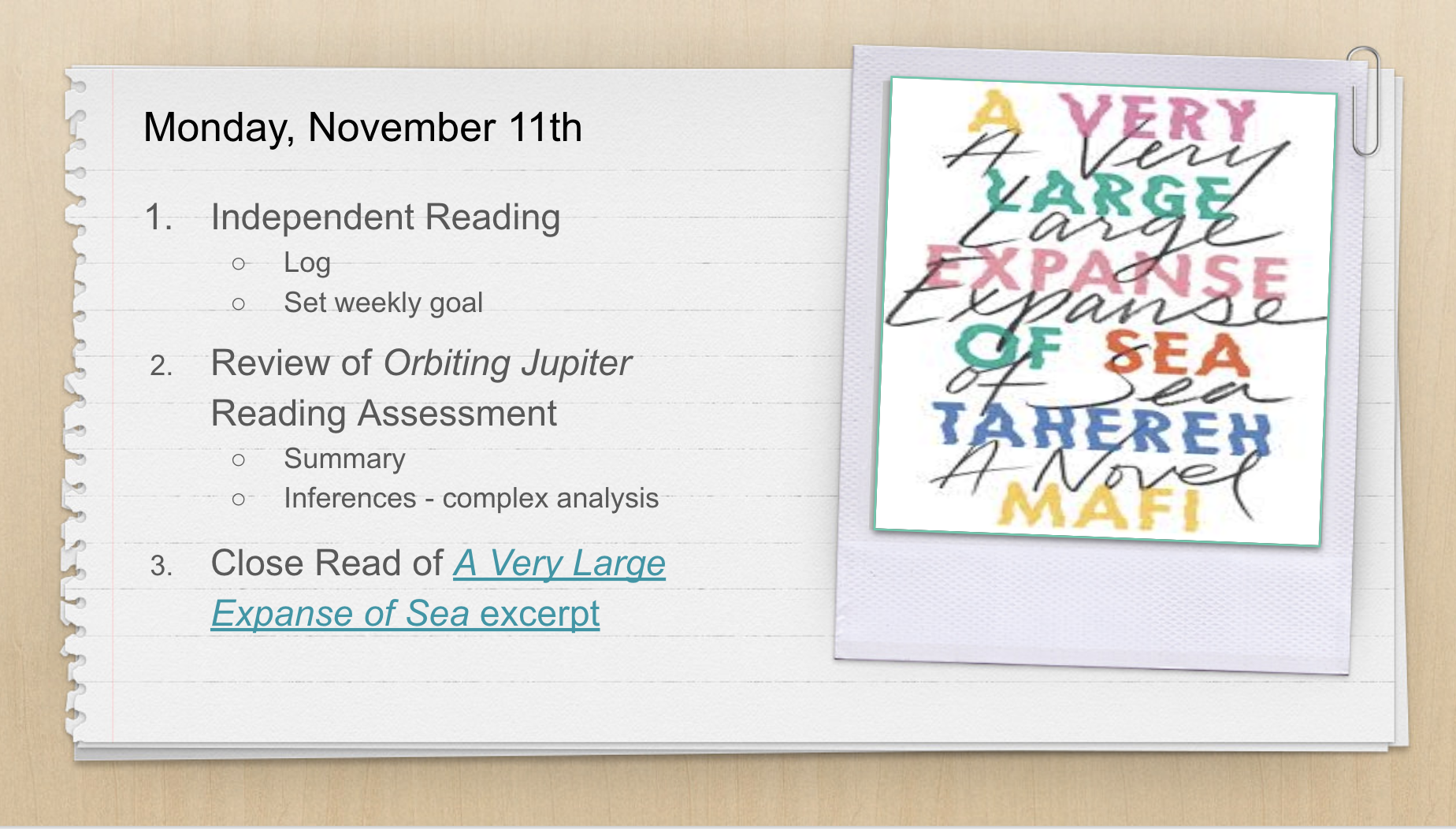
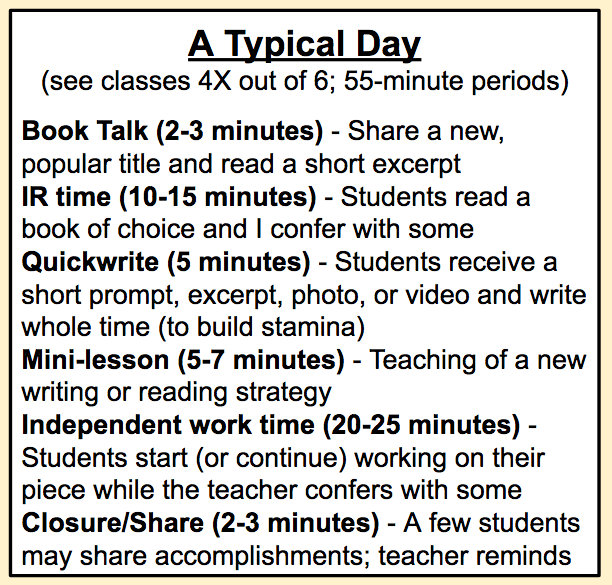
My daily schedule, which is based off of an example in Penny Kittle and Kelly Gallagher’s book, 180 Days.

I know the importance of listening, mainly because I know what it feels like to be ignored. To share an idea, only for someone else in a group to quickly move on to something else. What happens next? Silence. This is exactly what I don’t want in my classroom. I want my students to feel comfortable enough to speak up and write about topics that matter to them. I want them to see that I care, and I am listening.

This is where the freedom of the workshop model comes in handy.
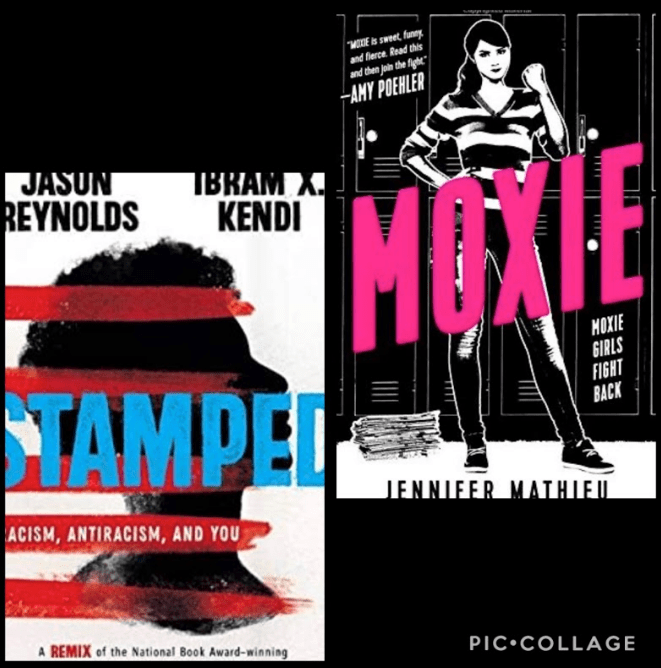
Two recent book talks.

For book talks, I choose titles that are written by authors that students love, or need to be introduced to. (I have students complete a survey at the beginning of the year so I know what they like and dislike right away.) I choose excerpts that they can connect with, and others that will shock them. Their to-read lists grow longer and longer.

During independent reading, I can confer with students. Sure, it’s often about the titles they are reading, but sometimes it’s my way of letting them know that I see something is different, and possibly wrong. I can check in and see what I can do to ease a worried mind. Or, maybe it’s my chance to applaud them on a job well done.

Quickwrites can incorporate poems, video clips, and excerpts that connect to topics students long to discuss. School should be a place where students can speak freely about topics like anxiety, current events, racism, the difficulties of growing up, and so much more. The possibilities are endless.

Mini-lessons may be brief, but I can work in some of my own writing here. This is where I put myself on display, and students can see I am a struggling writer just like them. Comfort and ease are added to our classroom.

Independent work time provides another opportunity for sharing ideas, whether it be through talk or writing. Students can write a piece with a peer, or one that’s all their own. Students can share their passions and frustrations in small-group or whole-class discussions. I can check in with them. I ask questions, if they need assistance, and what’s something they are proud of.

Finally, we share. Students share a new idea, a line they are proud of, or a word they’ve never used. We applaud one another. We build our community.

In today’s world, I am proud that I can give my students a classroom that is safe and inviting. Workshop makes that possible.

Sarah Krajewski teaches 9th and 12th grade English and Journalism.  She is currently in her 18th year of teaching, and is always looking for new, creative ways to help her students enjoy learning, reading, and writing. At school, she is known for dedicating her time to helping students become lifelong readers and writers. At home, she is a proud wife and mother to three readers. You can follow Sarah on Twitter @shkrajewski and her blog can be viewed at http://skrajewski.wordpress.com/.

When Your Teaching Life Throws You a Curve…

Hit a home run.

Or at least make contact, get on base, and rely on your teammates and experience to get you across home plate.

This new year, the new decade, reminds me that teachers often face new challenges and situations. Think about that student who transfers into your school nine days before the semester ends or the joy and then horror that flashes through your mind when you see that new copiers have been installed.

Sometimes though, we face new adventures that even vast swaths of experience cannot prepare us to handle the way we parry and deflect most of what’s throw at us. For me, a move away from athletics pushed me toward new classes that revealed just how comfortable I had become in my almost decade working with seniors. Last year freshman English and freshman Pre-AP English classes taught me about patience and pacing. This year sophomores and AP juniors force me to flex muscles I never knew I had and push me to explore the boundaries of my workshop pedagogy.

For those of us who face the anxiety of teaching a totally new class, a new unit of study, or even a new lesson, consider this advice:

  1. Lean on the pillars of experience around you.
  2. Trust the reading and writing workshop process.
  3. Build a team.
  4. Explore your literacy.

I’ve been blessed to leap into these last two years, and the change they promised, with groups of teachers who had been there before and knew what to expect.  Their knowledge and willingness to support me allowed for less time learning new content and more time planning effective lesson delivery.  While I have many questions, they seem to always have an answer that guides me back on the pathway to success.

Lean into the workshop that supports reading and writing because it invites literacy learners to feel safe within the routines and community that literacy learners need. New learning happens much easier then the teacher and the students feel comfortable and safe with each other.

Growing your support system beyond your teaching team is important. Living on front street with your students about your inexperience can be a scary proposition, but it can also invite them into the type of relationship where they understand that you will all grow together and that they are not the only ones being asked to shoulder a growth mindset. As for the adults in the building, instructional coaches are there to help you and support you, looking for clues to the type of help you need, listening when you struggle, celebrating your successes because they own a piece of your potential. Lastly, but no less importantly, build relationships with your administration. Extend the invitation for them to be in your room and learn about the students that pass through your life on a daily basis.  Admin isn’t there solely to handle disruptions or crisis. Rather, they, like every other educator in the building, have a vested interest in the success of your students and deserve the opportunity to experience your greatness.

Never forget the value of reading and writing beside your students. When you aren’t sure how to fairly and authentically assess the writing tasks you ask your students to perform, write your own response.  When you ask them to revise their writing, invite them into your process to help you explore your ideas.  They will jump at the chance to support your writing the way you support theirs. Share your reading life too.  Your reading life will engage them just as deeply, and as they learn more about what you like to read, they will learn more about you and, perhaps, about their own compassion.

Most importantly, trust the process. Believe in yourself in the face of new experiences. You owe it to the students and to yourself.


Charles Moore recently returned from a 2025 mile road trip vacation where he learned about new people and places and loved every minute of it. He encourages everyone to try to visit the Martin Luther King Jr. Historical Park and The King Center. Bring some tissues just in case a high school band spontaneously shows up to play for Dr. King.

#100DaysofNotebooking

Happy New Year!

As we ring in 2020, many of us begin to reflect on the previous year and to think about new starts and new beginnings. Some create resolutions or goals while others choose a one little word to guide them along the way.

My one little word for 2020 is commit, and I have created my own set of “10 Commitments.” One of my commitments involves writing, specifically notebook writing.

Notebooks are essential in a workshop classroom, but I have to admit that I lack commitment when it comes to using them regularly with my students. Using notebooks more in my classroom is always a goal of mine, but it is also a personal goal in 2020. It is important for teachers to model the writing process and to write with their students, including using writer’s notebooks.

So, when I saw the #100daysofnotebooking challenge by Michelle Haseltine, I had to check it out.

Michelle’s goal for starting this challenge was to help others develop a meaningful habit of writing and to discover the power of writing and the joy it can bring. I decided that if I want my students to become more committed to using their notebooks and if I wanted to be more committed as a teacher, then I needed to be more committed as a notebooker myself.

Looking at the pages in my current notebook, I found I typically write about my reading through the collection of quotes and snippets of writing that I can use as mentor texts for my students.

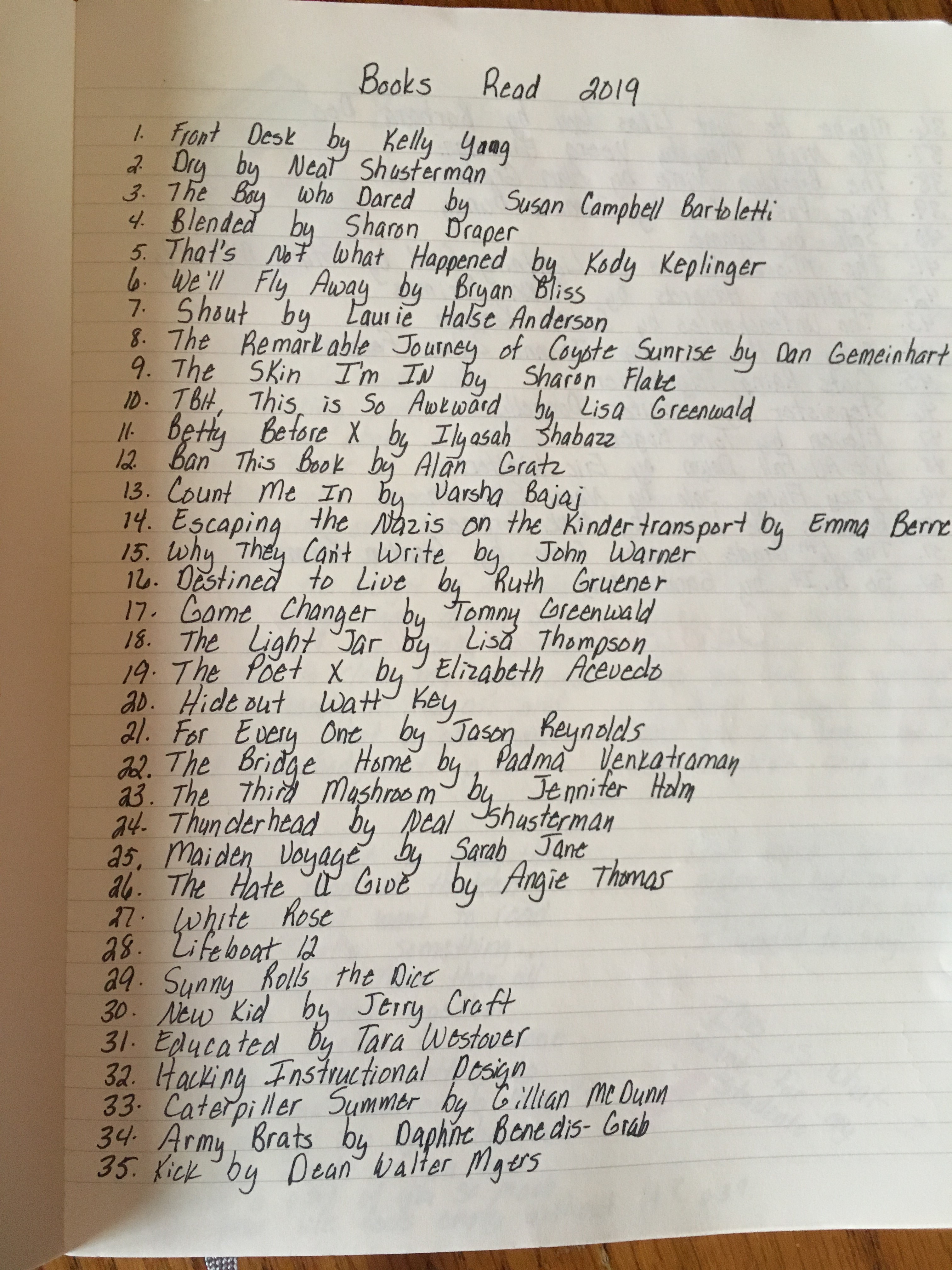
At the beginning of each year, I start a “books read” list. Although I have a Goodreads account, I like having easy access to a list of books I have read.

ttt6

I also play with words and do some initial drafting and explore for potential blog posts.

But here’s the thing…I am not consistent. These pages are actually weeks and sometimes months apart. This is why I have accepted Michelle’s #100daysofnotebooking challenge. I believe that teachers who write make better writing teachers and keeping a writer’s notebook is an important part of that development.

For more notebook inspiration, follow the #100DaysofNotebooking on Twitter or check out the Facebook group. You may also want to take a peek inside Shana’s notebook here and here or see how Amy reflected on an entry in her notebooks here. Seeing notebook pages from other writers always gives me new ideas and loads of inspiration.

If you want to create a better notebook writing habit, why don’t you consider joining me in the challenge? It is not too late to start, and you can find all of the information on Michelle’s website.

Happy New Year and Happy Notebooking!

Leigh Anne teaches 6th grade ELA in southern Indiana, is a notebooker-wannabe, and is ready to commit to a daily notebook habit.

One Word: Goals and Other Possibilities

Happy New Year! 

I always appreciate the expanse of winter break. After the joyful rush of the holidays (and sometimes the excess–so many cookies), I find myself with the time and space and never ending mugs of coffee needed. To think. To properly think and reflect. During this deliberate withdrawal from the world, I recenter and refocus. Usually, I develop new visions for my classroom, my students, and myself (professionally and personally). Last year, discovering #OneWord via my PLN energized my thinking. Jon Gordon describes it here as choosing the one word that will give “meaning, mission, passion, and purpose.” Beyond the fun of ruminating over possible words (always the nerd for words, here), I loved the intentionality of choosing the words that would anchor me for the year. I chose two: outside and feed. 

Outside moored me personally and professionally. I knew I wanted to spend more time literally outdoors, and so, I sought ways to do so: walking, running, hiking, scootering, skating, floating, fishing…even working outside. In fact, this one word led me to my best outside adventures of the year–hiking and running in Norway and enjoying a fjord cruise. This particular journey also fit my other interpretation of outside–seeking ways to go beyond or outside my comfort zone. The trip was the first long trip with my husband away from my children. Anchoring to outside helped me take risks professionally, too, which is why I write this now as an instructional coach. 

Feed became a mainstay in my classroom. I thought of feed as the ways in which I provided, maintained, or sparked the energy of the classroom and my students. So, I worked on delivering feedback that fed forward. I managed pace, working to stay brisk and lively. I altered mini lessons so that they stayed consumable. Feed nurtured my students and me. 

Reflecting now, I wish I had engaged my students in this kind of reflective anchoring. It’s a different way of goal setting, certainly. Here and here are some resources for getting started with students. But the possibilities for use during workshop make it worth further consideration. These extend beyond the variation of the New Year’s Resolution. 

Use OneWord to…

  1.  Set purpose each week for your class or for workshop time. Tethering to a carefully selected word might help students move more intentionally through the week and allows a reflection point at the end of the week. Class this week is brought to you by the word ___________. 
  2. Craft one word summaries of how their writing is going prior to conferring with you or their peers. Perhaps these one words are more about their affective states (build emotional intelligence further by providing them with a list); perhaps they indicate progress; perhaps they demonstrate the most valuable word of the piece. 
  3. Employ in quick writes. Encourage students to apply one word from independent reading into multiple quick writes from the week. That word might take on different meaning for that student. 
  4. Shape perspective. Instead of or in addition to essential questions, these one words become the essential ways for filtering reading and writing in the classroom. Maybe students use a blend of whole class (community perspective and individual one words (identity driven) through which to view reading and writing.
  5. Create a Words to Watch list of your own as a class. Consider using this list as a mentor text of sorts. Maybe students tie in Article of the Week and develop a word list based on their explorations of contemporary issues.
  6. Identify the developmental arc of a character. Students could choose one word to describe a character at each stage of transformation. 
  7. Craft one word summaries of their reading. This isn’t a new idea but maybe a reminder of how students might use words as mainstays–perhaps starting with what’s accessible before  
  8. Ground in reflection. Invite students to choose one word (provide them with a list if necessary) to depict their progress as readers, writers, or thinkers over the course of the week. They could use Flipgrid or SeeSaw or a Jamboard or just their notebooks or post it or notecard to present the word and reflect on it as their choice. 

And what else? I’m certain there are other ways to adapt the one word perspective. And I’m also certain that as we encourage students to ruminate over words–whether for the purpose of goal setting, reflecting, or creating–that we give them ways to anchor their thinking. 

I’m still ruminating over my word for this year. Pause is a strong possibility. So is perspective. And leap, dive, explore, and elevate.  I think I’ll pour another cup of coffee. 

Kristin Jeschke taught high school English for nineteen years, twelve in Waukee, Iowa at Waukee High School. She now serves as Instructional Coach (20 years in education in 2020!) and is as big a word nerd as ever. Follow her on Twitter @kajeschke. 

“It’s Beautiful” – A Simple Reminder

Happy Holidays!

I’ll keep this post short and sweet.

I hope you are finding your holiday break restful and rejuvenating, filled with warmth and time with family. I know I am enjoying spending time with both mine and my husband’s extended families. Both of our families are large and loud and full of children under the age of ten. It’s chaotic and joyful and, honestly, one of my favorite gatherings of the year – on both sides.

While sitting in church on Christmas Sunday, my three year old niece brought me a coloring page and began to use my lap as a table. The last one to grab crayons, she was stuck with a really drab brown. She enthusiastically scribbled and scrabbled and scratched her ugly brown crayon all over that coloring page with – seemingly – no rhyme or reason. Breathing heavily, she gave it her all for five frantic minutes.

Then she stopped, held up her art, and sighed. “It’s beautiful.”

My heart melted. Of course it was. She saw beauty where I only saw a mess.

It reminded me of conferencing with my students. There’s always something worth praising, something beautiful in their writing. I don’t know about you but my first instinct is to start with what we can fix, where I can teach by showing what the student can do better. When I start conferencing after the break, I want to remember my niece and ask my students: What do you LIKE about this piece? What’s beautiful?

I think that reframing will make for a good moment in our conferences.

Sarah Morris teaches AP English Language and Composition, AP Seminar, and Film as Literature in Murfreesboro, TN. She is currently reading and loving Mo Willems’s picture books. She tweets @marahsorris_cms.

Balancing Reading and Writing Workshop in a 50 Minute Class Period

A few years back our high school was on a four by four block schedule.  Students had only four classes a day for 18 weeks.  Teachers had 90 minutes to balance reading and writing in the classroom.  When we moved to reading and writing workshop the transition seemed seamless.  We had the time to balance both, even if we only had the students for one semester during the year.

And then our school made the switch – the one that was in the best interest of all of our students, but tough on teachers.  We are now on an 8 period day and students are in our classes for 50 minutes all year long.  Instead of having 90 students a semester we have 150 students. Instead of having a 90 minute plan period plus a common department lunch, we now have a 50 minute plan, 50 minute lunch and have added a supervision to our load.  It hasn’t been an easy transition, but we have learned that you still can balance both reading and writing workshop in the classroom.

As I was thinking about writing this post, I was reminded of what Amy Rasmussen posted back in 2015, My Classes are Only 45 Minutes – How Do I Do Workshop?, and Shana Karnes’ post in 2016,  Making Workshop Work in 45 Minutes.  I reread those posts  and shared them over and over with my colleagues who were struggling with how to make reading/writing workshop work on our new schedule.  If others could do it, so could we!  Amy said it best, “As you begin to plan for your 50 minutes, think about this:  How can you ensure that all students read, write, listen, and speak in every class period?” We learned very quickly that time flies in a shortened class period and we need to be intentional about every minute, every day.

These are our non-negotiables in our reading and writing workshop:

Students read for 10 minutes every day in class.  The only way for them to build a reading habit outside of school is to give them time inside of school to enjoy their books.  This semester our 24 freshmen read a total of 25, 905 pages and 113 books in 18 weeks.  We couldn’t have had those numbers without choice and time in class to read.

Confer with students all the time.  Sometimes this looks like a formal conference, sometimes it is a quick check in while they are reading or as they come into class, sometimes it is a quick book talk or book tasting while others are reading, and sometimes the students come read aloud to us. **The only day we don’t confer with students is on the first day of the week.  We want students to read the full 10 minutes so they can set their weekly reading goal and mark it on their weekly reading log.

Be intentional in your lesson planning.  Every lesson we teach, we connect back to our standards and we look to build on those skills over the course of the semester. We don’t just use mentor texts because “we have done it in the past.” We think about our students and what will engage them in the learning.  Each mentor text and the expectation of what students should do with that text gets more difficult as the course progresses.

Don’t try a  lesson with students that you haven’t tried yourself.  This helped us learn early on if the mentor text was the right text for what we wanted students to do.  If we couldn’t do what we expected students to do, then we had to find a new mentor text.

Balance between reading and writing mini lessons.  With only 50 minutes, we no longer have the luxury of reading a long mentor text and then writing about it during our class.  So now we balance our time and take 3-4 days to teach, practice, and assess reading standards and then move to writing standards.  The writing process does take more time, so beware that if you aren’t intentional about incorporating specific reading mini lessons into your class, you will become a writing course. (We learned this the hard way.)

Pull excerpts from books to use as mentor texts.  These are great book talks without actually formally doing this in class.  This semester our students read chunks from…

    1. Orbiting Jupiter by Gary D. SchmidtScreen Shot 2019-12-23 at 5.06.26 PM
    2. Butter by Erin Jade Lange
    3. The Absolutely True Diary of a Part-Time Indian by Sherman Alexie
    4. Booked by Kwame Alexander
    5. How it Went Down by Kekla Magoon
    6. A Very Large Expanse of Sea by Tahereh Mafi

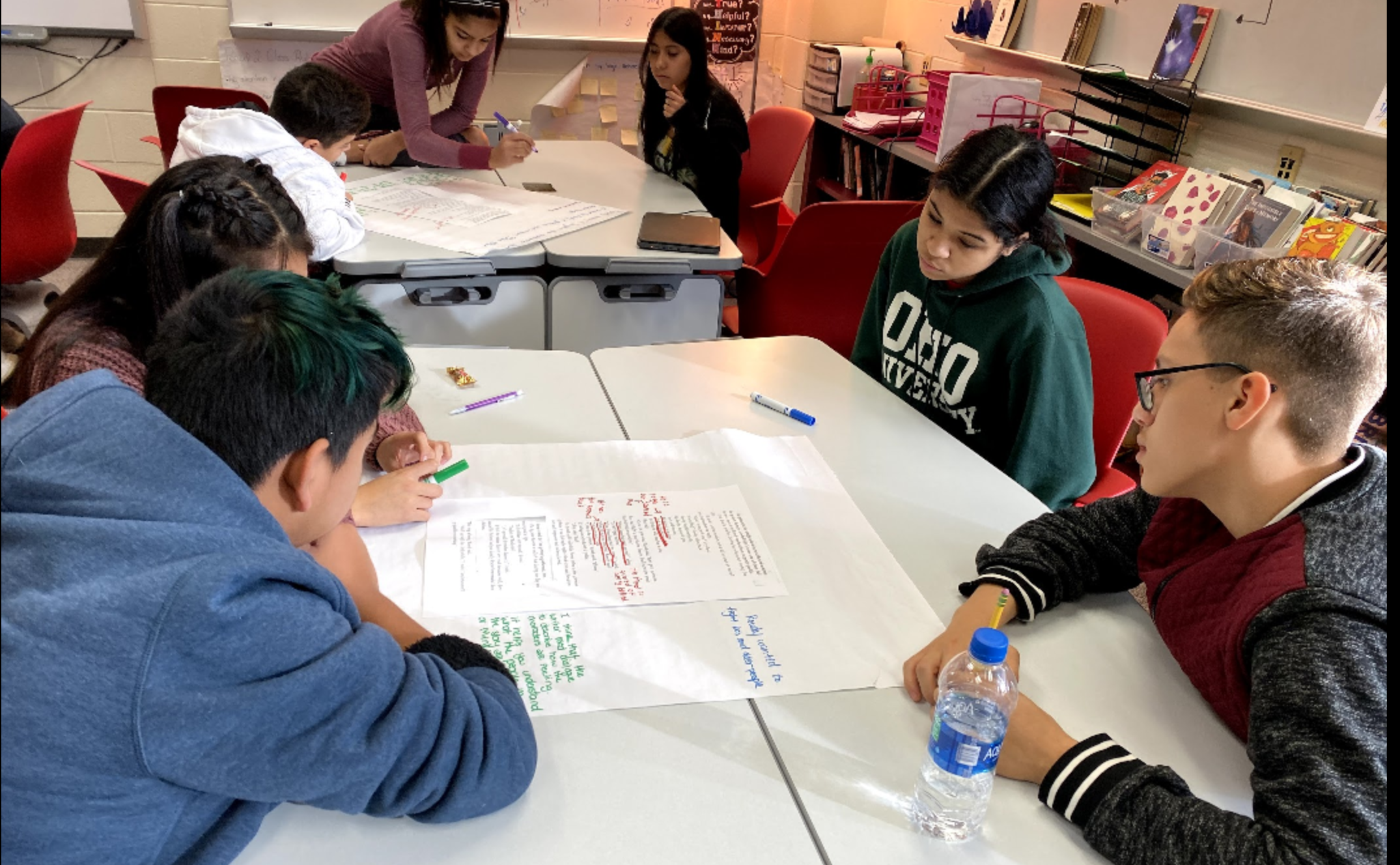
Give students time to work in class AND time to talk to one another while working in class.  Students need time to process the mini lessons we are teaching them, and apply them to their work.  Most of the time the processing requires them to talk through what they have learned. Our students sit in pods and are encouraged to share their work with one another.  They give each other feedback and discuss their questions together.

Screen Shot 2019-12-23 at 5.12.43 PM

We expect a lot from our students.  They work hard for those 50 minutes and it can be draining on us as teachers, but our students have responded to the structure and are growing as readers and writers.

How do you make workshop work in the time you have to teach English?  What are your non-negotiables that I may have missed?

Melissa Sethna is enjoying every minute of the 50 minutes a day she gets to spend with high school freshmen. When she isn’t teaching, planning or grading, Melissa can be found planning professional development for staff and reading YA books.  Her favorite YA book this month was Past Perfect Life by Elizabeth Eulberg and her favorite professional books were White Fragility by Robin DiAngelo and If You Can’t Manage Them, You Can’t Teach Them by Kim Campbell.


Playing with Parts of Speech by: Tosh McGaughy

This past week, I began reading Martin Brandt’s new book about grammar, Between the Commas. His ideas about the “pillars of sentence instruction” made me think about meaningful and effective instruction for the building blocks of sentences, the parts of speech, and how I taught them to students.

I thought about all the different ways that I tried to teach these functions to my students through sentence composing (thank you, Killgallon), sentence sense (thank you, Charlene Tess), and my own student-sample mentor text work. Mere labeling and defining was never successful with my students, and I disliked spending much of my precious workshop time direct-teaching parts of speech. But, I also couldn’t get my students to grow as writers if we did not have a common language to discuss how their words were forming meaning and then how they could make craft choices with the selection and position of their words in sentences. 

As a seventh grade teacher, I knew that anything effective with thirteen-year-olds had to be repeated… often. For the fundamentals, they needed to revisit and reapply those concepts at least six times during the year to actually “get” them. Robert Marzano’s ideas about vocabulary acquisition pushed me to think about the role of “play” in the recursive vocabulary work I needed my students to do. After lots of trial and error, I came upon two ideas that easily wove into our Readers/Writers Workshop classroom and gave us opportunities to make connections to the terms we needed to use as writers and to reflect and revise our understandings of the terms throughout the year. 

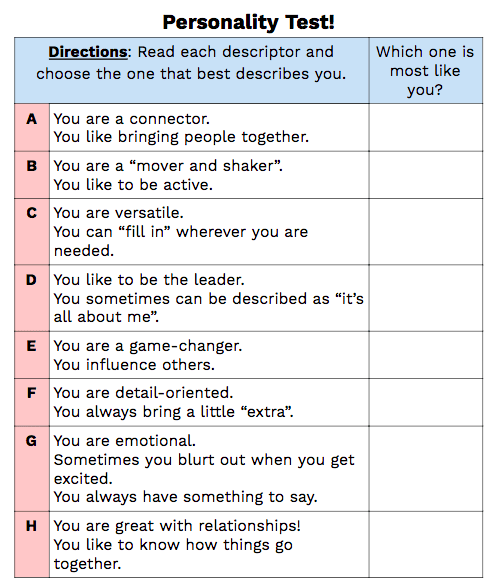
Idea #1: Parts of Speech Personality Test

My social media savvy teens loved taking online personality tests, so I started the year with one of my own. The students were given eight different descriptors and they read them, discussed with friends, and then chose the descriptor that they most closely identified with. They had to write a super short rationale for why they felt the descriptor described them. I kept the labels a secret until the big reveal, when I would have each of the 8 descriptor categories come to the front of the room for a group photo and the part of speech that matched their descriptor. They would pose as a group with a large poster of the part of speech, and I would make the photos into posters for the walls.

The funny thing that happened in every class was how the students began calling each other by the categories. “Man, you are being such a verb. Take a walk and settle down.” Or, “Sarah is the best to have in a group because she is such a conjunction. She always helps everyone bring their ideas together.” Basically, they began to apply the functions of the parts of speech to actual people, and those connections and discussions helped solidify their understandings of the terms enough for us to be able to dive deeper into sentence work during our writing conferences, without having to do a bunch of “circle-the-noun-and-underline-the-verb” work in their papers. 

At different points in the year, students got to revisit the descriptors and decide if they had changed at all. (If you know middle schoolers, they are an ever-changing group of humans, so the changes and the rationales for the changes were some rather enlightening short writing pieces.) Also, when I needed a quick grouping, I could also ask them to “get with someone who is a different part of speech” or “get together with someone who is the same part of speech”. It enabled us to discuss the parts of speech during the workshop in a way that was rooted in function, but that also gave us an organic way to keep the terms on the tips of our tongues. (And, it eventually became like a “sorting hat” when new students arrived. The class would eagerly await for the newbie to choose a descriptor and then that group would welcome their newest member. Yes, the interjections were always the loudest.)

Idea #2: Parts of Speech Physical Metaphors

Once a six-weeks, writing groups would have a quick warm-up creating metaphors for the parts of speech. Every group would be given an identical set of objects. (In the beginning, I gave exactly 8 objects per group, but to make it more challenging, I would do 10 objects by the end of the year so they had more choices and could add parts of speech they had learned recently.) The groups would have a parts of speech reference (one-pager with the definitions and examples) and a stack of different student-focused grammar and style guides that they would then use as they created their metaphors from the provided objects. As they agreed on a metaphor, one group member would write out the group’s reason that the part of speech was that object. All groups would share out, and the class would agree on the “best” metaphors. By the end of the year, students would begin to bring in their own “sets” of random objects for us to use for this activity, and they enjoyed bringing very weird things to spark discussions as they discussed the best metaphors. 

Both of these activities were quick ways for my students to have conversations about terms that I needed them to understand on a deep level. Making them discussion points rather than paper-based “progress checks” succeeded in adding them to my students’ academic vocabulary in an open-ended and formative way. And, for the record, I am very much an adverb.

  • Sentence Composing for Middle School by Donald Killgallon, 1997.
  • Between the Commas by Martin Brandt, Heinemann, 2020.
  • Simple Steps to Sentence Sense by Charlene Tess, Kindle version, 2019.
  • Building Background Knowledge for Academic Achievement: Research on What Works in Schools by Robert Marzano, ASCD, 2004.

Finding A Better Recommendation Letter Approach by Mark Nepper

To Whom It May Concern:

It gives me great pleasure to recommend Ethan for admission to your institution. Ethan enrolled in three of my classes through his high school career. He is a student who has achieved academic success and possesses great potential. He has inspired me and students in class with his work ethic, his writing ability and his thoughtful commentary. You will be pleased to admit him to your upcoming class.

Blah, Blah, Blah. That induces as much boredom reading it as it did writing it. But my college recommendation letters often read like that. What am I doing? I find myself wondering about the entire recommendation letter process.

By the time I let the computer cool down, I will have written 40+ recommendation letters this application season. Interestingly, it occurs that these letters actually represent a form of summative assessment. Though the students tend not to see them as such, these really afford the teacher the opportunity to give summative assessments of their students that are not in any way connected to points, grades and all the other elements of assessment.

I typically don’t share the letter with students. However, if I truly do value it as a summative assessment, then it seems I should share it with them. I should use it to provide teachable insights with the students and let them know this is how I see them not only as a students, but also as people. The comments and observations in the letters represent their strengths.

In the Greater Madison Writing Project we promote the C3WP (College Career Community Writers Program) protocols of argument writing to our project members. One of the elements that always stands out focuses on strengths in the students’ writing. So often in assessment we look at what doesn’t appear, or weaknesses. We get locked in to the deficit framework, sometimes to the neglect of the good. The National Writing Project rubric, though, suggests instead that teachers approach assessment from a point of strengths as opposed to weaknesses. We can learn and grow as much and likely more from emphasis on what we do well than a laser focus on what we have done less well.

When I write a letter of recommendation, I try to present insights into the ability of the student and important qualities of character. With thoughtful contemplation, this recommendation letter could become a clearer snapshot of the student’s abilities and work in my class than numbers on a page.

As I get excited about the possibilities of writing a letter not just for my students, but a letter to my students, I stop cold. I often have wondered about the actual, true importance of the letter in the student’s application.. And does it really matter? Many of my colleagues have come to believe it doesn’t. They put as little actual effort into the letter as possible. They believe admissions officers likely glance at the letter in search of red flags. So then I wonder if writing this kind of letter enhances admission chances. It may not. It will definitely take more time to write. If I choose to write a true reflection of the total student, I would want it to be more than just a writing exercise.

I like so much better the idea of writing a letter to my student, rather than a letter to some anonymous admissions officer, who is skimming through lines of type, eyes bleary, keeping a close count on their daily numbers of applications read and scored.

So Dear Ethan, or Dear Nana, Dear Shamyon, Dear Naia, Dear Eva, Dear Hannah, Dear Edwin, Dear All: This is my assessment of you. Let me tell you first of all, what a privilege it has been to teach you in this class and what a bright future you have ahead of you. Though I may not have taken the time to share these thoughts with you in class, I want you to know I always appreciated you and all that you did. Not only are you a thoughtful student, you are a fine and wonderful person. You should always know and believe that about yourself.

I would have loved to receive a letter like that from a teacher.

All right. I’m committed to the idea.

This is what my recommendation letters will look like:

To Whom It May Concern:

Dear Ethan,

While your friends socialized loudly before school, you leaned against a locker, studying a textbook on robotics. We don’t offer courses in Robotics, but you want to learn as much as possible to become a more effective leader of your robotics team. That is so you. You commit. Wholly. Completely. You stand out as one of those students who possesses this insatiable intellectual curiosity. You strive to constantly learn and grow, and what you want to learn crosses all spectrums of knowledge. You just want to know as much as possible. You have said you only get one opportunity to live your life. You might as well get as much out of it as you can. Everybody should adopt your philosophy on living. Interestingly, I wouldn’t classify you as a bookworm or a drudge, though. You possess a vast friend base. You thrive in social interactions with friends or teammates, whether they are swimming teammates or members of the robotics team. You draw people to you. Your laughter lights up a room. Your future looks so bright. It’s time for you to go out into the world and get after it.

Sincerely,

Mark Nepper

Mark Nepper teaches in Madison, Wisconsin and works with high schoolers as well as practicing teachers. While he has been teaching for over 30 years, he is not quite ready to retire.

How To Break Up With Your Phone

I have told every student I know about How to Break Up With Your Phone by Catherine Price. I’ve also told my friends, family, and actual strangers in the grocery store. Today, I want to tell you about this book.

Price, a health and science journalist, began writing this book only after she felt compelled to break up with her own phone (she writes about this moment with poignancy here).

As I write this, twenty teens are in front of me in a study hall. Of them, ten are studying or working on projects for another class. Three are gossiping. The other seven have their heads bent, phones in hand, screens scrolling. When I ask students what they do on their phones, they tell me–Instagram, YouTube, games. Passive apps that require no interaction and which don’t provide much “content” for absorption.

When pressed further, one student told me she was a little shocked to realize she’d never thought about what it was she actually did on her phone–it was just a reflex.

Too many of us do the same thing. I worry about the impacts of this habit on our society in terms of interpersonal interaction (read Reclaiming Conversation by Sherry Turkle or The Shallows by Nicholas Carr if you’re as fascinated with this topic as I am), but I also worry about it as a teacher of readers and writers.

A passage from Price’s chapter on attention span gets to the heart of digital vs. print reading:

If you’ve noticed that reading a book or printed newspaper doesn’t feel the same as reading the same material on your phone or computer, you’re not crazy. It’s not the same.

When we read a book or the paper, most of the distractions we encounter are external… This leaves our brains with plenty of available bandwidth to think about and absorb what we’re reading. …

But when we read on a phone or computer, links and ads are everywhere. …when mental fatigue causes us to give in to our brains’ natural preference for distraction…we reinforce the same mental circuits that made it hard to sustain our focus to begin with. We get better at not staying focused.

How to Break Up With Your Phone, pp. 56-58

The implications of this are massive. As more and more English departments shift to online textbooks, and as more and more of our students have a phone in their pocket, it becomes much more difficult to sustain attention to anything, let alone the habit of deep reading. A generation of distracted, solitary young people is being born before my eyes.

I fully look forward to a generation of young people who chooses to reject the addictive lure of mindless technology use–which, perhaps, I can help speed along by throwing this book at every teen I see–but until then, I’ll keep sharing what I’ve learned from this book with everyone I know in an effort to get them to break up with their phones.

Shana Karnes is working on breaking up with her own phone by making more frequent trips to her local library in Madison, Wisconsin. Reading print books before bed and in spare moments leaves her feeling more relaxed and intellectually productive at the end of a busy day filled with teens and her two small children. Connect with Shana on Twitter at @litreader.

The Importance of Story: Our NaNoWriMo Conclusion by Sarah Krajewski

On November 30th, the last day of National Novel Writing Month, I decided to sit down and reflect on how it went. As a teacher participating in NaNoWriMo for the first time, I was disappointed that I didn’t meet my word count goal. I didn’t even come close! And during NCTE 2019, I didn’t write everyday like I hoped to. At the same time, I was proud of how much I did write. I had never written a story of that length before. I never spent so much time planning a story out, and falling in love with my characters, scenes, and their purpose. Most of all, I learned so much about story writing and just being a writer. Yes, I am a writer.

A slides from A.S. King’s NCTE 2019 presentation called “Emotion at the Center: Narrative, Vulnerability, and Community in the English Classroom.”

As I walked back into school on December 2nd, I expected to hear a lot of students sharing they were thankful November was over, but I also had hope that many had the same experience I did. Sure enough, the vast majority of my seniors loved their stories, and many of them now want to continue writing into December. Others shared they were so proud that they made time to write outside of class. (I was not hearing that in the beginning of November!) So, what changed?

My notes from a NCTE 2019 presentation by Kylene Beers, Lester Laminack, Ernest Morrell, and Gholdy Muhammed called “The Joy and Power of Story: Why Raising and Teaching Readers, Storytellers, and Writers Will Change the World.”

My students started seeing themselves as writers. Most of them did not need (or want) my reminders to write. By the end of the month, I was receiving messages from them sharing how proud they were when they wrote. Writing had become a habit, and for many of them, therapeutic. Students fell in love with their characters and stories, and shared them with family and peers. I couldn’t be more proud.

Comments from my seniors as they reflected on their NaNoWriMo experience:

” I have learned to space out my time, and not cram everything together. Taking my time with things will allow the end result to be much more developed and thought out.” – Shymaa

“I am most proud of my progress within the second half of the NaNoWriMo month because I genuinely wanted to write and that is a big step for me.” – Kathleen

“I kind of see the similarities in how I do dialogue to how Jason Reynolds does his dialogue which shows improvement from the last time I tried to write a story…I feel like there’s a lot to pick up from how someone moves, looks, stands or the actions they do in real life and in a novel.” – Torien

“…I can say I am very proud of what I’ve wrote and how much I wrote. I never would have though of myself wanting to write a story of my own but it was something I did enjoy.” – Kiara

“I have plans for the story, to get more done with it. In the end it was just the want, the want is the important part of writing. I learned as a writer if I put my mind to it I can get it done.” – Anonymous

“…maybe there’s a kid who’s going through some stuff, and doesn’t have anywhere to turn to, to vent or talk. Then they go through NaNoWriMo and find the perfect place where they can take all these emotions and put them into something to make them feel  better. It’s definitely a fun and new experience, and I’m glad I got to experience it.” – Kylie

“I’m proud of the relationship that I’ve developed with the two main characters I have…this whole unit made me feel more confident in my writing even though it was a big challenge for me.” – Marisa

“…through this process, I have discovered that I genuinely enjoy writing. It’s a fantastic way to unwind at the end of the day, or to get something off my mind if I need to.” – Ashton

“I learned that when I put time and dedication into writing, I can really write something special.” – Hassan

After looking over their rationales, revisions, and reflections–and wiping away many tears–I know NaNoWriMo will be a staple in my classroom for years to come. My students and I entered nervous and self-conscious about our story-writing abilities, and we came out writers. Now that’s a win in my book.

Sarah Krajewski teaches 9th and 12th grade English and Journalism at Cleveland Hill High School near Buffalo, New York.  She is currently in her 18th year of teaching, and is always looking for new, creative ways to help her students enjoy learning, reading, and writing. At school, she is known for dedicating her time to helping students become lifelong readers, and for being a devoted reader herself who “knows her books.” At home, she is a proud wife and mother to three readers.  You can follow Sarah on Twitter @shkrajewski and her blog can be viewed at http://skrajewski.wordpress.com/.