 The reading arc of a school year is a lovely thing to witness, but an even more enjoyable journey to participate in. We begin the year falling in love with reading: a first quarter of high-interest, riveting works that match each reader where he or she is. The first days of school are filled with YA, novels in verse, pithy nonfiction, and short-but-powerful texts.
Second quarter, we begin the stretch toward more challenging texts, whether because of their difficult vocabularies, unfamiliar genres, or tough emotional or intellectual subject matters. My booktalks nudge students toward books that will push them to become stronger, more widely-read thinkers. Our reading ladders begin to incorporate themes of choice as well as challenge.
So, as September wound down, I picked up Neil deGrasse Tyson’s Astrophysics for People in a Hurry. This outside-my-comfort-zone book sent me to Wikipedia many times during each reading as I attempted to make sense of some term I’d newly discovered (dark matter, the Fermi paradox, the multiverse). I found myself down the rabbit hole of Wiki-links many a time, landing on pages like this a little too frequently for my furrowed eyebrows’ liking:
There is no question that anyone who encountered this book might have done the same, and as such, I have ample Internet history evidence to support my claim that reading this book made me a stronger reader. I doubtless practiced reading skills like summarizing, re-reading, decoding complex vocabulary, integrating new ideas into existing schema, looking for outside information to aid my understanding, paraphrasing, learning about new text features and signposts, noting quotes, and more.
But reading isn’t done solely for the purpose of practicing skills. In fact, the purpose of reading is as far from skills-focused as we are from the edge of the universe (pretty freakin’ far, in case you haven’t recently read about astrophysics). Consider, for instance, this passage from the final pages of Astrophysics for People in a Hurry:

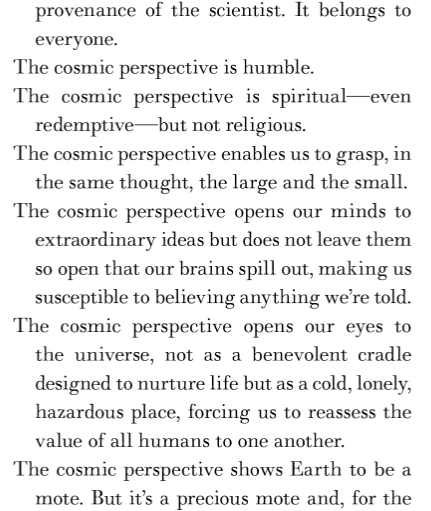
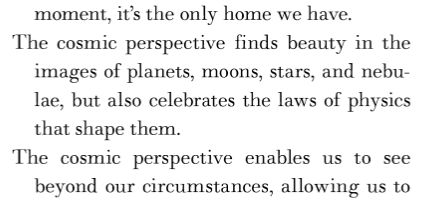

Beautifully written, no doubt, and I’d use it with my students as a mentor text in a heartbeat. Look at that parallel structure, that use of one-sentence paragraphs, that thoughtful choice of diverse verbs! Lo, the effect of repetition, the deft uses of the dash, the pristine placement of commas! All of these are worth studying alongside our students, but they are mere stepping stones on the path to the true purposes of reading and writing:
Joy, engagement, transcendence, learning, growth.
The expansion of our minds, of our perspectives, marching onward as relentlessly as the universe itself (yep, it’s forever expanding, knowledge I have thanks to Neil deGrasse Tyson). This passage–this argument, for looking at life from the cosmic perspective–is valuable for so much more than the way it is written. The meaning is in what is written, and how the reader makes meaning of it.
Looking at our teaching, our students, our lessons from the cosmic perspective, we must consider our small effect on these students’ lives in the grand scheme of things. Why would we insist students read a certain book, or a certain number of books, or write a certain number of pages, when we consider our real goal for students: to help them access the vast wealth of reading and writing they can do in the world to achieve their true callings.
 As we plan instruction for the second quarter, we must center our students’ reading and writing experiences on the highest purposes of those endeavors, and not remain too focused on the skills, structures, and rubrics we often get caught up in. We must not fall into the trap of sharing a passage such as this one with students solely to practice craft study, asking our students to replicate Tyson’s structure without appreciating what he’s trying to say to us by crafting it.
Let’s confer with our readers about not just how a text is doing what it’s doing, but also what their feelings are about that text, what they’re learning from a text on a holistic level, how they’ll insert this reading into their larger life philosophy.
Let’s coach our writers not just to become proficient in certain genres, but also toward authentic, purposeful, meaning-filled writing that they proudly craft and publish.
Let’s remember to harness the cosmic perspective in our work with students, as we consider not just what we know of them as readers and writers, but what we know of them as young adults who will go forth and change the world in some small way with their lives.
Let’s embrace the cosmic perspective when we consider reading and writing: those hallmarks of our intellect that make us uniquely human.
Shana Karnes is a lifelong reader and writer who daily tries to embrace the cosmic perspective in her work as a teacher, wife, and mother. She lives in West Virginia with her husband, two daughters, two cats, and five bookshelves. Connect with Shana on Twitter at @litreader.
Please share your higher purposes for teaching, for reading, for writing! Let us know in the comments, on Twitter, or on Facebook.

 I love going back to school for so many reasons, but one of the frontrunners is definitely that “second chance new year” feeling it provides. Teachers and students have the unique opportunity to have not just one fresh start at the beginning of a calendar year, but a second shot at goal-setting, changes, and achievements that the fall offers.





 But, as ever, reading is the great escape.
 Murder-Mystery
 The Word Exchange was completely, compulsively, un-put-down-able. Alena Graedon is a new author for me, and her tale of a world that loses its grip on language once a massive tech company monopolizes and commoditizes words was, for me, perfectly timed–I’ve been a little unsettled lately by my observations about how addicted to technology everyone is, and how afraid I am of what it’s doing to my students, and could potentially do to my children. This book spurred me to action in terms of deactivating my Facebook and Instagram accounts and making a conscious effort to leave my phone in another room–to make space to just be, and be bored, and have time to think and wonder and ponder.
 The Power by Naomi Alderman was just wonderful. It had all the elements of a gripping adventure story, along with a powerful message about what corrupts us. In this novel, women develop an electrostatic power and a society shifts from patriarchal to matriarchal in the space of a few generations as a result. The effect of women suddenly becoming more physically powerful than men leads to widespread revolution in everything from interpersonal relationships to world leadership. It’s beautifully written, too.
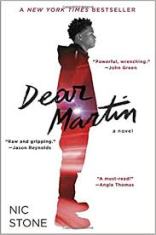 Dear Martin was a book I’d been recommended a thousand times, it seemed, but after reading so many books that felt similar–The Hate U Give, Long Way Down, etc., I just couldn’t pick it up–but I’m so glad I finally did. Nic Stone crafts this novel as a series of letters from young Justyce McAllister to Martin Luther King, interspersed with transcripts of news reports and first-person narrative. It’s complex and thoughtful and plausible and readable and powerful. I loved it.
 Teaching Books
 I grapple with this every summer. As a new teacher, I tried to make myself take the whole summer off from thinking about teaching, feeling like I was doing something wrong when I started doodling writing units or reading activity ideas. Later in my career I felt satisfied if I could turn off my teacher brain for just the month of June, and get back into the swing of things starting July 1.


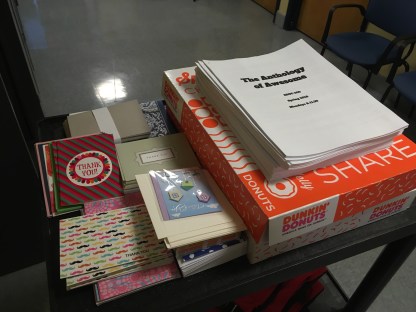

 students’ names and personalities. For my future teachers, I created our ideal school, in which we’d all teach and get to work together forever. In past years, I simply wrote a letter of well-wishes to my kids, and included each student’s name and a little compliment toward them all.
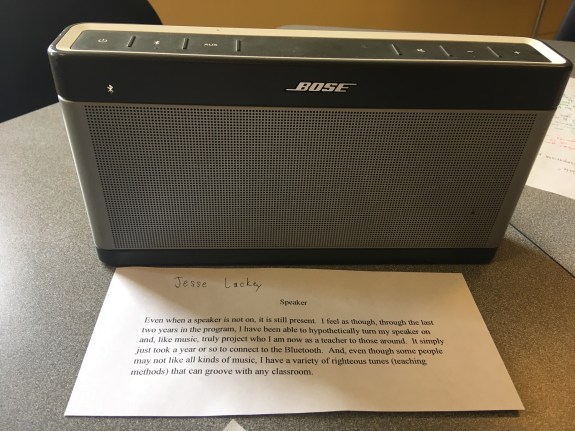

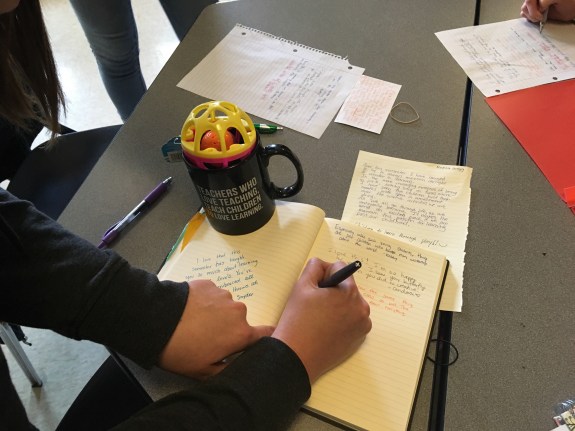


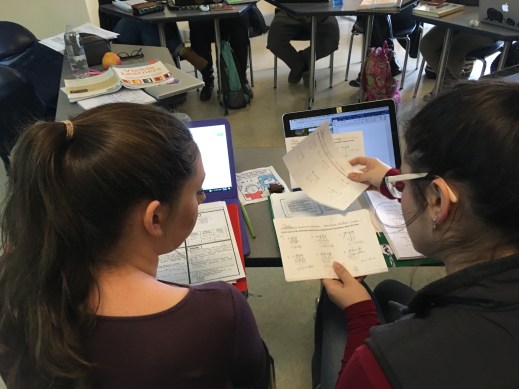
 And for the past two years, as I have worked with preservice teachers of all content areas and grade levels, my students have been
 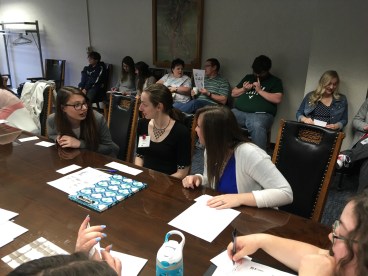 At our WV ELA State Conference, Elizabeth, Brittany, Sarah, Victoria, and Rachel shared one each of their tried-and-true strategies with participants.



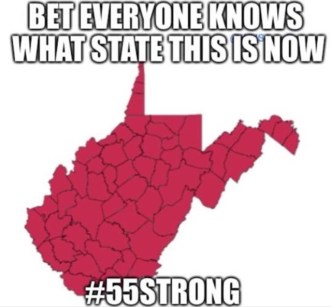 This week and last has seen my wild and wonderful state in the news quite a bit more than we’re accustomed to. Today marks the sixth day of a statewide teacher work stoppage brought about by decades-long frustration over legislative inaction to prioritize a long-term solution to problems with teacher benefits, salaries, and qualifications. As a result, every single school in all 55 counties of our state is closed.
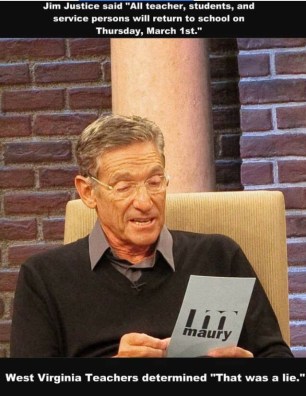 It’s clear why teachers are frustrated, right?
 That is the heart of why teachers are protesting, in my opinion, and it’s why I support the #55United effort. Our students’ right to a high-quality education is of paramount importance. It is with that education that they can enact change,
 Three Teachers Talk