Category Archives: Shana Karnes

A What-to-Read Conference: Books on Bullying

Many of my reading conferences happen at the bookshelf, as students finish one book and begin the search for another.  Here’s one example I just can’t stop thinking about.

Yesterday, a former student of mine came down to my room to borrow a book.  This particular student didn’t start out as a reader, so I was really excited to see him seeking reading material independently a year later.

“Do you have Winger?” he asked me.  We walked to the bookshelf and looked for it–all my copies were checked out.

“Why are you interested in Winger?” I asked him.

“Christina told me about it this summer,” he explained.  I smiled–books were still going viral, beyond our classroom community and into the summer months.

“Well, they’re all checked out.  What is it about that book that interested you?”

“The bullying,” he said, looking away.  Bullying?  I was surprised for a moment that this particular student was curious about bullying–he was a popular kid.  He drove a cool car, had a boisterous and charismatic personality, and had a trail of lovesick girls whose eyes followed his every move.  But then my surprise faded–all high school students, no matter how popular, confident, or smart they seem, struggle with their peers’ meanness.

I had to decide–what do I teach into here?  This student as a reader, or as a vulnerable teen?  I am no longer his teacher–so I don’t have to teach him as a reader, right?

Wrong.  I chose to treat this as a reading conference…but in doing so, I knew I was giving this student the tools to deal with the issue of bullying.

411MJMpTseL._SY344_BO1,204,203,200_I began to suggest alternate books about bullying, and I promised him that I’d set Winger aside for him when it was returned.  He ended up leaving with Thirteen Reasons Why, but I also suggested Nineteen MinutesYaqui Delgado Wants to Kick Your Ass, Simon vs. the Homo Sapiens Agenda, The Truth About Alice, Speak, Wonder, Aristotle and Dante Discover the Universe, and By the Time You Read This, I’ll Be Dead. 

I knew that when that student finished Thirteen Reasons Why, he’d be back.  I knew that I could guide him toward more books about this issue he was curious about, and that our future conferences could help him climb a reading ladder about bullying.

“Reading ladders take students from one level of reading to the next logical level…We can help them stretch as readers by showing them books that mirror what they already like but that…will challenge them more,” says Teri Lesesne in Reading Ladders.  By continuing to guide this student toward more complex books about the same issue, not only would I be helping him to grow as a reader, I would be offering him more titles that could help shed more light on the difficult issue of bullying.

Penny Kittle is fond of saying “reading saves lives.”  My own classroom library is emblazoned with the quote “We read to know that we are not alone.”  This student was seeking salvation, solace, and information in books.  He wanted to know that he wasn’t the only one feeling the way he felt, and he hoped to find a story that showed him a triumph over bullying was possible.  That he sought this guidance in a library shows the power of teaching readers…not books.

How to Respond to All Writers–Students and Professionals Alike

In a workshop classroom, all authors are mentors.  They are teachers of the craft of writing, and the foundation of the workshop model is built on acknowledging and celebrating them as such.  All writers are apprentices of other writers–Stephen King notes this in On Writing, Katie Wood Ray points this out in Wondrous Words, and Penny Kittle champions this in Write Beside Them.

This week, we’ve practiced treating two types of writers as mentors in our classroom–published authors and student writers.

Once we set up our writer’s notebooks, we began filling them with all things personal to us.  Heart maps, important photos, our hands, lifelines, reading histories, and more.  Then, we turned to adding the words of other writers.

IMG_9251

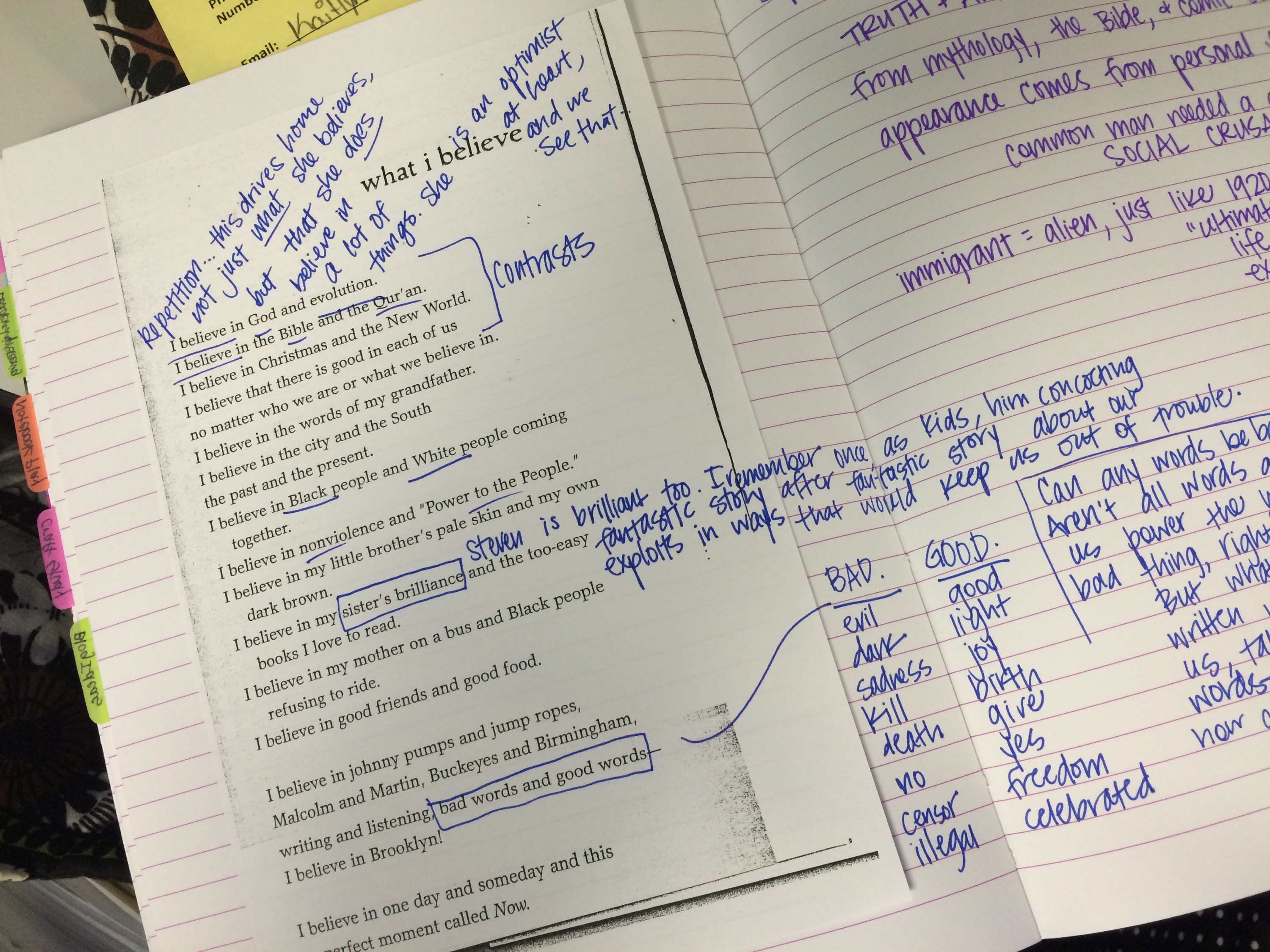
My writing atop Jacqueline Woodson’s

I wanted to show students the power of other writers’ words.  I wanted to teach them to read poetry not to “torture a confession out of it…to find out what it really means,” as Billy Collins writes, but to celebrate the act of simply reading that poem.  So, we glued in an excerpt from Jacqueline Woodson’s Brown Girl Dreaming.  I modeled for students how to respond to Jacqueline as a real writer, to notice and note her craft moves, to be inspired by her ideas and write more about our own feelings on those topics.  We wrote atop her poem, prioritizing our responses, reactions, and ideas rather than some analysis or “dulling down” of her meaning.  Responding personally and authentically to published authors will become an important part of our daily routine in our writer’s workshop.

I invited students to enter into a written dialogue with the authors we read.  So, as I settled down this weekend to begin reading a tall pile of student writing that had been turned in, I knew I had to walk the talk, as Amy always reminds me I must.  I ask students to treat authors as real people worthy of critical response, so why would I treat my student writers any differently?  I’ve always struggled with how to grade/evaluate/respond to student writing, but I’m thinking about it in a new way this year.  I just want to have conversations with my students about their writing, whether it’s in the form of a writing conference or in a weekend session with a stack of papers.  I know that when these conversations occur, student growth will follow.  In the excellent Portfolio Portraits, edited by Don Graves and Bonnie Sunstein, Linda Rief writes in an essay IMG_9248titled “Finding the value in Evaluation:”

I have discovered that students know themselves as learners better than anyone else.  They set goals for themselves and judge how well they reach those goals.  They thoughtfully and honestly evaluate their own learning with far more detail and introspection than I thought possible.  Ultimately, they show me who they are as readers, writers, thinkers, and human beings.

My thinking aligns with Linda’s.  When I remove myself from the role of “grader” or “evaluator,” I become an authentic reader of my students’ writing.  I invite students to assess their own writing, which in the words of Linda Rief “shows the value in evaluation.”

So this weekend, I read my students’ writing like I read books.  I noted beautiful lines they wrote, jotted down spiffy words they harnessed, and responded to thought-provoking ideas I saw them getting at.  I asked them questions, wondered about their meanings, and looked very much forward to reading more of their words in the future.  I will confer with students as I return their papers, and we’ll talk about how they might move forward with some of the topics, ideas, and stories they’d begun in these early writings.

In our classroom, we consider our responses to published writing as important as the writing itself.  The value of reading and writing lies in the interaction between the reader and the words, as Louise Rosenblatt describes.  When I transfer that value from the way I want my students reading writing to the way I want to read my students’ writing, new and important opportunities for student learning occur.

Simplify, Simplify: An Invitation

We’re six days deep into the school year here in West Virginia, and I am so happy, fulfilled, and content.  The start of this year has been the smoothest of my seven years, and our readers and writers workshop is coming together more quickly than it ever has.  I think it’s because of all of the invitations and welcomes that have been flying around our classroom, rather than the commands and directives of years past.

Amy’s post on inviting students to just talk helped me simplify the structure of my first week of lessons.  I strove to make our first days together as inviting as possible–as laid back, relaxed, and caring as I could.  Students were drawn to our classroom library with an invitation to check out whatever book they’d likethoreau-simplify.  They were intrigued by an invitation to write daily–nulla dia sine linea, in the words of the inimitable Donald Murray–as we set up our writer’s notebooks.  I invited students to just read for pleasure, to just listen to a poem to enjoy it, and to just write for fun.
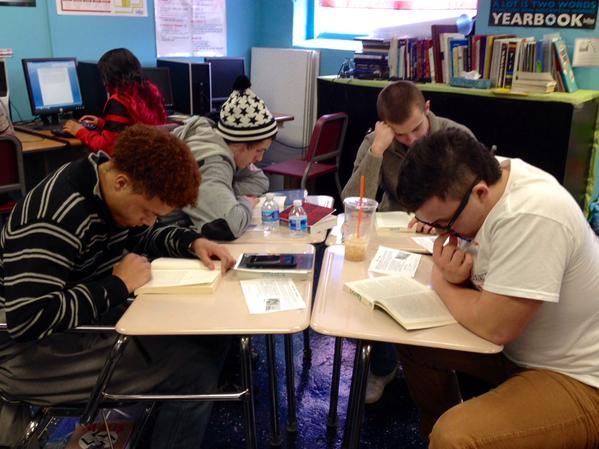
My invitations all centered around simplicity.

I want to slow down my thinking this year.  It seems my brain is always flying at a hundred miles a minute, and I bet my students’ minds are too.  I will invite my students to simplify their thinking–to streamline their thought processes, open their minds, and just write.  Just read.  Just talk.

This year, I’m inviting everyone in our classroom–adults and students–to put away their phones.  We read this article to understand why that may be necessary, as our devices can distract us without our consent.  Part of this conviction came after I read M.T. Anderson’s Feed, an award-winning YA novel about the mindlessness technology can fill our lives with.

I’m inviting learners to resist letting their lives be frittered away by detail, to simplify, simplify.  We will do more with less, and we will do all of our reading, writing, and thinking more deliberately.  These first six days have been marked by that simplicity, and I hope to continue that trend all school year long.

What are your goals this school year?  What do you hope to achieve with your learners?

Mini-Lesson Monday: Read Like A Writer

B9qMI_GIMAEriTZEstablishing the structure of the readers and writers workshop is one of the things I’m most excited about for the beginning of the school year.  The way these early lessons are structured will make all the difference in the way students view our work, our time, and our goals as a team of learners.  As such, “reading like a writer” is one of the earliest mini-lessons I teach when we return to school.

Objectives – Using the language of the Depth of Knowledge Levels:  Make observations about how a writer conveys what he conveys; Apply what you learn to your own writing.  Or, from the Common Core:  Analyze how style and content contribute to the power, persuasiveness or beauty of the text.

Lesson – My students and I begin this lesson by discussing the notion of apprenticeship.  Many of them are studying a trade–electrical work, HVAC, autobody repair, etc.  They are able to quickly explain that an apprentice studies a master in order to learn how to master a particular set of skills.

I then share with students Katie Wood Ray’s excellent description of writing being a craft apprenticeship:  “Like any other craftspeople, professional writers know that to learn their craft, they must stand on the shoulders of writers who have gone before them” (Wondrous Words, pp. 10-11).

Next, I invite students to turn to their newly-selected choice reading books and open to the first page.  I work beside them, opening my own book.  “Usually when I start a book, I’m mostly paying attention to who the characters are, when and where the book is set, and all of those usual details,” I say, thinking aloud, modeling my process.  “Now, I want to re-read this first page of chapter one and pay attention to how this story is written, instead of what the story is about.  I want to learn from this writer.”

We re-read, and after a few minutes, I ask students to talk with their tables about what they’ve noticed.  After some time, I model once more my process.  “I’m just going to take one skill I noticed this writer using and try to name it.  This particular writer is using lots of repetition here on page one–see how the beginnings of all of these sentences look the same?”  I’m pointing to the writing, displayed on the document camera.  “I like how the repetition draws my attention to what comes next in those sentences–I think it might be important.  I’d like to use repetition in my personal narrative.”  I invite students to name one craft move that they might also use in their personal narratives, and to jot that skill down in their writer’s notebooks.  They use each other as resources if their own books didn’t offer anything they felt truly drawn to.

Follow-Up – Following the mini-lesson, we’ll move into writer’s workshop.  At the beginning of the year, we’re crafting personal narratives, and we’ll study a variety of mentor texts to help us understand the possibilities of what that genre might look like.  As we do, I’ll continue to reinforce the idea of reading like writers–apprentices to the craft of writing.

What are some of your earliest mini-lessons? Share in the comments!

3 Ways Notebooks Top Digital Writing

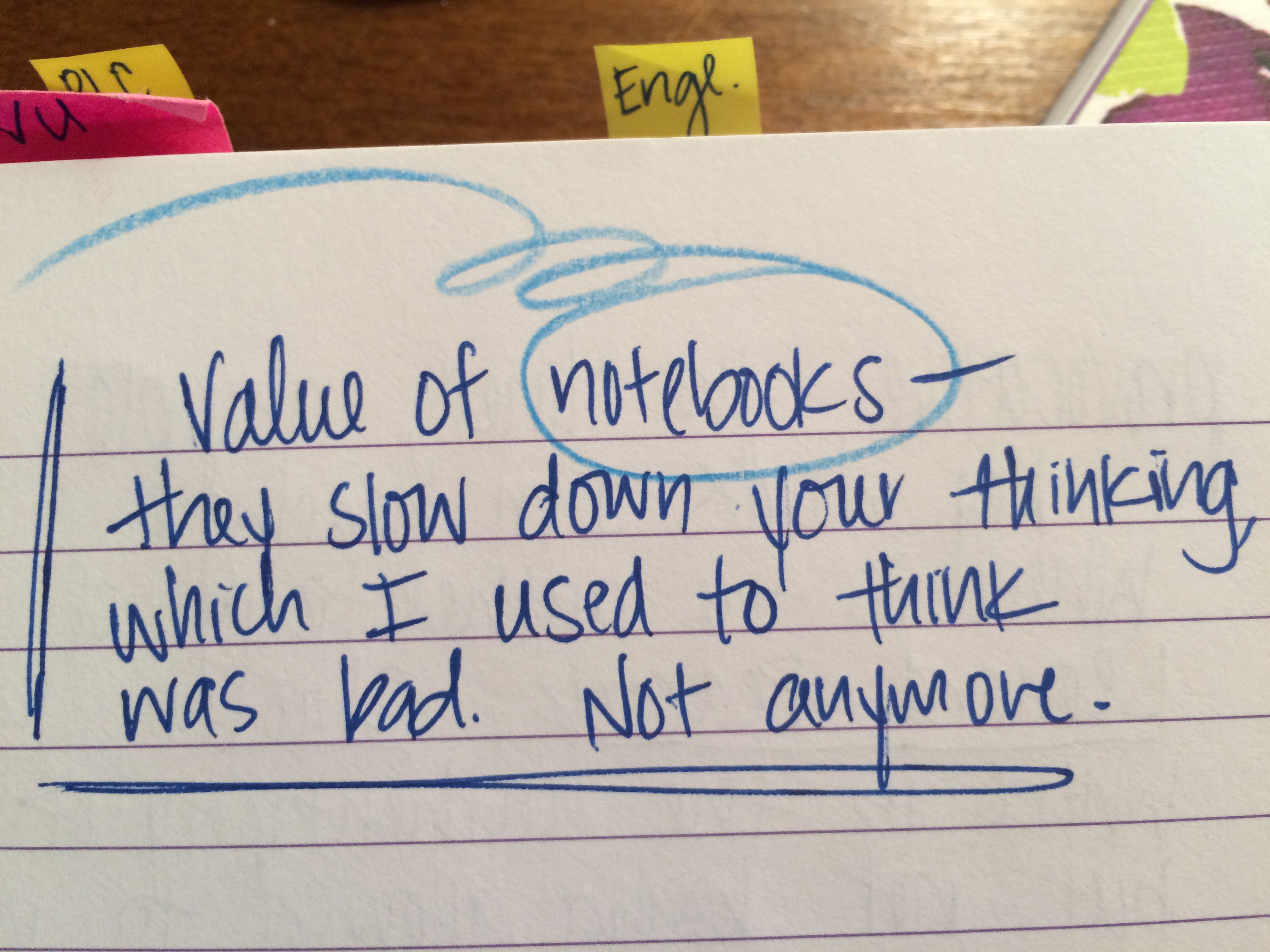
IMG_9111Has it already been two weeks since the last day of #UNHLit15?  Unbelievable.  Time is flying by, as it always does in the sweet summertime.  As I get older, I find myself wanting time to slow down…and that’s one of the perks of a writer’s notebook–it slows down a writer’s thinking.  At right is a note I jotted to myself during Tom Newkirk’s class two short weeks ago.  I’d been pondering the notion of length in my instruction–reading longer texts, writing longer pieces, sustaining an idea or a reflection for a longer period.  While brainstorming ways to do that, I realized notebooks were one way to add length to the thinking process.  They slow down a writer’s thinking, making it keep pace with the measured movement of a hand across a page, which is slower than the tapping of keys across a keyboard.  As Tom Newkirk writes in his credo, “I believe that slow reading runs counter to a media culture that stresses speed, distraction, and a loss of history.”  I believe the same thing of slow writing, in notebook form–it draws out thought in a way digital writing just can’t.

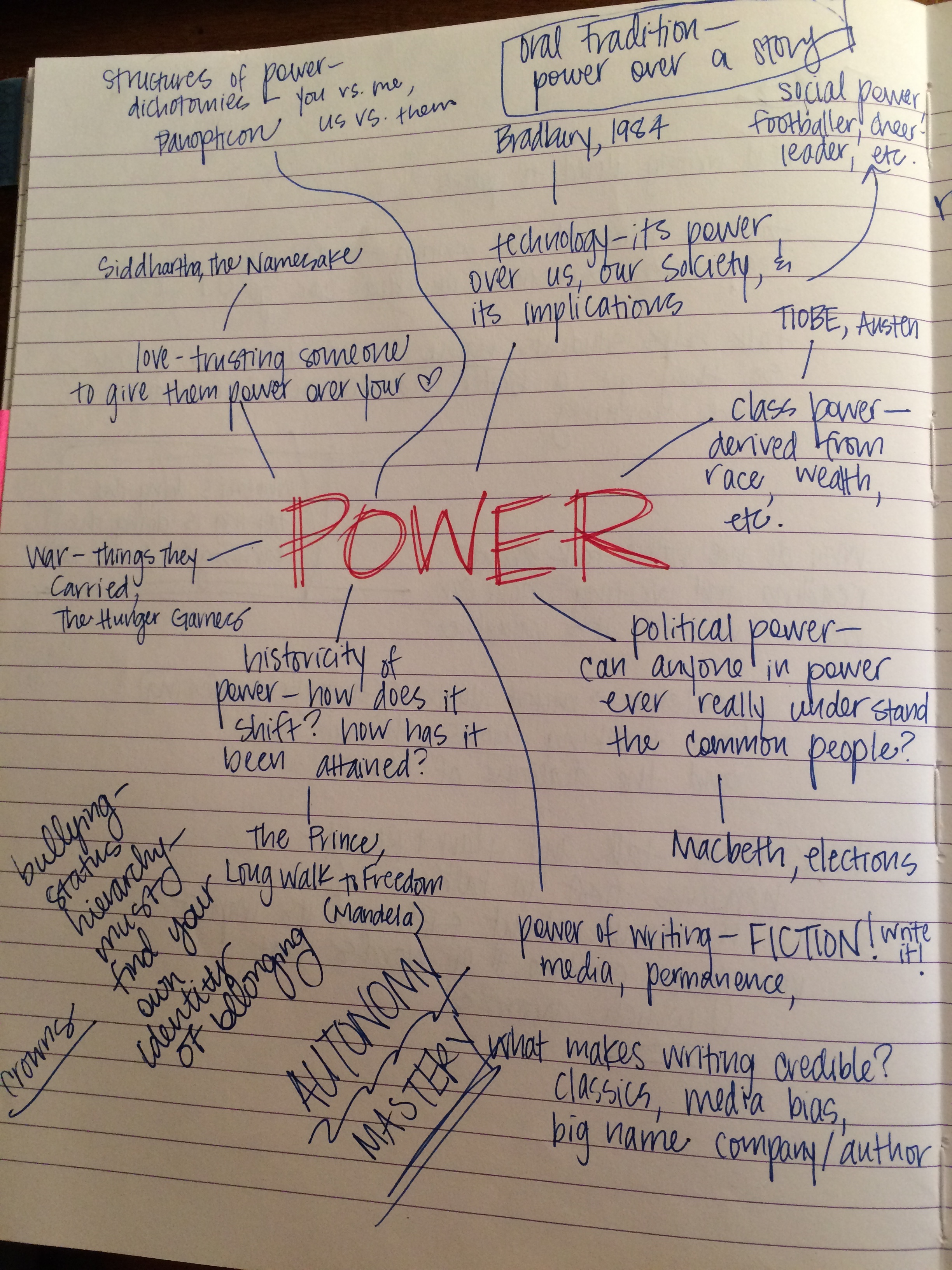
IMG_9110Notebooks also make thinking visual.  There is something about switching colors when revising, drawing lines to connect a tangled web of thoughts, or adding ideas to a pre-existing idea to show tangible growth that just can’t be done with a computer, voice recording, or video.  As I’ve pondered the theme of power–the overarching theme of my English 12 curriculum for this upcoming year–I’ve returned again and again to this page at my right, adding ideas, jotting inspirations, and connecting them to one another.  I’ve loved watching the page become more and more crowded, my thoughts finally spilling over onto the facing page before making it into my typed syllabus and curriculum map.  This visual map of my thinking is the most important part of my writing process, and without it, the typed pages I hand my students would lack coherence, focus, and quality.

Finally, notebooks illustrate volume in a way typed papers or blog posts just can’t.  Revisiting my old notebooks provides me a tangible location to mine ideas from–I can flip back to the summer of 2013 and find wild scrawls from my first class with Penny Kittle, or the fall of 2006 to see a plethora of hearts marking my budding courtship with my husband, or the spring of 2009 when I was frantically finishing my Masters thesis, evidenced by frantic scribbling and much crossing-out of ideas.  All of this evidence of my thinking takes up an entire bookshelf in my office, showing me proof that my thinking has evolved over time.  I want my students to feel that same sense of wonder and growth when they fill their second notebook by the end of our school year together.

Notebooks are a map, a timeline, a guide–to our lives, our minds, and our hearts.  They create a space for creative contagious concentration that is tangible and necessary, and which transcends the nebulous nature of digital writing.

Just Let Them Write: Boys and Autonomy

“Just let them be boys.”

This aphorism about dealing with boys is a long-standing one, but I learned last week in Tom Newkirk’s class on boys and literacy that it’s much easier said than done.

First, after reading a pretty fascinating article in The Atlantic, I realized that modern society doesn’t often let our boys be boys.  The economy, family structures, and workplaces of America have changed drastically in the past twenty years, and the traits and skills that used to make men successful and fulfilled have gone away.

Second, I listened to my fellow teachers discuss their classrooms this week at UNH, and I was struck by the language of control prevalent in teaching narratives:  “I make them;” “I let them;” “I shoot down their ideas;” “They have to;”…these were the words teachers used to describe their students’ activities.

These are phrases of division, of separation, of a differentiation of teacher and student, expert and learner, master and subject.  Having just read Daniel Pink’s Drive, the phrase “The opposite of autonomy is control” has been stuck in my mind.  It seems that even in the academically enlightened setting of the New Hampshire Literacy Institutes, many teachers still practice a teaching philosophy of control and compliance, rather than one of equity and autonomy.  Further, many of these speakers were women–so this was an issue not just of control, but of furthering the claims of the Atlantic article mentioned above regarding emasculation.

Our class talked about violence a lot, and whether it was acceptable in writing.  Ralph Fletcher’s Boy Writers taught me that violence in boys’ writing was as natural as the sunrise.  Newkirk addresses this issue as well, defining violence in general as “the intentional infliction of pain…on another,” and specifying that “writing would be a violent act if it caused pain to others…for example, if it caused readers to feel threatened or humiliated.”  Too many teachers in our class had a strict no-kill, no violence, etc. rule about writing topics–the opposite of autonomy.

Most reading and writing boys do doesn’t involve intention to inflict physical pain or harm.  Their topics may be provocative, but most of the time, it’s just boys working out things that are on their minds–huge issues like death, love, violence, and sexuality.  Adults do this all the time too–these are issues many of us haven’t quite worked out, so why should we deny children an opportunity to explore them through writing or other means?

Thanks to reading texts like Boy Writers, Misreading Masculinity, and Peter Johnston’s excellent Choice Words, I feel like I understand and enjoy many themes in my boy students’ writing. In fact, the first time I met my husband was in my freshman English class, where I wrote a story about a serial killer who stole college students’ identities and test scores by ripping off their faces and stitches them over his own. My professor asked me to share it in front of the class and I still recall the nervous giggling that followed my sharing, including Jon’s wide eyes. As a writer, I was just proud of creating a fictional voice so creepy and plausible, but the embarrassment of that experience shamed me to a degree that I’ve shied away from all fictional writing since.

As a teacher, I don’t want to quash a student’s creativity, violent or not. I love my boy writers and respect the sanctity of their writer’s notebooks, in which their fantasy lives can be explored and reflected upon in private. For them to grant me access to those fantasy lives through writing is a sign of respect and trust, and I wouldn’t want to violate that by censoring their thoughts, showing them to administrators, or asking them to share with the class.

But most of all, I want to distinguish between feeling “uncomfortable” and feeling threatened or unsafe.  Hearing me read my serial killer story probably made some of my freshman English students feel uncomfortable, but no one felt scared–I did not threaten anyone in the room, nor did my fictional narrator.  In fact, the end of the story revealed that the killer’s actions were mostly motivated by justice, revenge for his victims’ pervasive academic dishonesty.

Feeling uncomfortable, though, is something I believe is essential to learning.  Disequilibrium is the space in which our worldviews are challenged, where we achieve the Vygotskyan zone of proximal development.  We are confronted with new knowledge and are close enough to it to assimilate it into our existing schema.  An open, unfettered workshop classroom is one place where this kind of development can (and should) occur.  Rules like no violence, no swear words, no sex, no freedom, prohibit the opportunity for disequilibrium–and real social learning–to occur.  We cannot fear our students’ inner minds.  We must acknowledge the distinction between fantasy and reality in books, in writing, and in our kids.

Further, we must value that chasm, and respect our students’ varied and important processing strategies.  Writing these issues out is a way to come to understand them, so we must forsake this antiquated notion of creating control and compliance in classrooms.  Given choice, given autonomy, our students will read and write their ways toward understanding beyond our classes and into their adulthood, as we do.  We are the same as our students, grappling with concepts in writing (like I am here, now) and are no better than or superior to them.  Eliminate authority, cultivate autonomy, and just let them write.

#ShelfieShare – Growing Your Library

FullSizeRender[1]Yesterday was our last real day of school, and it was a busy one.  My students spent our last class periods together sharing their final multigenre writings with one another, clearing out their writing portfolios, and packing up their notebooks.

They also flooded me with classroom library books and sheepish smiles.

“Sorry,” Riley said, as she entered my classroom with a shopping bag full of books.  “I didn’t realize I had like 12 of your books at home.”

“I opened a cabinet and found like 20 of your books!” Emily said.

“If I bring back all your books, can I borrow like five for the summer?” Jordan asked.

“I found The Book Thief and almost just kept it, for the irony,” Hailey explained.

Now that all the books that are usually on kitchen tables, under beds, and piling on nightstands have begun to find their way back onto my bookshelves, things are looking a little crowded:

FullSizeRender

The five bookshelves in my classroom are mostly full of independent reading books–a class set of literature and grammar books, dictionaries, and book club collections provided by my department find their homes on the bottom shelves, but everything else has been a labor of love to build on my own.

FullSizeRender[4]I began building my library six years ago, and started with anything I could find at Half-Price Books.  I spent $20 a month in the clearance section, netting $1-2 finds that built my sci-fi and YA sections, and used my staff ID to get an extra 10% off.  During the holidays, HPB ran promotions for free $5 or $10 gift cards with the purchase of a $25 gift card, and I took advantage of those aggressively.

Next, I discovered Barnes & Noble‘s very generous 25% teacher discount, and shopped mainly in their clearance section, which was always well stocked with “former bestsellers.”  This was perfect, as a book had been out just long enough to generate buzz among my students.  I became a bit of a regular there, and began to ask the manager if he had any damaged, extra, or reject books he didn’t want.  He obliged, providing me with class sets of The Perks of Being a WallflowerWaiting to Exhale, and Tuesdays with Morrie–totally gratis.  I also got lots of hardcover books that were being replaced by paperback editions, again, for free.

Next, I discovered the generosity of my school’s PTA, which granted teachers up to $100 per year in classroom supplies.  Every year, my $100 was spent at Wal-Mart, Half-Price Books, or any other purveyor of cheap books.

FullSizeRender[3]By the time the summer of 2013 rolled around, my library was in decent shape–I had about 800 books, mostly paperback, mostly YA and general fiction.  I traveled to New Hampshire to take Penny Kittle’s course about informational writing, and fell in love with nonfiction.  I also met my amazing friends Amy, Jackie, Erika, and Emily, who told me about DonorsChoose.  I created, and funded, several projects–especially ones that helped me get lots of nonfiction–right away, which increased the number of books in my library up to about 2,000–all without a dime of my own money.

I also created DonorsChoose projects that were funded every October by U.S. Cellular, a partner of DonorsChoose.  Depending on your state, big businesses or even celebrities may fund your existing projects of up to $1000.  I used this partnership to fund two $1000 grants, growing my library up to about 3,000 books.

FullSizeRender[2]For my next brainstorm, I began to write letters to local big-box businesses, asking for donations of gift cards to purchase books.  Target, Sam’s Club, Kroger, and Wal-Mart all granted me gift cards, nearly monthly, of up to $50 per month.  Target in particular was wonderful, as their website offers a wide variety of books, especially great nonfiction finds, and free shipping on purchases of $50 or more.

When I finally got an iPhone in October of 2014, I joined Instagram and followed lots of bookish accounts.  Through these book fanatics, I learned about Book Depository, which offers discounted books with free shipping to anywhere in the world; Books-a-Million, which has a wonderful bargain section and an awesome used books market; and the glorious world of GoodReads giveaways, where free ARCs can be won by one and all.

This summer, I’ll take a week of rest, then begin to write book donation request letters, a DonorsChoose grant, and a variety of Morgantown-specific grants.  I’ll focus on replacing lost or stolen books, getting newly-paperback titles, and building shelves I think are a little weak.  I hope you’ll use this slew of resources to build your library, and your readers’ choices, too!

What are your favorite strategies for building your library?

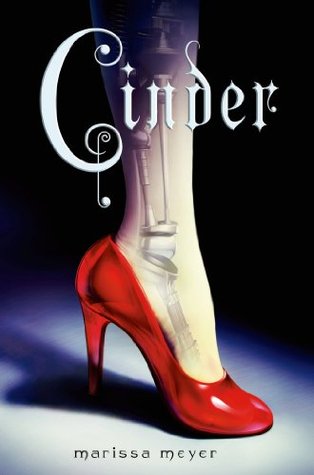
Cinder by Marissa Meyer

cinder

“Even in the future, the story begins with Once Upon a Time.”

Are you looking for a good old fashioned dystopian YA series to start your summer?

How about a modernization of a classic fairy tale?

Or, have you been craving a story about a cyborg mechanic, trying to avoid a plague, who’s got secret mental powers, a really crappy stepmother, and is actually a lost princess?

Well, if any or all of those books sound good to you, then look no further–this one will grant all your wishes.  Cinder by Marissa Meyer is book one of the Lunar Chronicles, a series incorporating futuristic versions of Cinderella, Little Red Riding Hood, Rapunzel, and more.  But it’s not just a book that retells a classic fairy tale–my boy readers love it too, because Cinder is a mechanic who works on androids in a post-WWIII future.  Complete with hovercrafts, bizarre medical technology, and sinister political plots, this story really has it all.

“But if there was one thing she knew from years as a mechanic, it was that some stains never came out.”

As a narrator, Cinder is complex, likable, sarcastic, and the embodiment of different.  In her society, cyborgs are considered less than human, and she battles this stereotype throughout the story.  Still, she responds to her critics with dry humor that made me guffaw as I read, and an unapologetic bent that made me know she’d be a great role model for my students.  Cinder defies convention in every way–a female mechanic, a plain princess, a cyborg in a human society–and yet her bioelectric backbone keeps her standing tall through it all.  I truly fell in love with her character by the heartbreaking, humiliating end of this first book, and immediately ordered the next two on Amazon.

“It is easier to trick others into perceiving you as beautiful if you can convince yourself you are beautiful. But mirrors have an uncanny way of telling the truth.”

Marissa Meyer crafts an incredible, fascinating future in the Lunar Chronicles, and writes with a style and flair that lend personality to the dystopian drama that unfolds in this series.  I highly recommend Cinder and its sequels for the science fiction shelf of your classroom library–scoop it up to enjoy before the magic wears off at midnight!

What I Didn’t Teach This Year

The end of the year is upon us (finally!), and I’ve been reflecting as I always do.  This year, though, I’m thinking about something I’ve rarely considered before–not just what I taught, what worked, or what I want to do next year.  I’m thinking about all the things I didn’t teach this year.

There are 180 precious days in a school year, and the way my school is structured means I spend 90 days with each set of students.  That seems so fast.  There was no time to waste, so here’s what I didn’t fill that time with:

FullSizeRender

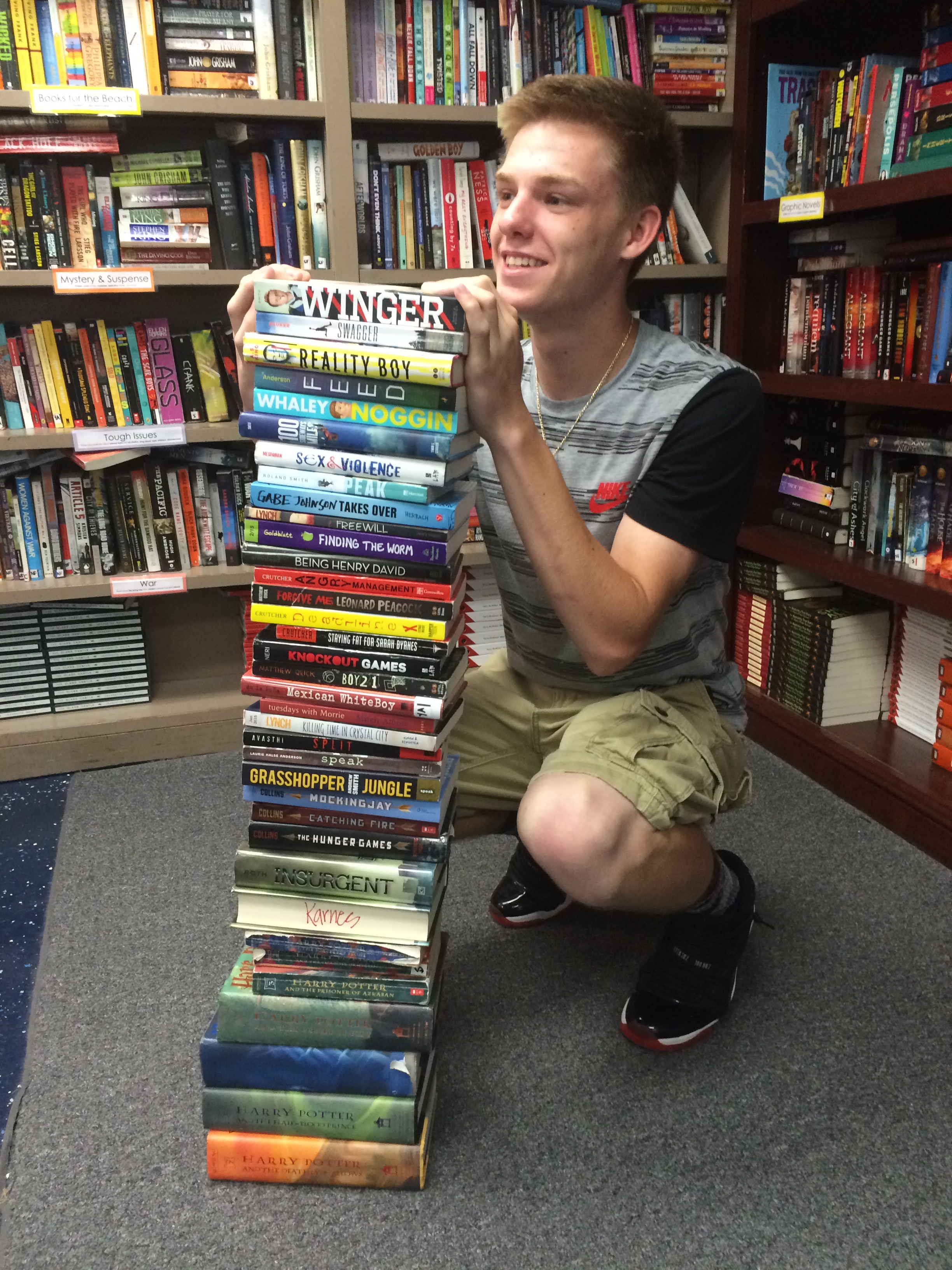
As Sabra stepped up for her reading ladder picture, she said, “This is pretty good for someone who didn’t finish a book until your class!”

Whole class novels.  This was a controversial choice for me, given that I love so many authors of American literature–Mark Twain, Walt Whitman, Nathaniel Hawthorne, etc.  But, no matter what novels I’ve chosen in the past, there’s always a student that book isn’t right for.  Fahrenheit 451, The Absolutely True Diary of a Part Time Indian, The Glass Castle, Maus–none of them is a perfect match for every child.  I’ve used a wide variety of strategies to get students to be able to read those books, and every ounce of passion I can muster to get them to want to read those books, but still–students have been conditioned to not read, to just get on SparkNotes, or ask an older sibling, or use Wikipedia.  When the stacks of matching novels come out, groans abound and engagement tangibly disappears.  I’ve seen this.  I’ve battled it.  No more.

So, I scratched whole class novels altogether.  Students worked in book club groups twice, and engaged in independent reading challenges two other times.  We read tons of short stories, articles, essays, and middle-length writings together.  But we didn’t read a single whole-class novel, and my readers still thrived.

IMG_8294

“I found myself as a reader this year,” Jordan writes.

Did my students grow as readers this year?  Yes.  I watched students who hated reading come to love it.  I watched students who couldn’t read well at all increase their stamina, passion, and skills related to reading.  I watched students who were good readers but bored with books fall in love with nonfiction, poetry, graphic novels, or award winners as they discovered new genres.  I watched students who loved to read flourish and challenge themselves with complex texts and childhood favorites alike.  Most of all, I watched a community of real readers spring up in my classroom–students recommending books to one another, self-selecting books and keeping long to-read lists, telling me all about their finds at Barnes & Noble.  These readers have become truly independent.  “Now,” Taylor writes, “I think I can read anything that’s put in front of me…and enjoy it.”

FullSizeRender

Isaac performs a poem for Nathan on poem-in-your-pocket day.

A movie.  As I’ve walked the halls this last week or so, I hear the unmistakeable sounds of cinema from behind closed classroom doors and darkened rooms.  I have no doubt that students are watching relevant films–movie adaptations of Romeo and Juliet in English, Forrest Gump in History, etc.  But this year, I felt I had absolutely no extra time…there was SO MUCH I wanted to do!  I used to love showing O Brother Where Art Thou with The Odyssey, and my students really delved into the symbolism of both texts.  But this year, my SmartBoard was full of YouTube videos, slam poets, or the still, quiet images of a document camera showing some writing.

I didn’t have time to show a movie, but I also wasn’t pressured by the crush of hours of grading that usually prompted me to show films in the past.  I’ve taken Kelly Gallagher’s rule about student work to heart–students should be doing four times as much reading and writing as we could ever grade.  So, I’ve read and responded to about a quarter of my students’ work, and let self-evaluations, peer conferences, and notebook passes do the rest.

Most of what I taught last year.  Last year was great, don’t get me wrong–but this year, my students were a new batch.  They’re different kids than last year’s group, so the same things won’t work for them.  After seven years in teaching, I know that.  I didn’t waste time trying to figure that out…I just started fresh.  I know I’ll do the same thing next year…out with the old, and in with the new.

IMG_0054

Shailyn read almost all of my YA fiction, and wrote reviews about nearly every book for our school newspaper.

Tests or formal essays.  Tom Romano likes to call the typical English essay a “five-paragraph you-know-what,” and it truly is a dirty little assignment.  At an NWP workshop I attended, each teacher was asked to bring some samples of student writing.  All around me emerged typed, double-spaced, Times New Roman, size 12, thesis-at-the-end-of-the-first-paragraph essays.  From my own bag came photocopies of messy scrawls in notebooks, multimedia This I Believes, strongly-voiced commentaries, poetic musings developed from quickwrites, and lengthy, involved, multigenre research papers.  No two pieces looked alike, and they certainly looked nothing like most other teachers’ samples.

I’d be lying if I said I didn’t feel a faint nostalgia for my own high school days, when I took pride in being able to punch out a perfectly formatted five paragraph essay in just under an hour, and which made absolutely no sense but looked great, and which constantly netted me As.  But I listened to my neighbors rant about poorly integrated in-text citations and incoherent thesis statements, I dismissed that nostalgia and read my own students’ work for what truly matters–good writing, heart and soul on a page, and authenticity at work.  As my husband said when he saw me dwarfed behind a pile of multigenre papers to grade, “I could read some of those for you.” “You wouldn’t know what to look for,” I said.

“Good writing is just good writing,” he replied, and he is right.  As the year ends, my students are good writers and good readers–not all of them are great, and there are kids I feel I could’ve pushed harder, but all are certainly better than they were when the year began.  I’ll look forward to our last day of class, when I’ll gift them each a new composition notebook and a pile of classroom library books to read over summer…and to months beyond, when I get to hear their stories of summer literacy in the fall.

#PoetryChat Tonight, 8ET

poetry-prompts-rantLet’s talk poetry.

A few months ago, a pre-service teacher I know asked me to give her some feedback on a poetry unit she’d written.  Her mini-unit, a 25-page document filled mostly by her professor’s formatting requirements, troubled me for a few reasons.

First, as Amy established, poetry is more than a unit–it’s a powerful way of teaching linguistic precision, the art of writing, and the freedom of expression.  It shouldn’t be a two-week item to scratch off a curricular checklist.

Further, pre-planning a unit in such a detailed way takes the power out of learning. “You’re doing too much of the thinking in this unit, and your students aren’t doing enough,” I wrote to her. She had selected every poem, every genre, and every skill for her students to learn–in doing so, she took away a valuable opportunity for her students to seek out, evaluate, and share found and original poetry.

Second, this teacher’s unit was full of contradictions.  I loved seeing her ideas about including slam poetry, spine poems, blackout poetry, and other engaging, unique poetry possibilities.  However, I was confused by what seemed to be an obligation she felt to teach every literary and poetry term ever.  “Focus on getting your students to learn how to WRITE poetry by studying other AUTHORS of poetry,” I advised. “When Dickinson was writing poems, it wasn’t because she was like ‘oooh I love metaphors’–it was because she had a broken heart.”

In teaching poetry, it seems like too many of us are yoked to an antiquated view of poetry–metaphors, dactyls, metric feet.  We are focused too much on the HOW of poetry, and not enough on the WHY.  As we teach our students, let’s focus on them as poets, not simple readers of poems.

Join us tonight at 8ET for a #poetrychat about ways to transform our students into poets by getting poetry off our shelves and into their hands, introducing them to mentor authors, and encouraging play with nontraditional poetry forms.

#PoetryChat Questions:

Warm-Up: Your favorite line or phrase from a loved poem

1. Why do you think many students find poetry intimidating or inaccessible?

2. When you teach poetry, how do you balance the students’ READING of poetry and WRITING of poetry?

3. What are your favorite genres of nontraditional poetry (prose poetry, spine poems, etc.)?

4. Who are your favorite mentor poets? How do you use them to teach your students?

5. What can our students gain from novels in verse? What are your favorite in-verse titles?

6. Let’s finish by sharing our most successful poetry teaching stories. What’s yours?