Category Archives: Writers

Implementing Readers Workshop by Shelby Scoffield

Teaching high school English is a difficult job. In a world overrun with cell phones and gadgets, getting students to actually sit down and read a book seems like an impossible task.  Every year that I taught the classics, students would depend on outside sources to get them through the reading, and sometimes completely ignore the book. 

It was when a former student came back to me and proudly declared “Ms. Scoffield, I never read one book in your class!” that I decided to restructure my class and implement a Readers Workshop. While researching, I heavily relied on books by Nancie Atwell and even traveled to Maine to see her school first hand. 

After implementing the workshop in my classroom, I have eventually come to the conclusion that allowing students to pick their own books in the English classroom drastically increases student interest and allows them to take a more active role in their learning. 

During the introductory unit, I hold a book tasting in my classroom. I hold conversations with the students and direct them to genres they would be interested in.  Between my classroom and the library, they find their top three books. 
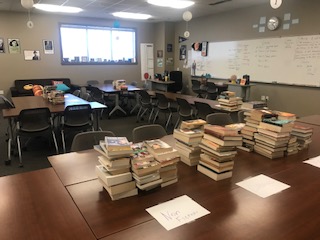
After finding their selections, I introduce them to Goodreads and have them read the reviews of their chosen books. Once they make a final decision, we are finally able to launch into the unit. The process of choosing books takes several days.

Topics that we cover in the unit are: 

  • How to read your book
  • Characters
  • Elements of a Plot
  • Analysis of major passages 

In my classroom, we use the Station Rotation model of Blended Learning. When a student walks into my classroom, they look at the board and decide what assignment they want to complete that day. They are required to come to “Table One” sometime throughout the week, because that is a teacher led and often the hardest assignment for the week. 
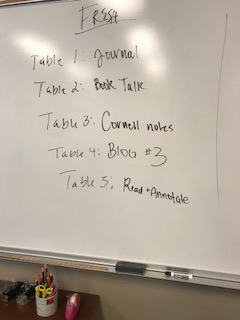
What do the assignments usually look like?

Book Talk: For this assignment, students are required to start a Twitter conversation with a classmate on Twitter. They have specific questions they answer and a hashtag we use for the class. Check out #mhhsfreshies for ideas! This is also a good way for the students to ask authors questions. You never know who might respond!

Journal: Using excerpts from a mentor text, we practice skills like analyzing passages or creating a character profile. Once the skill is practiced, they apply it to their own books.

Blog: Students work on a blog post once a week. The question focuses on what is currently being discussed that week in class. Students are required to respond to other classmates. This is also a great opportunity to connect with other classes across the globe. 

Supplemental activity: This can be an assignment that the teacher uses to help students learn the skill that is being discussed. I have used it as an opportunity to do Cornell notes, make videos, or create Buzzfeed character quizzes. 

Because I allow my students to choose their own books, a love of reading has been developed throughout the classroom. I have students zooming through books and talking about  them with their peers. I even have two students going through a book a week. 

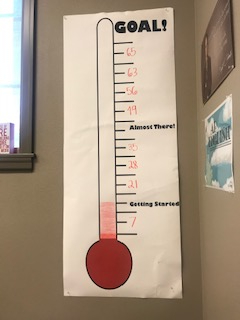
As a class, we have a class goal of reading 70 books by the end of  the semester. Students are constantly checking the thermometer on the board to see our progress and they are excited to see the number go up.
One of the biggest concerns I hear about this way of teaching is students not being able to read a piece of text deeply and get an analytical experience with a piece of text. While this concern is valid, I would like to state that I have never had students read more deeply.

Give your students time to read and make their assignments worthwhile. Fewer and yet more meaningful assignments are more impactful. It also gives students more time to read in class and hold meaningful conversations with the teacher. 

I also believe that teachers need to remind themselves who their audiences are. Teaching kids in the 21st century is hard and it is vastly different from our own high school experiences. We need to think carefully about our students and what will help them be the most successful. For me, it means implementing a readers workshop.

Shelby Scoffield is a high school English teacher. She loves reading, writing, and playing with her nieces and nephews. You can find her on Twitter at @sscoffield.

If You’ve Ever Been Coached, Then You Know: Why You Should Consider Using Your Coach (Part 1)

My teaching career (former English teacher) and my career coaching teachers (now Instructional Coach) seem to be converging lately. Of course, this must be: they’re narratives, intertwined, leading me to learning. Keep learning was the theme of the Teaching Learning Conference I attended in October, facilitated by Jim Knight and the Instructional Coaching Group.  I used theme intentionally; in Knight’s Keynote opener, he spoke to the power of story. Knight anchored this in words from Barry Lopez: “The stories people tell have a way of taking care of them. If stories come to you, care for them. And learn to give them away where they are needed. Sometimes a person needs a story more than food to stay alive. That is why we put these stories in each other’s memories. This is how people care for themselves.” With these words,  I realized I am still helping others to write their stories and to learn from them.  And, it’s why I believe teachers–in all stages of their careers–should share their stories with their instructional coach (or literacy coach or data coach, etc.). This is a powerful way to stay alive in the classroom, full of possibility.

The most recent intersection of story and coaching occurred as I shared stories with a former student; I cared for the stories he shared but a question he asked of me about my new coaching role caused me to pause and reflect. He asked, simply, “How many of the teachers have been coached (in sports, or music, or something else) at some point?” He followed this with “Because if they’ve ever been coached, then they know.” Yes, teachers would likely know–they would know that coaches see what can be and guide toward that possibility. And, if teachers didn’t know, then there’s opportunity to learn all the ways a coach can act with the compassion necessary to differentiate according to teacher needs, ultimately helping to shape the story. 

Coaches can ….

  1. Help teachers imagine new realities. Coaches (in many places) aren’t there to tell you what to do. In fact, some coaches would love to collaborate on co-writing a new story for your classroom. Recently, I spent time working with a teacher to shift classroom practices so that play anchors the work and intentional grouping will lead to enhanced collaboration. Together, we imagined a reality where her students took the kinds of risks as learners that lead to rich learning.  
  2. Help teachers see the story of their classroom from different perspectives. In working with a world language teacher, I tried to, in Jim Knight’s words, “whisper a different narrative.” For this veteran teacher with perfectionistic tendencies, articulating and affirming where the teacher was already successfully making the moves she desired encouraged her to step back, reflect, and start to shift the story she was telling herself. 
  3. Help teachers determine which story is most important AND help them own a story. Just as when I was in the classroom, I find myself taking note of what I hear or using visuals to help provide structure to thought. As I listened to a teacher share her story of a particularly difficult class, I took note of every strategy she tried, categorized them, and then used this to help her prioritize her challenges. We not only uncovered which challenge mattered most to her to address but also referenced that long list of strategies as a story that shows her strengths of persistence and problem solving. 
  4. Help teachers continually revise and edit the story–even of students. Sometimes this means working together to problem-solve for one student. When working with a teacher whose student struggled to write an argument research paper, we imagined a different approach for this student, improving the likelihood the student could complete the writing.  

This is not an exhaustive list. I’m still uncovering all the possibilities, but I do know that I’m learning to listen better for the story as I work to support teachers. And, as words always have, this keeps me alive in learning.

Kristin Jeschke is a former high school English teacher turned Instructional Coach in Waukee, Iowa. Follow her on Twitter @kajeschke. 

Writing Workshops Modeled on Writing Center Theory

Image result for writing center

I was a writing center tutor when I was in graduate school, and my current school allows me to run a student-tutored writing lab for our population during the school day – a dream come true! 

Anyone who has worked as a writing tutor knows that it changes how you see yourself as an instructor. You see beautifully and poorly constructed writing assignments and equally helpful or unhelpful commentary on written work. Helping students navigate an instructor’s expectations makes you better at setting expectations for your own students. 

Perhaps the most powerful pedagogical contribution of writing center theory is the focus on the writer over the writing. A good tutor’s job is to improve the writer, not the paper, a concept described in Stephen North’s 1984 essay “The Idea of a Writing Center.” This is often done through questioning strategies that force the writer to think about her writing rather than commands of how to “fix” it. 

After training my tutors in writing center theory each year, it occurred to me that these ideas could transform writing workshops in my classroom. Now, before my first writing workshop each year, I make sure to teach all my students on a foundational writing center concept: HOCs and LOCs. 

Higher Order Concerns (HOCs) and Lower Order Concerns (LOCs) are how we set the agenda of a writing center appointment. In our writing lab, we have roughly 20 minutes for an appointment, so we need to quickly choose a focus. How do we decide? HOCs and LOCs are our guide. 

HOCs are typically big-picture questions related to revision. Does the paper actually fit the assignment? Is the author’s purpose clear? Does the author need better or more evidence? Has the author provided enough explanation? Would the ideas be better structured a different way? 

These ideas are higher order because, if they are not meant, nothing else really matters. The paper can have beautiful imagery and perfect grammar, but if the message is not communicated, who cares? 

LOCs are often editing issues. I prefer to call them “later” order concerns rather than lower. They are still important, but they should be addressed later in the writing process or at least after the HOCs. These include punctuation, spelling, correct citations, and word choice. Of course, any issue can become a HOC if it interferes with meaning too much. A student whose grammar is incomprehensible may need a lesson on basic sentence structure first. 

In my experience, left to their own devices, students focus first on LOCs, regardless of the goals of the workshop. It is so much easier to tell someone where to add a comma or that “effect” is misspelled than it is to find out what someone was actually trying to say. For my students to be able to have useful workshops, I need to push them beyond what is easy. 

To train my students, we first outline the HOCs and LOCs on the board. Then, together we read a sample paper out loud, and I have them determine what area should be worked on first and why. What are the most pressing issues in the paper? If you really want to challenge them, make sure the paper has some glaring grammatical problems but even bigger issues with argument. 

Then, we discuss our process and rules for writing workshop. 

  1. Start with the author’s concerns. Most authors know what they are having trouble with, so ask the author first. This also puts the author in control of her own paper. 
  2. Read each paper out loud with everyone in the group listening. Ideally, the author should read his own paper. This keeps busy hands from adding commas all over. Students are never allowed to simply pass papers around in my classroom. 
  3. Have a conversation about the paper. I encourage my students to ask questions, such as “What did you mean here?” or “I thought what you were trying to say was … Was that correct?” or “Why did you choose to put this example in this paragraph?” Questions force the writer to think about his own choices and be an active participant. 
  4. Brainstorm possible solutions to problems together and make sure that the author writes them down. 

Over the course of working on a paper, we will eventually get to those LOCs, but again, we do not just want good papers but better writers. Students discussing the decisions behind their writing will inevitably lead to more fluent writers. 

If you’re interested in reading more about writing center theory, a great place to start is The Allyn & Bacon Guide to Peer Tutoring

Sarah Esberger teaches AP Language and Composition and Sophomore English at Central Magnet School in Murfreesboro, TN where she lives with her second-grader, her husband, three furry friends, and a bearded dragon. She also runs her school’s student-tutored Writing Lab and is always seeking new ways to incorporate James Britton’s concept “reading and writing float on a sea of talk” into her teaching.

Real World Writing: A mini-unit using Chipotle as a mentor

I’m in Chipotle, munching the chips and reading the bag. I loved the essays from Aziz Ansari and Sarah Silverman over the past months. Today I notice something different. This essay was written by a high school student.

“Excuse me,” I approach the counter at Chipotle. “Can I have some bags?” I explain to the clerk that I work with teachers and want to use these bags in class. The teenager handed over a stack. I feel my heartbeat quicken, the way it does when a teaching idea starts forming. As a literacy coach, I couldn’t wait to share these with the teachers whom I was working. One of our favorite units of writing was born.

I’ve been training myself to read like a writer my whole life. I just didn’t always know it. I loved reading cereal boxes when I was a kid. I’d pour my milk and then pore over every word, reading riddles and puzzles, then on to the nutrition information. At doctor’s offices, I read Highlights. At the grocery store, I’d speed read Tiger Beat. I read everything.

It wasn’t until I was older that I realized how much all that reading impacted me as a writer. And it wasn’t until I was a Fellow in Ohio Writing Project’s Summer Institute that I had a name for it: “Reading Like a Writer,” a term I learned when reading Wondrous Words by Katie Wood Ray.

As we began to think about how to use these Chipotle bag essays with students, I came back to what I know is true about writing instruction, a rhythm gleaned from countless professional texts (Penny Kittle, Ralph Fletcher, Allison Marchetti & Rebekah O’Dell, to name a few). My OWP colleague Beth Rimer succinctly captures this rhythm when she talks about the ideal conditions for writing:

  • Modeling: writers need to see the possibilities for their own writing by looking at lots of examples. And as often as possible, I want those mentor texts to also exist in the real world (See Writing With Mentors for support around this).
  • Ideas: writers need support to find an idea. As Don Graves said, “Unlimited choice is no choice at all.” Instead, writers need strategies to find the ideas they might explore (My favorite way to nudge writers is with Linda Rief’s Quickwrites books).
  • Drafting: writers need time to write, to mess around, and to get feedback (Write Beside Them by Penny Kittle changed my teaching life).
  • Revision: writers need explicit instruction about ways they might make their writing better (I love Revision Decisions by Jeff Anderson as a way to focus my lessons).
  • Feedback: writers need feedback in lots of ways — from themselves, from each other, from an “expert” (Jenn Serravallo’s book about Writing Conferences is a great place to start rethinking how we give feedback).

Every single time I find a piece of writing in the world that I want to share with students, I come back to this. I use it to build our mini-lessons, to decide on instructional days, and to remind me of what writers need. It might look like this:

Day One – Notice. Gallery walk the Chipotle bags. Talk about what we notice the writers doing. Make a list of possibilities for our own writing.

Day Two – Generate ideas. Once we notice that these essays are all about small moments connected to food memories, we might create a moment map, or a quicklist, or a sketchnote.

Day Three – Start writing. Mess around. Get dirty. Know that this doesn’t have to be perfect. Resist the temptation to give students a template and instead remember that writers need time to let a draft take shape. Confer with the writers in the room, nudge and get to know what they’re working on.

Day Four-Five – Teach. Look at what writers have been struggling with and teach more. Look at what writers have been doing well and put that up on the document camera.

Day Six(ish) – Publish. Sometimes we just turn it in. Sometimes kids can print their essays on paper bags and then have a gallery walk, leaving post-it notes of feedback.

This isn’t always what writing looks like in our classrooms, but we try to build in these moments of authentic writing so that students have a chance to stretch important muscles. They build fluency and confidence. They have the chance to work through the writing process quickly, therefore getting to do it more often. They have an authentic audience and see that writing is all around them.

I recently worked with a 7th grade teacher whose students wrote Two Minutes On essays as one of their first experiences. The products were amazing. Students took risks, they wrote from the heart, and they stretched themselves.

If you’d like to try this mini-unit, you can find the mentor texts here. What real-world writing has inspired you and your students? Share in the comments!

Angela Faulhaber is a literacy coach in Cincinnati, Ohio. She loves burrito bowls and is happiest when eating tortilla chips with her kiddos and husband. She works with teachers and students from grades K-12 and the scariest day this year was when she taught a group of adorable kindergartners a writing lesson.

Layering Notice and Note Signposts over the Plot Triangle

Teaching seventh grade is both a challenge and a joy. Students are inquisitive, silly, maturing . . . and in the seventh grade. Until last year, I hadn’t taught this grade for about eighteen years, and I wasn’t expecting to. But, life can be unpredictable, and in a strange and wonderful turn of events, I have found myself teaching seventh grade students.

I couldn’t be happier.

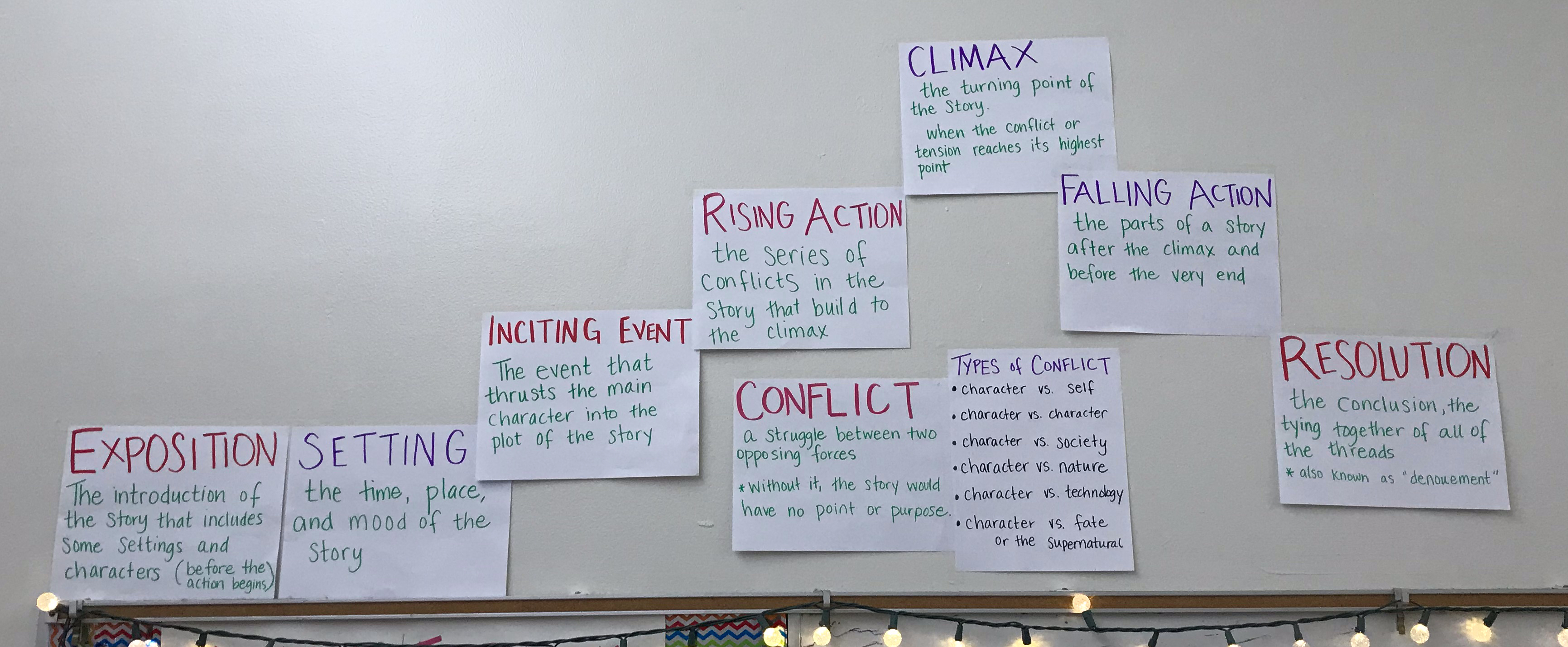
Recently, because of some standardized testing they were involved in, the concept of the plot triangle was raised. My students, for the most part, stared at me blankly, not understanding what it was. I realized that the plot triangle is a simple diagram, but can be a difficult concept.

It was really perfect timing because we were starting to read some short stories together as a class, and we needed some common language for when we discuss and write about them.

I created a chart I and posted it on our classroom wall.

plot triangle

As the students digested the ideas in the plot diagram, I was peppered with eager questions.

Why is the climax so close to the resolution? 

What is the falling action? 

How many events belong in the rising action? 

We talked it through, and students started to feel more comfortable with the ideas, but the next question was one that made me smile. Why does the plot triangle matter?

Fair question. Why? is always a fair question in my classroom, and I had a proud teacher moment.

In trying to explain why the plot triangle matters, I tried to share that a visual representation of a story helps us to understand more deeply.

We made the connection that the fiction signposts also help us to more deeply understand a story. Since we’ve been studying the signposts as we study short stories and narratives, it was a great connection to make.

IMG_6285

So, after class I annotated our wall chart with the fiction signposts. It took some thinking, and I’m hoping I got it right.

I didn’t want to limit anyone’s thinking by suggesting that a signpost might only be found in one part of the story, but I did want to let them know where they might start noticing them.

They started to create plot triangles with some of the stories we had recently read together, and then layering some of the signposts into the plot triangle.

  1. Charles by Shirley Jackson
  2. Thank You, M’am by Langston Hughes
  3. The Medicine Bag by Virginia Driving Hawk Sneve
  4. Fourteen by Alice Gerstenberg

Here are some examples of what they did right at first:


My students aren’t done creating their plot triangles, and they aren’t done thinking about how the layering of the plot diagram and the signposts complement one another, but so far their thinking is going in the right direction.

They are asking questions and making connections. They are talking to each other and challenging each others’ thinking. They care more deeply about the stories and the characters they are reading about.

I’ll call it a win.

Update: I had another “aha moment” and asked my husband to help add another layer to the wall chart. What do you think?

plot triangle w tape

Julie has been teaching secondary language arts for twenty years, spending the first fifteen in rural Central Oregon,  four in Amman, Jordan, and the most recent school year in Managua, Nicaragua. 

Follow her on twitter @SwinehartJulie

Not Averse to Verse: Using Novels in Verse to Engage English Learners #ILA2019

This is a guest post by Dr. Helen Becker, and I owe her a big apology. I had agreed to run this post before her presentation at ILA. I have a million excuses:  None will do. So I publicly I say, “I’m sorry for not following through,” and if you are reading 3TT today, know this:  Helen is one of the smartest educators I know.   ~Amy

To understand the instructional power of novels in verse in the high school English classroom, you must first know a bit about my former school. Clear Creek High School, a comprehensive high school in Clear Creek ISD in southeast Houston, serves 2500 students in grades 9-12. According to Texas Academic Performance Reports (TAPR) published by the Texas Education Agency (TEA), in the last five years, the campus has experienced a steady rise in the number of English Language students. Many of these students have come from Latin American countries.

What you must also know is that our district advocates student choice reading in a reader/writer workshop setting. Furthermore, to provide students greater choice in reading material, the district invested nearly a million dollars to flood classroom libraries with high-interest books. Self-selected independent reading has become a constant in the changing school landscape at Clear Creek High School.

Fast-forward to my fifth period Reading class two years ago: a group of thirteen boys and one girl who, despite the best of intentions and instruction, had still not passed both End of Course (STAAR) exams in English. Enrollment in a Reading course, coupled with co-enrollment in grade level English class, was meant to close the gaps in their reading and writing lives. This is where the workshop model and classroom libraries intersected with my fourteen EL students. When the District ELA coordinator brought a stack of newly released novels in verse to my fifth period Reading classroom, the students devoured the books. Thanks, Billy Eastman.

And so began my quest to know more about the power of using novels in verse in the EL classroom. I knew I had found a topic that I needed to know more about – for not only my use in my classroom but use in the classrooms of others as well. While researching the topic further, I encountered a noticeable lack of research-based information about using novels in verse with EL students.

In fact, the only direct source of data I located was from Farish (2013) who writes based on her first-hand work as a librarian at a school with a large population of EL students. Farish writes in School Library Journal that the poetic form of novels in verse mimics folksongs and tales that are part of many foreign cultures. As a result, EL students feel comfortable with the novel in verse genre because of this similarity.  Farish (2013) adds, “Many who work with English-language learners and others who struggle with reading seek novels that promote fluency and a sense of competence in readers.” Verse novels accomplish just that. They can move fast and offer readers at any level a feeling of completion.

I broadened my research scope to consider the transferrable skills all students, not just ELs, could practice with novels in verse as an instructional medium. The arrangement of words and a sheer abundance of white space on the page makes these books, well, friendly and approachable. EL students have fewer words to decode. Furthermore, Young Adult novels in verse often involve a protagonist with the same issues the EL students themselves are encountering. In short, novels in verse promote student agency (Garud, Hardy, & Maguire, 2007; Oakeshott & Fuller, 1989; Tran & Vu, 2017), and self-efficacy (Bandura, 1977).

But my experience with novels in verse really concerns one Fifth period Reading student in particular: Emerson. Emerson moved to our community from Guatemala five years ago and had difficulty finding books in English to read in my class. He experimented with books at a lower Lexile (I, for one, feel that Lexile level hinder rather than encourage literacy. This Literature Review from ALA provides data to support my stance on Lexile levels), but he was quick to abandon them, shrugging and saying, “They are boring, miss.” When I put Booked by Kwame Alexander in his hands, I totally mean it when I say that I didn’t see Emerson’s nose for a long time…it was in his book the entire time. In fact, I’m pretty sure Emerson read the book several times over. When I asked him about the book and why he liked it so much, Emerson said, “It speak to me.”

I cried those tears you cry when a student finally connects with a book.

As a result of my experience with ELs, I authored and co-presented a workshop at TCTELA on using novels in verse to engage English Learners in the high school classroom. In the session, fellow teacher and now Instructional Coach Megan Thompson and I delved into ways to leverage this popular genre to encourage reading comprehension and improve writing craft. I reworked the presentation for the International Literacy Association (ILA) conference this month in New Orleans, and Megan and I and invited our fellow teacher and TCTELA High School Section chair, Charles Moore, to join the presentation team. Both Megan and Charles brought their expertise as literacy leaders to the presentation.

Helen Charles Megan at ILA2019

If you were not able to attend the presentation but want more information on novels in verse in the EL classroom, reach out to me at hbecker@ccisd.net. I’d love to share my learning with you.

P.S. I gave my copy of Booked to Emerson as his graduation present.

For research citation see here.

Helen Becker has taught all levels of English Language Arts as well as AP Capstone Seminar in her seventeen years teaching secondary English. Today, Dr. Becker teaches Senior English at Clear Brook High School in Clear Creek ISD. Any day now, a suitable replacement for her will be found, so she can transition to her new job in the CCISD Office of Assessment and Evaluation. Until then, every day is a workshop day. Which means every day is a good day in Room 406.

Book Snapchats

While I’m a little bummed I’m not attending NCTE in Baltimore this year, NCTE 2018 in Houston was awesome–I’m still going through my notes nearly a year later!  Not only did I get to meet a handful of Three Teachers Talk contributors in person, snag new books, fangirl favorite authors, and catch up with former colleagues from Lousiville and Houston, I headed home challenged by new ideas and armed with new activities to implement in my workshop.  NCTE is truly a magical event for educators–enjoy if you’re heading to Baltimore next month!

Like many of us, I am always seeking different, engaging ways students can interact with and analyze a text.  One such activity from Charles Youngs (@Charles_Youngs), an educator and instructional coach in Pennsylvania, was Book Snaps.  Students are tasked with finding a significant page in a text, then creating an analytical “snap” via Snapchat.  While we work on annotating and sketchnotes throughout the year, Snapchat opens the arsenal of analysis tools students can access to create meaning.  There are stickers, filters, animated gifs, color tools, stamps, and other features I don’t even know about which students can use to digitally annotate.  Last year, I used the activity to study the minor characters and themes in The Bluest Eye in small groups.  This past week, my students created a snap about their independent reading book as the quarter comes to a close.

As students spent time finding the page that would “sell” their book, the discussion surrounding gifs and stickers turned analytical.  Students asked one another for advice on the features and, in the process, discussed the characters, conflicts, and themes with one another.  I didn’t expect to hear such thoughtful commentary while students were creating.

If students did not have Snapchat, I offered the opportunity to take a picture of the page then edit it on Google Slides.   Once students completed and downloaded their Snap, we compiled them on one Google Slide deck.  Don’t worry if you’re not Snapchat savvy–your students definitely are!

Maggie Lopez only sends snaps of her dog Bounder to her husband and is currently reading The Spy and the Traitor by Ben MacIntyre.  You can find her on Twitter @meglopez0.

A Picture Book for Your High Schoolers

Image result for the word collector

I’ve always been a little puzzled by my dichotomous love for both classic, canonical literature and…….unabashedly romantic, sometimes risque, always happily-ever-after……..romance novels.

But as I thought more about it, I realized that what I love about the classics is their lasting potency, the punch that their language and stories deliver, no matter when they’re read. And what I love about romance novels is watching the classic, timeless journey of a fall into love.

And, thanks to a coffee-fueled epiphany in my notebook, I realized that being a teacher of readers and writers was the perfect career for those two passions of mine: I love to see my students falling in love with reading and writing.

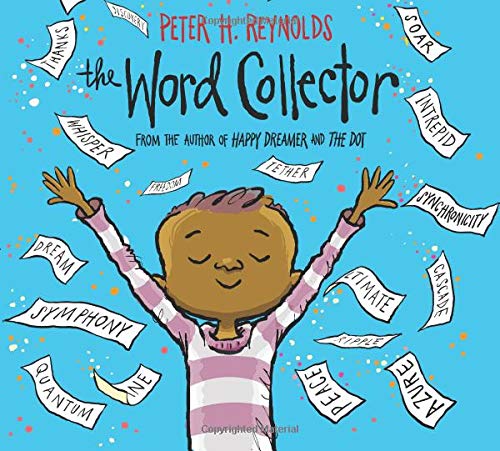
Last week, I read a new book to my daughters that struck me as the perfect illustration of that journey into love with words: The Word Collector by Peter H. Reynolds.

As I read, I was struck by what a perfect picture book this would be to share with my high schoolers. Not only is it chock-full of SAT vocabulary words (which, while that is a concept I loathe, I do admit is a lovely list of cool words), it shows the power and joy of language and all that it offers to both readers and writers.

If you have this book, I urge you to read it with your students. If you don’t, the video linked above does a great job telling the story as well. The possibilities for linguistic play and discovery as you study the text are endless, and endlessly enjoyable–and don’t we all need that kind of joy in our classrooms, as often as possible? Try this text out for one way to bring some sunshine into this dreary Friday.

Shana Karnes lives and works with teachers in Madison, Wisconsin. Her two daughters push her to discover new texts and sneak in the reading of grown-up ones as often as possible. Connect with Shana on Twitter at @litreader.

Getting to Know You: Beginning of Year Conferences by Sarah Esberger

I know, it’s not the start of the school year anymore. We’re in, and there’s no going back. Still, I wanted to share how beginning of the year conferences went for me this year, so your next year can get off to a great start. Just tuck this idea away until then. 

We all know it’s important to build relationships with our new students. We also know that, in a writing classroom, it’s especially important to develop a classroom community. If students are going to share their writing and give and receive useful feedback, they have to feel comfortable. Like me, I’m sure your year often starts with get-to-know-you activities that introduce the students to each other, maybe help them problem-solve a little, and also introduce some low-stakes writing activities. 

This year, however, I knew I would be conferencing with my students on a regular basis about their writing and reading, so this process also needed an introductory activity. 

The Process

During the first full week of school, I asked the students to prepare to meet with me one-on-one. These were the directions I gave them: 

I would like to be intentional about conferencing regularly with all of you, usually about your reading and writing. While you work with your groups today and the next two days, I would like to also meet with each of you individually for about 3-4 minutes. I will not conference with the entire class, so if your group has a question about your project, please come see me. I will also come around and check on you.

Obviously, these will be short conversations. I would like you to come ready to tell me about any of the following:

  • What’s really important to you – in or out of school
  • How you feel about this class so far – concerns or worries/excitements
  • Anything you think I should know about you that might affect your performance in this class
  • Any questions you have for me 

Throughout the next couple of weeks (this took longer than the few days I imagined), any time students were working in groups or working individually, I held conferences with students at my desk. I keep a writer’s notebook throughout the year with my students, so I simply created a section for each class period and added each student’s name, leaving space for notes from future conferences.

When they came to speak to me, I set a timer on my phone for 3 minutes, letting them know that this would be a clue to wrap up our conversation, and then I just simply asked, “What should I know about you?” 

We would talk for a few minutes with me taking notes, and then I would move on to the next student. 

Thoughts

I had asked students to complete a Google form asking much of the same information I asked for these conferences, but students told me so much more when we talked in person. I learned who really loved English class and who had other passions. I was able to talk books with my readers and assure my science-minded students that there was a place for them in the research we do in AP Language and Composition, especially when it comes to choice reading. I learned who worked long hours at night and on weekends and who had little siblings to take care of after school. I could connect with them over favorite musicals, traveling, and video games. 

Perhaps most importantly, students revealed mental and emotional issues that they would not likely share in a survey. I learned how I could help my students with PTSD cope with feelings of distraction during class. I learned who may need to see the counselor for anxiety issues. I learned who was a cancer survivor and who had just started seeing a therapist. 

These were important discoveries that may have taken me the whole year to learn. Perhaps most importantly, I established that I cared about my students, their learning, and their lives in the first few weeks. I have noticed that my students have seemed more invested in my class this year. They are taking the assignments seriously, doing their best work, and communicating regularly about their progress even without my prompting. Perhaps this is all because I showed them that I was invested in them.

Sarah Esberger teaches AP Language and Composition and Sophomore English at Central Magnet School in Murfreesboro, TN where she lives with her second-grader, her husband, three furry friends, and a bearded dragon. She also runs her school’s student-tutored Writing Lab and is always seeking new ways to incorporate James Britton’s concept “reading and writing float on a sea of talk” into her teaching.

Text Talk: Speak by Laurie Halse Anderson

Speak, by Laurie Halse Anderson, has been on my radar for years, but it burst into my classroom last year after Pernille Ripp’s Global Read Aloud inspired me to do a read aloud of Anderson’s text in my class. With some heavy groundwork laid for trigger warnings and difficult subject matter, the text spurred conversation, self reflection, and some seriously intense quick writes.

So, during my latest jaunt to Half Price Books, I was beyond tickled to see the graphic novel version of the text with illustrations by Emily Carroll. Though it’s been out for well over a year, I missed its release, and I’m so sorry I didn’t snag it sooner.

After some perusal, I find it to be an absolutely gorgeous visual text. It’s full of gripping images that convey not only the raw emotion of the pain and uncertainty Anderson’s main character Melinda experiences, but the formatting of the text itself is also a work of art.

Ways I Have Used Speak and Its Graphic Novel Version:

  • Character Analysis: Especially early in the book, the protagonist Melinda is a wealth of character development through thoughts, actions, dialogue, and mysterious backstory. Students (especially my freshmen) can relate to her struggles on the first day of high school and as the book progresses they see the reasons for her struggle as raw and real.
  • Prose as Poetry: The formatting of the graphic novel highlights specific words and phrases, literally drawing the depth of the text into a mentor for rhetorical analysis in a way that helps struggling students see the emphasis and emotions without quite so much inference. For some of my language learners, this is key to both understanding and engagement.
  • Narrative Mentor Text: As students transition from studying narrative to writing their own, this text serves as a mentor with clear and engaging voice, rich story lines, realistic dialogue, and relatable characters.

Have you used Speak as a mentor is your classroom? Have you read and enjoyed it yourself? Feel free to leave a comment below and share your enthusiasm for this awesome text!

Lisa Dennis spends her school days teaching AP Language and English 9, while also leading the fearless English department at Franklin High School, just outside Milwaukee, Wisconsin where she lives with her husband Nick, daughter Ellie, and beagle Scout.  She now tries to live life based on the last pieces of advice her dad gave her – Be kind. Read good books. Feed the birds. Follow Lisa on Twitter @LDennibaum