Category Archives: Writers

You Tell Me You Know What It’s Like To Be A Teacher In A Pandemic

You tell me you know

what it’s like to be

a teacher in a pandemic.

Yes, you’ve had zoom meetings, too!

You worked from home as well, juggling

kids, work, health, social isolation.

You were also scared, but somehow

somewhat relieved because of the freedom

from hectic schedules.

You, too, weathered the pandemic.

But were you forced back

to in-person work while the government

officials declared that you were essential

not for educating children, but to get the economy

back “up and running”?

Were you forced to do your job twice over

in-person and online at the same time?

Were you also given new duties of nurse,

custodian, and therapist for the inevitable trauma?

Were you constantly gaslit, told to “smile,

the kids need to see that everything is okay,”

yet you went home and often cried because

no one was assuring you?

Were you then told that despite

your hard work and grueling year,

“the students are behind” and

you must find a way to “catch them up”?

You tell me you know

what it’s like to be

a teacher in a pandemic,

and you may have lived through

this historical event at the same time

as us, but

you will never truly understand

what it has been like

to be an educator in this time.
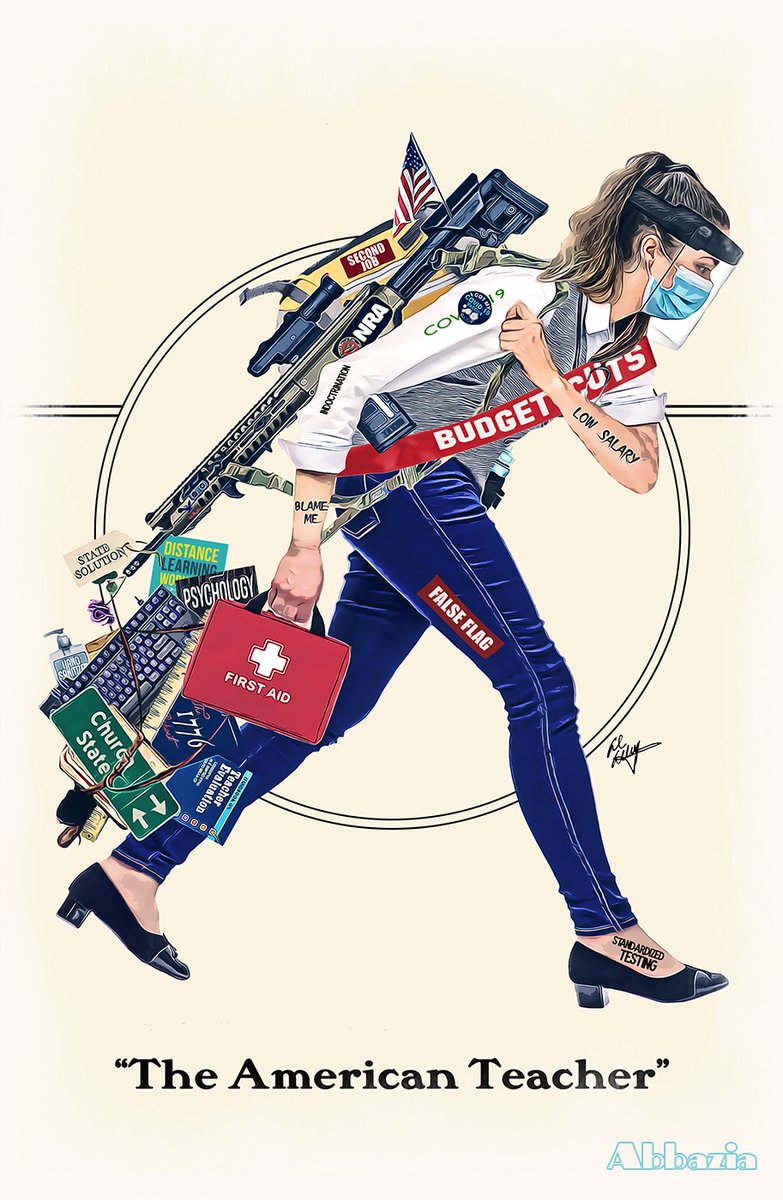
Find the artist on Twitter @alabbazia

One of my favorite Quick Write lessons of all time was when I showed my students this video of Darius Simpson and Scout Bostley performing “Lost Voices,” and then we responded with our own poems, starting with the line “You tell me you know what it’s like to be…” From there, students could choose any identity they had that they felt people often acted like they understood or could relate with, but it was too deeply a personal experience that those outside of that identity could never understand. This idea came from Penny Kittle and Kelly Gallagher’s 180 Days in the Narrative section where they provided all sorts of mentor texts for “swimming in memoirs” to encourage students to address their own story from lots of angles.

When I did this lesson with my students in my second year, they soared. I got quick writes that started with “You tell me you know what it’s like to be autistic,” “You tell me you know what it’s like to be an assault victim,” and “You tell me you know what it’s like to be an immigrant.” Each story, each window into those students’ lives were so powerful. I often did not know what it was like to be what my students were writing about, but their willingness to be vulnerable in their writing helped me see from their eyes and understand just a little more.

As I recover from this year of teaching in a pandemic, my mind wandered back to that activity, and I began writing the beginnings of the poem above. As I mentioned in my previous post, I struggle with finding time/space/ideas/willingness to write. I keep having to learn that it often only takes a strong mentor text and I am off to scribble in a notebook. This remembering will play a huge role in my teaching this coming year. I am also having to constantly re-learn/remind myself how powerful a tool writing is for processing things. It has been an almost impossible year for many teachers, including me. It is only the beginning of summer, but I have had all sorts of reflections and emotions surface. I hope, if you want to get into more writing as well, that you will take time to soak in the words of these poets and write your own “You tell me you know what it’s like to be” poem. Maybe it’ll help you process the emotions and experiences of your year, too.

If you do write using these ideas, please share in the comments or tweet it tagging @3TeachersTalk.

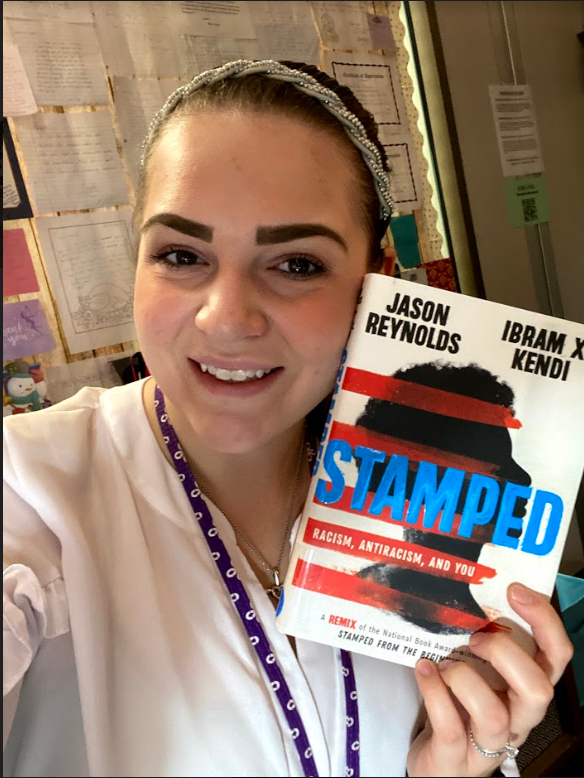
Rebecca Riggs is a writer (or tricking herself into being one the same way she does her students- by just declaring it so). She is currently reading The Girl Who Smiled Beads: A Story of War and What Comes After by Clemantine Wamariya and Elizabeth Weil. Her current obsession is trying out new cookie recipes and working hard to not fill up her entire schedule so she can actually rest this summer. You can connect with her on Twitter @rebeccalriggs or Instagram @riggsreaders.

Friday Night Quickwrite 6/11

Welcome to Friday Night Quickwrite! Each week I will share something that has sparked my writing and hopefully will spark yours as well.

I struggle with finding balance in many areas of my life. It seems I overdo one thing and neglect others, whether that is a balance between work and home, time with family or by myself, or even a balance between time spent reading or writing. Does this sound familiar?

This week I ran across a blog post from Stephanie Affinito, A New Perspective: From Balance to Beats. She explains how there is no such thing as balance, and she shifts the thinking from balance to beats. (Before writing today, I encourage you to take some time to read her post.)

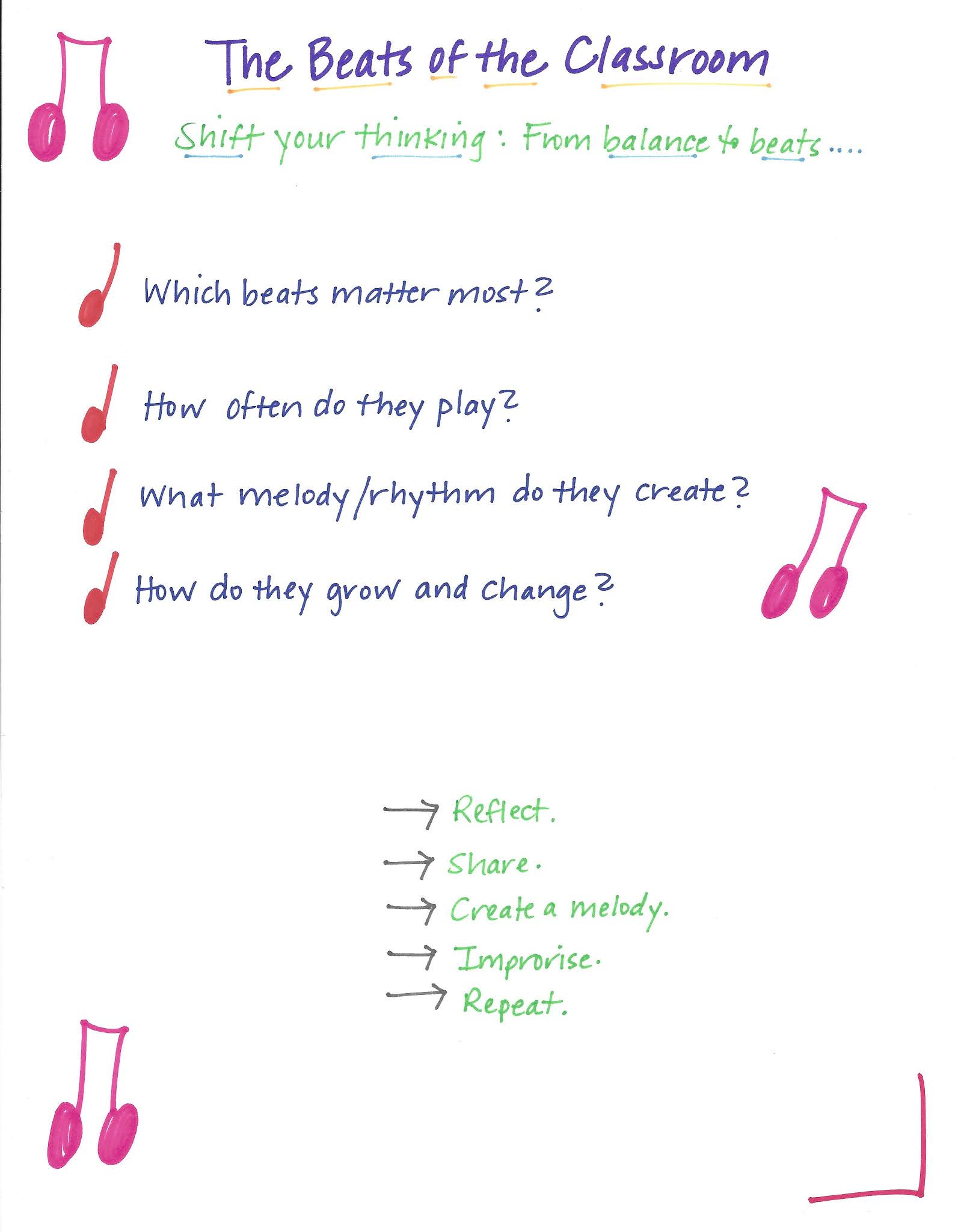
She further explains “If we think of teaching and learning as a melody played in our classroom, then we would naturally expect variation in the beats over the course of the song. The rhythm might shift from fast to slow, gain intensity and then dissipate and even have a repeating chorus. The point is that the variation is what makes the song a song and the varied practices in our teaching are what make a classroom a classroom.

I have also included Stephanie’s sketchnote to get us going. There is so much to think about and unpack from this blog post, quote, and sketchnote.

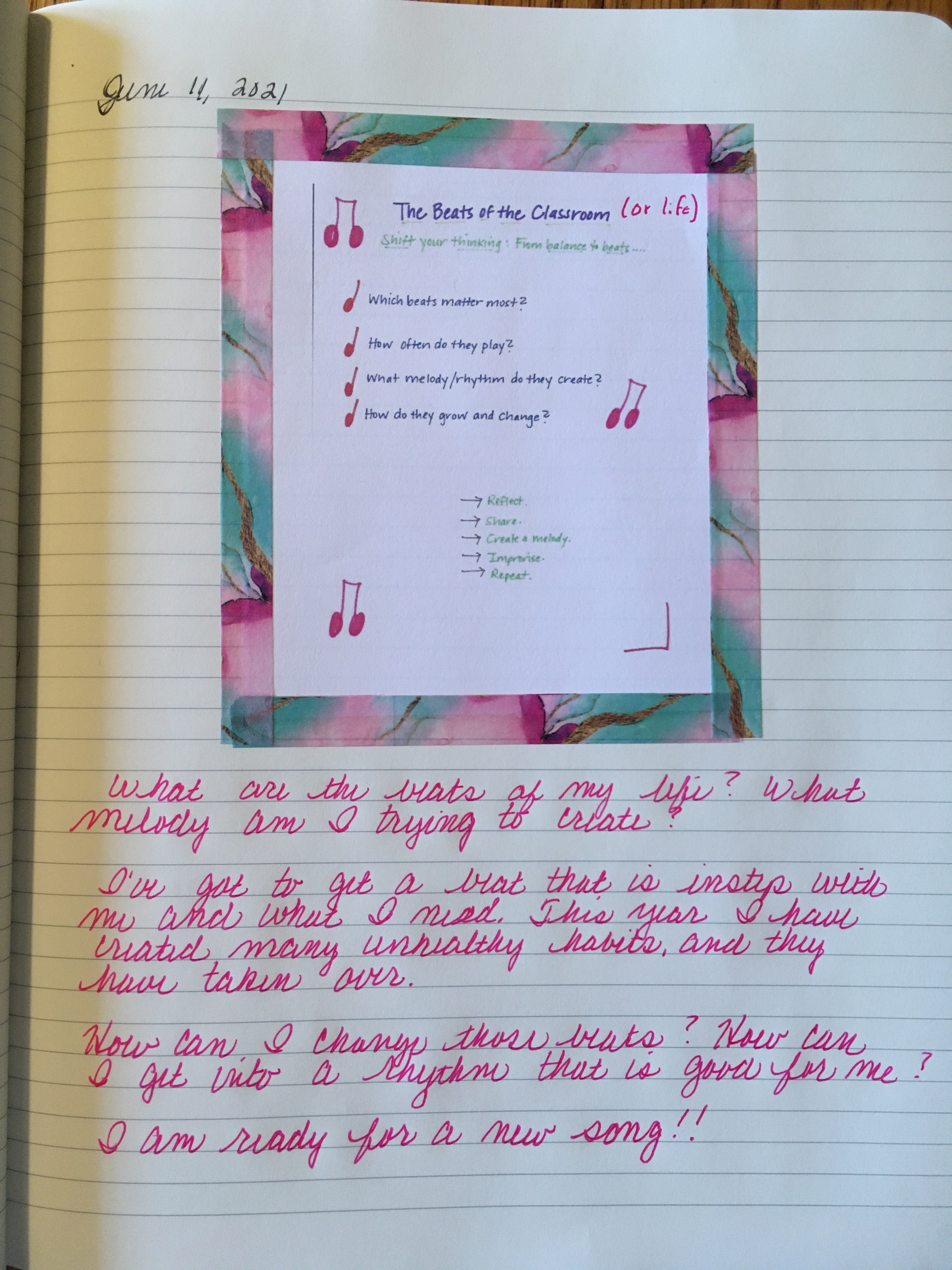
Although this is designed for thinking in the classroom, I took some time to write questions about my life in my notebook. These questions led me to some answers and some goals, which I have chosen not to share.

What melody are you creating in your classroom? In your own life? Please take some time to think about this week’s prompt and share your your thoughts and where your writing took you. If this prompt inspired a blog post, then please share the link in the comments. As always…I look forward to writing with you this week.

Leigh Anne is a 6th grade ELA teacher in southern Indiana and is trying to find a new summer melody by focusing on and taking care of her. Follow Leigh Anne on Twitter @Teachr4 or on her blog, A Day in the Life. She would love to connect with you.

Micro-writing for the Win

Sometimes it takes a lot of patience. That was my first thought when I read Sarah’s post last month The Hits Will Come. She shares how baseball and writing have a lot in common–both require a lot of practice. And sometimes the “hits” come quickly for student writers. Sometimes they don’t. Sometimes we have to help students want to even try to write a hit.

My thoughts turned to a student I taught last year. I’ll call him Dan. The very first day of class as I made the rounds, trying to speak to each students individually for just a moment, Dan said to me, “Miss, I know you just said we were gonna write a lot in this class, but I gotta tell you, I can’t write. I mean, really, not even a decent sentence.”

theofficeofficequotes.com

Of course, I appreciated the honesty, and that Dan thought enough about how I started the class to tell me straight up how he felt, but inside I was thinking, “Dude, you are a senior about to graduate high school in a couple of months, what do you mean you can’t write a sentence?” Of course, I didn’t say that. Instead I asked him why he thought he couldn’t write. His answer still makes me angry.

“My teacher last year told me,” he said. “I failed every essay. I just couldn’t seem to write what she wanted me to write.”

So many thoughts.

Over the course of the first several days of class, I made sure to find the time to talk with Dan. I learned that he had plans to go into the military as soon as he graduated. I learned that the only book he’d read all the way through in his 11 years of school was American Sniper by Chris Kyle.

And during the next few weeks, I learned that Dan could write–when he chose what he wanted to write about, and when his peers and I gave him feedback that made him feel like he was a writer. This took a lot of time and patience.

First, Dan had to want to write. He had to know that I wasn’t going to judge whatever he put on the page. He had to trust that I was sincere in 1) wanting to know what he thought, 2) helping him string sentences together so they said what he wanted them to say.

Reading helped. Since Dan liked Chris Kyle’s book, I helped him find other books written by those who had served in the Armed Forces. Lone Survivor by Marcus Luttrell and No Easy Day by Mark Owen were ones my own soldier son had read. Then, I found the list “Best Modern Military Accounts” on Goodreads.com and the article The 13 Best Books the Military Wants Its Leaders to Read. Dan didn’t read any of these books (not for my lack of trying to get him to choose a book), but during independent reading time, he did read about them–and this was enough to give me talking points to help him understand why growing in his confidence as a writer might be in his best interest– and topics for him to write about that semester.

Relationships helped. Since Dan had been so forthright with me about his experience with writing, I asked if he’d share his thoughts about writing with the peers who shared his table. He was all too eager! I’m pretty sure he thought his peers would share his writing woes. But like a miracle from heaven, Dan happened to have chosen to sit with two confident and capable writers. These students did not know one another before my class, but they grew to trust each other as we followed the daily routines of self-selected independent reading, talking about our reading, writing about our reading (or something else personal or thematically related to the lesson), and sharing our writing with our table groups.

Prior to independent notebook writing time, sometimes I’d say, “Today as you share your writing in your groups, let’s listen for just one phrase or sentence that you think holds a punch. Talk about why you like what they wrote.” This instruction gave students a heads up. Oh, I need to be sure to write at least one pretty good sentence.

One pretty good sentence was a good starting place for Dan. This micro writing gave Dan his first “hits.” And once he started to gain some confidence, he started to write more. Once Dan started to write more, he started asking for help to make his writing better. I think that is what it means to be a writer–wanting to improve your writing.

I think sometimes we get rushed. We expect more than some students are able to give. When I first started teaching, I assigned writing instead of teaching writers. Thank God I learned a better way. I would have missed out on a lot of joy in my teaching career.

I don’t know that Dan will ever have to write in his career in the military. It doesn’t matter. What matters is that he can write, and he knows he can. Even if it’s just a pretty good sentence and another and another.

Amy Rasmussen lives in a small but about to burst small town in North Texas with her husband of 35 years, her poison dart frogs Napoleon and Lafayette, her Shelties Des and Mac, and her extensive and time-consuming rare tropical plant collection. She believes educators should Do Nothing all summer. (Affiliate link, so you buy, 3TT gets a little something.) You can find Amy on Twitter @amyrass, although she rarely tweets anymore, or on IG @amyleigh_arts1, where she posts about grandkids and grand plants.

Tried and (Still) True: An Architectural Approach to Writing

Helen Becker

If you know me, you know that I am a Brene’ Brown fan. No, take that back. I’m a huge Brene’ Brown fan. Brown helps me make my life make sense, both personally and professionally. Brown’s work as an ethnographic researcher influenced my research in educational best practices. As I began my doctoral research in self-efficacy and perceptions of college and career readiness among high school students, I gravitated to Brown’s experiences in grounded theory. Grounded theory, she writes, evolves from people’s lived experiences rather than from experimentation to prove or disprove theories.

Brown adds, “In grounded theory, we don’t start with a problem or a hypothesis or a literature review, we start with a topic. We let the participants define the problem or their main concern about the topic, we develop a theory, and then we see how it fits in the literature.”

Reflecting on these statements, I had an “A ha!” moment: much the same happens in the writing process when a teacher allows students to authentically express their thoughts and ideas. We create opportunities for our students to start with a topic – maybe a person, place, or a moment – and see where the writing takes them. Then we add layers and layers of instruction to shape the first draft into new drafts and eventually, maybe, into various writing products. A poem? Perhaps. An essay? Form follows function.

We teach writers how to bend their writing into new and different forms rather than generating prompt after prompt after prompt for students to write in circles of nothingness.

So how does Brene’ Brown fit into this blog post? Brown’s May 4th Dare to Lead podcast features author and leadership expert, Douglas Conant, and his new book (with Amy Federman) The Blueprint: 6 Practical Steps to Lift Your Leadership to New Heights. Conant’s book, like many featured by Brown, has high priority on my “To Read Next” list. In the podcast, Conant discusses the importance of a strong foundation to guide us through times of uncertainty. Times like now. Our experiences, Conant states, are a blueprint for our future.

Brown and Conant’s discussion intersected my own thinking as I pondered the next installment of “Tried and (Still) True” for Three Teachers Talk. What came to mind? Blueprinting.

Blueprint writing from an equity stance means considering spaces other than the “traditional” blueprint layout.

Tried and (Still) True – June 2021

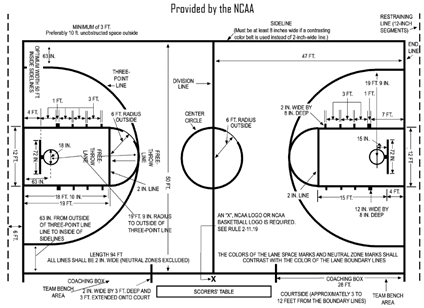
This month, I’m sharing The Blueprint, modified from a lesson learned by many Abydos teachers, with credit for the original lesson going to Dr. Joyce Armstrong Carroll in the first edition of Acts of Teaching and Peter Stillman in Families Writing. While the original lesson described in Acts of Teaching calls for a house-esque foldable, over the years, I modified the lesson to have students think about any dwelling space (a home, a basketball arena, a car) where they could envision a blueprint. Modifying the lesson in this way meets the needs of students who may not have a place to call home but rather a place where they feel at home.

Here’s a rough sketch of The Blueprint lesson cycle:

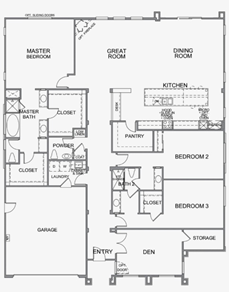
We begin with the concept of a blueprint: what is a blueprint, who uses it, what it communicates, and why it is important? We look at sample blueprints and engage in some inferential thinking based on what the blueprint communicates between and beyond the architect’s blue lines.

Then I invite students to think about a space that is important to them. We might draw on previous pre-writing activities such as “People, Places, Moments” or an A to Z list. I encourage students to think about spaces other than a house: one student drew the dashboard of his beloved vintage (beatup) Camaro while another chose the principal’s office because he spent a lot of time there. Before students land on a place to sketch, I model how I sketched the blueprint of my grandmother’s house in Longview, Texas. I tell them how the details you can’t remember don’t matter. What matters is what you remember. I also remind them this isn’t Art class. I’m not grading the accuracy of the drawing.

Once students get their own blueprint generated, I have them focus on one aspect of the blueprint where they can add more detail: what is on the walls? Is there furniture? Plants or trees? Photos? This line of inquiry generates more details to add to the blueprint.

For example, some student-writers feel more comfortable on the basketball court or soccer field.

Then I invite students to write about the connections they feel to this space or to one aspect of the space they just drew. These connections may turn into a narrative or an informative piece or a poem. Form follows function.

One year, a student blueprinted my classroom. He wrote, “In Mrs. Becker’s classroom, I can be myself. I can walk in the door, sit in my desk, look at the pictures of her family, and I feel like I am part of her family too.”

Carroll says in Acts of Teaching, blueprinting “allows students to recreate places that hold memories worth writing about” (18). It is in these memories that stories come back to life from the perspective of the writer, now a few years older and hopefully wiser. Collecting these stories on paper, what Brene’ Brown calls “storycatching,” becomes a means to understand our past and use our memories, both positive and negative, to guide our writing and shape our future selves.

About the author:

One time I blueprinted my Moscow kitchen and wrote about scorching quinoa and testing the bounds of international relations.

Dr. Helen Becker has used blueprint writing as a pre-writing vehicle in nearly every high school ELA course she has ever taught, accounting for roughly 16 years of her own blueprint stories! She has blueprinted about life in her tiny Moscow apartment (pictured here) with her husband as well as the layout of the #8 hole – her nemesis – at Leland Country Club. In her current role as a Research Data Analyst for Clear Creek ISD in the Houston, Texas, area, she is more likely to blueprint her two-screen Excel spreadsheet dashboard than the dashboard of her car.  Her newest blueprint story though? Designing the guest room of her new home to welcome her first grandson for a visit at the end of June. The library of children’s books continues to grow by the day.

Friday Night Quickwrite 6/4

Welcome June! And welcome to Friday Night Quickwrite where I give a prompt each Friday and invite you to write along with us anytime this week.

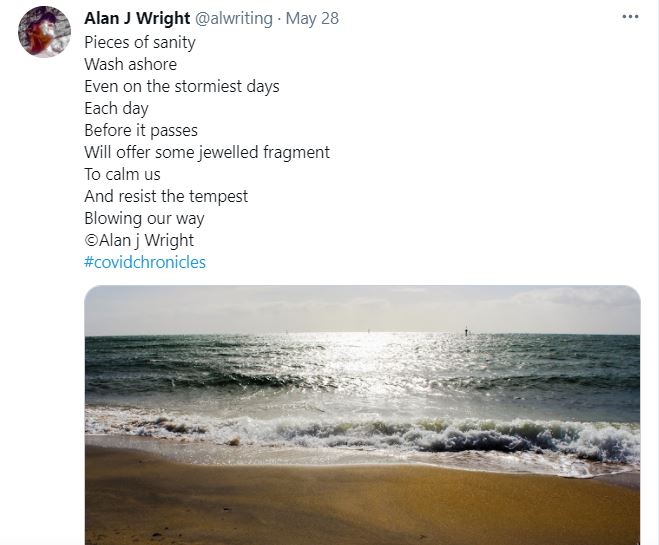
Today’s prompt is a tweet from Alan J. Wright. Alan wrote this poem while in the middle of the pandemic, but I think we can still take his wise advise on any given day and at any time in our lives. Read his words and let them take you to a time, a place, or a moment in your life that was stormy. What jewelled fragment did you find? How did you resist the tempest? Where did you find the strength? You could even take a line or a word and write off of it. The important part is that you free your mind and let your words flow.

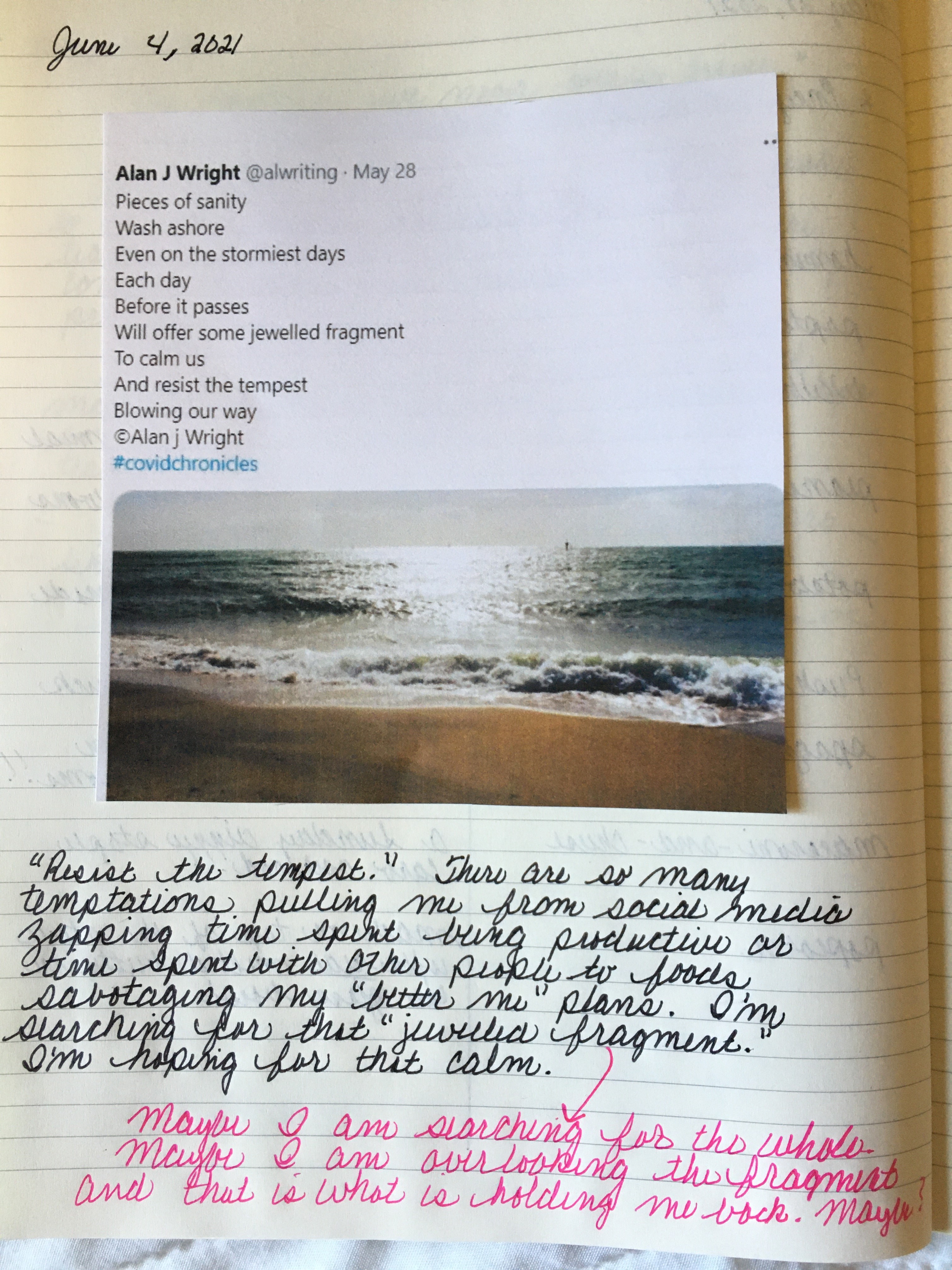
The line “resist the tempest” is what was speaking to me today. I have so many temptations that are keeping from doing things I need to be doing. I am trying to take care of ME this summer, and there are too many temptations. I am searching for that “jewelled fragment” that is being offered. As I wrote in my notebook, I realized that maybe I am searching for the whole jewel and not just a fragment. Maybe I am wanting too much, too soon.

Please share your writing or your process with us in the comments below, and please spread the word with your writing friends. We welcome all writers!

Leigh Anne jumped into summer today, as today was the first pool day of the season. When not teaching 6th grade ELA, she enjoys reading and writing poolside.

Researching conspiracy thinking

I’ve never felt super-confident about teaching research. I often feel like it’s a made-up genre, that research manifests itself in so many different ways that teaching it in isolation is a little bit like eating the ingredients of a cookie without mixing them. But when I read a book like On Immunity by Eula Biss that beautifully blends genres as she researches vaccinations, or when I read Eating Animals and follow along as Jonathan Safran Foer breaks into a chicken farm, I’m enthralled. They don’t seem to care about synthesizing sources or MLA formatting, though they do both things. Their content is king, and their structures are malleable. They seem to live and move in the spaces that overlap between narrative, exposition, argument, and analysis. They write with heart and voice and objectivity that creates clarity even while including subjective experiences that add authenticity. So we set about to try some authentic research during second semester, and though our products may not measure up to Biss or Foer, we made steps in their direction. There is nothing new about the topic or process below. I’m just sharing how the puzzle pieces came together this year (we were fully in class from the beginning) because it might spark an idea for your classroom. 

A framework: truthiness v. factfulness

We started the unit by thinking about what Stephen Colbert called “Truthiness” in 2005 (see the original clip from his show or a good article about it), which was his way of describing the kind of information problem that arose when the internet and cable news usurped traditional media. Those issues have only been exacerbated by the rise of social media since then, so we set out to define the difference between truthiness and factfulness (using some of Hans Osling’s Gapminder resources). This gave us a pretty simple lens to use to evaluate sources (is it truthy?), and it gave us a way to talk about what kind of information we’re consuming. 

We used the following essential questions to guide our work:

  • In what ways does “truthiness” interfere with our culture?
  • In what spaces would “factfulness” improve our culture?
  • Are we living in a “post-truth” culture? Do facts matter?

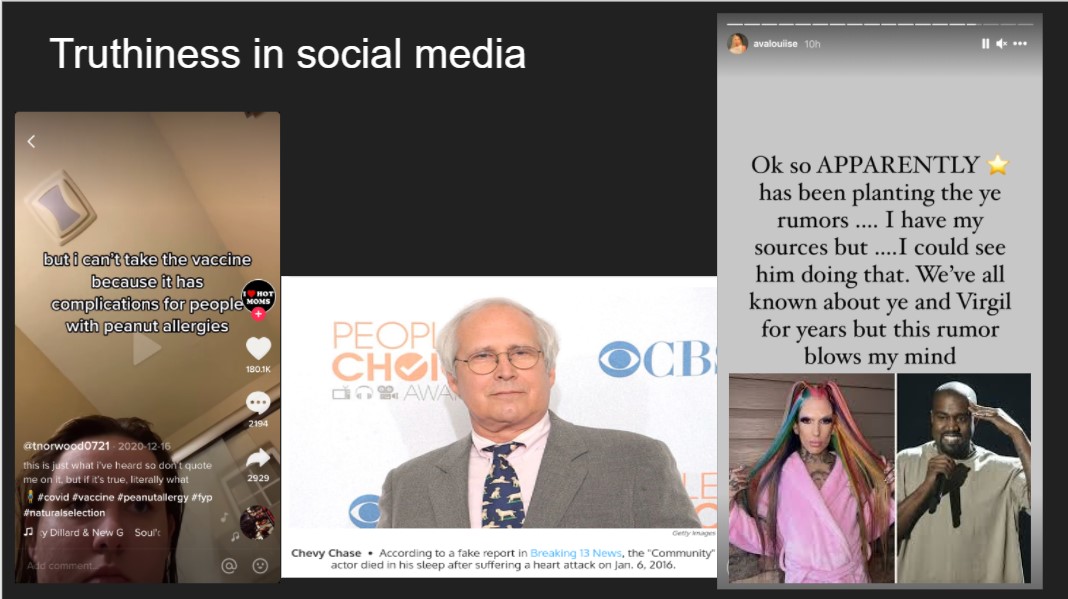
Students did a small team task where they found examples of truthiness in their social media feeds and we discussed the relationship of misinformation, disinformation, and propaganda. It felt like a pretty organic way to begin thinking about research, and it gave me some language to use as they began doing some writing.

Some examples that a group from 4th bell used to illustrate the prevalence of truthiness in their feeds.

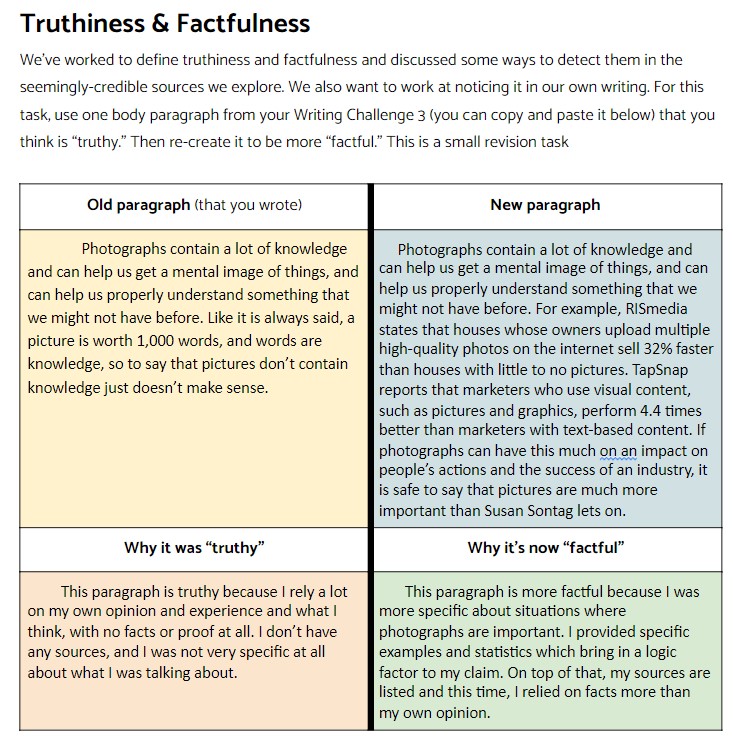
I also had them take an argument essay they had written during first semester, choose one body paragraph, and make it more factful. It was fun to see them recognize the truthiness in their own writing, which set up some expectations for our writing later. You can see an example of a student from my 4th bell below:

An angle: conspiracy theories

One of the other challenges about research writing is the topic generation process. I see value in letting students choose a topic. I’ve also seen the frustration of a kid who genuinely doesn’t know what to do and has options paralysis. So I chose conspiracy theories for the class because it’s a place where truthiness and factfulness intersect. I envisioned students reading what conspiracists think and say, and then reading the evaluations and rebuttals of those conspiracies. It’s a natural way to explore several perspectives.

An individual task: choosing a research path

We did a series of Deep Dives to start the research, one that focused on conspiracy theories broadly (why people buy in, what some common and obscure ones are–some sources we used), then students chose one conspiracy to dig deeper into. We never really called it research, which I think made us all feel better. We were just learning about chemtrails and the Denver International Airport. Students built a 2-3 page paper that used the sources to help us understand the conspiracy. We used a section from Eula Biss as a mentor text, then I gave them some structure options, basically a really loose outline, hoping to help us think more like Biss and Foer, more like writers making choices. Some took risks, some played it safe. But our goal was to let what we had found in the deep dives dictate the structure. Topics ranged from celebrity deaths (Michael Jackson, Princess Diana) to QAnon, from assassinations (MLK and JFK) to animals (birds aren’t real).

A team task: defend a conspiracy theory

The final piece was to share out because the topics were so interesting. Each student shared an overview of their research with their table teams, then the teams each picked one and were tasked with convincing the rest of the class that the conspiracy was true. This forced them to think a little bit differently, to do some additional research, and to help us have a little bit of fun before the deluge of spring standardized testing hit us. 

Takeaways

  1. De-emphasizing the research aspects and emphasizing the content questions enabled us to actually do better work on the research aspects. By not frontloading information about MLA format, embedding quotes and citations, or other general research expectations, we were able to better discuss those elements as they more naturally arose and students felt a need for them.
  2. Me choosing a topic is okay if there are still opportunities to personalize the pathways. Student ownership over the subtopic and paper structure seemed enough to keep interest and ownership high. 
  3. Conspiracy theories are a rich opportunity to think about the misinformation epidemic. While some are political, my students veered away from those. With that little bit of distance we could talk about the challenges of navigating our feeds, of considering sources and modes, of being more conscious citizens. They found it to be a topic worthy of researching.

Check out some good posts from TTT on research to kickstart some more ideas:

Nathan Coates teaches junior English at Mason High School, a large suburban district near Cincinnati, Ohio. His favorite conspiracies are sports ones, like the NBA suspending Michael Jordan for gambling or fixing the draft for the Knicks to get Ewing.

Friday Night Quickwrite 5/28

Many of us are enjoying the beginning of summer, while others still have a few weeks of school left. No matter where you are in the end-of-the-school-year process, I hope you take some time to write. Writing and journaling have so many health benefits, which is why I extend this writing invitation to you each week.

Although it is titled Friday Night Quickwrite, you can join us and share anytime during the week. I will provide a spark or prompt with some kind of inspiration to get your mind going, and when you are ready, just write and share.

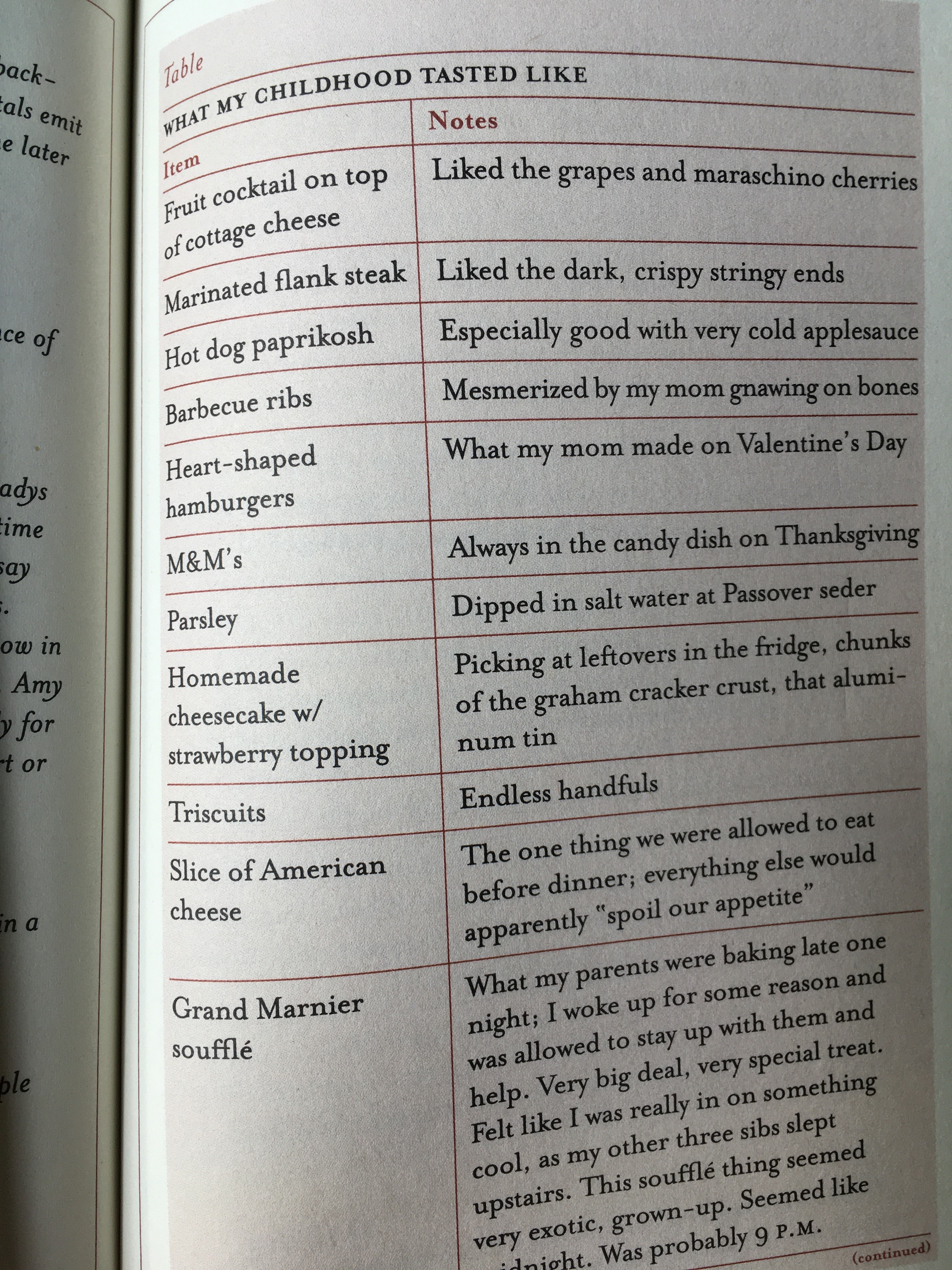
This week I am sharing a text from Encyclopedia of an Ordinary Life by Amy Krouse Rosenthal. This book is full of short entries organized from A to Z that captures moments, observations, and emotions from her life. This book is full of writing ideas and inspiration. The one I used tonight is filed under “Childhood Memories” and includes a table with the heading of “What My Childhood Tasted Like.”

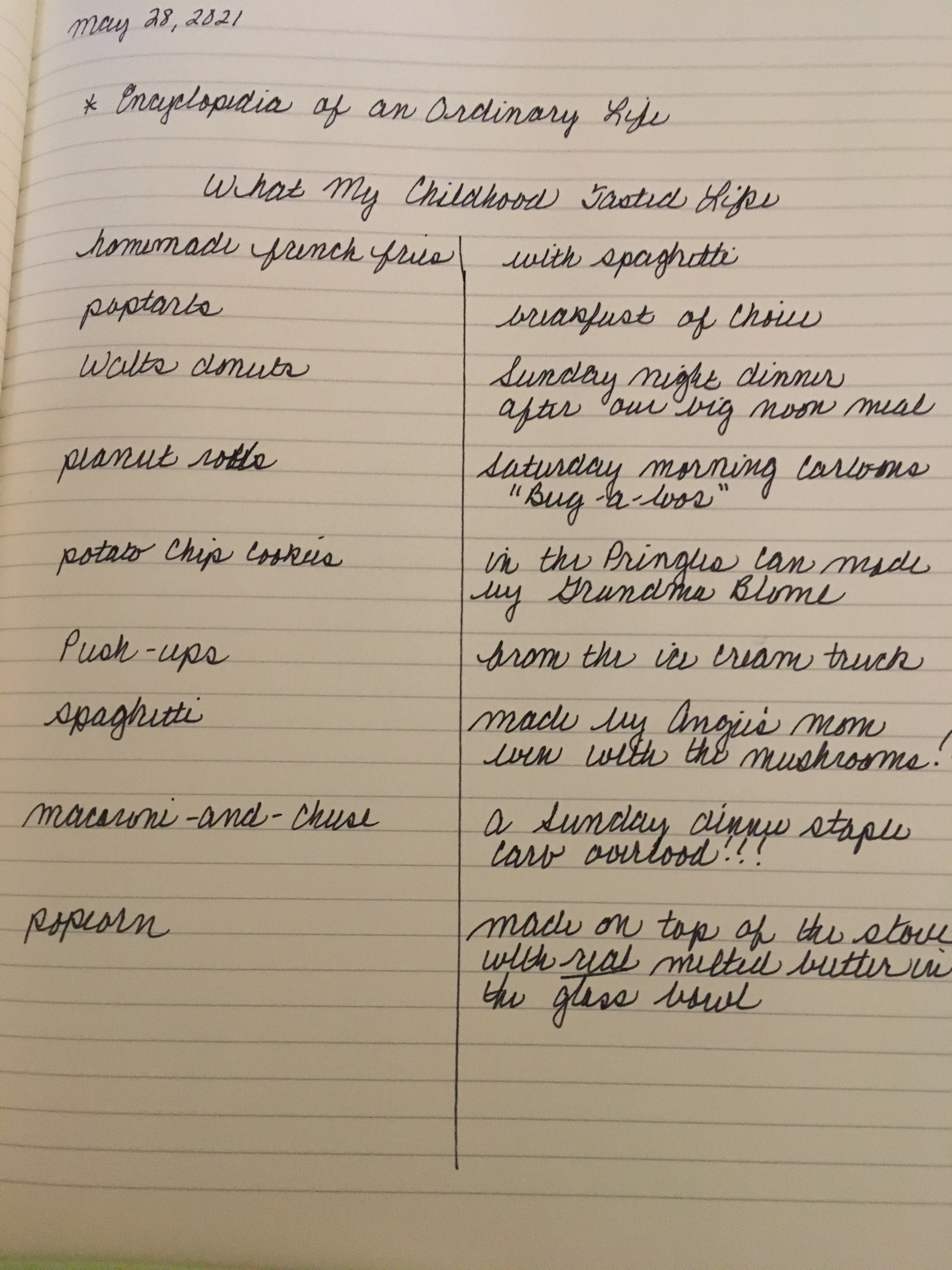
In my notebook I made a table similar to AKR’s with food items and a little snippet of what they remind me about my childhood. It was fun to recall these special memories. I even texted my siblings and asked them about foods, and we share many of the same memories.

I am always intrigued how foods, smells, and songs attach themsleves to memories. Many of these food items on my list could be written as a memoir, a poem, or even a short story. Full of writing possibilities!

Please join me and writing about your childhood tastes and share it with us below. Happy writing and enjoy your long weekend!

Leigh Anne is currently on summer break and is waiting for the water temperature to warm up so she can read while relaxing with her sister and daughter (both teachers!) in the pool. When not on summer break, she teaches 6th grade ELA in southern Indiana.

Friday Quickwrite 5/21

Welcome to the weekend and another Friday Quickwrite. Remember you can come back and write any time with us. It doesn’t have to be Friday night (it just rhymes with quickwrite!)

I saw this post by Tera Jean Elness on Instagram last week and it got me thinking, and of course, it got me writing, too.

To honor is to revere and to revere is to regard with respect tinged with awe.
(and big thanks to dictionary dot com cuz I really LOVE that definition)
Yes.
Tinged with awe.
Pretty awesome, amen?
Honor your brave Beloved.
Hold it in high regard and give it the weight it deserves.
Honor your brave.
Your brave in staying.
Your brave in going.
Your brave in trying despite the risk.
Your brave in holding on.
Your brave in letting go.
Your brave in finally – FINALLY – living fully and freely as YOU.
Yes.
Honor your brave Beloved.
Your brave in the heartache.
Your brave in the tears.
Your brave you’ve been hiding all of these years because you believed that your voice was simply one of many and not one that needs to be heard.
What a lie amen.
Honor your brave Beloved.
Honor it.
It deserves it.

The words “honor your brave” really spoke to me, and I began to think about the times when I didn’t think of myself as brave. The brave in holding on and letting go and living fully.

I made a list in my notebook and was led by an item on that list. An item that is too private to share but one that needed to be written. I hope you find some inspiration in Tera’s words this weekend, and I would love to hear what path these words led you.

Happy Writing!

Leigh Anne finished up her 14th year of teaching today. It was a wild and wacky one but amazing nevertheless. She is looking forward to some summer reading and writing time by the pool.

Friday Night Quickwrite 5/14

Welcome to Friday Night Quickwrite, a time to sit back, relax, and get a few words on the page. My orignal intention was to post this once a month. However, I received positve feedback from teacher-writers, and they enjoyed writing last weekend. They found that it was a good way to wind down from the week and take some time just for them.

So, here we go for week two.

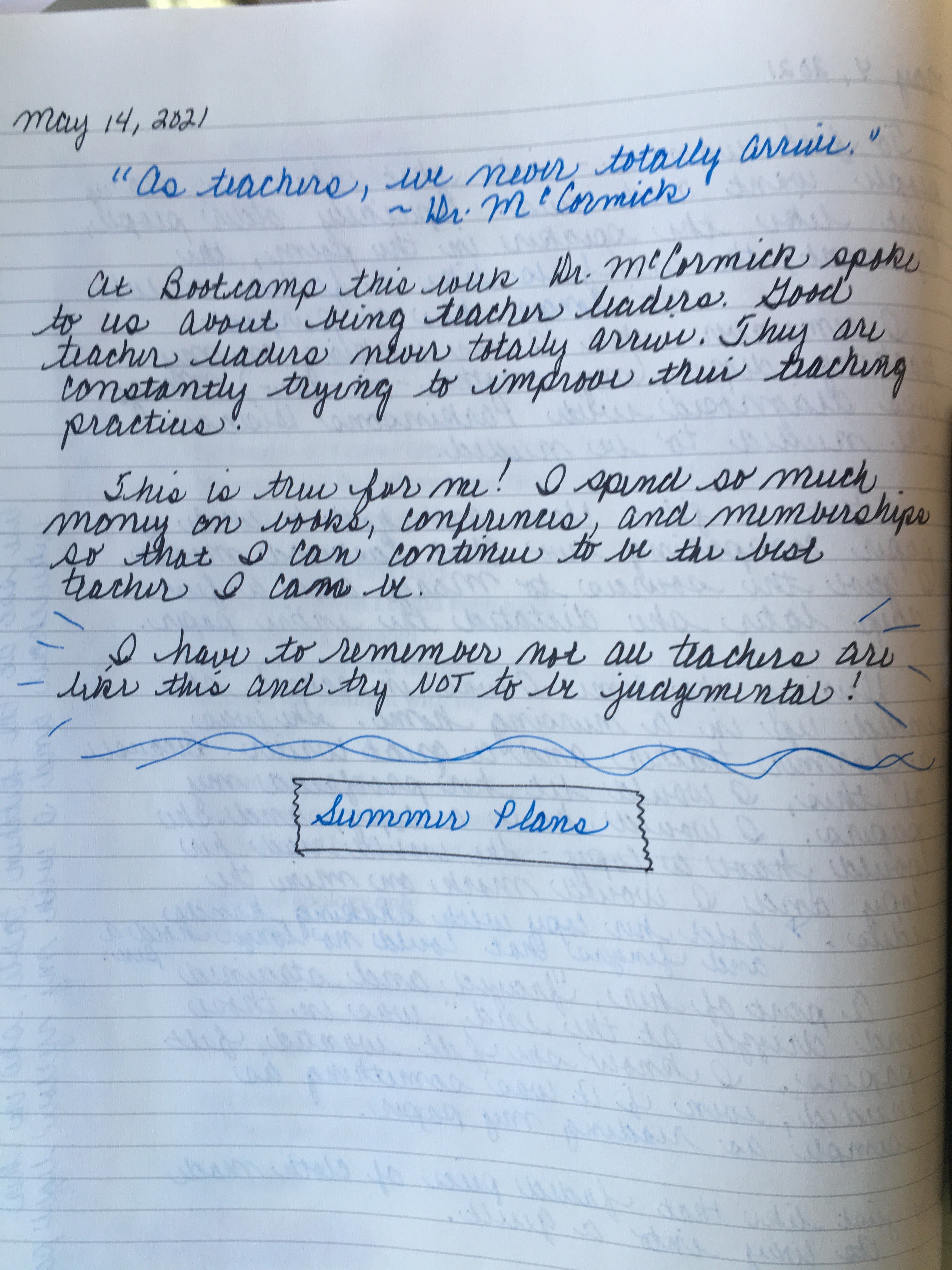
This year I have been particpating in a Teacher Leader Bootcamp for Indiana teachers. Thursday was our wrap-up, and our former State Superintendent made a surprise visit. She talk about how important teacher leaders were right now and how as teacher leaders, “we never totally arrive.”

I took to my notebook to write about this quote. It lead me to begin thinking about my summer plans to grow as a teacher – I know I have not totally arrived!

What does this quote make you think about? Have you totally arrived as a teacher? As a parent? As a partner? Take a few minutes this weekend and jot in your notebook. Come back and let me know where this quote took you? I would love to have a conversation.

Leigh Anne is a mom to Megan, who is a third grade teacher and Ethan, who is a behavior coach for elementary children. She enjoys being a parent to “adult children” but knows she has not “totally arrived” in this area either.

Getting Uncomfortable and ‘Writing Beside Them’

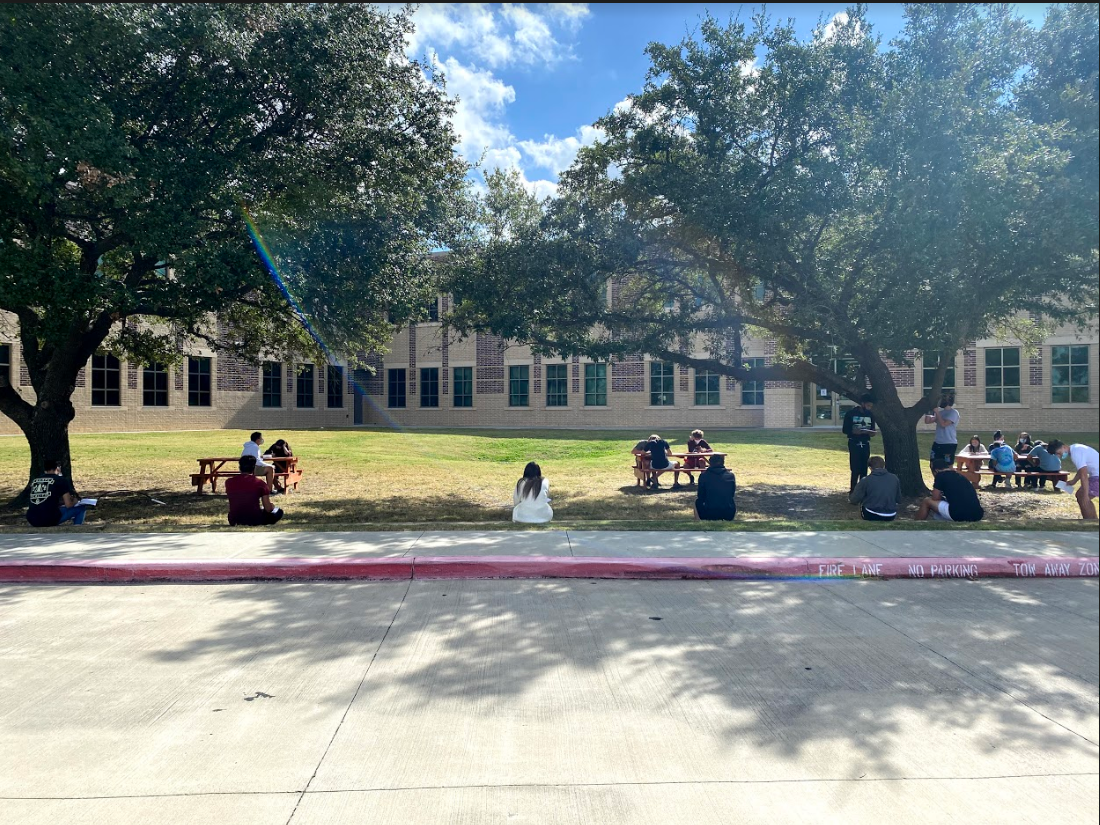
When we were starting our Transcendentalist unit this year, we did a “nature walk” to try to get our students to experience some of the tenets of the concept. We were inspired by this teacher’s blog. My whole team took our students outside (and told online students to set a timer for about 15 minutes and sit outside as well). We left all electronics in the classroom and simply took in the nature outside of our school with all five of our senses. It wasn’t perfect since we were right by a traffic-filled main road and the students really wanted to talk instead of being quiet, but a lot of students got the hang of it by the end. One student reflected that they had not spent any quiet time outside to just take it in in years, if ever. Many were inspired to write like I am at the beach- more on that later.

The 2020-2021 school year has been one of tremendous growth for us all, whether we wanted to grow or not. I spent my year learning how to be even more flexible than ever before, becoming more clear on what is a priority and what can be left for later, and finding myself in a team leadership position when I was the only certified teacher present on my team for over two weeks. However, I do not feel I have grown in my teaching practice as much as I have in my character growth. For that reason, I am seeking situations to put myself in where I am uncomfortable to grow in that area; becoming a contributing writer on this blog is one of them. I am terrified!

Through my four years of teaching, I have mostly mastered the art of independent reading in class and using that to help students master/demonstrate mastery on most essential standards. I have become a pro at book talks and first chapter Fridays and reading conferences and recommending books. Now that I feel like I have my feet firmly planted underneath me with reading, it is time to become a better writing teacher. Writing is not usually a practice I partake in myself outside of school as I do reading. To be honest, it scares me! Will I have interesting things to say? Am I using a diverse enough vocabulary? Am I creative enough? I prefer my comfortable, familiar cocoon of reading, but I am forcing myself to Write Beside Them like Penny Kittle encourages. I will be re-reading that book over the summer as I make that the focus of my growth for the year.

Two people on the beach watching stars above the sea | Flickr

When thinking about improving the writing part of my teaching practice, I reflected on where I felt most inspired to write. Without a doubt, it is when I am in nature like my students above. My friends will tell you that I wax poetic and create all sorts of metaphors when we are at the beach. For example, there is nothing like staring up at a starry sky while laying in the cooling sand of the beach and hearing the salty water lapping up. The more you look up at the sky, the longer you take it all in, the more stars appear. It gets more beautiful, more bright the longer you take the time to look at it. That always stands as a metaphor for many things in life for me. When we slow down and just stay present, the more beauty we see. 

Taking both my experiences in nature and my students’ experiences, I have made a commitment to spend my summer outdoors with my notebook and pen in hand as much as possible to just be present and write as I feel led. How will you get uncomfortable this summer/next school year to grow?

Rebecca Riggs is a reluctant writer like many of her students, but she is working on it. She is in her 4th year of teaching at Klein Cain High School. She is looking forward to a summer of snoballs and walks at her favorite park. She is currently reading Salt to the Sea by Ruta Sepetys and highly recommends it! You can find her on Twitter @rebeccalriggs or on Instagram @riggsreaders