Category Archives: Writers

Nothing New Under the Sun?

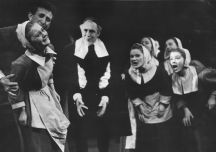
So many thoughts came up as I read Maggie’s post last week, the same day the American people, indeed the whole world, had a chance to witness our judicial process unfold in TheCrucible_940x470-678x381real time. My very first thought was, “I’m going to read The Crucible aloud with my AP students, too.” Miller’s play is one of the core texts of the junior English curriculum. Having promised myself that this year, I intended to provide my AP students with as much of the RWW as I could while still “covering” everything, this idea was perfect.

the-crucible-3360718-59ac57cf0d327a0011aa0fe9My next thought … politics. In the play, Reverend Hale is one of the few characters who exhibits any change in thinking. He observes. He listens. He struggles to negotiate his worldview when what he sees and hears doesn’t fit. Reverend Hale — indeed the whole village — experiences the crucible of accusation, doubt, and disintegration.

By definition, a crucible is “a situation of severe trial, or in which different elements interact, leading to the creation of something new.” The “something new” in Salem? Miller concludes, “To all intents and purposes, the power of theocracy in Massachusetts was broken.”

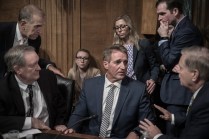
My hope is that our study of this play will evoke conversation about our current democracy, about whose voices are heard, about whose voices are (at the risk of further mixing david-butow-brett-kavanaugh-senate-vote-friday-1literary allusions) a little more “equal” than others. And how can this “interaction of elements,” lead to the creation of something new, perhaps some power structures that need to be broken? 

So, what to do with this as teachers of writing, and to glean something practical from our own real-time crucible? My students will write an “Open Letter” essay as we study The Crucible to explore concepts of voice and audience. (McSweeney’s is a great source for open letter examples of all kinds. I want to provide an opportunity for them to give voice — their own — to what matters to them, directed to the audience that most needs to listen.

Writing Conferences: Stories, Schemes, and Strategies

Conferring is hard brain work. When do I listen? How do I listen? When do I talk? How much? How do I anticipate what a student needs? When do I step back and let them problem solve? Am I even conferring right? (Maybe not. So put your Judge-y McJudgers pants away while you read this.). As Shana explained in this post back in January, there’s so much value in talk, in engaging our students in conversation, in encouraging them–as Amy framed here— to tell the story of how their writing is going.

Because (as Tom Newkirk suggests) we have minds made for stories, over the years I’ve begun to recognize some common schemes while conferring. Recognizing these patterns frees me to listen and to respond. Perhaps you’ll recognize the stories of your own students in the stories I share. Perhaps you’ll pick up a strategy or two. 

The What-Did-I-Do-to-Myself Conference

This conference may typically begin from a position of fear–mine because my student’s eyes have suddenly become two daggers, piercing my helpful, loving heart. This occurred in a recent conference, where my student who chose ice cream as her multi genre research project topic hurled at me these words: “I don’t know how I’m supposed to write an argument about ice cream.” Was she complaining about lack of direction? Instruction? I took a deep breath to let go of any defensiveness I felt. Then I reflected on her question. Oh. Oh! The fear was not mine to have.

My student needed:

  1. to hear that to write about this is, indeed, possible.
  2. to understand the possibilities for executing the writing.

Conference next steps:

  1. I confirmed the correctness of my reflection by paraphrasing (So, what I think you’re saying is that you’re feeling pretty uncertain if you can, and if you can, what it looks like?).
  2. Once confirmed, I chose another seemingly tiny and narrow topic like tacos and verbally processed some options for how I could craft an argument for an audience on tacos. I did not do any written modeling or reach for any mentors at this point. My role in this early phase conference was to dispel fear, to affirm possibility, and to confirm faith in my student’s ability.

Student next steps:

Following this verbal modeling, my student disarmed with affirmation and a smile, she continued working in her notebook, mapping her argument and the rest of the multi genre.

The I-Need-to-Change-My-Topic Conference

This conference may typically begin from a declarative statement: “Just so you know, I’m changing my topic.” I’m being put on notice here.  But I delight in these William Carlos Williams “this is just to say” moments almost as much as ripe-n-ready plums. So, curious now, I say, “Tell me about why you abandoned the old topic” (I’m always thinking we can learn something from discarding topics) and “Tell me about the new topic.” That’s when my student in this case explains that the topic is music but that’s all he has. Hmm.

My student needed:

  1. To narrow his topic by sinking his teeth into the best tidbits of it.
  2. To get moving. And fast. IMG_2711.JPG

Conference next steps:

  1. With the topic so broad, I asked the student to tell me a story that shows his relationship with music.
  2. Once the student shared his story–one that involved him writing his own music and performing several songs at a local concert venue (Our students do amazing things!)–we mapped out a plan for the different parts of his multi genre text.

Student next steps:

With a story in his head (and probably a song) and a general plan mapped out, this student left for the day, ready to focus on more specific planning.

The So-Can-I? Conference

This conference may typically begin and end within a very short burst of time; a meteor shower during the Perseids, this conference starts with a short burst of light from the student, a recognition of how to apply a resource. In a recent case, the student examined a resource on possible argument structures I shared with the class, and ingenuity bursting forth, queried, “So, I can use the pro/con structure? And, can I make this modification to it?”

My student needed:

  1. To know that he has more freedom than he’s using.
  2. To have the affirmation necessary to keep burning bright.

Conference next steps:

  1. I replied,” Tell me a little more about that” and followed that with paraphrasing, “So, what you want to do is . . .?”
  2. Then I simply said, “Yes.” 

Student next steps:

Following this all-of-sixty-seconds-conference, the student returned to mapping out writing, synthesizing his own ideas with the resource. And, I spent five minutes with the next person instead of three.

The I-Know-I-Need-to ______ , But . . . Conference

This conference may typically begin with candor from the student. Like the first sip of lemonade on a hot summer’s day, it’s so refreshing to hear in response to my opening questions (How’s the writing going? What roadblocks are you running into?), “I know I need to _______, but I’m having a little trouble.” Ah. This can become an opportunity to model for the student or offer a micro-lesson; sometimes–like in a recent conference where my student wanted to build a more humorous tone–I help the student find or use mentors. **Note to self–I should probably start asking my students to tell me about mentor texts they’ve turned to when they’re tackling challenges. 

My student needed:

  1. To resolve gaps in skill level (impressively, one’s the student recognized).
  2. To access additional resources  for strategies.

Conference next steps:

  1. For this student working on narrative writing, I pulled David Sedaris’ “Let It Snow” and a couple of others.
  2. Then we talked through typical strategies a writer uses to develop humor.

Student next steps:  

Time well-spent, smiling now, my student worked on reading and studying the mentors.

 
The I’m-Avoiding-Letting-You-Read-My-Writing Conference. May also sometimes appear as the I-Don’t Have-Any-Writing-to-Show-You-Yet Conference

This conference may typically begin, well, haltingly–like a first time driver slowly circling around the empty high school parking lot. I’ll ask, “How is the writing going? What roadblocks are you hitting?” “Doin’ fine. No roadblocks.” Okay. Next approach. “Why don’t we look at a section together? Show me a section you feel really good about. Let’s celebrate what’s working!” Sometimes that gets us turned in the right direction (a smile and an oh, sure and we’re underway); sometimes we skid (uh, so, um, I don’t really have much yet. Uh-oh.). When I most recently tried this approach, my student offered, “Well, I really like this paragraph; but I’m not sure about how to develop it more.” 

My student needed:

  1. to feel safe enough–safe enough to embrace the opportunity or safe enough to admit to lack of progress.
  2. to have re-direction for what conferring might look and sound like. Sometimes they just don’t have the mechanisms down.

Conference next steps:

  1. In the first situation, I generally point out the parts that are really working in the section the student chose to share. I thank them. Then I ask if there’s anything else they want to share or questions they have. And, sometimes I get to look at more writing. I did in this particular case. And, had I not pressed gently, I don’t think I would have (I was kind of impressed that it actually worked!).
  2. In the second situation, I paraphrase what they might be feeling. I might say, “I imagine you might be feeling ___________ (stressed for not having more done; frustrated by how to begin; confused about the direction of your writing; etc.). They typically correct me if I’m wrong and we work together to plan next steps, even if it’s breaking down the process further.

Student next steps:

In the first situation, the student began applying feedback; in situation two, the student typically articulates what’s getting in the way and what resources are needed and then begins tackling a small goal (drafting a paragraph versus drafting the whole thing).

When I’m conferring, I’m listening, paraphrasing, questioning, re-teaching, modeling, affirming, finding resources, building possibility, and showing my students that what they write matters. No wonder my brain hurts.

Kristin Jeschke remembers with fondness the many teachers that encouraged her writing but especially Greg Leitner who always listened more than talked. And who always inspired her to keep writing. Now as an AP Language and Composition teacher and senior English teacher, Kristin appreciates the gift of moments spent conferring. Follow Kristin on Twitter @kajeschke.  


Taking a chance on reading aloud

One of the most prevalent memories I have from my childhood is being read to.  Every week, my mom would load my sister and I in the van and head downtown to the library where we would practice returning, renewing, and selecting new books.  I can still see the orange carpet in the children’s library, the shelves that stood only as tall as a seven year old, and hear the crinkle of the plastic covers that protected each precious story like shrink wrap.  During the week, my sister and I vied for places on her lap as she read aloud each book. I wouldn’t say she was a theatrical reader, I don’t recall her trying on different voices or even pausing to ask us what we thought, but it was her voice telling a story.  Isn’t that the magic of being read to?

Read alouds in K-12 classrooms have immense benefits, although their usage and popularity have ebbed and flowed overtime, as discussed by Steven L. Layne’s book In Defense of Read-Aloud which Amy writes about along with practical strategies for implementation.  This summer, I began to notice much discussion around reading aloud in the adolescent classroom and my interest was piqued.  My challenge to myself this summer was to try implementing read alouds, not just think alouds, in my classroom.

Admittedly, I got a little scared.  Then I chickened out. 

Having just hours to submit a book list to the department chair and having never visited the school I was about to teach at, I was unsure how a read aloud would be perceived by my new students and new colleagues.  So, I played it safe and opted to start the year with a full class read aloud using one of the required texts, The Crucible (I work with a curriculum that includes highly suggested texts for English 3, American Literature in the state of Utah, which has led me to a balance the requirements while choice).  I put students at the center of the read aloud, hoping they would embrace and take ownership of hearing a story versus reading it.

Did I fear a lack of student buy in?  Yep. Did I wonder if my pedagogical reasoning would be questioned?  At some points. Am I planning for a class-selected read aloud in the coming weeks?  Sure am!

Students loved it.  

I loved it.

We laughed, we questioned, we build community, and we worked on critical reading skills. We also enjoyed the story–there is power in students hearing a story, even when they’re 16 or 17 years old.

IMG_0312.JPG

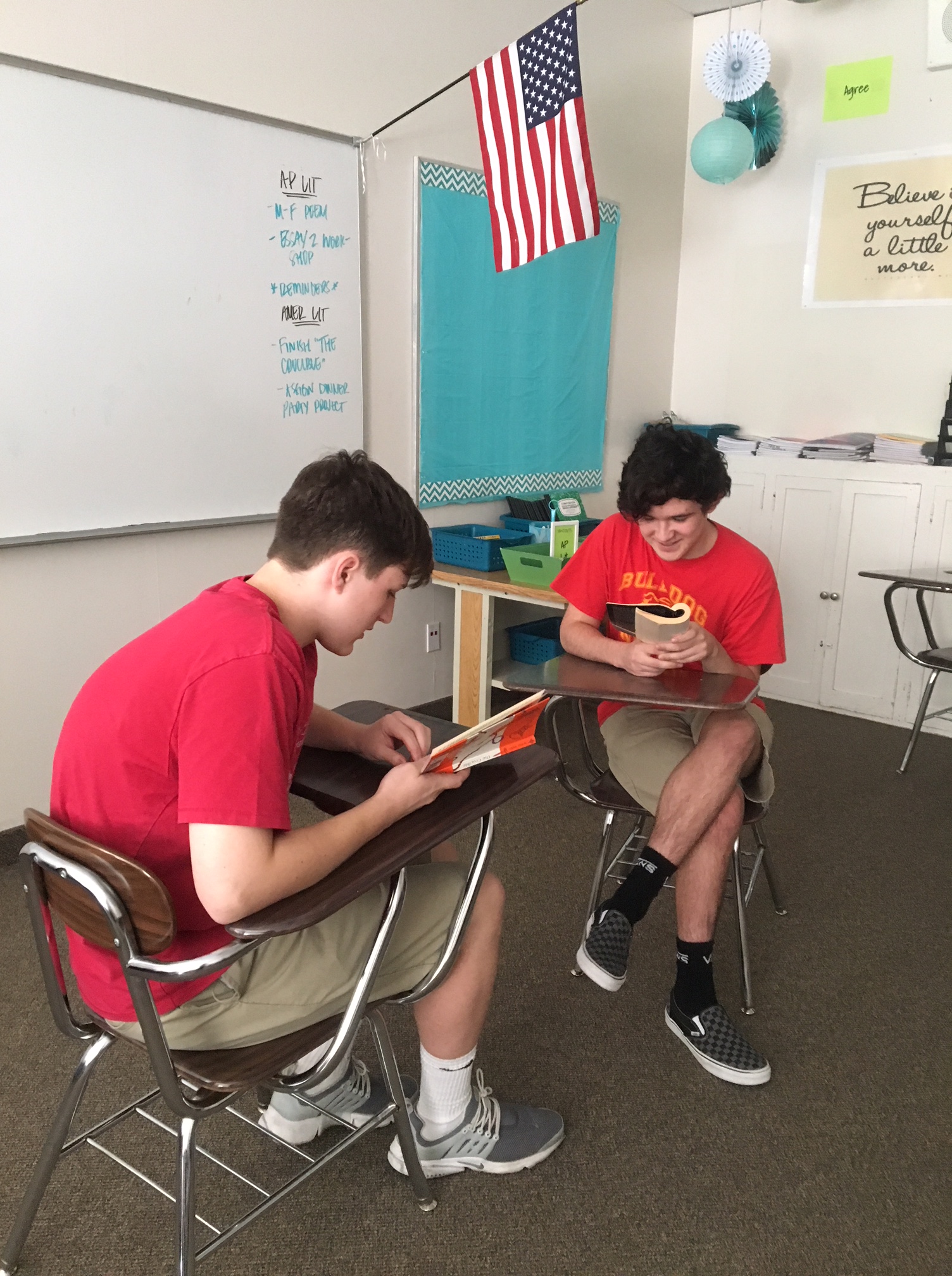
6th period was so into reading, they literally begged me to read the deleted scene between John Proctor and Abigail Williams once they discovered it at the end of the play–how could I say no?  While we were all entertained with Sam and Noa’s reading, we were able to discuss how the scene adds to and takes away from the text as a whole, in addition to making inferences about Miller’s choices.

Building upon Layne’s research, here are the benefits I noticed in my classroom:

  • Students received a foundation of reading strategies to start the school year.  As a play is essentially a “think aloud,” with the narrator teaching students to make inferences about characters, conflict, and the social setting. Prior to starting, we discussed our reading voices, what Chris Tovani has labeled as “Interacting” and “Distracting” voices in Do I Really Have to Teach Reading?.  The interacting voice is what makes connections and predictions, asks questions, develops an opinion, and identifies confusion as we are decoding words.  The distracting voice is what pulls a reader’s attention away from the text (Tovani 63). For struggling readers, the narrated parts and asides modeled this “interacting voice” and we implemented “Fix Up Strategies,” as defined by Tovani, when our distracting voice overpowered our interacting voice, leading to muddled comprehension. We paused to recap the plot, ask questions, and make predictions during our full class reading.  Students had permission to pause the read aloud and we implemented these strategies together and practice themselves.
  • Students made connections between the false accusations and lies of Salem and our current world.  I never had to answer the age-old English question of “Why are we reading this?”  Big win when students understand the relevance of a common text to their world.
  • Students became comfortable reading and sharing–many began taking on the person of the accused, answering using “I,” demonstrating they were engaged in the text and thinking like the characters. This has created an environment where their voice and opinions matter.
  • Students dug into their choice reads in their own time because much our class time, aside from writers notebook time, was dominated by The Crucible.  Without realizing, students began to develop the habit of reading daily on their own time. Sa-weet!
  • I gained incredible insight into my students’ preferences, personalities, and habits.  I immediately learned who participates in the theater program and who only volunteers when the role is small.  I learned who needs to be engaged fully to keep on task and whose brain wanders thus requires reminders to “enter” the scene.  I learned who likes to lead, taking charge in the scene as the main character, or play the mother hen and keep everyone “on task” as a narrator. You learn who always brings their book and who always forgets, who annotates and who ponders.  It was like watching a collaborative group unfold.
  • We built rapport.  I believe beginning with a play set the tone that our classroom environment is one where we work together and discuss literature–what we love, what resonates with us, what we can connect to.  Our classroom is one where reading is an enjoyable experience.

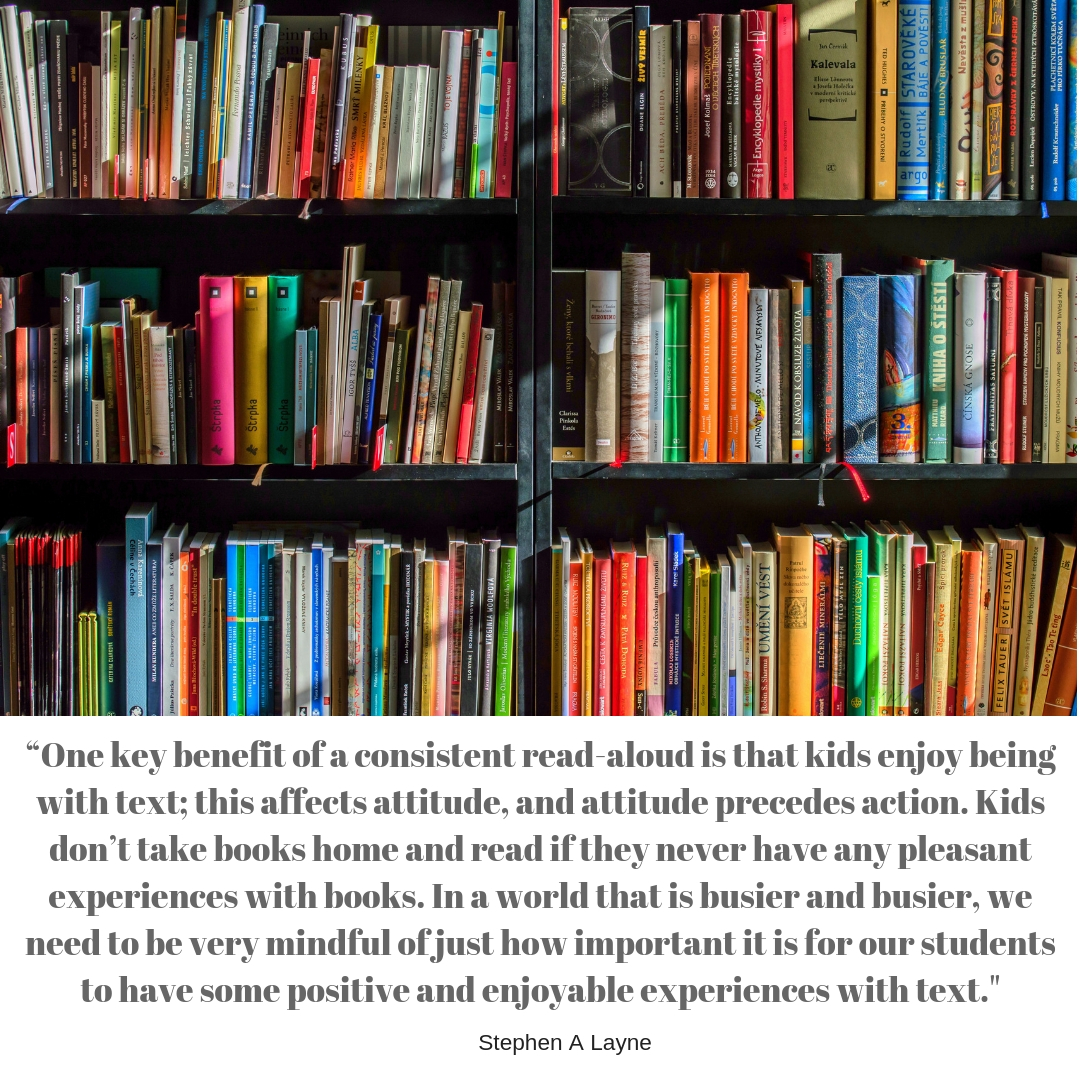
“One key benefit of a consistent read-aloud is that kids enjoy being with text; this affects attitude, and attitude precedes action. Kids don’t take books home and read if they never have any pleasant experiences w.jpg

I also wonder if their reading was deepened because we read together as a community, bringing 20+ backgrounds and ideas together to create a collective understanding.  Maybe the struggling students thought “I can do this” for the first time. Maybe the advanced student thought “Now I more time to read what I want at home” for the first time in a long time. Maybe other students simply thought “Huh, this wasn’t so bad.”

Part of a read aloud’s magic is its power to change student perceptions around books.  My goal, OUR goal, is to create and encourage readers. I encourage you to bring oral reading into your classroom.  I am going to be braver in the coming weeks and embrace a full class read aloud, so students can simply enjoy hearing a story for a few minutes each day.

Maggie Lopez has made the move west to Utah where the mountains are a gorgeous golden purple every day and ski season is around the corner.  She is indulging in promoting banned books this week with students and currently reading a student rec, Brain on Fire.  Follow her on Twitter at @meg_lopez0.

Better Feedback Better Me

When I first attended Penny Kittle’s class at the University of New Hampshire Literacy Institute, and really learned what authentic writing instruction looked like, I thought I had to do everything like she did. I remember even saying to her at one point, “I want to be you when I grow up.” She quickly said, “No, you want to be you.” What I heard was –“You want to be the best you.” I know that’s what she meant.

My biggest failure in trying to be Penny instead of myself was reading and giving feedback on students’ writing in their writer’s notebooks. I just could not keep up with the volume of it all. And the volume of writing was important. I knew that.

dmitry-ratushny-412448-unsplash

Photo by Dmitry Ratushny on Unsplash

I also knew that volume serves its own purpose, and coaching writers to improve required a different focus that just getting students to write more. (When I first started workshop, I was really good at getting students to write more. I was lousy at helping them improve as writers.)  When I made the conscious effort to provide better and more continual feedback, I started to see a change in myself as writing coach — and a change in my students’ writing ability and confidence.

I started a better rotation system of collecting student notebooks, and I worked on planning student activities that allowed for me to read and comment on at least part of a class stack during a class period while students worked on something independently or in small groups, so I wasn’t doing it during planning time or after school. And I limited my comments to this simple method:

  • Two things that struck me about the writing (validating ideas, language, images…)
  • One suggestion for taking the thinking further or some aspect of improvement.

This feedback method has worked for me for a long while now, and I use it on pretty much every draft of writing I read. Lately, I’ve been working on giving more feedforward than feedback, which I think will make an even better impact. For more on that, read this. (And maybe buy this book.)

I’d love to know how you manage giving feedback on your students’ writing. Please share in the comments.


Amy Rasmussen lives in North Texas where she’s been enjoying lots of rain. Lately, she’s spent a lot of time reading about becoming a better writer (See this and this) and trying to break through the wall of her writer’s block. Follow Amy on Twitter @amyrass


Good books — and a teacher’s expertise in using them — can do it all

On Sunday, my friend and extraordinary literacy-leader, Billy Eastman, and I got to giveBookTweet away books. We presented at the Coalition of Reading and English Supervisors of Texas (CREST) fall conference, and Follett Learning gave us 30 books, six signed by the authors, to raffle off to our audience. It was kind of an Oprah moment: “You get a book, and you get a book.” Oh, the thrill of book giving.

But giving books is just part of the thrill. We know this. We ‘give’ books to readers and students we hope will become readers often. We model our reading lives. We read aloud. We line whiteboard rails with new titles. We do book tastings and speed dating with books. We celebrate our readers and exhaust our arsenal of book-loving ideas.

And some would-be readers still don’t read. What’s a teacher to do?

Here’s three ideas that have worked for me:

1. Never give up. When we set high expectations, when our students know we are serious about Book Love, when we practice keep-on-keeping-on with all the things I listed above– and we relentlessly share our joy, passion, and commitment to their reading lives– even if we never get a student, or a handful of them, to read a book, we have succeeded.

2. Believe in #1. Often we focus on the one student who just won’t budge. She chooses books, flips a few pages, fakes reading a chapter, bluffs her way through a conference, and we get discouraged. Keep trying — but do not let her be a black hole. So often we find ourselves gravitating to the one over and over again when we need the energy to keep encouraging, moving, and celebrating the many.

3. Make it okay to not read novels (yet). Anthologies are awesome. Sometimes

61doyibbmql-_sx395_bo1204203200_

“… this anthology empowers the nation’s youth to listen, learn, and build a better tomorrow.”

students who don’t like reading just need to enjoy a good piece of writing. Many will then want to read more by a particular author. One title many of my students dabbled in, and often read in its entirety, is Flying Lessons & Other Stories with authors Kwame Alexander, Jacqueline Woodson, Matt de la Pena, and more. I’ve recently purchased Fresh Ink, which is similar and looks equally engaging. It’s got authors Nicola Yoon, Jason Reynolds, and more! And I just read about this one this morning:  We Rise, We Resist, We Raise Our Voices. It’s now in my shopping cart.


In our session at CREST, Billy and I discussed implementing the new ELAR standards for Texas (We both served on the teacher committee that wrote them), and we shared the transformative role investing in teacher expertise and authentic resources has made in his district (We wrote about some of it in this English Journal article.). Access to engaging books like the ones we gave away in our session is just part of it. Knowing how to use them to teach thinking, reading, writing, speaking, and listening skills is the other.

Good books — and a teacher’s expertise in using them — can do it all.

Billy Eastman at CREST

We know the real thrill isn’t in getting a new book but in the knowledge, the empathy, or the know-how that books gives to us. This is the thrill we want for our readers. It’s the reason we do what we do.


Amy Rasmussen is a mother, grandmother, reader, writer, and wannabe sleeper. She spends a lot of nights thinking about growing readers, encouraging writers, and talking to her writer’s block. She’s back to working on that book she started five years ago, so if you’ve got any extra luck hanging around, please send it her way. Follow Amy on Twitter @amyrass 

Choice Reading Shouldn’t be a Choice Not to Read

I love that silence that permeates our reading time. A certain peace settles over the room as thirty souls lose themselves in the pages of their books, the only sounds: rustling pages, tapping feet, or contented sighs.  I also love that groan they emit when, after ten minutes, an eternity of silence, I implore them to mark their page and pause their reading for now.  That’s exactly what I say to them, “Alright kiddos, lets pause our reading and get out our reader’s/writer’s notebook.”

While we’ve practiced that transition dozens of times, they still plead begrudgingly, “Can we just have more reading time!!!”  “You can,” I tell them, “on your time.”  Some of them, the truly committed, make time for their self-selected independent reading, but most, for now, do not.  This reality, jarringly disturbing to committed readers like you or me, is something that keeps me up at night.  It prompts old teacher/football coach friends to text me on Sunday morning, asking for some kernel of knowledge that might help them move readers.  For this problem, though, there is only one short and fast answer: Hard Work.

I wrote about the difficult task of moving seniors into reading lives last year: here and here. The results, transformative for some, middling at best, and woeful for many, read like a Picasso.

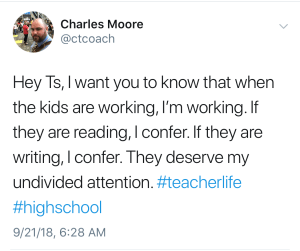
I promise you this: We can’t afford not to give them everything we’ve got.  That thought spurred this tweet from me earlier in the week:

Tweet1


We know reading and writing dovetail to form literacy.  If we instruct using whole class novels, we run the risk of alienating many who can’t engage with something in which they have no interest and as a result, we get nothing. If we encourage choice reading and we allow the kids to choose not to read, we get nothing.

We must engage in their self-selected reading lives and I believe that I can’t do that if I’m reading while they read.  While they read, I’m moving around the room, tracking pages read, asking the reluctant about their reluctance, asking the readers when, where, and why they are reading on their own, simultaneously serving both ends of the reading spectrum.  You won’t ever find me sitting behind a desk, because my desk is shoved up against the wall, relegated to table status, as a place where papers pile.

It’s hard work, like everything about our roles as literacy advocates.  It takes planning,  reflection, and intention to match every kid to the perfect reading conference question.

That’s part of it too.  One question does not fit all.  If a student isn’t reading, they can’t reach into their reading experience to share with me their opinion on the effectiveness of setting, for instance, in their selection.

Also, I have to give them the sobering news that this lack of reading life may hinder their writing life as well, and while I don’t take grades for self-selected reading, I do take grades for writing and their engagement from one directly affects their success in the other.  I need to tell them that, before their grades do.

Charles Moore loves conferring with readers, even struggling ones.  He loves concerts with his wife and when his son texts during the concert, he texts back, “We are having fun without you.”  He’s loving the new adventure with Pre-AP students and his freshman are growing on him; they are adorable.  Check out his book review blog at www.mooreliteracy1.wordpress.com and his far too frequent twitter rants at @ctcoach.

The Magic of the 100-Word Memoir: in Retrospect

100_Word_Story_Logo_332x190We (my teaching partner, Mariana, and I) never questioned the value of the 100-word memoir, the first piece we would take through a full prewriting – drafting – revision process with our students. After all, it’s what Penny and Kelly do in 180 Days. Need we any better reason? No. Turns out, though, there is major added value we hadn’t realized about this little genre as the first text we ask of our students. (My guess is Penny and Kelly knew, but didn’t have space to elaborate in the book.)

So, here are the values and beliefs that our experience of the 100-word memoir brought to light, mostly after the fact:

1. Short pieces offer even the most reluctant writers a sense of accomplishment. Those writers who need more time than their classmates — and we all see them right away — turned in their notebooks with a complete draft within the allotted time frame. Every single student turned in a complete draft (even if the rest of their notebooks were still in progress). Just a guess, but an early sense of “I can do what’s being asked of me in this class” can set a tone of that invites rather than excludes.

2. The value of re-vision in its truest sense becomes apparent, even palatable. I’m sure we are all used to the experience of reading a student draft that gets to any substance only at the very end, close to the word count. With the 100-word memoir, more students than I can count on two hands (out of 83 total) saw this in their own writing. They were not only willing to but intent on rewriting. Questions went from “Is it good enough if I just fix …?” to “If I’m rewriting the whole thing, should I do that in my notebook first?”

3. Students begin to understand their own processes as writers. The above questions naturally led to a class discussion of the difference between meeting a teacher’s requirements and cultivating good writing. Even my youngest students (sophomores) are mature enough to understand the value of knowing themselves as writers. “Do you prefer to rewrite the draft by hand? Or will you ‘revise’ as you retype the draft into a document?” The offer of that respect to them as real writers was a major trust builder at this critical early moment in the year. The concept of writing conferences is still alien for most students. But when they called for a one-on-one conversation about whether another “first” draft was required if they were completely rewriting, a conversation opened up about their own process. Doing so, I had the opportunity to point out we were in the midst of a writing conference right then. I don’t think it’s overly optimistic (no one has ever accused me of such a stance) to imagine that any trepidation a student had about a writing conference with me was at least a little dispelled — and I made sure that fellow writers at that table who were conspicuously keeping their heads in their notebooks heard that, too.

4. Students writers can benefit by learning the art of DELETING. Kristin Jeschke writes thoughtfully here about the value of teaching students to be incisive. Our 100-word memoirs aren’t long enough for us to do literal paper-cutting (or are they … hmm), but the practice of incision with a short piece can instill this habit early on. In Intention: Critical Creativity in the Classroom, Amy Burvall and Dan Ryder discuss — among other innovative cross-curricular ideas — the notion of “creative constraints.” I’ve pretty much fallen in love with this phrase in place of language resembling “criteria” or “learning targets” (and the meanings can conveniently satisfy the paperwork of performance evaluations). The phrasing helped students to see “criteria” as a creative challenge: at best, inspiring and at worst, less arbitrary than some assignment “criteria” can be. AND, as Mariana pointed out, inevitably our seniors must cure the logorrhea in their college essays, and the 100-word “creative constraint” gives them practice.

Coulda3Usually my own post-lesson, reflection phase is a litany of all that I could have, should have done. How refreshing, then, to reflect in a way that identifies value beyond what we’d hoped. What an affirmation that our practice recognizes beliefs we hadn’t even seen.

I have no intention of giving up my private, critical post-practice litanies. But the experience of the 100-word memoir lowered the volume of that familiar, reproachful teacher-self. At least for a day or so.


What Do Today’s Students Need?

This post very nearly slipped through the cracks, but I’m tickled to have found it. Mid-July Lisa and Two-Weeks-Into-School Lisa are of the same mind, if not the same sleep surplus, and now is the perfect time to resurrect my enthusiasm around knowing our students from as many angles as possible.


Greetings from McKinney, Texas where the RealFeel temperature is 108 degrees and this Wisconsin gal is melting her way through professional development with an awesome group of enthusiastic, inquisitive, and insightful secondary teachers.

It is always such a privilege to be asked to teach teachers. The energy that’s built around sincere investment in collaboratively improving practice is inspiring, even in those desperate weeks when “Back to School” advertisements burst onto every conceivable media outlet in that all-out assault to all things summer that makes me equal parts desperate, angry, and a little bit twitchy.

In our work in McKinney, we’ve had a goal to both educate teachers on the inner workings of workshop instruction and to encourage them to provide opportunities for students to have transactional experiences with texts. To begin, Amy shares a quick YouTube piece that gets us all thinking about how the students who sit before us are defined (and how they are not defined) based on the chaotic, frenetic, and often times depressing experiences the wider world has thrust into their lifetimes.

We then reflected in our notebooks on what this video suggests to us about the needs of our students.

Now, let’s be frank before your own list of student needs forms in your head. If the needs of our students are defined by the standards that require assessment, the chunks of curricular content that define the roadmap of our lesson planning, and or our preconceived ideas of their abilities, we’ve started in the wrong place.

We must always remember…we teach humans. Our work with specific content, abilities, skill levels and learning styles can be important factors in meeting our professional obligations and/or defining parts of what we do each day. However, it is the growth of students as readers, writers, and thinkers that must be at the center of our determination of their needs.

With this in mind, here was my sixty-second jot list:

  • They need role models
  • They need calm in a world of unending chaos
  • They need security
  • They need to learn to communicate effectively, both in person and through technology
  • They need to see themselves reflected in their education
  • They need to see the value in their voices and then have a place for that voice to be heard
  • They need to better understand one another in an effort to build empathy.

The large group shared out a list of ideas that was beautifully responsive to the wide variety of difficult realities our students face. These are the needs of a generation, as one PD participant suggested, who have been largely raised by “lawnmower parents,” in other words, those who pave the way for their children to avoid conflict, though the wider world is full of it. So in essence, our students need not only a respite from the chaos of the world but also a place that then challenges them to critically think through how they can maneuver their way through it and problem solve solutions to big issues.

IMG_3461

So, what to do with this information? Everything. We do everything with this information. It guides the choices we make from the start of the year to the end, from the first time we sit down to plan to our responsiveness in the face of differentiated preferences and needs, from the enthusiasm that bolsters the start of the year to the shadow that can fall on our practice when we’ve lost our way and enthusiasm and productivity can plummet in our classroom.

It’s no easy work, but as we know, so often that means that it is precisely the work that needs doing most.

What specific needs are your students exhibiting early this year? How are they impacting your daily work? Feel free to comment below!

Lisa Dennis teaches English and leads a department of incredible English educators at Franklin High School near Milwaukee. Follow Lisa on Twitter @LDennibaum 

Takeaways from Tyrolia: Four Days with Kylene Beers, Penny Kittle, Bob Probst, and Linda Rief by @KarryDornak

Tyrolia Ranch
I still haven’t mentally returned from my time at Tyrolia, Kylene Beers’ ranch, in Waco, TX. My mind still thinks I am sitting at her dining room table, painting a watercolor picture while overlooking a pond banked with Cypress trees. Or nestled on one of her incredibly-comfortable couches talking about a podcast with a newfound friend. Or riding a Mule (the all-terrain vehicle, not the animal) with Penny Kittle and five other people who were just as giddy as I was. Or sitting around her living room chatting and laughing with Bob Probst and Linda Rief while the aroma of the evening’s dinner tempted our senses.
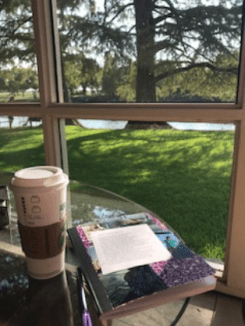
Scenic Tyrolia RanchIt’s amazing that a place of scenic tranquility and beauty could rouse such feelings of rebellion and determination.

But you can’t talk about rebellion without first talking about power, so let’s start with the power of literacy.

For the first time in history, power is no longer based solely on wealth. Power is a Tweet. A YouTube video. A social media post. Kylene gave a fascinating talk about the “ugly roots of literacy in America.” In Colonial America, “literacy” primarily meant one’s ability to sign a document or contract. Who held the power there? Those who could sign the document, or those who could write the document? During the Revolutionary and Civil War times, penmanship was valued as literacy. But who had the leisure to practice their penmanship? Those with wealth, privilege, and power. From the Civil War to World War I, literacy meant one’s ability to recite poems, monologues, and stories. But who had the leisure to practice memorization? Those with wealth, privilege, and power. Then we get to the Industrial Revolution, where the assembly line was born. And then our schools began modeling the assembly line design (can’t you just picture kids on a conveyor belt being carried from class to class?). From the 1950s to 1980s (and even in the present), literacy meant analyzing the meaning of what we are reading. But still, someone else held the power (it was the teacher — or CliffsNotes —  who determined if a student’s analysis was correct or not).

The point is, the definition of literacy shifts to reflect what is happening in the country and world. Presently, businesses see the value in synthesizing information and identifying potential problems rather than just solving existing problems. So what does this mean for our classrooms?

It means we abdicate the power we as teachers have held on to for decades and give it to our students. If we are only teaching them analytical literacy, we are preparing them for 1980. For this century, students need the same literacy skills they’ve always needed: to summarize, to retell, to articulate, to evaluate. But more importantly, they also need a willingness to see another perspective, the chance to take a risk, the ability to sustain their focus, an acceptance of ambiguity, and the self-confidence that allows them to identify as readers and writers. Because that’s power, right?

But the chances are, if you’re reading this, you already believe this. Chances are, if you’re visiting Three Teachers Talk, you are already subscribed to the belief that education has not caught up to the 21st century. And chances are, you sometimes feel alone in this belief. Or isolated. Like you are fighting a losing battle. Like you have found a great discovery, only to feel that no one else believes you.

That’s where Penny Kittle’s words ring true  — that courage is more important than caution. I understand not wanting to “rock the boat” or damage friendships with your colleagues, but at what cost? The risk of sending our students into the world illiterate by 21st century standards and powerless?

Kylene told us that to start [educational, metaphorical] fires, we must start with our best kindling. So find your tribe. Find your people. Those who value courage over caution. They may not be in your hallway. Perhaps they’re across campuses, across districts, across states, across international borders. That’s who I found at Tyrolia. I found my tribe.

And persist. Penny said that it is often the changemakers who take the lumps. And I don’t know about you, but I have definitely felt it. But our kids are worth it. Linda echoed this sentiment when she said that even if you just change one teacher, that is one group of kids who are benefitting. To add to the conversation, Bob suggested we focus on the 5%: the 5% of teachers who are ready and willing to make a change, or the 5% of our teaching that we are dedicated to improving. So ask: “What’s one thing we can change this year?”

For me, I am vowing to write more. Penny encouraged us to start the habit of writing for fifteen minutes a day. You know what I said to her? I’ve tried to keep notebooks and journals, but I always lose interest because I feel like what I’m writing doesn’t matter.

Dwell on that sentiment: My words don’t matter.

You know many of our students feel the same way. How can I show my kids that their words and voices matter when I don’t even feel that my own do?

But she told me that my words did matter. And then four days later, she retweeted this, and I can’t help but think it was for me:

PK notebook tweet

The truth is, words matter.  Everyone’s: mine, yours, our students’. The words we read shape our thoughts. So immerse yourself in the words of Kylene Beers, Penny Kittle, Bob Probst, and Linda Rief. Their words are life-changing.

Immerse your students in words of both the past and the present, so that they understand how we got to now, and how we can change the future. And the words we write matter. They help us reflect, learn, process, and discover.

I’m slowly wakening from the dream that was Tyrolia, but I hope that we all remain:

Determined to write.

Unafraid to rebel.

Revolutionaries for 21st century literacy.

On a mission to find our tribes.

The 5%.

As of today’s publication, Karry Dornak has continued to write, rebel, revolutionize, and seek out her fellow 5%. She is balancing life in Spring, TX, as an instructional specialist, teacher, wife, mom, and Pumpkin Spice Latte enthusiast. Follow Karry on Twitter @karrydornak
 

My Classroom Library Shelves went from Empty to Full . . . and Yours Can, Too!

My family took a big plunge five years ago, and made the decision to move from our placid, beautiful Central Oregon to Amman, Jordan. So much about Jordan was wonderful, but part of our decision to move away from our home, from Oregon, was about traveling the world. So after four years in Amman, we decided to move away from Jordan, to Managua, Nicaragua.

Between making the decision in January to move to Nicaragua and actually arriving this July, Nicaragua’s travel advisory from the US State Department went from level 2 to level 3 because of civil unrest, crime, and limited healthcare availability. Of course that travel advisory rating, combined with what we were reading in the news and hearing from people who lived in Managua gave us pause, and we carefully considered the choice we were making. Ultimately, we decided to move to Managua, and we are happy with our choice.

I share this background because I want to point out that while private schools often don’t share exactly the same issues and concerns found in public schools, private schools are not always utopian. Our school is wonderful, students are eager, teachers are welcoming and caring, and our facilities are beautiful. But with the current situation in Nicaragua, some families have chosen to leave the country, which ultimately means revenue from student fees is down, and the budget reflects that situation.

Everywhere I have ever taught has had budget concerns, public or private. I’m sure all teachers can relate to budget issues, which is why I bring it up.

Even in a time of budget concerns, my classroom library grew from empty shelves to full shelves in a matter of weeks, and it didn’t cost me an extra dime.

I walked into a nice, big, but empty classroom. The bookshelves were beautiful, but bare.

IMG_9968

Within a day or two of being in my new space, at my new job, in my new city of residence, I was having conversations with administrators and coworkers about how to build classroom libraries.

Our first step was to visit the book room. I think most schools have a book room, and in my experience they are full of books that are rarely in the hands of students for any length of time. We decided to gather a copy of each book for each of our five classrooms, and if a teacher needed one of those copies for teaching a whole-class-novel, we would give it to that teacher to use during that particular unit.

There were also books in the book room that were not being taught as whole-class-texts, and that weren’t available in high enough numbers to be used in that way. They might be titles that could be used in future book clubs, but we decided that getting these books in the hands of students sooner rather than later was the right choice, so they were distributed as well.

My classroom library was greatly improved by visiting the book room and reimagining the uses for all of the wonderful reads that could be found there.

I found some small white boards in the closet in my classroom and repurposed them as book displays so that I could highlight titles that might be especially interesting to my students. I think the same thing could be done using repurposed cardboard and printer paper, so I want to encourage others to use what’s available in order to highlight high-interest books. There are many other ways to focus attention on desirable titles, but sometimes simple is easiest.

After raiding the book room, it was time for step two. We checked in with the main library at our school. The shelves in our library were packed tight, full of great titles, and because shelves were so full, we had the ability to pull books out of the library and redistribute them to our classroom libraries.

Our librarian has spent the last several days pulling titles from the shelves and delivering them to our classrooms. Every other day or so, a basket of books arrives, and we never know what we are going to get. What we do know is that we will have more and more books as this process progresses. There will be additional books in our classroom libraries and more room on our school library shelves. Reallocation of resources is working in a very positive way in our school.

Once I received the books from the book room and the library, I implemented step three. I organized the books. I don’t think it matters how the books are organized, just that they are organized.

I categorized my books into the following sections, and used markers and printer paper to make my labels:

  • award winners
  • historical fiction
  • classics
  • mystery
  • fantasy and sci-fi
  • contemporary fiction
  • nonfiction
  • romance and other fun reads
  • “orphan” series books (books that are #2 or later in a series when the others aren’t there)
  • short stories and essays
  • poetry and verse

As you can see, I didn’t spend a dime on any books. I didn’t ask anyone else to spend any money, either. I used what was already in my school and simply helped to redistribute resources.

In some schools or districts, asking students to bring in books, applying for grants, and asking the parent-teacher groups to support classroom libraries will be great options. However, I wanted to share that sometimes, maybe often, classroom libraries can be built with what we already have.

What do you do to help build your classroom library? I’d love to see your ideas in the comments below.

Julie has been teaching secondary language arts for twenty years, spending the first fifteen in rural Central Oregon, and the last four in Amman, Jordan. She’s thrilled to report that she and her family have moved across the world to Managua, Nicaragua this year, where a new adventure has begun.

Follow her on twitter @SwinehartJulie