Category Archives: Jackie Catcher

Finding A Teaching Family Outside of School

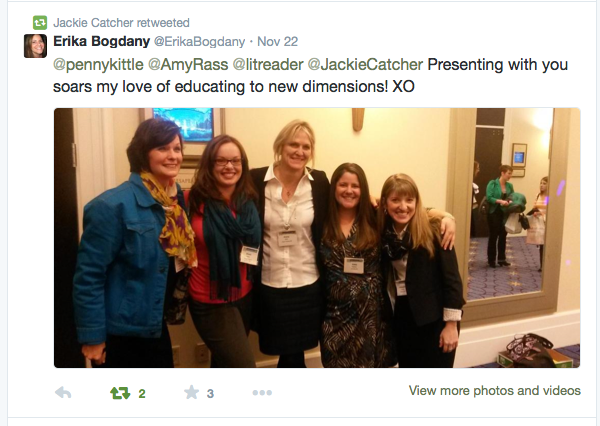
“It’s funny how my closest friends live states away,” Amy said to me as we crossed the convention center’s atrium during NCTE. I agreed; our group of four, Amy, Shana, Erika, and I, might live in different parts of the US, but we share a unique bond, one that has carried me through both the highs and lows of teaching.

Teaching is an anomaly: for being such a social career, it is also quite isolating. I learned this my first Screen Shot 2014-11-26 at 9.37.08 AMyear when I went from sharing a classroom during my yearlong internship to suddenly being by myself at the end of the hall. I found that while my colleagues and I would sit down for lunch everyday, we struggled to find common times to chat about our work or pedagogy outside of professional development days or staff meetings. Despite being within the same building, we’d oftentimes take to the Internet to discuss our plans and work with one another. Over the summer I would receive messages from Jenn about a fantastic new book we could incorporate into our academic English curriculum or recently I received a Pinterest pin from Kristina pointing out a fun way to teach sentence diversification.
Social media has changed the face of my professional learning network. While many of my teacher-friends are at my school, my core group doesn’t just involve those within my state anymore. I have discussed pedagogy with teachers in Canada, talked shop with friends in Washington D.C., and connected with educators across the country. Teaching is no longer the isolated occupation it once was. Over the past two years, these discussions have had a profound effect on my development as a teacher. Many teachers have helped to shape the workshop model within my classroom by being honest about their successes and struggles. My PLN has given me a place to geek out over reading, writing, and discussing literature. And ultimately, this passion online translates into my enthusiasm within the classroom.

With Thanksgiving right around the corner, I cannot be more thankful to my online peers as well as to Screen Shot 2014-11-26 at 9.33.43 AMthose teachers who I have met at conventions and in classes. I am grateful for the relationships I have garnered via social media and e-mail. No teacher should feel alone in this occupation—there are countless resources to uplift and inspire even the most isolated. After all, teaching is an occupation composed of charismatic, committed, and loving individuals who not only see the best in their students but also search for the best in each other.
#NCTE14 J.44 A Reader’s Workshop Starter Kit to Jumpstart the Process

Erika, Amy, Shana, and I are presenting at the NCTE conference today at 2:45pm! Penny Kittle is our Chair, so please join us to discuss the landscape of workshop. We are session J.44.

Think back to your first day of teaching on your first year of teaching. What were you feeling? Happy, nervous, excited, afraid?IMG_1776 Fear. Fear was the first thing I experienced when I stood in my classroom on the first day of school. That and enthusiasm, excitement, eagerness, and hope, but ultimately, I was afraid, knee shaking, stomach churning nervous as I stood in front of my new class. Fear comes with the unknown, which is why my nerves of being a new teacher were compounded by my entry into the workshop model. The concept of the workshop model is simple, yet it’s a structure that so few of us grew up with. In turn, as I transitioned my classroom, I found my nerves could be categorized into the fear of breaking tradition, the fear of parents, the fear of students not reading, and the fear of proving rigor. I was not alone though. Interns and teachers who were new to workshop model faced many of the same fears. In turn, I created a reader’s workshop starter kit to provide my colleagues with concrete documents that helped them establish the workshop model in their classroom. The starter kit includes the following documents:

  • Elements of a Reading Workshop by Penny Kittle
  • Reading Letter for parents
  • Calculating Reading Rates & Reading Rates Log Sheet
  • Weekly Reading Recording Sheet
  • Excel Sheet Weekly Reading Recording Sheet
  • Book Conference Log
  • Questions to Ask While Conferencing
  • Book Talk Outline
  • Resources for Helping Students to Find New Books

Whether you are a new teacher or simply new to the reader’s workshop, I hope this starter kit will make your journey a bit easier. Enjoy every step and savor even the smallest successes. If you have any questions or comments about starter kit, please feel free to contact me at Jackie.catcher@gmail.com.

Click Here to Download the Reader’s Workshop Starter Kit

It goes far beyond your Everyday story

51i318LHixL._SY344_BO1,204,203,200_If you doubt, question, or undermine the complexity or rigor of young adult literature, read Everyday by David Levithan. Despite the book’s bland beige and gray cover, there is nothing dull or colorless about this story. It is a philosophical and, in my opinion, a political statement that calls into question what it means to be an individual in today’s world.

In the book, A is a genderless soul that inhabits a different body everyday (hence the title). The conflict is that A, in the first chapter, falls in love with Rhiannon, the girlfriend of a boy whose body A currently inhabits. Don’t worry; it isn’t as confusing as it sounds. This simple love story leads its readers to question what defines gender and even love as A inhabits different bodies throughout the book. Furthermore, A questions what the difference is between the soul and the body and how they can function as one or even two distinct beings.

David Levithan captures the beauty and innocence of being human through the simple yet straight forward perspective of A, an old soul with deep knowledge: “If there’s one thing I’ve learned, it’s this: We all want everything to be okay. We don’t even wish so much for fantastic or marvelous or outstanding. We will happily settle for okay, because most of the time, okay is enough.” A goes on to one of my favorite passages of the book, a passage that is great for book talking and providing a brief teaser without giving anything away.

I am a drifter, and as lonely as that can be, it is also remarkably freeing. I will never define myself in terms of anyone else. I will never feel the pressure of peers or the burden of parental expectation. I can view everyone as pieces of a whole, and focus on the whole, not the pieces. I have learned how to observe, far better than most people observe. I am not blinded by the past or motivated by the future. I focus on the present, because that is where I am destined to live.

“I learn. Sometimes I am taught something I have already been taught in dozens of others classrooms. Sometimes I am taught something completely new. I have to access the body, access the mind and see what information it’s retained. And when I do, I learn. Knowledge is the only thing I take with me when I go” (Levithan 6).

As a teacher, it is easy to love this passage. After all, it ends with the value of learning, but beyond that, this page (the entirety of page 6) shows A’s struggle with defining him/herself as an individual. Not only is there minimal diversification in the sentence starters, but A uses the personal pronoun “I” 25 times in just one page: “I would,” “I took,” “I felt,” “I am,” etc. This practice goes against the rule of what we oftentimes teach to young writers—stray away from using I at the beginning of every sentence. Levithan’s willingness to break the rules and question the norm is what makes this piece both a masterful mentor text and thought provoking must-read.

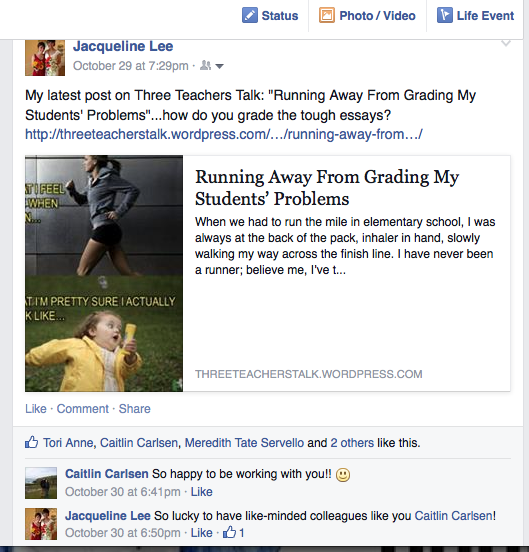
Running Away From Grading My Students’ Problems

when-i-runWhen we had to run the mile in elementary school, I was always at the back of the pack, inhaler in hand, slowly walking my way across the finish line. I have never been a runner; believe me, I’ve tried. So on Saturday afternoon, when I got the urge to hit the pavement in a light, albeit slow, jog, I was running away from more than my problems—the heaps of papers, laundry, meetings, assignments, and work I had waiting at home. I was running away from grading the problems of my students.

In the beginning of the year I always find that students are hesitant with their writing, cautious to share with one another, eager to find personal stories that are interesting yet not too revealing. I don’t blame them—after all, as much as we want to believe high school is a safe space to share our feelings and experiences, it isn’t. Bit by bit though, students unravel, some sooner than others, and slowly I begin receiving stories that are raw and honest. This last set of personal narratives I received included stories about the deaths of parents and grandparents and the suicide of a close friend. Students spoke about dealing with anorexia, suicidal ideations, and clinical depression. At 16 and 17 years old, many of these students have lived more life than some adults.

Part of this process has to do with the fact that my students peer review each other’s work. I find that as they are exposed to one another’s writing they tend to open up further. In addition, I share my own writing with them, in particular one piece on the complications that happened after my father had open heart surgery two years ago. I pick and choose what classes I share this piece with. Some classes are ready to hear that their teacher is capable of fear, anger, anxiety, and hurt; some classes aren’t. The piece is revealing of who I am as a daughter and sister instead of pigeon holing me into the role of a leader and teacher.

The problem with this dynamic is that it doesn’t fit into the traditional education system. While I am not an advocate of grades, I am also not anti-grades. Still, I find that no number can adequately convey the power of writing or the strength and guts of these students. As a teacher, I have to look at the structure, craft, mechangrade-620x425ics, and formatting of a paper, but no matter how much I observe the concrete aspects of a piece, I cannot help but remember that my job isn’t just about correcting punctuation or spelling; my job is to do justice to the stories of my students, to help them tell these stories in the most compelling way possible, which is what led me to my run on this fall day.

Unfortunately, my tromping across scattered leaves with heavy breathing and a stitch in my side didn’t bring any clarity, and when I returned to my kitchen table, the same stories sat underneath my pen, covered in blue ink that praised their bravery, their craft, their story. But still, these stories were gradeless, waiting for a number, waiting for the end of the quarter, waiting to be put into my online gradebook. So my question for all of you teachers, those of you who have been teaching and grading for far more many years than I, how do you tackle these difficult papers? How do you tack on a number to something that has so much more value?

Painting With Words: Sold

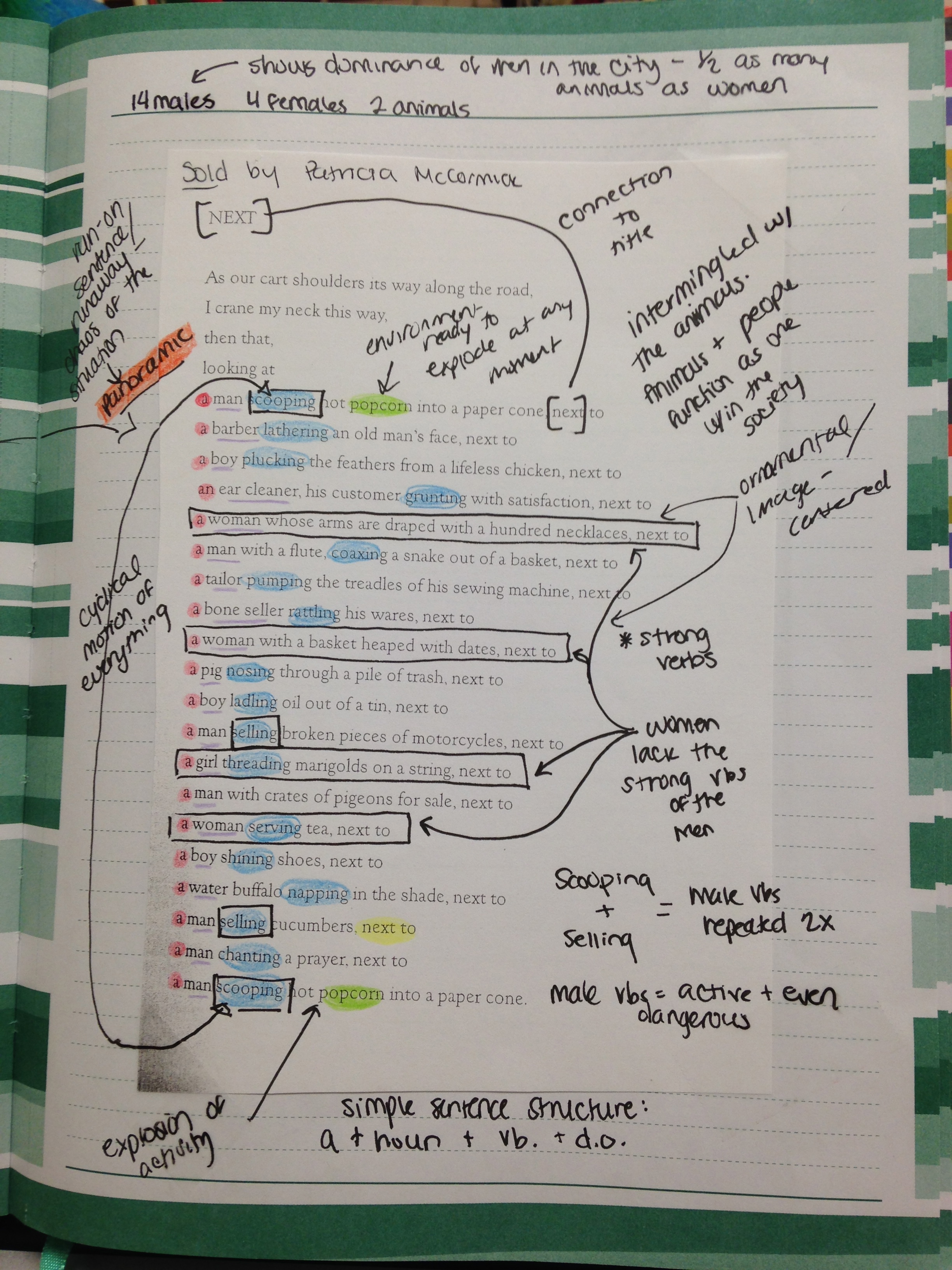
c_soldPatricia McCormick is a painter. Not literally, but she might as well be given the way she writes. Her vivid imagery and poetic prose paired with her short vignettes make Sold a must-read.

Somehow, Patricia makes the heavy subject of sexual slavery both approachable and manageable. Whereas many of my heavier books on women’s rights or international affairs sit dormant in my classroom library, Sold has made it through many hands. I believe there are multiple reasons for this: first, Sold isn’t intimidating in length or size. It feels manageable for many students. Second, Sold is written in short vignettes with wide spacing between the lines. Students can find themselves ten or twenty pages into the book with minimal effort.

Furthermore, the book lends itself to close reading and craft study. Each vignette is chock full of exceptional writing as Patricia McCormick plays with diction, descriptions, repetition, and a wide variety of craft marks. In turn, I can’t pick only one example, so bear with me as I walk you through two of the many passages with which I am obsessed:

Everyday, students walk into my classroom burdened by mammoth backpacks and equally sized worries. It’s tough to be a teenager, which is why I love the vignette “What I Carry.” I hope to use this as a quickwrite to find out what students carry with them throughout the

One of the many passages I have photocopied and dissected in my writer's notebook.

One of the many passages I have photocopied and dissected in my writer’s notebook.

day.

WHAT I CARRY

Inside the bundle Ama packed for me are:

my bowl,

my hairbrush,

the notebook my teacher gave me for being the number one

girl in school,

and my bedroll.

Inside my head I carry

my baby goat,

my baby brother,

my ama’s face,

our family’s future.

My bundle is light.

My burden is heavy.

In the second passage, “Between Twilights,” I love McCormick’s use of sensory details. This is an excellent passage to model the concept of “show don’t tell” in writing.

BETWEEN TWILIGHTS

Sometimes, between the twilights.

I unwrap my bundle from home

and bury my face in the fabric of my old skirt.

I inhale deeply,

drinking in the scent of mountain sunshine,

a warmth that smells of freshly turned soil and clean laundry

baking in the sun.

I breathe in a cool Himalayan breeze,

and the woodsy tang of a cooking fire,

a smell that crackles with the promise of warm tea

and fresh roti.

Then I can get by.

Until the next twilight.

Please Don’t Judge Me

“So, uh, yeah this is pretty embarrassing for me.” I could feel my face flush in front of my 1st period Advanced Composition before I’d even begun. My voice shook as I stood in front of the 24 pairs of 17-year old eyes—the most vulnerable position one can be in. I had captured their attention at 7:45 in the morning, but I could feel my innards twist as I stammered through some of the usual excuses I hear from my student-writers: “I need to tell you the backstory first” and “I hope you get what I’m trying to say.”

Then I started, reading line by line the maid of honor speech I will deliver in fewer than two weeks at my best friend’s wedding. It wasn’t the first time I had shared my writing; I write with my students during quickwrites, share finalized pieces with them throughout the year, and discuss drafting pieces for this blog, but this speech was different—it was raw, personal, and untraditional. I had made some major stylistic decisions that pushed me, particularly as a writer, outside my comfort zone.

“I really need your feedback,” I said to them. And I was honest, practically on the verge of begging. “You see,” I continued, “writing happens throughout your life, and in this instance I need your help to make sure I don’t make a fool of myself in front of 200 guests.”

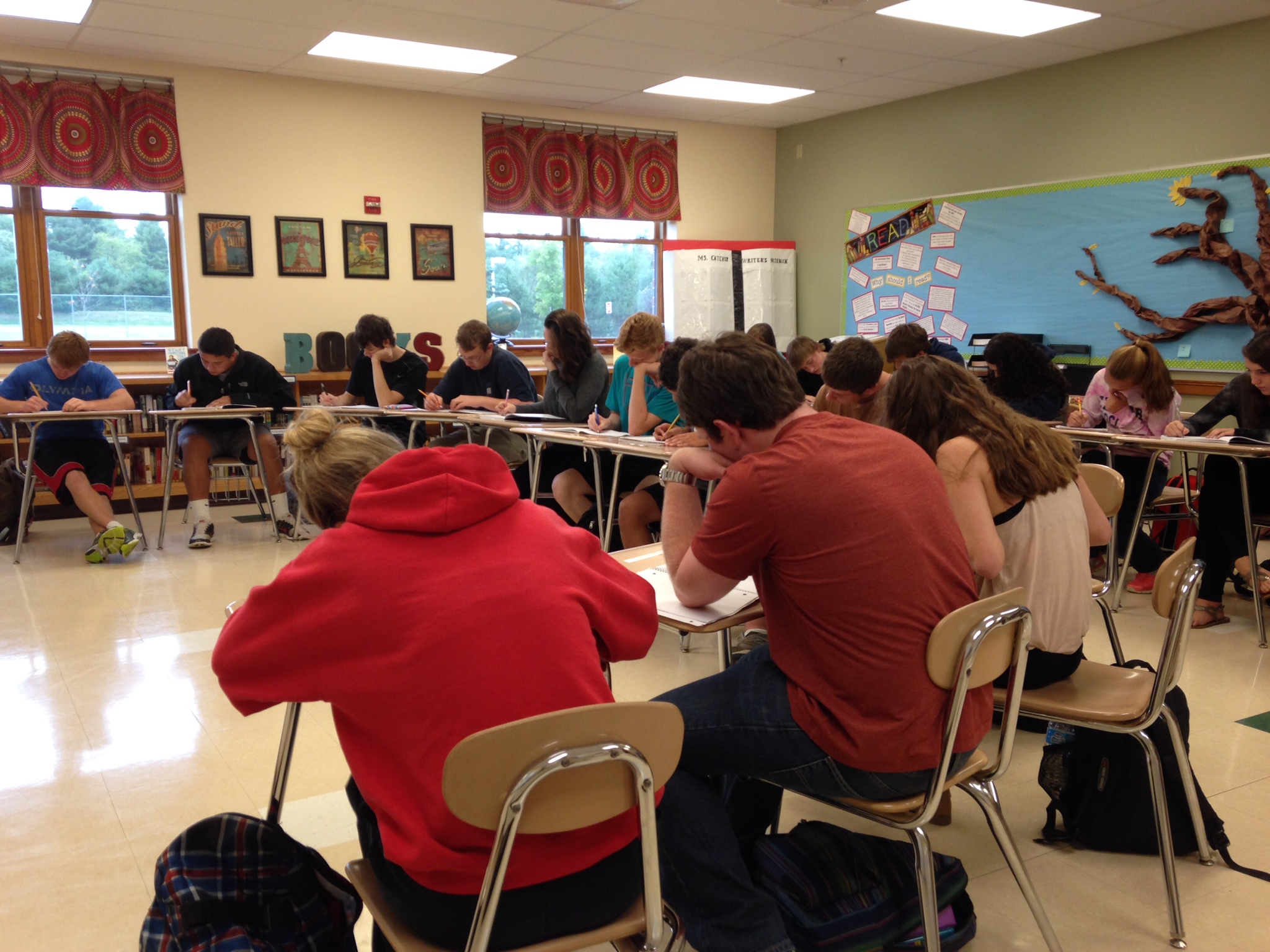
photo-1

My Advanced Composition class, pictured here, helped to walk me through the revision process.

“You’re going to trust us?” a student asked.

“Yeah,” I responded, “Plus, at the wedding I’ll be in front of 200 people I might never see again, whereas here, I’m with you guys for the rest of the year. So, if I’m embarrassed here, it’s going to be really bad at the wedding,” they laughed and they listened to me recite the piece with a calm voice and a racing mind, a mind that begged them to chuckle at the jokes and coo at the memories. When I came to the end, I looked up, realizing again, as I have realized so many times before just how vulnerable it is to share writing. This time though, as much as it made me nervous, I knew that the only way to teach writers was through modeling. If I was asking them to expose their writing to each other, I had to be willing to expose my writing flaws as well, even if it felt like singing solo karaoke stone-cold sober.

Then the suggestions came: “I’m not sure what you were doing with that transition, maybe try to make it more specific.” “I would like to hear about when you first met her fiancé.” “I think you could add another story.” Their words were carefully chosen as not to offend but instead encourage and help. While some students doled out praise, others helped to polish the piece. Even trailing side conversations pertained to how to make the piece stronger. I typed their comments into the document, repeating what each of them would say, and then I sent them to begin a similar process of reading aloud their personal narratives within groups of three.

Next week I will arrive in class with another draft of my speech, and I will repeat the cycle. They must see me live the life of a writer if they are going to believe what I say. They must see me absorb their feedback if they are going to understand the value of peer review. And above all, they must watch me return, raw nerves and baited breath, if they are to believe that I see value in their words.

Confession: I’m dating a “non-reader”

“I don’t like to read.”

These words slipped off the tongue of my date as he sat across from me digging into a burger. I could’ve excused myself to the bathroom then slipped out the restaurant’s back door. Instead, I sat, paralyzed by his open admission.

Does he not realize I teach English? My quaint dreams of cozy dates at used book shops and Sunday mornings curled around novels dissipated. I couldn’t possibly share my life with a non-reader. I spent months fostering a love for literature in my students. I handpicked books for my teens, stocked my shelves with the latest releases, and inhaled literature in my free time. Dating a non-reader was like sleeping with the enemy.

The date was dead.

Or so I thought.

Two years later, we are still together, and Eric has proven to be one of my most valuable assets in understanding self-identified non-readers. Just as I had pigeon-holed Eric into an archetype of resistant male readers, he had categorized me into the antiquated outline of his high school English teachers—the ones who made him hate reading in the first place.

Eric’s teachers were staunch traditionalists. They assigned classics then tested, quizzed, and sucked any joy or personal exploration out of the books, leaving a pulpy mess of literary repulsion. Eric didn’t identify as a reader because his teachers had given him every reason to not identify as one: he struggled with literary analysis and didn’t enjoy fiction. Like many of my students, he skated through English relying on online cheat sheets to get around reading the required books.

This same resistance to identify as a reader plagues many students who step into my classroom. They have fixed perceptions of what a reader is or should be— a person who reads fast, favors classics and fiction, and enjoys literary analysis. Self-identified non-readers see no room in reading for personal growth, gratification, interest, exploration, and pleasure. Ultimately, they see no room for who they are as a person when they recognize that the only celebrated books within English classrooms are those that fit a set standard of literary merit.

Eric's "to read" shelf

Eric is drawn to informational books. Here are some of the books on his “to read” shelf.

Eric was a self-identified non-reader simply because he did not favor traditional literary classics that his teachers drilled in high school. Yet when I first met him, he voraciously read online articles. Gradually he found his niche in books that dealt with scientific theories and particle physics. Recently, Eric completed The Quantum Story: A History in 40 Moments by Jim Baggott, a 410 page book, and he is halfway through A Short History of Nearly Everything by Bill Bryson, which is 478 pages. Furthermore, he listens to audiobooks on his commute to and from work and our bookshelves are packed with volumes on his to-read list, including On the Origin of Species by Charles Darwin and Discoveries and Opinions of Galileo.

If Eric is a “non-reader,” he is exactly the type of student I want in my classroom—the type who has a personal, vested interest in his or her reading and seeks to learn from the material. Gradually, I

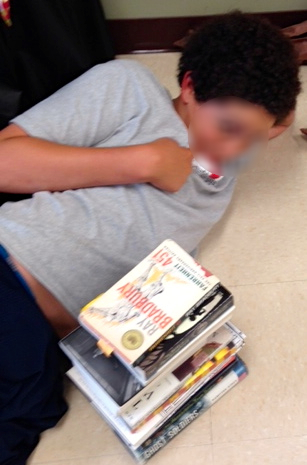
Trevor's Reading

Trevor poses with his stack of books read throughout the year.

have come to find Eric’s reading patterns in my own students. Trevor who hated reading found his niche amongst non-fiction books like Ghost Soldiers by Hampton Sides and Into the Wild by Jon Krakauer while Ben, who was rarely interested in whole class reads, challenged himself with diverse genres ranging from science (Stiff by Mary Roach and The Double Helix by James D. Watson) to historical fiction (The Book Thief by Markus Zusak). These students need the time and space to not only figure out how to define themselves as readers but to also establish a sustainable reading pattern.

By definition, readers are individuals who “look at and understand the meaning of letters, words, symbols, etc.” (Merriam-Webster Dictionary). Thus, as long as a student can read, they are readers—classics, fiction, and stereotypes aside. But as English teachers, we must not only show them that this is the case, but also we must help them to foster reading lives that reach beyond the classroom. A generation

of apathetic teen readers doesn’t have to lead to a generation of

Ben's reading

Ben with this stack of twelve books.

apathetic adult readers.

This past weekend while winding the back roads of a coastal Maine town, Eric and I spotted a library book sale. I would usually be the one to erratically swerve to the side of the road and park on a sidewalk if it meant gathering additional books for my classroom library, but this time, it was Eric. As I sorted through the stacks of books, I looked up to find Eric with a stack equal to my own. This was exactly the type of person I could spend my life with.