Category Archives: Jackie Catcher

#FridayReads: What do Amy Poehler and Sherman Alexie have in common?

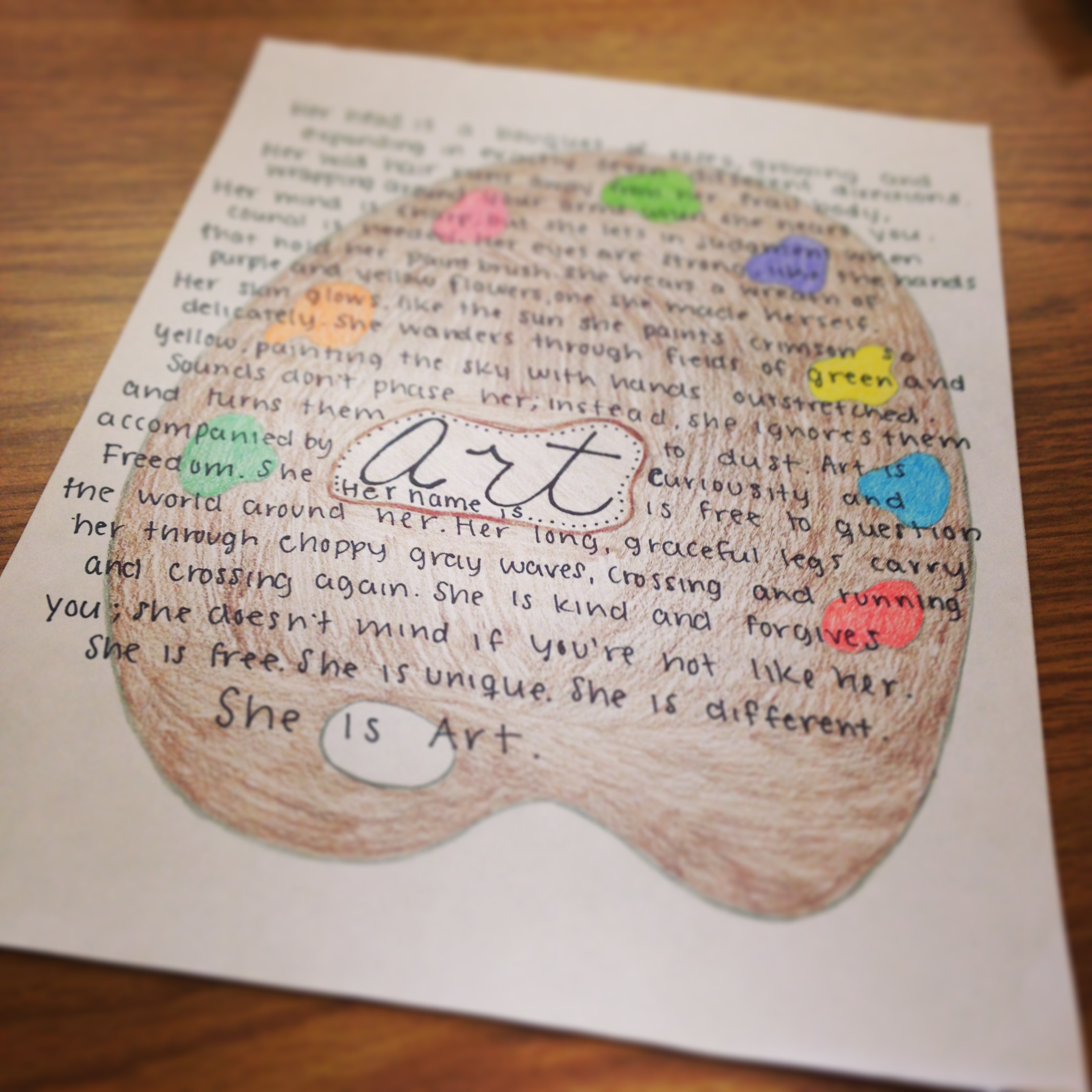
Personifying art--one piece from a student's multigenre project.

Personifying art–one piece from a student’s multigenre project.

Both my students and I love funky writing—the weird eccentricities of modern print where authors dabble with a variety of fonts, writing styles, photographs, and formats. There’s something about that departure from the norm that draws us in, holds our attention, and keeps us reading just to see what is on the next page.

In turn, when I began the multigenre project based on Tom Romano’s book Blending Genre, Altering Style: Writing Multigenre Papers, I knew I needed a new set of mentor texts to help guide my students’ writing. I loved sitting down to stacks of multigenre papers, and my students loved reading each other’s work. The problem was my students rarely had strong examples to guide them in developing the continuity that comes with one paper on one topic written through multiple genres. And so the search began.

This year, one of my new classroom shelves includes “multigenre books.” The benefits are twofold: students will become familiar with the multigenre concept before even being introduced to the project and they will see the unique ways a wide variety of authors diversify their work. The greatest part is that multigenre writing extends across a variety of literary genres.

Here are some highlights from my new collection:
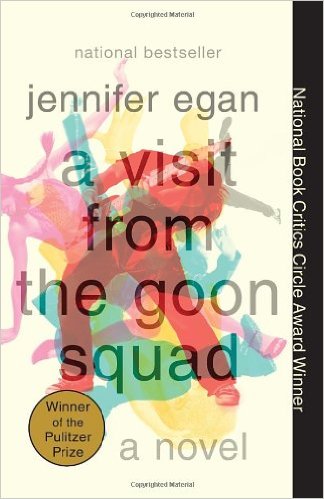
41HGJKFdW3L._SX327_BO1,204,203,200_51uJcmUm23L._SX322_BO1,204,203,200_A Visit from the Goon Squad by Jennifer Egan—Has an entire chapter in PowerPoint slides. How cool!

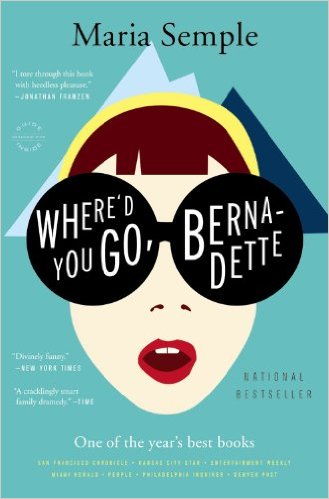
Where’d You Go Bernadette by Maria Semple—Amusing memos and e-mails illustrate character development and voice.

The Absolutely True Diary of a Part-Time Indian by Sherman Alexie – Hilarious doodles, caricatures, and cartoons. One ofmy all time favorite books!

Extremely Loud and Incredibly Close by Jonathan Safran Foer—Every year I have to assure a student that the red ink wasn’t a student’s bored graffiti; it really is part of the author’s the writing.

In the Company of Whispers by Sallie Lowenstein – Includes family letters and black-and-white photographs.

Eyes Wide Open by Paul Fleischman – Great use of infographics for research.

Why We Broke Up by Daniel Handler (author) Maira Kalman (illustrator)—Not only is it written in letter form, but the letters are about individual objects, all of which are accompanied by gorgeous illustrations.

The Art of Secrets by James Klise—Letters, articles, lists, and shifting perspectives keep you interested.

Encyclopedia of an Ordinary Life by Amy Rosenthal—Rosenthal not only wrote a memoir in encyclopedia entries, but she also made reading encyclopedia entries fun.

Yes, Please by Amy Poehler—There are two pages devoted to haikus on plastic surgery. What more is there to say?

Your turn! What multigenre books might you suggest? What are some new shelves you’ll be adding to your classroom library this year?

3 Ways to Jump-Start Reluctant Writers

IMG_1703My younger sister Brittany is a phenomenal writer; in school, she excelled in all subjects, including English, but I never saw her struggle quite as much as when she was required to keep a writer’s notebook. For me, writer’s notebooks had always been liberating. I kept one in my spare time after having read Ralph Fletcher’s A Writer’s Notebook the summer before sixth grade. This was not the case for my sister though who, at the urging of her teacher, would write, “I do not know what to write” for ten minutes straight. Her teacher would tell her, “You’ll figure out what to write after a while,” but she clearly didn’t know my sister who is not only brilliant but also strong willed and persistent. In turn, when I told my sister I’d be integrating writer’s notebooks into my classes, she groaned, saying, “I hated those things.”

Brittany’s PTSD was reasonable. When used without encouragement or prompting, writer’s notebooks can become tedious and painful. Students can easily learn to loathe this tool that should otherwise be fun and stimulating. In turn, when my students explore their writing, I make an effort to help fuel their ideas and interests through a variety of writing activities and exercises that oftentimes help even the most particular writers.

  1. Prompt Board: At the beginning of the year, I ask students to write 3-4 pages in their writer’s notebooks. This helps students establish a writing routine and it helps me to learn about my students quickly. That being said, many students stall when it comes to putting pencil to paper. After running into this problem early on, I began posting five writing prompts per week on the side of my main white board. These topics included personal questions about students’ interests or extracurricular activities as well as sentence starters and fictional scenarios intended to lead into creative writing. I compiled the majority of these prompts off of social networks like Twitter and Pinterest, but I also use sentences from my book talks during the week as prompts as well. I post these prompts on my website in a separate section so students can always go back and revisit the prompts from past weeks.
  1. Ideas Shelf: Teens love thumbing through the pages of oddly shaped writing books. One of my most well-loved books is a cube shaped book called The Writer’s Block, which has “786 ideas to jump-start your imagination.” That being said, there are plenty of fantastic average size books that I store on an ideas shelf, which also includes 642 Things to Write About, Now Write: Nonfiction, Now Write: Fiction Writing Exercises From Today’s Best Writers and Teachers, and 100 Quickwrites by Linda Rief. When stuck, students gravitate towards this shelf. In addition, with the help of my Writer’s Club, I am hoping to add a jar of words, images, and prompts this year for students to pull from whenever they are struggling.
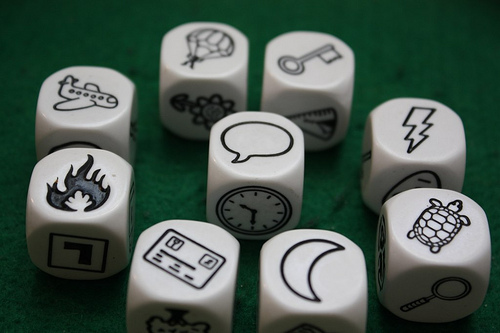
  1. Self-Guided Activities: As the adviser of Writer’s Club, I always have trinkets on hand Rory's Story Cubes for StADato help students put their pencils to paper. Some of my students’ favorite toys include Rory’s Story Cubes, which are dice with small pictures on them. Students can toss a handful of dice and incorporate the images into a story. I also have a collection of old skeleton keys I bought at a craft store. Tied to each key is a tag with a sentence starter that discusses where the key might have been found or what the key opens. Another easy activity involves collecting paint strips from your local hardware store and having students write stories involving the absurd color names on each strip.  Finally, I love utilizing found photography like the pictures from Miss Peregrine’s Home for Peculiar Children or old calendar images to get students thinking. I have a collection of small Dana Heacock calendar images, which are brightly colored drawings of New England scenery or objects.  These images oftentimes stir up students’ memories of childhood and lead to fantastic personal stories.

How do you help inspire your reluctant writers?  What methods do you use to jump-start their independent writing process?

Fart Jokes in 12th Grade

photo 2-2Three minutes into silent reading, someone farted. I have the band-aid colored desk-chair combos, which meant that one vibrating toot was magnified against the metal frame of the guilty student’s seat. The room stayed silent for half-a-minute and then erupted in laughter. The girls quietly chuckled, but there was no way the boys could settle back into their books, so we moved on to our minilesson and called it quits.

My boys can’t get enough of lowbrow humor. Their writer’s notebooks and fictional stories are full of crass humor—farts, sexual innuendo, embarrassing stories, and offensive humor. For years, I chalked up their obsession with these topics to immaturity. I love a good fart joke or sarcastic paper, but I never truly understand the point.

Newkirk argues that humor is a mode of exploration for students, particularly boys. Instead of chastising them for vulgar or lowbrow humor, teachers should capitalize on boys’ love for the weird, gross, and funny. He pointed out that classic literature is full of crass humor, citing Beowulf and Shakespeare as examples. Boys, he noted are inclined to read humorous literature and use these as mentors for their own writing.

Too often though, teachers either don’t understand boys’ humor or they fear that the silliness somehow undermines the assignment. This shouldn’t be the case. Just as we give girls the room to explore emotionally charged pieces about self-confidence or dating, we must also give boys the opportunity to investigate their own questions, which may very well include both humor and violence, as Shana discusses. In an excerpt Newkirk gave us from Boy Writers, author Ralph Fletcher notes that “some of the crass humor in their writing (burping, farting, dirty diapers) tries our patience, but many boys are simply making ‘text-to-text’ connections between their writing and the kind of humor they read in books.” These connections are invaluable when it comes to capturing the attention of our male students.

IMG_2367In turn, we must allow our boys a space to explore humor. Sometimes jokes are just funny, but other times, they soften heavy themes in literature. They open up deeper discussions that are otherwise inaccessible or uncomfortable. As Newkirk writes in Misreading Masculinity, “[Humor] provides a forum for negotiating and sustaining male friendships, and of making overtures to girls. It allows us all to laugh at the peculiarities of our bodies, as we escape, if only briefly, from our embarrassment at the sounds they involuntarily make and the smells they produce” (Newkirk 167). Will students toe the line between inappropriate and appropriate humor? Most likely. Will they take their jokes too far? Potentially. But learning is about testing our surroundings and studying voices to find our own. At the end of the day, I’d much rather my students explore their world through laughter than not, fart jokes and all.

Wrapping up with book trailers

After a slew of snow days and an extended year that pushed the end of school into the second-to-last week of June, my students’ motivation lagged as we approached our final month together. They needed an engaging project that still proved to be challenging and fun. Inspired by Amy’s work, my students and I celebrated the end of the reader’s workshop with a final book trailer project.

The process was organic; students latched onto the idea of watching mentor texts and dissecting the craft to gain a firmer understanding of the writing genre. Over the course of a few days, we analyzed and discussed the differences between the book and movie trailers for John Green’s upcoming film Paper Towns, a class favorite. We combed through countless examples of professional book trailers, dissecting the craft of the films and looking at the cinematography, hook, pacing, script, music, and scene choices. Finally, after brainstorming and storyboarding, students used Stupeflix, WeVideo, Puppet Edu, or iMovie to generate stunning book trailers. The results blew me away.  Here is a small sample of some of the trailers I’ll be using to supplement my book talks next year.

**Make sure to unmute the video. In some cases, the sound doesn’t automatically play.

The Boys in the Boat by Daniel James Brown–Created by Matt

http://https://www.wevideo.com/hub#media/ci/410328553

Perfect by Ellen Hopkins–Created by Emily

Missing Pieces by Meredith Tate–Created by Alyssa

Looking for Alaska by John Green–Created by Tristan

There are years of innovation and then there are years of transformation

1506480_10102034229280020_1983828873_n

Emma was sunshine personified. She was salty hair and smiles and surfing. She was the student who sat in the front row, the one who showed up early to class just to chat. Emma died this past September in a car accident, one day after I revised her college essay, one day after she told me “one more concussion and I’ll be dead,” one day after she laughed off my nervous, “Be careful!”

When I first hear the news, I had been given the wrong students’ name, and I am ashamed to admit that for a moment I selfishly breathed a sigh of relief. But then her picture loaded, the pixelated image appeared line by line on my smartphone, her sandy blonde hair and smile, flashing section by section and I fell apart alone in my living room at 6:30am.

That was only the beginning.

Quickly students began unraveling. I am a second year teacher, a relative novice in the education world, yet I feel like I have lived a thousand lives. Had you asked me to reflect on my world after my first year, I would have peppered you with stories of passionate readers and personal successes, comedic performances of Macbeth, and classes that became family.

This year was different.

The questions weren’t the same, and while my first year had its own challenges, my second year was consumed with worst case scenarios. How was I supposed to deal with my seventeen-year-old students’ funeral? Where should I go when my student has an anxiety-induced nervous breakdown in the middle of class? How do I respond when my entire class just watched their classmate carried out in handcuffs? Or punched in the face in the middle of class? Or attacked by another student with psychiatric disorders and no impulse control? What do I do when my student disappears after being threatened with gang violence? Or because they attempted suicide? And these were only a handful of questions that I dealt with.

I have learned that there are years of innovation and then there are years of transformation. This was my year of transformation. No workshop or course could have prepared me to deal with the needs of my students this year. From them, I have learned unconditional commitment as a teacher. I have defended the rights of my students to remain in my classroom despite their disabilities. I have learned the value of opening my classroom as a safe space for those who have no place to go, whether that is at 7:00am or 4:30pm, to chat or just to read silently away from the prying eyes of peers. I have learned the value of openly modeling enthusiasm and empathy, of thanking them for filling my days with humor and love. I have learned the value of showing them that their words matter—that I will get their friend help immediately, that I will notice their change in disposition and book them an appointment with the school case worker, that I will sit with them in silence if that’s what they need.

I have a week-and-a-half left with my students, and while this year has saturated every ounce of my being, I will enter summer both as a stronger teacher and individual. As always, the end of our journey together is bittersweet, maybe even more so this year after the amount of time and personal energy I have invested into my students’ well being and success. This summer, I will delve into new novels and make lists of new lesson plans. I’ll attend multiple courses and collaborate on curriculum development, but I won’t forget that at the heart of my job is compassion. I can only hope that my students learn as much from me as I learn from them.

Shelfie Saturday: Book List Bookmarks

shelfieThis year, I am convinced that the patron saint of libraries has arrived at EHS in the shape of a silver-haired spitfire. Kathy Vetter and her crew of library assistants have managed to shift the culture of our library from a stuffy prison in which students got kicked out all too often (for eating, sleeping, talking, breathing) into a warm, inviting space of relaxation. Surprisingly, this transformation and the allowing of food in the library have also ignited students’ interests in reading.

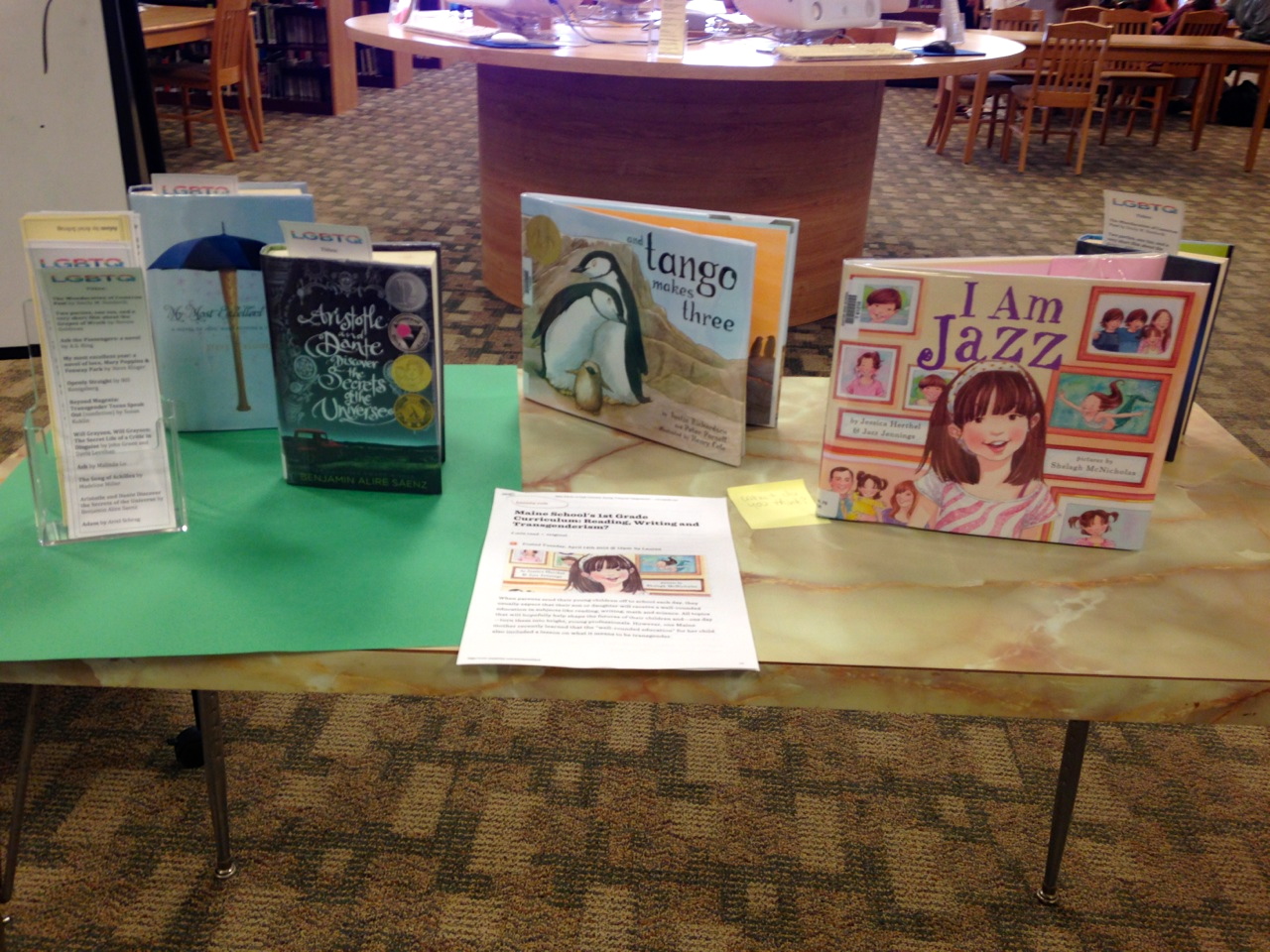
One of the library’s greatest programs for engaging readers has included setting up simple displays to attract students’ attention. While the displays aren’t flashy or ornate, they expose students to a wide variety of books. For example, in honor of June being LGBTQ month, the library set up a small table with a selection of LGBTQ literature. The selection included I Am Jazz, a book about a transgender child that recently sparked controversy in Maine (ourIMG_2153 neighbor) after an elementary school teacher read it to her class. In addition to the display, the library also provided copied articles about the I Am Jazz dispute to educate students. Talk about a teachable moment!

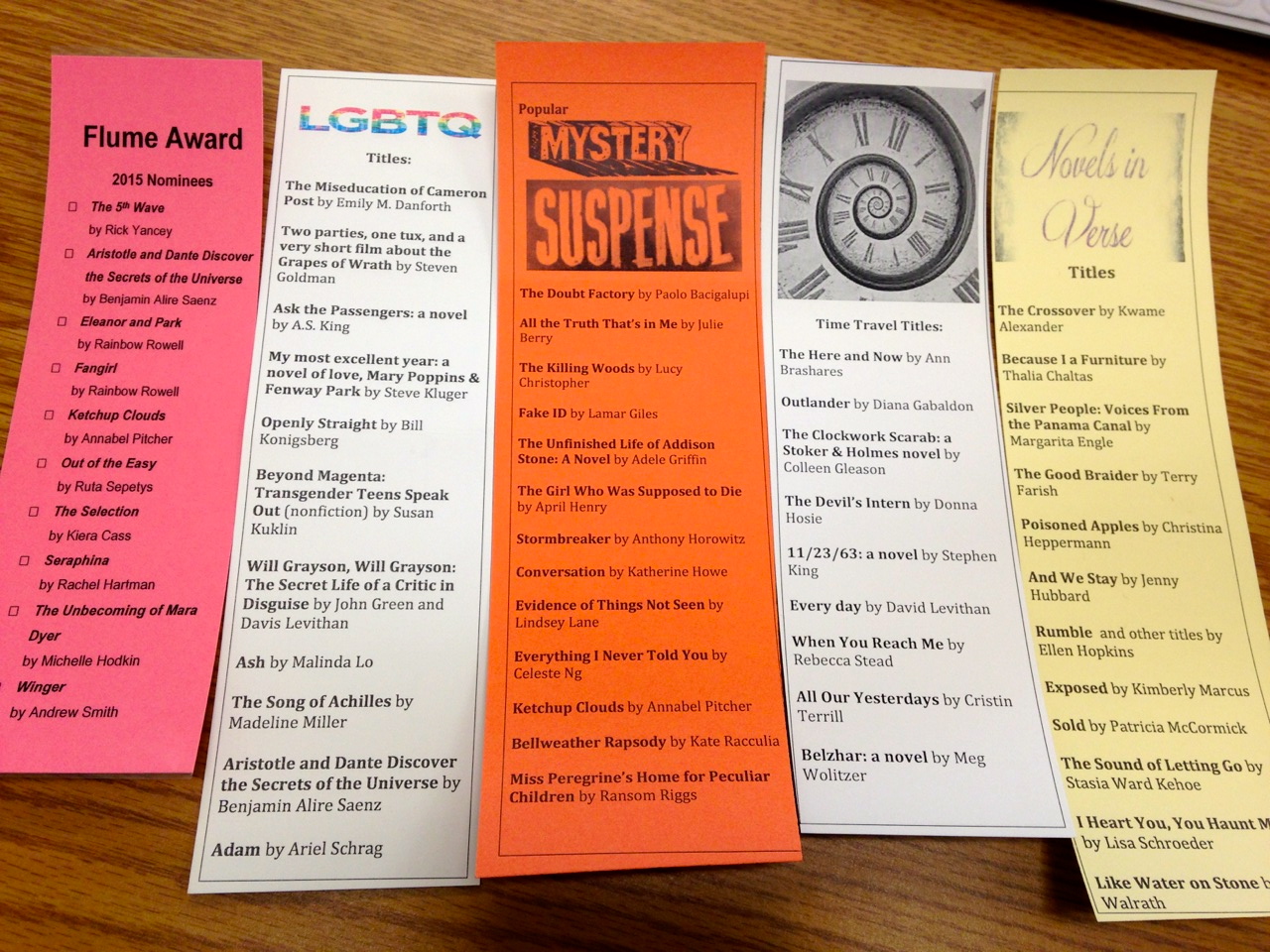
What I love most though is the increasedIMG_2154 availability of book list bookmarks. Throughout the year, the librarians have managed to set up an elaborate display of bookmarks including lists of Flume Award nominees, time travel titles, and novels in verse. Many bookmarks even include suggestions based off popular books; for example, one reads, “If you liked The Fault in Our Stars, you might like…”

As I reflect on my currently library, I look forward to aligning with the library and using their model within my own classroom. I currently use plate stands I bought from a craft store to display books on top of my bookshelves. I am planning to not only steal some book list bookmarks to provide to my students (who are always looking for bookmarks), but I am also going to use these bookmarks to help me develop my book displays

and even my classroom library shelves. In the meantime though, I will certainly count my blessings that such an angel of books not only appeared at EHS but changed the environment that surrounds one of our greatest school resources.

Missing Pieces by Meredith Tate

24903132I love receiving e-mails from students—not the “Is this due tomorrow?” or “Why do I have a zero in PowerSchool?” e-mails—but the ones that are written bleary-eyed, late at night (or sometimes early in the morning) from students who have just finished a book. Recently, Alyssa, one of my Advanced Composition juniors e-mailed me at 10:30pm after finishing Missing Pieces. She wrote:

“Wow, I just finished the book and I am completely shocked! Was definitely not expecting…[Can’t put this in because I don’t want to spoil it!]…I am extremely happy the way it ended! This was most certainly one of my favorite books that I read this year and if any of my friends ask for a recommendation I would without a doubt recommend it.”

As a teacher, finding a book students can connect with is a victory! But in this, case the victory was even sweeter. I grew up with Meredith Tate, the author of Missing Pieces, and even as children playing in the sandbox at our tiny four-classroom elementary school, Meredith knew how to weave a story.

Missing Pieces is the story of Tracey (Trace) and Piren, two best friends growing up in a dystopian world where they are matched with their spouses at six years old based on genetic compatibility. Despite Trace and Piren’s undeniable friendship and eventual attraction, they are paired with different partners. It is a fight between fate and free will.

While the plot might sound generic, resembling the many dystopian romances novels we’ve seen lately, Meredith succeeds in weaving together a distinctly unique story. Trace and Piren are flawed and frustrating and real. They live in a world of messy mistakes. As a social worker, Meredith doesn’t skirt around issues of alcoholism and abuse—instead she confronts them head-on, addressing the harsh, debilitating nature of addiction. I love that this book doesn’t cleanly fit into any distinct genre—it’s a romance, but it isn’t mawkish; it’s categorized as “new adult” but it begins when the protagonist is 14 years old; it’s dystopian yet it distinctly resembles modern society. Despite the numerous questions posed throughout the book (including those in the excerpt below), we learn that life is a series of difficult decisions; it’s the pure beauty of this rawness that makes this book relevant to teenagers.

“What if the one you’re supposed to be with, and the one you want to be with, are two different people? My entire life was mapped out for me before I was born. Is my only choice to silently follow the course already plotted? To blindly accept my future and walk that trail until I die? To smile and pretend everything is okay and I’m happy and in love with my Partner when I’m spiraling downward and drowning in my loneliness? I’m drowning, like in my childhood nightmares. Only this isn’t a nightmare; I can’t wake up from this life.”

Why Assignment Sheets Might Be Killing Your Students’ Writing

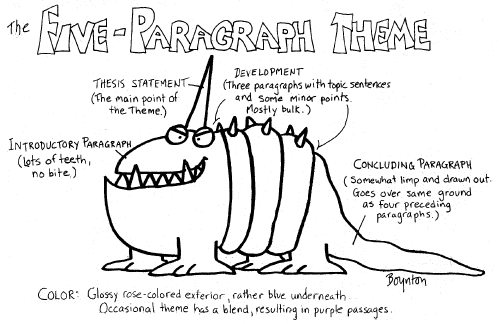
58090ec056811830ee936030edb1c9dbMy first year of teaching, I didn’t realize that the “five-paragraph essay” was a dirty phrase. My  internship year I painstakingly dragged my freshmen through the essay outlining process, watching them regurgitate homogeneous essays about symbolism in Lord of the Flies. At the end of our six-week study of the book, I slogged through 25 nearly identical essays, all of which had eloquent yet oddly familiar intro, body, and conclusion paragraphs. I’ll readily admit that despite the dull content, I felt victorious. My students had completed literary analysis essays and I had taught the foundation of essay structures.

It was that summer that my perception on structured essays changed. Two days into taking Penny Kittle’s writing course at the University of New Hampshire’s Literacy Institute, I realized that I had committed a cardinal sin of workshop teachers. Admitting to teaching the five-paragraph essay (let alone the sandwich method of paragraph-writing) was like confessing to enjoying McDonald’s burgers at an elegant chophouse: the cut (or concoction) of meat might serve the same purpose, to fill me up, but the quality was quite different. In turn, I was feeding my students homogeneous writing, a detailed equation to a subject that couldn’t be distilled down to simple mathematics. If I expected greatness, I needed to break beyond the boundaries of such a restrictive form of writing. After all, an introduction + body paragraphs + conclusion didn’t guarantee a solid essay; if anything, it guaranteed an entirely unspectacular essay.

This process of digesting the material and then providing a summary of the structure was far too easy for students. Not only did it place the onus on me to provide a set guide of instructions, but it also required me to complete the majority of analysis. Instead of my students engaging with the text and delving into the intricacies of structure and craft through individual exploration and group discussions, I was basically pre-digesting the material before offering it to them.

IMG_1845

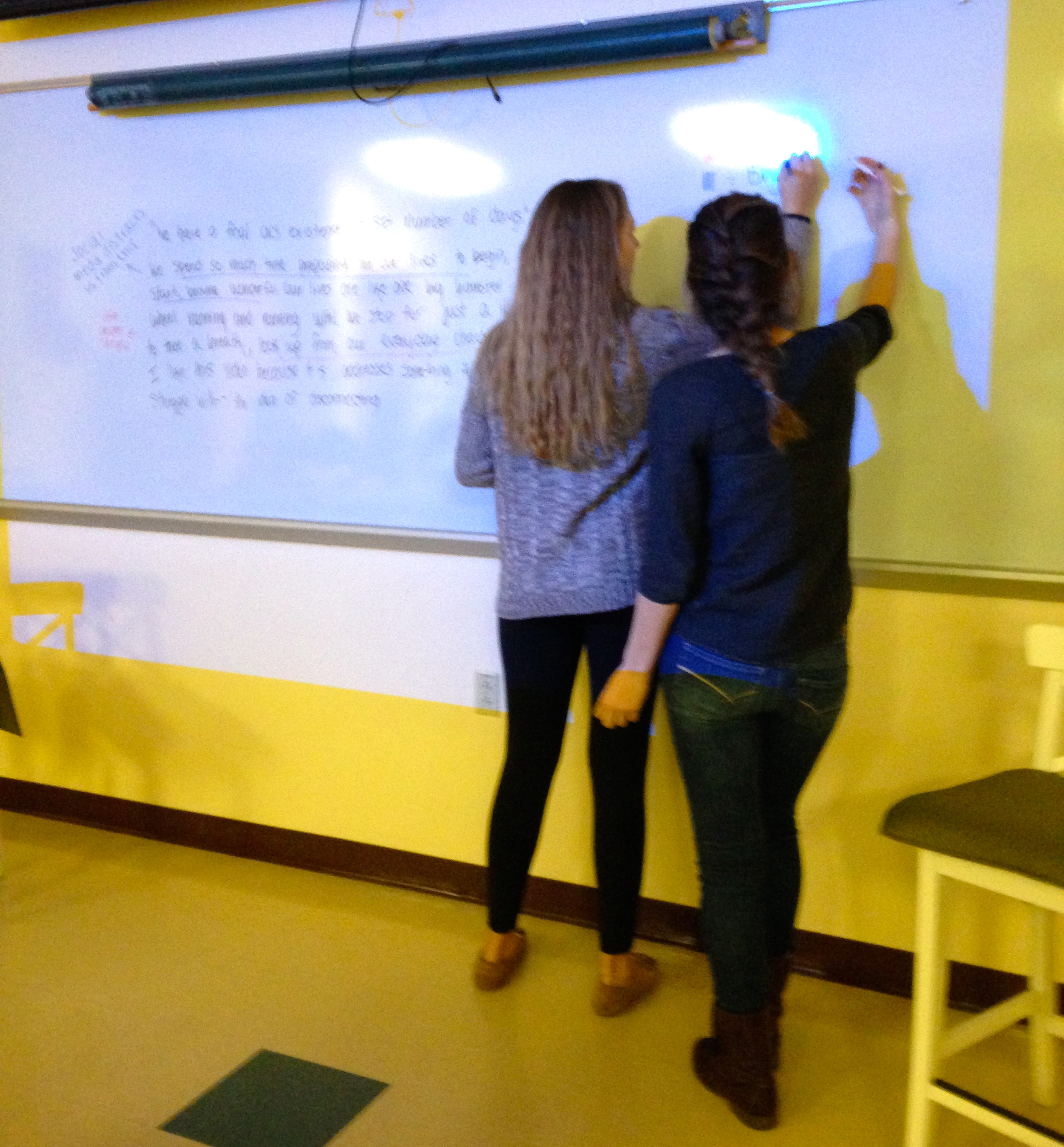
Students analyzing an author’s craft in front of the class.

This year I have made a point to wean my students, particularly my juniors and seniors, off the assignment outlines they so desperately desire. Instead, my students now receive a half-page sheet simply telling them the type of essay they are writing (cause and effect, definition, personal narrative, etc.), the mentor texts they may refer back to, the page length requirement, and the due date.

Initially, they were frustrated with this format. As one student said during our career building unit in which we practiced writing cover letters and resumes for celebrities, “Ms. Catcher, do you have an assignment sheet for this or something?” When I pointed out the paper I had given to him previously, he replied, “No, I mean something that tells me how to write this paper.” We discussed the numerous mentor texts we had read and dissected and how these as well as our class discussions ultimately provided the basis we to develop our pieces. As a class, we asked questions of the text and author, starting broad by looking at the overall tone, voice, structure, intended audience, and progression of the piece. Then, independently or within small groups, we delved into more of the intricacies—what examples were provided, word choice, sentence structure, punctuation, and transitions. Students have gradually learned that there is no set solution for getting an A, which also means that they are forced to read and reread mentor texts to gain a firm understanding of a piece’s intricacies.

My problem from the beginning was that I was too busy telling my students how to write an essay to allow them to discover the messy albeit enlightening connection between reading, writing, and modeling. As we complete the last six weeks of school, I have noticed a significant difference in the structure and craft of my students’ work. They are relying more readily on mentors to help guide them in their process, and I can see both their group and independent analysis directly translate into their writing. For the past three years, I have harped on my students about showing rather than telling, but as the year comes to a close, I can finally say that I have internalized my own advice when it comes to my teaching.

How do you inspire students to rely on mentor texts instead of assignment sheets?  What steps have you taken throughout the year to make them more independent and confident writers?

Shelfie Saturday

sticker,375x360.u1While my last name is Catcher, I’m far from a natural athlete. In fact, my high school softball career ended after I “caught” a stray throw with my forehead, landing me in the ER with a swollen eye and thirteen stitches. Still, I can appreciate a brilliant sports story, the type that moves beyond the game and captures the essence of teamwork, leadership, and friendship. The “Sports” section of my classroom library does just this.

Over the past year, I have cultivated the sports section to reflect the varied abilities, ages, and interests of my students. I teach freshmen, juniors, and seniors ranging from struggling to gifted readers. Because of my diverse students, my library must appeal to 14-year old freshmen and 18-year old seniors alike. Fortunately, sports can oftentimes bridge this age gap while also pushing students to gradually engage with more complex texts.

My somewhat anemic-looking sports section.  Many of the books (particularly the ones not pictured here) have waiting lists and won't return to this shelf until the end of the year.

My somewhat anemic-looking sports section. Many of the books (particularly the ones not pictured here) have waiting lists and won’t return to this shelf until the end of the year.

My younger students (and even some of my older) tend to gravitate towards popular young adult novels at the beginning of the year, like those written by Matt de la Pena and Mike Lupica. After they exhaust the options on my shelves, they inch towards lengthier and more complex analytical or historical books like Moneyball: The Art of Winning An Unfair Game by financial journalist Michael Lewis or The Punch by sports writer and commentator John Feinstein. More than any other genre, these brilliantly crafted pieces serve as strong mentor texts for a wide variety of mediums including nonfiction, narrative, research, and persuasive writing. This year, books like Ice Time by Jay Atkinson inspired many of my hockey players to explore their sport through personal narratives while Shoeless Joe by W.P. Kinsella served as the basis for one of my freshman student’s research papers on the Black Sox Scandal.

Sports hold leverage within our society, particularly amongst teenagers. From die-hard fans to benchwarmers, both athletes and non-athletes can appreciate a sports story, particularly when it transports us into a world packed with suspense and action.

Join the conversation by posting your own shelfies!  Share a shelfie with #shelfieshare and let us know if it’s a #classroomshelfie, #bookstoreshelfie, or other miscellaneous find.

Persepolis by Marjane Satrapi

persepolisIn honor of ALA’s recently released 2014 Banned Books List, I can’t help but recommend the second most banned book Persepolis by Marjane Satrapi.   Persepolis was one of the three graphic novels that made the top ten list this year. The book is criticized for its use of gambling, offensive language, and political viewpoints as well as for being “politically, racially, and socially offensive” and for having “graphic depictions.” In reality, this graphic memoir isn’t afraid to tackle the horrifying and at times comedic realities of growing up in a community faced with political turmoil. After all, Satrapi wanted readers to recognize that Iranians are normal people, just like everyone else. They enjoy music and parties and clothes; the difference is that the characters in Persepolis are living during the Iranian Revolution. Satrapi begins her narrative at six years old, relaying the stories of every day life as the Shah’s regime is overthrown, the Islamic Revolution takes hold, and the war with Iraq destroys her community.

What I love most about Persepolis is its ability to attract my reluctant readers, particularly my students who would otherwise steer clear of the international shelf in my classroom library. These students are drawn to the simple black-and-white cartoons and the rebellious teen protagonist. They love her quirky sense of humor and her obsession with American music icons like Michael Jackson. Like many of our students, she is an angsty teen coming of age. The difference is that she grows up during political conflict and war. Her world is changing around her, war has becomes standard, and she, as a teenager, is attempting to find normality in completely abnormal circumstances. But it’s Marji’s ability to navigate this morbid world and go through complex transformations that make her come alive on the page.

I tend to use graphic novels towards the beginning of the year when my students are becoming acclimated to analyzing writer’s craft (or even when they need a refresher on it). Oftentimes students are more in tune to looking at the details of drawings than of writing; they find it easier to pick out the eccentricities of images yet rarely do they question why the artist made the choices they did. Graphic novels give them the opportunity to do just this.

I have students work in small groups to analyze the artistic decisions of the illustrator. For example, in Persepolisthe scene to the right, Marji has been taken into custody by the Women’s Branch of the Guardians of the Revolution, a group in charge of monitoring women’s wearing of the veil. When they stop to study the images, students notice the repetitive stern expression of the guardian and the way Marji’s face appears to melt into squiggly lines as the frames progress. They notice the transition of the lines surrounding the word bubbles from smooth curved lines to sharp zig-zags. They recognize changes in font size and effects as well as the underlying narrative strand at the bottom of the frame that shows internal dialogue. As they analyze these details, they also begin questioning the choices that lead to the depictions of these conversations and emotions and what they ultimately mean in the context of the story. By the end, the graphics take on a more complex tone. The images come alive, the artist’s intentions become clearer, and they have immersed themselves in a new lens that allows them to take a second look at literature.