Category Archives: Guest Post

Make Sure We Are Momma Bears for Our Students by Lindsey Cary

I had a momma bear moment this weekend.

images.jpg

You probably know what I mean.  This bear came out at the baseball diamond, mid-day, in 90-degree weather and a blazing sun.  It was the kind of day where I had to eat my popsicle from the concession stand in three bites or I’d be wearing it.

Despite the heat, my six-year-old finally had a hit (yea!), but unfortunately, he saw the throw to first hit the baseman’s glove, so he turned to run back to the dugout thinking he was out. However, the first baseman dropped the ball.  If my son had kept running and ran through first as he was taught to, he would have been safe. Most fans were encouraging albeit disappointed in his rookie move. But, one older gentleman, decided to yell and bark his feelings about the mistake and then about how he could correct it.

According to my sister, I was a subdued Momma Bear.  I gave my mean look, which if we are being honest still looks fairly nice, and I quietly responded from a safe distance that “He is six.  This is not the Majors.” I don’t think there was any damage done…at least my non-confrontational self hopes there wasn’t!

Although it is summer break, my teacher mind is still churning, and this episode caused me to think about how we give students feedback.  I came to the realization that I need to be more of a Momma Bear for my students. I think I generally orchestrate feedback fairly well, but there is always room for improvement.  Here are some guidelines or some points to ponder for being a “Momma Bear” for our students.

  1. Constructive Feedback Doesn’t Need to be Public

Whether I’m redirecting a behavior or providing a student with writing feedback, I DO NOT need to broadcast this to the whole field…err, I mean classroom.  This is probably a no-brainer, but we’ve all had that student at some point when gentle nudges and private hallway or after class chats don’t seem to be working.  We are frustrated and just want to do our jobs. As our temperatures rise and our patience levels fall, we slip up. Little good will come from this. And just think, how would this student’s momma bear handle hearing your feedback broadcasted from across the classroom?  Let’s keep exploring other avenues other than public embarrassment to redirect our students’ behavior or to provide writing feedback (see number 4 below).

  1.  Feedback Overload Doesn’t Work

The gentleman from the baseball game had all the best intentions I’m sure just as we, as teachers, do.  He wanted to help my kid understand, make him a better player, and win a close game. In his mind, barking out five different suggestions to my guy seemed like a helpful and sensible idea.  However, there was no way my son was going to process all that! He just learned you can run through first base this year!

I’m guilty as a teacher of what this man did.  I want to help my students so much, so I’m often tempted to point out mistakes and improvement suggestions all over their papers.  But, we need to put ourselves in our “players'” and “Momma Bear” shoes. My son was not going to remember all five things he yelled at him; he was only going to head back to the dugout discouraged and confused.  We need to purposefully provide a reasonable amount of constructive feedback that focuses on improvement and growth. A student can tackle a few changes at a time. Then, we can add new skills to work on once they reach mastery.

  1.  Praise Goes a Long Way

I knew I would need to talk to my son about the incident in the game, but I tried to approach the topic in a kind and nurturing manner as any Momma Bear would.  After the game as we walked back to the car, we stopped and looked down first base line. I shared with my son how proud I was of his hits during the game and how he scored his first run on a close play.  As we reminisced, I brought up how cool it is that he can run through first base in baseball so that he doesn’t have to lose any of his speed. We discussed what he should have done instead when he was out at first, and I made sure he understood.  He walked away from the game laughing and happy but determined to do better next time.

Isn’t this what we want for our students?  When giving feedback to our students, we have to look for the positives.  Our brains aren’t always trained for this; I know that my default setting is correction mode.  Maybe this is because that is the way many of us were taught by most of our language arts teachers, or maybe it is because of the stress we all feel from above to raise student standardized test scores.  Regardless, we need to take a breath and consider the awesome writerly moves our kids are making.  

Ralph Fletcher wrote, “Even with a “bad” piece of writing, a good teacher will reach into the chaos, find a place where the writing works, pull it from the wreckage, name it, and make the writer aware of his or her emerging skill with words.”  With a growth mindset philosophy, no writing is “bad” as students work toward improving their craft. Furthermore, we can’t just say “good job,” but we need to give specific praise. When we honor what our students are doing well, they are more receptive to what we want them to improve.  We need to retrain our brains to look for the positives. Maybe we make ourselves a cheat sheet of different writing moves we can praise, maybe we look for the most recent mini-lesson skills we’ve worked on and appreciate how the student attempted to incorporate them, or maybe we notice the effort our student put into a new piece.

  1.  Relationships, Relationships, Relationships!

My son didn’t know this older man.  All he knew was that he was someone’s grandpa and came to most of our games.  Momma Bear brain was screaming, “Let his coach explain it to him. He doesn’t even know you!”  

The same goes for our students.  We can’t be that well-meaning, grumpy old man on the sidelines to them.  If we want them to take our feedback to heart and mind, we have to be someone to them.  In Write Beside Them, Penny Kittle describes a time she received feedback on a piece of writing from a stranger and how upsetting it was because that person didn’t even know her.  She later reflects on this incident, “You just can’t develop a relationship with a writer by trying to fix everything.”  

We have to build that trust and show students that we care about them and their writing from day one in our classrooms, and we have to foster these relationships every day all year long.  Students have to know that once they step foot in our classrooms we have taken on Momma Bear responsibility and will do whatever we can to make them a better person and learner!


Are these four reminders earth-shattering? Probably not.  But do we all fail at these from time to time? I know I do.  Come August I plan to arrive at school ready to be a protector, a guide, a cheerleader, and a full-out Momma Bear for my students.

Lindsey Cary is an ELA teacher of 12 years, a graduate of the Indiana Writing Program Summer Institute, and an Apple Teacher working to make reading and writing relevant for all learners. Connect with Lindsey on Twitter at @lindseyacary.

Guest Post: Why I Want My Classroom To Run Like Zappos

I like shoes. Like many 20 something teachers, I want some variety in what I wear to 9d67eecb760e5f2da5199c53ffd5e85awork (heels, flats, boots, hand-painted Tom’s with Shakespeare’s quotes…) which means I’ve spent a lot of time perusing, purchasing, and inevitably returning some of those online shoe purchases. Hands down, their company is one of the easiest to return or exchange those shoes that don’t quite match that new blazer, I also bought online. All that aside, that isn’t why I want my classroom to run like their company.

For the last few years, Zappos has consistently shown up on the best places to work list. But why? This company has recently touted movement toward a “holacracy.”  This term, initially dubbed by the political writer, Arthur Koestler, focuses on the importance of individual autonomy and self-governance. Zappos prides itself on letting their employees be their own boss. Who hasn’t at one point or another dreamed of being their own boss?

Zappos’ move toward a holacracy is one that we’ve been slogging toward in the academic world for years. Author of multiple New York Times best-sellers and Ted-Talk Famous, Daniel Pink’s research on behavioral science, especially that on motivation, has verified what we as teachers have known for years; when we let the students be the boss, the quality of work often shows a shocking improvement in both output and originality.

Jumping on the Genius Hour bandwagon, with guidance from peers, I integrated this concept into my 12th grade English course. Once a week for twelve weeks, students researched and created a project that was their choice. In our district, people more powerful than me pushed for this concept to be a “real” part of our 12th-grade curriculum: the capstone of their high school experience. Through new curriculum development and alignment, this new course came to fruition. Relying heavily on Pink’s tenets for motivation, I’ve found that the level of work submitted to my “College Prep” English 12 classes often surpasses that of their Advanced Placement counterparts. Students have dazzled me by turning their ideas of starting a nonprofit organization into reality. Students who’ve written business plans for an online venture they want to begin in college.  Students who’ve created and launched their own drop-shipping companies and websites. Students who mastered specific aspects of Leonardo Da Vinci’s drawing style. Students who analyzed the psychology of repetition changing the neuroplasticity of brains. Students who completed a statistical analysis of data where they collected and disaggregated data on whether standardized test scores are representative of student GPA. Students who have designed and coded games of their own creation.

Students who don’t consider themselves “lovers of English” find success in this class. Students with special needs find success in this class. Why? Because, for once, they are their own boss.

Screen Shot 2018-07-01 at 10.53.17 AMWe start the trimester by exploring Pink’s research using excerpts from Drive and Dan Ariely’s book Payoff while also viewing Pink’s RSA Animate video. While my favorite part might be the Back the Future references, what we actually discuss are the ideas of companies like Skype, Wikipedia, and Atlassian. As a class, we dissect how each of these companies fulfills the concepts of purpose, autonomy, and mastery.

The conversation inevitably leads to the question: How are we going to do that in a class? From those big ideas (no, I don’t expect you to start a fully functional company), we scale back. What can students realistically complete in twelve weeks?

After brainstorming and project tuning, I become more of an instructor on educational pedagogy than the traditional English teacher. Each student is responsible for creating their individual learning plan and personal curriculum. Some days I slip on my curriculum boots and help kids write their own essential and guiding questions, explore (and explain) the Common Core State Standards, climb up Bloom’s Taxonomy and wade through Webb’s Depths of Knowledge. Students know these educational researchers and can articulate how their research and projects are fulfilling these expectations for curriculum. On other days, I tie on my English teacher tennis shoes and help students improve their research skills, encourage networking for action research, and determine the structure for research writing, revising, and editing.

Encouraged by the holacracy of their working environment, Zappos team members might set the record for longest and friendliest customer service calls. They might send you flowers when they make a mistake on your order. These employees go the extra mile not because they must, but because they want to.

In my classroom, I want students to go that extra mile: give an hour-long expert presentation on their learning, start a nonprofit, paint a mural in an impoverished community, teach their peers self-defense, create, design and 3-D print a new product. What does that mean for me as a teacher?

I compare it to watching my niece learning to tie her shoes. Even though it would be so much faster for me to tie her shoes for her, it is essential to explore the process and allow her to move at her own pace. Sometimes you’ve got to let her figure out if bunny ears or loop-swoop-and pull works best.

I want the same experience for my high school seniors. No matter the age, people learn best when they can be their own boss. Though it is easier said than done, we need to think about our identity as educators in an ever-shifting perspective. We need to continue to revise what it means to be a teacher. There are moments when you are needed to be the expert in English, literature, language and writing, but in a class that thrives on Genius Hour organization, you also have to accept that you are not the expert in every single avenue of research your students will take. As the teacher, you do your best to learn alongside your students and model what it means to be inquisitive and passionate about learning.  It takes time and a willingness on our part as educators to take a step back from being the “sage on the stage” and allow students to explore and engage in new content in a way that is meaningful to them.

Hayley McKinney is an English teacher in Birmingham Public Schools where she primarily teaches 10th and 12th grade English as well as public speaking classes.  She coaches forensic and debate in her spare time. She recently completed a Masters of Arts in Educational Leadership.


Guest Post – Chronicles in Conferring

4

I was so excited when Charles Moore asked me to write a guest post for The Three Teachers Talk community.  After meeting Amy Rasmussen and reading posts like Writing Heals. Writing Assignments Do Not and How to Confer Like a Ninja, I continue to learn solid strategies for engaging my students in authentic writing activities that matter to them.  I am an avid reader and writer; so, it is no surprise that my favorite part of this job is conversing with students about their own reading and writing lives!

In the past, my conversations with students tended to be informal and sporadic; I would only focus on the more traditional feedback like formatting, conventions, and organization. But, with no end-goal or clear means to measure if these conferences were improving my student’s abilities to really think like writers, I would often feel lost and underwhelmed.

3

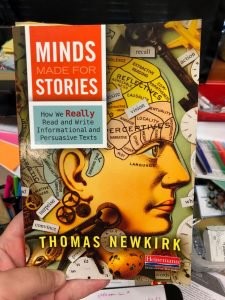
Luckily, I found some real direction after reading, Minds Made for Stories, by Thomas Newkirk and Writing with Mentors, by Rebekah O’Dell and Allison Marchetti.

Both books inspired me to weave together genuine writing advice with mentor texts the students could use as unique needs emerged during their writing journey.

I am so thrilled to share my experiences with other teachers because I love workshop now, and each day is a new opportunity to promote passion and purpose through writing. Charles Moore showcases some great resources for similar strategies in his post, Formative Assessment Works!!! 

A Look Inside My Classroom; Conferencing & Sharing Mentor Texts

Setting the Scene: Sarah, a music enthusiast, has been working on a song analysis essay for a few weeks and she started getting frustrated with her lack of progress. I met with her on several occasions, narrowing her choices in artists and songs, until she had a solid

2plan for her draft. Suddenly, she felt like “it just wasn’t going anywhere,” and she was ready to abandon the project entirely. I think we’ve all seen this before; it was a classic case of “I know what I want to say, but I don’t know how to say it.” She was also suffering from the mind-numbing effects of having more material than she could manage. What to do?
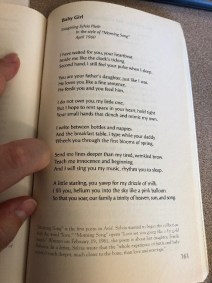
The Intervention: In response to Sarah’s crises and hearing similar angst from other students, I decided to have them all conduct a peer-to-peer conferencing activity. Students would read each other’s drafts and provided feedback that both praises the connections made and presses the writer to stretch a little more.

The Sharing Magic: Sarah decided to exchange her draft with another student who is really into writing poetry and has published several poems during Workshop this year. The two writers discuss, and Sarah is immediately rejuvenated by her partner’s comments and recommendations.  Her partner suggests that she use lines from the songs she has analyzed to write her own epic poem.

5

My Teachable Moment: As she is emphatically exclaiming her eureka moment, I turn to the bookshelf behind me and grab an annotated translation of Dante’s Inferno. I hand her the book, explaining how Dante created elaborate allusions in his poem that are illuminated by the translator’s detailed footnotes.

I never get tired of having moments like this with my students! Sarah now had a mentor text to help guide her through the treacherous depths of poetry composition and analysis.

The next day I brought her a copy of  Your Own, Sylvia by Stephanie Hemphill.  A portrait of the poet’s life told in a collection of verse. Each poem includes insightful footnotes that Sarah could use as a model for her own writing.

1

The Final Act: I was so happy to see a copy of Dante’s Inferno and Your Own, Sylvia on the desk of a student who had spent the entire first semester fighting me to read anything other than mystery novels. Not only is she growing as a writer, she is also growing as a reader. Funny how it works like that.


Jenna Zucha teaches English II Pre-AP at Clear Springs High school. She is currently reading Trevor Noah’s Born a Crime and is looking forward to spending more time with her dog, Scout, and devouring her summer reading list! Follow her on twitter @MsZucha and There’s a Book for That

We Cannot Act Alone – Equity For Every Classroom by Cornelius Minor and Lisa Dennis

3TT Corn Chat

Rattling around the dimly lit corners of the teachers’ lounge and shuttered mall locations of Successories nationwide, one can find the oft-quoted sentiment that teaching may well be the greatest act of optimism.

However, I would argue that today’s teacher is far more likely to embody optimism by learning.  

When we stretch, scrutinize, professionally and personally grow, challenge, inquire, and courageously push ourselves to learn for the sake of better understanding and connecting to our students, then we are better educators and better leaders and better agents of change in our classrooms.

Because we need far more than optimism. We need realism.

At the upcoming NCTE conference this November in Houston, Texas, a convention focused around raising student voice, the passionate crew from Three Teachers Talk will be honored to share with a you a talk entitled, “Accomplice”-ing Great Things: An Action Plan for Equity, Inclusivity, and Allied Partnerships in ELA Classrooms.

Additionally, in the realm of hardcore fangirling, I am pinching myself to report that the incredible, incomparable, inimitable Cornelius Minor has agreed to be our Chair for the session. As Lead Staff Developer for Columbia University’s Reading and Writing Project, Mr. Minor is a tour de force in the fight for equity in the classroom whose passion and persistence is blessedly catching to all those who yearn to do better and be better for our students.

The crew at Three Teachers Talk has been in love with Cornelius Minor for years. I had the pleasure of first hearing Mr. Minor speak at the 2016 NCTE conference in Atlanta, Georgia. I recall being so struck by his words that I uncharacteristically approached him after the session. My thanks for his message turned into some sort of incoherent blubbering, I’m sure, but Mr. Minor smiled that blazing smile he’s known for and gave me a hug saying, “We’ll talk soon, ok?”

Maybe my teacher universe didn’t really pitch wildly at that moment, forever altering the trajectory of my work with students, but really, it did.

Among countless brilliant insights Cornelius shared that morning in Atlanta, I was particularly struck by his statement that it’s our job as educators to teach children how to “maintain partnerships” in order to “define our culture.” I recalled this statement recently as Amy, Shana, and I brainstormed on ways to best share our ideas at the NCTE’s 2018 Convention – Raising Student Voice.

Thus, our work as accomplices to our students came to the forefront of our planning, and a few things became clear.

Chief among them; We cannot become who students need us to be if we act alone.

This work toward equity is deeply personal, beautifully nuanced, and to many of us, it is brilliantly new. We are in a constant state of knowing that for far too many children, there is a savage gulf between what education promises and what education is.

We know the research. Girls are underrepresented in science and technology. Children of color continue to be suspended at exponential rates compared to their white peers. Poor children are more likely to attend schools with fewer resources. These outcomes are sexist. They are racist. They are classist. School, as an institution, continues to perpetuate them. We can change this, and we are certain that the way forward is together.

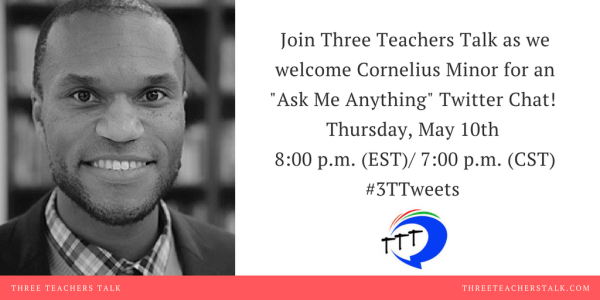
In the spirit of moving forward together, we’ve invited Cornelius to join us for a very special Twitter chat.

So that we can share as much as possible, we’ll be using an “Ask Me Anything” chat format. AMAs, as they are commonly called, are a little different from traditional Twitter chats.

Cornelius will be moderating, but he won’t be posing the questions. You will!

For one hour, you will be able to ask Cornelius anything about literacy, education, equity, activism or Fortnite.

We’re looking forward to seeing where this goes! We’ll put a little bit about Cornelius below so you can get to know him before the chat. Feel free to comment below too with any questions that you hope he’ll answer as we Tweet the night away. 

Can’t wait to see you in the Twittersphere!
Thursday, May 10th at 8:00 p.m. (EST) / 7:00 p.m. (CST)!
#3TTweets 


Here’s a sampling of some of Mr. Minor’s recent (brilliant) thinking:

“We Can Do Better” from the March/April publication of ILA’s  Literacy Today. 

“Five Steps to Launching a Schoolwide Social Justice Movement” from Education Week Teacher

A two-part interview conducted with Laura Hancock at Literacy Junkie


What questions do you have for Cornelius Minor? Leave them in the comment section below as we look forward to watching Cornelius’s fingers fly over the keys on May 10th! Please join us and spread the word for this important discussion with one of today’s foremost educational leaders on equity. 


The Trouble with Grading by Abigail Lund

I sit down at my desk. It’s the end of quarter 3 and it’s time for the dreaded report cards — the time where I average the homework grades, find missing assignments, and vigorously come up with something to say. My computer flickers on and my online gradebook comes to life. It happily tells me many students are receiving A’s and B’s and then, as if it is the Ghost of Christmas Past, the dreaded F appears. John Doe: English Language Arts Quarter 3: F. I stare blankly at the screen.

This very moment I had been dreading the whole quarter. What does this F tell me about John Doe? Does it say how much he’s improved in reading over the quarter? Does it say if he knows how to compare two texts or write an introduction to an opinion writing piece? More so, does it tell me about his cooperation with others and his big heart?


A year ago this is how I graded, this vicious, unnerving cycle of grading. Then I found Twitter. Twitter is a beautiful tool, and after a bit of digging I realized that there were other classrooms out there that were gradeless (an amazing Twitter community for all of this is Teachers Going Gradeless; @TG2chat). I wasn’t the only crazy person – so I took the plunge.  The past seven months of a gradeless classroom has changed my perspective and gives my John Does a fighting chance

Gradeless doesn’t mean a lack of assessment. It means giving students an opportunity for success through practice, voice, and self-reflection. A gradeless classroom is multi-faceted and is constantly changing.

In my experience, it offers students more practice, collaboration, observation, conferring, and gives more time to accomplish what I, as a teacher, was asking for previously. Gradeless classrooms take the pressure off of points and focuses on learning and growth (which happens for kids at different times). According to the Organization for Economic Cooperation and Development (OECD), researchers concluded that “after around four hours of homework per week, the additional time invested in homework has a negligible impact on performance.” This very fact was the first step into my gradeless classroom. As teachers, our time is often consumed with grading endless amounts of homework in hopes that our kids will average a decent score at the end of the quarter, but with my gradeless classroom I spend my time on more things of value.

When I finally had this mind shift, I allowed for more student reflection on work, which has a positive affect, and I eliminated graded homework. Previously I spent a lot of time assessing students’ homework. When I decided to move to gradeless I moved more towards rubrics and conferencing, which naturally moved away from homework. Students reflect on the work they have done. Through reflection and rating of their understanding, I am able to confer with them more effectively during our conferencing and small group times – far more than homework ever did.

images.jpgBy ditching homework students have more opportunity for self-reflection and practice without the pressure of having every piece of their work graded. Students take more risks and ask more questions, because there isn’t the fear of failure. For example, student practice work and homework becomes less about getting the right answer and more about the exploration of the process. In the day to day students are meeting in small groups, reflecting on learning using rubrics, and analyzing strong mentor models.

Eventually, as the learning processes unfold, I formally measure students’ understanding through using my State’s standards: student exceeds standard, meets the standards, or does not meet the standard. This assessment occurs after students have had ample time to ask how they need to improve and what they need to learn. There isn’t a specific algorithm for when this assessment occurs, but by meeting with students weekly you will get a strong sense of what your students know and how you can push them towards meeting the standard.

When I started caring LESS about the percentage and MORE about my students learning, I began to let go of control. Gradeless means more attention to detail. As a teacher, I am able to observe student work and evaluate it with a greater purpose in mind. When evaluating, I use standards based grading, which is district initiative. This lends itself greatly to my gradeless classroom because it eventually assesses students on skills and not percentage based scales. Standards-based and gradeless are not synonymous but are blended very easily. If you are thinking about going gradeless, standards based is a route you may want to go, but there are other avenues as well.

This can also be done by creating standards-based rubrics and face-to-face conversations for assessment. It allows for my students to work through projects together to begin with, and after gaining confidence, they often being to soar through the second quarter. Through this gradual release, I am able to create lessons that are multi-faceted and allow students to know what I am expecting, the standards, and how to achieve them.

Some questions come to mind

What will my report cards say if my district isn’t like yours and has percentage based grading?

An encouraging word I was gradeless before my district moved this way. Unfortunately when it comes to report cards you will have to average your students’ work. However, this doesn’t have to be done in the traditional sense of a composite score of homework, assessments, and projects. This can be done with observation notes, through assessing what your students really DO know, and using your knowledge of your students to grade them fairly.

How do you keep track of your students’ progress?

In my classroom I have my students send their work via Google-classroom. This gives me a portfolio of work to draw from when I am assessing with our standards. My students are rated on a 1-4 scale (1: not progressing 2: progressing with guidance 3: grade-level achievement 4: achieving above grade-level). Also students rate themselves on their understanding weekly. I am able to pull from those examples to compile an understanding of where my students’ understanding is.

How did I explain this to my students’ parents?

For the most part my parents were very much on board when I decided to go gradeless, this was probably because we were also going to standards based grading scales, which was a district decision that they communicated to parents. I was very upfront at the beginning of the year, explaining the gradeless philosophy, and had a lot of support from my parents.  With a gradeless classroom I believe that I am talking more to my students than I ever did before, and this translates to home as well. Keeping an open conversation going about student progress keeps parents happy, whether it is concerning grades or not.

Going gradeless is an ever-changing, flexible way of teaching. This isn’t perfection but what in education is? My hope is that my classroom would be a place where students can explore, desire education, and create. My greatest desire is that my students would be known and their ideas & thoughts would be validated. The place I have chosen to start is to know my kids by name and not by a letter.

Abigail Lund teaches 4th grade ELA and math to her fabulous kiddos in Cincinnati. She loves coffee about as much as her husband and cat… and is a self-proclaimed lifetime learner. Catch up with daily happenings and ramblings on Twitter @mrsablund.

Guest Post by @cJezasaurusRex — An Open Letter from a Book Thief

Dear Ms. Gerdes,

You were the first teacher who taught me how/ when to properly use “Ms.” You taught me the power of a Phenomenal Woman. You taught me to value my mother. Big Time. And you taught me that reading is magic.

Ironically, you were my math teacher.

I wish I could say that you “gave” me books. The fact of the matter is that — I actually stole them. Actually. Literally. (Non?)Legitimately. STOLE A BOOK FROM YOU. Maybe even more than one. Probably, Likely so.

And all I can do right now is to apologize. Also–what is your address? Do you prefer USPS, FedEx, UPS, Armed Guard?

Just, please forgive me.

If you remember me at all, then you know (at 36) I would eventually be safely breaking every conventional rule in regards to punctuation and grammar. I hope you knew me well enough to know there is purpose behind my rebellion.

This all started more than 25 years ago. You were a Pioneer for Choice Reading time. And I know that I talked through most of those minutes, but I swear to you that I WAS SOAKING IT IN. Conduct marks set aside, I watched as you made time to focus on your own book during MATH!? I was, assuredly, a total A-Hole about it. Again, Sooooooo Soorrryyyy About that. But— I need to tell you that you are the ONE who (unknowingly) gave me a gift that I hope I am worthy enough to pass on to hundreds of other fellow humans.

I teach English to High School Students, and I flipping swear that 15-year-olds are and will remain the ultimate worst EVER. I love them. Every day. Not every second of every day… but mostly just every day. I look at them and am reminded of when I got sent to ISS or locked in a book closet by my English Teacher, and so it’s just effing fine by me that I threw my Pre-Law Degree out the window (wish the student loan attached would disappear too).

Since I’m always broke, and I’m the baby sibling, my Big siSTAR gave me her OLD Kindle about 12 years ago. Before I reset the account, I had to read ALL THE BOOKS she left on the account. One was Readicide by Kelly Gallagher.

For roughly 12 years, I’ve (kinda) done what I’ve been told by The System while I operated another system behind that closed door. I’ve tossed the curriculum back to my students like a contagious, hot potato. What. Do. YOU. Love. To. Read. As teachers, we often forget that it was NEVER about us, and it NEVER will be about us. And it has been my mission since my first year of teaching to throw my neck out on the guillotine to fight for that freedom.

Ms. Gerdes, I hope you are proud of the part you played in creating this monster.

But I stole your book. Now that I have built a classroom library of close to one thousand books, I know how pissed I get when my curation starts to disappear. Year after year, the carefully selected and bargained-for dwindles as quickly as cotton candy in a humid, Houston Heater. Some moments, I look at my shelves and wonder why my students can’t just return that damn book!

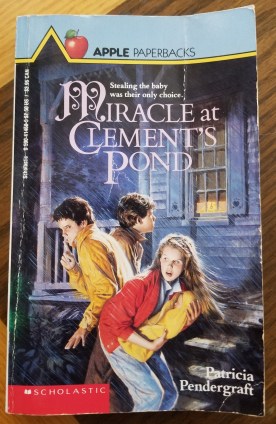
Today, while my Punky Brewster of a daughter was helping me pull all the donations we have for our town’s Little Free Library, she brought me Miracle at Clement’s Pond by Patricia Pendergraft. Your name written in permanent marker across the back.

miracle 1miracle-2.jpg

I’m. Melting. I am so sorry. I won’t even say that, “I can’t believe it.” I won’t even say that, “I’m so ashamed.” I can believe it. And I’m a little glad that I’m not ashamed.

You must have told me about the miracles found in books. Maybe, even this one in particular. Maybe I wasn’t ready, at 11 years old, to read what my teacher suggested–but I was ready to STEAL it so HARD! (I am sorry about that.) Mostly, at 36, I know what it feels like to bury my nose in words that make magic. The spell that is crafted by each stroke of the pen. To finish a novel and then hold it close to your heart with your eyes closed. Brimming with tears of empathy and connection. The feeling that next day of “Great Book Hangover” causing all other brain functions to fail.

This is the most life-altering lesson any teacher can leave behind.

I’m real sorry that I stole your book. (Plus, also I am sorry I was kind of a pain). The most sincere apology I can offer is that I am about to read this book, and I will NEVER forget Miracle at Clement’s Pond by Patricia Pendergraft–even if it sucks so hard. Plus, each time one of my books turns up missing, I promise to think of this apology. I promise to think of how pseudo- crappy kids can turn out to be alright humans. Or that ultra-rad kids can sometimes make terribly impulsive decisions. I promise. I promise. I promise. I stole something from you that is much bigger than a 242 page paperback from Scholastic.

I stole promise.

I hope you will forgive me. I hope you know that you truly changed my life. I hope to do the same for others.

Incredibly Sincerely Best of all Regards,

Crystal Jez

Crystal Jez has been teaching high school English in Texas for twelve years.  As curator of a chaotically color-coded classroom library, she is typically knee-deep in stacks of books.  When she isn’t reading or teaching, you can find her chasing chickens or saltwater kayak fishing.  Crystal is the wife of a super-hot guy and mom of three ultra-rad kids.

At the Heart of It All Is Literacy by Sarah Morris

The recent teachers’ strike in West Virginia has me thinking about my Grandmother, Mercia Dunmire. She taught in a one-room schoolhouse in Monongah, West Virginia, a community framed by mountains and mines, teaching the children of coal miners and subsistence farmers in a multi-grade classroom.

As family mythology tells it, after noticing children coming to school hungry, Grandma Mercia organized an effort to feed everyone every day. Parents who could do so donated from their gardens and pantries, and older students cooked lunch, learning to prepare food and sustain the group by working and eating together. In the guise of a daily home economics lesson, Grandma Mercia’s students learned service and community, caring for each other as an act of equity. She fed others’ children even while she struggled to feed her own, racking up debt for groceries on credit at Manchins’ store after her husband died, sealed in a fire-filled mine.

Grandma Mercia was like that–she saw opportunities out of need and struggled to help her students in ways beyond teaching them to write and read. She filled my shelves with books, but, more importantly, she influenced me to be aware in the world, to see and struggle against injustice, and to teach.

In 2007, I represented West Virginia as our state’s Teacher of the Year, attending several events and conferences where teachers from all US states and territories gathered together to learn from each other and raise our collective voice. At one of our events, we dressed to represent our home states. Given that so many recognizable costumes related to West Virginia are caricatures grounded in stereotype, I wanted to choose a memorable and impactful way of representing our heritage and history.

19141-004-41679953.jpg

Mother Jones

I dressed as Mother Jones. I pulled my hair in a bun and donned a black dress and wire rim glasses. I carried a sign marked with her words: “Sit down and read. Educate yourself for the coming conflicts.” I found myself explaining many times who she was, what she meant to miners, what she meant to West Virginia, and what she meant to me. Like Grandma Mercia, Mother Jones taught me through her legacy about how to be in the world.

Today, I’m thinking of Grandma Mercia, Mother Jones, and teaching in West Virginia. This week, teachers are picketing and rallying, closing down the schools, fighting to raise pay from 48th in the nation and for adequate healthcare for all public employees (myself included, since I’ve moved to the university classroom).

Today, our governor owes more in back taxes than a teacher will see in a lifetime, our state legislature refuses to pass a severance tax that could fund public health insurance, and a coal boss runs for senate with the blood of 29 miners on his hands; our world doesn’t look much different now than it did 100 years ago, echoing with injustice.

Today, it’s our teachers, red bandanas around their necks and holding signs, who are waging the fight, yet they are still caring for students, even out of the classroom: packing lunches, spreading word about how we can help through organizations like Morgantown’s Pantry Plus More who are feeding students while they’re out of school.

These are my thoughts and my experiences, but I know they resonate with other teachers. This is just my story, except when it’s not. I can see, in this moment, that West Virginia teachers are standing in the light of Grandma Mercia and Mother Jones. Whether she is a hellraiser heroine on the picket line or an everyday activist peeling potatoes for the soup, a West Virginia teacher is an agent of change and a fierce advocate for students.

download.jpgAnd, at the heart of it all, is literacy. Reading is revolution. Writing is power.
We must remember, as Mother Jones said: “reformation, like education, is a journey.”

Teachers do the work of progress every day, in and out of the classroom. Especially in this moment, our teachers are educating us: these strike days are readings in civic literacy, in social movements, in what it means to be a West Virginian. The teachers walk the line, writing the people’s history, and we are students, all.

NWP@WVU Co-Director Sarah Morris teaches undergraduate writing courses and is the associate coordinator for the Undergraduate Writing Program at West Virginia University. Her research interests include human science phenomenology, embodiment, writing process, and student-centered teaching. Follow Sarah on Twitter at @drcerelyn

Assessment Graffitti – Guest Post by Margaret Lopez

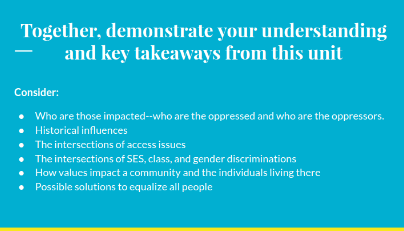
After a largely discussion and low stakes writing-based unit on Social Justice with three texts (Half the Sky, Hillbilly Elegy, and Ghettoside), I was contemplating a final activity to assess their understanding.  I wanted evidence of their thinking.  I wanted my students to show me, in any format, they “got” the unit–that they understood what injustices exist in the world, how they’re connected to privilege and access, and what solutions are necessary to equalize the playing field.  

But I didn’t want to have another seminar.

I didn’t want to give them time to write.

I didn’t want to read another article.

And, full disclosure, I certainly didn’t want cumbersome grading as we are in the final stretch and up to our necks in their year-long inquiry project.

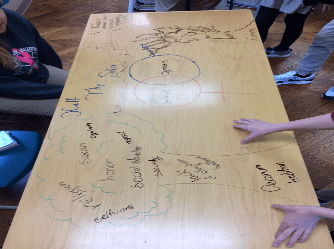
I wanted something new, something we hadn’t done all year.  So, I decided to let my students do something forbidden–I equipped them with Expo markers and let them draw on the furniture.

Disclaimer:  I checked before to see that Expo markers washed off my classroom tables with a little elbow grease and Clorox wipes.  Please do so before!

I simply gave my students these instructions:

Lopez

Then, I stepped aside.  Students had about 30 minutes to complete their visual and were immediately engaged (likely because they were drawing on school property).  

Lopez2

Dev and Lisa collaborating on a cause and effect analysis of Appalachia according to Hillbilly Elegy. 

As they were collaborating, students were discussing the issues we had examined throughout the weeks, Students talked about the values of the oppressors compared with those who are oppressed, and how those intersect with community values.  Students connected historical roots with the current issues discussed in their books, structures of power and privilege that exist, and what solutions should be invested in.  Their purposeful talk around the assessment proved they had read deeply, thought critically, and synthesized multiple issues.

The products were great–original and insightful.  Students gained more listening to their peers explain their group’s visual at the end of class because the conversation was extended and connected, again synthesizing ideas between the texts and our world.

Lopez3

A live tree and dead tree representing opportunity and access for males versus females in Half the Sky.

Lopez4

Graham explains his group’s problem-solution web for the violent community discussed in Ghettoside. 

Lopez5

Emma explains the culture of have and have-nots that exist in other countries between males and females, emphasizing the barriers to equality.

While I ushered students out of the classroom, I heard the ultimate combination of compliments:

  • I feel like that actually assessed my thinking.
  • This unit was great, you should do it next year.
  • That was fun!

Mission accomplished.


Maggie Lopez has six years of teaching experience at large public high schools in Louisville, Houston, and now Chicago.  A graduate of Miami University, she had the pleasure of learning from the workshop masters and is on a continual quest to challenge, inspire, and learn from her hilariously compassionate juniors and seniors. 


Screen Shot 2017-05-01 at 8.44.22 PM

Care to join the conversation? We’d love to add your voice! Please email guest post ideas to Lisadennibaum@gmail.com.

Remembering How Good Readers Read – Guest Post by Brandon Wasemiller

Happy New Year, Three Teachers Talk! We hope your new year is off to a magnificent start. Hot off the presses from Franklin High School, my colleague Brandon Wasemiller writes about challenging our toughest students to value their voices and embrace the opportunities that reading can hold in their lives and their academic experiences with participation in The Global Read Aloud. 


We often talk about sparking the love of reading in our students. It is our daily, yearly, and career-defining struggle. Over the past few weeks, I tried something new because I was really struggling with a Tier II Intervention class (A class I have taught in the past but was reassigned to this year). I was giving book talks, getting to know the students, helping them with their books, teaching them how to be readers; but nothing was sticking. Most of them didn’t even try.   

It wasn’t until the second week of class that I came to a realization through a reading engagement survey, a pre-assessment, and a set of conferences. It was an idea that slapped me across the face and helped me guide the class. They’ve been nonreaders for so long that they have forgotten what it is to BE a reader.I have to re-teach these kids how to read.

And with that, I was off.

A fellow teacher, collaborator, and 3TT All-Star told me about a great project–The Global Read Aloud. A way for teachers and students in different classrooms (and most of the time different states) to collaborate and talk about the same book at the same time. So what was the chosen book? A Monster Calls by Patrick Ness.

(Listen, quick aside here,  but if you haven’t read A Monster Calls yet, what are you even doing?)

And so we began reading A Monster Calls. I tried to think of as many ways as possible to teach this book and make it fun and interesting. I started teaching them about active reading and about thinking while reading. I modeled for them how I read, and I had them track questions and comments throughout, but honestly, I felt like I was spinning my tires.

Then, one day, I pulled out the good ole Audible app and I played the audiobook. The chapters (The Wildness of Stories”, “The First Tale”, and “The Rest of the First Tale”) all feature two distinct characters. Conor, a young boy who is suffering through his mother’s battle with cancer, and a gigantic Yew Tree that turns into a monster at 12:07 to tell Conor stories. At the end of listening to all three chapters, we had a discussion as a class. To my sheer amazement, every single student discussed what happened and had amazingly in-depth responses to my questions.

So what was different? Why did the audiobook reach them better than some of my other activities?

And it hit me.

They are listening and experiencing a real and authentic reading experience.

They are actively engaged and plotting along with a READER who is emphasizing words, speaking in different voices for multiple characters, and emphasizing italicized and stylized words, all helping us as readers paint a picture of the novel in our heads. These are the qualities that good readers do independently. These are the qualities my students needed to re-learn.


I have a memory that I don’t think I will ever forget. I was probably six or seven, and I was at my grandma’s house. Every day, after nap time, my grandma would have story time and she would read from this book of Disney short stories. She would read us a few and she always did the voices. My grandma was Br’re Rabbit and talked in a thick southern accent, she was Mickey and squeaked her voice. My brother, sister and I were her captive audience. Our favorite story, however, was the Tale of the Headless Horseman.

One dark, rainy afternoon (I’m being serious, it really was dark and stormy) my grandma stepped out of the bathroom and her head was tucked inside a jacket and the jacket was zipped all the way up. The effect was that she seemed to have no head. She sat down to read the tale of The Headless Horseman as the Headless Horseman. She performed the tale of Ichabod Crane and his race to get across the bridge before losing his head.

That was not story time, that was an experience. I was there on the bridge racing to save my life, I was looking at the evil horseman careening towards me as I begged the horse to ride faster, I was there as the Horseman drew his sword and prepared to strike….

The idea for this unit came to me as I remembered that sometimes enjoyment in reading is lost because we lose what it is that makes us readers.

When you’re a kid, your parents read to you in different voices. When you read out loud to your parents or to teachers at a young age, they encourage you to read like they do. They help you sound out words, understand what a comma does in a sentence, what it sounds like to read a sentence as a question or exclamation; and then at some point–after the training wheels are off–we no longer read out loud.

So we have students who hate reading because it has been force fed to them for so many years. We get them into Workshop and spark the passion of reading, but they have forgotten how to read. My hope for this unit is that it will help those students.

And so, with this new realization, I decided to have my students tell a tale of their own using A Monster Calls as my mentor text.


Prep: Find chapters that will challenge the students to be readers.

I decided to use chapters featuring two distinct characters. Conor and the monster. Students had to create two distinctly different voices (yes, having a monster voice was a requirement) and they had to deal with sarcasm, anger, frustration, and other emotions throughout the chapter. brandon1

There were three chapters all about seven to eight pages long, so I made three groups of seven to eight students per group. Each group was responsible for a chapter, BUT each individual student had to read–out loud–one page. (Huge selling point here, I just kept telling them “It’s only one page!”)

Mini Lesson – Active Reader Annotating

I told my students that the goal for our first class was to focus on how characters speak throughout the chapter. However, for me, this was an opportunity to teach them how to be an active reader and note taker. I did the first page myself under the document cam.

brandon2I annotated after each line of dialogue for how the character spoke. “What emotions are being expressed here?”  I also told them that we needed to pay attention to italicized words and what they are there for.

We looked at the line “‘He’s been very good, Ma,’ Conor’s mum said winking at him from behind his grandma, her favorite blue scarf tied around his head” (41).

“So why is the word VERY italicized?” I asked. The class then talked about sarcasm and how his mom says it that way as an “inside joke” between her and Conor. “It’s so that Conor’s mom shows him that she gets that this is hard for Conor to handle. She wants him to know she is on his side” one student amazingly pointed out. These are the kinds of things I want them to notice. Not so much content, but style and sentence fluency.

Then they set off on their own! It was time for them to work in their small groups and annotate their chapter–together. I knew that I wanted them to collaborate together so I printed out each chapter on extra large (11×17 to be exact) paper, and set them up in areas that they could circle up and all work together. I gave them the space to work it out and let them discuss the dialogue. If they couldn’t get it, I encouraged them to read it aloud to each other and discuss.

I was amazed at how well they did in their chapter prep work. Often there are students who will push back because they are scared to read out loud, but I found that having only one page, and six other students doing the same thing helped them through their stage fright.

The last step of that day: I let them chose the page they will be reading aloud for the audiobook chapter.


Practice (Group and Individual)

I opened the next class by reading a chapter to them. I did my deep intimidating monster voice, I did my frustrated Conor voice, and I did my mean grandmother voice. I put myself out there and it made the kids smile (and yes laugh) but that is the point. Model for them what you are looking for, voices and all.

brandon6

I told them that they need to practice and become comfortable with their reading of the page and now is the time to do that. Armed with Screencastify (an easily downloadable Chromebook extension for most computers) and a copy of their individual page with annotations, I send them out to record themselves. After they turn the recording into me, I listen and give feedback. I did my best to coach them away from monotone reading, whispering, reading too fast, or too slow, or most importantly, NOT doing a monster voice.

Clearance and Final Recording

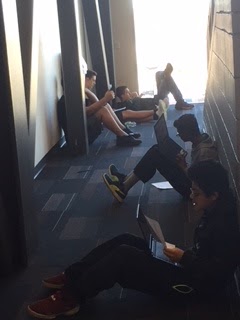
The students were set to go.  As one final step, I called each group into the hallway and had them rehearse the whole chapter, as a full group, for me. I gave them my last bits of feedback and sent them back into the room to do a final recording.


I am already looking forward to revising this unit–make it even better. I feel that it can work in any and all classrooms. So much can be learned by understanding how a book is meant to be read and it is our jobs to help the students learn that.

What do you think of reading aloud and making group chapters come to life? Do you see your students struggling to be authentic readers? How have you encouraged students to have authentic reading experiences in your classroom?


Brandon Wasemiller has been teaching a Franklin High School for the past four years. He graduated from the University of Milwaukee-Wisconsin where he majored in Secondary English Education. When he is not teaching, Brandon coaches multiple sports (Girls XC and Baseball) and enjoys listening to audiobooks while at the gym.


The best books I read in 2017 – Guest Post by Adam Glasglow

I’ve been begging Adam to write a post for us since I met him at a training in CCISD just Clear Creek ISD June 2017 (1)over a year ago. I knew then he was not only a fantastic teacher but an accomplished writer. Last summer when we met again, Adam shared with me a couple of book titles I read and loved, so when I got this post from him this week, my heart did a wee flip.

As you can see, this is not a true guest post. It’s a re-blog of Adam’s Medium site. I’m claiming it here. I read A LOT, but I’ve only heard of one book on Adam’s list. Thank goodness it’s almost winter break — I’ve got more reading to do.

Take a look. Then, please leave a comment and add the titles of the best books you read in 2017.

The best books I read in 2017 – Adam Glasgow – Medium


Adam Glasgow spends weekdays spreading a love of reading and writing with his 10th grade students. On evenings and weekends he enjoys reading, writing, watching movies, learning about wine, roasting his own coffee, trying to get better at disc golf, and hunting for new obsessions. He lives with his beautiful wife in the Houston area along with their two cats, one of which used to live in a dumpster, and another named after a crazed murderer from a Stephen King novel.