Category Archives: Amy Rasmussen

A Novel in Verse to Study Craft

I recently read my first Ellen Hopkin’s novel in verse — all 666 pages. I’d often wondered why some of my most reluctant readers, girls mostly, would stick with and finish Hopkin’s books. Now I know.

While the thickness of the book is intimidating, the number of words on each page is not. The poems are short and beautifully worded, using language that makes the storyline pop like a 3D movie.

Impulse is the story of three characters, all with distinct voices, portrayed in their own series of poems. The point of view shifts from character to character, which I love because that adds to the complex thinking students must do to understand what is happening in the story.

All three characters suffer from some of the worst abuses that can happen in the lives of individuals. All are in a facility trying to figure out themselves and their horrid lives — primarily as result of the actions of adults.

This morning while checking my Twitter feed I was reminded of the need to introduce students to books as mirrors and windows. Students should be able to see themselves within the characters they read about, and they should be able to see into the lives of others that they may never know. Sometimes books allow students to do both. Impulse is one of those books.

I think it would be interesting to use this poem from page 2 as an exercise in imitation. What four verbs might students choose to write into their four sentence poem?

The Thread

Wish

you could turn off

the questions, turn

the voices,

turn off all sound.

Yearn

to close out

the ugliness, close

out the filthiness,

close out all light.

Long

to cast away

yesterday, cast

away memory,

cast away all jeopardy.

Pray

you could somehow stop

the uncertainty, somehow

stop the loathing,

somehow stop the pain.

Starting with the Ending

I am not one of those people who jumps to the last few pages to read how a book ends before I’ve ever started it. I do not understand those people. At all. I like to savor a good book, take it slow, breathe in and out the beauty of the language. OR, I like to devour it in one sitting, holding my breath and wanting more. So, it’s a little surprising that I’ve pulled the last paragraph of a book to use as a craft study.

I promise it gives nothing away. I also promise:  you may just shudder at the loveliness of the language like I do.

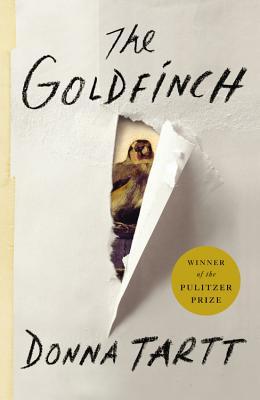
If you have not read The Goldfinch by Donna Tartt, you must. Find the time. It’s worth it.

I don’t know if I can motivate my students to read this lovely book though– it is thick with 771 pages, and the story itself is long, and there are times your love/hate relationship with the main character makes you want to shout the house down. But I’ll try. Because I love it.

This is why:

The Goldfinch by Donna Tartt P771

Whatever teaches us to talk to ourselves is important:  whatever teaches us to sing ourselves out of despair. But the painting has also taught me that we can speak to each other across time. And I feel I have something very serious and urgent to say to you, my non-existent reader, and I feel I should say it as urgently as if I were standing in the room with you. That life — whatever else it is — is short. That fate is cruel by maybe not random. That Nature (meaning Death) always wins but that doesn’t mean we have to bow and grovel to it. That maybe even if we’re not always so glad to be here, it’s our task to immerse ourselves anyway:  wade straight through it, right through the cesspool, while keeping eyes and hearts open. And in the midst of our dying, as we rise from the organic and sink back ignominiously into the organic, it is a glory and a privilege to love what Death doesn’t touch. For if disaster and oblivion have followed this painting down through time — so too has love. Insofar as it is immortal (and it is) I have a small, bright, immutable part in that immortality. It exists; and it keeps on existing. And I add my own love to the history of people who have loved beautiful things, and looked out for them, and pulled them from the fire, and sought them when they were lost, and tried to preserve them and save them while passing them along literally from hand to hand, singing out brilliantly from the wreck of time to the next generation of lovers, and the next.


Let’s just take it sentence by sentence. Then let’s choose a sentence we like and respond to it. That’s enough for now.


A Lesson in Craft: The Yellow Birds

If you have not read The Yellow Birds by Kevin Powers, go buy it and start reading it today. It’s that good. Maybe I loved it because Powers is a poet, and his poetry flows into the language on every page. Maybe I loved it because I have similar fears as the mothers portrayed in this book. At least one of my sons will join the Army in a year.

Whatever the reason, I love this novel, and I know many of my students will appreciate the beauty of it, too.

Many passages are worthy of study, but when I read myself into this one, I knew that the discussion around it in class would be powerful. What do you think students might discover about language by reading this?

I hadn’t know what I was doing then, but my memories of Murph were a kind of misguided archaeology. Sifting through the remains of what I remembered about him was a denial of the fact that a hole was really all that was left, an absence I had attempted to reverse but found that I could not. There was simply not enough material to account for what had been removed. The closer I got to reconstructing him in my mind, the more the picture I was tying to re-create receded. For every memory I was able to pull up, another seemed to fall away forever. There was some proportion about it all, though. It was like putting a puzzle together from behind: the shapes familiar, the picture quickly fading, the muted tan of the cardboard backing a tease at wholeness and completion. I’d think of a time when we sat in the evening in the guard tower, watching the war go by in streaks of read and green and other, briefer lights, and he’d tell me of an afternoon in the little hillside apple orchard that his mother worked, the turn and flash of a paring knife along a wrap of gauze as they grafted uppers to rootstocks and new branches to blossom, or the time he saw but could not explain his awe when his father brought a dozen caged canaries home from the mine and let them loose in the hollow where they lived, how the canaries only flitted and sang awhile before perching back atop their cages, which had been arranged in rows, his father likely thinking that the birds would not return by choice to their captivity, and that the cages should be used for something else: a pretty bed for vegetables, perhaps a place to string up candles between the trees, and in what strange silences the world worked, Murph must have wondered, as the birds settled peaceably in their formation and ceased to sing. And I’d try to recall things until nothing came, which I quickly found was my only certainty, until what was left of him was a sketch in shadow, a skeleton falling apart, and my friend Murph was no more friend to me than the strangest stranger.

Sometimes There’s This One Book

Before the first day of school this year, I learned that a student who was to attend our campus took her own life. She was 15. This would have been her 16th year. It should have been a shining time for her:  a junior in high school, a driver’s license, maybe her first job, and if her family was like mine, her first date (I had to be 16).

Her family, of course, is devastated. I didn’t even know this child, and I am devastated, as I am every single time I hear of the awful reality of suicide.

We have to do something.

I don’t know what, really. I do know that the world should be a hopeful place. I also know that so often adults refuse to act like it is. I am as guilty as the next guy of going through the motions, mirroring the depressive nature of my Bad Day. But I vow to stop.

I want to be an example of hope. I want to smile more. Love more. Laugh more. I want my students to see that I love my job. I cannot wait to get there. (That’s what being at a new school has done for me this year. I’ve let the negativity that I let nag at my soul so long go, and I feel new, reborn, liberated. Strange to use those words, I know, but they describe the “freeing” best.)

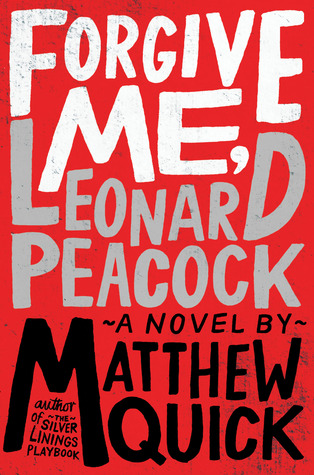
Recently, I read Matthew Quick’s book Forgive Me, Leonard Peacock, and it rocked my world. Seriously. You know when you read a book, and then it haunts you — like forever? This is one of those books for me. I am, and will be, a better teacher, friend, wife, mother, daughter, colleague, leader, consultant because I read this book.

Here is a bit that I will use in class. Maybe we’ll use this passage for close reading. It’s a good one for tone or sentence structure. Maybe we’ll use it to launch a class discussion about hopes and dreams and how to hold on to them. I don’t know yet. But there’s something important here — for us and our students. Read it. You’ll see what I mean.

Forgive Me, Leonard Peacock by Matthew Quick, p46-47

The whole time I pretend I have mental telepathy. And with my mind only, I’ll say– or think?–to the target, “Don’t do it. Don’t go to that job you hate. Do something you love today. Ride a roller coaster. Swim in the ocean naked. Go to the airport and get on the next flight to anywhere just for the fun of it. Maybe stop a spinning globe with your finger and then plan a trip to that very spot; even if it’s in the middle of the ocean you can go by boat. Eat some type of ethnic food you’ve never even heard of. Stop a stranger and ask her to explain her greatest fears and her secret hopes and aspirations in detail and then tell her you care because she is a human being. Sit down on the sidewalk and make pictures with colorful chalk. Close your eyes and try to see the world with you nose–allow smells to be your vision. Catch up on your sleep. Call an old friend you haven’t seen in years. Roll up your pant legs and walk into the sea. See a foreign film. Feed squirrels. Do anything! Something! Because you start a revolution one decision at a time, with each breath you take. Just don’t go back to that miserable place you go every day. Show me it’s possible to be an adult and also be happy. Please. This is a free country. You don’t have to keep doing this if you don’t want to. You can do anything you want. Be anyone you want. That’s what they tell us at school, but if you keep getting on that train and going to the place you hate I’m going to start thinking the people at school are liars like the Nazis who told the Jews they were just being relocated to work factories. Don’t do that to us. Tell us the truth. If adulthood is working some death-camp job you hate for the rest of your life, divorcing your secretly criminal husband, being disappointed in your son, being stressed and miserable, and dating a poser and pretending he’s a hero when he’s really a lousy person and anyone can tell that just by shaking his slimy hand–if it doesn’t get any better, I need to know right now. Just tell me. Spare me from some awful f******fate. Please.”


Note:  There are two footnotes in this passage. I left them off quite simply because I do not know how to format them in WordPress. Sorry, Mr. Quick.

A Feedback Protocol for Revision Workshop

I didn’t mean to make them cry, but that’s what soul writing can do to a person. (Soul writing is what my students and I coined as the type of writing that rips at our guts, makes pools fall from our eyes, and leaves us lurching toward the door to “take a little break.”) We are only into the third week of school, and I tried a new protocol for feedback; something I learned at The Frost Place Conference on Poetry and Teaching, directed by Dawn Potter.

Giving honest and critical feedback to one another is difficult for many of my students. So afraid of offering offense, they either do not say anything, or they do the proverbial pat-on-the-back and mutter “good job.” I tell  them that when they refuse to be honest in their feedback, it’s cheating. They cheat their friends out of ideas that can help them grow. And that is what we want in a community of writers — we want everyone to experience opportunities to grow.

The tears today watered some tender little seeds. All afternoon I gushed about it to anyone who who listen.

We sat in a circle around the large table in the center of my classroom. Many students came to class without their drafts*, so I sentenced them to the outer edges and advised them to get their brains and their pens working. I told them to write silently, but they might want to keep an ear tuned to the conversations happening in the middle. If they did, they learned more than they could have from any one-on-one conference with me.

First, I explained that giving feedback can be a bit tricky. We want to be honest, but if we do not deliver that honesty well, we can cripple our writer. (I use the word cripple because that was my own experience. I’d spent months drafting a chapter for my book. I’d finally finished what I thought proved to be a powerful piece of writing. Then I asked a friend, someone I trust, for feedback. She gave it to me: honesty cloaked in sweet little daggers. When I read her comments, all my ideas crumpled, and my focus limped right out the door. I didn’t write another word for six months.)

The “I wonder ____” protocol is really very simple:

Those who offer feedback:

  • Listen carefully as a classmate reads her piece.
  • Think about ideas that might help her improve it.
  • Offer feedback that allows for the writer to “play with the possibilities” (Dawn Potter) by putting the ideas you have that might help the writer revise the piece into statements that begin with “I wonder ___”.

Those who receive feedback:

  • Read the piece loudly and with clarity. (Repeat if necessary.)
  • Listen to the “I wonder” statements made by peers and write yourself notes.
  • Try to just listen (This is hard because we tend to want to justify why we wrote certain things).
  • Play with these various possibilities while revising.


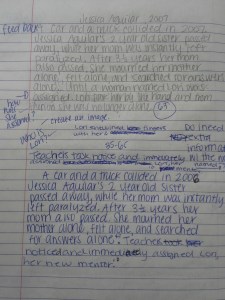
I asked for a volunteer to read her writing. Eyes darted all around the table until Jessica read her draft.

Jessica went first:
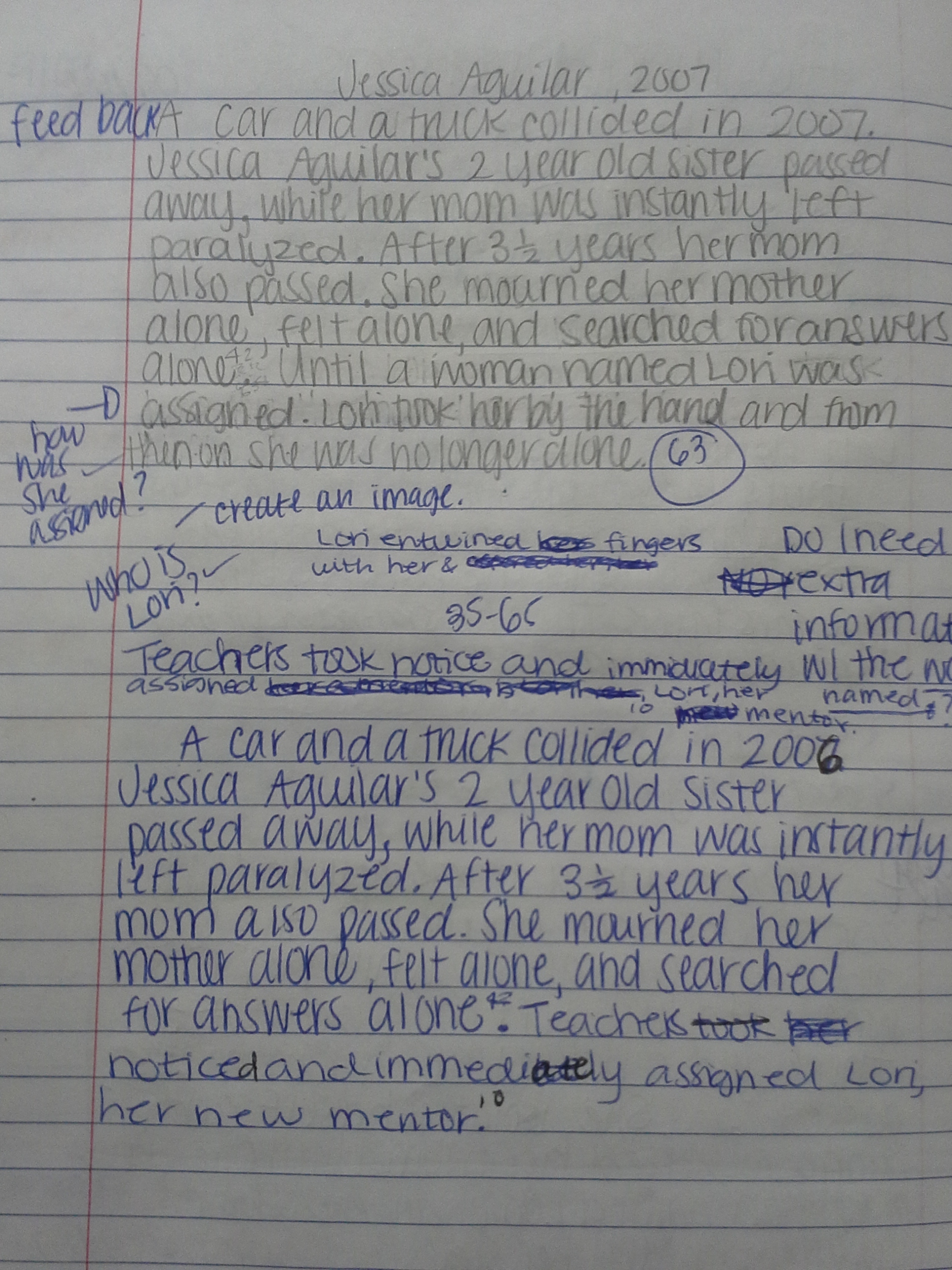
Jessica GoWorld story

Wow, right? She punched us right in the stomach, and we sat in silence. Finally, I said, “Okay, we’ve got some amazingly powerful stuff right here. How can we improve it?” and they looked at me like I had hornets on my head. I knew I better go first, or this feedback thing wasn’t going to work.

“I wonder if you need to tell us that Lori’s a woman,” I said.

Long pause.

“I wonder who ‘assigned’ her to you,” Mikaila spoke up.

“I wonder what she did that was so helpful,” Mariam said.

“I wonder how you survived,” said Daissy.

Jessica listened, answering a few questions, and taking a few notes on the comments her friends gave her.


And we were off . .


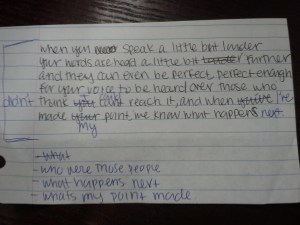
Daissy read next:
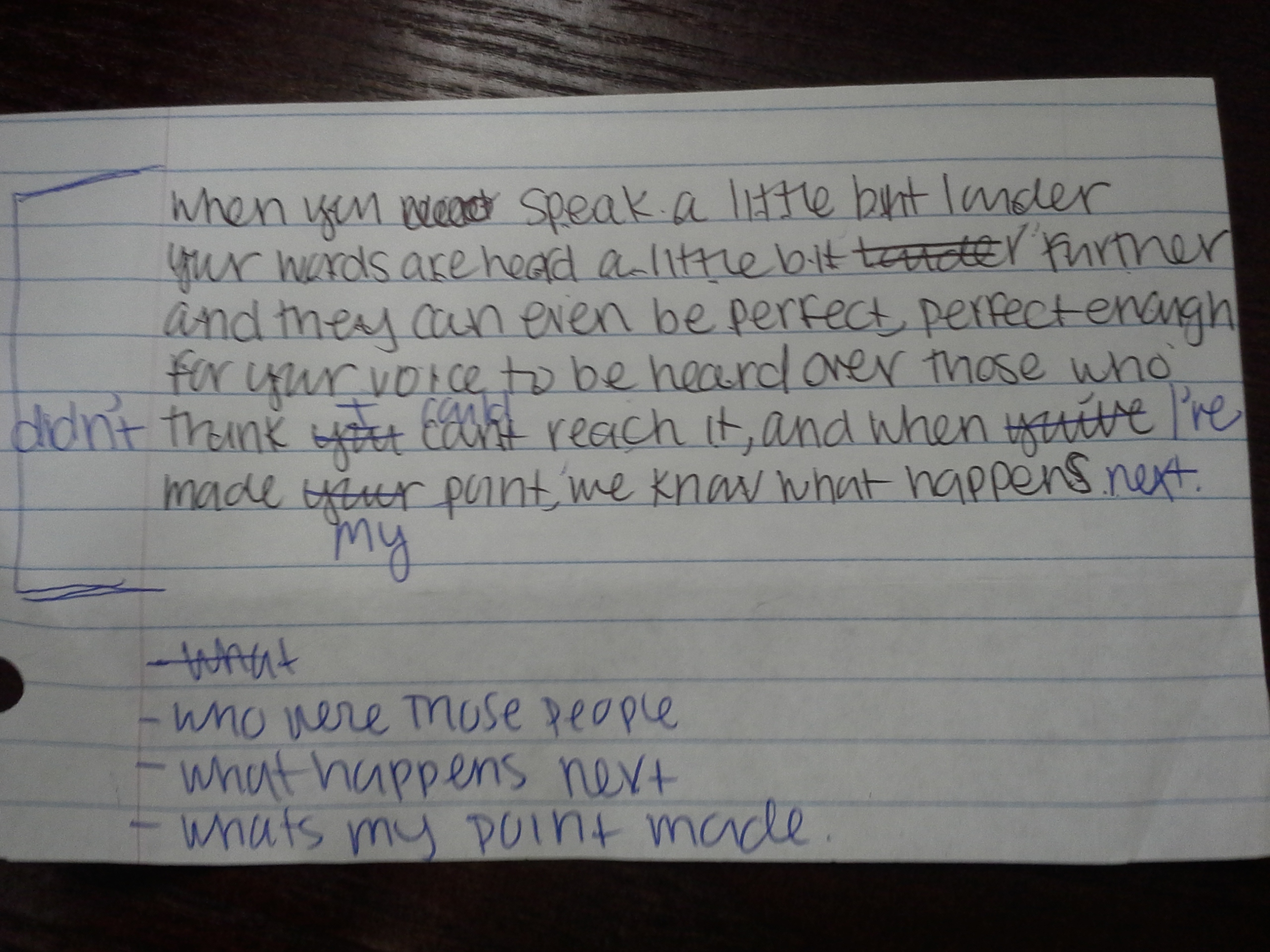
Daissy GoWorld story


“I wonder who ‘those’ are.”

“I wonder what the problem was.”

“I wonder what happens next.”

“I wonder what happened that made you change.”

And then Daissy could not remain silent any longer. She had to explain her stuttering, and how she’s worked so hard to overcome it, and how now wants to major in broadcast journalism and speak on live TV.

We forgot to preface our comments with “I wonder” when we all told her THAT is the story she needs to write.

revision corrections 2-7-12Feedback Magic happened with this “I wonder” protocol. And it happened in every class period, and so did the tears.

Students shared the honest writing from their hearts, and students gave honest feedback with tender and caring insight. Writing improved.

Even better? Imagine being in this kind of classroom with this kind of community of writers.

Heaven.


*Our mentor texts were VISA Go World commercials. I got this idea from an assignment I did at a class taught by Penny Kittle at the University of New Hampshire Literacy Institute. We watched several of the videos in class and discussed and analyzed the various structures of these very short, yet poignant, stories. Students were to watch and analyze a few more examples, transcribing the words to use as models for their own writing. Then they were to write their own, playing with word choice and syntax.

Sentence Imitation with We Were Liars

I listened to the audiobook, and liked the novel so much I had to go and buy it in hardback for my classroom library. The story still haunts me. (I read it soon after I read Jellicoe Road, and that story haunts me, too. These two books make an interesting pairing.)

The following is the beginning of chapter two in We Were Liars. It’s an compelling list of sentences that create the the basics of what we need to know about our protagonist. It will be an interesting passage to use for sentence imitation.

I wonder what my students will say about themselves.


We Were Liars by E. Lockhart P4

My full name is Cadence Sinclair Eastman

I live in Burlington, Vermont, with Mummy and three dogs.

I am nearly eighteen.

I own a well-used library card and not much else, though it is true I live in a grand house full of expensive, useless objects.

I used to be blond, but now my hair is black.

I used to be strong, but now I am weak.

I used to be pretty, but now I look sick.

It is true I suffer migraines since my accident.

It is true I do not suffer fools.

I like a twist of meaning. You see? Suffer migraines. Do not suffer fools. The word means almost the same as it did in the previous sentence, but not quite.

You could say it means endure, but that’s not exactly right.


What is the “soundtrack of your rebellion?”

I liked this book in a lot of ways, and I hated it in others. Maybe because my heart is too soft for all the heartache and suffering of these children. The mother in me couldn’t stand it. Maybe because my Christian heart couldn’t stand the hypocrisy of so many people calling themselves Christian, the parents included. My friend raved about how her students devour this book. It has left me unsettled, but I do think many students will like the emotion this book evokes. It’s just not my kind of emotion.

This is a passage that I think my students will be able to make a connection:

Jesusland by Julia Scheers P159

That day I realized I wasn’t immune to my father’s violence. For years, while my brothers were whipped and I was spared, I thought I had some kind of biological privilege — that my father wouldn’t harm his own genetic material. But in their absence, my father didn’t have anywhere to train the spotlight of his rage on but me.

So when my parents left for another missionary meeting in California and the nurse from my dad’s clinic who was staying with me caught Scott climbing out of my bedroom window one morning, I left home. If my father wanted to choke me over a forgotten milkshake, what would he do to me for losing my virginity?

I moved in with my brother Dan and his three roommates at Purdue and found a part-time job as a busgirl at the Howard Johnson’s Hotel on Highway 52. I biked to work, and to Harrison –an hour’s ride away–if I couldn’t find someone to drive me. I didn’t go to school if I wasn’t in the mood for it, and a couple of teachers threatened to flunk me before passing me with D’s.

Although I was dirt poor–I paid half of Dan’s rent, and frequently resorted to eating off the room service trays I was sent to collect from the hotel hallways–I was happy. I didn’t have to go to church, spent hours watching MTV, and didn’t need permission to do anything. I was free.

I listened to Van Halen’s “Running with the Devil” on my Walkman as I rode through the streets of Lafayette on my bike, rewinding the cassette tape again and again.

It was the soundtrack of my rebellion. That was me, running with the devil. Doing bad things and liking it.


I wonder how students would respond to this question:  What is “the soundtrack of [your] rebellion”?

The Power of (very short) Stories

As soon as I created my own very short story, modeled after VISA’s Go World videos, I knew I would have my students create their own.

For our introductions at the Book Love class I attended with Penny Kittle this summer, she had us watch a few of the Go World videos, and then imitate one of the structures. This is harder than it seems.

Here’s a few of the ones I watched and transcribed. They all represent moments that matter in the person’s life, and they are only in 35 to 60 words.

Lopez Lomong started running when he was six. And he didn’t stop for three days and three nights as he escaped life as a child soldier. Twenty years later he was still running; he just had a different thing driving him every step of the way.

Hours before his race in ’88, Dan Jansen’s sister Jane passed away. He’d promised her he’d win gold. He didn’t — until six years later. Then he skated a victory lap with his daughter — Jane.

Derek Redmond didn’t finish in first place in the 1992 400 meter. He didn’t finish in second or third or fourth. He, and his father, finish dead last. But he and his father finished.

People had been leaping over the high jump bar the same way since the sport began until one day when Dick Fosbury came along and moved the whole sport forward by going over the bar backwards.

You should watch a few of you own. Then write down the words and look at the structure of these very short stories. Then, I challenge you to write your own.

Think about your writing process as you write. Revise in your notebook. Pay attention, so you can share your process with your students. I’ve learned that the best thing I can do as a writing teacher is let them see me struggle as I try to make meaning.

I ended up writing four different versions with four different structures before I wrote a version that pleased me.

Here’s mine:

I am introducing this writing activity to students next week. I thought about having them write a full-blown narrative first and then having them cut their stories down to their own Go World stories. That would be an interesting exercise in word choice. I decided instead to have students write and create their own videos first — then we will tackle descriptive writing and work on exploding our very short stories into ones with a little more substance.

I opted for the fast-track to build community.

Story does that, you know.

Any ideas on how you might use this type of mentor text with your students? or any others you’ve had success with?

Beautiful Sentences

Sometimes we just enjoy the beauty of the language. I don’t usually write in my novels, but I did mark “I love this sentence” in the margins when I read this book.

I do not know how many of my students will read this novel, although it is a Pulitzer Prize winner, I am not sure many students will be interested in the musings of a dying Calvinist minister as he writes letters to his young son. They might.

I will show them the lovely language.

Like this sentence on page 71 of Gilead by Marilynne Robinson:

“As you read this, I hope you will understand that when I speak of the long night that preceded these days of my happiness, I do not remember grief and loneliness so much as I do peace and comfort — grief, but never without comfort; loneliness, but never without peace. Almost never.”

Teacher friends, do you have favorite beautiful sentences that you share with students?

Read Like a Writer

Katie Wood Ray quoteI didn’t know what it meant to read like a writer until I stumbled upon Teaching That Makes Sense. I love that site, and I printed out every pdf doc available, reading everything as I punched three holes and secured them in a big fat binder. Honestly, I do not remember half of all those helpful things, but I am grateful that the light finally dawned, and I realized that reading like a reader and reader, and reading like a writer, are not the same.

How did I make it through my higher education and not know that? OR maybe I did, and I just didn’t flip the switch that made me realize the need to ‘pay attention’ and explicitly teach it to my students.

I am sure the simplicity of TTMS helped. I thank Steve Peha for that.

Reading like writers is the basis for analysis. I’d learned the importance of teaching students to analyze at the numerous Pre-AP workshops and AP Summer Institutes I’d attended. I’d never learned about how to teach students how to teach themselves how to analyze — quite simply by paying attention to how the author constructs meaning.

I’d been pulling passages from the classic texts we were (not) reading. I’d given released prompts and

asked students to complete timed writings. I’d done all kinds of cruel and unusual assignments because I didn’t get that to read like a writer is the crux of good writing instruction. (It’s also the crux of good reading instruction.)

Now, I teach my students to pay attention. As we read our self-selected books, we watch for the ways the author crafts meaning. We notice imagery and what it does for the author’s message. We notice figurative language that helps create this imagery. We might underline sentences that speak to us boldly or whisper to our souls. And we talk about how these elements create tone and theme. But more importantly, we talk about why these sentences speak to us as people.

In my class at UNH this summer, a classmate asked Penny Kittle if there was a list of examples from books to use for this study that Penny calls “play.” Penny shook her head and said:

“No list of books will ever teach this for you. You must change the way you read.”

I agree. Now, when I read, I look for gold. I read because I love the story, but I also read to find beautiful language that I can share with my students. I project passages on the board that we read together. Sometimes we just read and enjoy the language. Sometimes we write a response to the meaning of the text. Sometimes we analyze the elements, talking about why the author used the device and how that device affects the meaning.

Sometimes students model this language in their own writing. Most learn to pay attention as they read. Because once they get it, they are the ones projecting the passages they find, and sharing their own golden language.

Every other Monday on this blog I will post examples of the types of texts I use in my class for craft studies. If you have your own favorite passages, some kind of gold you’ve found in your reading, please share in the comments.