Category Archives: Amy Rasmussen

7 Ways I Read for Resolutions

I’m pretty sure I started making New Year’s Resolutions in about 1976, the year I got my first notebook for Christmas. I was 12. I’m pretty sure that every list of resolutions since then had “lose weight,” and “keep closet organized” penned on the page. Thanks to my daughter and her contagious 5K-junkie attitude, in 2014 I lost a lot of the weight I’d been lugging around the past several years, but I’ve given up on the closet. (That’s what doors are for.)

This year? I hesitated even thinking about my goals. I simply did not know where to start.

With the hope of getting ideas, I turned to my Personal Learning Network, some I know personally and some online.

1. I read my online-friend Elizabeth Ellington’s “Top 10 Reading Goals of 2015” and got a tiny inkling of ideas and a little overwhelmed. Elizabeth is a sharp educator and a brilliant and prolific blogger. I learn from her often.

2.  I read this post, which I saw Sir Ken Robinson tweeted. It begins like this: “This New Year’s day I will not be trying to moderate Sancerre consumption, cut back on Nicorette gum, exercise more or aim to finish my next book by Easter. I have decided to postpone all resolutions until February 19th which according to the Chinese calendar is the ‘ Year of the Sheep.’”

“Year of the Sheep?! Hmm. More time to think of good resolutions,” I say to myself.

3. I read my colleague Erika Bogdany’s post “Cliche No More,” and it takes me to my knees. Erika writes:

“. . .every morning with the heat blasting . . . there’s an essence that is viscerally undeniable.  I walk into a space, a quiet and waiting space, that invites risk, mistakes, setbacks, and quite frankly – the undeniable ugly.  Yet, there is no judgement, discerning undertone, nor slight anticipation that today there will be no progress.

Why would I want to leave all of that in 2014?!”

The last few weeks before the break were hard. My failure rate was out the roof, and after contacting parents via email and a translator, and meeting with an assistant principal for an hour and a half, and forcing myself to leave a stack of 120+ essays on my desk at the demands of my worried husband, I began to question everything I’d accomplished in the fall. All that choice reading. All that critical writing practice. All the relationships with my students. All of it.

I’ve grown because of my challenges. My students have grown as readers and writers. Why would I leave all of that in 2014?

For some reason God wants me teaching in high poverty schools. (This article helped a few things make more sense: “What if Finland’s Great Teachers Taught in U.S. Schools“)

4.  I read at Electric Lit, one of my favorite new sites: “Writers and Editors on Their Literary Resolutions.” Read it. You’ll see why it made me feel better.

5. I read Seth’s blog: “Used to Be.” And these words resonated:

“Used to be,” is not necessarily a mark of failure or even obsolescence. It’s more often a sign of bravery and progress.

If you were brave enough to leap, who would you choose to ‘used to be’?”

I repeat to myself, “Who would you choose to ‘used to be’?”

6. I read my poet-friend Dawn Potter’s “New Year’s Letter,” and felt the burn of my own candle. Dawn reminded me of my love for words. She sent me back to The Frost Place and the hope I had last summer.

Tweet this: I can do this. I can set goals for the new year. I can push through the closet and other things that annoy and exhaust me. I can be better. Do better.

7. I read a message from my friend Whitney Kelley. She asked if I followed Poets & Writers and got their daily prompts. I do now.

Today’s poetry prompt:

Screen Shot 2015-01-01 at 5.57.16 PM

I pulled out a new notebook that Whitney gave me for my birthday in December. I uncapped a new pen. And I wrote.

I don’t even care that it’s not very good. Just like this new year — It is a beginning.

I’d hope for world peace but

inner peace matters more to me right now

My daughter left this morning

She’s driving to her new life 2,000 miles from mine

I want her to go

Until I don’t —  I can be selfish like that.

I hope for greater love and

out-of-my-way kindness that he needs

That I need

I hope for burning lights and blurring lines and bold declarations

Be me. Be you. Be decisive and strong.

Let’s live a little and live a lot

Seek for understanding and

Understand for seeking


I’ll meet you at the airport with the camera

Poetry in AP Lang

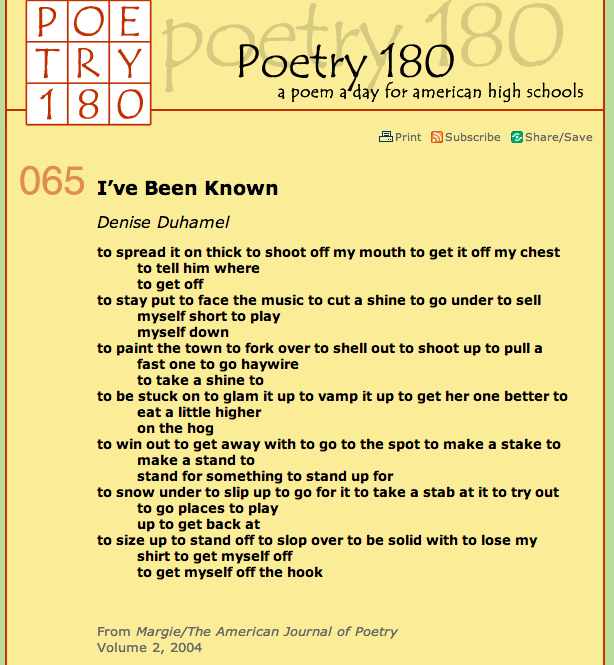
Do you subscribe to Poetry 180 through The Library of Congress? It’s probably the single most valuable thing I’ve done as a way to remind myself to use poetry in my AP English Language and Composition class. We read and write many an argument. I often forget about the poetry.

But I read a poem every day. You can, too. Sign up for a poem in your inbox here.

Some days it’s a natural fit to incorporate the poem into my lesson. Some days it’s a little more complicated. Some days I don’t even try to make the poem fit — we just enjoy the language.

Like this one today:

Screen Shot 2014-12-10 at 6.26.56 PM


Conferring: On the Lookout for Gifts

“I think parents should read this book — these kinds of books, too,” Monica said as we chatted about the book she just finished, Impulse by Ellen Hopkins. “They need to know what we go through and how we think about things. It would help so much.”

I listened as she shared her feelings. She needed me to hear her disappointment at the ending. The characters mattered to her, so I knew they needed to matter to me.

The relationship between student and teacher changed in that moment. We gave each other a gift in that brief conversation about a book.

When we consider our conferring moments with students, do we give enough gifts? Do we allow our students to?

Think about the origin of confer:  Latin conferre to bring together, from com- + ferre to carry.

At the end of that three-minute conference with Monica, I carried a bit of the burden she had on her heart, and she carried the knowledge that one more adult cares about what she thinks. A conversation about a book brought us together.

I love that.

At NCTE I asked a room of teachers what part of their workshop classroom they struggle with the most. They all said student conferences.

Finding the time, being consistent, knowing how to prod students into thinking, allowing students to do most of the talking —  these concerns all emerged as trouble spots that we’d like to overcome.

In a perfect classroom with perfect students it would be easy. What’s the big deal? Just talk to your students. Yeah, right.

I asked one colleague how she conducts her reading conferences. She replied quickly, “Oh, I don’t do those. I cannot talk to one kid without the other 35 talking.”

Yes, that can be a problem.

I don’t think we stop trying though.

One-on-one conversations with students create the heart of my workshop classroom. Our relationships grow and change as we gift one another with ideas and information. We learn and change together as individuals who are trying to make sense of our world. Regular conversations make this happen.

I’m reminded of a line I boxed in bold when reading Choice Words by Peter Johnston: “Talk is the central tool of their trade.” Their meaning teachers who create environments wherein through language they help students “make sense of learning, literacy, life, and themselves” (4).

Talk is central

That’s what I want as I create opportunities to confer with the students in my classroom. I want to help my students make sense of all it:  what happens in the classroom, what they read in books, what they’ll face in the future, and what they see in themselves. That’s a tall order, and the only way I know how to do it is to talk to more of my kids more often.

My burning question now circles on student conferences. How can I improve the precious moments of time I have with each of my students?

I am paying a lot more attention to the gifts we give as we converse with one another.

What about you? What are your ideas, concerns, questions about student conferences?

©Amy Rasmussen, 2011 – 2015

Talking Choice Reading, NPR Radio

When Highland Park ISD banned (suspended, officially–then reinstated w/parent permission required) some books during Banned Books Week, my students and I paid attention.  Of course, I pulled the books in question from my shelves — and book talked them right then and there.

The True Story of a Part-time Indian is one of the hottest titles in my classroom library year after year. I know it gets raw in places. I know that it’s the grit that makes kids want to read it. I get that this book is not for everyone.

Few books are.

And that is why choice is so important.

I had the chance to share my thoughts on this in an interview for KERA,  NPR nor the Texas. You can read/hear the news article here.

In a few days I will return to my classroom, fresh from NCTE and ALAN with boxes of new books for my students to read.

image

My box of books at ALAN

We talk a lot in my class about books being windows and mirrors. Windows help us see outside ourselves into the lives of others. We grow in empathy. Mirrors help us see ourselves so we know we aren’t alone. We read literature to learn what it means to be human afterall.

It would be hard to learn the truth if we never read the raw and the grit that makes humanity humanity.

Please Don’t Ignore the Repetition: a Mini-lesson

My students are pretty good at noticing rhetorical devices in texts; they aren’t so good at analyzing what effect they have on meaning. Since we immerse ourselves in independent reading all year, and we read bookshelf after bookshelf of YA novels, I find that using bits from those books and then talking about why the author wrote the text that way helps when students need to analyze these devices in more complex texts. Somehow this practice takes their tentative and repetitive “for emphasis” away and makes their analysis so much richer. (Most of the time.)

Like this passage from Please Ignore Vera Dietz by A.S. King:

I wonder if I’d called the police back when I was ten or thirteen or fifteen, would Charlie be alive now. I regret it. I regret every minute I lived keeping that secret. I regret every time I didn’t talk to Charlie about it. I regret having parents who couldn’t try to help or seem to care. I regret not being reason enough to make them care more. I regret never saying what I was thinking, never saying, “But what if that was me? What if I marry some loser who hits me? Would you care then? Would you help?” And I regret not called the police that first day we met the pervert. Because I’m sure he had something to do with how Charlie was acting at the end. p264


Exhausted but Renewed #NCTE14

NCTE pres

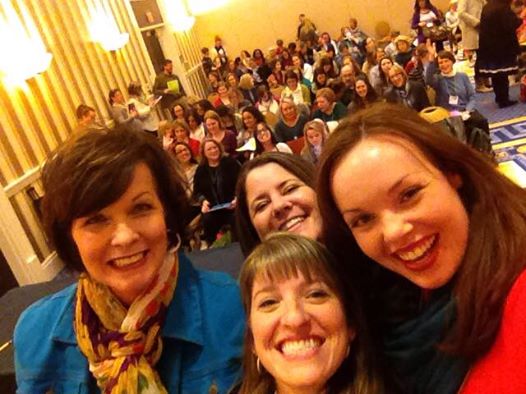
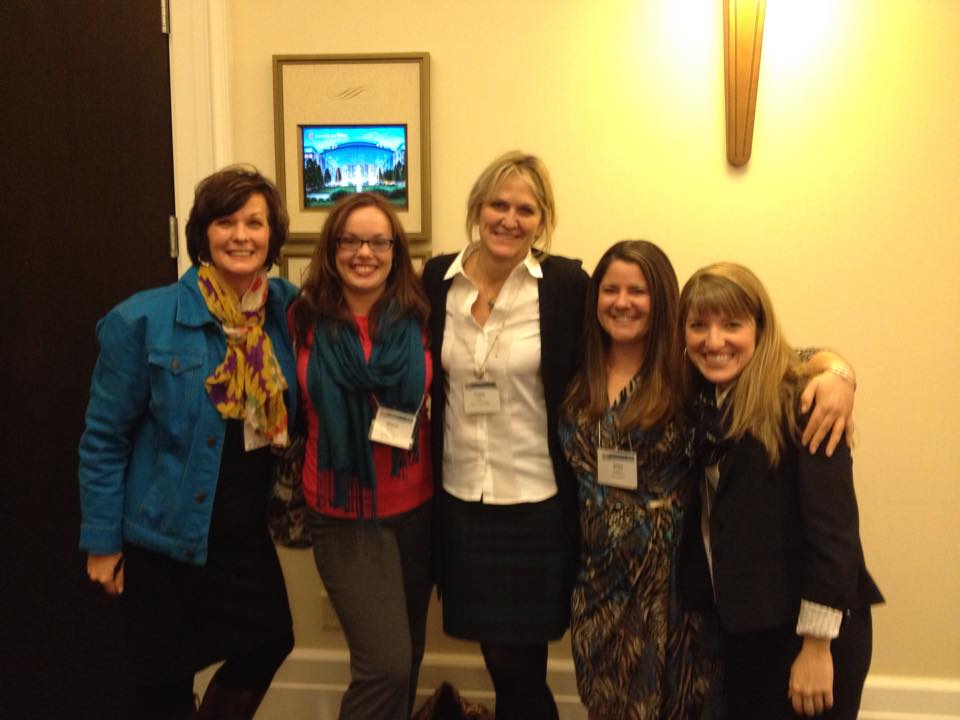
After our presentation at #NCTE14, I stood in the hotel lobby talking with Penny. We’d wandered from the hallways outside our session room, meeting several teachers along the way who had attended our presentation. They complimented me on my work and told me to praise Jackie, Erika, and Shana for theirs. They told Penny how much her work meant to them, and how her ideas and presentations had shaped their teaching. This happened a lot. I felt a little like Robin to her Batman. For a heady moment.

While standing in that lobby, one particular educator grabbed my heart. She reached out to Penny, thanking her so genuinely. Tears pooled in her eyes as she said, “I almost left the profession, and then I read your books. I’ve changed, and I love teaching again.”

I couldn’t help thinking of my own situation last year. I almost left the profession, too. (I wrote about it here: Grateful November)

I almost wrote a Grateful November part 2. Something along the lines of how the NCTE conference infuses a renewal in the soul, like running through sprinklers in Texas in August. Laughing with colleagues, old and new; learning from teacher-heroes we’ve read about and learned from through books and professional development from afar; stock-piling ideas scribbled in notebooks that we cannot wait to share with students because more than anything we come here to learn how to help them learn.

Penny tweeted about her experiences at this conference:

Screen Shot 2014-11-23 at 5.49.45 AM

Profound shifts in thinking.

So true. And so powerful I’m taking it with me.

The memory of presenting “The Landscape of Workshop Across America” with the brilliant educators Jackie Catcher, Erika Bogdany, and Shana Karnes will keep my mind singing. They challenge my thinking regularly and help me find clarity when the chaos in my head gets too loud to hear the silence.

The memory of speaking to Katie Wood Ray in the hallway just prior to our session will keep me spinning as I continue to write.  As Shana says, “a living mentor text.” Such grace and insight. I’m acting on her counsel. [Want to join me in @lindaurbanbooks #writedaily30 challenge?]

The memory of hundreds of beautiful book covers screaming at me until I picked them up in the exhibit hall will keep me sinking into YA novels, devouring stories, so I can share them with my readers who need to devour them, too. Toomanybooksnotenoughtime.

I am exhausted but renewed.

And today I go to ALAN. If you’ve never stayed for that conference, if you love teens, books, authors, and reading, you might want to put it on your bucket list.

Blessings to you all this Thanksgiving week.

God is Good.

NCTE pres w Penny


#NCTE14 J.44 The Landscape of Workshop in AP English

Shana, Jackie, Erika, and I will be presenting at NCTE in Washington, D.C. on Saturday at 2:45 pm. Penny Kittle is our Chair. We are session J.44. Please, come and join the conversation.

Readers and Writers Workshop was a mystery to me for a while, literally. I didn’t even know about it. I’m still puzzled that I made it through my teacher education program without learning about it.

My first three years of teaching, I pretty much taught the same way I was taught in high school. I chose the books we read. I chose the topics students wrote about. I was queen of my classroom, and I decreed that my preAP freshmen would read Dickens. They hated it. No, that’s not right. They hated trying to read it. So they didn’t. Gratefully, at least a few of my first-year students don’t hold it against me. We got together this summer for dinner, and Cara and Marcus relieved my growing guilt.

When I finally came to understand how Workshop could revamp my instruction, that guilt grew. I wasted so much time. I could have done so much more to help my students become readers and writers.

I am different now.

My goal as an educator is to foster the literacy skills in my students that will provide them with the confidence and the capability to contribute to our community and our world.

A week ago I sat in a department meeting and listened as the department manager explained the direction our district is moving in terms of English instruction:  Readers and Writers Workshop. Skills-based instruction. Exactly the instruction I believe in. Exactly the instruction I try to provide my students every day.

I sat there stumped when one veteran teacher began to fidget. His face turned red. His hands twitched on the desk. Finally, he spoke up when the conversation turned to assessments and the need for skills-based exams to match skills-based teaching, not exams based on the content in books read (or not read) in class.

“What’s the point then? We might as well not even call it an English class then,” he said, and several other heads nodded.

What?!?

Because you are being asked to foster a love of reading in your students, allow them choice in reading materials, encourage them to write about their reading, model the life of a reader, and do something similar in the way of writing instruction, you think that is not an English class?

I remembered a conversation  I had with someone struggling with letting go of only reading classic novels with their students. I asked what her number one question was. She said, “Equity. Shouldn’t our students be reading the same timeless texts as so many students do in wealthier areas?”

Shouldn’t the equity be in the literacy skills our students possess more than the books they have read?

With the College Board and school districts and schools promoting more and more students take advantage of Open Enrollment in Advanced Placement classes, in my experience, many of those students do not have the prerequisite skills to be successful in an advanced English class. Many of the students I have this year have not passed their state-mandated English I and English II test, and now they are expecting to be successful in a college-level course. I am all for differentiation, but it gets difficult when students are on so many levels, struggling to the exceptionally talented gifted student.

my classroom

Readers and Writers Workshop has helped solve a lot of my challenge. I teach the reader not the reading. I teach the writer not the writing. And every student is different.

So many students are hurting, and isn’t it part of our job as teachers of teens to help them learn about what it means to be human:  empathetic, kind, compassionate, intelligent, courageous? All the characteristics we learn from the best protagonists in the best literature. That is what I tell my students:  We read literature to learn what it means to be human in a world that would like us to forget. Books in hand make us slow down, quiet our minds, embrace moments of stillness — something we so badly need in this social-media, speed-of-light world.

Read this entry in a student’s notebook. She gave me permission to share. It’s raw and frightening.

We Chris notebookwere brainstorming topics for a narrative we’ll write soon. I asked students to think about their lives and write to the question

“What if ______?”

Can you even imagine?

Every day students face challenges, fears, and troubles that no child should have to face. I believe teachers can be healers. We can be healers when we value the student more than our content. When we embrace the individual and focus on her needs, academically and emotionally.

Three of my students cried as they told me of their worries before second period was over on Friday. I am honored that they trust me.

Community matters.

Conferences matter.

Mentor texts and Modeling matter.

Choice matters.

TIME matters.

All students, advanced or otherwise, need teachers who are willing to let them make choices that lead to profound learning, relieving their worry sure helps that happen.

Watch this clip of some of my students sharing what they like about our Readers and Writers Workshop instruction:

And here’s my slide presentation for NCTE. I will only talk about a tad of what I wrote on this post there. I hope that if you are in Washington, D.C. you will come to our session. And if you are not, join the conversation on Twitter beginning on Saturday at 2:45. #NCTE14

©Amy Rasmussen, 2011 – 2015

Grateful November: If the love’s gone, make a change

Today a friend asked me how I’ve been. “Great,” I said. But then I thought about it:

I’ve been FANTASTIC.

I changed jobs this year. I moved to a school about a 25 minute drive from my other one. Love is not a strong enough word, but really, I love going to work every day.

The students are great, but that’s not it.

The building is new, but that’s not it either.

Another friend, a colleague from my other district, was on my campus on Friday. She roamed the halls and found my classroom. We hugged and talked for an hour.

She is not fantastic.

I listened. I remembered.

Meetings that never seem to accomplish much. Students who “own” the power in the school but don’t put their strengths toward learning. Lack of planning time. Mandated policies. All things that kill the joy of teaching for a perfectionist like me, and my friend. There is not enough time in the day to do it all. I believe most teachers would agree.

Maybe we care too much. I thought that a lot last year. The third in my growing unhappiness in a system growing out of control.

But now? I am at a place where the principal supports his students and his teachers. He manages with insight and thoughtfulness. He’s respected because he takes the time to show respect. He holds meetings when necessary — not out of routine. Is there any better sign of respect for his teachers than to respect their time?

So, today when my friend asked me how I was, it gave me pause. In this season of Thanksgiving, I am grateful. I am grateful to my former district for the opportunities I had to grow as an educator. They are many. I am grateful for the trust of some administrators who believed in my skills and my passions. (I know you know who you are.) I am grateful that I listened to God when He said, “It is time for a change.”

I would have left the profession. I almost left the profession.

But now, my heart swells with love for students who trust me to help them learn. And I feel humbled and grateful for the trust and welcome from new colleagues who believe in my skills set. They’ve made me feel at home.

Grateful November

grateful November

A Mini-lesson on Extended Metaphor

The Good Luck of Right Now is the first book by Matthew Quick that I read. It is a good book. I love the quirkiness of the narrator’s voice. It reminds me a little of the narrator in The Curious Incident of the Dog in the Night Time. I don’t know which I like better.

I am not sure this is a book that my students will want to read, although I will share it with them with my high praise. I do know that there are several passages that I can use for mini-lessons. I especially like this one with an extended metaphor. I think students will be able to write their own, and maybe add it into their narratives, once we take a close look at the way Quick uses this one here:


The Good Luck of Right Now by Matthew Quick, p111

(I have to say that everything seems to be unraveling lately. Or maybe it seems as though I am a flower myself, opening up to the world for the first time. I don’t know why this is, and I’m not really in control of it either. Flowers do not think. Okay, it is now May, so I will reach up toward the sun and relax my fist of petals into an open hand. They do not think at all. Flowers just grow, and when it is time, they shoot colors out of their stems and become beautiful. I am no more beautiful than I was when Mom was alive, but I feel as though I am a fist opening, a flower blooming, a match ignited, a beautiful mane of hair loosened from a bun –that so many things previously impossible are now possible. And I have been wondering if that is the reason I did not cry and become upset when Mom died. Do the colorful flower petals cry and mourn when they are no longer contained within a green stem? I wonder if the first thirty-eight years of my life were spent within the stem of me — myself. I have been wondering a lot about a lot of things, Richard Gere, and when I read about your life I get to thinking that you also have similar thoughts, which is why you dropped out of college and did not become a farmer like your grandfather or an insurance salesman like your father. And it’s also why so many people thought you were aloof, when you were only trying to be you. I read that you used to go to the movies by yourself when you were in college and you’d stay at the movie house for hours and hours studying the craft of acting and storytelling and moviemaking. You did all of this alone. This way maybe when you were in the stem–before you exploded into the bloom of internationally famous movie star Richard Gere. Such vivid colors you boast now! But it wasn’t easy for you. I have been learning by researching your life. So much time spent acting on the stage. You lived in a New York City apartment without heat or water, one book reported. And then you made many movies before you became famous –always trying to beat out John Travolta for roles, and being paid so much less than him. But now you are Richard Gere. Richard Gere!)


Do you have other passages that work well to teach extended metaphor?

Writing as Punishment? Oh, the Nerve!

“As punishment I have my students write a response to an ethical question when they are done with their social studies test,” a colleague said during a recent professional development session.

I’d been asked to lead a discussion on writing in disciplines other than English, and I’d asked the attendees to share out the various types of writing they have students practice in their classes.

“That’s pretty much the only kind of writing I do in my class,” he said, “That’s why I’m here.”

I might have stuttered a bit as I caught myself from falling down. I guarantee my neck turned red as it does when I am frustrated.

PUNISHMENT?! Did I hear that right?

What does a writing teacher do with that?

Imagine if I sat in his history classroom and boasted that I punished students by making them learn the historical context of a text prior to reading it. Imagine if I made a disparaging remark about his content at all. The nerve.

Therein lies a big part of the problem with student writers. Many people, teachers included, think writing is boring, or too much work, or punishment.

Then, it’s left up to English teachers with a passion for the craft to push and prod and plead with students to put at least a tiny thought on the plain white page. Somewhere someone ruined that child for the written word, and we have to undo some damaging false notion.

Don Graves reminds us that children want to write before they want to read. I know this is true. My own children reached for their dad’s pen or the random crayon before they ever sat still long enough to read a book. The two-foot-tall art on the clean white walls of my brand new house was evident often enough.

Children want to write. We must protect that desire. Nurture it with freedom and ideas and time.

Shame on the teacher who ever makes writing a punishment.

And yes, in case you are wondering, I spoke my mind.

“I challenge you to never call writing a punishment again,” I said as he squirmed just a bit, “Students will write, and they’ll love writing. You have to be the model of what that means in your own classroom.”

I believe that with all my heart.