Category Archives: Amy Rasmussen

#3TT Workshop — Digital Reading in the Reader’s Workshop

Three educators. Three states. Three demographics. All practicing Readers and Writers Workshop in our Secondary Classrooms. Read more about us here.

We are the Modern PLC, and every Wednesday, we share our behind-the-scenes collaboration as we talk about the most urgent moving parts of our classroom pedagogy.

Despite the proliferation of e-readers, tablets, and digital reading and writing technology, recent research is making digital texts look a little less appealing.  This article discusses the slow reading, complex-text, and comprehension literacy skills we just can’t get from reading electronically.  This one has lots of great links to the reasons digital reading “fail[s] to adequately recreate certain tactile experiences of reading on paper that many people miss and, more importantly, prevent people from navigating long texts in an intuitive and satisfying way.”

As Shana’s school in West Virginia is increasingly making the move to one-to-one technology, digital learning, and an increased emphasis on electronic reading and writing, she wondered how this shift would impact readers’ literacies.  Her discussion with Amy follows.  Please join the conversation in the comments!

digireadWhen much of the research points to poorer reading comprehension and lower rates of retention in electronic reading, why are some schools moving toward digital reading?

Shana:  My school recently adopted a new textbook series across multiple content areas that contains a small print book and a massive digital one.  This online textbook features texts, activities, tests, and quizzes that can only be accessed digitally.  By and large, my students have reported immense dissatisfaction with their reading experiences in this digital format–in history class, English, and math.  I wondered if that was because they just weren’t used to reading digitally, but during our reading conferences, they disagreed.  They use e-readers, they read articles on their phones constantly, and they have become accustomed to taking their state tests on computers.  Most students reported that they were more tired after reading digitally, that they didn’t retain the information well in that format, and that they were frustrated by their inability to interact with a physical text by annotating, highlighting, etc.  

After talking with students and experimenting with digital vs. print reading myself, plus reading the articles linked above (and many more), I felt really frustrated about the de-emphasis of print reading in schools.

Amy:  Interesting question. I haven’t seen this move toward digital reading myself. My district does have 1:1 iPads, and I know there was a big technology push just prior to me moving to my school, but I’ve never heard that students should be reading digitally instead of reading in print. I’d probably throw a bit of a fit if I did. Personally, I love paper. I love everything about print on the paper page. I’ve moved to digital in a lot of ways — my students create and write on their own blogs, and they turn most of their drafts in using Google docs, but when I sit down to confer with them, I’d much rather have a look at the printed page. It seems easier to zero in on skills that shine brightly or those that need some work — but that is probably just preference.

It’s an interesting argument though, and really, if I believe so much in the importance of digital writing — and I most definitely do — shouldn’t I also believe in the importance of digital reading? Hmm. Now, you’ve got me thinking.

Shana:  I love paper reading and writing, too, Amy.  This is probably why my desk is currently cluttered with books, notebooks, and stacks of paper.  Certainly electronic reading would be cleaner…but it lacks the tangible presence of print that shows me my progress through a book, a student’s writing process, and physical thinking on a page.

Why are physical textbooks, literary anthologies, and notebooks being phased out of our students’ educational routines?

Amy:  I don’t know much about how this might look in other teachers’ classrooms, districts, or states, but I have not used a literature textbook or anything like an anthology in several years. I find them cumbersome. When my students and I read short passages for analysis, I make copies. I need readers writing on the page. If a text is too long, I give them QR codes, and they all know how to annotate digitally with an app on their iPads (I didn’t teach this. They learned it last year or the year before.) I use a lot of texts that can easily be found online, e.g., columns by Leonard Pitts, Jr., and articles from The New Yorker. For full-length texts, we read in book clubs where my students all purchase their own books, or borrow one of mine. Annotating is a valuable skills, and using a textbook makes doing that quite difficult.

Shana: I love the QR code idea for a longer text!  I’ve always felt that it sucks a bit of the joy of learning reading skills out of students when receive a thick, copied packet that I ask them to read and annotate.  I’m with you on providing print copies of columns, articles, or books to students for teaching specific reading skills.  I love when students check out a book from the classroom library that was previously annotated during a book club reading.  They always ask who read the book previously, and their notes become part of that new reader’s experience with the book.  That experience of seeing a prior reader’s interaction with text on a page is just not possible with textbooks or digital reading.

What are your thoughts on digital vs. print reading?  Join the conversation in the comments, and check back tomorrow as we discuss digital vs. print writing.

I think reading may not be all that important — What?!

I am not often speechless. But it’s not often I hear statements like this — from teachers no less:

“There are so many other ways for students to get information. I think reading may not be all that important to students today.”

We were into the second hour of a three hour workshop on conferring. We had already brainstormed and charted what we believe are the needs of our students:

  • trust in authority
  • time and attention from adults
  • a caring teacher who is a listener and is consistent with discipline and classroom management
  • technology to learn and communicate
  • critical thinking skills
  • a context for what we want them to learn
  • positivity and discernment
  • a focus on what matters/ability to ignore “the noise” of unnecessary information
  • the opportunity to freely think and to take risks
  • the ability to communicate in ways that are socially acceptable and responsible

We had just read research on reading as detailed by Nancy Motley in the book Talk, Read, Talk, Write. I share it here:

Literacy skills for the twenty-first century are far more complex than in previous generations (Goldman, 2012). In addition to the basics of reading comprehension, today’s students must also know how to read with purpose, integrate new information, resolve conflicting content in different texts, and identify the writer’s perspective (Biancarosa & Snow, 2006). Students can only learn these skills by reading. Because many students enter the classroom with underdeveloped literacy skills, we often replace reading tasks with lecture and interactive activities to ensure that students stay engaged and learn the content, Hoyt (1999) explains.

“…expository reading for many students is often a listening experience. Well-meaning teachers, concerned about textbooks that are too difficult, often create situations where one student reads from the text and others listen or attempt to follow along in the book. This situation does little to build conceptual understandings, and it can actually deter from the learning process as the listeners are engaging in very little reading.”

When teachers “deliver” the curriculum to students, students lose the opportunity to construct meaning for themselves (Tovani, 2000). According to the Reading Next (2006) report (a meta-analysis of adolescent reading), three of the most statistically significant practices for increasing the academic achievement of middle and high school students included:

  1. direct, explicit comprehension instruction
  2. reading and writing skills embedded in content area classrooms
  3. text-based collaborative learning

Put simply,

“When we routinely model and make explicit the methods adults use to read, think, and make connections, students learn to do it, too. Furthermore, they will see that such close, insightful reading is within their reach — that they can do such reading and thinking, which is central to an education.” (Schmoker, 2011).

I am not often speechless. But this teacher’s comment left me chewing my lip. Did he read the research? Did he understand what it meant? Does he really believe that reading is not important?

“If I gave my students The Canterbury Tales and expected them to read it, that just wouldn’t happen. I read it to them, and they get a lot of information, and they come to like it,” this teacher continued.

And I countered, embracing my inner Penny Kittle, as I facilitated another hour of professional development:  “What is your purpose for ‘reading’ The Canterbury Tales — or other texts you choose for your students? What skills are you teaching with that book? How do you know your students are learning them? How are you helping your students develop as readers — because that is our job as English teachers. If we are not helping students become better readers than they were when they came to us, we are not doing our job.””

“Today’s students must … know how to read with purpose, integrate new information, resolve conflicting content in different texts, and identify the writer’s perspective.  Students can only learn these skills by reading.” 

They must also know how to discern viable information from the barrage of biased and unreliable information. And know how to understand a rental agreement when they sign a lease, a sales contract when they purchase a car, a speeding ticket when they get one, a ballot in a voting box when they are standing in line next to you and next to me.

Students can only learn to read by reading.

benefits of reading

What do you think? Is reading important to the students we teach? How would you have responded to my teacher friend?

Grateful November and a give-a-way for you

Sometimes thank you has to be enough.

Last evening I joined in #poetrychat and learned from 28 teachers from various parts of the U.S. and Canada about how to more effectively teach grammar by using poetry. Chats like this inspire me, and I want to be a better teacher. Tomorrow I will share this poem with my students as we begin argumentative writing:  The Joy of Writing by Wislawa Szymborska, my new-found favorite poet.

Thanks to all of you who’ve joined in our monthly chats about poetry. I am a better poet, and poetry teacher, than I was last May when TTT started hosting the monthly poetry chat.

Also, I am a better teacher because of you, the readers of this blog. I teach with more intention because I know I will write about the lessons, activities, books, and other resources I use with my students.

Audience matters to every writer, and I consider it a gift that my audience is also my muse. Thank you for your questions that inspire such deep thinking and so many posts.

May November bring a sense of gratitude and rich blessings in the lives of each of our readers. Thank you for your confidence in us as we share the experiences, lessons, and activities from our workshop classrooms.

So what’s the give-a-way already?

Shana, Jackie, and I met online last week to talk about our goals for this blog and how we can support you more fully. We might be able to help more if you give us some direction. So —

We know it’s not much, but it will buy a few books: We’re giving away one $25 Amazon gift card.

Just complete the short 3-5 minute survey, and you’ll be entered automatically. We’ll choose a winner randomly on November 10 and let the winner know via Twitter or email.


3 Lessons from Running a Spooky 5K

spooktacular runSaturday was the one-year anniversary of the race that changed my perspective about running — the “Spook-tacular 5K.”

I’d trained for about three months, getting up early for interval training before the hot TX sun demanded I go right back inside. Then at dusk going out again to run-a-little-walk-a-lot while my stamina claimed some courage.

Volunteers dressed up as ghouls and witches jumped from behind trees and fences along the pathway. Zombies roamed and groaned their way against the grain of runners. It was all fun and games until I lost sight of my daughter.

That’s when it got spooky. I could not see my daughter Jenna, my running partner who kept me from giving up.

Jenna’s a lot younger than me, so it’s no wonder she didn’t want to hang back and shuffle along. I even told her to run ahead.

But then the doubt started. What if I want to stop? Jenna won’t be here to tell me to power up. How will I keep going if Jenna’s not here to talk me through the sameness of a 3.1 mile jog? You know you hate running, why do you even try?

Two years before I’d tried to become a runner, but I could not make myself enjoy it. Jenna and I’d run one race back then, and I’d stationed myself behind an 70 year old man who ran with a walker. Really he ran with a nurse, but still, and there I was pacing myself behind him. He ran slowly, steady and sure, never stopping to catch a breath or break stride. A vacuum cleaner ate my lungs, but I kept moving. By the end, I thought my rubber legs would kill me.

Obviously, they didn’t.

Now, here I was in much better shape. Jenna and I worked out hard, and I knew I could run this whole race without stopping. I just needed to prove to myself that I could.

So I ran. I steadied my breathing, and I refused to stop. Booing ghosts and all.

I got about a hundred yards from the finish line, and I could hear “Monster Mash” blaring from the pavilion. I knew I’d almost made it when about eight little stick-figure-girls cut a corner and raced past me from behind.

Little cheaters.

I’d run the whole race, slow but steady, and these little adolescents with their long legs and glow sticks ran just long enough to “glisten” as they crossed the finish line right in front of me.

I crossed the finish line complaining. I didn’t even notice my time or relish the fun of finishing. I let them steal that from me.

And I learned some lessons that night:

1) I am stronger than I think I am.

2) I can do hard things, even by myself.

3) I shouldn’t let anyone at anytime steal my celebrations or my joy.

So what does this have to do with teaching? with readers and writers workshop and sharing what I know works? with conferring with my readers and teaching kids to write? with facing a room full of teens each day who need all the skill I’ve got?

Yeah, if you’re reading this post, I know you get it.

We train and practice and learn. We keep talking about books and conferring with our kids. We find joy when they light up about a book — or finally finish one. We focus on the skills we know our students need. We stay positive and hold fast to our pedagogy. We know workshop works. We revision our classrooms to meet the needs of our students — every single day. . . and sometimes every class period.

We keep moving, so our readers and writers will keep moving, too.

©Amy Rasmussen, 2011 – 2015

Mini-Lesson Monday: Learning Concrete Details with Independent Reading

More than any other writing, I love reading my students’ narratives. We start the year with narrative for many reasons, but my favorite is that I get to know my students faster than I can get to know them during one-on-one reading conferences or during group activities and discussions.

Here’s a short list of what I’ve learned from student stories just this week:

  • several of my male students wish they had a father who showed interest in their lives
  • a few of my girls live with their fathers because of their mothers’ poor choices
  • several boys and girls journeyed long and far, walking miles through jungles, so their families could escape oppression, rape, and murder
  • many of my teenagers have experienced heartache because of love interests, friends, and family members
  • a few are still grieving the loss of grandparents, aunts, uncles, and friends who died from suicide
  • at least one young woman still holds anger toward her mom because of the way she handled a brother’s addiction and abuse

Personal and powerful, all of these stories matter. My goal as a writing teacher is to help my writers harness the words so emotion reigns in the heart of the reader. The problem?

Abstract language.

Objectives — Using the language of the Depth of Knowledge Levels: Show understanding of the terms abstract vs. concrete; in your independent reading books, identify concrete details and figurative language; analyze the effectiveness of the author’s language; revise your writing to include fresh concrete details and figurative language as you create a text that evokes powerful emotions.


Lesson
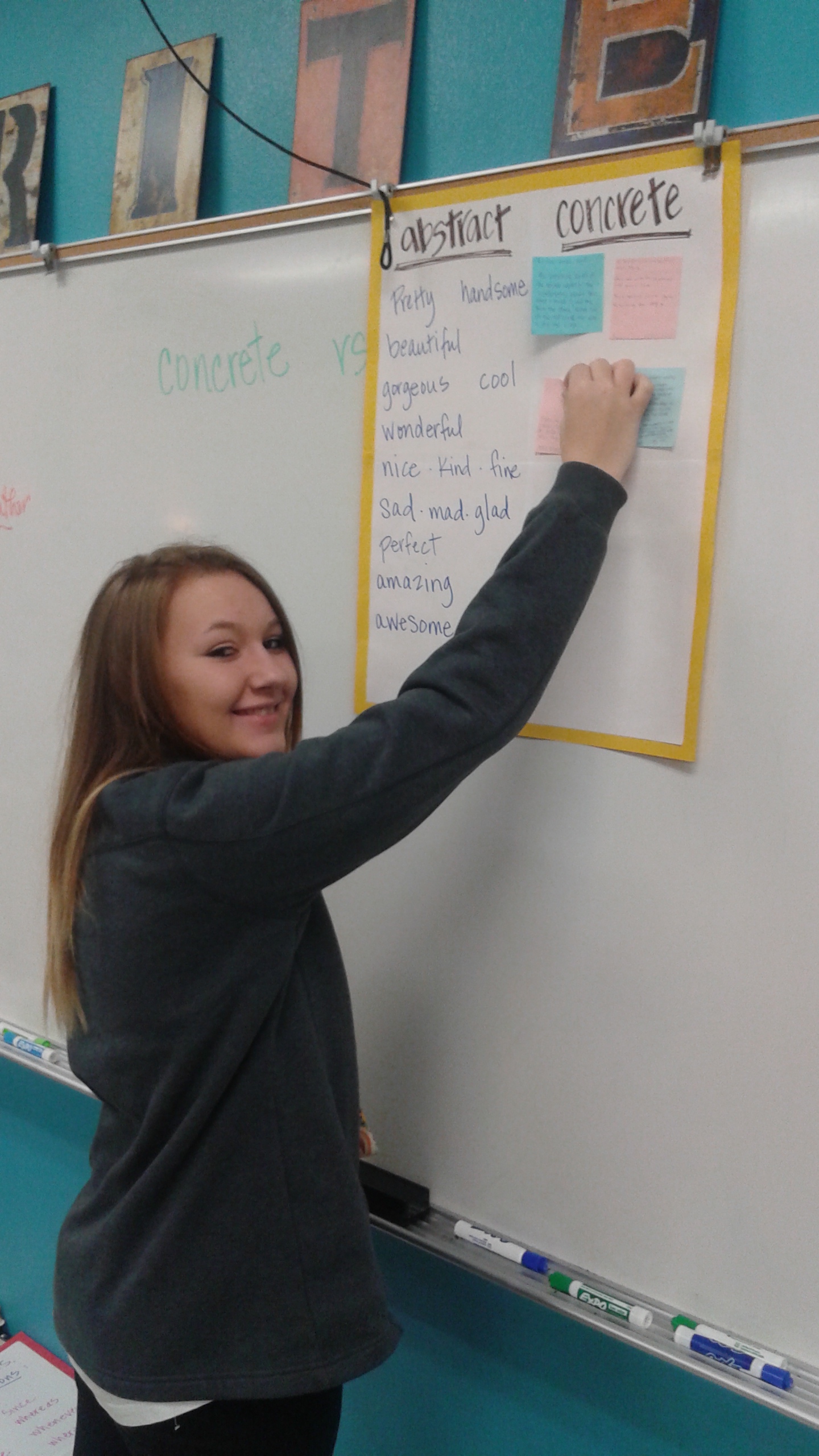
— Before the mini-lesson, students have already drafted a few pieces, narratives or poems. I abstractconcreteusually do the mini-lesson after silent reading time, but for this lesson I begin before because I want to give students a specific purpose for reading.

First, I write on the board ABSTRACT and CONCRETE and we review what these terms mean when it comes to writing. I try to use only abstract words as they begin to discuss this with me.

“Awesome, you might get it,”

“Wonderful, I think you know what I mean,”

“Hey, that’s pretty good…”

Eventually, they will pick up on what I’m doing, and we make a list of abstract words. Then I give each table-group a word and challenge them to come up with a concrete description that shows us that abstract word. They get 1-2 minutes, and then we share out as I write the concrete details on the board. We discuss the difference in how an author can create emotion.

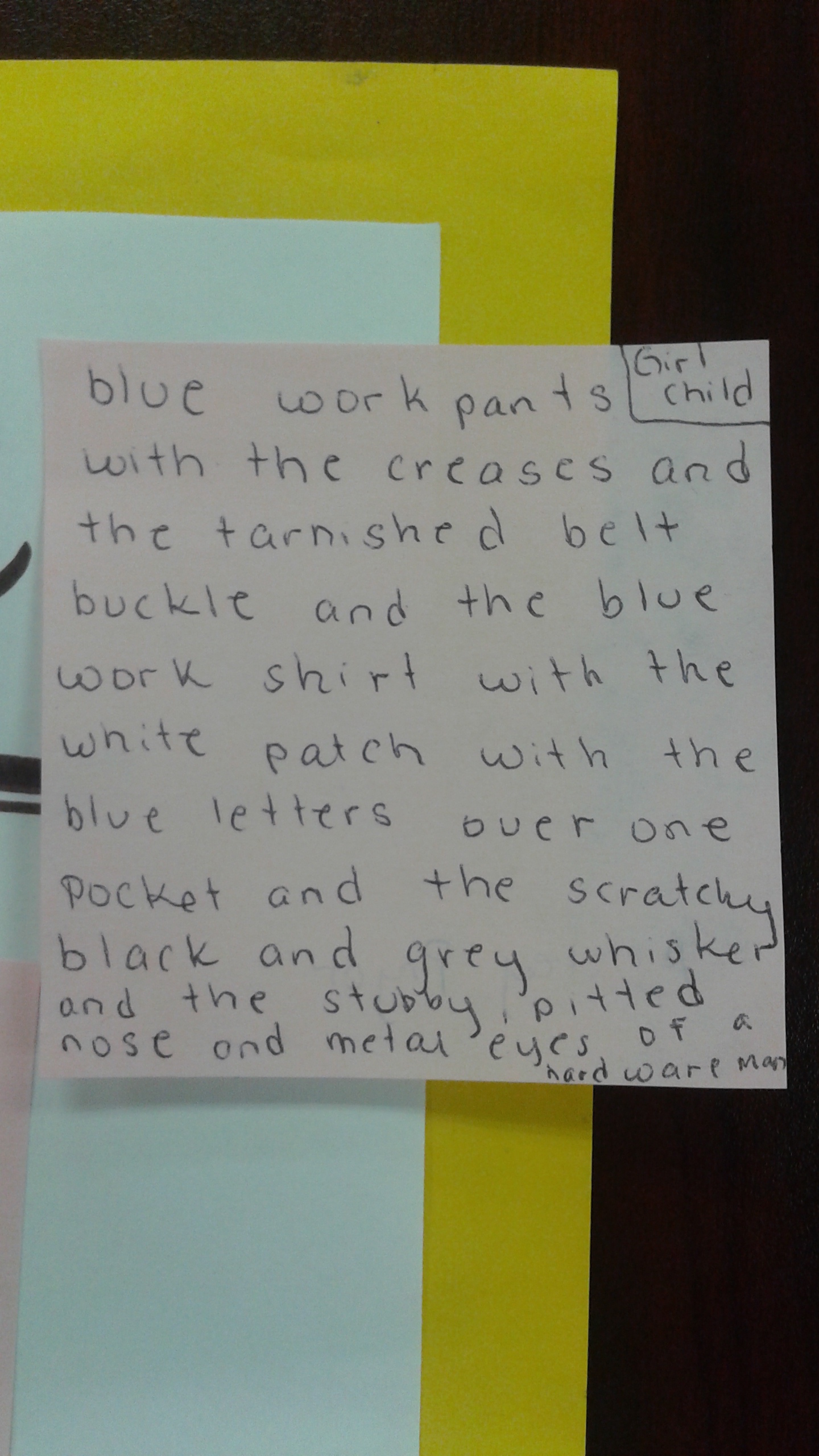
Next, I ask students to pay attention to the concrete details in the book they are reading, and I give them each a sticky note. “As you read today find at least one sentence where the author does something really clever with concrete details and/or figurative language,” I say.

Students read for 15 minutes, pen in hand, paying particular attention to the author’s craft. When time is up, I ask students to share their sentence in small groups and to analyze the effectiveness of the author’s word choice.

AllieTate“Think about what he’s trying to do there. Why did he mention the color of the sweater, or the smell of the breeze?” If they feel like the author’s accomplished creating emotion, they put the sticky on the board (or as in the photo here –poster).

Students need to not only recognize the details and know that they create some kind of imagery, they need to think about how effective the word choice is for what the author is doing at that moment in the story. If I can get them to start thinking about this, I can get them to begin making purposeful choices in their own writing.

Next, I ask students to search their own writing for concrete details that create images and to add a lot more. “Where can you add a phrase or line similar to what you found in the book you are reading? Is there somewhere you can add color or shape or texture?”

And we revise.

Follow-Up — When students immediately apply learning we’ve practiced using their personal reading materials, they begin to see the connections between becoming active readers and purposeful writers. This is the kind of lesson I do again and again with a different literary or grammar skills students to master. Next up:  subordinating conjunctions.

A few lines from students’ published narratives:

“Each body turned to watch as the green army, blurry, entered the gate. The ground only knew sadness and the sky transformed into a dark night, roaming like a lion.” –Tha Sung

“My first impression when I met Lucila:  petite, chunky, short red-velvet hair, wearing a sweater that covered her sins, mysterious face with a sealed silent mouth.” –Karina Rangel

“My brothers slept like angels with devilish grins.” –Geovanni Medina

Sharing Student Work — Making a Pledge to Do More

For some time now I’ve thought I needed to do more. I ask my students to write a lot. I ask them to take ownership of their process, practice their craft, take risks. I hope they will care about their audience, but unless it’s a post on their blogs (and sometimes even then) I don’t think they consider much about their readers.

My colleagues here at Three Teachers Talk and I had the idea a few years ago to publish student work on this site regularly. We planned it all out. We’d hope for student volunteers that might want to produce something like a mini-Nerdy Book Club but with student readers and student writers. Then I did a little research:

I found sites like Young Writers SocietyTeen Ink, Figment, Teen Lit, and of course, NaNoWriMo that publish the work of young writers and allow them to join online writing communities and learn about competitions, awards, scholarship, and more. This list of 40 of the Best Sites for Young Writers has even more resources.

I still want to do more, but what I need to do is introduce my writers to site like these and extend the invitation that they explore, discover, and get involved. I know a few will. Maybe many will.

In the meantime, here’s a sampling of the writing I’ve read this week. Not because I like the topic — it horrifies me on many levels — but because this writer shows heart, I want to share her work.  Read it. You’ll see why I know I need to do more to help my students write for audiences that will appreciate their craft.

Bruised-Knees by Alexia Alexander

It was a breaking point.

By the time my spoon scraped the bottom of the bowl, my face was wet with tears. I was sick, in part from eating, and in part from everything else. I had to cry quietly; I suffered silently in order to avoid questions, sometimes, even hidden behind smiles and laughter. The chocolate and caramel ice cream weighed my stomach down. I felt 200 lbs of milk, sugar, grief, loneliness, depression, cocoa, corn syrup, and artificial flavors. My entire 500 caloric intake itched in my throat. I felt heavy now. I felt worthless now. I felt defeated now. I ran as quickly up the stairs as I could, but voices, almost as loud as the screaming downstairs, followed me.

Why’d you eat that ice cream? You’ve already had enough. You’re just going to GAIN weight if you eat something like that. You can’t you even starve yourself right,” I told myself.

Staying up late reading about it, I prepared myself for chaos. Although I laid under two blankets and behind a locked door, I found little comfort. In fact, I hadn’t even kept the monsters out; they began to creep inside of my head. I spent the nights crying, reading pro-anamia blogs, drowning my ears out in Maria Mena, and looking up the most fabulous ways to destroy myself, self-esteem first.

Now getting a chance to test my research, I rushed to the bathroom, still crying. I looked at myself in the mirror; I cried even more. I was sobbing and choking, sounding like that one kid in elementary that always forgot his inhaler on mile-day. I dropped to my knees, as if I were about to pray, but I couldn’t remember what people were supposed to say to a divinity.I gripped the sides of bleach-white seats, as if my faith would be found there, and hung over the porcelain throne, like a sea-sick passenger. The bathroom became dizzy in my eyes, and the pink walls were a blur mixed in the leopard print bathroom curtain. The white tiles painted my knees black and blue and staring at them made the wave of sickness more intense. In the reflection of the toilet-bowl-water, I even looked green and sickly, but I can’t say my self-perception was quite accurate in those days.

I had screenshotted instructions on my cracked iPod screen on how to do it. I looked up everything. I needed all the how-to’s before I went through with anything. I knew I could use a toothbrush or two fingers. I knew I could make markers in my stomach. I knew how many seconds it would take. I knew that it would sting. I knew the long-term damage the acid could do to my teeth. I knew how deadly it was. I knew how sick I was.

But I continued, another event to add to my list of “First-Times.”

Slowly shoving a finger in between my lips, I danced it around trying to find the spot. I felt the tickling as I touched the dangling piece of skin. I added a finger, this time gagging slightly, but knowing no matter hard I cried, I couldn’t take my hand out. I gagged again,  bringing up the bile taste in my throat. I couldn’t choke. I had to keep going. I gagged another time, body split over the toilet as I heaved.

I had found the food that comes up almost as easily as it goes down. The ice cream coated my throat, for a second time, and it still felt cold. It masked the normal taste of vomit, gladly, and I finally felt lighter;I equated that to feeling better and didn’t think twice about why I was still crying.

Maybe you can be lovely now. See, you’re already feeling better,”  said the demons in my head, who told me things like this frequently. I tried to ignore them, but sometimes my own silent voice felt like a scream between my ears. I cried myself to sleep that night, still trying to convince myself I had done well.

I wish I had known then what I really was trying to rid myself of. I wish somewhere on that ground I really had some holy revelation, but wisdom like self-love and perseverance can only be taught from low moments like those. It took years to find what really weighed me down, more than food or fat. It took years to love myself and my body. It took years to get over the urge to skip a meal, and the shame after eating. It took years to face the demons and shut them up. But each moment that buckled me to my knees gave me strength, and brought me closer to where I am now. Moments I’d rather forget, have to remain real, so  I always remember my growth, and never repeat the past.


©Amy Rasmussen, 2011 – 2015

7 Reasons to Stop Asking about AP Test Scores

The question took me by surprise.

I’d just spent an hour or so sharing how I facilitate readers and writers workshop in my AP English Language classroom. I’d shared a video that showed my students testifying to how much they like having a choice in the books they read and why they feel like they will learn through choice reading this year. I’d shared a mini-lesson on how I teach skills using the books students choose to read, even when they are reading 30 different texts. I’d answered a variety of questions asked by pre-service teachers in Dr. Leavell-Carter’s master’s class at the University of North Texas and started to pack my things.

“What about your AP scores, did they go up?” one young woman asked, “I mean, I just think that would be a double benefit,” she said with a smile.

They say there are no bad questions, but I’ll go to the mat arguing that this is one we really need to stop asking.

I answered as honest as I could: “No. . .well, yes, when I began facilitating writer’s workshop, my scores increased double digits, but I don’t put much stock in AP scores, any standardized test scores, really, there are so many variables, you know; the students and their abilities differ from year to year, and since I’ve only taught in Title I schools where open enrollment is an invitation for all students to take AP classes with no prerequisites or even any preparation for the rigorous coursework, it’s difficult to prepare all students all the time at the same level of learning…”

Then I kicked myself all the way home. Why was I trying to justify my test scores? I’ve written about this before. I have much better proof that workshop works than any kind of testing data:

  1. Many of my students read more during the nine months they spend in my class than they do in

    from Joseph’s reading self-evaluation

    all of the 10 years of school they’ve had prior to coming to me.

  2. Almost all of my students read more books the year they spend with me than they read the year before.
  3. Many students read their first book cover to cover their junior year in my AP English class.
  4. Most students move into complex reading on their own because choice not only gets students reading; it gets them reading critically.
  5. Students tell me every year, “Thank you for allowing me to love reading again.”
  6. My readers learn to see themselves, and to see beyond themselves, by participating in book clubs with peers in non-threatening conversations about literature.
  7. My writers take ownership of their writing and compose beautifully and skillfully crafted texts.

There is no test that measures what my student come to appreciate as readers or what they come to realize as writers.

Sure, I want my students who choose to take the AP exam to do well, but I do not believe it shows what they come to understand about language. (And after scoring essays in Kansas City in June, I believe that even less.) Sure, I’ll keep encouraging my students to take the exam, but I believe most of them will benefit from taking freshman comp in college — even if they read and write well enough to score a 5. At least one English professor agrees with me:

“AP-credits are not always an accurate gauge of student learning. High AP scores in chemistry, for example, may indicate that students understand the basic concepts, but that doesn’t mean they know what to do at a laboratory bench.” (Bobby Fong, college dean and English professor).

I say what’s true for chemistry is also true for English. That doesn’t mean they know what to do when writing an essay for graduate school or a blog post for their employer or reading a report for their business or a decree in a divorce settlement.

Let’s focus on the skills our students need to be successful in the lives that lay before them.

For me, readers and writers workshop helps me do that.


©Amy Rasmussen, 2011 – 2015

Developing Habits of Mind Through Readers and Writers Workshop

Grades might be the death of me. Not grading — I can handle that. It’s my students’ obsession with grades that is beginning to break my already aching back.

Right after we’d spent 75 minutes of our 85 minute class period color-coding our best drafts and revising what we thought was pretty good writing to craft better writing, a student — we’ll call him JWP — asked me if I would read his essay.

I thought he asked for a writing conference.

Not quite.

“Sure, what would you like me to look for in your essay?”

“Um, I don’t know,” he said, “I just want to know what grade I’ll get on this.”

“But, you haven’t done anything with the ideas you got in the discussion today,” I said.

“Yeah, I know. But I really just want to know if this will get me a passing grade.”

I can feel my breathing change. I sigh.

“I am happy to read your essay,” I said taking the paper, noticing the green and red marks from our color-coding session but no blue, orange, or purple. I tried to think fast, not sure of the best way to bridge the obvious gap:  Writing for a grade versus writing to convey meaning because we care about our message and our craft.

I hope what I said to JWP made a difference. I thought of a million things to say but knew he wasn’t in a place to hear anything more that this:  “Are you proud of this piece? Does it represent what you’ve learned about the writing process?”

I guess I’ll know if what I said made a difference when JWP turns in his essay today.

How do we get students to care more about the learning than about the grades?

I believe it has to do with helping them change what they might believe about school. This is hard. My students are juniors in high school with 11 years that have shaped their beliefs. Somehow I have to get them to want more.

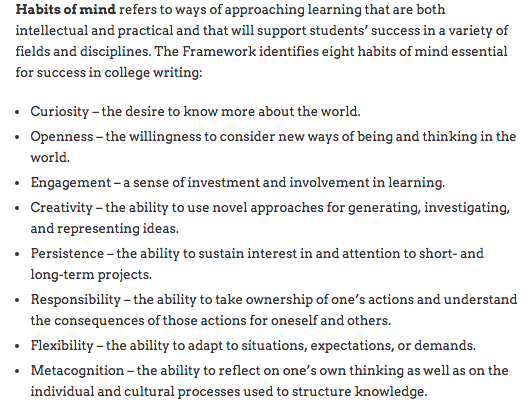
Searching the NCTE website for info unrelated to the topic of this blog post, I found this page, which discusses the Framework for Success in Postsecondary Writing, a collaborative piece by NCTE, NWP, and representatives from Council of Writing Program Administrators that details what it means for the 21 Century student to be “college ready.”

from Framework for Success in Postsecondary Writing

from Framework for Success in Postsecondary Writing

The aha hits me:  These habits of mind are what my readers and writers workshop instruction is all about:  a “way of approaching learning that is both intellectual and practical and that will support students’ success in a variety of fields and disciplines.” At least I try to make it so.

My students need these habits of mind. They need them so they can be successful in college and careers years after they leave my classroom. They need them if they are to be the change agents in the workplace and the world they inherit.

I am persistent. Little by little we embrace this thinking in my classroom. I keep inviting and encouraging.

“Make choices,” I say. “Choose the books you read and the topics you write about. Let’s think about issues that matter to us. Let’s experiment with risk.”

I meet with my learners to help them think through their thinking, conferring with every student as often as I can.

We explore different texts we can write and different authors we want to read. We talk about our reading experiences. We share our writing and our writing processes because everyone has a different way of practicing their craft. We discuss complex texts and practice complex thinking. We choose projects that challenge our comfort and lead to deeper learning.

Many students quickly adjust to the freedom and uncertainty of workshop. Others struggle. Like JWP.

He’ll get there — we have until June.

Do you have JWPs (Just Wanna Pass) or, on the other end of the spectrum, those students who grub for grades? How do you deal with the grades over learning conversations? Please leave a comment and join this conversation.

Mini-Lesson Monday: Sentence Boundaries and Adding Some Variety

Sorry, I forgot to record the book’s title.

Even the students in my AP English class struggle with correct punctuation and varying their sentences. In one-on-one conferences, I’ve started to remind them more often to pay attention to how the author of their self-selected books craft meaning. I used to get glossy-eyed blank stares, but students are beginning to understand that writers make intentional moves to draw us in, and keep us within, the pages of their books.

“As a writer, you must do that, too,” I remind them.

This lesson grew out of a conferring conversation with a student who told me:  “I just do not understand all the comma and semicolon stuff, but I have a pretty good idea of what I want to say in my writing.”

Objective:  Using the language of the Depth of Knowledge levels, students will recognize the sentence boundaries and the variety of sentence structures in their self-selected books. They will make observations about the author’s use of punctuation in these sentences, assessing the writer’s effectiveness in crafting meaning. Students will then use their author as a mentor as they apply their knowledge of sentence boundaries and sentence variety and create, revise, and rewrite sentences in their own pieces of writing. Finally, through peer-to-peer conferring, students will evaluate the accuracy and effectiveness of one another’s sentences.

Lesson:  Every student needs their independent reading book. If a student is reading a book of poems, or a graphic novel without many sentences, you will want to supply a stand in book for this lesson or ask the student to find a book she’s previously read.

Tell students that you’ve noticed in their writing that they are ready to make their sentences more sophisticated. Correctness is one way to do this. Varying the length of sentences is another way. Instruct students to turn to a random page in their books, say page 51. Ask them to read the page in search of one long sentence and one short sentence. Give students sentence stips or blank paper and have them write out the sentences they find in their books. They should spell and punctuate the sentences exactly like the author does.

sentence boundaries lessonNext, in small groups, ask students to discuss with one another the structure of the sentences. They might put all the short sentences together and compare them. Then they might put the long sentences together and look at how the authors use commas to separate ideas. Some students will know more about grammatical terms than others, and that is okay. The idea is to get students noticing how writers compose within the boundaries of standard English and to get them to understand how punctuation works to craft meaning. Ask questions that help them discover why boundaries and variety work to produce effective writing.

You may choose to have students imitate the sentences they chose from their books. Imitation is a useful tool for many writers.

Using self-selected books, not just to practice wide reading, but to teach students to read like writers, adds an important element to the workshop classroom. Our writing improves when we take the time to notice and apply the skills of professional writers.

Follow up:  Have students review a piece of their own writing. The writing can be in any stage of the writing process. They should study their writing to evaluate their use of sentence boundaries and variety. Encourage students to revise their writing as necessary, remembering to use the author of their books as their mentors.

Extension:  This lesson works to have students study leads, similar to what Jackie wrote about in the mini-lesson Pick up Lines and Leads. It also works to have students search their books for sentences that include imagery.


©Amy Rasmussen, 2011 – 2015

#FridayReads — Oh, Mercy! Have I got a plan for this mentor text

Usually I read about four books at a time. This makes for a mess on the bedside table, the coffee table, the kitchen table. I rarely use bookmarks, which is a shame because I have quite a lovely collection.

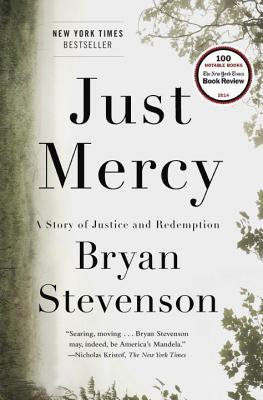
I end up leaving books split open and sound asleep right where I left them –sometimes just so I can remember the parts I know I want to use in class. I refuse to read on until I capture the sentence or passage that gives me pause. Such is the case with my new now bent-spine-copy of Just Mercy, a Story of Justice and Redemption by Bryan Stevenson. I’ve been stuck on page 18.

Here’s a portion of the passage I will use with my AP Lang students. You will, of course, find the rest of it when you buy the book, or here.

     When I first went to death row in December 1983, America was in the early stages of a radical transformation that would turn us into an unprecedentedly harsh and punitive nation and result in mass imprisonment that has no historical parallel. Today we have the highest rate of incarceration in the world. The prison population has increased from 300,000 people in the early 1970s to 2.3 million people today. There are nearly six million people on probation or on parole. One in every fifteen people born in the United States in 2001 is expected to go to jail or prison: one in every three black males babies born in this century is expected to be incarcerated.

     We have shot, hanged, gassed, electrocuted, and lethally injected hundreds of people to carry out legally sanctioned executions. Thousands more await their execution on death row. Some states have no minimum age for prosecuting children as adults; we’ve sent a quarter million kids to adult jails and prisons to serve long prison terms, some under the age of twelve. For years, we’ve been the only country in the world that condemns children to life imprisonment without parole; nearly three thousand juveniles have been sentenced to die in prison.

     We also make terrible mistakes. Scores of innocent people have been exonerated after being sentenced to death and nearly executed . Hundreds more have been released after being proved innocent of noncapital crimes through DNA testing. Presumptions of guild, poverty, racial bias, and a host of other social, structural, and political dynamics have created a system that is defined by error, a system in which thousands of innocent people now suffer in prison.

…..

     We are all implicated when we allow other people to be mistreated. An absence of compassion can corrupt the decency of a community, a state, a nation. Fear and anger can make us vindictive and abusive, unjust and unfair, until we all suffer from the absence of mercy and we condemn ourselves as much as we victimize others. The closer we get to mass incarceration and extreme levels of punishment, the more I believe it’s necessary to recognize that we all need mercy, we all need justice, and — perhaps — we all need some measure of unmerited grace. 


Before we ever read the text, and I did pull much more of it than I’ve posted here, we’ll spark our thinking with an image like this, posted at The Sentencing Project, and then write our initial responses in our writer’s notebooks:

Next, we will TALK. I know my students will want to share what they think about this graphic. Many will identify personally with it because they know a family member or a friend who’s served prison time.

When I introduce them to Stevenson’s text, I’ll give them a purpose for reading — besides just comprehending the message (identifying the purpose is a breeze since he tells us the reason he writes the book) — I want my students to notice the structure, the progression between ideas, the repetition and patterns they will see in the language. All the clues that build the tone.

I will ask them to mark the text, noting their thinking about these things. Without a purpose for reading, too many of my students struggle with the stamina they need to make it through even a page when I ask them to read critically.

Next, we will TALK. Talking will help some students understand what they read. It will help other students clarify their understanding. Some students will have noted what I asked them to notice as they read. I will rely on them to help the others — skill level is just one way my students are diverse.

I will also hand them a stack of questions that prepare them to write. They will read something like this:

What do you know about the writer based on what he writes?

What is the Stevenson’s purpose? Why does he come out and tell us so plainly?

What are the facts in this piece? What are opinions? How do you know?

What do you notice about the structure, any patterns, repetition? What do they do for the message?

How does Stevenson move between ideas?

And then we will write. Maybe I’ll give a prompt like this: Based on the text, and our discussion, is Stevenson’s opening argument effective, why or why not?  Maybe I’ll ask students to come up with their own analytical-style question to respond to. (I like this idea a lot.)  [see Talk Read Talk Write]

That’s probably enough for one class period, but my mind is still stirring:

  • What if I ask students to problematize the issue? Who are the stakeholders? Think all the way around the issue. Why do they care? Why do we care? What kinds of questions do we have about the claims Stevenson makes? What kinds of evidence do we need to convince us they are valid? How and when could anything regarding this issue change?
  • What if I ask students to identify just one of Stevenson’s claims and then research it? I assume the author provides support throughout the book. I’ll know when I keep reading. But what if students did a bit of research and then collaborated on substantiating Stevenson’s claims. Collaborative writing can be a powerful learning experience.
  • What if I ask students to brainstorm other issues Stevenson’s text suggests? We could probably create a pretty elaborate bubble map of ideas. These could lead to student choice in research topics.

What do you think? Any other ideas?

©Amy Rasmussen, 2011 – 2015