Category Archives: Writers Workshop

The Power of Authentic Literacy

Let me tell you about my fall, y’all. It’s been a doozy. 

Depending on which list of the top life stressors you look at, I’ve managed to hit two, maybe three, right on the head. And mine is spinning.

I moved last week. If you’ve ever packed and moved during the school year, you know how stupid I planned the timing. The Rockstars and Tylenol PM have kept me functioning. Some.

Sometimes life gets in the way. Sometimes life gets away from us.

new books in honor of my father

My English department surprised me with this gift of books in honor of my father — one of the sweetest things colleagues have ever done for me. My classroom library is growing!

My father passed away the first part of September. And while he was old, and his health had been fading for a while, his death hit me hard. I used to call him when I drove long distances alone to present workshops. I miss our talks. My dad was a quintessential optimist:  wise, encouraging, smart — and he believed in me.

We all need people who believe in us. 

Everyday I try to show my students I believe in them. They’ve been so great with all my spinning. Compassionate, kind, studious. Mostly.

I started at a new school this year, and I’ve remembered how much I love working with young people. I also remember how much I detest the distractions: the drills, the mandatory To-Do’s, the paperwork. But that’s a post for another day.

Most days I fake my way — I’ve yet to find a rhythm.

But that’s okay. I believe in the power of authentic literacy instruction. I know those who read and write and communicate well have a better chance at navigating life than those who don’t. 

So everyday we read. Everyday we write. Everyday we talk about our reading and writing. Every Friday we discuss important issues. I believe these things trump any other use of instructional time. The routines work. But for many students it is hard.

A few students fake their way — they’ve yet to find their reason.

That’s not okay. I will keep trying. Trying to get books in hands that spark joy in reading, trying to develop writers who believe in the power of words and the beauty of language, trying to get the quiet ones to share their thinking with their peers. They often have the greatest insights.

My evaluator visited my class last week. We were analyzing essays, discussing the writer’s craft –noticing the moves and their effect on meaning– and preparing to write our own Op-Eds. As the administrator left the room he whispered, “It’s hard to get them thinking.” 

Yesterday in our writing workshop, right after a little skills-based lesson on making intentional moves as writers, a young man said, “You mean everything I write has to mean something?”

What do you do with that?

I think we have a hard row to hoe, my friends. Gardener, or not, helping our students understand the role of critical thinking in their lives is what may save them. It may save us. It’s saved me for the past few months.

In a Forbes’ article published a year ago, titled “What Great Problem-solvers Do Differently,” we learn five skills that enable people to be great problem solvers:  deep technical expertise and experience; the ability to challenge, change, innovate, and push boundaries; a broad strategic focus rather than a narrow focus; drive/push; and excellent interpersonal skills.

I can’t help wondering how I can help students develop more of these skills while in my English class. I know it’s possible. Possibilities mentor hope.

This week a small group of my students — seniors who are eager yet terrified (their words not mine) to face the world after high school — and I chatted a bit about the responsibilities of adulting. I’m afraid I didn’t quell their fears. I might have quickened them. 

The stress that comes with independence sometimes sends us spinning. 

My students are my witnesses, and while I’d wish it otherwise, perhaps this fall is the most authentic I’ve ever been as a teacher.


Amy Rasmussen teaches senior English in a large suburban high school in North Texas. She tries to write beside her students and wrote this piece as a practice for their Op-Eds. She’s currently trying to unpack and get used to her new commute. Dallas traffic can be a doozy.


Narrative Writing: Teaching Diction and Imagery Through Shorter Mentor Texts

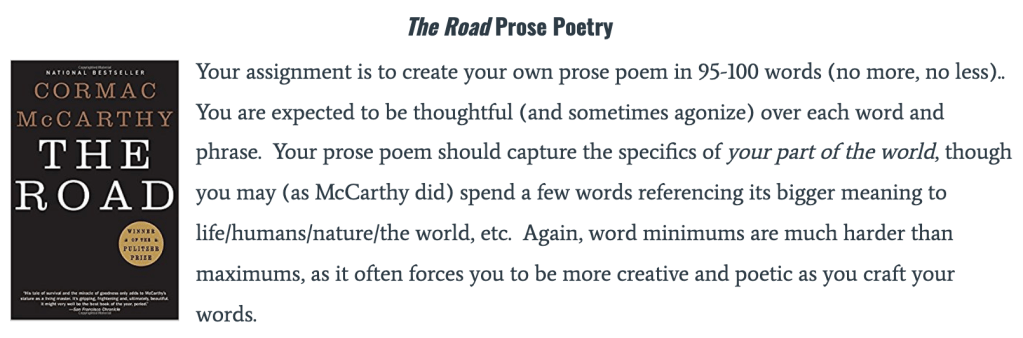
Writing is hard and encouraging students to write can be even more difficult! We have been focusing on teaching narrative techniques in our freshman English classes as a build up for their personal narrative. After reading 180 Days by Kelly Gallagher and Penny Kittle, our English team has created “laps” in which we teach different types of writing. With each new piece of writing we do, we ask them to build on the skills from the previous ones. To teach diction and imagery, we introduced our students to the last paragraph from The Road by Cormac McCarthy. The passage we chose is short, yet challenging for our students. It takes several reads to understand what it is about:

Part One: Comprehending the Text

Once there were brook trout in the streams in the mountains.  You could see them standing in the amber current where the white edges of their fins wimpled softly in the flow.  They smelled of moss in your hand. Polished and muscular and torsional. On their backs were vermiculate patterns that were maps of the world in its becoming.  Maps and mazes. Of a thing which could not be put back. Not to be made right again. In the deep glens where they lived all things were older than man and they hummed of mystery.

(McCarthy, 241)

We read and our students visualize the text, drawing pictures in their composition notebooks. They reread and circled unfamiliar words. In their pods, they used thesaurus.com & dictionary.com to find synonyms and added new details to their drawings to help them construct meaning from this text.

Part Two: Identifying Narrative Techniques

The students worked together highlighting and annotating their text for examples of the narrative techniques used by McCarthy in this final paragraph. This became their model to imitate with their own writing.

Part Three: Write and Revise

If there is one thing I have learned from writer’s workshop, it is the importance of writing alongside my students each step of the process. I was reminded of this during a session I attended at the Illinois Reading Conference a few weeks ago. The presenter called it “The Curse of Knowledge Bias,” when we already know how to do the work we expect of students and we forget the difficulties we faced learning it. By writing with my students, they saw me struggle and welcome their feedback to improve my writing.

My brainstorming model turned into first draft

For this piece, we brainstormed ideas and then turned them into writing. We anguished over what words to use, making sure to “show not tell,” incorporating imagery and strong word choices throughout our pieces. We offered each other feedback – both students and teachers – celebrating those lines that WOWed us, and offering constructive advice where needed. In the end, our students blew us away.

My final draft after students gave me feedback.

A Few Examples of Their Work

What mentor texts do you use to teach diction and imagery? How do you get students to add details to their writing and WOW you with their work?

Melissa Sethna has been a high school instructional coach for the past ten years. While coaching is her passion, she missed the students and is so grateful to have the opportunity to co-teach one freshman English class this year.

Writing Workshops Modeled on Writing Center Theory

Image result for writing center

I was a writing center tutor when I was in graduate school, and my current school allows me to run a student-tutored writing lab for our population during the school day – a dream come true! 

Anyone who has worked as a writing tutor knows that it changes how you see yourself as an instructor. You see beautifully and poorly constructed writing assignments and equally helpful or unhelpful commentary on written work. Helping students navigate an instructor’s expectations makes you better at setting expectations for your own students. 

Perhaps the most powerful pedagogical contribution of writing center theory is the focus on the writer over the writing. A good tutor’s job is to improve the writer, not the paper, a concept described in Stephen North’s 1984 essay “The Idea of a Writing Center.” This is often done through questioning strategies that force the writer to think about her writing rather than commands of how to “fix” it. 

After training my tutors in writing center theory each year, it occurred to me that these ideas could transform writing workshops in my classroom. Now, before my first writing workshop each year, I make sure to teach all my students on a foundational writing center concept: HOCs and LOCs. 

Higher Order Concerns (HOCs) and Lower Order Concerns (LOCs) are how we set the agenda of a writing center appointment. In our writing lab, we have roughly 20 minutes for an appointment, so we need to quickly choose a focus. How do we decide? HOCs and LOCs are our guide. 

HOCs are typically big-picture questions related to revision. Does the paper actually fit the assignment? Is the author’s purpose clear? Does the author need better or more evidence? Has the author provided enough explanation? Would the ideas be better structured a different way? 

These ideas are higher order because, if they are not meant, nothing else really matters. The paper can have beautiful imagery and perfect grammar, but if the message is not communicated, who cares? 

LOCs are often editing issues. I prefer to call them “later” order concerns rather than lower. They are still important, but they should be addressed later in the writing process or at least after the HOCs. These include punctuation, spelling, correct citations, and word choice. Of course, any issue can become a HOC if it interferes with meaning too much. A student whose grammar is incomprehensible may need a lesson on basic sentence structure first. 

In my experience, left to their own devices, students focus first on LOCs, regardless of the goals of the workshop. It is so much easier to tell someone where to add a comma or that “effect” is misspelled than it is to find out what someone was actually trying to say. For my students to be able to have useful workshops, I need to push them beyond what is easy. 

To train my students, we first outline the HOCs and LOCs on the board. Then, together we read a sample paper out loud, and I have them determine what area should be worked on first and why. What are the most pressing issues in the paper? If you really want to challenge them, make sure the paper has some glaring grammatical problems but even bigger issues with argument. 

Then, we discuss our process and rules for writing workshop. 

  1. Start with the author’s concerns. Most authors know what they are having trouble with, so ask the author first. This also puts the author in control of her own paper. 
  2. Read each paper out loud with everyone in the group listening. Ideally, the author should read his own paper. This keeps busy hands from adding commas all over. Students are never allowed to simply pass papers around in my classroom. 
  3. Have a conversation about the paper. I encourage my students to ask questions, such as “What did you mean here?” or “I thought what you were trying to say was … Was that correct?” or “Why did you choose to put this example in this paragraph?” Questions force the writer to think about his own choices and be an active participant. 
  4. Brainstorm possible solutions to problems together and make sure that the author writes them down. 

Over the course of working on a paper, we will eventually get to those LOCs, but again, we do not just want good papers but better writers. Students discussing the decisions behind their writing will inevitably lead to more fluent writers. 

If you’re interested in reading more about writing center theory, a great place to start is The Allyn & Bacon Guide to Peer Tutoring

Sarah Esberger teaches AP Language and Composition and Sophomore English at Central Magnet School in Murfreesboro, TN where she lives with her second-grader, her husband, three furry friends, and a bearded dragon. She also runs her school’s student-tutored Writing Lab and is always seeking new ways to incorporate James Britton’s concept “reading and writing float on a sea of talk” into her teaching.

Real World Writing: A mini-unit using Chipotle as a mentor

I’m in Chipotle, munching the chips and reading the bag. I loved the essays from Aziz Ansari and Sarah Silverman over the past months. Today I notice something different. This essay was written by a high school student.

“Excuse me,” I approach the counter at Chipotle. “Can I have some bags?” I explain to the clerk that I work with teachers and want to use these bags in class. The teenager handed over a stack. I feel my heartbeat quicken, the way it does when a teaching idea starts forming. As a literacy coach, I couldn’t wait to share these with the teachers whom I was working. One of our favorite units of writing was born.

I’ve been training myself to read like a writer my whole life. I just didn’t always know it. I loved reading cereal boxes when I was a kid. I’d pour my milk and then pore over every word, reading riddles and puzzles, then on to the nutrition information. At doctor’s offices, I read Highlights. At the grocery store, I’d speed read Tiger Beat. I read everything.

It wasn’t until I was older that I realized how much all that reading impacted me as a writer. And it wasn’t until I was a Fellow in Ohio Writing Project’s Summer Institute that I had a name for it: “Reading Like a Writer,” a term I learned when reading Wondrous Words by Katie Wood Ray.

As we began to think about how to use these Chipotle bag essays with students, I came back to what I know is true about writing instruction, a rhythm gleaned from countless professional texts (Penny Kittle, Ralph Fletcher, Allison Marchetti & Rebekah O’Dell, to name a few). My OWP colleague Beth Rimer succinctly captures this rhythm when she talks about the ideal conditions for writing:

  • Modeling: writers need to see the possibilities for their own writing by looking at lots of examples. And as often as possible, I want those mentor texts to also exist in the real world (See Writing With Mentors for support around this).
  • Ideas: writers need support to find an idea. As Don Graves said, “Unlimited choice is no choice at all.” Instead, writers need strategies to find the ideas they might explore (My favorite way to nudge writers is with Linda Rief’s Quickwrites books).
  • Drafting: writers need time to write, to mess around, and to get feedback (Write Beside Them by Penny Kittle changed my teaching life).
  • Revision: writers need explicit instruction about ways they might make their writing better (I love Revision Decisions by Jeff Anderson as a way to focus my lessons).
  • Feedback: writers need feedback in lots of ways — from themselves, from each other, from an “expert” (Jenn Serravallo’s book about Writing Conferences is a great place to start rethinking how we give feedback).

Every single time I find a piece of writing in the world that I want to share with students, I come back to this. I use it to build our mini-lessons, to decide on instructional days, and to remind me of what writers need. It might look like this:

Day One – Notice. Gallery walk the Chipotle bags. Talk about what we notice the writers doing. Make a list of possibilities for our own writing.

Day Two – Generate ideas. Once we notice that these essays are all about small moments connected to food memories, we might create a moment map, or a quicklist, or a sketchnote.

Day Three – Start writing. Mess around. Get dirty. Know that this doesn’t have to be perfect. Resist the temptation to give students a template and instead remember that writers need time to let a draft take shape. Confer with the writers in the room, nudge and get to know what they’re working on.

Day Four-Five – Teach. Look at what writers have been struggling with and teach more. Look at what writers have been doing well and put that up on the document camera.

Day Six(ish) – Publish. Sometimes we just turn it in. Sometimes kids can print their essays on paper bags and then have a gallery walk, leaving post-it notes of feedback.

This isn’t always what writing looks like in our classrooms, but we try to build in these moments of authentic writing so that students have a chance to stretch important muscles. They build fluency and confidence. They have the chance to work through the writing process quickly, therefore getting to do it more often. They have an authentic audience and see that writing is all around them.

I recently worked with a 7th grade teacher whose students wrote Two Minutes On essays as one of their first experiences. The products were amazing. Students took risks, they wrote from the heart, and they stretched themselves.

If you’d like to try this mini-unit, you can find the mentor texts here. What real-world writing has inspired you and your students? Share in the comments!

Angela Faulhaber is a literacy coach in Cincinnati, Ohio. She loves burrito bowls and is happiest when eating tortilla chips with her kiddos and husband. She works with teachers and students from grades K-12 and the scariest day this year was when she taught a group of adorable kindergartners a writing lesson.

A Picture Book for Your High Schoolers

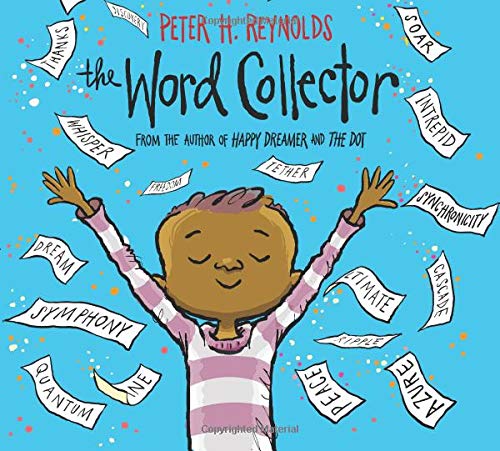
Image result for the word collector

I’ve always been a little puzzled by my dichotomous love for both classic, canonical literature and…….unabashedly romantic, sometimes risque, always happily-ever-after……..romance novels.

But as I thought more about it, I realized that what I love about the classics is their lasting potency, the punch that their language and stories deliver, no matter when they’re read. And what I love about romance novels is watching the classic, timeless journey of a fall into love.

And, thanks to a coffee-fueled epiphany in my notebook, I realized that being a teacher of readers and writers was the perfect career for those two passions of mine: I love to see my students falling in love with reading and writing.

Last week, I read a new book to my daughters that struck me as the perfect illustration of that journey into love with words: The Word Collector by Peter H. Reynolds.

As I read, I was struck by what a perfect picture book this would be to share with my high schoolers. Not only is it chock-full of SAT vocabulary words (which, while that is a concept I loathe, I do admit is a lovely list of cool words), it shows the power and joy of language and all that it offers to both readers and writers.

If you have this book, I urge you to read it with your students. If you don’t, the video linked above does a great job telling the story as well. The possibilities for linguistic play and discovery as you study the text are endless, and endlessly enjoyable–and don’t we all need that kind of joy in our classrooms, as often as possible? Try this text out for one way to bring some sunshine into this dreary Friday.

Shana Karnes lives and works with teachers in Madison, Wisconsin. Her two daughters push her to discover new texts and sneak in the reading of grown-up ones as often as possible. Connect with Shana on Twitter at @litreader.

Text Talk: Speak by Laurie Halse Anderson

Speak, by Laurie Halse Anderson, has been on my radar for years, but it burst into my classroom last year after Pernille Ripp’s Global Read Aloud inspired me to do a read aloud of Anderson’s text in my class. With some heavy groundwork laid for trigger warnings and difficult subject matter, the text spurred conversation, self reflection, and some seriously intense quick writes.

So, during my latest jaunt to Half Price Books, I was beyond tickled to see the graphic novel version of the text with illustrations by Emily Carroll. Though it’s been out for well over a year, I missed its release, and I’m so sorry I didn’t snag it sooner.

After some perusal, I find it to be an absolutely gorgeous visual text. It’s full of gripping images that convey not only the raw emotion of the pain and uncertainty Anderson’s main character Melinda experiences, but the formatting of the text itself is also a work of art.

Ways I Have Used Speak and Its Graphic Novel Version:

  • Character Analysis: Especially early in the book, the protagonist Melinda is a wealth of character development through thoughts, actions, dialogue, and mysterious backstory. Students (especially my freshmen) can relate to her struggles on the first day of high school and as the book progresses they see the reasons for her struggle as raw and real.
  • Prose as Poetry: The formatting of the graphic novel highlights specific words and phrases, literally drawing the depth of the text into a mentor for rhetorical analysis in a way that helps struggling students see the emphasis and emotions without quite so much inference. For some of my language learners, this is key to both understanding and engagement.
  • Narrative Mentor Text: As students transition from studying narrative to writing their own, this text serves as a mentor with clear and engaging voice, rich story lines, realistic dialogue, and relatable characters.

Have you used Speak as a mentor is your classroom? Have you read and enjoyed it yourself? Feel free to leave a comment below and share your enthusiasm for this awesome text!

Lisa Dennis spends her school days teaching AP Language and English 9, while also leading the fearless English department at Franklin High School, just outside Milwaukee, Wisconsin where she lives with her husband Nick, daughter Ellie, and beagle Scout.  She now tries to live life based on the last pieces of advice her dad gave her – Be kind. Read good books. Feed the birds. Follow Lisa on Twitter @LDennibaum

AP Lang Learning

This year my conference period falls in the dead the middle of the day.  Periods one through three are versions of English II, featuring students who are learning English as second language and students with accommodations, along with general education students.

The last three periods of my day bring (mostly) juniors into the classroom for our AP Lang classes. Just like the morning classes, these classes feature learners who vary wildly in ability and performance levels. In the past, teachers have shared with me the opinion that AP classes don’t require a great deal of consideration with regard to differentiation and that these classes don’t lend themselves to reader’s and writer’s workshops.

Some teachers might say that having a conference period splitting two different preps would be a chance to switch gears and shift to a more traditional style.

I couldn’t disagree more.

I’m learning more about more about the content of AP lang, and I’m learning how to deliver that content through routines and practices in which I believe. Those routines and practices are grounded in workshop pedagogy.

Take, for instance, this recent lesson cycle:

Formative assessment data told me that the students were feeling comfortable with the “rhetorical situation” and identifying it’s elements. Assessment was also telling me that many of the writers struggled to express their understanding in their writing.

In my mind, this indicated they needed to see authentic responses where real writers wrote with a purpose similar to what I was asking them to write. Luckily, College Board recently released sample essays with scores and commentary. I could have (and will soon) shared my own writing, but these examples were too good to pass up, and I wanted the writers to start to make a connection between their writing abilities and what they will be asked to write between now and May 13th.

img_5796Taking one paragraph each from the sample essays, we read them like writers and explored the decisions and moves made by those writers. Our process of discovery put the cognitive load on the students and allowed me to serve as a “tour guide.” We learned how our argument skills can be applied to this specific writing task, finding new words to add to our personal dictionaries and use in our own writing.  We debated the use of claim and evidence and the utility of being intentional with the length of the direct evidence we blend into our argument. We examined the sentence structure decisions made by the writers and noticed how combining sentences can make our writing, and our argument, clearer.

A good friend of mine, someone with AP Lang experience, recently reminded me that a big part of analysis is about looking for repetitions and contrasts. Bringing this idea into our conversation unlocked deeper meaning and more writing territory we could explore.

Before we finished looking at the mentors, they were ready to dive back into their own writing. They moved into the independent practice portion of the lesson with confidence, but also questions, and I set about conferring with individuals and groups depending on the needs of the learners.

I won’t say it was a mystical vortex of learning, but I will say that this turned out to be exactly what they needed at that moment. Meeting their needs based on what I learn from many different streams of data helps me get there. The data part is a conversation for another day.


Charles Moore is attempting to recover from the beat down he received in fantasy football ….from his wife. He is thrilled to look forward to ILA 2019 this weekend as he is co-presenting with two amazing teachers about how novels-in-verse can be used to help English learners.  Their session is Saturday at 11 am in room 295.

The Power of Wonder & Mentor Texts (a post inspired by Kwame Alexander)

Last week my 12-year-old son and I attended an event with Kwame Alexander at our local book store, Joseph-Beth Booksellers.

You have never heard someone read a book like Kwame Alexander reads a book. This man takes his time. He lets the words fill up the air. He chews on a pause, taking his time, stre-e-e-e-tching it out. He understands the power of pacing and performance.

I’ve seen Kwame perform before; he and his partner Randy Preston put on a show. Randy plays guitar beneath Kwame’s words, punctuating, pacing, elevating the performance. Sometimes they break into song, or rap, or they just riff.

Sharing this experience with my son was important. Reading Crossover broke him out of a reading rut a few years ago and he’s devoured so many of Alexander’s titles. I’m looking forward to sharing the graphic novel with my other children, who are big GN fans, and with the students I see, who I know will love it.

But what’s really staying with me about this experience is what I found while wandering around the bookstore. Tucked in a back corner, I stumbled across this collection of poems, Out of Wonder: Poems Celebrating Poets. Kwame Alexander, along with Chris Colderley and Marjory Wentworth, and illustrator by Ekua Holmes, have created a beautiful book and I can’t wait to share it. 

IMG_6447

I flipped through the collection and while I recognized many of the names —  Giovanni, Oliver, Hughes — I realized they weren’t the writers of the poems. Rather, they were the inspiration. The whole book is a celebration of poets, full of pieces written in the style of the poets themselves. I’d found a treasure trove of mentor texts!

For example, this one by Wentworth, “(Loving) The World and Everything In It”, inspired by Mary Oliver’s poem “My work is loving the world …”


The collection is broken into three sections:

  1. Got Style: where the poets imitate the style of a famous poet.
  2. In Your Shoes: poets imitate the tone and voice of other poets.
  3. Thank You: poets pay homage to their favorite poets, “sharing with the world how awesome we feel about the poet and the poem.”

I love thinking about being in conversation with poets and their poems in these ways. Wouldn’t it be powerful to give kids the opportunity to find a poet that resonates with them, or to explore different poems (maybe in a gallery walk like the one talked about here in Teach Living Poets). Then to let them choose a path to enter into dialogue.

Share with us the way you have students talk back to their favorite poems. (And we hope you have the chance to see Kwame Alexander on his upcoming tour.)Screen Shot 2019-09-29 at 9.20.36 PM


Angela Faulhaber is a literacy coach in Cincinnati, OH. She’s in the middle of having the honor of attending several amazing author events this fall: Angie Thomas and Kwame Alexander in September, and now Bryan Stevenson, Ruta Septys and Raina Tegelmeir in October. In her spare time she likes to ask her kids’ friends what they’re reading and making book suggestions to pretty much everyone. 

Maybe the Best #MentorText I’ve Found Lately

Don’t you just love to find mentor texts that make your head spin with ideas? Okay, maybe it’s just me.

But take a look at this one and see what you think:  The 25 Songs That Matter Right Now, published in the NY Times.

I’m not sure how I’ll use it yet — I’m still trying to get my head wrapped around teaching seniors everything they can possibly need to know to be successful as readers and writers beyond high school when I only have them in class one semester. (We are on accelerated block.) But this text is way cool, and I think most of my students will like it.

It’s got music and images and music started playing without me even doing anything.

It’s got analysis and commentary and reflection. It’s multi-modal!

As I begin thinking and planning for what comes next in my instruction, I’m moving this to the top of my mentor text stack.

I’d love to know your ideas on how students might write beside it. Please leave your ideas in the comments.


Amy Rasmussen teaches senior English at a large suburban high school in North Texas. She loves her school, her students, and adding mentor texts to her ever-growing lists of “We Could Do This to Learn That.” She’s a bit of a fanatic about matching readers to books and writers to whatever it takes to help them amplify their voices. Follow Amy @amyrass — and if you’re reading this, our team would love it if you follow this blog if you aren’t already.

Empowering Students by Celebrating Banned Book Week Any Time of Year

It’s banned book week, which means many of us teachers are highlighting books that have either been controversial in the past or are controversial now. I love that banned book week gets our students and colleagues talking about what we should all be allowed to teach, read, discuss, and learn about. It makes us all feel smart, in the loop, and empowered.

Because I displayed and highlighted some banned and frequently challenged books, students asked some great questions which have generated some important conversations. They felt smart and important when they learned about banned and challenged books.

When students express an interest in these books, or any book for that matter, I let them know that I appreciate that they are challenging themselves. Maybe they are challenging their thinking about a certain topic, they are exposing themselves to new experiences through books, or they are reading a complex text, but banned and challenged books can be problematic for many reasons, and those problems often lead to new learning and ideas. However, if a book becomes “too much” for any reason, whether it be their hearts aren’t ready for it (I explain that Marley and Me is still too much, several years after the death of my beloved dog, Bart), or the text is too challenging, or the words or situations make them uncomfortable (especially for the middle school students I teach), they can give themselves permission to drop the book or save it for later.

It’s empowering to be able to choose your own book. It’s also empowering to be able to drop it.

These conversations this week started because of a simple book display I put together because I was inspired by the fact that it is Banned Book Week. I used the ALA’s list of frequently challenged books as a resource so I could pull books from my classroom library shelves. A couple of my colleagues shared similar displays in their classrooms, so many students are curious, asking questions, and talking about censorship.

This is the type of display that can be shared at any time. Banned Books Week is a great time to start the conversation, but the conversation might take more than a week. In fact, I think it should.

Because that conversation takes more than a week, I’d like to suggest a unit around research, argument, and banned books.

Last year, a colleague and I did just that. We based it off of a Read Write Think lesson about banned and challenged books, and it went really well. Even thought Banned Books Week is in September, we worked on this unit in May, because talking about banned books is important all year long.

Screen Shot 2019-09-24 at 3.57.11 PM

Students researched, read about, discussed, and wrote about banned and challenged books.

They looked at Laurie Halse Anderson’s statement about intellectual freedom and felt empowered.

They read the NCTE statement on The Students’ Right to Read and felt empowered.

They watched Trevor Noah and Jason Reynolds discuss what it means for books to be mirrors and windows and felt empowered.

Essentially, when students researched and read about titles that have been censored, they felt empowered that they were able to access these books. When students saw the display of challenged and banned books, they felt empowered that they could access them in their own classroom libraries.

Teaching students about banned books empowers them. Banning books removes the agency from students and teachers, but exposing that censorship empowers that same demographic. My students feel empathy for those who have been denied access to these important and powerful books. They are also grateful that they have easy access to these same titles.

By exposing censorship, teaching about intellectual freedom, and providing access to all types of books, students, teachers, and communities are empowered.

Aren’t we all about empowering our students?

Julie has been teaching secondary language arts for twenty years, spending the first fifteen in rural Central Oregon,  four in Amman, Jordan, and the most recent school years in Managua, Nicaragua. 

Follow her on twitter @SwinehartJulie