Category Archives: Writers Workshop

3 Ways to Jump-Start Reluctant Writers

IMG_1703My younger sister Brittany is a phenomenal writer; in school, she excelled in all subjects, including English, but I never saw her struggle quite as much as when she was required to keep a writer’s notebook. For me, writer’s notebooks had always been liberating. I kept one in my spare time after having read Ralph Fletcher’s A Writer’s Notebook the summer before sixth grade. This was not the case for my sister though who, at the urging of her teacher, would write, “I do not know what to write” for ten minutes straight. Her teacher would tell her, “You’ll figure out what to write after a while,” but she clearly didn’t know my sister who is not only brilliant but also strong willed and persistent. In turn, when I told my sister I’d be integrating writer’s notebooks into my classes, she groaned, saying, “I hated those things.”

Brittany’s PTSD was reasonable. When used without encouragement or prompting, writer’s notebooks can become tedious and painful. Students can easily learn to loathe this tool that should otherwise be fun and stimulating. In turn, when my students explore their writing, I make an effort to help fuel their ideas and interests through a variety of writing activities and exercises that oftentimes help even the most particular writers.

  1. Prompt Board: At the beginning of the year, I ask students to write 3-4 pages in their writer’s notebooks. This helps students establish a writing routine and it helps me to learn about my students quickly. That being said, many students stall when it comes to putting pencil to paper. After running into this problem early on, I began posting five writing prompts per week on the side of my main white board. These topics included personal questions about students’ interests or extracurricular activities as well as sentence starters and fictional scenarios intended to lead into creative writing. I compiled the majority of these prompts off of social networks like Twitter and Pinterest, but I also use sentences from my book talks during the week as prompts as well. I post these prompts on my website in a separate section so students can always go back and revisit the prompts from past weeks.
  1. Ideas Shelf: Teens love thumbing through the pages of oddly shaped writing books. One of my most well-loved books is a cube shaped book called The Writer’s Block, which has “786 ideas to jump-start your imagination.” That being said, there are plenty of fantastic average size books that I store on an ideas shelf, which also includes 642 Things to Write About, Now Write: Nonfiction, Now Write: Fiction Writing Exercises From Today’s Best Writers and Teachers, and 100 Quickwrites by Linda Rief. When stuck, students gravitate towards this shelf. In addition, with the help of my Writer’s Club, I am hoping to add a jar of words, images, and prompts this year for students to pull from whenever they are struggling.
  1. Self-Guided Activities: As the adviser of Writer’s Club, I always have trinkets on hand Rory's Story Cubes for StADato help students put their pencils to paper. Some of my students’ favorite toys include Rory’s Story Cubes, which are dice with small pictures on them. Students can toss a handful of dice and incorporate the images into a story. I also have a collection of old skeleton keys I bought at a craft store. Tied to each key is a tag with a sentence starter that discusses where the key might have been found or what the key opens. Another easy activity involves collecting paint strips from your local hardware store and having students write stories involving the absurd color names on each strip.  Finally, I love utilizing found photography like the pictures from Miss Peregrine’s Home for Peculiar Children or old calendar images to get students thinking. I have a collection of small Dana Heacock calendar images, which are brightly colored drawings of New England scenery or objects.  These images oftentimes stir up students’ memories of childhood and lead to fantastic personal stories.


How do you help inspire your reluctant writers?  What methods do you use to jump-start their independent writing process?

Fart Jokes in 12th Grade

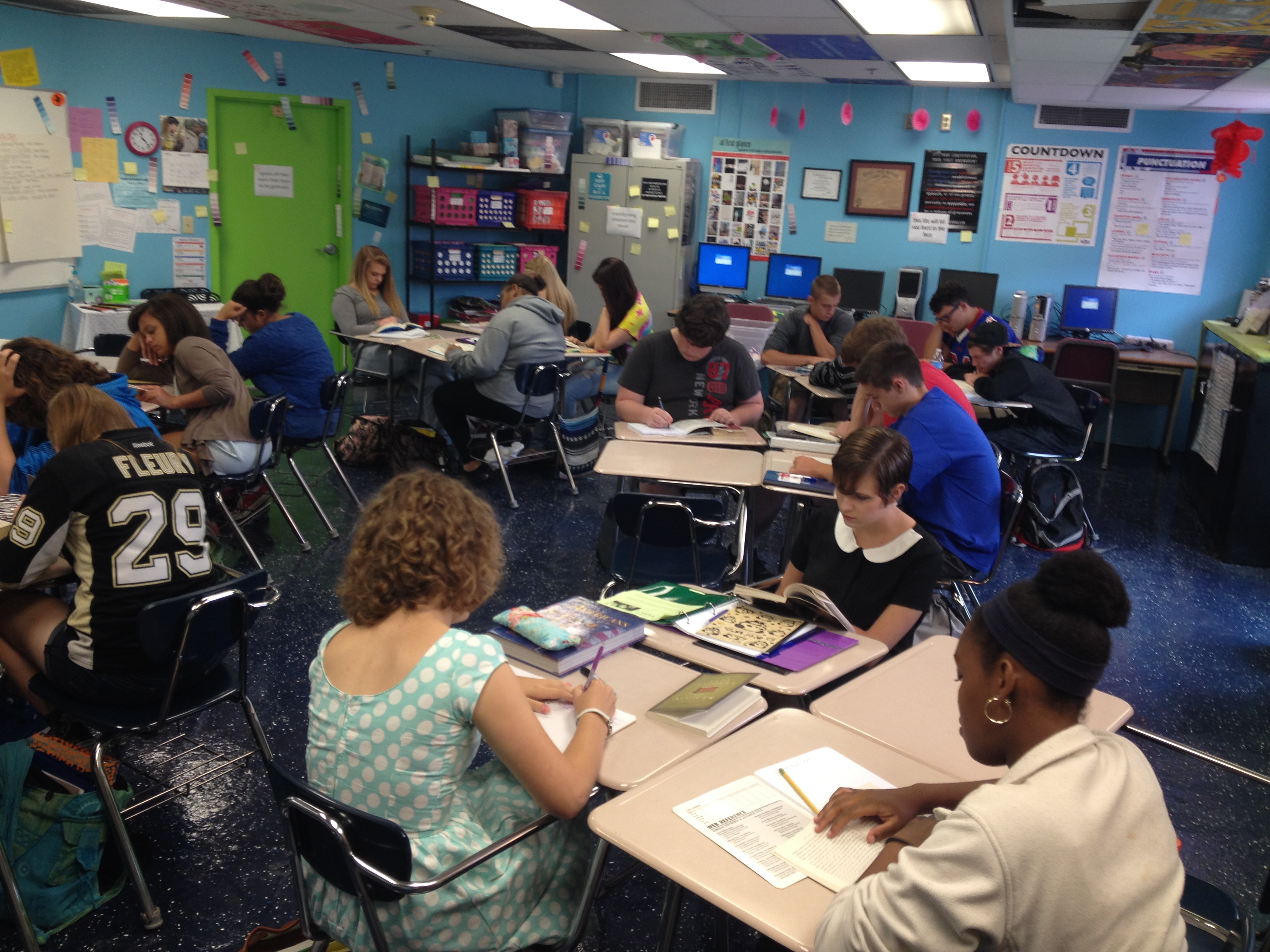
photo 2-2Three minutes into silent reading, someone farted. I have the band-aid colored desk-chair combos, which meant that one vibrating toot was magnified against the metal frame of the guilty student’s seat. The room stayed silent for half-a-minute and then erupted in laughter. The girls quietly chuckled, but there was no way the boys could settle back into their books, so we moved on to our minilesson and called it quits.

My boys can’t get enough of lowbrow humor. Their writer’s notebooks and fictional stories are full of crass humor—farts, sexual innuendo, embarrassing stories, and offensive humor. For years, I chalked up their obsession with these topics to immaturity. I love a good fart joke or sarcastic paper, but I never truly understand the point.

Newkirk argues that humor is a mode of exploration for students, particularly boys. Instead of chastising them for vulgar or lowbrow humor, teachers should capitalize on boys’ love for the weird, gross, and funny. He pointed out that classic literature is full of crass humor, citing Beowulf and Shakespeare as examples. Boys, he noted are inclined to read humorous literature and use these as mentors for their own writing.

Too often though, teachers either don’t understand boys’ humor or they fear that the silliness somehow undermines the assignment. This shouldn’t be the case. Just as we give girls the room to explore emotionally charged pieces about self-confidence or dating, we must also give boys the opportunity to investigate their own questions, which may very well include both humor and violence, as Shana discusses. In an excerpt Newkirk gave us from Boy Writers, author Ralph Fletcher notes that “some of the crass humor in their writing (burping, farting, dirty diapers) tries our patience, but many boys are simply making ‘text-to-text’ connections between their writing and the kind of humor they read in books.” These connections are invaluable when it comes to capturing the attention of our male students.

IMG_2367In turn, we must allow our boys a space to explore humor. Sometimes jokes are just funny, but other times, they soften heavy themes in literature. They open up deeper discussions that are otherwise inaccessible or uncomfortable. As Newkirk writes in Misreading Masculinity, “[Humor] provides a forum for negotiating and sustaining male friendships, and of making overtures to girls. It allows us all to laugh at the peculiarities of our bodies, as we escape, if only briefly, from our embarrassment at the sounds they involuntarily make and the smells they produce” (Newkirk 167). Will students toe the line between inappropriate and appropriate humor? Most likely. Will they take their jokes too far? Potentially. But learning is about testing our surroundings and studying voices to find our own. At the end of the day, I’d much rather my students explore their world through laughter than not, fart jokes and all.

Just Let Them Write: Boys and Autonomy

“Just let them be boys.”

This aphorism about dealing with boys is a long-standing one, but I learned last week in Tom Newkirk’s class on boys and literacy that it’s much easier said than done.

First, after reading a pretty fascinating article in The Atlantic, I realized that modern society doesn’t often let our boys be boys.  The economy, family structures, and workplaces of America have changed drastically in the past twenty years, and the traits and skills that used to make men successful and fulfilled have gone away.

Second, I listened to my fellow teachers discuss their classrooms this week at UNH, and I was struck by the language of control prevalent in teaching narratives:  “I make them;” “I let them;” “I shoot down their ideas;” “They have to;”…these were the words teachers used to describe their students’ activities.

These are phrases of division, of separation, of a differentiation of teacher and student, expert and learner, master and subject.  Having just read Daniel Pink’s Drive, the phrase “The opposite of autonomy is control” has been stuck in my mind.  It seems that even in the academically enlightened setting of the New Hampshire Literacy Institutes, many teachers still practice a teaching philosophy of control and compliance, rather than one of equity and autonomy.  Further, many of these speakers were women–so this was an issue not just of control, but of furthering the claims of the Atlantic article mentioned above regarding emasculation.

Our class talked about violence a lot, and whether it was acceptable in writing.  Ralph Fletcher’s Boy Writers taught me that violence in boys’ writing was as natural as the sunrise.  Newkirk addresses this issue as well, defining violence in general as “the intentional infliction of pain…on another,” and specifying that “writing would be a violent act if it caused pain to others…for example, if it caused readers to feel threatened or humiliated.”  Too many teachers in our class had a strict no-kill, no violence, etc. rule about writing topics–the opposite of autonomy.

Most reading and writing boys do doesn’t involve intention to inflict physical pain or harm.  Their topics may be provocative, but most of the time, it’s just boys working out things that are on their minds–huge issues like death, love, violence, and sexuality.  Adults do this all the time too–these are issues many of us haven’t quite worked out, so why should we deny children an opportunity to explore them through writing or other means?

Thanks to reading texts like Boy Writers, Misreading Masculinity, and Peter Johnston’s excellent Choice Words, I feel like I understand and enjoy many themes in my boy students’ writing. In fact, the first time I met my husband was in my freshman English class, where I wrote a story about a serial killer who stole college students’ identities and test scores by ripping off their faces and stitches them over his own. My professor asked me to share it in front of the class and I still recall the nervous giggling that followed my sharing, including Jon’s wide eyes. As a writer, I was just proud of creating a fictional voice so creepy and plausible, but the embarrassment of that experience shamed me to a degree that I’ve shied away from all fictional writing since.

As a teacher, I don’t want to quash a student’s creativity, violent or not. I love my boy writers and respect the sanctity of their writer’s notebooks, in which their fantasy lives can be explored and reflected upon in private. For them to grant me access to those fantasy lives through writing is a sign of respect and trust, and I wouldn’t want to violate that by censoring their thoughts, showing them to administrators, or asking them to share with the class.

But most of all, I want to distinguish between feeling “uncomfortable” and feeling threatened or unsafe.  Hearing me read my serial killer story probably made some of my freshman English students feel uncomfortable, but no one felt scared–I did not threaten anyone in the room, nor did my fictional narrator.  In fact, the end of the story revealed that the killer’s actions were mostly motivated by justice, revenge for his victims’ pervasive academic dishonesty.

Feeling uncomfortable, though, is something I believe is essential to learning.  Disequilibrium is the space in which our worldviews are challenged, where we achieve the Vygotskyan zone of proximal development.  We are confronted with new knowledge and are close enough to it to assimilate it into our existing schema.  An open, unfettered workshop classroom is one place where this kind of development can (and should) occur.  Rules like no violence, no swear words, no sex, no freedom, prohibit the opportunity for disequilibrium–and real social learning–to occur.  We cannot fear our students’ inner minds.  We must acknowledge the distinction between fantasy and reality in books, in writing, and in our kids.

Further, we must value that chasm, and respect our students’ varied and important processing strategies.  Writing these issues out is a way to come to understand them, so we must forsake this antiquated notion of creating control and compliance in classrooms.  Given choice, given autonomy, our students will read and write their ways toward understanding beyond our classes and into their adulthood, as we do.  We are the same as our students, grappling with concepts in writing (like I am here, now) and are no better than or superior to them.  Eliminate authority, cultivate autonomy, and just let them write.

Good Writing Moves Us — THIS Writing Moves US

I want to include you in a celebration of the work of a student that represents several of my kids this year. If you teach, or have taught, ELL students, I know you will understand.

The last assignment was an intensive writing piece that we workshopped for about seven weeks. Writing in class almost daily, conferring regularly, and mini-lessons with mentor texts and modeling served as the routine. Students turned in their writing in three separate chunks, gave one another feedback at least three times, presented their final pieces (published on their personal blogs) as their semester exams. Formative assessments were student writing conferences and the checkpoints along the way. Summative assessments were a self-evaluation and a self-evaluation paired with my feedback from a rubric we crafted as a class.

Biak with the book she loved the most this year. She read 12.

Please read the writing of Biak Par. The poems are original, and the story is her own. Just before school was out, I had to call Biak to my desk and let her know that she failed the state English II EOC. Again. That was nothing short of heartbreaking — for both of us.

Take several minutes and read Biak’s story. You will read the words of an improving and authentic writer. These words are elegant, poignant, and powerful. Good writing moves us — this writing moves us. 

Now, take a look at Biak’s writing from the beginning of the year— her first blog post is here, and her second is here.

Now, think about her end-of-year piece of writing. I know it is narrative, but you will note what I do — improvement. So much improvement. Voice, coherence, organization.

I wish I had another year with Biak, and several of her friends. We’ve come so far, and this is the work she should be allowed to celebrate — not a test score.

I know — preaching to the choir.

©Amy Rasmussen, 2011 – 2015

Our Year-In-Review

As we round out the 2014-2015 academic school year, I would like share our Year-In-Review from us here at TTT and dedicate it to all of our loyal and contributing teacher friends who share in our experiences throughout the year.  Playing with the Reading Writing Workshop model is always exhilarating and fresh and exciting and freeing and thought-provoking.  It’s always propelling us, as educators, to break through barriers and teach with our most authentic teaching souls.

So, to capture the essence of how we have all explored the model this school year; here are highlights that allow us to celebrate the risks, the questions, the stumbles, the ‘ah-ha’s, the setbacks, and of course…the successes.  As we are all still progressing through this last month of our current school year, we hope that resurfacing some of our favorite moments will ignite the fire that keeps us all educating with fierce passion, deep inquiry, and continual evolution.

The calm zen of the RWW in Texas.

The calm zen of the RWW in TX.

First up: The lovely Amy Rasmussen who never ceases to amaze all of us with her wit, wisdom, and wildly insightful thinking.  Here is a woman who has taken the RWW by storm and has not looked back; the only time she does is to pick up, dust off, and gently guide those who are trying to find their way through the process.  She is an excellent mentor and extraordinary educator who ensures that her Advanced Placement students are gifted the wonders of the RWW. Here is a collection of how Amy has guided us through the intricacies of customizing the RWW for our own learners:

A Feedback Protocol for Revision Workshop

5 Reasons Why Reading Conferences Matter — Especially in High School English

5 Ways to Enjoy the Last Month of School


A reminder of student movement and achievement.

A reminder of student movement and achievement in NH.

Next: Jackie Catcher’s name could not be more appropriate.  We know the catcher’s responsibility on the field is to guide the team to strategic success; Jackie does the same infield – in her classroom. She moves her students with her unyielding dedication through continual infused literacy by craftily customizing projects and lessons that engage students. She is a powerhouse who, through all the struggles and obstacles of a second year educator, never ceases to find innovative ways to educate and inspire.  Most importantly, she is always a learner first and shares her inquiry with others to not only think collectively, but to create success-driven solutions.  Here is some of her story:

Building My Library Around My Students

Unraveling the Mystery of Poetry

The Question That Changes My Students’ Writing


A bright and energetic learning environment in WV.

A bright and energetic learning environment in WV.

Thirdly: The always-invigorating Shana Karnes. Shana is a shining light to her students, yet her light shines brightly for the world of evolving educators as well.  She is open to sharing her passion, her innovative thinking, and the way she creatively customizes the RWW for her students in the throws of West Virginia.  Shana never loses sight of how vital piles and piles of literature are for the growth of her young readers and emerging writers.  She knows how to roll up her sleeves and do the work right beside her scholars.  It is through the sheer joy of all things literacy, that Shana explores the world of the RWW:

We Learn Facts from Fiction

Teach Readers, Not Books: A Case for Choice Reading in ALL Classes

The Value of Talk


The shelves where our identities are qualified, our ideas solidified, and our passion realized.

The shelves where our identities are qualified, our ideas solidified, and our passions realized in NY.

Rounding it out: Erika Bogdany.  Through the RWW I have challenged my students, and they in turn, have challenged me.  They push me continually with their own inquiries and want to be more fluid writers.  They challenge my writing by offering suggestions and insight that I have bestowed upon them; the gift of creating a safe community for all learners to read, write, risk, and share.  It is through the RWW that students find pride in their work, volume in their voice, crafted secrets in their writing, and beauty in themselves.  It is with passion and grace that students flutter and flop; yet learn how to fly:

All it Takes is a Tutu and Some Focus

Beyond These Four Walls

Today We Draw


We hope that our moment of reflection and celebration continues to provide you ideas and inspiration throughout the remaining time you have with your unique readers and writers this year.  We’d love to continue hearing your voices, feedback, and generous insight while we round out this school year…and look forward to the year ahead!

Why Assignment Sheets Might Be Killing Your Students’ Writing

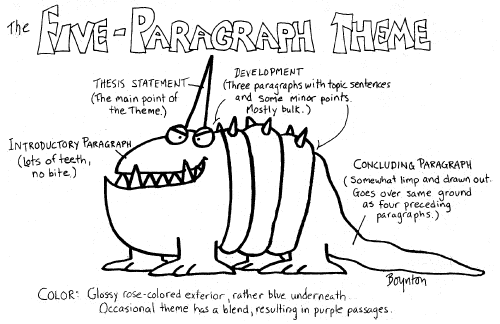
58090ec056811830ee936030edb1c9dbMy first year of teaching, I didn’t realize that the “five-paragraph essay” was a dirty phrase. My  internship year I painstakingly dragged my freshmen through the essay outlining process, watching them regurgitate homogeneous essays about symbolism in Lord of the Flies. At the end of our six-week study of the book, I slogged through 25 nearly identical essays, all of which had eloquent yet oddly familiar intro, body, and conclusion paragraphs. I’ll readily admit that despite the dull content, I felt victorious. My students had completed literary analysis essays and I had taught the foundation of essay structures.

It was that summer that my perception on structured essays changed. Two days into taking Penny Kittle’s writing course at the University of New Hampshire’s Literacy Institute, I realized that I had committed a cardinal sin of workshop teachers. Admitting to teaching the five-paragraph essay (let alone the sandwich method of paragraph-writing) was like confessing to enjoying McDonald’s burgers at an elegant chophouse: the cut (or concoction) of meat might serve the same purpose, to fill me up, but the quality was quite different. In turn, I was feeding my students homogeneous writing, a detailed equation to a subject that couldn’t be distilled down to simple mathematics. If I expected greatness, I needed to break beyond the boundaries of such a restrictive form of writing. After all, an introduction + body paragraphs + conclusion didn’t guarantee a solid essay; if anything, it guaranteed an entirely unspectacular essay.

This process of digesting the material and then providing a summary of the structure was far too easy for students. Not only did it place the onus on me to provide a set guide of instructions, but it also required me to complete the majority of analysis. Instead of my students engaging with the text and delving into the intricacies of structure and craft through individual exploration and group discussions, I was basically pre-digesting the material before offering it to them.

IMG_1845

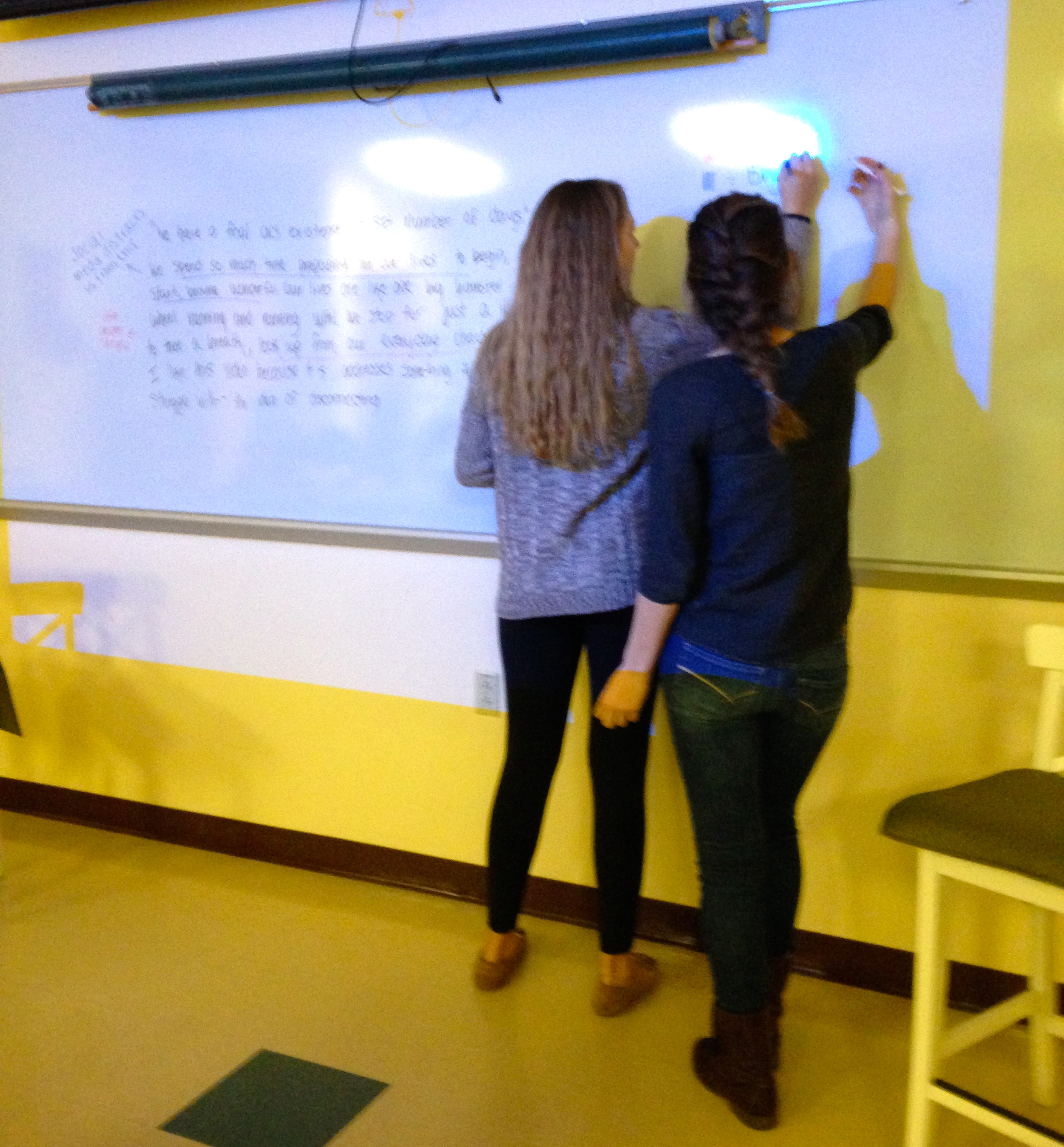
Students analyzing an author’s craft in front of the class.

This year I have made a point to wean my students, particularly my juniors and seniors, off the assignment outlines they so desperately desire. Instead, my students now receive a half-page sheet simply telling them the type of essay they are writing (cause and effect, definition, personal narrative, etc.), the mentor texts they may refer back to, the page length requirement, and the due date.

Initially, they were frustrated with this format. As one student said during our career building unit in which we practiced writing cover letters and resumes for celebrities, “Ms. Catcher, do you have an assignment sheet for this or something?” When I pointed out the paper I had given to him previously, he replied, “No, I mean something that tells me how to write this paper.” We discussed the numerous mentor texts we had read and dissected and how these as well as our class discussions ultimately provided the basis we to develop our pieces. As a class, we asked questions of the text and author, starting broad by looking at the overall tone, voice, structure, intended audience, and progression of the piece. Then, independently or within small groups, we delved into more of the intricacies—what examples were provided, word choice, sentence structure, punctuation, and transitions. Students have gradually learned that there is no set solution for getting an A, which also means that they are forced to read and reread mentor texts to gain a firm understanding of a piece’s intricacies.

My problem from the beginning was that I was too busy telling my students how to write an essay to allow them to discover the messy albeit enlightening connection between reading, writing, and modeling. As we complete the last six weeks of school, I have noticed a significant difference in the structure and craft of my students’ work. They are relying more readily on mentors to help guide them in their process, and I can see both their group and independent analysis directly translate into their writing. For the past three years, I have harped on my students about showing rather than telling, but as the year comes to a close, I can finally say that I have internalized my own advice when it comes to my teaching.

How do you inspire students to rely on mentor texts instead of assignment sheets?  What steps have you taken throughout the year to make them more independent and confident writers?

The Question That Changes My Students’ Writing

My first year of teaching I taught thesis statements as these grandiose sentences that establishedimages the entire infrastructure of a paper. I conducted minilessons and writing units just on how to write a three-pronged thesis, which would inevitably lead into a five-paragraph essay. While this technique was arguably successful in its own right, it was also highly limiting. Because the three-pronged thesis set students’ papers up with a distinct outline right from the beginning, it didn’t allow students to delve deeper into their topics. If anything, it actually limited their exploration of their topic or research because it set too stringent of guidelines.

It wasn’t until I read Kelly Gallagher’s Write Like This that I found one of the single-most valuable suggestions for student writers. Somewhere in this treasure trove of practical suggestions, Gallagher changed my approach to teaching theses with one question. Instead of asking what the point of the paper was, he questioned what the student wanted their reader to learn. Now during mini-conferences I ask students, “What do you want your reader to take away from this piece?” Not only does this question prompt them to acknowledge and think about their audience, but it also makes them recognize the value of their writing as a reputable, informative piece. As students answer this question, I jot down their responses, asking them additional questions to deepen my understanding of the subject. Eventually, when the point of the essay has become clear, I give them the notes I have taken and say, “This is your thesis,” showing them that the information we want our readers to take away is really the mission of our essay as a whole. From these notes, we formulate their thesis together to better address the overall message of their paper.

In the end, this approach oftentimes transforms students’ papers from flat, five-paragraph essays, to papers that delve deeper into the content. My freshmen recently finished their five-page research papers while my juniors and seniors completed eight-page TED talks. I used this approach during the initial conferences to help them hone in on the issues they wanted to research. After our conference, Emily’s essay transitioned from a simple history of prosthetic limbs to a deeper exploration of the rapid evolution of modern prosthesis and the technology needed to make them more lifelike. Sarah, on the other hand, found that her fascination with the Russian mafia also led into a deeper exploration of a lethal new drug called Krokodil, which is being trafficked through Russia. Each time students were able to isolate what they found to be fascinating about their topic and then ultimately use that as a jumping point for the rest of their paper. In the end, asking this one question helps students clarify an otherwise intimidating thesis while also helping them to polish their approach to the subject.

Hoping to See Some Damn Good Sentences

I am thinking about sentences.

For a few days now, I’ve been scoring stacks of essays. (If you teach English, I know you’ve been right here with me. Shana wrote about her disdain for grading and some solutions here.)

Reading student essays can be a joy or a chore. A really long never-ending chore. This time around, it’s like scrubbing the tub with a cotton ball after a team mud race.

With almost every essay, I’m scratching my head wondering how a student gets to be in 10th or 11th grade without learning how to write a clear, concise, complete sentence. Just give me one I want to say.

We could work with that.

So today, I am thinking about sentences and how to help students think about what they want to say before they ever lift their pens. And how talking about their thinking will help with their writing.

I am reminded of the importance of reading. Students must read and read a lot. We must teach them to notice how writers construct meaning by linking words into sentences. We must encourage them to talk about what they notice.

I’m thinking there’s more than one meaning here.

I am reminded of the value of mentor sentences. We must expose students to a variety of single sentences and help them talk through what moves the writer makes in each of them. Word choice, structure, details, figurative language: we must help our students understand how and why writers make intentional choices as they craft meaning.

Then, we must encourage them — and give them time — to practice crafting with intention on their own.

I am reminded of the need for conferences. We must make it a habit to talk with our writers one-on-one, regularly. The more we speak with them as writers, the more they will develop the identities of writers.

Writers take time to craft their sentences.

I recently read this post “5 Ways to Write a Damn Good Sentence,” and I am going to work these tips into my instruction the next few weeks as my students work on their final writing project. I am also going to find some mentor sentences that model each of the first four tips. We’ll practice the fifth one.

Next fall, I will not wait so long.

1. Insert facts.

2. Create images.

3. Evoke emotion.

4. Make promises.

5. Practice, practice, practice.

©Amy Rasmussen, 2011 – 2015

Four Ways to Formatively Assess in Workshop

dtrfyguhujSometimes I wake up in the morning, thinking about what I’ll be teaching and learning that day, and feel like a rebel.  That’s right–I think to myself, feeling inexplicably cool–I teach workshop. Yeahhhhh.  Even though this is the most research-based, data-driven form of instruction I’ve encountered in my teaching career, a successful workshop is still such a rarity that I feel like I’m breaking all the rules by employing it every day.  I’m a rebel with a cause.

Still, when I stop feeling like James Dean and reality bites me in the butt, I know I need to be practical and follow the rules by putting some grades in the gradebook–once per week is the suggestion at our school.  If I had it my way, I’d go gradeless and celebrate the myriad acts of literacy within the confines of a classroom.  That’s not possible right now.  I needed another solution, and I think I found it in Amy, right here on this blog.  She writes powerfully about formative assessments in this post.  Her thinking mirrors mine:

I know when I am learning a new skill, I want to be able to practice–free from judgment–so that I might build some confidence before I am formally evaluated.  The same is true for kids.  We should give them opportunities to practice and build confidence.

One grade per week, when I’m grading to evaluate, is impossible.  We don’t master a different skill every single week.  Mastery requires practice.  So, I’ve focused lately on formative assessment for eight out of the nine-week grading periods, and summative for just one.  Here are the four categories I see formative assessment broken down into, and how I put them in the gradebook.

IMG_5605

Un-gradeable, amazing writing

1. Writer’s notebooks – I collect writer’s notebooks every two weeks, and students can receive up to 20 points per collection.  If all of our prompts and exercises are present, and I can see the student’s effort, he or she gets the full 20/20.  I also ask students to mark for me anything they’d like feedback on.  I check to see the status of their to-read, wondrous words (vocab), and cool craft (quotes) sections, but I also look for a telltale pink sticky note.  If I see one, I read the marked piece and write back–just feedback.

2.  Reading logs – Our reading logs are quite messy; you can see one example here.  There are arrows everywhere, new reading rates scribbled in, and tons of titles being read every week.  When students complete their reading goal of two hours per week–determined by individual reading rates–they get 10 points, every week.  Reading logs show me the big picture of a class’s progress, while conferences help me go deeper.  The reading log lets me know, at a glance, who’s soaring and who’s not–helping to give my conferences direction.

IMG_6904

Word play

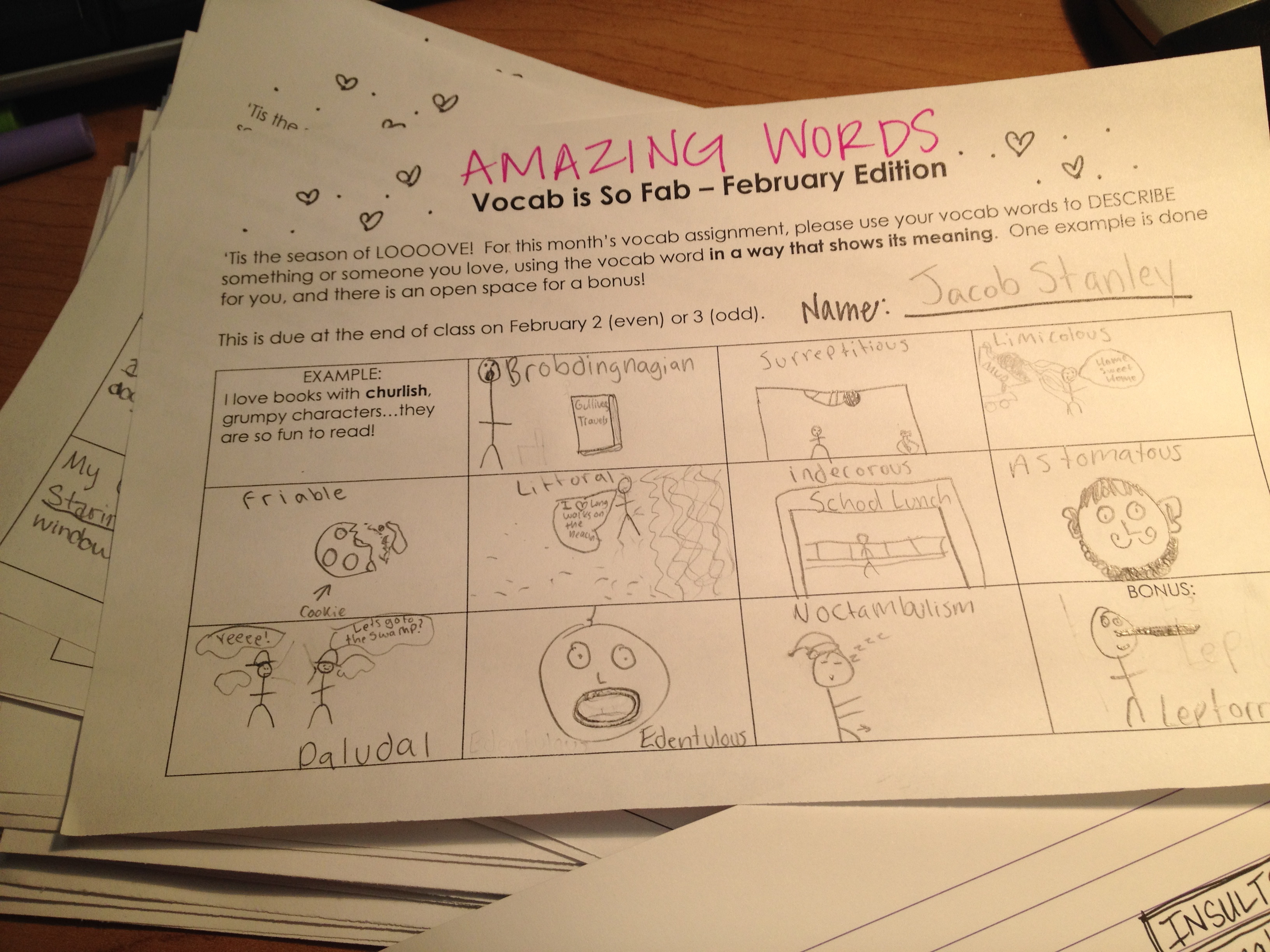
3.  Vocabulary – I still remember my orange Sadlier-Oxford vocab books from high school.  Those well-worn paperbacks were the source of many a cramped hand and a frantic fifteen minutes of homeroom before English class.  I know from personal experience that I don’t retain new words by completing fill-in-the-blank exercises–I learn by reading widely.  So, I ask my students to maintain a “wondrous words” section in their notebooks, writing down unfamiliar or unknown words as they read.  Then, I give them a different activity to complete with those words every two weeks.  The activities are worth 10 points each, and run the gamut from writing stories using the words to drawing pictures illustrating their meanings.

4. Honest self-assessments – When we finish a unit of any kind, usually about once a month–a writing unit, a reading unit, a book club, a challenge–I pass out a half-sheet with self-assessment questions on it.  I begin each half-sheet with a disclaimer:  “Be honest.  There’s no judgment here.  I just want to know why you were as successful as you were with this unit, and to know how I can help others be successful in the future.”  Students answer very truthfully, sometimes humorously so.  If their answers are thorough, they receive 15 points.

These four formative assessments total about 115 points per month.  With 9-week grading periods, students’ grades therefore are made up of about 2/3 formative assessments (230 points or so) and 1/3 summative assessments (100 points or so).  Well over half of the formative assessments are credit for the simple acts of doing the assigned reading and writing–no evaluation of those acts, just credit for the effort.  I value practice and process over product–and this grading system reflects that.

How do you handle grading, formative assessment, evaluation, etc.? Please share in the comments!

They Taught Me the Lesson Here: It’s About Time

Please tell me I am not the only one in a rush. Every spring I feel this pressure to teach more, do more, assign more. I know part of it is the AP exam date creeping closer and closer. I know my students are still not ready.

We still struggle with rhetorical analysis. Most students are getting better at recognizing devices in the texts of others, but when they try to analyze the effect? Well, the light bulb is still quite dim. And I have to practically beg to get students to add a device or two in their own writing. So many are afraid to take risks or to explore with words and sentences.

As a way to help students play with language, I turned to POETRY. (Yes, even in my primarily non-fiction AP Language class.)

We read Meg Kearney’s “Creed” poem together, and we talked through the moves she makes to craft it.

Students noticed the sound devices, the contradictions, the little story, the concrete details. They did a fine job of noticing.

But we have to do much more than notice. And that’s the hard part.

I found this “Creed” assignment by a Mrs. Rothbard online, which fit my hopes for my students exactly, and I asked students to read and study the poem themselves and then mirror the moves of our poet.

I still cannot believe how difficult this was for some of my students. Some simplified the assignment and just wrote their own lovely poems. Others made beautiful lists of their personal beliefs — but that was not the assignment. Others modeled Kearney’s first few lines and then rambled on about angst-filled beliefs that the student writers didn’t even care about when they read them to the class. (Note to self: Revision workshop must last much longer next year.)

But, some…some student writers took ownership of their own craft and composed lovely poems, modeled after our writing coach and poet Meg Kearney.

Here’s the links to JerashiaGuillermoNaWoon, Doreen, Josh, and Sydney-Marie‘s blogs where they posted their poems. They’d love it if you’d read them and maybe leave a comment (actually, they will probably die because they think publishing to the WWW makes them anonymous–so much scarier to read their poems aloud in class, which is a topic of another post I need to write.)

I learned some valuable things as a result of this writing task, and I am glad that my students talked to me about what worked and didn’t work for them. I am glad I took the time last week to let them talk.

The comment that will guide our learning the rest of the year came from a table in the back when one of my quiet ones said:

“Could we slow down? We need more time to write with you in the room to help us.”

Yes, I know that.

If I want to truly help my students grow as critical readers and writers, I must devote the time to letting them think, draft, read, write, revise, re-do, share, and all of this again and again with me in the room as their coach, their mentor, and their cheerleader.

My students need to talk to me and to their peers like I talk to my husband and my collaborators when I am writing.

I thought I had this down by now. But what I think is enough time is obviously not what my students think is enough time, so I’ll listen, and starting today.

Class time will be different.

©Amy Rasmussen, 2011 – 2015