Category Archives: Writers Workshop

Mini-Lesson Monday: Talking Tone and a Bit More Reasoning in Our Writing

I sat at our staff Christmas party talking to a colleague about the essays my students just drafted. We read and analyzed several pieces by Leonard Pitts, Jr, talking about the effectiveness of his style, arguing over his opinion, justifying our own. The task was to write their own OpEd piece, responding to a topic in the news or a topic of their choice. Most chose interesting topics:  How the world defines beauty, Should armed guards protect our schools, Does keeping a home clean matter in the long run..

A few students wrote clearly articulated arguments that show intentional craft moves.

Many showed intentional craft moves but wrote little in the way of argument — or anything close to critical thinking about their topics. In short, some of my writers say pretty much nothing, but they say it very very well.

Therein lies the problem:  How do I get some of my students to think critically about their topics so they can write critically about their topics?

Sitting at that dinner, my friend and colleague, Mary Heffner, shared an activity she’d recently done with her students to help them understand tone. I decided that not only would it help my students understand tone (which most failed to consider when they began writing — “Do I have to remind them of every little thing?” she says with a sigh), but it could help them reason through the beliefs they have about their topic and write stronger sentences they might use when they revise.

Objectives — Using the language of the Depth of Knowledge Levels: Define the tone of your essay; Construct reasons to express why your topic should be expressed by that tone word; Create sentences and synthesize your knowledge of punctuation, syntax, and sophisticated vocabulary to express your reasons while using this tone; Revise your writing to include these well-constructed sentences.

Lesson — (Prior to reading their drafts, I asked students to identify the tone of their pieces and write it in the top right corner of their papers. I determined quite easily that many of my writers thought they felt a certain way about their topics but were having trouble expressing that tone.)

First, I ask writers to clarify their choice of tone word by putting a short list of common adjectives that describe tone on the board:  infuriated, excited, confused, sorrowful, scornful, exasperated, concerned. We quickly define what each word means. I then tell students what I noticed when I look at the tone word they wrote on their papers and when I read their essays. “Some of you have a misconnect — you think you’re taking a certain tone, but you have little or no evidence of it in your writing. (Time permitting we might revisit one of Pitt’s pieces that we read as our mentor text and analyze the tone.)

“The other thing I noticed in your writing is a lack of reasoning. Today we are going to practice getting both a clear tone and powerful reasoning into our arguments.

“Once you have your tone word, and you know this is how you feel about your topic, you will write five reasons that support your topic and demonstrate this tone. Sometimes you can even use the tone word, or a synonym of it, in your reasoning sentences.”

Then I show students my own reasons I wrote to add to my writing. My topic “longer vacation time over the holidays.” The tone “emphatic.”

Reasons:

  1. Two weeks vacation time hardly covers the travel time when a family must drive far distances to share just a moment with their loved ones.
  2. Teenagers thrive on rest and relaxation.
  3. If families spent more time together we may have fewer problems in our society.
  4. Teachers work too hard, sometimes even taking work home over the break, to not enjoy more one-on-one time with their families over the holidays.
  5. With a longer, more relaxing, break, students and teachers would return to school more rejuvenated and infused with energy to embrace the love of learning.

As they read through my reasons, I ask students to talk to one another about my word choice:  How do I show I emphatically care about this topic?

Follow up — Students will revisit their drafts and work on clarifying gaps in reasoning. They will add their five new sentences to make their arguments stronger and more logical.

Reflection — As we move into our next writing piece, I will be more purposeful in directing students to think about tone. We will spend more time thinking through our reasoning before we begin writing.

Sometimes I assume too much, and I end up having to take us back and start again.

Writing critically is hard for many of my students — although their style is improving. I remind myself that I must continue to give them interesting and thought-provoking things to think about — their words and many of their worlds are so limited.


5 Non-Negotiables When Designing Writing Instruction

IMG_0528

First draft of a unit plan in my notebook

I plan my units of instruction in three-week chunks, alternating between a reading-focused unit and a writing-focused unit.  In every unit, and in every class period, I keep some routines the same, much like Amy describes here.  While I do most of the big thinking about a unit up front, I do leave some holes in the plans to make space for mini-lessons that are responsive to what I discover students need during our conferences.  And every year, I design brand new units.

While each unit is unique, I was reminded while at the NCTE Annual Convention of five non-negotiables to keep in mind when designing writing instruction.

Writing should be low-stakes.  Students need to write a lot, and a lot of that writing should be ungraded, unread, or worth very few points.  I have felt liberated in terms of grading writing since I read Kelly Gallagher’s research-based statement that students should be reading and writing four times as much as a teacher could ever grade.

I think, since I embraced that philosophy, that my students also feel liberated.  Their notebooks are a “safe place for regular, ungraded practice,” as Penny Kittle described in her Ignite session.  While we write in our notebooks every day, and outside of class in one-pagers, I only collect notebooks every two weeks, and only carefully read and respond to one or two pieces my students have marked.  Indeed, 80% of the writing we do stays in our notebooks and never makes it to ‘published’ form.  This takes the pressure off writers to produce something perfect or error-free, because “our classrooms need to be a safe place to fail,” in the words of Taylor Mali.

IMG_0265

The first two weeks of Kelly Gallagher’s unit plan–week three is filled with revision and getting to best draft #3 at the ‘deep end’

Teaching writing is complex, layered, and nuanced.  In her session on revision, Georgia Heard shared the five things all students need in order to make authentic revision happen:  “opportunities for students to write, mini-lessons on craft and revision, choice in topics, mentor texts, one-on-one conferences with both teachers and students.”  Kelly Gallagher’s unit plan he walked us through adhered to those rules remarkably well.  “Assigning writing and teaching writing are two different things.  Grading writing and assessing writing are two different things,” he reminded us.  It is impossible for students to produce great writing if it is merely assigned.  Thus, when I plan a unit of writing instruction, I leave ample time for craft mini-lessons, modeling my own writing, and talk amongst students and myself.

When teachers are writers ourselves, and experience the process of topic choice, revision, and studying craft moves beside our students, we can become the most effective teachers of writing.  We have to walk the talk.  “Great, effective teachers must be informed AND inspired,” Kwame Alexander asserted.  To be a truly informed teacher of writing, a teacher must be a writer herself. I learned more about writing a strong narrative while participating in NaNoWriMo alongside my students than I ever did just trying to teach fiction before I wrote fiction.  I loved the experience six years ago during my first attempt, and I’ve continued to complete all assignments beside my students ever since.  When we write with our students, inspiration will spread through “the contagion of passion,” in Penny Kittle’s words.

Writing should be personal.  While I love to write about reading, and find it valuable for students to do so often, most of the writing in my classroom is personalized, choice-driven, and often remains private.  When we do a nonfiction writing unit, like the rhetorical analysis we’re in the midst of right now, our written products are focused on the students’ relationships to the texts they’re analyzing–in this case, the misleading rhetoric often found in American politics.  Mostly we write narratives, even in the midst of nonfiction, telling the stories of our connections to the topics we discuss in informative or argumentative genres.

“You can write yourself out of dark places. How much of the writing we do in school nurtures that?” Gary Anderson wondered in his session on reflection.  We have to honor the fact that students are not inherently motivated to write for their futures–for college, job applications, or resumes–but rather they are motivated to write for the here and now, and for themselves.  This is why choice is, and will remain, at the center of my writing instruction.

How do you design writing instruction?  Share your process in the comments!

#3TT Workshop: Assessing Writer’s Notebooks and Sparking Engagement

Three educators. Three states. Three demographics. All practicing Readers and Writers Workshop in our Secondary Classrooms. Read more about us here.

We are the Modern PLC, and every Wednesday, we share our behind-the-scenes collaboration as we talk about the most urgent moving parts of our classroom pedagogy.

Recently Three Teachers Talk received an inquiry regarding our use of Writer’s Notebooks.  Naturally, this question got us talking–what do notebooks look like between New Hampshire and Texas, Freshman English and AP Language and Composition?

We all agree that Writer’s Notebooks are one of the essential tools to a successful classroom, but integrating and sustaining them can prove challenging.  This week’s conversation between Jackie and Amy seeks to explore some of the ins and outs of writer’s notebooks by discussing what we, as teachers, consciously choose to include in our students’ notebooks and what we decide to leave out.

Make sure to visit the first installment of our conversation, and please join the conversation in the comments!

As the year progresses, how do you keep students engaged in their writer’s notebooks?  How do you help students to recognize their inherent value?

Screen Shot 2015-12-01 at 3.34.55 PMAmy:  Well, we do use our notebooks every day. Of course, this helps with keeping students invested in their use. This year I wish I had taken more time to have students decorate their notebooks, really take ownership of them. I love how Jackie setup collage stations and took the time for this with her students. Students care more about their notebooks when they have taken the time to personalize them.

My students also come to value their notebooks more during our conferences. For example, today I met with a student to talk about her reading life. I asked her how she felt she was progressing. She told me that she was stumped because “I keep abandoning books. I’ve started 10 this year, but I’ve only completed four.” I asked to see her Currently Reading List in her writer’s notebook. She did not have it updated. First, we took some time to write all her titles down, and then we marked ‘finished’ or ‘abandoned’ like I’d hoped she would do all along (my fault for not checking notebooks with more fidelity.) Once we had a complete list of the books this students had tried, I was able to talk her through why she might have needed to let them go. We zeroed in on the narrators. The books she has finished have unique narrators:  a dog, a voice in verse, an 11 year old boy, an autistic 16-year-old. We then talked about the narrators of the other books — all third person omniscient, which she did not know, so I taught her the term in a mini mini-lesson. Together we learned that when the narrator “goes off into some other character’s part of the story, I get confused.” This was a powerful learning experience for my student, and a great reminder to me. There is power in the IMG_0163writer’s notebook. It can be our primary teaching resource.
Jackie: Sustaining interest in writer’s notebooks throughout the year can be a difficult task; students must be invested in and committed to their notebooks to understand their full value.  I believe sustained investment comes with consistent use.  As Amy mentioned, the collages at the beginning of the year helped students connect to their notebooks.  Even now I have students adding to their collages or entirely recovering their notebooks.  

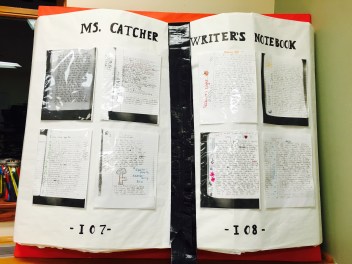
Using notebooks everyday also reinforces the value of these tools.  I talk about them constantly, conduct notebook checks throughout the year, and ask to see them during reading conferences.  I display example pages in a giant writer’s notebook, and I typically ask students to write their drafts by hand.

How (and how often) do you assess writer’s notebooks?

Jackie: Writer’s Notebooks provide a safe space for play within the writing process.  To become confident and secure writers, students must have a low stakes area to both visualize and enjoy the process of putting pencil to paper.  That being said, notebooks are also valuable because they provide me with insight into a student’s thought process, progress, and personal exploration.  

FullSizeRender

Students’ notebook pages are displayed in a giant writer’s notebook.

My grading process is relatively simple.  I keep a list of notebook contents on a board in my classroom, adding to the board every day.  Notebook checks take place every two-to-three weeks depend on the class content and units.  A week before we have a notebook check, I provide students with a checklist, with which they self-grade and return upon notebook submission.  On notebook check day, students use mini-sticky notes to mark two pages, one page they want me to respond to, and another page they want to display for their peers in our class’ giant writer’s notebook.  This process reinforces that students are writing for a wider audience than myself, while also embracing the messiness and imperfection that comes with writing.  I value the scribbled drafts full of doodles for the sole reason that they model the realness of writing, the fact that these pieces, while fun and entertaining still require molding and modeling to become a polished final piece.

While my grading is low stakes, I file writer’s notebooks under summative assessments for a few different reasons: it helps me assess student’s executive functioning skills, which is particularly important for my freshmen and struggling learners.  In my school, it allows students to “retake” the assessment, requiring them to revisit, revise, and refashion.  The more they return to the contents of their notebook and develop its structure, the more invested they become in the final product.  Finally, notebooks align with the common core, which is essential in my competency-based grading school.  They help “students develop and strengthen writing” (W.9-10.5), “write routinely over extended…and shorter time frames” (W.9-10.10), and “determine the meaning of words and phrases [in their dictionary section]” (RL.9-10.4).

Amy:  I’ve tried scoring the whole of the notebook. I even have a glue in for how I would if I did. I am not disciplined enough. I find short chunks much easier to manage, and I can zip around the room and look at everyone’s personal dictionary to see if it is up-to-date in the first 15 minutes of class while students are reading. Or I can collect notebooks and look at just the skill we practiced that day. These always equate to completion grades. Sometimes I’ll pass out sticky notes and ask students to mark whatever writing they’d like me to read. I learn important information about my students this way. When students share their hearts with me, I value it in a way that is so much more important than a grade. How would I ever grade that anyway?

How do you keep your students excited about their writer’s notebooks throughout the year?  How do you assess notebooks without stifling creativity?


#3TT Workshop: The Ins and Outs of Writer’s Notebooks

Three educators. Three states. Three demographics. All practicing Readers and Writers Workshop in our Secondary Classrooms. Read more about us here.

We are the Modern PLC, and every Wednesday, we share our behind-the-scenes collaboration as we talk about the most urgent moving parts of our classroom pedagogy.

Recently Three Teachers Talk received an inquiry regarding our use of Writer’s Notebooks.  Naturally, this question got us talking–what do notebooks look like between New Hampshire and Texas, Freshman English and AP Language and Composition?

We all agree that writer’s notebooks are one of the essential tools to a successful classroom, but integrating and sustaining them can prove challenging.  This week’s conversation between Jackie and Amy seeks to explore some of the ins and outs of writer’s notebooks by discussing what we, as teachers, consciously choose to include in our students’ notebooks and what we decide to leave out.

Please join the conversation in the comments and check back for the second installment tomorrow!

Why are writer’s notebooks important in your classroom?  What value do they hold?

IMG_1485Jackie: Notebooks are the lifeblood of my writing curriculum.  My students need a safe space to practice low stakes writing.  Too often they’ve been forced to write formally, slogging through rough and final drafts of disconnected, five-paragraph essays.  The formality of it all removes the artistry, pleasure, and process of writing.  

I enjoy the controlled messiness of notebooks and the voices I rarely heard as a first year teacher.  Honestly, writing brings me closer to my students.  It connects my classes, makes students recognize their peers are indeed human, and at the end of the day, gives many of my kids, as Ralph Fletcher says, “A room of [their] own.”

Amy:  I am all about organization. Often, my students have a difficult time keeping up with everything they need to practice, track, monitor, and evaluate their reading and writing lives. Our writer’s notebooks make all of this easier. The value of a daily writer’s notebook rises with each use of it.

How do you integrate writer’s notebooks into your classroom? How are they set up?

Jackie: We start using our Writer’s Notebooks the second day of school, when I help students establish the various sections in their composition books.  

My sections, which are all pulled from Linda Rief’s Inside the Writer’s-Reader’s Notebook, include the following: 1. Books Read (a log of the books they read throughout the year), 2. Inspiration Page (where students keep story ideas, photos, images, etc), 3. Graffiti Wall (For beautifully crafted sentences from their independent reading or inspiring quotes), 4. Notes and Entries (the bulk of the notebook), 5. Wondrous Words Dictionary (where they keep their vocabulary from their independent reading), and 6. Books to Read (a list of books they want to read).  

Our notebooks are our single most important tool within the classroom, which means that this is where we store all of our quick writes, writing, rough drafts, notes, minilessons, mentor texts, and thinking.  

When we aren’t writing in class, students independently write three pages outside of class per week.  This independent writing allows them to develop quick writes, explore various writing prompts, or jot down potential ideas.  As author Janet Burroway says, “The best place for permission is a private place, and for that reason a writer’s journal is an essential, likely to be the source of originality, ideas, experimentation, and growth.”  The act of writing helps students not only develop their voice, but it also serves as a safe space to explore various writing styles.

Screen Shot 2015-12-01 at 3.33.19 PM (1)Amy:  My students and I set up notebooks with similarities to Jackie’s. Ours look like this:  We’ve got our main reading goal written right smack dab on the front page. Then we’ve got the “currently reading list” on the next. We’ve got a “to read next list” on the very back page, so as I do book talks — or students talk about books with each other, they are able to keep a running list of titles that sound interesting. (This is a time saver in helping students who just finished a book find another one to read relatively quickly.) In the very middle of our notebooks, we’ve got our “personal dictionaries.” These are the words students find and define from their independent reading (five words a week). We also have a poetry section where we respond to poetry, or glue in poems and write around them. There’s a “write my life” section where students write an entry a week about anything they please. And we have a “reader’s response” section that we write our thinking about our books, articles, etc — pretty much any other kind of text other than poems.

I did something new this year and created notebook glue-ins. I thought this would be helpful to remind students of what went where and the expectations for learning and growth I have for each section. Honestly, I do a poor job of checking notebooks with any kind of regularity — although I do check parts of them at least every other week — so I don’t know if the glue-ins are valuable yet or not.

Jackie: I agree about the glue-ins, Amy.  While I haven’t gone that far, I have students trim down mentor examples, checklists, and typed rough drafts and tape them into their notebooks.  It keeps them better organized and makes it easy to return to previous craft lessons.

Why do you value writer’s notebooks, and how do you integrate them into your classrooms?  What successes have you had with your notebooks this year? What challenges might you still face?  

#3TT Workshop — Digital Writing in the Writer’s Workshop

Three educators. Three states. Three demographics. All practicing Readers and Writers Workshop in our Secondary Classrooms. Read more about us here.

We are the Modern PLC, and every Wednesday, we share our behind-the-scenes collaboration as we talk about the most urgent moving parts of our classroom pedagogy.

Despite the proliferation of e-readers, tablets, and digital reading and writing technology, recent research is making digital texts look a little less appealing.  This article discusses the slow reading, complex-text, and comprehension literacy skills we just can’t get from reading electronically.  This one has lots of great links to the reasons digital reading “fail[s] to adequately recreate certain tactile experiences of reading on paper that many people miss and, more importantly, prevent people from navigating long texts in an intuitive and satisfying way.”

As Shana’s school in West Virginia is increasingly making the move to one-to-one technology, digital learning, and an increased emphasis on electronic reading and writing, she wondered how this shift would impact writers’ literacies.  Her discussion with Amy follows.  Please join the conversation in the comments!

writing rhet and digital media_1Why is one-to-one technology such a big deal? Does every child really need a laptop or a tablet?  Isn’t their generation suffused with enough technology as it is?
Shana: I surveyed my students this year, and 98% of them have a smartphone with data access that they’re accustomed to using all day.  This troubled me–there was no space in their routine for slowing down their thinking.  I don’t think the reader’s-writer’s workshop works without deliberate attention to reading, writing, talking, revising, thinking, and pondering.  So, I invited my students to simplify their lives this year by putting away all smartphones, but wondered if I was being a hypocrite when we wrote frequently on the laptops I keep in my classroom.

Now that it’s November, I’ve decided I’m not actually a hypocrite–the experience of writing drafts in print, revising and workshopping them, and then transferring them to a published form digitally is far different than the instant-gratification experience of using a smartphone.  Still, though, I watched a student just yesterday play a game on his smartphone while he waited for his computer to boot up.  My students don’t seem to know how to handle free moments to just think, or wonder, or daydream–at stoplights, in hallways, or just waiting for a computer to load.  I worry that this reliance on technology to fill their time will prevent this generation from thinking slowly enough to learn, grow, solve problems, and just think.

Amy:  Just like the literacy gap that happens between children who grow up in print-rich home and those who do not, I’ve started to see a digital literacy gap. Haven’t you? The idea that students are digital natives does not mean they are digitally savvy. Most of my students do not have internet access at home, but they do have cell phones. They can text like thumb-numbing tornadoes, but they cannot format a Word document to save their lives. And since their thumbs do not work so well on iPad keyboards, most tap at the keys like chickens pecking at the dirt. They are slow typists. Now, having said that — that does not mean that I do not think they should learn how to write digitally, format correctly, and type efficiently. All students in this age need to become digitally savvy, and I haven’t found that one mandatory technology class in high school is enough to help them get there. No even close. As English teachers, our role shifts as the literacy shifts. If we are not including some element of digital literacy, I think we do many students a huge disservice.

Shana: “Thumb-numbing tornadoes.” Amy, you are a wordsmith.  I agree that our role shifts as literacy shifts–it’s scary to have to learn new skills fast enough to teach them to our readers, but it’s our reality.  I know writing at Three Teachers Talk has helped me immensely to learn how to write and publish digitally–and it’s a skill that has benefited my readers and writers in the classroom.

What are some authentic best practices related to digital writing?

Amy:  The cool thing about writing is that the skills we need to write on paper are not so far from the skills we need to write digitally. Typing excepted. We still need to think on the page, study models, learn from experts, practice drafting, review and revise… And publishing can be so much more fun — at least I think so. We have the opportunity to share our writing much more through digital means than we had via paper. I like that. I like that my students can share writing with yours. Yours can share writing with mine. I know, we could stuff a big fat envelope with student essays, but I am not so likely to do that. I will however send you my students’ blog links.

Shana:  In a perfect world, my school would mandate a typing class for all ninth-graders that includes not just keyboarding skills (which they are TERRIBLE at), but also digital publication skills.  There are vast opportunities for meaningful discourse that can take place between readers, writers, and thinkers when we get students writing and publishing digitally.  I still very much believe in the power of print writing–but, I know, thanks particularly to Amy, how valuable digital writing is, too.  As Whitman says– “Do I contradict myself?  Very well, then I contradict myself.  I am large, I contain multitudes.”  I can’t wait to have our students writing digitally with one another!

What are your thoughts on digital vs. print writing?  Join the conversation in the comments, and check out yesterday’s discussion of digital vs. print reading.


Mini-Lesson Monday – Strengthening Dialogue With Punctuation

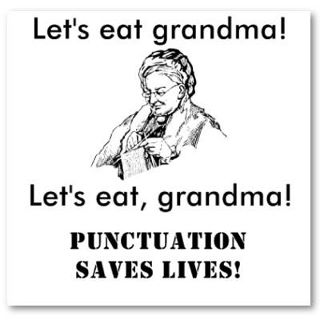
Punctuation_Saves_Lives2After reading second drafts of my students’ narratives, I was wowed by so much of their writing.  Thoughtful leads, powerful topics, intriguing plot structures.  But, despite a mini-lesson on the conventions of writing dialogue last week, some of their characters’ conversations were lacking.  I needed to design a responsive mini-lesson accordingly.

Objectives — Using the language of the Depth of Knowledge Levels: Synthesize your knowledge of how punctuation works with narrative speech conventions to craft thoughtful dialogue; Construct dialogue based on your knowledge of a character’s personality.  Or, from the Common Core: Write narratives to develop real or imagined experiences using effective technique, well-chosen details, and well-structured event sequences.

Lesson — While reading drafts, I set aside a few exemplary pieces of student work in terms of dialogue.  In each class period, there were at least two students whose dialogue was superior.  It was subtle, nuanced, and really added to the characters’ depth.

I asked students to open their writer’s notebooks to the Craft Study section and I projected one example of a student’s work on the board using my document camera.  “Good dialogue isn’t just about what a character says,” I begin. “It’s also about how they say it.  A greeting can really change based on phrasing or punctuation.”

I point to the example on the board.  It’s Logan’s, and in his dialogue, his mom is yelling at him for getting drunk:

“LOGAN WAITMAN SANDERS!” Mom hollered. “Just WHAT do you think you are doing, young man?!  And…and…YOU, Jeremy!  You should be ashamed of yourself!”

Everyone laughs, and I ask a volunteer to read the dialogue aloud.  Dylan does, with perfect angry-Mom-inflection.  He makes Logan shrink back in his seat a little.

I ask the class, “Why did Dylan know how to read that dialogue so perfectly?”  They volunteer: the capitalization helped; he knew when to raise his voice.  “How did he know to stutter?”  They say: the dots (ellipses, I add helpfully) told him to stutter.  “How did he know to sound kind of incredulous while yelling?”  They reply: the exclamation points, and especially that exclamation point mixed with a question mark.  “How did he know when to pause?”  They know: commas.

I put up other kinds of punctuation on the board–dashes, periods, italics–and we discuss what effect each of those would have on a character’s dialogue.  Students jot all this down in their notebooks.  Then, I pass back their drafts and ask them to find a partner.  “Now that you know how to really make dialogue more personal, revise your dialogue in your drafts.  Work with a partner to determine whether or not your dialogue has the effect you want it to when you revise–write a line, then ask your partner to read it aloud the way Dylan read Logan’s.”

Students take ten minutes per person to revise, then we launch into writer’s workshop with the remainder of class.  I write beside them on the board, working on my own dialogue in my NaNoWriMo novel.

In each of my other classes, we repeat this exercise with drafts that contain good dialogue.  It’s so important to use student work as mentor texts–students see that great writing is attainable, not just imitable, when we show them their peers’ successes.

Follow-Up — After today’s revision and writing workshops, students will have one more day in class to keep working on their drafts before turning them in again.  I’ll hope to see much improved dialogue, and as such, I’ll ask writers to answer a question on their self-evaluations about how their dialogue enhances their characterization.

Mini-Lesson Monday: Learning Concrete Details with Independent Reading

More than any other writing, I love reading my students’ narratives. We start the year with narrative for many reasons, but my favorite is that I get to know my students faster than I can get to know them during one-on-one reading conferences or during group activities and discussions.

Here’s a short list of what I’ve learned from student stories just this week:

  • several of my male students wish they had a father who showed interest in their lives
  • a few of my girls live with their fathers because of their mothers’ poor choices
  • several boys and girls journeyed long and far, walking miles through jungles, so their families could escape oppression, rape, and murder
  • many of my teenagers have experienced heartache because of love interests, friends, and family members
  • a few are still grieving the loss of grandparents, aunts, uncles, and friends who died from suicide
  • at least one young woman still holds anger toward her mom because of the way she handled a brother’s addiction and abuse

Personal and powerful, all of these stories matter. My goal as a writing teacher is to help my writers harness the words so emotion reigns in the heart of the reader. The problem?

Abstract language.

Objectives — Using the language of the Depth of Knowledge Levels: Show understanding of the terms abstract vs. concrete; in your independent reading books, identify concrete details and figurative language; analyze the effectiveness of the author’s language; revise your writing to include fresh concrete details and figurative language as you create a text that evokes powerful emotions.


Lesson
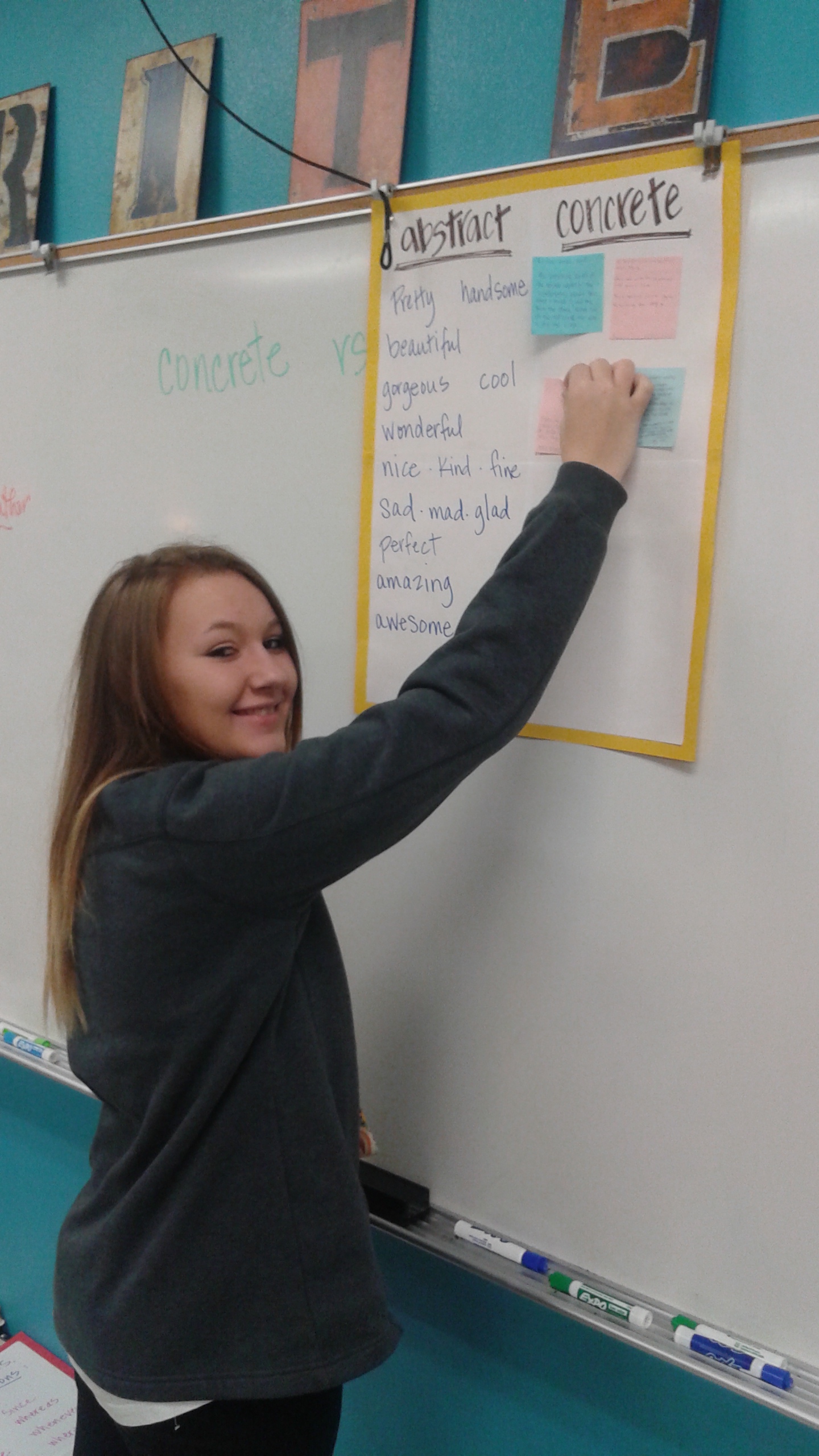
— Before the mini-lesson, students have already drafted a few pieces, narratives or poems. I abstractconcreteusually do the mini-lesson after silent reading time, but for this lesson I begin before because I want to give students a specific purpose for reading.

First, I write on the board ABSTRACT and CONCRETE and we review what these terms mean when it comes to writing. I try to use only abstract words as they begin to discuss this with me.

“Awesome, you might get it,”

“Wonderful, I think you know what I mean,”

“Hey, that’s pretty good…”

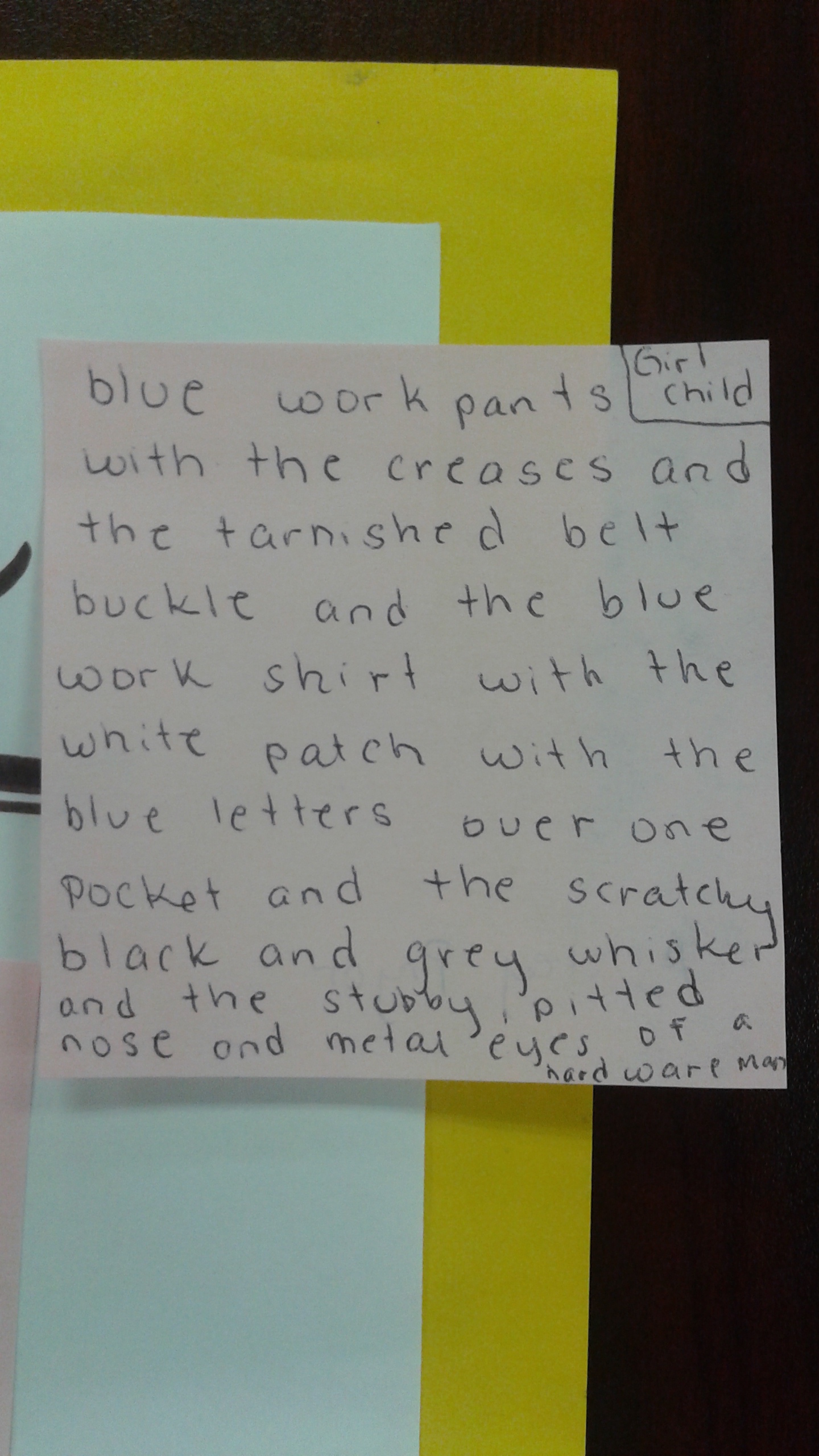
Eventually, they will pick up on what I’m doing, and we make a list of abstract words. Then I give each table-group a word and challenge them to come up with a concrete description that shows us that abstract word. They get 1-2 minutes, and then we share out as I write the concrete details on the board. We discuss the difference in how an author can create emotion.

Next, I ask students to pay attention to the concrete details in the book they are reading, and I give them each a sticky note. “As you read today find at least one sentence where the author does something really clever with concrete details and/or figurative language,” I say.

Students read for 15 minutes, pen in hand, paying particular attention to the author’s craft. When time is up, I ask students to share their sentence in small groups and to analyze the effectiveness of the author’s word choice.

AllieTate“Think about what he’s trying to do there. Why did he mention the color of the sweater, or the smell of the breeze?” If they feel like the author’s accomplished creating emotion, they put the sticky on the board (or as in the photo here –poster).

Students need to not only recognize the details and know that they create some kind of imagery, they need to think about how effective the word choice is for what the author is doing at that moment in the story. If I can get them to start thinking about this, I can get them to begin making purposeful choices in their own writing.

Next, I ask students to search their own writing for concrete details that create images and to add a lot more. “Where can you add a phrase or line similar to what you found in the book you are reading? Is there somewhere you can add color or shape or texture?”

And we revise.

Follow-Up — When students immediately apply learning we’ve practiced using their personal reading materials, they begin to see the connections between becoming active readers and purposeful writers. This is the kind of lesson I do again and again with a different literary or grammar skills students to master. Next up:  subordinating conjunctions.

A few lines from students’ published narratives:

“Each body turned to watch as the green army, blurry, entered the gate. The ground only knew sadness and the sky transformed into a dark night, roaming like a lion.” –Tha Sung

“My first impression when I met Lucila:  petite, chunky, short red-velvet hair, wearing a sweater that covered her sins, mysterious face with a sealed silent mouth.” –Karina Rangel

“My brothers slept like angels with devilish grins.” –Geovanni Medina

#FridayReads: Learning to WRITE WHAT MATTERS with Tom Romano

IMG_9890With the release of his newest book, Write What Matters, this year marks the tenth year I’ve been reading and writing beside the words of Tom Romano.  If you’ve not discovered his wisdom on injecting writing voice into student work, his guidance about writing to discover, or his brilliance in coining multigenre…you’re missing out.

This summer, at the UNH Literacy Institutes, Tom Newkirk talked at length about the guts it took for Tom Romano to publish Clearing the Way in 1987–the first “teacher book” of its kind.  Guided by the research of Donald Graves and his contemporaries, Romano explains the text’s origins to his reader:

“This book is born out of my own struggles to write well and fourteen years of working hard with teenage writers.  Both the writing and the working have been worth it.  They are fine passions.

Thus began my pedagogical education–I read Clearing the Way in my very first English methods course in 2005.  Chapters like “The Crucial Role of Conferencing,” “A Creative Current,” and “Literary Warnings” showed me the possibilities if I created a classroom full of passion and verve and real writers.

IMG_9889Next I happened upon Crafting Authentic Voice, in Romano’s own writing methods class at Miami University in 2007.  A quote from page five of this book hangs prominently in my classroom to this day: “Voice is the writer’s presence on the page, the writer’s DNA.”  I point to those words when I endeavor to help students develop voice.  Chapters like “Enter Craft,” “The Five-Paragraph-You-Know-What,” and “Imitation” have guided my teaching of writing, and I see in those topics the work of Katie Wood Ray, Penny Kittle, and Georgia Heard.

Blending Genre, Altering Style I read in my Master’s level writing methods course, again with Romano himself.  This book helped me flesh out the nuts and bolts of teaching multigenre, which remains to this day both the most effective, enriching work I do with my students, and their very favorite thing.  Reading and writing about chapters like “The Many Ways of Poems,” “Genres Answered,” and the practical “Evaluation and Grading” led me to present with Romano on the many possibilities offered by multigenre at NCTE13.

I’d been teaching five years and was already living in West Virginia when I read Fearless Writing, seeking more guidance about teaching writing.  Practical chapters like “Easing into Poetry Through Imitation,” “Crafting Narrative,” and “Self-Assessment: Raising the Blinds” pushed me to take my teaching of many genres to new heights, with wonderful student results.

Last year, thrashing in the throes of a difficult PhD program, I sought wisdom from Romano in Zigzag, where his chapter “Meltdown” showed me empathy, peace, and guidance.  “I’d never been more at peace with a big decision,” Romano writes of leaving his own doctoral program.  I did the same, and I’m at peace too.

Now, as I prepare to welcome my first child into the world, I’m contemplating where my career will take me.  I’ve long known I don’t want to try to sustain my level of involvement with teaching high schoolers while trying to be a mom.  But I don’t want to leave the amazing, sustaining, nurturing community of teachers and writers and thinkers I engage with here at TTT, or at NCTE, or on Twitter.  I don’t want to leave my tribe, as Penny Kittle says.

Screen Shot 2015-10-23 at 5.34.59 AMAnd, again, Romano is here to guide me through my next steps–Write What Matters: For Yourself, For Others is lately ordered from Amazon and on its way to me.  I know that chapters like “Trust the Gush,” “Risk and All,” and “Who Are You to Presume to Write?” will guide me as I wonder about my future teacher-writer identity.  I know that this book is what I need right now:

Many want to write. But sometimes they lose heart. They are cowed in the face of so many fine writers of fiction, memoir, poetry, columns, and creative nonfiction. Their confidence wanes. If you want to write, but are hesitant, let Tom Romano lift your confidence. In Write What Matters you will find discussions of writing processes that make sense, demonstrations of effective strategies to try, advice about developing productive habits to get your writing done, and examples of illuminating writing from fearless writers, both professional and novice. Your voice, your vision, your way with words matter. They are tied to your identity. You know that you are more alive when you put words on paper. Accept that you not only want to write. You need to write. Write What Matters will help you learn to dwell in your written words and craft them into writing worth reading by others.

Pick up Write What Matters, or any of Tom’s many other works of wisdom and power.  Let Tom Romano lift your confidence–in your writing, your teaching, and your passion.  His words, and he, have been my single most reliable, important mentors as I seek to be a teacher of writing, a teacher-writer, and a plain old Saturday-morning-notebook-storyteller.

Sharing Student Work — Making a Pledge to Do More

For some time now I’ve thought I needed to do more. I ask my students to write a lot. I ask them to take ownership of their process, practice their craft, take risks. I hope they will care about their audience, but unless it’s a post on their blogs (and sometimes even then) I don’t think they consider much about their readers.

My colleagues here at Three Teachers Talk and I had the idea a few years ago to publish student work on this site regularly. We planned it all out. We’d hope for student volunteers that might want to produce something like a mini-Nerdy Book Club but with student readers and student writers. Then I did a little research:

I found sites like Young Writers SocietyTeen Ink, Figment, Teen Lit, and of course, NaNoWriMo that publish the work of young writers and allow them to join online writing communities and learn about competitions, awards, scholarship, and more. This list of 40 of the Best Sites for Young Writers has even more resources.

I still want to do more, but what I need to do is introduce my writers to site like these and extend the invitation that they explore, discover, and get involved. I know a few will. Maybe many will.

In the meantime, here’s a sampling of the writing I’ve read this week. Not because I like the topic — it horrifies me on many levels — but because this writer shows heart, I want to share her work.  Read it. You’ll see why I know I need to do more to help my students write for audiences that will appreciate their craft.

Bruised-Knees by Alexia Alexander

It was a breaking point.

By the time my spoon scraped the bottom of the bowl, my face was wet with tears. I was sick, in part from eating, and in part from everything else. I had to cry quietly; I suffered silently in order to avoid questions, sometimes, even hidden behind smiles and laughter. The chocolate and caramel ice cream weighed my stomach down. I felt 200 lbs of milk, sugar, grief, loneliness, depression, cocoa, corn syrup, and artificial flavors. My entire 500 caloric intake itched in my throat. I felt heavy now. I felt worthless now. I felt defeated now. I ran as quickly up the stairs as I could, but voices, almost as loud as the screaming downstairs, followed me.

Why’d you eat that ice cream? You’ve already had enough. You’re just going to GAIN weight if you eat something like that. You can’t you even starve yourself right,” I told myself.

Staying up late reading about it, I prepared myself for chaos. Although I laid under two blankets and behind a locked door, I found little comfort. In fact, I hadn’t even kept the monsters out; they began to creep inside of my head. I spent the nights crying, reading pro-anamia blogs, drowning my ears out in Maria Mena, and looking up the most fabulous ways to destroy myself, self-esteem first.

Now getting a chance to test my research, I rushed to the bathroom, still crying. I looked at myself in the mirror; I cried even more. I was sobbing and choking, sounding like that one kid in elementary that always forgot his inhaler on mile-day. I dropped to my knees, as if I were about to pray, but I couldn’t remember what people were supposed to say to a divinity.I gripped the sides of bleach-white seats, as if my faith would be found there, and hung over the porcelain throne, like a sea-sick passenger. The bathroom became dizzy in my eyes, and the pink walls were a blur mixed in the leopard print bathroom curtain. The white tiles painted my knees black and blue and staring at them made the wave of sickness more intense. In the reflection of the toilet-bowl-water, I even looked green and sickly, but I can’t say my self-perception was quite accurate in those days.

I had screenshotted instructions on my cracked iPod screen on how to do it. I looked up everything. I needed all the how-to’s before I went through with anything. I knew I could use a toothbrush or two fingers. I knew I could make markers in my stomach. I knew how many seconds it would take. I knew that it would sting. I knew the long-term damage the acid could do to my teeth. I knew how deadly it was. I knew how sick I was.

But I continued, another event to add to my list of “First-Times.”

Slowly shoving a finger in between my lips, I danced it around trying to find the spot. I felt the tickling as I touched the dangling piece of skin. I added a finger, this time gagging slightly, but knowing no matter hard I cried, I couldn’t take my hand out. I gagged again,  bringing up the bile taste in my throat. I couldn’t choke. I had to keep going. I gagged another time, body split over the toilet as I heaved.

I had found the food that comes up almost as easily as it goes down. The ice cream coated my throat, for a second time, and it still felt cold. It masked the normal taste of vomit, gladly, and I finally felt lighter;I equated that to feeling better and didn’t think twice about why I was still crying.

Maybe you can be lovely now. See, you’re already feeling better,”  said the demons in my head, who told me things like this frequently. I tried to ignore them, but sometimes my own silent voice felt like a scream between my ears. I cried myself to sleep that night, still trying to convince myself I had done well.

I wish I had known then what I really was trying to rid myself of. I wish somewhere on that ground I really had some holy revelation, but wisdom like self-love and perseverance can only be taught from low moments like those. It took years to find what really weighed me down, more than food or fat. It took years to love myself and my body. It took years to get over the urge to skip a meal, and the shame after eating. It took years to face the demons and shut them up. But each moment that buckled me to my knees gave me strength, and brought me closer to where I am now. Moments I’d rather forget, have to remain real, so  I always remember my growth, and never repeat the past.


©Amy Rasmussen, 2011 – 2015

The Importance of Narrative: Stories That Stay With Us

I was reading a weekly one-pager yesterday and came upon this little note from a student:

IMG_9850

This student, Aleigha, had taken an elective writing class with me as a sophomore.  Now, as a senior, she wanted to revisit the story she’d begun two years ago, and give it a different ending.  I was surprised that Aleigha had remembered that story, and that its ending had nagged her for two years.  I was even more surprised, as I started to read her one-pager, that I remembered her story, too–a fictional narrative in which two soulmates are torn asunder by circumstance.  She’d ended the story unhappily, leaving the two protagonists separate.  In this year’s one-pagers, though, she’s slowly bringing them back together.

Aleigha’s narrative was powerful to her, and personal, despite its fictional genre.  Her peers’ feedback indicated that her characters’ situations were relateable–that everyone wants people in love to end up together, because it’s something we all strive for as humans.  Narratives give us something to root for.

During a Google Hangout this summer, Jackie talked about her students’ writing of narratives, and how “the transformative power of common stories” brought out their best and most vulnerable writing.  “Every child has a story to tell,” agrees Don Graves.  Because of this truth, narratives are my favorite genre to teach.

We all have a story to tell–a story that stays with us, that we can’t get out of our minds, no matter how long it’s been since the idea was seeded.

As my students write their narratives, I’m shocked by how naturally the words are flowing out of their pens.  When the topic is powerful, I feel like I have little to do in the way of writing instruction–I simply have to get out of the way and let them write.  I have mini-lessons planned on pacing, setting, sensory details, and characterization.  But I’m finding beautiful writing already extant in their drafts:

“Every time I step onto the ice, it takes me to my childhood,” Mitchell’s story begins.

Kaylee stuns me with: “The musky smell of burning wood rose into the air as the sound of water crackling split the silence.”

“Realizing you’re gay, and accepting you’re gay, are two very different things,” another story leads with.

The brilliant Tom Newkirk explains why students are able to effortlessly write this way in Minds Made for Stories:  “The hero of the story is a narrative itself…Narrative is there to help us ‘compose’ ourselves when we meet difficulty or loss. It is there to ground abstract ideas, to help us see the pattern in a set of numerical data, to illuminate the human consequences of political action. It is home base.”

We make sense of the world by weaving its happenings into a story–by the time our students come to their notebooks with an idea, they’ve already rehearsed this story many times.  They are just bursting to tell it.  It is home base.

While narrative may not be considered the most “rigorous” of genres, I believe it is the most important one.  It is the writing that demands to be done–the genre that is the most personally fulfilling, the most emotionally wrenching to write, but the most necessary to exorcise from our minds.  Let your students write their stories–write your own beside them–and watch your community of writers bloom.