Comedy is all about voice, and we’re gearing up to notice and imitate as much voice-filled comedy as possible in the next few weeks. When thinking about how to help students identify and craft their own written voices, I thought of a lesson Amy and I shared in Franklin a few weeks ago.
 Objectives: Using the language of the Depth of Knowledge Levels: students will make observations about a writer’s craft, identifying patterns in sentence structure, punctuation, and word choice to help define voice. Or, in the Common Core, students will interpret words and phrases phrases as they are used in a text and analyze how [they] shape meaning or tone.
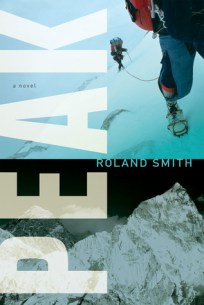
Lesson: I’ll distribute copies of this excerpt from Peak by Roland Smith, which will serve today as both a booktalk and a mentor text. I’ll introduce the piece as a book I loved, then segue into how it serves as an examplar of voice.
“Peak–that’s the main character’s name–is writing the whole book in the form of journals to his English teacher, so his voice is very conversational. I found him pretty hilarious and sarcastic.
“Today we’re going to look at this excerpt from page one and try to see how Peak creates his writing voice. Let’s all read this and annotate for craft–just notice HOW he’s saying what he’s saying.”
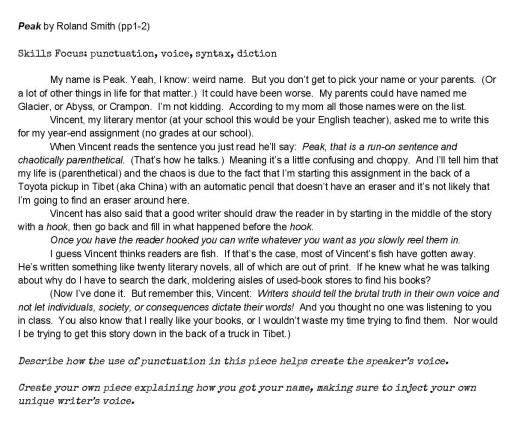
After a few minutes of student annotation, which I am doing alongside them on the document camera, I’ll ask students to share their noticings in their table groups. “Share with your tables what you notice about Peak’s sentence structure, punctuation, and word choice,” I’ll say, writing those bold terms on the board.
Once students have shared in small groups, I’ll ask each table to share out what they noticed. As a group, we’ll arrive at some conjectures about Peak’s use of:
- parenthetical asides to the reader
- occasional fragments amidst his varied sentence structure
- relaxed jargon
- rhetorical questions.
Once we have those key terms in our notebooks, along with great examples from the text, I’ll ask students to practice using these skills.
“In this case, using these writing moves create a writer’s voice unique to Peak. We’re going to imitate this piece now by writing a quickwrite about how we each got our own names. Write your piece imitating Peak’s style, and use those four writing moves as you do.”
Follow-Up: We’ll all take about eight minutes to craft our name stories, imitating Peak’s voice, in our writer’s notebooks. We’ll share them in our small groups, then use that quickwrite as a seed prompt for a possible comedy best draft as we move through the unit.
How do you help your students craft their writers’ voices?

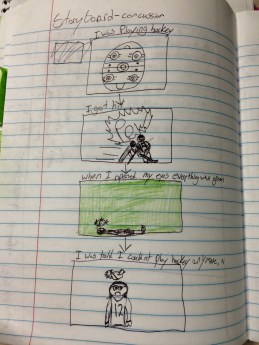
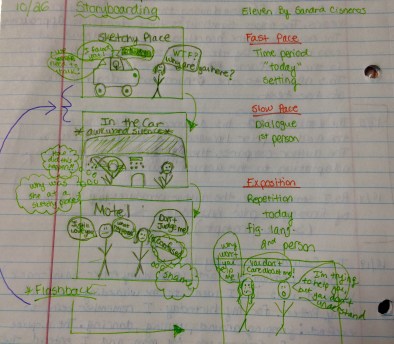

 It’s -4 degrees in West Virginia today, which might explain why I’m thinking about the narrative skill of freezing time. I’m also thinking about it because I’m reading the fantastic Dumplin’ by Julie Murphy, the story of an unconventional small-town beauty pageant contestant. As I read, I was aware of how quickly the writing hooked me–I began to look for reasons why, inspired by


 What are you reading now, and/or what are your latest finds that could be strong mentor texts?
  Shana
Shana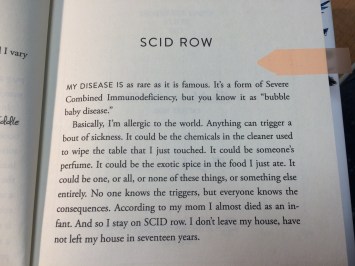 My students asked for more craft study and grammar instruction in their midterm
 What prompted you to begin the process of noticing examples of mentor texts or craft study?


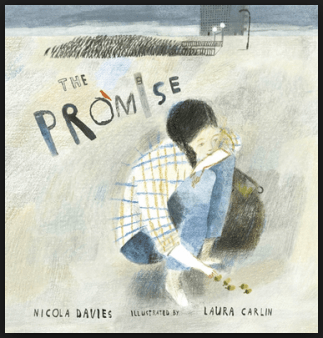 The Promise written by Nicola Davies and illustrated by Laura Carlin is a beautifully crafted story of a girl growing up in a hardened city. After stealing a purse from a pedestrian, the main character makes a promise out of desperation, only to realize that the purse she has stolen has no value and is instead full of acorns, which she must now plant across the city. The story reads more like a poem and has a cyclical ending that allows students to see the succinct structure of a short story.


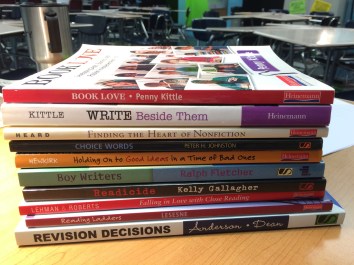 I met with my new student teacher a few weeks ago, and he asked me to borrow any books that might help him get going on the readers-writers workshop–the “theory” version of


 Three Teachers Talk