Category Archives: Modeling

Formative Assessment Works!!!

For those of you who haven’t taught Seniors, trust me on this:  Formative assessment during the second semester is challenging.

If you’ve taught seniors, then you might understand where I’m coming from:  Sometimes it’s hard to tell if they aren’t grasping a concept, or they are just too tired of school to have the energy to engage.

I hurts my heart to even consider that my precious learners are worried about bigger issues than Comparative Literary Analysis essays or finding examples of bias in their self-selected texts.  Prom looms five days away and graduation seven weeks after that.  They work, they compete in extra curriculars, they deal with the adults and peers in their lives.  I forget, sometimes, that their plates are filled with important thoughts.  I remind myself I’m not doing their stress levels any favors by point out that we still have important work to do before June 2nd.

Last Monday we reviewed an excerpt from Niel Schusterman’s Thunderhead as a mentor text for practicing literary analysis through all the lenses that should be crystal clear to these literate learners.  I needed to assess their understanding and thinking so that I could make decisions about the instruction leading up to the summative assessment.  That’s the point of formative assessment; to “form” a plan for instruction.

I read the short selection with them, and asked them if they would, please, mark their thinking on this first lap through the text.  They should, as they’ve done many times before, underline or highlight what they noticed about the words the author chose through the lenses of diction, bias, author’s purpose…literally anything they noticed within the realm of literary analysis. It’s the last nine weeks of their public education career. They should be able to look at a text through a variety of lenses.

Some of them made some marks on the page while others wrote notes next to highlighted lines or words.  Others, though, marked nothing.  [Alarms wiggle and stir in my head. Something’s not right.]

I asked them to share within their groups what they noticed.  Muted whispers of ethos, tone, and metaphor struggled out of some groups, but again, most said very little.  Very few connections were being made. For them and for me, the picture was as clear as mud. This, by itself, is important formative assessment. This wasn’t working. [Def Con 55- Full tilt klaxons at maximum volume!]

Yet, I refuse to blame them.  I fully believe that it is solely on me, the teacher, to facilitate engagement with the text.  Somehow I need to do a better job inviting them to take all those useful tools out of their tool belts and dissect this very meaningful text.

New England Patriots at Washington Redskins 08/28/09

I bear a striking resemblance to Tom Brady.  Photo by Keith Allison

In football parlance, I needed to call an audible in the middle of the game. What I had hoped they would do; they won’t or can’t.  It’s time for me to jump in and scaffold this concept to a place where they can see the connections they can make and I can assess their thinking.  I’m not going to put them in a position to fail on the summative assessment if I know they aren’t ready for it.

In a whole class mode, I read over the text, mark what I notice and verbalize my analysis.

Now I ask them to talk about what they notice.  There it is…an increase in discussion, an inflation in dialogue. The alarm volume turns down a notch, but it doesn’t turn off.

I wrap the class period up with an invitation to write about what moves the author is making and as they do I confer with a few students who seem completely flabbergasted.  The bell tolls, signaling an end to their literary torture session.


Thus was the source of my salvation:

book

I only saunter.

Jumping into this book reminded me of a few important tenets of writing instruction that I let myself forget:

  1. Give them choice- I was allowing no choice in the subject of their analysis.  I know better than to restrict their reading and writing experiences and I let my, and their, end of the year exhaustion affect my decision making.
  2. Show them, not tell them, what you want to assess.  I wasn’t showing them examples of literary analysis and again, I know better.  I was expecting, wrongly, that Senior English students would confidently engage in literary analysis and move forward with their thinking in a way that shows me they can write a response in essay form.

After school, I tore up my lessons plans for the next four days and re-wrote them to reflect what I SHOULD do to support my students in this exploration.

On page 5 of their amazing new book Marchetti and O’Dell introduce a mentor text written by Joe Fassler from The Atlantic.  His recurring series “By Heart” is a collection of responses from a diverse group of thinkers and writers and is an amazing resource.  A simple Google search returned a link to this series of essays. I scanned the list of the titles and discovered an article from September titled, “What Writers Can Learn From Goodnight Moon.”   In it, Celeste Ng describes her feelings of the children’s book and how it “informs” her writing.

Perfecto!!!

This checked so many of the boxes of what I was looking for in a mentor text.  And…I get to read a children’s book to “big” kids.  I know enough about my students to know they will love this.

Also, I used Marchetti and O’Dell’s five part descriptions of literary analysis on pages 11 and 12 to create a glue-in anchor chart for their readers’/writers’ notebooks that helped to clarify what exactly we should look for when reading and writing literary analysis.

Confidence restored! Disaster averted… kind of.

We Ng’s reflection and discussed how this was a perfect example of literary analysis.  They asked questions, we laughed about Goodnight Moon.  I saw their confidence grow and I knew we were back on track and ready to move toward our essay.

Thursday, we started the drafts and I hope to see many of them tomorrow.

Being responsive and intentional is a crucial part of the workshop pedagogy.  I can’t stress enough how this one piece can make our break my teaching.  My lesson planning skills have finally reached the point where I plan for and anticipate opportunities to change up what we are doing to match what the students need. This was an opportunity for which I hadn’t planned, but we made the adjustment and made it work.

Sometimes, that’s how it goes.

Let me know in the comments below when you’ve had to make big changes on the fly to support your students’ learning. I know I can’t be the only one.

Charles Moore is neck deep in Children of Blood and Bone.  He’s spending the day taking his daughter to school and then having lunch with her.  It might be the best day of his life.  His summer TBR list is growing uncontrollably; feel free to add to it in the comments.

Say it Ain’t So! Poetry Can’t Help Readers with Non-fiction!

I know, I know. I write about poetry ad nausem.  Poetry has been a focus for me this year I’m constantly finding ways to fold poetry into my instruction all the time. I wrote about it here.

Don’t single me out; Amy included her own poetry thoughts in this post.

I’ve noticed that my students don’t connect their emotions to non-fiction pieces as well as they do with poetry.  That’s unfortunate because real world issues should elicit an emotional response…but in most cases they just don’t.  I think its important, in literacy instruction, that we try to bridge that gap.

Recently, I found an opportunity to integrate a little poetry with some non-fiction.

One of several non-fiction pieces that I brought into the classroom was this one from the New York Times written by Carl Wilson. The piece talks about Rupi Kaur and her popularity compared to those who published poetry before the avalanche of social media.

Our focus was not only to look at these non-fiction pieces in order to see the moves that authors make, but also read with the thought that we could respond to the articles in the form of a Letter to the Editor.

I chose this response format because I saw that it might facilitate and opportunity for us to talk about citations, embedding quotes, and responding to nonfiction in a way that might appeal to my students.  Not only did the student struggle to connect to the pieces, they struggled to keep their eyes open the first time they read through.

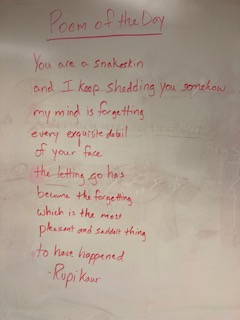
Not coincidentally, the poem of the day was by Rupi Kaur herself.  It was about how when we let go of someone to whom we are connected, it can be cathartic. At least thats what it means to me.

 poem

(I know its hard to read, but I hand write the poem on the board every day.)

I invited the students to respond to the poem in one of two ways: either by using the poem as a mentor text that could engage their poetic thoughts and help them write a poem of their own, or by responding to the poem about how it makes them feel or think.

We group talked our emotional reactions and shared how so many of us could relate to the poem.  Most of us connected with it in some way, but we discovered that those connection vary widely from person to person.

The next day, we came back, read the articles, began our letters to the editor, and completely failed to connect with the pieces on an emotional level.

There had to be a way to show them that we can have an emotional response to non-fiction. So, in a move stolen directly from Kelly Gallagher, I wrote a model Letter to the Editor in which I roasted the author and his article for being wrong-headed and totally missing the point of Rupi’s poetry.  The students perked up as we went through my example noticing elements like formatting, structure, embedded quotes and properly cited sources. Most importantly, they saw how I was able to show an emotional engagement with another author’s non-fiction piece.

We brainstormed some reasons that they struggled to make the same connections to non-fiction and talked about how they can have the same kind of emotional reaction across genres.

By the time we ended our discussion, they blasted off on the trajectory of writing their own letters to the editor, providing blistering commentary or thankful praise to writers they’d never even heard of before.

The writing I read was authentic, heartfelt, and emotional.  Something about weaving the poem and the article about the author of the poem allowed them to carry that connection to other pieces and release their feelings in a way that showed a real connection to something they otherwise would not have paid a second glance.

What I was reminded of once again, was that this isn’t about non-fiction texts or thoughtful poems.  It was about the students embracing their potential as writers and having the confidence to express their voice. This is a lesson that I’m sure I’ll have to learn over and over, but I won’t stop treating students as writers, even when they don’t believe that they are. 

 Charles Moore fell in love with Sing, Unburied, Sing by Jesmyn Ward and no one has seen him since.  Rumors persist of sightings out in Phoenix and even San Francisco. Please visit his hourly musings @ctcoach or visit his instagram account @mooreliteracy1.

Why It Matters

An enormous part of my teaching philosophy is centered around teaching students to question the “why” of what we learn. Not necessarily why are we learning, but why does what we learn matter? How does what we do in our classroom apply to their lives? I sincerely believe that if students cannot walk away from my class each day able to answer those questions, then I need regroup and question the purpose of my lessons.


pasted image 0Kelly Gallagher, a high school teacher in California, is an advocate for getting students to think critically, read deeper into various texts, and along with several other educational rockstars, structures his classroom according to the workshop model.

In his book, Deeper Reading, he discusses the “Say/Mean/Matter” chart as a way to make any text relevant to students in addition to helping them become critical readers and thinkers.

 I regularly use this strategy in several ways in my classroom which consistently provides me with opportunities to keep my lessons meaningful to my students. What I love most about using it is that it provides students with an opportunity to focus on what they are learning and why/how it matters. This also shows them that EVERYTHING we read, write, discuss, etc., has a purpose.


I recently completed novel studies with my students and was able to implement the “Say/Mean/Matter” concept with all 3 of my grade levels. In my experience,  I learned that I needed to provide more scaffolding for my younger students versus my Juniors who were more equipped to take the concept and run with it. It seems like the older they get, the more eager they are to share their opinions and challenge what they read.

For my Freshmen

Earlier this school year, I was fortunate to have the opportunity to attend a professional development session that centered around Kelly Gallagher’s Say/Mean/Matter strategy. I was able to scaffold this lesson by targeting specific pieces of the novel, To Kill a Mockingbird, a few at a time in order for students to focus on examples of social injustice. Over a series of impromptu class discussions and informal reading/writing responses to various texts about inequity, I broke each section of Say/Mean/Matter down so that students were familiar with applying this idea to various forms of literature. Once we reached the pivotal point in the novel, we completed this with partners they chose (and some they didn’t), using sticky notes to frame discussion.

This slideshow requires JavaScript.

From there, we completed our graphic organizer together using our stickies from the day before. Students were asked to expand on the ideas they came up with together. After modeling my discussion notes and conferencing with students, their responses clearly showed that these examples of social injustice meant something to them. It became more than just an assignment to them, it was a chance for them to safely explore, discuss, and write about opinions that mattered to them.

This slideshow requires JavaScript.

Eventually, this led to a Socratic Seminar that took us 2 full class periods to complete. Every student was engaged and ready to share their ideas and ask questions because it was relevant to them. Not only was this a chance for their voices to be heard, but they truly cared about what each student had to say and remained open-minded throughout the process.

A Small Snapshot

This was just one of the incalculable ways to foster relevance and meaning to students that perfectly aligns with the benefits of teaching through the workshop model. Now more than ever, what we do as educators is of the utmost importance. By building these moments of discovery into our lessons, we allow students to create and develop meaning for themselves. The students are our purpose. Our profession centers around helping them develop and unleash their potential. Once students realize what we teach has applicability and value, there is no limit to what they can accomplish.

I would love to know other ways you make your lessons meaningful and relevant to students in your classroom in the comments!

Gena Mendoza currently teaches Freshmen, Sophomore PreAP, and Junior English in Texas. She is passionate about teaching her students to use their powers for good and not evil in her classroom. When not pouring over any written or spoken word by Jason Reynolds, or preparing her family for their next Disney adventure, you can catch her Tweeting/Retweeting at @Mrs_Mendoza3 on Twitter. 

Making the Leap: How one text supports another.

cactus2

This past summer I took advantage of an extraordinary opportunity. I mentioned it in my first ever blog post and my thoughts about that experience are unwavering.  The Summer Institute reinforced some of my already held readers/writers workshop beliefs and clarified many others.

One experience was particularly profound.  Meggie Willner and I found it so evocative that we based an entire professional learning presentation around it that we presented at our district  Profession Learning Day in August and even submitted a similar presentation for consideration at TCTELA this year.  Unfortunately, we weren’t selected for TCTELA, but Meggie and I still talk about how much this lesson taught us and how we still reach back to that lesson as this year moves forward.

On Day 7 of the institute, Amy presented us with a piece called “The Cactus,” by O’Henry.  I’m not intimately familiar with O’Henry’s works, but Meggie is and her opinion is a favorable one.  Amy took us through the exercise of discovering the beautiful language and writer’s moves that exist in the piece and we shared our thoughts and “workshopped” the text the way we should with our students.

At some point, Amy stated that this was a text we needed to present to our STAAR Camp students and Meggie and I simultaneously turned to each other in fear.

Meggie 2

Our initial thoughts were identical.  We knew our students very well and we knew that this text was far too difficult for them to conquer.  Meggie and I weren’t sure that we could shepherd them through this text and as soon as the session ended, we hustled up to our classroom to find something with which we were more comfortable and something we felt would engage the kids.

We quickly found a story called “Checkouts,” that was both easier to dig through and thematically similar to “The Cactus,” and away we went.  The lesson went beautifully, the students engaged with the story and we were able to guide them through discovering the writer’s moves and the thematic ideas in the text.  Meggie and I both agreed that we made the right decision for our kids.

Early on Day 8 Amy said something to the effect of: “I noticed many of our teacher teams chose not to use “The Cactus” in their lessons yesterday and went with texts that were less complex.” (I’m paraphrasing this because I don’t remember the exact words Amy used, but I remember feeling my face turn red and Meggie and I slow-turning to each other with matching looks of horror.)

Meggie1

Amy continued her thought by telling us how important the complexity of the text was to our readers and how texts that our kids would encounter on the STAAR test would match the complexity of “The Cactus.”

As soon as that morning’s session ended, we scurried up to our classroom with our tails between our legs and sat down to develop a plan to present “The Cactus” to our students.

We planned the activities that are typical of workshop to go with this piece. We drafted  questions that we thought might prompt their thinking and help them engage the text.  We looked at the text with an eye towards anticipating the places they would struggle with the language.  Looking back, we prepared well for this lesson.

Our preparation paid off when the students dug into the text. If you haven’t read “The Cactus,” please take my word for it that there are many difficult to understand words and this is what made us feel apprehensive. To our great joy, a piece that we thought would stump them turned out to be accessible and engaging and they found insight and nuance in its words. They floored us!!!

We discovered something too: our idea to present them first with “Checkouts” provided a scaffold to “The Cactus.”  They were able to digest the complexity of the more difficult text because they were comfortable and familiar with its thoughts and themes.  They trusted us because we built that relationship with the more easily accessible text. They learned that they don’t have to have understanding of every single word in the text to experience mastery of the text.  They can still engage in the nuance of theme and voice and other important skills. Once they found success engaging “The Cactus,” we could see their confidence build and they were able to enjoy the text in the same way as the adults in the room; as readers.

This is such an important lesson for me to learn.  Often, I take for granted that the students will engage with a text or just assume that they won’t.  My thinking, instead, should be about I can move them into a text by using what they already know or what they are interested in.  This may be obvious to other teachers, but I’m not a trained reading and writing teacher and I still have many lessons to learn.

Charles Moore still can’t figure out how to stay off of Amazon.com on snow days.  He is currently reading Warcross by Marie Lu and Truly Devious by Maureen Johnson and keeps his eyes open for suggestive cacti. His almost daily musing can be found on his twitter page @ctcoach

Creating Community One Story at a Time

My son started Grade 6 this year at a brand new school. This was a nerve-wracking shift for us as he had been attending his previous school since preschool. His fears were largely centered around finding new friends and fitting in, but as a teacher/parent my fears centered more around the learning environment and if his new teacher would conduct the class in a way that fostered inquiry and creativity.

After the first few weeks of school, it became clear that this teacher had a different style of teaching than the ones at my son’s previous school and  I fretted that he wasn’t learning enough and that he was going to be bored with this new style of instruction. In one of my particular moments of panic and after just finishing a lengthy text to rant to a teacher friend of mine about my fears in regards to the way my son was learning, my wise sage of a friend responded with a simple response – yeah, but how much do you really remember what you learned in Grade 6 content wise anyways? What you should really be asking yourself is what type of classroom community is being fostered.

Just that one simple question quelled the storm of concerns and made me reflect. What was my son’s new classroom community like? So, when he came home from school each day, I stopped listening for what he learned and focused more on the tidbits he shared with me about how he is learning. Once I started listening for the how, I realized the gift that his new teacher was sharing with him was the gift of story. I soon saw that my son who so often answered questions of “what did you do at school today?” with a shrug and an “I don’t remember” was now answering the question by sharing the stories he learned.  You see, his new teacher has created a classroom steeped in story and story is a powerful community builder. Every day he tells the students stories of his life, stories of the past, and stories of his hopes for the future. He also surrounds the students with stories with a huge classroom library that the students are free to access at any time. Most importantly, however, is the culture he has created by one simple habit- everyday he reads aloud to his Grade 6 class. I soon began to realize that my son was excited to tell me the stories that were being read to him and his classmates and recounted them with a verve and detail he has never had before when talking about school. Will my son remember the content of his Grade 6 Social Studies lessons? Maybe not, but he will remember the power of those stories being read aloud to him and what they made him feel.

In her blog and in her book Passionate Readers: The Art of Reaching and Engaging Every Child, Pernille Ripp discusses the importance of reading aloud to our students and the importance of providing joyful reading experiences. When we read aloud to our students, we model our own enjoyment of reading, tap into the inherent human love of story, and provide a joyful reading experience for our students. Why then do we stop reading aloud to our students as they get older? This was the question that came to mind when I thought about my own teaching practice. Do I read aloud to my students? In reflection, I realized I do read the practice sample reading paragraphs to prepare for the Provincial Exams to my Honours English 11 class and I occasionally read out samples of strong essays, but this would hardly count as joyful reading. I quickly realized that I had fallen into the mindset of the senior English teacher – the one that does not see reading aloud to her senior English students as a valuable use of time.

For more detail on techniques to bring read alouds alive in your senior classes, please read Amy’s post on the topic.

Once this realization hit, I went straight to my senior English department colleagues and started to brainstorm ways that we can bring the joy of storytelling into our senior classes and these are the first steps we took.

Besides integrating daily reading time to each class, we also focused on how we can bring storytelling into their lives. Our school is a K-12 school and our senior students are fortunate enough to have many connections with the junior students. One program we have is a Kindergarten/Grade 12 buddy program where our Kindergarten students and our Grade 12 students meet once a month. Right away, I knew this was a perfect opportunity to allow my Grade 12 students to share stories. Prior to our next buddy meeting, I took the Grade 12 students down to the library and set them free in the picture book section with one simple task – find a story to read to your buddy. Off they went and magic quickly happened. As they were searching the shelves, stories started to present themselves to them. They found their favorite picture books they read as a child or ones that were tied to special reading memories. These were the books they choose to share with their buddies – the stories of their childhood. As they read the stories to their buddies the pride and the joy of sharing stories was evident.

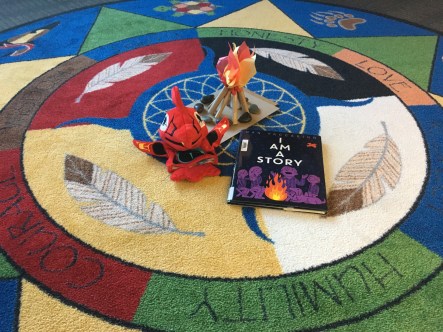
IMG_0458

Before starting our living library, I read my Honours English 11 students the amazing picture book I Am A Story by Dan Yaccarino to get them in the story telling mood. We also made little campfires to tell the stories around to further create the atmosphere of sharing stories around a campfire. Some of my Grade 11 students were a little shy to tell their stories, so they enlisted the help of our school library puppet collection.

Another storytelling initiative I took on was having my Honours English 11 students create a living library for the Grade 3 and 5 students at our school. A living library is where students become living books with a story to tell. The Grade 3 and 5 students circulate around the library and “check out” an Honours 11 student and listen to the story the Grade 11 has prepared to tell. The purpose of the living library is not to ask questions or to engage in conversation with your audience, but simply to share your story. My Honours students have recently been studying how authors create voice in their writing and what better way to study voice than to create story using our own voices. When I first proposed the idea to my Honours students, I presented it as an exciting opportunity in storytelling and I was met with less than enthusiastic groans. They wanted to know if they really had to do this (the answer being yes, I want you to try) and “are we being marked on this” (the answer being no, but it will help you develop voice in your storytelling). Despite their reservations, they all actually showed up on the living library day and ended up having a blast. Upon reflecting on the experience afterwards, my students talked about how they had to change their stories to suit the different audiences that were listening to them. In some cases it was because they had an older or a younger audience, but in many cases it was because of the way the audience was reacting to the story. At the end of the experience, all of the Grade 11 Honours English students could agree on one thing – they loved telling their stories and they wished they could do this every class.

While running a living library every class is not really possible, this experience reminded me how I need to weave story into my daily classes more because story is a powerful tool. By reading aloud to my senior students, by giving them opportunites to read aloud, by sharing my stories, and by allowing them to share theirs I can help foster a class community that is steeped in the joy of story and storytelling.


Pam McMartin teaches Senior English, is the English Department Head, and the Senior School Teacher Librarian at a school in Tsawwassen, British Columbia Canada. When not trying to balance her many teaching roles, she loves sharing stories with her students, her son, her dogs, or anyone who will listen. She tweets at @psmcmartin.


3 Ways to Utilize Audio and Visual Recording with our Readers and Writers

There is much debate regarding the use of digital technology in the classroom. For teachers, cell phones and other technology are both frustrating helpful when it comes to student use. They have the potential to be distracting and disruptive, as we all know, but tech is useful when it comes to some classroom activities, such as keeping a next reads list, or looking up word gaps. I love the idea of using them for the powers of good, so recently, I tried asking my students to use their mobile phones just for the purpose of recording, and to try to ignore the notifications that might come across as they used them.

I’m always looking for new strategies to help the readers and writers in my classroom, and in the past few weeks I’ve tried a couple of different applications. Using cell phones and iPads is simple, and it meets one of the simple rules I am trying to follow when it comes to working with students: meet them where they are.

Recently, while my grade nine students were in the thick of drafting informational essays, I asked them to read their essays aloud, and listen to the flow, the choppiness, the parts that sound great, and the parts that “just don’t sound right.” While I’ve asked students to read their own work aloud before, this time I asked them to record themselves, and then after, to listen to their voices while reading, keeping a pencil in their hands, pausing the audio and editing and revising as they go.

My students were reluctant at first, but once they got over the initial awkwardness of listening to their own voices, they indicated that it was a simple and useful strategy for revision. It’s one that can be used in other classes, and doesn’t require any other tools or even other people for help.

Another strategy we employed using recording technology was focused on the use of video recording. Before my students had started writing informational essays, we studied informational texts, using the Nonfiction Notice and Note signposts, along with the Book Head Heart strategy found in the works of Kylene Beers and Robert Probst.

IMG_4387

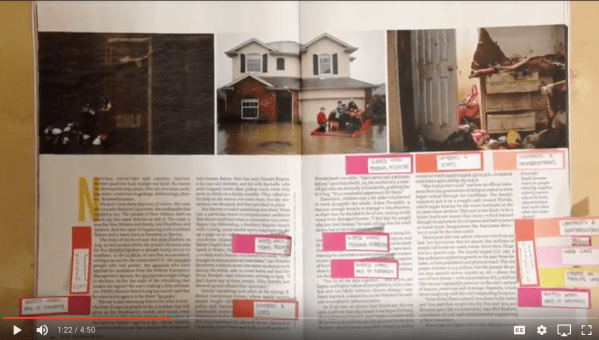
When students learn reading strategies and skills, it’s important to be able to see just where they are in the learning process, but it takes time to thoroughly check in with each and every one of them. So with this unit, our ninth grade English teacher team decided that it would be great if students could demonstrate their learning through a think-aloud. Doing this in class would take a lot of one-on-one time, so we asked students to demonstrate their thinking and reading skills on their own, and to use the video recording capabilities on their iPads and cell phones.

videothinkaloud

A screen shot from a video-think-aloud

Because we, as teachers, had modeled the think-aloud strategy in our classes many times, students knew exactly what we meant, and were able to demonstrate their understanding of the strategies and skills necessary when reading magazine articles. They annotated, exposed their initial confusion, shared their process of finding understanding, and demonstrated a multi-draft reading of the articles they had chosen. It was a successful method of assessment, and I plan to utilize it again. Students had a chance to showcase their thinking and understanding, and it wasn’t a one-off opportunity. They had the chance to try multiple takes with their recordings, so the pressure was off and they could easily share their thinking.

Our most current rationale for the utilization of video in class is with our new short novel unit, in which we formed book clubs. We are squeezing in a shared text at the beginning of second semester with Of Mice and Men. While all of my students are reading the same text, they are split up into groups of three and four so they can form their book clubs. One of the summative assessments with this unit is a small group discussion that they will record. They will need to demonstrate some academic, sustained, literary discussion in their videos, and are practicing in class, leading up to the recorded discussion. I’ll be able to have five small-group discussions going on at the same time in my class, which means precious class time isn’t frittered away with transition times between discussions, for example. Students will be thinking, reading, and discussing, and I’ll be able to watch the video later, when the pressure is off, and I can truly assess the conversation. I’ll try to remove the guess-work because I can slow down the speaking and listening assessment portion of it all.

annotation OMAM

One student has heavily annotated in preparation for the recorded small group discussion.

These are just a few ways to allow students to use the simple technology that is available to them. Kids know how to make movies and to splice audio, so there is little need to instruct regarding the technical details. They can use the audio and video to showcase their skills.

It’s also a timesaver as far as the classroom goes, and it takes some of the stress off of students who have test anxiety or who struggle when it comes to on-demand assessments.

While it’s not a student-recording, I will share one last recent use of video in class. I played the video in this NPR article about a murmuration of starlings as an inspiration for a quick write this week. I played it without sound, and hit replay several times. My students were fascinated and wrote some fun responses. One was even moved to write music: img_5972.jpg

I love how my students are constantly surprising and impressing me. They are unexpected and wonderful.

I’d love to hear more about how teachers and students are using laptops and cell phones for the power of good in the comments below!

Julie has been teaching secondary language arts for nineteen years, spending the first fifteen in rural Central Oregon, and the last four in Amman, Jordan. She’s thrilled to report that she and her family will be moving across the agua to Managua, Nicaragua next year, where a new adventure will begin.

Follow her on twitter @SwinehartJulie

Follow her blog https://adventuresinhighschoolworkshop.wordpress.com/

Collaboration 4 Ways

The Classroom

It had been a great week in the classroom: we had shared our stories, written in our notebooks, and analyzed Queen’s awesome “Bohemian Rhapsody” (if that’s not a “fun on a bun” way to dive into rhetorical analysis, I’m not sure what is!). But despite my best intentions, I had not faithfully modeled engagement with writing mini lessons (ML’s) and folded in collaboration the way I intended. Okay, or much at all. You know how it goes . . . you nibble some off this end and things slide a little at the other end.

So, I found myself without time–as I so often do (Help Pacing Gods and Goddesses! Help me learn to be less thorough already!)–and wondered if/how I could efficiently address the 4 ways writers can collaborate. My colleague and I believe writers collaborate with mentor texts, people (teachers via ML’s and conferences and peers), materials, and themselves. How could I satisfy this need, this craving to model these fundamental skills in a totally wholesome way without cramming it down their throats?

Thus, Collaboration 4 Ways was born. Reminiscent of Steak ‘N Shakes’ Chili 5 Ways, I quickly figured out how to model what I wanted to do by synthesizing the 4 collaboration skills into a one-plated ML, focusing on the 6 Word Memoir, which is our lead into application essay writing for our seniors.

  1. I modeled collaborating with a mentor text, using an online sample off NPR’s site, taking note of what worked. I annotated interesting arrangement of words, varied syntax, clever pairings of language and visual, and more. Then I thought aloud regarding what I ought to “throw into the mix”–measuring out words that helped to build meaning.
  2. I modeled collaborating with the teacher; and, pulling the picture of my sweet and silly Ingrid as a unicorn, used the ML strategy of writing about what the picture encapsulated in 17 words or fewer. Ideas first; concision later.
  3. I modeled collaborating with materials (AND my students): gathering small thumb drive size sticky notes, I wrote each word and
    IMG_1142 (1)

    Here’s what I mixed up–with student collaboration–on the doc cam. The whole sticky notes reflect student suggestions and “drafts.” Note to self: they do sell thumb sized sticky notes . . .

  4. piece of punctuation on one and with student help, moved the words around and changed/added punctuation to truly model that sentences are made of moveable parts and that punctuation DOES matter (what taste it adds, darn it!).
  5. Finally, I modeled collaborating with myself, thinking aloud and reflecting to create my final piece. Does this arrangement of words build meaning? Does it build power? Should I revise the punctuation? Etc.

And, I did this all in 10-15 minutes (what I had originally allotted each day to teach each one of those separately).

Discovery:

Served early in the course, this lesson acted as a catalyst for many of my students. Some use the 6 word memoir approach to generate topics or meanings of topics; some manipulate syntax via sticky notes for their purposes; some spend more time talking through ideas; some realize then and there the value of a mentor text.

As for me, I discovered that maybe, just maybe, I needed to shift my thinking. Because it will shift my students’ approach. ML time has been about modeling what to do and getting help from my students, too, discussing and processing. To me, the ML steps have seemed a recipe for success–a thorough list of ingredients and instructions to follow as they work at isolating and problem-solving a certain challenge in their writing. With someone modeling it all for them. Collaboration 4 Ways allowed me to model possibilities . . . instead of the way, one way with an intended outcome.  Serving up Collaboration 4 Ways reminded me that students need to see what’s possible. And how even a seasoned cook needs to test and try.

Truth: Possibilities precede problem-solving.

Giants whose shoulders I stood on:

Many a giant supported me on this one  . . .

  • My Directors of Teaching and Learning who reminded us before school began that we have more freedom than we are using. And, what opportunity really means.
  • Angela Stockman’s Make Writing 5 Teaching Strategies That Turn Writer’s Workshop Into a Maker Space for inspiring me to experiment more with making writing.
  • My colleagues for holding me to the fire with how I ML because sometimes there’s not much mini about it.
  • Three Teachers Talk Mini Lesson Mondays!

Kristin Jeschke, in addition to enjoying Chili 5 Ways during late night study sessions back in college (too many years ago to mention here), appreciates constraints, good talk, and post it notes (lots of them, in all sizes) when writing. Follow Kristin on Twitter @kajeschke. 

What do colors have to do with teachers writing? Today, a lot.

When I read You Don’t Have to Say You Love Me by Sherman Alexie, I knew I’d found mentor gold. Infused with stirring poetry, this memoir tells the story of Alexie’s less than ideal relationship with his mother and how he grieves the loss of her, what was, and what could have been.

I reached for this book Monday as I began a session of PD. On a whim, I flipped the pages and landed on the poem, “Ode to Gray,” thinking it may spark some kind of response in my audience. It’s simple enough. And lovely.

Ode to Gray

This isn’t the complete poem. I just wanted you to get the idea. There’s one more stanza. Really, get this book.

After I read the the poem aloud, I asked listening teachers to write in response.

“Think of a color, and write about that. Write your own poem, or a paragraph. Doesn’t matter. Just write about your color.”

After writing five minutes, which is rarely long enough, I asked these writers to read over their words and do a bit of revision, challenging them to add an appositive phrase somewhere in their writing. This is a directive I often use with students:  We write. We read our work. We revise, often with a singular purpose that ties to a specific skill or craft move.

I walked the room, peeking over shoulders, listening to conversations — and noticed about a third of the group didn’t write a thing. Funny how some teachers are so much like some students, huh?

Maybe they didn’t get the simple task. I guess that makes sense if they’ve never been asked to write like this. I do not think that’s the case though. I heard one too many sigh and saw one too many eye roll to know I wasn’t the first presenter to ask this group to think and write.

It didn’t matter. We cannot make people eat. We can keep inviting them to the table.

Writing teachers should be willing to write.

Accountability in RWWorkshop

Some teachers in that session wrote a lot — and they wrote beautifully. Adam showed me his piece about the color black. I should have asked for a copy. All I remember is the line “Little black lies.” It’s a great line.

Of all I wrote, one line holds a bit of promise:  “Orange, the color of sunsets, why are you so lonely?”

And then there’s Mary. She took that little quickwrite and turned it into something tender, touching, real. She published it on Facebook and said I could share it here:

An Ode to Red
Workshopping With Amy Rasmussen
1.15.18
Red is the fire of your cheeks as you demand to be heard in the morning before school, on a day I was supposed to get to sleep in late. Red is the fire of mine as I scream back, frustrated, unsure of how to solve this trembling toddler enigma. You want red grapes, I gave you purple. In your mind, they are not the same.
“What’s your favorite color, Mommy?” you ask. You expect an answer.
“Purple,” I say, knowing the question that comes next. We do this daily dance, aware of each other’s rhythm.
“And what else?” you ask.
“And orange.”
“That’s good, Mommy. Mine’s red. Red and blue. I love red and blue.”
Red is the sucker, no, the second sucker you negotiate for after getting your hair cut. Just one of the many tricks/bribes that I’ve learned along this short parenting trip we’re on together. Sticky, stained red lips, sticky, stained red teeth and sticky, stained red fingers.
“Go wash your hands before you hug me!” I yell as we walk in the house. “5, 4, 3, 2, 1…”
Red is the color of the bath water after you dump the entire bottle of finger paint into the tub.
“Bubble bath!” you shriek excitedly, giggling, red steaks strung along the sides of the just-washed tub.
Red is my heart each time I leave, and each time I return. Red is the love. All of the love, engulfing me in flames.


I see red a bit differently today.

Thank you, Mary. My kids are grown, and now I get to watch them practice parenting. It’s hard and noble work, and you will feel every color of emotion — sometimes all on the same day and sometimes more than once. But it’s that “love. All the love” that turn these emotions into rainbows. And sometimes just writing about them helps us see every moment just a bit more clearly. Thank you.

In an article by Tim Gillespie, published on the National Writing Project website, he sums up what I believe and have experienced myself as a teacher writer.

Accountability in RWWorkshop (1)

Here’s the thing, you teachers who refused to even try:  It doesn’t matter if you think you can write. Just write.

What does matter is that our students see us working at it. Just like we must be readers in order to help our students find the “just right” book, we must be writers if we want to know the struggle our students face when writing.

We learn when we are vulnerable. We learn when we practice.

So I am challenging myself as much as I am challenging you:  Write beside your students more. Let them see your thoughts, your mistakes, your struggles. Ask them for feedback.

If I truly want a community, where we all work to grow as readers and writers, I need to do more to get us there.

Amy Rasmussen began writing in journals at age 8. In addition to this blog, she now writes in notebooks and on sticky notes. A lot of sticky notes. She also tries to write the assignments she gives her students. She wishes she would have had teachers who wrote with her, but she does not remember one K-12 teacher ever doing so. Follow Amy on Twitter @amyrass and @3TeachersTalk

Every Teacher a Reader. Every Teacher a Writer.

Do any of you follow the Middle and High School Secondary ELA group on Facebook?

Now, I am not trying to pick any fights, but I’m just going to say it:  Some of the comments drive me straight over a rocky cliff. Honestly, I tend to get a little snarky if I spend too much time there. (Sorry, not sorry.)

Today an ELA teacher posted “Writing sucks.” What?! I sure hope a student never hears her say that. Yesterday a teacher posted this question:

“Silent reading…have you built it into your routine? For how long? Do you find your struggling readers or non-readers (at home) love this time? I currently have built it in for the first 15 minutes since I know many of my 6th grade sts do not read at home. I think it works, but just brainstorming other ways to do things for next year. Just curious what you all do! I would be curious if HS teachers still give time to silent read, too.”

I had a hard time reading the thread with comments like “They won’t read, or forget their books… It turns into wasted time.”

Of course it does, if teachers do not establish the all out importance of reading, the benefits of reading, the time commitment to grow as readers; if teachers do not walk the talk of readers, share their reading lives, promote books and match books to kids and beat the drum of reading. Every. Single Day. We have to help students value reading.

The same holds true for writing. We have to help students value writing. We have to help students value the struggle of writing well.

Are we teacher-writers who model the difficult task of writing? Do we share the struggle of getting thoughtful ideas on the page and revising and revising and revising to convey the meaning we intend to the audience we intend? Writing well means we make intentional choices and we develop the habits of writers. Read Donald Murray’s “Habits of Writing,” and then internalize his last line: “Consider my habits of writing, but develop your own by studying what you did when the writing went well, and make what you discover your own writing habits.” (If you really want to build your writer-mojo, I suggest Murray’s books, The Essential Don Murray:  Lessons from America’s Greatest Writing Teacher, and Learning by Teaching.)

We can learn to write well. We can learn to teach writing well as we discover our own writing habits and guide students into developing their own. But this will never happen if we do not write.

readerswriters

I’ve written about walking our talk before — and I believe it more every day. I think we owe it to our students to be actively engaged in the learning process the same way we ask them to be actively engaged. I can never be a good enough reader. I can never be a good enough writer.

So, this summer I commit to keep working on my craft. I will read. I will write.

If you are reading this post, I know I am preaching to the choir. I know you already share at least some of my beliefs about reading and writing. Thank you for that!

I invite you to share your reading and your writing, to amplify our collective voices as teachers who read and write, and walk our talk — even during the summer. Shana posted our summer posting plans yesterday. I hope you’ll join us on our Facebook page, our Instagram feed, and on Twitter. And as Austin Kleon famously asserts:  Show your Work!

Let’s spread it far and wide!

Amy Rasmussen lives in north Texas and teaches AP English Language and English 4 (new prep in ’17. She loves talking books, daughters’ weddings (two this year), and grandbabies (five). She also loves facilitating PD for other teachers making the move into a workshop pedagogy. Amy adheres to the words of Emerson: “We aim above the mark to hit the mark,” and Jesus: “Love one another.” Imagine a world if we all aim higher. Follow Amy on Twitter @amyrass. And she really hopes you will follow this blog!

Stay Gold, Ponyboy. Authentic Literary Analysis: Poetry in Two Voices – Guest Post by Elizabeth Oosterheert

Over the past several months, social media has been a buzzing hive of Tweets, articles, and teaching resources for The Outsiders, as S.E. oosterHinton’s beloved classic celebrated fifty years of resonating with readers of all ages around the globe.
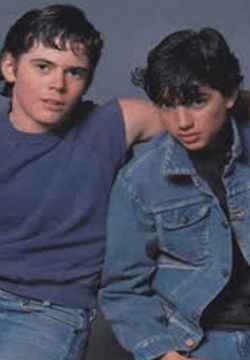

In using The Outsiders as a whole class text this spring with a seventh grade class composed of nearly all boys, I began to explore juxtaposing the beauty and power of poetry during National Poetry Month, and authentic literary analysis. How could I use poetry as an analytical catalyst?

The answer came in an approach that I love because it promotes several of the pillars of writing workshop:

  • Student agency/ownership of the writing process
  • Collaborative writing and thinking
  • Mentor texts as models for writing craft moves
  • Opportunities for teachers to participate in workshop as writers

Poems in Two Voices are an excellent way to invite creative literary analysis, since by definition, they challenge student writers to take on the personas of fictional characters and to look at a literary work through the lens of their chosen character’s perspective.


As an invitation into learning about Poems in Two Voices, I shared a poem that I wrote from Johnny and Pony’s point-of-view during our workshop time, as well as poems written by former students.

Seventh Grade Literature
The Outsiders
“The End of Innocence: A Poem in Two Voices” by Mrs. O.

ooster2

Ponyboy Curtis Johnny Cade
Nature’s first green is gold, her hardest hue to hold. Nature’s first green is gold, her hardest hue to hold.
Gold was my mother. She was beautiful. Nothing gold can ever stay. My life has been black.
Gold is my brother Soda. Movie star handsome. He kind of radiates. I pulled a silver switchblade, thinking it was for the best. Disaster from then on.
Beauty was the sunrise in Windrixville. There was a silent moment when everything held its breath. I did, too. I remember Pony’s voice as he read Gone With the Wind. Dallas is gallant, going into battle like those Southern gentlemen.
I thought things could only get better, but we went from ice cream sundaes at Dairy Queen to the red Hell of the church on fire. We started it with our cigarettes. I was a hero for a moment. Instead of being beaten down, I was giving life. Pony said Jerry thought we were sent from Heaven.
Johnny never thought of himself. We can’t live without him. The gang needs him. I don’t want to die now. Sixteen years ain’t long enough.
Sixteen years on the street, and you can learn a lot. But all the wrong things, not the things you want to learn. Sixteen years on the street, and you can see a lot.  But all the wrong sights, not the sights you want to see.


Then leaf subsides to leaf… Then leaf subsides to leaf…
We had a rumble, but in the midst of the fight I realized, I don’t hate the Socs anymore…None of us should have been there, throwing punches with a gang of future convicts. Useless…fighting’s no good. I tried to tell Pony that. I have to get the words out while I still have a pulse.
Johnny was so quiet, I thought Dallas and I were too late. I thought Johnny was already dead. “We’re all proud of you, buddy.” That’s what Dallas said. I loved Dallas. I wanted to die with his words in my ears.
Johnny was trying to talk to me. I leaned in,  close to his burns, his closed eyes. “Stay gold, Ponyboy. Stay gold.”
The pillow sank a little, and Johnny died. I see something on the horizon. Light.
So Eden sank to grief,

So dawn goes down to day.

Nothing gold can stay.

So Eden sank to grief,

So dawn goes down to day.

Nothing gold can stay.

After sharing my poem, and giving students the opportunity to read several student written poems aloud, we wrote the following list of writing craft moves:

Writers of Poems in Two Voices…

  • Look back at passages in the text where the characters they’ve chosen are actually speaking, or where they can “hear” their thoughts.
  • Base their poems on a specific passage in the book, or make their writing a more general reflection of everything that they’ve read so far.
  • Might give a voice to a character who doesn’t speak often or is silent. This allows creative license as a writer. For example, what would Bob say if he could speak to Johnny or Pony about what happened in the park? What would Johnny say to the children he rescued from the church in Windrixville?
  • “Steal” lines or word choices from the book such as a favorite Again and Again, or golden line
  • Sound like the character being represented
  • Decide which lines will be read in unison, and which ones will be read individually
  • Include important details from the novel to illustrate close reading
  • Practice reading poems ALOUD with coauthors to work on timing and inflection


Two voice poetry allows students to powerfully express how a text has changed their thinking about the world, gives them the opportunity to write with a coauthor, and to present their poetry to others.  It works beautifully with any book. My students loved revisiting favorite scenes in The Outsiders, and we’ve also written narrative poetry, found poetry, and whipstitch poetry together.

The end of the year is the perfect time to utilize poetry as an analytical tool.

How do you use poetry with your students? Please add your ideas and questions to the comments below!


Elizabeth Oosterheert teaches middle school language arts and directs the 8th Grade Theatre Troupe at Pella Christian Grade School in Pella, Iowa.

She loves reading and writing with middle schoolers.


Screen Shot 2017-05-01 at 8.44.22 PM

Care to join the conversation? We’d love to add your voice! Please email guest post ideas to Lisadennibaum@gmail.com.