If you haven’t had the chance to see Jeff Anderson in person, and hear him deliver the gospel of editing instruction, be prepared…he’s very tall. He’s also funny, charismatic, and passionate. He has an ability to take something very difficult and make it seem accessible, even to an old ball coach like me. Also, he got me to say, “AAAWWUBBIS.”
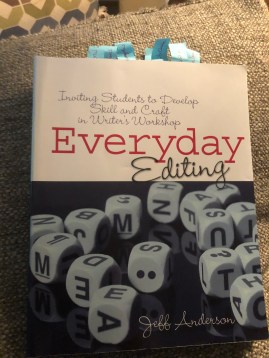
In my post a month back, I outlined how Jeff Anderson describes the first three parts of inviting students into the editing process.
- Invitation to Notice
- Invitation to Imitate
- Invitation to Celebrate
The next three parts are how we take what we’ve noticed and start putting those skills into practice.
Invitation to Collect
Those of us whose students spend most of their time in a notebook might have a dedicated section where we collect “sentence gems.” These are beautiful examples of sentence construction that we want to hold on to, and maybe one day, imitate. Anderson points out that he starts this practice with mentor texts that are “controlled.” In other words, he puts specific texts in front of the kids that contain sentences that he wants to help them find. Once they’ve got an idea about what it means to “collect beautiful sentences, he lets them loose to find sentences in, for instance, their self-selected reading. Mini-lessons are another place where we can examine well constructed sentences even if our lesson focus is somewhere else. Many times I’ve paused a mini-lesson to point out a beautifully constructed sentence or a familiar pattern even when it wasn’t a sentence that related to our lesson focus.
Invitation to Write
Putting our skills into practice is the step that might need the strongest shove forward. Whether we use sentence strips, foldables, or just a blank page in our notebooks, we have to sit in the chair and explore these moves in authentic ways. I think we can all agree that the true internalization of a writing move is most effectively solidified through our hands-on practice with that move. After that, its up to the writer to use those moves in places where it will increase the effectiveness of a piece.
Invitation to Combine
Anderson writes about how practice with combining sentences helps “develop students’ sentence sense.” This idea shows us that we can help students understand that they should be “thinking analytically about meaning.” Um…that sounds like effective and engaging instruction and it sounds like the highest level of thinking to me?
Anderson uses a sentence from Lois Lowry’s Gooney Bird Greene (2002) to help us understand that students might learn about combining sentences by working backwards.
Lowry’s sentence: When the class was quiet, Gooney Bird began her Monday story.
Uncombined:
The class was quiet.
Gooney Bird began her story.
Gooney Bird’s story was a Monday story.
Anderson goes on to suggest how separate groups could work to combine and uncombine sentences alternately. Some teachers might see this as too elementary for our secondary classrooms, but I would argue that the writing my students produce tells me this type of practice is still very necessary.
If Anderson’s sentence wouldn’t present much of a challenge, take a look at this one from Nic Stone’s Odd One Out (2018):
She’s probably got Jupe by an inch or so height-wise, but completely opposite body type: slim, kind of willowy.
I think there is enough there to start a conversation about how sentences can be combined.
Now we can use…
- Invitation to Edit
- Extending the Invitation
- Open Invitation
Anderson’s methods speak to me in that they are intentional and specific. My growth in literacy instruction leans more towards writing instruction recently, and Anderson makes this type of instruction easy for me to understand. The greater my understanding, the better chance my students have of understanding, and growing, and exploring their place in this world.
Everyday, Charles Moore hides behind a narrow tree in his front yard waiting for his daughter to walk the three house distance from the bus stop. She sees him the whole time, but he pretends to jump out from behind the tree and scare her before they run giggling into the house. He’s interested to know if anyone else collects beautiful sentences and if so, what are they?

 piqued my desire to give painting a try, so I sent her a message asking advice on beginner supplies. She was gracious and encouraging in her response.

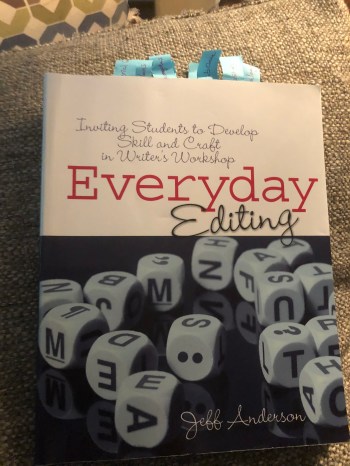

 remember the power of short writing assignments make it all seem so…doable!), and finding pearl after pearl to share with my students about moving their own writing forward, specifically memoir.
 The 1985 mini series on the trials and triumphs of fiery tempered Anne was a favorite of my grandmother, and we watched her two tape VHS version together until it literary broke.


 Students wish for us to tell them what to cut out before the essay has even been developed, before the central story has been identified and fleshed out to its most meaningful degree. Mariana and I brag to students about our 100% success rate in revising with students to pare down their college essays to within the word count: possibly the ONLY 100% success rate we can boast. Still, this critical skill of letting go what isn’t needed in the writing — which also, 100% of the time, results in a cleaner, more gratifying piece — is one students still struggle with.
 Like all great lesson plans, the 100-word memoir was “borrowed” from Kittle & Gallagher. We didn’t even realize the value of adhering to this limited verbiage until we witnessed students engaging and (willingly) struggling with it. While this exercise doesn’t seem to have been quite enough to provide students with enough strategy to pare down their 1000+-word college essay drafts by almost half during revision, we found the concept of a limited word count so potentially instructive that we have decided to turn it on its head with our seniors in our second quarter fiction-writing unit.
 To heighten the deletion and word-choice challenge — and, more importantly to encourage students to boil down prose (their own and others’) to its very essence — one might consider “
 In the meantime, though, I can feel the value of requiring shorter work for both us and our students, on so many levels: precision in word choice, saying more with less (vocabulary development); eliminating redundancy (sentence variation / sentence combining); not to mention the refinement and clarity of ideas that is required to say what you mean with an extremely limited word count. Not to mention the exquisite beauty of conferring on 100 focused words as opposed to 1000+.


 Earlier this week we observed
 real time. My very first thought was, “I’m going to read
 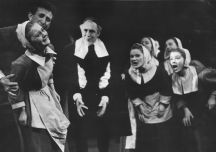 My next thought … politics. In the play, Reverend Hale is one of the few characters who exhibits any change in thinking. He observes. He listens. He struggles to negotiate his worldview when what he sees and hears doesn’t fit. Reverend Hale — indeed the whole village — experiences the crucible of accusation, doubt, and disintegration.
 literary allusions) a little more “equal” than others. And how can this “interaction of elements,” lead to the creation of something new, perhaps some power structures that need to be broken?


 Three Teachers Talk