Category Archives: Readers Workshop

Could We Just Get Students to Read and Write in All Content Areas?

So one of the problems on my campus is the fact that students don’t read. Oh, I know some do, but by and large, the majority of our students are not readers. As a school we are struggling with this new problem of practice, trying to define “complex language.” We’ve spent hours with this already, and have yet to come to a consensus. In frustration last week, after discussing this for two and a half hours, my colleague wrote on the bottom of our PD group’s thinking sheet:  “Could we just get students to read and write in all content areas?”

Really. It could be that simple.

A few years ago, our campus began whole-school reading. Built into our daily schedule is a 30 minute Advisory time, where a good number of minutes could be used for independent reading– if only teachers would enforce it. Most students like to read when they are given their choice of the right books. But if teachers are not reader themselves, it’s no wonder they don’t care if their students read.

Mine do, but that’s not surprising. The students in my English classes read for 10 minutes at the beginning of every class. So, if their advisory teachers are mandating reading, my students should be reading at least 25 minutes during every school day. That’s not a lot, but it is something.

Of course, independent reading will not solve all our problems. Students need to think deeply about texts, not just increase their fluency, and non-readers will abandon a book rather than struggle through it. That’s why if we really want to get our students to develop complex language skills, we must get them to practice complex reading. This is the kind of reading teachers must do with their students. You know, modeling close reading, modeling thinking about a text? And I think English teachers who know how to do this need to be given the opportunity to teach math and science and choir and business teachers how to read closely with all students.

We can talk about complex language all day as a staff. We can define it and put the definition on the walls of our classrooms, but that won’t do a thing until all teachers in all content areas start reading complex texts with their students. (And maybe it’s too much to ask, but imagine the growth if every student wrote in every class every day, too.) Hey, friends in other content areas, I’m glad to show you how.


Does your school have a wide reading program or other reading initiatives that include reading and writing in all content areas?


The Importance of Being Reflective (as well as Earnest)

ocsI’m going to be honest…I’m feeling pretty bummed as I sit here to write this post. I have had my first “wish-I-could-do-over” teaching days of the school year.  I haven’t felt this icky about a teaching day since…2005.  Oh Amy, you would have flipped out to see my utter lack of zen today.

It’s all too easy for me to focus on what I’ve not been doing well this year, how I have been falling oh-so-very short.  But I’m going to view this opportunity to reflect on my practice as a way to reset and to return to the core of my teaching soul for the coming week.

One bright spot in all of my classes this year has been a small change I’ve made in how I talk about books. One thing Penny Kittle emphasized this past summer (love to #UNHLit13) was the importance of book talks as part of her class every day.  I’ve always gushed about books I’m reading (see Shana’s post “Fangirling About Books”, which may as well have been my post! Kindred spirits!), and I’ve always prided myself on being able to match students with books that resonate with them.  But I decided to make book talks a regular part of each day, right after starting class with independent reading.

This Monday I’ll talk about books #51 (Invisibility by Andrea Cremer and David Levithan) and #52 (Dash & Lily’s Book of Dares by Rachel Cohn and David Levithan).  My students like finding the connection between the two books, though the connection between these is kind of obvious!

There are myriad benefits to having these daily book talks.  Some of the great books I read from and talk about are new to my students, and sometimes there are some who have read them already.  This has created community and conversation around books, as students share opinions, do their own spontaneous plugs for the books, ask questions, and start fighting about who gets to read them first!  Students started a Book Wait List on the white board.

It has surprised me how much the students enjoy the book talks.  One day a couple weeks ago, I forgot to book talk (it’s a verb now!), and Stephanie, who doesn’t ever say anything in class raised her hand and asked, “Are you not going to talk about a book today?”  When a new student joined our class, I had Noe help her get oriented, setting up her notebook and so forth.  I overheard her say, “After we read, she introduces a couple of books. It’s one of my favorite parts of class, no joke.  There’s a lot of cool books she shows us.”  The other day, students pointed out that I neglected to update the titles for book talks on the agenda.

All of the energy around books has helped create a culture of reading in our classroom so that even the most reluctant readers are giving books a try. The books have become a bridge between me and some of the students who are typically “hard to reach.”  It’s still a challenge to be sure, and there are days some students are fake reading, but for the most part, students are realizing the books are here to stay!

For me, it’s always easier to dwell on the negative, but when I stop to think about it, there are quite a few things going well. It’s a process, and I’m growing and figuring out how to make my class an authentic reading and writing workshop. It is a source of strength to know there are people in my PLN all over the country striving to do the same!

(Coming up next month: How to respond to the question, “How do you assess that?!”)

Reel Reading for Real Readers: Alice Bliss

Alice Bliss coverI asked my colleague if she’d read anything good lately, and she recommended Alice Bliss by Laura Harrington. “You know me, I rarely show emotion, but this one…maybe I liked it so much because of the close relationship I have with my dad. It got to me.”

I liked this book, too, but for different reasons. My son wants to join the Army. I couldn’t help but get emotional. If you’ve read the book, you know why.

I don’t know if many of my students will relate to Alice Bliss. I don’t know if they have the kind of relationships with their dads that Alice has with hers, but I know they probably want one. And it’s not too late it their lives to try and make it happen.

You know, my dad used to garden–a big deal in the hot Texas sun, but I rarely spent time with him out digging around in his grow boxes. I was impatient, and he didn’t say much. He also worked on cars in our garage and built fly rods in his workshop. I had no interest, and he didn’t push. Now, I wonder at the missed opportunities, and I’m sad that it’s too late.

I will share this sweet book with my students and remind them that it is not too late for them.

For an idea of the beauty in this book, check out this beautiful collection of images on Laura Harrington’s Pinterest board. Showing students the images might be enough to spark some interest, along with a passage or two that shows Alice’s voice.

Oh, and this Pinterest board idea– imagine if students create one for their favorite book? That might be a nice way for them to show me they understand imagery, allusion, symbolism. Hmm. Now, I got myself thinking. What do you think?

Reel Reading for Real Readers: Outliers by Malcolm Gladwell

20130207-190708If we invite author’s into our classrooms, they can become personal coaches for our students. I will introduce the book Outliers to my students with this CNN interview between Anderson Cooper and Malcolm Gladwell.

First of all, Gladwell’s an interesting looking character that’s for sure, and really, who wouldn’t want to read a book by a guy who is so interesting AND articulate?

Converting the Fake Reader

I’m trying something new this year:  my students are reading every day. Last year I reserved Friday for independent reading. Students did okay with that, but few read as much as I had hoped they would. This year I dedicate the first 10 minutes of every class to silent reading. We’ve been in school a month, and I have many students who have finished a book–some have finished three and four.

The first week of school I set the expectation, and I talked about books a lot. Every day I introduced a book and its characters to my students. I read passages and book covers. I testified to the importance of a book in my life. I read reviews and showed book trailers. I worked at getting a book in every single student’s hand. And it’s paying off.

Even for Ever.

Ever is that one student. You know the one. He grabs the first book off the shelf and pretends to read it. He does this every day for a week. You know he’s a Fake Reader. You’re just waiting for the right time to talk with him about it. Then one day he leaves The Invisible Man by H. G. Wells in the classroom–you know he’s not reading this book anyway. What normal sophomore would? So you hide it just to see what book he’ll choose to Fake Read next. He doesn’t. He sits. And does nothing.

Finally, you make your way to talk with Ever. “What’s up with this Fake Reading?” you ask.

He mumbles something that you don’t understand.

“If you tell me what you’re interested in, I can help you find a book,” you offer.

He shrugs but walks to the bookshelves, soon returning to his seat with a bright non-fiction paperback. You don’t see the title, but you watch to see if Ever’s reading.

Nope. He’s an Advanced Fake Reader.

Then he surprises you. He asks for help finding something real and historical, so you offer a stack of memoirs with authors from Cambodia, Iran, and South Africa. He doesn’t even bother to pick them up, but he’s drawn to the shelf they came from. You can see it in his eyes.

You’re pushing but not too hard. You barely know this child, and you know the first three weeks can make or break the relationship with a student for the whole year. Then you see him. He’s got a thin book–historical fiction. And he’s reading. He’s really reading Once by Morris Gleitzman.

The next day Ever is one of the first students in class. You glance over, and Ever is reading, and the bell hasn’t even sounded yet. You walk over to offer a bit of praise.

“Hey, Miss, I’ve read 120 pages since yesterday!” he tells you. And inside you’re grinning so widely your cheeks hurt.

Ever finishes that book the next day and reaches for Then.

Then You know you’ve got him when he turns the pages in Now.

And maybe, just maybe you’ve converted the Fake Reader.


How do you get your Fake Readers to give a book a try?

Fangirling About Books

Image

Never has my complete and total geekdom served me so well as it has in these past few weeks.  While I’ve just started to appreciate my nerdiness fully, it has been long in the making.  For example, when I was in middle school, our family’s answering machine message included the phrase “May the Force be with you.”  In case you’re imagining that I was mortified by this fact, let me add this–I was the one playing the Star Wars theme on my violin in the background.

So, as you can see, I have a history as a nerd, dork, geek…whatever you want to call us.  What sets we citizens of a fandom apart from those who live outside of one is our unabashed love and adoration of whatever beautiful world we choose to immerse ourselves in.  The beautiful world I happen to geek out about is the world of books.

A few weeks ago, as I munched on junky appetizers with fellow teachers during a happy hour, one of them asked me, “But seriously. How are you getting them to read?”  She told me about students she’d been talking to who had already read two or three books this school year in my class, and expressed her shock that they were even doing “anything” for me.

Her question, while simply phrased, was a valid one–what exactly was I doing that was getting kids who “hated” books to pick one up–and finish it?  And then actually tell people about it?!?  I thought of what I was doing differently this year, and that’s when I realized–it’s the geeking.

Image

There are only two really big differences as to how I structured my independent reading program this year vs. last year.  One is a daily booktalk, and the other is illustrating my reading life beyond school.  In previous years, I’d always allowed time for independent reading, provided easy access to a beautiful library of desirable books, and modeled my thinking as a reader in class.  This year, though, I start every class with two booktalks.  These are not staid speeches in which I summarize the plot and then move on, no–these are performances during which I share my own experiences with these books.  I excitedly describe the scenario in which I (or a friend) read this book, and how it impacted me, and what I thought of it.  Then I give a bit of the backstory and introduce them to the narrator’s voice by reading a carefully selected passage of the text.  It’s amazing how quickly students will begin asking for the book–even kids who don’t love reading like I do (yet).

Image

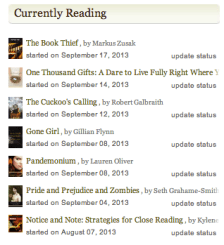
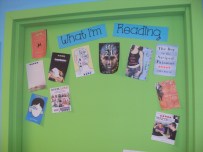
The second thing I’m doing differently is showing them my life as a reader.  I tell them about bookclubs I’m in, friend them on GoodReads so they can see my extensive “currently reading” list, and put colorful book covers on my colorful door.  I show them the wide variety of books I read–from teaching books to YA lit to general fiction–and I model the need for not just different genres, but different levels of difficulty in my reading.  Columbine, I tell them, had to be followed up by the light, speedy 13 Little Blue Envelopes.  It is incredibly impactful to them to hear that I spent my Monday night with their soccer coach, math teacher, and assistant principal talking about The Book Thief and eating German-themed food.  When I talk about my reading life with my students, they become more comfortable talking about theirs in our reading conferences, and they slowly, miraculously begin to see themselves as readers too.

Image

So, as summer slowly fades into fall here in wild and wonderful West Virginia, you can picture what I’ll be doing–reading amongst the autumn splendor…and then going to school to fangirl about it.  It may sound simple, but it works.  Geeking out about books is getting my students to enter the fandom of literacy, and I imagine my fellow teacher-reader-writer-fangirls–Amy in Texas, Erika in New York, and Emily in California–are seeing this as well.  Their students are transforming too, a perfect mirror of the seasons, in all the corners of our compass.

Reel Reading for Real Readers: The Good Soldiers by David Finkel

20130207-190708My own sons love to read books on war. That’s the main reason I have so many in my classroom library.   My twin sons Zach and Chase both plan to enlist in the military after they serve two year missions for our church. Every once in a while they will come home from Barnes and Noble with a new book. Chase brought this one home just yesterday:

Every once in a while I come across a book that I surprise them with, and usually they argue over who gets to read it first. Good Soldiers by David Finkel is one of those books.

My sons were reluctant readers in middle school and most of high school. The majority of their teachers stuck to the required reading of classical literature and rarely talked about books other than those they were reading for class. Chase finally found books as a way to escape bullying, and Zach found he liked a lot of the books Chase was reading. They became readers on their own, which I am grateful for, but I still think “what if?” What if a teacher had taken the time to learn of their interests in the military, in war stories, in patriotism? What if a teacher had let them read where their passions lay? Maybe they would have had a much more enriching experience in high school English.

I haven’t read Good Soldiers yet, but Chase has. He read it in a day.

Good Soldiers Audio Book Review:

David Finkel reads an excerpt:

Day One Disaster?

Our Compass Shifts 2-1  Fact has it that my wonderful Personal Learning Network (PLN) was back in the swing of things well before the 2013-2014 school year started in the boroughs of New York City.  So, for the entire last week of August and into the beginning of September, I was watching magic take place all over the country through my computer!

I was with Amy @amyrass, in Texas, as she embarked on her first day of Writer’s Notebooks which brought tears to those who were starting their writing journey together; as honest writing so often does.  Shana’s @litreader themed library, standing tall against newly painted bright blue and green walls, inspired her students to embrace literature from the moment they walked into their West Virginia oasis.  Out in California, Emily’s @booknerdkim community of learners were so enthralled to be engaging in the Writing Workshop, that decorating their individual notebooks became a source of (very!) friendly competition.  I was taking note.  I was excited.  I was ready.

Or, so I thought.

Day One has arrived.  I am channeling the beauty of the work being done throughout the country and greeting my students with smiles and complete calm.  Yes, calm.  And yes, I myself am a bit in awe that “I” and “calm” have been partnered to describe the beginning of this journey.

Day One comes and goes in the blink of an eye, as it so often does, and I find myself sitting alone in my classroom with a wild mix of emotions.  I’ve taught my classes; students have left the building and are transitioning into their evening lives; and as I look around I notice…there are no traces left behind that any learning has taken place.  Chairs are pushed in, supplies are neatly organized in each table’s bin, and the floors are still glossy from this summer’s wax.  Did anything happen in here?

As I journeyed home that night, uncomfortable and uncertain, I was unsettled with how calm I remained.  As I reflected on the day I was consumed by the flat energy, the lack of bubbling conversation, the quiet minds, the mechanical smiles…  I couldn’t help but wonder that if I was the most prepared and ready to educate than ever before, how could Day One be so disappointing?  And, if I was this disappointed, I couldn’t imagine what students must be feeling.  Sigh.

Day Two comes, as it always does.   As I’m getting situated to begin the day, there is a knock on the door.  I look at the clock and it is 8:33a.m. – not time for class.  Surprised to see this student with a huge smile on his face peering through the tiny window separating us, I open the door.  There are no words, only actions.  He passes me, what seems to be a blank composition notebook.  I look at him with a puzzled look.  His smile grows.

“I wrote.  Here.”

As I walk back into the classroom alone, I open this Writer’s Notebook.  I happen upon pages of text…full pages, with words scratched out, abbreviations, acronyms, exclamation points, (unintentional) disregard for punctuation, grammar and spelling.   Yesterday, when asked, he thought he was being honest about not being a writer.  So, as I carefully maneuver through and reach the end, I am moved by how brave this student is.  He is courageous to explore his stream of consciousness – in writing- for the first time.  He is an evolving man full of character.  He is willing.  He is hungry.  He is fighting for more.  He shared this all with me. 

Mid-week students’ energy starts surfacing; hands are finding their way into the air in hopes of answering a question; the buzz (I so desperately missed) is starting to fill our community with a new excitement; and while this year is going to be unique (as all others are) we seem to be starting to find our groove.  This groove is calm yet exciting; quiet yet intellectually stimulating, and most importantly…it’s all ours to explore and share as a collective.

Day Five greets me (again!) before the start of the school day.  A student comes rushing toward me with an urgency that stops me in my tracks (hands full of bags, books, and dangling keys) as I’m just about to unlock the door to unload.

“Ms. Bogdany, I LOVE my book!  I was reading last night and shut off the TV so I could concentrate more.  My mom asked me why I was doing that.  She said, “You never shut the TV off to read.  What are you doing?!” I explained that I wanted to focus on my book because I’m really starting to like it.  I still want to read Jesus Land, but I’m going to finish this one first!”

Without interruption, and as we move over the threshold from the hallway to our shared learning space (where I finally put down everything I am carrying), this wonderful young woman continues.

“Yesterday, when I was on the bus, I was reading.  You know my boyfriend he’s in your other class.  When we got to his house he said, “You know we have to read for fifteen minutes.”  I told him of course I knew!  I took out my book, he took out his and we read.  It was awesome!”

I’m smiling, and in my head thinking “Forty-five minutes…forty-five minutes of reading, but we can start with fifteen!”  And just as the bell begins to sing, there is one last message this student wants to leave me with before she rushes to her class.

“You know, Ms. Bogdany, my twin siblings; they’re not good at reading.  I wasn’t either when I was young.  Actually, people told me my mom should pull me from school because I was never going to learn.”

Yes, people actually told her that.

“So, I know what they’re going through and I want to help them be better.  Tonight (Friday) we are going to sit as a family and read; I’m going to help them with their books from school.   I want to do this every week with them.”

My heart starts to swell.

“I’m scared though.  Next year I want to go away to college so who will help them get better?”

While I’m not sure I have the answer to this, and so many other questions, I do know that what seemed to be a disastrous Day One was really an illusion.  I recently heard someone say, “My mind shuts off and my soul takes over.” I made the mistake of allowing my mind to interpret quiet and calm for an educational atrocity.  Students are listening.  They are engaged.  They are passionate.  I am now taking solace in knowing I don’t always have to be swinging from rafters and tap dancing on tables to educate.  My soul truly believes in the power of calm.


Reel Reading for Real Readers: Behind the Beautiful Forevers

20130207-190708This one is still on my TBR list, but just reading this excerpt at NPR has made me think of the many ways I can use Behind the Beautiful Forevers: Life, Death, and Hope in a Mumbai Undercity by Katherine Boo in my English classes this year. Look at the sentence structure, the word, choice, the imagery, the power and beauty of the language. Oh, wow!

Many of my students know next to nothing about life outside of Carrolton, TX–or if they do, it’s the best exits to take for fast food and restroom breaks on their long drives from here to Mexico where they go to visit family. It’s not all their fault. They do not come from families of world travelers. They do not even come from families of readers.

One goal I have this year is to read more world literature myself. If I read it more, I will talk about it more, and I can hopefully get my students reading it more. There are so many wonderful stories, heartwarming and heart-wrenching stories, and I want my students to experience them.

Here’s Katherine Boo explaining her book. I just love her!

Starting Close Reading with Mexican White Boy

Matt de la Pena is scheduled to speak at TAIR in Denton, TX on September 30. If things work out, he’ll be coming to my school to speak on the 28. I am excited for my students to hear Mr. de la Pena’s story. It is so similar to their own.

Mexican White BoyMexican White Boy is the first de la Pena book I’ve read. Ball Don’t Lie, We Were Here, and I Will Save You are rising on my TBR pile. I imagine my students might get at them first.

A passage from Mexican White Boy made me take note. It’s a great read aloud, but it’s also a great piece for a text study. It’s packed with literary and rhetorical devices and would be ideal for close reading for concrete vs. abstract details. Or, tone. Or, syntax, Or, all of them.

It all hits him as he stares at a half-finished love letter. No matter how many words he defines or love letters he composes or pieces of junk mail he reads aloud to his grandma while she waters spider plants potted in old Folgers coffee cans he’ll still be a hundred miles away from who he’s supposed to be.

He’s Mexican, because his family’s Mexican, but he’s not really Mexican. His skin is dark like his grandma’s sweet coffee, but his insides are as pale as the cream she mixes in.

Danny holds the pencil above the paper, thinking:   I’m a white boy among Mexicans, and a Mexican among white boys.

He digs his fingernails into his arm. Looks up to see if anybody’s watching him. They aren’t.

Sometimes he’ll just watch his family interact in the living room. The half-Spanish jokes and the bottle of tequila being passed around with a shot glass and salt. The laughing and carrying on. Always eating the best food and playing the coolest games and telling the funniest stories. His uncles always sending the smallest kid at the party to get them a cold sixer out of the fridge and then sneaking him the first sip when Grandma isn’t looking. But even when she turns around suddenly, catches them red-handed and shots, “Ray! Mijo, what are you doing?” everybody just falls over laughing. Including Grandma.

And it makes him so happy just watching. Doesn’t even matter that he’s not really involved. Because what he’s doing is getting a sneak peek inside his dad’s life (89-90).

My students will start the year with a study of narrative writing. Thanks, Mr. de la Pena for this accessible piece to get us started.

Do you have any similar short texts that you use for close reading? Please share.