Category Archives: Readers Workshop

Workshopping Yourself

ocsIf I ever write a book about teaching, I will write about the importance of being yourself in your classroom.  For some reason, I used to believe that it was not appropriate to be the real me as a teacher–maybe it was because I was fresh out of college, inspired by professors’ styles that were so very different from my own, or maybe it was because I was so young when I began–just 20 years old–that I felt I should try to put some distance between myself and my students.

Over the years, I’ve dropped the stern, strict, distant persona I tried initially to teach behind…and have just been myself.  I embrace my nerdiness, I’m loud all the time, I never stop smiling, and I don’t try to hide my enthusiasm for what I love (coffee, cats, my husband).  I’ve subscribed to the philosophy that I’m not just modeling reading strategies or writing processes for my students–I’m modeling a life philosophy too, of being oneself.  I have, essentially, workshopped myself…revising, paring down, adding in, and determining what to let alone in order to become the best possible version of Teacher Me.

Still, what I’m beginning to realize is that no matter what lesson plans I write down, what stories I choose to tell from my anecdotal arsenal, or even what clothes I put on in the morning, I’ll never have full control of how my students see me.  We never perceive ourselves the way our students perceive us…we never can.  I’m sure if I perused one of my old literary theory textbooks I could find a name for this phenomenon…but for now, we’ll just say that our students see right through us.  Right through the masks we wear when we’re having a bad day, through the halfhearted energy we try to muster if we’re ill, or through the moment’s hesitation it takes us to consider a diplomatic response to a particularly strange question or comment.  They see right through our sometimes-staged actions to our true beliefs, our values, and our feelings.  They see the real us, which is why I shake my head now at what a fake they must have thought I was during my first year of teaching.

Thanks to the fact that my students (current and former) write me lots of notes, I’ve gotten to do a little bit of research on exactly what they see.

IMG_1434

One thing that they all know is that I spend a lot of time reading and writing.  One student left me a note saying that she hoped I had a good weekend reading since I don’t own a TV.  Another student wrote in an exam response that he was shocked to see me at the gym on a Saturday night, “getting swole,” since he assumed teaching was my “entire life.”  Another student wrote that sometimes when he read books, the voice in his head was “a letdown” because it wasn’t as excited as mine when I read a passage for booktalks.

One of my most excitable learners, a foreign exchange student from Brazil, gave me a goodbye note on her last day of class.  It was a simple list of things she was thankful for, and its straightforwardness couldn’t have been more tearjerking.  She said “thank you” for…

  • being crazy for books
  • being patient about my questions
  • lending me books
  • being happy every day
  • accepting me with open arms
  • being honest
  • saying the things you say
  • being my teacher

There is nothing on that list, or in any of those notes, about becoming a better reader or writer–nothing there about increasing knowledge of domain-specific vocabulary, or learning how to make a strong claim and support it with evidence, or analyzing the development of a theme throughout an extended work.  And yet…that list, and those notes, made me feel like an amazing teacher.

The things our students take away from our classes don’t always have to do with what we write in our lesson plans. Sometimes they do, yes–but so often, the things we teach are so far outside of our content standards that we don’t even know how to name them…when we talk about modeling, we can’t forget that we are also ROLE models…thinking models, reading models, relationship models, fitness models, etc.  Our students absorb the lessons of these models incredibly quickly.  We are influential in ways that we may never intend to be.

In a recent letter from a former student, the following words brought tears to my eyes: “I really do appreciate your kind words and wise ones. If it’s not evident already, your one year in my life has taken the effect of many.”

I don’t know what exactly the effect I have had on that student is, or will be (which is a little bit terrifying, to be honest).  What I do know is that I’m thankful for the chance to affect kids every day in my classroom, and I think the workshop model is an excellent way to do that.  There are so many opportunities for meaningful dialogue in this structure, both between student and teacher and in small or large groups of learners.  As workshop participants, students AND teachers get to be themselves, and get to discover more about themselves (and each other) through talk about reading and writing.  There’s no pressure to conform–the whole POINT is to be yourself and do your own thing, and that right there is more than enough to motivate me to do the outside work the workshop requires.  So, I’ll wrap up this post–and get to the two-foot stack of grading next to me–by leaving you with the wise words of the always-original Oscar Wilde:

by

Reel Reading for Real Readers: The Black Count

ReelReading2My personal reading goal for 2014 is to read more award winning books. The first for the year is The Black Count  by Tom Reiss; it’s the winner of the 2013 Pulitzer for biography.

I cannot even tell you why I was drawn to this book, other than while wandering the aisles and staring at the stacks of books at Costco, I saw the gold prize emblem on the cover. My mother had just died, and I’d rushed off to Utah to plan and participate at her funeral. I needed a book to read or I’d go mad.

I remembered reading The Three Musketeers as a young teen and falling head-over-heels for all four of Dumas’ dashing men. I’d later read The Count of Monte Cristo, which I loved, and once I read the cover of The Black Count, I knew I could escape into the story of Dumas’ dashing and daring father.

Honestly, I do not know if I can get any students interested in reading this book. I doubt many have much interest in French history, although several probably know Dumas’ famous stories. I want to try though. The writing is not just informative, but at times it is moving. Reiss helps us feel the love that the novelist Dumas has for his long-forgotten (but never by him) father.

I only found one book trailer, and it was kind of weak. I’d rather introduce this insightful book to my students through the author’s own words.

Author’s essay from Amazon:

I’ve always loved exploring history. It’s like an uncharted hemisphere, and when you look at it closely, it has a tendency to change everything about your own time. I’m also drawn to outsiders, people who have swum against the tide. I often feel like a kind of detective hired to go find people who have been lost to history, and discover why they were lost. Whodunnit?

In this case, I found solid evidence that, of all people, Napoleon did it: he buried the memory of this great man – Gen. Alexandre Dumas, the son of a black slave who led more than 50,000 men at the height of the French Revolution and then stood up to the megalomaniacal Corsican in the deserts of Egypt. (The “famous” Alexandre Dumas is the general’s son – the author of The Three Musketeers.) Letters and eyewitness accounts show that Napoleon came to hate Dumas not only for his stubborn defense of principle but for his swagger and stature – over six feet tall and handsome as a matinee idol – and for the fact that he was a black man idolized by the white French army. (I found that Napoleon’s destruction of Dumas coincided with his destruction of one of the greatest accomplishments of the French Revolution – racial equality – a legacy he also did his best to bury.)

I first came across Gen. Dumas’s life in the memoir of his son Alexandre, the novelist. And what a life! Alex Dumas, as he preferred to be known, was born in Saint Domingue, later Haiti, the son of a black slave and a good-for-nothing French aristocrat who came to the islands to make a quick killing and instead barely survived. In fact, to get back to France in order to claim an inheritance, he actually “pawned” his black son into slavery, but then he bought him out, brought him to Paris, and enrolled him in the royal fencing academy, and then the story begins to get interesting.

What really stuck with me from reading the memoir was the love that shows through from the son, the writer, for his father, the soldier. I could never forget the novelist describing the day his father died. His mother met him on the stairs in their house, lugging his father’s gun over his shoulders, and asked him what he was doing. Little Alexandre replied: “I’m going to heaven to kill God – for killing daddy.” When he grew up, he took a greater sort of revenge, infusing his father’s life and spirit into fictional characters like Edmond Dantes and D’Artagnan, with shades of Porthos, too. But the image of the angry child stuck with me and drove me onward to discover every scrap of evidence I could about his forgotten father.

And recovering the life of the real man behind these stories was the ultimate historical prospecting journey for me: I learned about Maltese knights and Mameluke warriors, the tricks of 18th-century spycraft and glacier warfare, torchlight duels in the trenches and portable guillotines on the front; I got to know about how Commedia del Arte influenced Voodoo and how a Jacobin sultan influenced the Star-Spangled Banner, about chocolate cures for poisoning and the still brisk trade in Napoleonic hair clippings. I discovered the amazing forgotten civil rights movement of the 18th century – and its unraveling …

This review here The Sentinel Alexandre Dumas:  The Black Count lends a powerful voice to the impact of this biography. It also includes some audio clips from the book, which I will share with my students.

That’s another of my reading goals:  more audio books. I think busy students need to know the value of listening as reading, too.


Finding Success in Hell

Guest Post by Jackie Catcher

flames“Ms. Catcher, do you have Inferno?”

Inferno?” I asked.  I looked up at Sean*, a skinny freshman with small gages in his ears and a bleached blonde buzz cut.  His punk skater image matched the rebellious reputation of the book he had recently finished: The Perks of Being a Wallflower.  This was the first time he had come to me with a book request for his independent reading.

“Yeah, you know that book about hell.”  I couldn’t help but chuckle—when Sean came into my classroom he associated books with being in hell, now he wanted a book on hell.

“Um, yeah, let me find it.  Dante’s Inferno?” I repeated again.  I tried to mask my surprise but could hear my voice crack with the title.

“Yeah, that one,” he said straight-faced.  The image of my tired college English professor popped into my head; the threadbare sports jacket he wore as he droned on about Inferno; I remember feeling like he single-handedly had pulled me through all nine circles of hell.

Sean owned the video game adaptation of the book, which had sparked his interest.  I handed him a copy, warning, “This is a hard read.  Even if you get through part of it, that will be impressive!  I read this in college.”  I felt the need to somehow soothe his frustrations even before he started.

“Ok.” He brushed off my warnings.

Every day I watched Sean crack open Inferno and slowly make his way through the convoluted English translation.  And every day I expected Sean to walk into my classroom and abandon the book.  But he didn’t.

“How much does he really understand though?” asked another teacher after I brought up Sean’s accomplishments.  She made a good point.  Not only was Sean in my academic class, the lowest level in my tracked high school, he had also scored partially proficient in reading on the New Hampshire state standardized tests over the past two years.  Even if Sean didn’t understand the book in its entirety, I believe he gained just as much as any freshman English major dissecting the poem.

Sean might not have delved into the intricacies of the epic poem, but he took away a sense of confidence and pride that can only accompany struggle.  Many students lack the reading stamina Sean exhibited, an essential skill for success in post-secondary schooling.  Students can be quick to abandon books, and I have found that it isn’t until students become more developed, advanced readers that they understand the value of pushing beyond the first ten or even one hundred pages of a book to get to the “good stuff.”  Despite Sean’s distaste for reading prior to this year, his hunger for a challenge paired with the independent reading initiative allowed Sean to build his stamina and prove himself as a reader.  As Sean said, “I kept telling myself it’s just a book.  You can keep reading.”  Reading Inferno stemmed from his curiosity and transformed into an undertaking of pride.

Sean’s experience with Inferno didn’t include deep literary analysis and his takeaway would most likely make my stuffy college professor cringe, but I’d argue that Sean learned the lesson Dante intended: perseverance and hard work lead to significant achievements.


*The name has been changed to protect the identity of the student

 Jacqueline Catcher is a first year teacher at Exeter High School in Exeter, New Hampshire. She teaches Academic and College Preparatory Freshman English and an upper level elective writing course using the workshop model.  She can be reached at jcatcher@sau16.org.

Christmas Miracles

ocs

December has traditionally been my least favorite month of the school year.  Something about it bogged me down, without fail, every winter–the dark, sunless days…the mountains of papers to grade…the looming specter of exams–to write, administer, and grade.  I hated my job in December.  From old journals, I know that I was consistently unhappy in the twelfth month of the year, and I wanted to quit teaching every time it rolled around.

This December, though, things couldn’t be more different.  I am LOVING my job!!  Last week, I found myself completely caught up on grading–something that literally hasn’t happened yet this school year.  Somehow, I had plenty of time to plan great lessons, confer with students with no back-of-the-brain worries, AND reorganize my classroom library.  I was a productivity machine–and it didn’t stop at school.  At home, I found the energy to assemble Christmas cards, decorate my apartment, and make some holiday crafts.  As I type this, my fingers are still sticky with powdered sugar from the big batch of cookies I baked this morning.  What’s with the freakish perfection, you ask?  One little, made-up, three-week-old, hashtag of a word:  #nerdlution.

nerdlution-button-tiny-01

Teachers across the country made nerdy resolutions that would be kept for 50 days.  They could be anything–write every day, exercise, a more robust reading life.  A Thanksgiving day Twitter chat gave rise to that wonderful idea, which I hope will become an annual tradition.  Still riding my NCTE13 high, I resolved (nerdsolved? nerdluted?) to spread professional ideas about English teaching any way that I could, every day.

IMG_1036I started by leading an epic two-hour workshop for my English department.  We book-passed (a la Penny Kittle) the entire contents of my professional library, shared best practices in a “gift exchange” of ideas, and made our own heart books (a la Linda Rief) of things we wanted to try.  Afterward, Kristine, a 20-year veteran with a reputation for pessimism, approached me.  “I used to have your energy,” she said.  “I don’t know what happened, but I haven’t had it…for years.”  She teared up, then borrowed Blending Genre, Altering Voice by Tom Romano, a balm for her troubled teaching soul.  Other books from my NCTE haul were checked out, too–Georgia Heard’s brand new Finding the Heart of Nonfiction was battled over by two first-year teachers, Penny Kittle’s incredibly dog-eared and highlighted Book Love and Write Beside Them were taken by veterans, and Tom Newkirk’s well-loved Holding On To Good Ideas in a Time of Bad Ones was checked out by our department head, who has held his position since 1972 (I’ll let you do the math on that one).

I was elated, and my colleagues’ willingness to try new ideas didn’t stop there.  The next day, a friend came and talked through some ideas about having her students do mini multigenre projects on Greek gods.  Enthused, I told her I couldn’t wait to see the results.  The following morning, Kristine, the tired veteran who’d borrowed Tom Romano’s book, stopped me in the hall.  “I came to school every day this week with a new attitude.  I feel the spark again,” she told me.  I nearly cried after we went our separate ways.

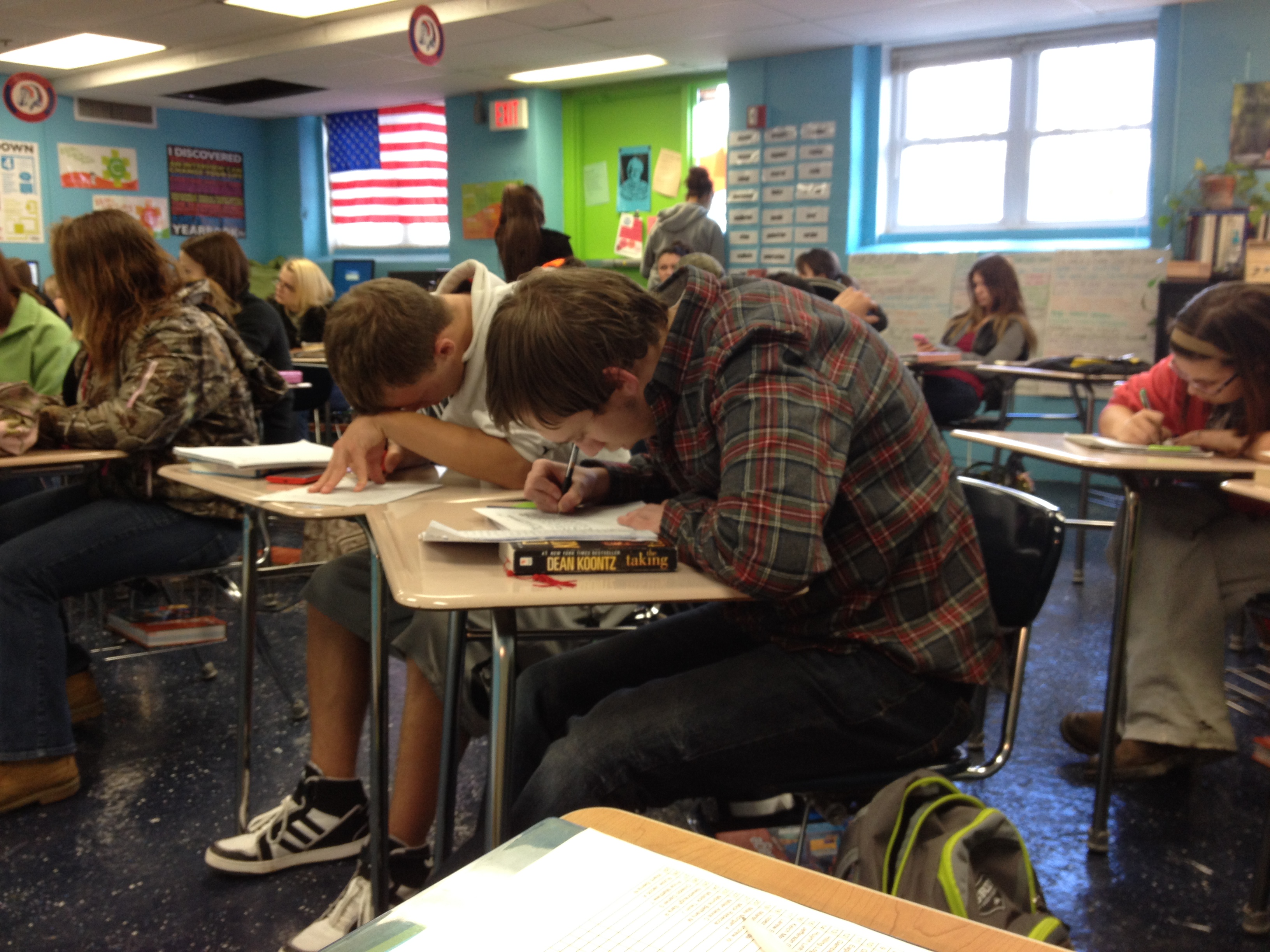
IMG_1313The following week, it all seemed to be coming together–our entire English department was on board for trying something new, especially the workshop model.  They wanted to see it in action.  In five days, I was observed eight times by fellow teachers, and they saw my students doing amazing things.  With heads down and pens on paper, their extended narratives were growing to eight…twelve…twenty-six pages long.  They were BEAUTIFULLY written, and on an incredible variety of topics–hunting, car crashes, detectives, breakups, death.  One male student wrote a narrative about rape from a woman’s point of view after hearing me booktalk Speak.

IMG_1314As my colleagues listened in, my students conferred with me about their writing like the confident, thoughtful, reflective authors they are:  “I want it to read like a Rick Riordan story,” Kenneth told me.  “Do you think the pace is too slow?” Nora asked.  “I just need to zoom in a little more on this,” Tevin realized.  “I’ve resorted to writing in my vocab section because the rest of my notebook is full,” Adam admitted with a giggle.  I ended every class with a smile and a feeling of pride threatening to burst out of my chest.  My colleagues were stupefied.  “How are you getting them to read so much?  To write so much?  To work on this stuff in study halls and for homework?”  They were flabbergasted, but all I had to do was point them toward that professional bookshelf, full to bursting (but with more and more empty spaces!!) with the brainchildren of so many of my teaching heroes.

So, my #nerdlution, as well as this little workshop experiment that Emily, Erika, Amy, and I have been trying out, is going beautifully.  The two are combining to bring me the most peace I’ve felt during the holiday hustle and bustle in a long time–and that, for me, is a Christmas miracle.

Reel Reading for Real Readers: My Friend Dahmer

ReelReading2My Friend Dahmer by Berf Backderf only sits on my shelve until I book talk it just once. My students are fascinated when I tell them that the book is based on a real boy who grew up to be a real man who murdered people. They only know of serial killers from TV and the movies. I get the “pleasure” of introducing them to a real life psychopath. It creeps me out a bit that this is such a popular book, but students love to read it.
He read ZERO books before he came to me. Not Good Enough.

He came to me pretty much hating to read. This tall freshman, eager to talk and laugh, and constantly wanting to do anything else but open a book. He admitted that he read zero books his 8th grade year.

The first book I got him to attempt was Game, a chapter book of about 160 pages that took him four weeks to get through. Every day I had to put a hand on his shoulder and whisper “Get to reading.” Next, he tried Gym Candy, and while he seemed to read it faster, he couldn’t tell me much about the plot or the characters.

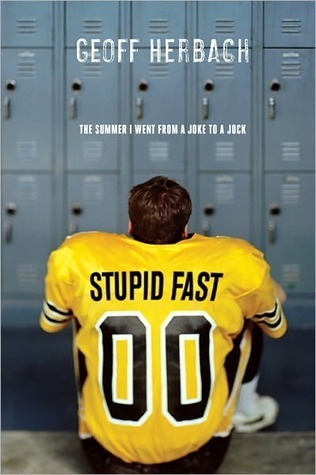
Finally, with a stroke of luck, this young man picked up Stupid Fast by Geoff Herbach. I had book talked it a week or so before, reading the first few pages to the class. At the time, R.J. wasn’t interested. When I saw him with this book, I hurried over and practically begged him to give it a try. “Okay,” he shrugged and moved away from the bookshelf toward his table.
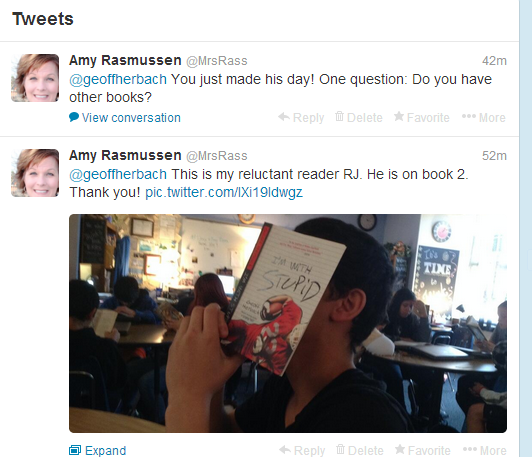
Every day for two weeks, R.J. came to class and told me how much he had read. “I like this book,” he smiled at me more than once. He finished this book in two and a half weeks, and then took himself to the bookshelf to find I’m with Stupid. (At the time, we thought this was the next in the series.)

When I finally made it over to kneel by R. J.’s table and conference with him about his reading, he told me that the beginning was hard to read because the main character’s family was “weird,” but he really liked the parts about football. We talked about character development and how the main character Felton changes throughout the book. “He grows up,” R.J. notices. I asked him what kinds of questions he would ask the author if he had the chance, and then I remembered:  I follow this author on Twitter.

“Hey, R.J., let’s take a picture of you reading this book and tweet it to the author. I bet he’ll respond.”

“No way…. Oh, okay.”

So we did.

RJ tweets to author

RJ tweets to author responses


R.J. left class that day feeling pretty special. He will finish his fourth book this week. His personal reading goal for the whole year was only FIVE.

Now, here’s the really cool thing:  While wondering the exhibition hall at NCTE in Boston, I struck up a conversation with the representatives from Sourcebooks Publishers. They asked if I knew of the books by Geoff Herbach, and, of course, I had to tell them about R.J. Then one of those very sweet insightful women reached under the table and handed me this:

Fat Boy cover

She understands the value of nurturing readers. She’s helped me make a difference in the life of this young man. I wish I could describe the yelp I got when I told R.J. he’d been gifted with an ARC of an ARC — how cool is that?

I’d love to hear your best “Conquering the Reluctant Reader” story. Please share.

Reel Reading for Real Readers: Girl, Stolen

ReelReading2I picked up this title at the thrift store, and the moment I talked about it in class a young woman grabbed it and wouldn’t let go. Later, I found out that this is a popular book in some of my colleague’s classroom libraries. I don’t know why teenagers like books with disturbing themes, but they do. I guess it’s part of the psyche trying to make the plight of others worse than their own. Or something. Right now there is a waiting list for it in my room for this book. Maybe someday I’ll get to read it.

Girl, Stolen by April Henry

Reel Reading for Real Readers: The Collector by Victoria Scott

20130207-190708I’m really not sure what to make of this, but I think my female students are going to clamor for this book.

I got an email from my school librarians inviting me to bring my students to a panel discussion with YA authors who would be visiting the CFBISD Literacy Night. Of course, I said yes. I didn’t even care who the authors were. I did ask for a list of names though, and then I searched for their books.

This is the first cover I saw:  Can you hear the girls whispering?

Then I did a search for a book trailer and came upon this great site called the “Teen Fiction Fiend.” Although the book was released last April, it will be brand new to my students–my copy arrived from Amazon last weekend, and the clever reveal here will have my girls who loved Perfect Chemistry falling all over one another as they clamor for the check out clipboard.

See for yourself:  Alice Marvel’s for theTeen Fiction Fiend

From the back cover:  “Dante is the kind of guy I wish I’d met when I was seventeen. And the kind of guy I’d kill if my daughter brought him home.” ~Mary Lindsey, author of Shattered Souls

Oh, brother… to be young again. *scurrying off to read (this book)*

Reel Reading for Real Readers: Between Shades of Gray

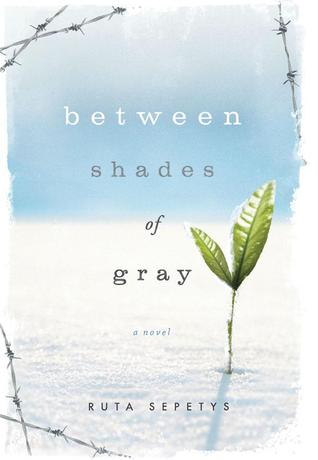
20130207-190708.jpgI’ve wanted to read this book for some time now, but it wasn’t until I was searching the shelves at my  favorite Salvation Army that I got my hands on it. (That’s a post for another day:  Building a Killer Classroom Library by Hanging out at Charity Shops) I have a students who is passionately interested in WWII literature. He’s already read two books a

bout it this grading period. I will put Between Shades of Gray in his hands as soon as I am finished with it.

I’m doing a good job this year of talking about a lot of books. Of my 140 students, I’m down to just threefake readers. Many students are reading slowly, but they are reading. I’ve decided I need to do a bit more than just talk about books. I need to step up my use of videos and book trailers to get them interested. The only problem? Every time I use visual images like this, I have more than one student who wants the book. I want to believe that this is a good problem, but it’s pretty sad when not everyone gets a copy of a book when they are excited about it.

Here’s a clip of Ruta Sepetys talking about the story behind the story.  I just know I’m going to need more than one copy.

Gifted and Talented Teacher Leaps off Cliff of Faith and Experimentation

Guest post by Tess Mueggenborg

Make no mistake about it: I’m a classical canon gal.  Always have been, always will be.  And when I say “classical,” I also mean “really old” – few things written after 1650 hold much interest for me.  Favorite work of literature? Milton’s Paradise Lost.  Favorite time period of literature? Early Roman Empire (Ovid & Virgil).  Favorite English Lit class from my undergrad days? Greek Tragedy.

But as much as I love the canon – and I’ve had surprising success with teaching the canon in the past – I’m also a pragmatist.  I know that what I love isn’t always what’s best for my students, and their learning should take priority over my passions (I know … radical idea, right?).  I also acknowledge that the real world in which I live and work is far from my ideal.  Would I like to devote all of my class time to discussing Beowulf and Canterbury Tales?  Of course.  But can I realistically get my students to read and engage with these texts, and develop a passion for them?  Not likely.  Some, of course, will – and I’m happy to guide them on their own paths of classical literature studies.  But I bet (I hope) that those students will wind up as English Majors, and they’ll get their fill of such works in college.  I must work with the students I have, not the students I wish I had.  And the students I have are awesome: bright, curious, hungry for meaningful learning and wisdom.  So this classical pragmatist has started to break her own mold.  Here’s how …

I teach a class known as World Experience; it’s for Gifted and Talented sophomore students, and it combines AP World History with literature.  The history drives the course – it sets the pace, scope, and sequence for the year.  It’s then pretty easy to match up literature with the corresponding time periods.  leap off cliffAncient River Valley civilizations at the start of the year? We read Gilgamesh and Horus the Hawk.  Classical civilizations come next – that mean Antigone and a few selections from Metamorphoses.  Next up is the Medieval period … and this has always been a struggle.  I love Medieval lit, I can read Middle English, and I can wax poetic on the virtues and merits of The Song of Roland and Sir Gawain and the Green Night ad nauseum.  And while the students usually enjoy these stories, they don’t usually get much out of this unit in terms of literature.  They don’t learn much about author’s craft, they can’t do much literary analysis, and they become so frustrated with the archaic language of the text that most of them give up … and it takes me another six weeks to pull them back into literature.  So this year, I’ve scrapped all this, and leapt off a cliff of faith and experimentation.  The results have been pleasantly surprising.

Our district head of English Language Arts was kind enough to buy $600 of books for my classroom library.  I got to choose every one of them: all award-winners (or by award-winning authors), all world literature, all contemporary, all high-level.  No softballs in this classroom library – these are, after all, GT students.  Each student got to pick a book (this was a time-consuming and sometimes contentious process, but it certainly got every student interested in the books and invested in their choice).  Once a week, they’ve been blogging about their novel, based on someone generic questions posed by me.  Some of the questions are just opinion (Do you like this book so far? Why or why not?); some of the questions are analytical (Who is the main protagonist of your novel? What problems do they encounter in the course of the novel? How do you predict they will resolve these problems … or not?); some relate back to the history half of the course (In what ways does your novel relate to the history we’ve studied so far this year?).  Some responses have been good.  Some have been profound, moving, passionate, and elegant.  None have been outright bad, and none have been missing.  That’s right: NONE have been missing.  Every student has been reading and blogging.  Even the student who earned a grade of 9 (yes, a single-digit 9) for the first 9-weeks is reading and blogging about her novel.  I’m calling this experiment a success.

To be fair, I should say: this hasn’t been easy, and it hasn’t been without challenges.  But they’re good challenges, and not insurmountable.  Some students read their novels in a week – and then wanted to borrow another book.  YES!  Many students didn’t devote enough time to reading their novel, and they’ve fallen behind.  But they haven’t given up: they’re still reading.  I haven’t had any complaints of “this book is boring,” though I’ve had many complaints of “this book is so sad/depressing/pessimistic/disheartening.”  Which has led to some great discussions about the point of literature, analysis of tone, and some hefty doses of maturation (I’m pretty sure the girl who read The Kite Runner in a weekend has been inwardly weeping for two weeks now).

We’re wrapping up this unit, and thus this great experiment.  And I think it bears repeating: I’m calling this experiment a success.  Enough of a success that I’ll be spending this weekend revamping the next unit (which starts Monday) to include more student choice and incorporate more of these novels, though in a slightly different fashion.  Stay tuned.

Am I still a classical canon gal? Heck yes. Always have been, always will be.  But my students don’t need to be classical canon fans – they just need to be readers, eager to engage with the world and its complexities.  I think they’re well on their way.

“Professor” Tess Mueggenborg teaches English (and anything else with which her students need help) at RL Turner High School.  Her academic passions lie in comparative language and literature.  The Professor lives in Dallas with her husband, Jeff. Tess’ on Twitter @profmueggenborg