My AP English students are in the middle of an end-of-year book project. In groups of three, they chose a book from the Pulitzer Prize or the Man-Booker Prize lists. They are reading and discussing these books and trying to determine what makes them award winners. They will create most of the parts of an AP English exam, based on the books they’ve read and discussed together.
Students are reading and discussing these complex, rich texts–literature at the top of the literary food chain. There are few things that make me more excited.
Here’s a glimpse into one of the books students chose for this project:
I love @professornana, the Goddess of YA Literature, and I learn a lot from reading her posts. This one got me thinking, and I opened and read every link she embedded in it.
The article got me (and not in a good way) at the title with the word “assign.”
My students are reading more than they ever have before because I am talking books, and suggesting books, and showing off books more than I ever have before.
I am not assigning them.
Choice works. Allowing students to read what they want, high or low lexile, works.
Do I sometimes steer students into genres, or most recently into Prize winners? Do I meet with kids and challenge them into more difficult books? Yes, but I’ve learned to always include some element of choice.
The past several days I’ve spent conferring with students during the first 10 minutes of class. Ten minutes that we devote to independent reading. I’ve met with 2/3 of my 145 students so far. Every student but two has read more this year than they did last. Most have exceeded the goal they set during our first reading conferences at the beginning of the year.
That kind of data speaks louder than any kind of lexile level. (I need to just say that my auto-correct changes lexile to exile every single time. Do you think that’s telling?)
Recently, a colleague visited my classroom. He watched my students engage with literature while I sat at a back table and listened. Later he asked how I conduct my readers/writers workshops. I told him “You saw it.”
My task is to get students reading and to teach them to talk about a texts: books, stories, articles, passages, poems. Once I do that, students can do most everything else when it comes to reading on their own.
There’s freedom here. Freedom for me and freedom for them.
Funny how my students learn more from each other than they do from me anyway. I wonder why it took me so long to realize that.
I’m reminded of a post Donalyn Miller wrote almost a year ago, and I echo her title:
P.S. Are you thinking about Summer Reading yet? It’s about to be a hot topic on my campus. To allow kids to choose or not to choose, that is the question.
P.S.S. I have to figure out how to allow student choice in AP Literature, which I am most likely teaching next year. Every experienced AP Lit teacher I’ve talked to “assigns” specific books. Still trying to think through this. Any suggestions?
My AP Language students are in the middle of this big book project. I had them choose an award winning book from the Pulitzer or the Man-Book Prize lists. They are reading and discussing these books in small groups. Then they will create an AP exam using passages from their books–we are working on thinking like test writers. I told them when they were selecting titles that if the book had been made into a movie they had to include a film study into their project and teach class for a day.
One group chose to read The Road by Cormac McCarthy. I look forward to their analysis of this movie.
A while back I had a problem. I had finally succeeded in getting some of my resistant sophomore boys to read. But they were stuck in the Ranger’s Apprentice series. Now, it’s not that I have a problem with those books. No, I love those stories– mostly because many boys who will not read another thing will read them, but. . . we are talking pre-AP 10th graders here. I knew I needed to get them moving up the ladder of complexity — at least a little bit.
I called on my PLN and tweeted out a plea for suggestions. The Chronicles of Imaginarium Geographica series lit up my screen.
Okay then.
I have no idea if this series is really more complex; I don’t care. If nothing else, my students have more choice.
Here There are Dragons by James A. Owen is the newest book for the fantasy shelf in my classroom library. I hope it never gets to sit there. Books are much more useful in a child’s hands.
This is a student-made trailer. I love that the description on Youtube says,
“This is the trailer for the best book I have ever read.”
This week, the first of the fourth quarter, has flown by for me–has it for you all? Perhaps I’m feeling the passage of time because of making end-of-year lesson plans. Maybe it’s because of the spring sunshine and storms. Or, it could be because I’m looking into summer course offerings at UNH, the NWP, and our nearest university, WVU. Whatever the case may be, I am acutely aware that I don’t have much time left with my fabulous students this school year.
Since that is the case, I want to give them opportunities to showcase what they have learned and how they have grown. Of course, I want a unique, rigorous way for them to show me this, so I’ve been designing some workshop-appropriate final assessments for my students. The abilities I am curious about are their independent reading, their informal writing, their reading of difficult literature critically and deeply, and their crafting of excellent, time-intensive writing.
My goal at the end of the year is that students can read a variety of texts independently, can think and speak critically about those texts, and can choose and recommend a variety of books for themselves and others. To see whether they can do this, students will complete an independent reading project that includes a craft analysis of the writing itself, a creative portion in which students show their comprehension of deep layers of the text, and a presentation of the project overall in which other students and I ask questions about the book. Additionally, students will do their own booktalks, in which they recommend a text to the class, perform a fluent read of a short bit of the book, and discuss their own reading experience with it.
In terms of quickwrites, or the informal, fluency-building writing we do at the beginning of every class, I want students to be able to understand and show their own growth with this type of writing over the course of the year. I do this by having them do a final “Journal Harvest,” an excellent idea I got from NWP mentor Sally Lundgren, which we’ve also done once or twice a quarter thus far. In this harvest, they read over all of their writing from the year and write a formal reflection about its growth, content, and style. Additionally, they choose three pieces to revise and draft into formal, typed pieces. Lastly, they share their notebooks, reflections, and revised final pieces with their writing groups in order to give and get feedback.
We’ve read two class novels so far this year, and for the final part of the year, students have chosen from a variety of books to read in literature circles. Being American Literature, I booktalked the standards Fahrenheit 451, Huck Finn, The Scarlet Letter, and A Separate Peace. Students chose which of those they wanted to read and have been collaboratively discussing, interpreting, and completing tasks related to their reading in groups. To share their understanding with the class and me, they will complete creative projects in groups, as well as write a formal book review they’ll publish on the wonderful GoodReads.
Finally, the Multigenre Project will show off my students’ abilities to write, revise, and refine formal, coherent writing. I have already discussed the way I teach the MGP extensively elsewhere, so I’ll be brief here. The MGP allows for student choice, curiosity- and question-driven research, frequent talk in writing groups and through final presentations, and rigor. To my mind, it’s a perfect culmination to a year of workshop, and I can’t wait to see what my students produce with it.
In true teacher-participant form, I will be doing all of this beside my students, and I am quite looking forward to the reflection time this quarter’s modeling will allow. I’ve already begun the process we all go through at the end of the year, in which we start to wonder what we’ll change in the future and what worked wonderfully that we’ll hang onto. In reflecting, I find my thoughts and writing returning again and again to the power of talk. Its deliberate addition into my curriculum this year has been the biggest change from previous years, in which student talk used to be in a space reserved for group work, presentations, etc. This year, though, student talk is at the center of my teaching, and I think it’s made an incredible difference in my students’ ability and willingness to learn. I’ve consciously included it in all of my final assessments as a result, as it’s been where I’ve learned the most from my students.
As you can see, there is a lot of grading, planning, and facilitating in my future, but I think it will be well worth the effort…and enjoyable to boot! Here’s hoping that my students will learn as much from each other in these final weeks as I’ve learned from them all year. Cheers to the fourth quarter, all!
I am not sure how the book Twelve Mighty Orphans walked into my house, but it fit right in. All four of my sons played Texas football, and for many years we lived at one football stadium or another. One year we attended three games a week with three sons on two different middle school teams, and our oldest son playing on varsity at the high school. It was either that year or the next that Tanner’s team won the state championship. It’s all a blur of blue and white.
Everything you have heard about Texas football is true. It’s big, and it consumes your life.
Maybe that’s why this book by Jim Dent had such a voice at my house. My husband read it. My sons read it. How could I not?
Not much compares to talking with your teenage athlete sons about a book.
This non-fiction book chronicles the efforts of one man to make a difference in the lives of orphan boys. He teaches them to play football, but he teaches them much more than that. This trailer introduces the storyline with beautiful images:
My hope for all educators is that we never, ever lose a student. And while that is my hope, life has it that sometimes a student’s passing becomes a reality. In 2010, that’s exactly what happened. Francis Gittens departed our school community leaving behind his energy, electric personality, and smile that only those lucky enough to have had the opportunity to know (and work with) him experienced.
A long time colleague and friend asked me, “Erika, how are you going to continue Francis’s legacy?” At the time, I was overcome with grief and emotion and couldn’t possibly consider this very tall task. However, as I started to work with my new over-aged and under-credited student population, their thirst and desire to obtain information in order to quench their ongoing curiosities provided me the answer.
A library.
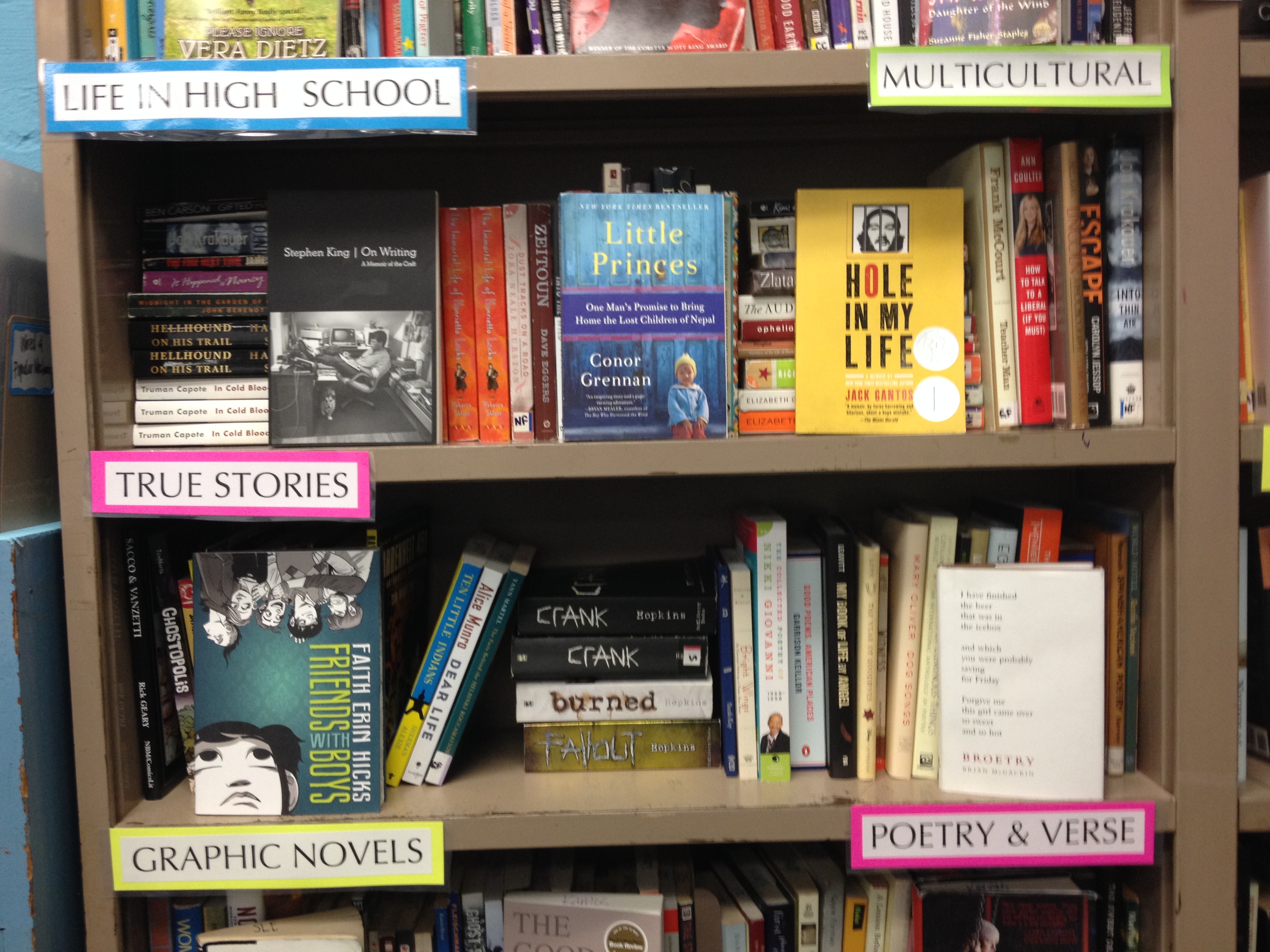
Not just any old library, but the Francis Gittens Lending Library. A library filled with rich pieces that have impacted other book lovers from all over the country. I’m talking all genres. I’m talking too many books for the amount of shelving we currently had. I’m talking opportunity.
Out went the email chronicling my mission. The recruiting had begun to wrap the two-hundred plus books that continued to be delivered and dropped off at my classroom door. Ms. Vasquez (Francis’s mother) had agreed to be present for the post-holiday surprise. Food had been ordered. Students had no idea how their lives were about to change. Full of emotion; I was ready.
What has happened in the two and a half years since must still be a figment of my imagination. Students are reading feigns who request piece after piece. Students and their families are continually donating to our class library. Not to mention all of the other generous donors who continue to surprise us with their favorites. Students have created Next-To-Read Lists because they can’t possibly read all the pieces they are intrigued by simultaneously, although many of them are juggling a couple at a time. Educators swing by to see what’s new on the shelves for their own reading enjoyment. And I have become quite the book connoisseur while perusing book store after book store seeking out unique pieces to book talk the very next day.
Just recently, after I reorganized our theme-based library, I sat back and found myself in awe. The growth of the library, now two-thousand plus books, stopped me in my tracks. I realized that as a collective, we have figured out a way to support our (sometimes struggling) readers and found a way for them to have all the access they want (and need) to the world beyond their own. Astounding.
I immediately phoned Ms. Vasquez inclined to show her what’s been taking shape in room 382. To no surprise her response was, “What day works best?” We both felt the urgency. She found her way to Brooklyn Bridge Academy without hesitation that very next Monday. As she entered the room, student conversations quieted and a hush fell over our shared space humbling us all.
As we all regained composure, conversations started to bubble and students were excited to share the literature they are (and have been) reading. Ms. Vasquez took her time scaling the length of the library and, overcome with emotion, she cried.
Ms. Vasquez pointing out an inscription to Francis from his Grammy in Sidney Poitier’s Measure of a Man.
She took the opportunity to talk to students about their lives and the decisions they are making. As we sometimes say, “She went there.” She focused on the young men, their appearance, and the injustices they are ultimately always going to face. She spoke directly to the females and advised them in believing in themselves, taking care of their bodies, and their intelligence. She focused on the vast literature lining the shelves and how this (education) is their key to the lives they deserve to live.
A tender moment with a male student.
As educators, it’s these ‘full circle’ moments that make us truly feel full with love, hope, motivation, and connection. Students are reading more now than ever before.
Our read literature this year. 180 plus books! Beautiful collection from the FGLL.
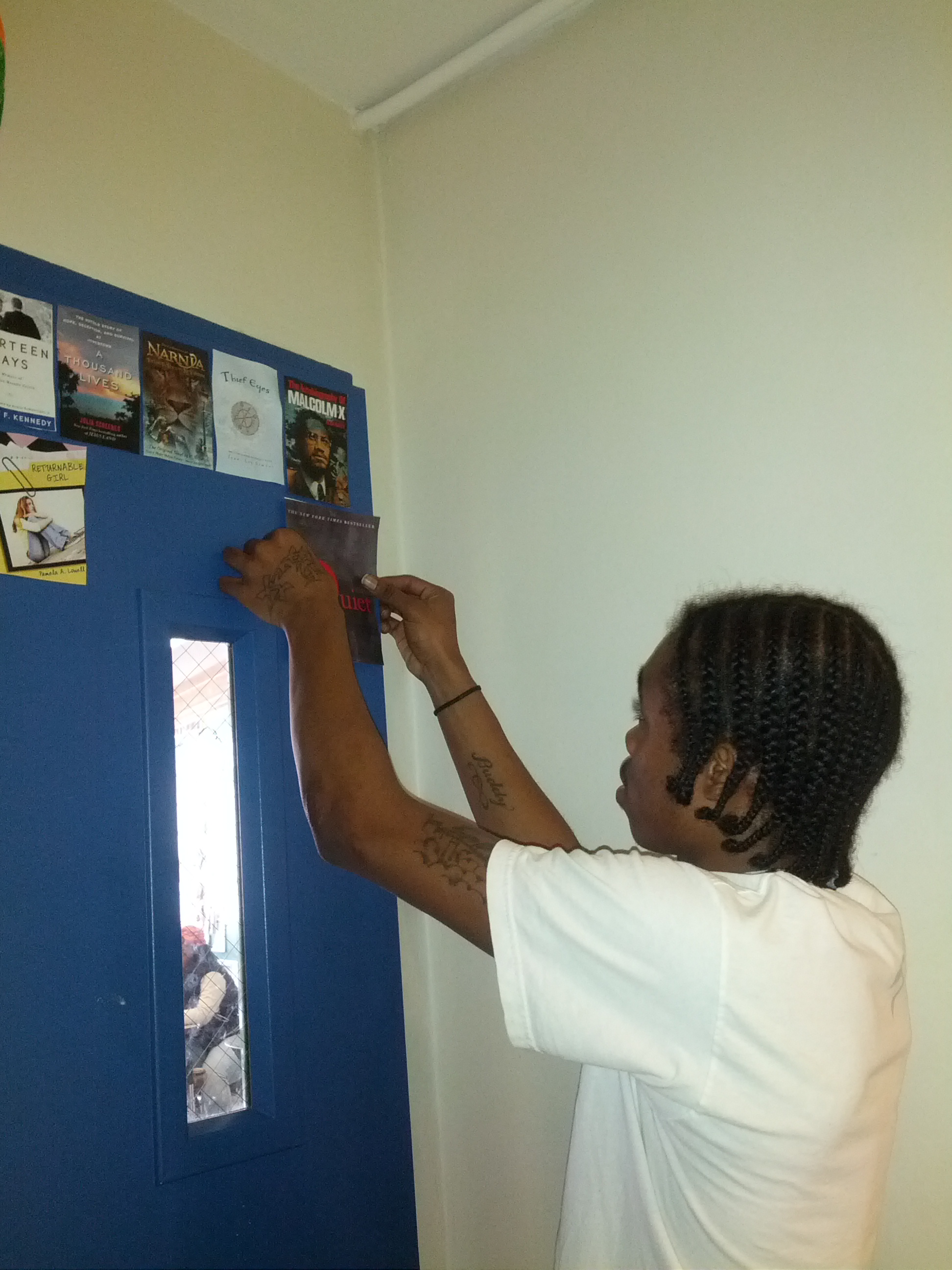
A proud student adding Quiet by Susan Cain to the other side of the door.
They are embracing their inquiries and willing to do the work to find answers. They are supporting me in my own reading journey and I them. We are collectively always looking for pieces of literature to add to our library and relishing in the ones that we can’t believe we actually found.
Each donated book receives a FGLL Placard (Donors, location, date)
We have shared humorous moments. Tears have been shed. In-depth thinking has…and continues to take place.
From an incredibly tragic loss to a beauty hard to put into words, we are all so very thankful. But most of all, humanity came together for those sixty minutes on a random day in March that none of us will ever forget. We are in this together, as a whole, as one.
Our ‘serious’ class photo. (My favorite!)
How will you continue to build and support literacy initiatives in your classroom?
Many of my female students love her Delirium series, and I am happy to say that maybe even some of my guys will take on Panic, Lauren Oliver’s newest title.
The topic is FEAR.
I haven’t read very far, but I have read enough to know I like this narrative voice. I especially like that I can share it with my students by using this video where Lauren Oliver reads them the first chapter.
My student teacher’s last day was yesterday, and, frankly, I’m lost without her. In eight short weeks together (less, when you count the 17 snow days), we have transformed each other as educators, brought our students to new heights, and had an exorbitant amount of fun. I’m hoping she’ll take away a myriad of ideas as she goes on to a middle school placement, because I knew I’ve learned much from teaching her.
During the first semester of this year, I worked to implement the reading and writing workshop model successfully in my classroom. Things were going fine, but I felt that something was missing. My students were producing excellent writing, and reading lots, but I wasn’t getting the magical results I wanted. It wasn’t until I began mentoring Katie that I was able to truly understand the holes in my efforts.
After a few days of observation, Katie became familiar with the workshop model. She knew that I used mentor texts as teachers, saw dialogue as an assessment measure, and read for craft and content in student writing. She saw that workshop was collaborative–within it, my students and I responded to each other’s work as fellow readers and writers, not as teachers and students. She took those foundational ideas and ran with them.
Newly-added graphic novel shelf
Katie taught students to write powerful, convincing letters of complaint to make claims they felt strongly about. In her quickwrite prompts, she showed them how to break down visual texts, emphasizing analysis of pop culture. Many of those videos she then used as mentor texts for public speaking skills, which helped her guide students through the writing of speeches and debates. She booktalked several graphic novels, a genre I had, before her arrival, been woefully uninformed about. She blossomed into a confident leader of the reading and writing workshop.
As I watched Katie teach so passionately, with such new and exciting resources, I began to see a gaping flaw in my own first try at workshop: I was relying too heavily on all of the texts, ideas, and strategies I knew and loved. I’d worked hard to make them comprehensive–I’d sought them out from all genres, time periods, places, and people–but I was amazed by how many resources she used that I’d never heard of. Katie Wood Ray says that our students should expect not only the best mentors of writing, but also teachers who will search for them. Although I was constantly searching for good books, mentor texts, or strategies, I was not effective enough–where were these pop culture visual mentor texts? My graphic novel shelf? Oral, not written, speeches as products of the writing process?
As I reflected, I came to realize that I was relying only on my own cultural capital to create the best workshop environment for my students. It was, by definition, impossible for me to extend my knowledge beyond what I knew, or knew how to obtain. I needed more brains–brains with their own unique cultural capital–to help me bring diverse resources into the classroom. Where could I find them?
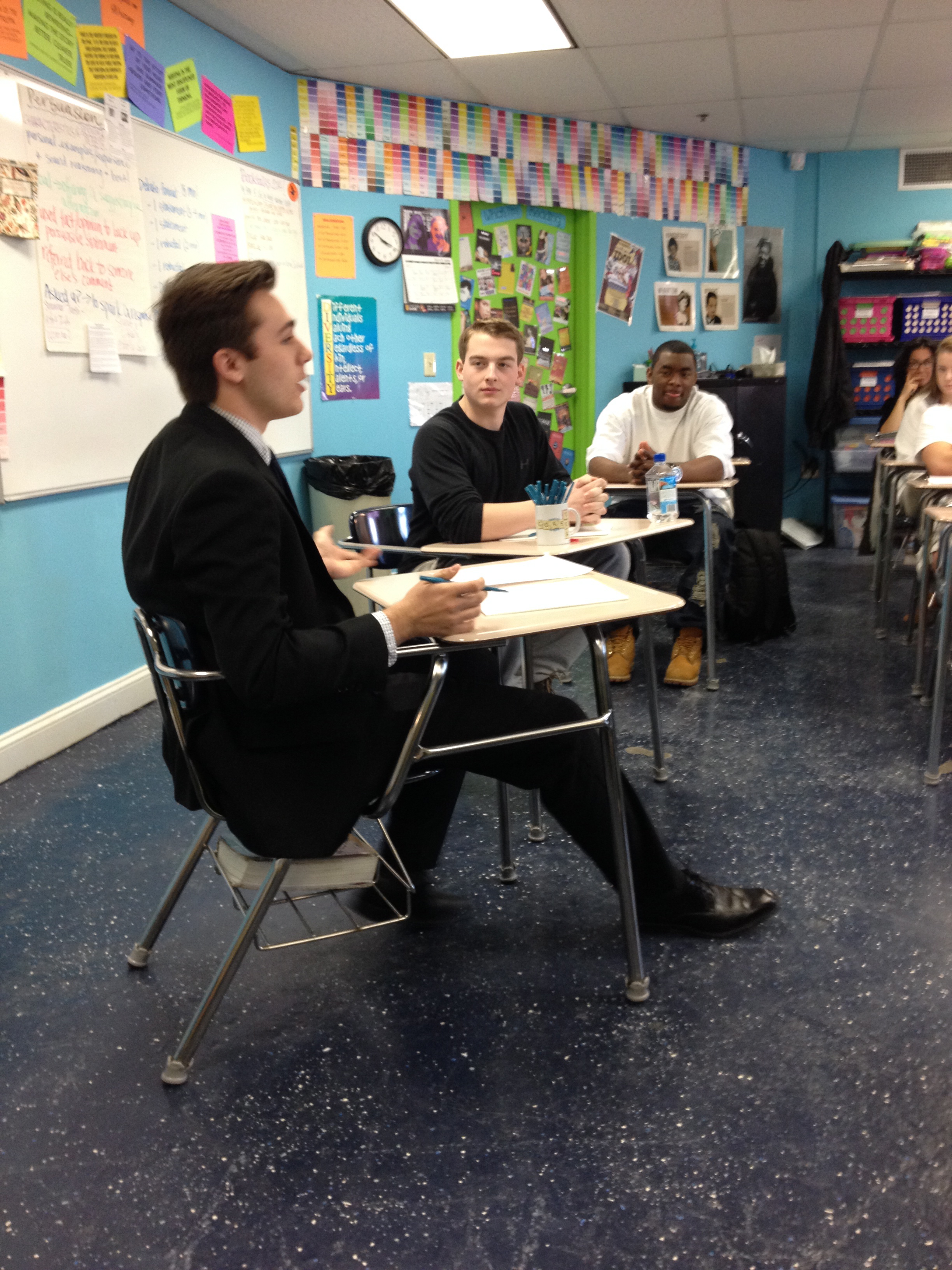
Zach and Brendan debate alternatives to the tardy policy
As I watched our students professionally, conscientiously debate each other, I saw from their products that they knew not just how to write and speak persuasively, but why that was important. I watched thee audience, and saw students changing their minds about things they’d believed for years, slowly having their eyes opened not by the adults in the classroom, but by their peers. They revised their scorn toward legalizing marijuana as Moshe spoke about his battle with leukemia, and the helpfulness of the medical marijuana he was prescribed. They felt ashamed to write about why the drinking age should be lowered after Anderson spoke about seeing a neighbor killed in a drunk driving accident. They questioned long-standing religious tenets after listening to Stephanie and Leanna debate the legality of abortion. They were guiding each other to that which all teachers want their students to learn–critical thinking.
In struggling to be a mentor teacher for the first time, I realized that the power needed to be even less in my hands than it already is in the workshop–it needs to be in the learners’ hands. In terms of Katie’s learning, she thrived when I let her just go crazy with her own wonderful ideas, instead of my giving her lots of suggestions. In terms of my students, I saw that they benefited from being more regular leaders of the classroom. I needed to do more than just give their writing importance by having them share it each day, or use their pieces as mentor texts, or listen to their suggestions about books, my writing, or my teaching. I needed to let them take an active hand in designing the curriculum, so that they could teach and learn from one another. Hence, a Eureka moment–the leadership in my classroom must by shifted to the students.
Katie Bush, Super Teacher
This weekend, I’ll be sitting down to write my first lesson plans in two months. Thanks to what I learned while teaching Katie, I’ll be designing structured leadership roles for my students–far more involved than the occasional student booktalk, or the daily quote sharing, or the class-by-class student mentor text. I’ll arrange for every student to give a booktalk this quarter. I’ll create a routine for all students to lead the class in a quickwrite with their own prompts. I’ll ask them to suggest titles to their peers for literature circle texts.
I’ve learned much about the reading and writing workshop model by teaching it to someone else, and I hope I will continue to grow as I hand the reins over to my students. Let this wild and wonderful workshop journey continue as the fourth quarter begins!
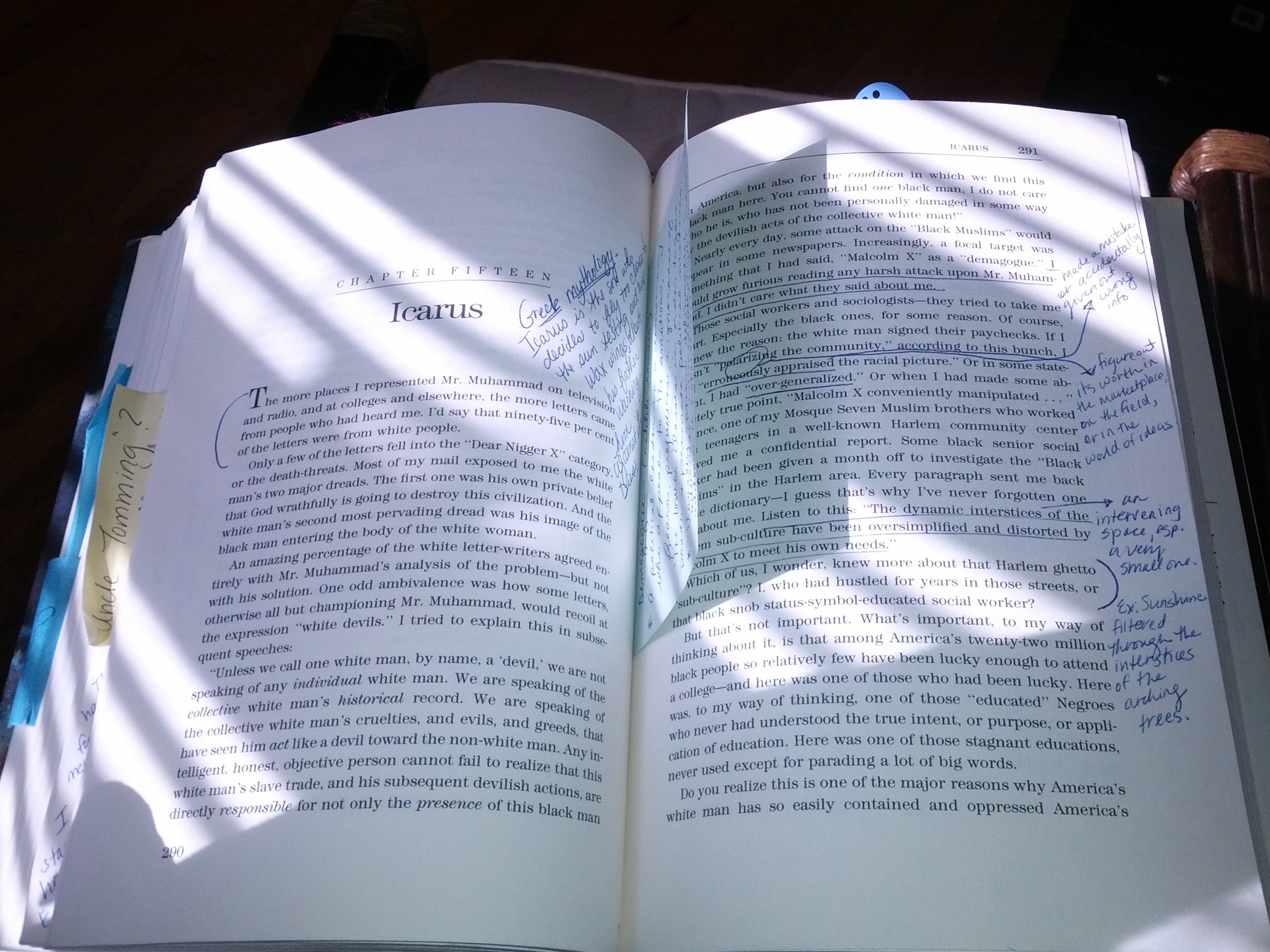
While recently in the throws of February break rejuvenating away from the hubbub of the city in the quaint beach town of Montauk; Malcolm X and I were becoming intimate acquaintances. We had been for quite some time, actually. But it was here that I really started questioning him, his motives, and his overall sense of dedication to any cause he finds justified. As I was making direct connections to my own beliefs and passions, my pen went haywire. There was, by no means, enough blank space on the pages of this autobiography for my own thinking. Out came the post-its. The power button on the iPad came alive and my inquisition and deep thought went ablaze. While X and I could not be more different human beings the ideal of commonality among passion elated me.
Later that very same day, I was introduced to Dr. Jeff Duncan-Andrade’s invigorating message that immediately added even more fuel to my already-burning fire. From the moment I pressed play (thank you, Apple TV) I was captivated. Jeff is an outstanding educator who believes there are three kinds of hope: material, critical and audacious. He believes that our [urban] students are roses growing in concrete. I mean, the city has always been referred to as the concrete jungle! In order to really grasp the intensity and genuine love Jeff exudes with his message, you’ll have to watch for yourself.
There I was, hours away from the city and my students, yet never have I felt so connected. X’s passion exudes from his autobiography; Jeff’s passion seeps through his pores as his care is so loudly presented; and my passion was turning up the waves in the ocean right outside my window.
On my drive back to work that first Monday morning after break, I made a promise to myself. I promised to stay true to my passion and invite the new found passions I discovered to reside within me as well. My focus was by no means on the road, it was zoomed in on Jeff’s mantra: Tu eres mi otro yo! (You are the other me!) How could it not be? How could I not be heading back to room 382 thinking, “Students, you are my reflection…you are what I see when I look in the mirror. We are one.”?
As I headed into our building, my mind automatically trained itself on a female student that I have been working with for six months, but have yet to authentically connect with. Today was the day that was going to happen. The day had not begun, but I was sure of it. I was sure of it because I was going to channel all of the passion, intensity, and love I gathered over the break and pour it all over this student. I only hoped she wouldn’t mind!
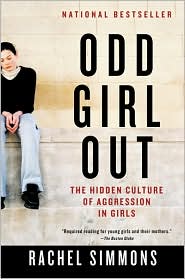
As independent reading commenced I asked this student to join me with her new book, highlighter and pen. It was a piece well below her reading level (as is typical of her reading selections), but the premise captured her attention immediately: females making decisions based on their desperate need for belonging among other female peers. There’s no wonder.
X followed me to class that day, in many regards. As I put my chosen piece of literature on the table, a ‘huh’ surfaced from this female student. I opened to the chapter titled Icarus. I asked her if she knew what the title meant and the following is the dialogue that surfaced:
B: Nope.
Ms. B.: Neither did I. I decided I wasn’t going to go any further into this chapter until I understood what this name resembled.
B: Huh.
Ms. B.: So, I took to the internet and realized Icarus is the name of a Greek mythical figure whose father warned him of not flying too close to the sun with the wax wings in which he created for him. But, he did. And he fell straight out of the sky. Can you imagine?
B: Wow. Huh. That’s interesting.
Ms. B.: Isn’t it? Then, check this out…(I flipped to the last page of the chapter.) Read this last sentence. (B does.) Do you see it?
B: Whoa. It connects to the title. It explains what you just did. (Smile)
And it was at this moment, that the gathered passion, intensity and love I poured all over this student started to work its magic. Because here’s what happened next:
B: Ms. Bogdany, how do you know what to highlight though? I never know what to say — I mean annotate.
This may seem like a simple (and potentially expected response) but after working with this student since September, this was the very first time she was confident enough to be vocal with her inquiry. From there we opened her book (with much fervor) and highlighted a portion that she noted. I asked her what it meant, and she started to explain it…and, in her book, I wrote down her thoughts. I then asked her about her own ideas regarding this concept, and (with the longest response to date) she explained her insights about the decisions the main character is making. So, again…I scribed. We discussed. I annotated. She smiled.
Ms. B.: Do you see it now?
B: Hahah. I do. It…it makes you understand more. Thank you.
Before she left to resume this process solo, I pointed her in the direction of another female student who had just started reading:
I explained the premise of this piece. She raised an eyebrow. I mentioned that when the other student was done, she may want to engage with it as it’s the same concept that envelopes her piece, yet it’s an informational, non-fiction piece. This piece is more level appropriate for her. Same concept, different genre, enhanced level. We’ll see.
In the meantime, I noticed during the rest of our two hours together that day, B’s book kept finding it’s way back onto her desk; her highlighter was incredibly busy; and her pen was relaying her inner voice on those very pages that previously would have remained untouched. And instead of refocusing her on the day’s lesson and activity; I whispered internally, “Tu eres mi otro yo.”
 My AP English students are in the middle of an end-of-year book project. In groups of three, they chose a book from the Pulitzer Prize or the Man-Booker Prize lists. They are reading and discussing these books and trying to determine what makes them award winners. They will create most of the parts of an AP English exam, based on the books they’ve read and discussed together.









 Three Teachers Talk