Category Archives: Pedagogy

8 Ways Listening Leads to Learning

not-listeningWe teachers often talk too much. Research on listening suggests that adults spend an average of 70% of their time engaged in some sort of communication; of this average, 45% is spent listening compared to 30% speaking, 16% reading and 9% writing. I would argue that this data does not represent teachers in the classroom. We tend to talk more than we listen.

I wonder how many of us have thought of teaching as communication.

Think about this definition of communication: “Two-way process of reaching mutual understanding, in which participants not only exchange information, news, and ideas and feelings but also create and share meaning. In general, communication is a means of connecting people or places.”

Now, think about how much richer our classroom environments could be if we planned, prepared, and presented our lessons through this lens of communication — with the goal of reaching mutual understanding, exchanging information, ideas and feelings, and creating and sharing meaning. To do so, we must listen more than we speak.

What about the time, we may ask, what about the content knowledge we must impart?

When we exchange our need to talk with our students’ vital need to have us listen, we

  1. transform our teaching by looking for ways to invite students into conversations
  2. better utilize the time we have with our students, meeting their needs in one-on-one and small group discussions
  3. deliver information in new ways, other than students listening to lectures or taking notes from slide presentations, or completing worksheets
  4. break down walls many adolescents have built against school and against authority — they know we see them as the unique individuals they are, and they respond
  5. provide opportunities for students to learn from one another so we may listen as they share with one another
  6. help students discover and take ownership of their needs, both personally and academically — talk often works as a lead into deeper thinking
  7. facilitate communication that leads students to take on the characteristics and behaviors of readers and writers — or in a biology class as scientists, or in a history class as historians.

Fostering room for more listening is the first move into creating a culture of conferring.

Does it make us vulnerable? Yes! and facing our vulnerability is where our growth as teachers takes root, taps into strategies that nurture our learners, and eventually blossoms into the instruction and learning experiences we want for all students.

How do you make room for listening in your classroom? Please share in the comments.

Amy Rasmussen lives in north Texas and teaches AP English Language and English 3 to the Fighting Farmers at Lewisville High School. She adheres to the words of Emerson: “We aim above the mark to hit the mark,” and Jesus Christ: “Love one another.” Imagine a world if we all love more than we think we can. Follow Amy on Twitter @amyrass.

Why Conferring Matters

Conferring is the interaction missing from many of our students lives.

Consider this:  the current generation thrives on one-on-one attention. They do not remember a time before social media, and many live much of their lives online via their smartphones. They turn to instantaneous interactions that have a direct impact on how they feel about themselves:  Snapchat, Vine, and Instagram over Facebook, which they are abandoning in droves because “it’s for old people.”

Our students crave immediate feedback. They seek personal communication — and they need it.

Think of the implications of this virtual-reality world on long-term relationships and problem-solving. We have already seen how it impacts our students in the classroom: short attention spans, skimming versus sustained reading to name a couple, not to mention the addiction to notifications.

Our students need to experience and understand the importance of eye contact, facial expressions, and body language, and how these physical features create non-verbal communication. They need to interpret and explicate tone.

The students in our classrooms today are different from Millenials. Anyone born after 1995 earns the new title of Generation Z, also called iGen, Centennials, Founders, and my favorite title: Gen Edgers.

As a whole, these students use technology as their primary source of communication — to validate, and to feel validated.

They also value genuine relationships, loyalty, and honesty and are increasingly more careful than the previous generation with the friendships they form online. They want to know their voices matter and that they are okay just being themselves instead of being the perfectly-phrased word count they must craft online.

Our students need opportunities to share thoughts, feelings, ideas, and knowledge in non-threatening situations through real face-to-face conversations.

Conferring opens opportunities to meet the needs of our students at the core of their longing.

When we invite students to talk and affective filters lower. Students relax. They respond.

When teachers confer with genuine interest in the well-being of the child, we grant students permission to be their genuine selves. Research on the brain shows that “positive comments and positive conversations cause a chemical “high,”” and with less pretense and stress, students experience more learning.

Conferring gives students the chance to share their stories; and besides creating trusting relationships, conferring allows us to meet them where they are and help them advance in knowledge and skills from there.

On-going regular conferences ensure that every student receives the one-on-one interaction and instruction they deserve. Peter Johnston reminds us that every student has a personal history that affects our ability to help them advance in their literacy skills.

Through conferring we learn the cultural and personal backgrounds that shape our learners, along with the experiences that shaped them in the past as readers. Both are important factors. By asking questions that invite students to recall their learning histories, we initiate future learning.

Conferring also sparks critical thinking, creativity, and curiosity.

No matter the teaching style — be it an English class where the teacher makes the choices about books and writing topics, or a workshop inspired classroom where students choose what they read and write, or even a classroom of another content area — when conferring becomes a norm, students proactively engage in learning, which results in more growth, independence, and mastery of content and concepts.

Our students learn to ask questions, ponder responses, and seek for interesting ways to show they are learning. Differentiation happens naturally.

Imagine the opportunities students may create and the innovative energy they will have in the future if they experience this kind of learning in their secondary schools.

The children in our classrooms are part of the fastest growing force in the workplace and the marketplace. Their influence is changing companies, marketing styles, and consumer habits.

This generation wants to make a difference in the world. They are pragmatic, self-aware, goal-oriented, and self-taught via YouTube. They’ve grown up “dealing with too much vs. too little information their entire lives.”

They will soon become our peers standing in voting lines, our colleagues standing near the copy machines, maybe even our bosses, or perhaps the officials that govern our cities and our states.

As adults we must provide each child with the education that prepares them for the future they are moving into.

We cannot keep teaching the way we have always taught with one-size-fits-all lesson plans and instructional models. We cannot keep making all the choices about books and reading or essay topics.

We must talk to our students one-on-one about what matters to them personally. Our future, and theirs, depends on it.

And for the teacher who worries about time, conferring provides a means of easy and accurate formative assessment, which saves valuable time spent grading:  time teachers may spend planning effective lessons or conferring with more students.

When done with fidelity, conferring improves the effectiveness of our teaching. I don’t know one teacher who doesn’t want that.

Please share your thoughts on conferring in the comments. What are your conferring routines?

Amy Rasmussen lives in north Texas and teaches AP English Language and English 3 to the Fighting Farmers at Lewisville High School. She adheres to the words of Emerson: “We aim above the mark to hit the mark,” and Jesus Christ: “Love one another.” Imagine a world if we were to all aim higher to love our fellow man. Follow Amy on Twitter @amyrass.

Light Bulb Moments: Igniting Students Interest in Their Own Learning

What is it you love about teaching? I have a few favorites.

More than anything I love to see the light bulb moments. You know what I mean — you see them, too. The thinking becomes almost visible like a thought bubble above a student’s head, then the thought spins a cartwheel, lands on both feet, and ignites some insightful murmur.

“Ohhh, I get it,” sighs the student.

I long for these moments.

I get them with my students, sure, but lately it’s teachers who have warmed my heart as they’ve come to embrace the philosophies of readers-writers workshop.

In December, I facilitated a workshop training in a district in my home state of TX. A little while later, I exchanged some messages with Candice Thibodeaux, an English department manager and English III teacher in Clear Creek ISD who attended that training. I asked if I could share her comments (although I am late in doing so) because I think they may speak to many of our readers who are new to implementing the moves of workshop in their classrooms.

Candice:  I wanted to say once again that it was a pleasure to meet you. I think why it was so easy to hear your message is because there was no doubt you understood where we were because you are in the same trenches we are each day. I was already convinced that I wanted to move my department to the workshop method, but you cleared up some fuzzies and gave me a lot of confidence. I feel like I am in the infancy stages of implementing it, but you have me so excited. I am worried I may not implement my thematic idea well, but I am going to jump in and take note of what works and what doesn’t. I feel it has the possibility to ignite the students interest in their own learning.

Me:  Your ideas for the thematic units are fantastic, and I think you will be so pleased with the responses you get from your students. And once your teachers see the kind of engagement and work your students produce, they will be more apt to want to join in the thinking and planning for workshop. Remember to be patient with yourself. There are just a few things that really matter: choice, time to read and time to write, lots of talk around books and writing, talking to kids one on one about all of it. I know we focus on the standards a lot in Texas, but really, good reading and writing requires skills that are reciprocal — and practice is what matters most.

Candice:  Thanks so much for the response! I am so anxious to get back to school because I

candiceclassroom

Ready for student talk. Candice’s new classroom set up invites collaboration.

did a whole lot over the break that will be so much fun to put into action. I changed my room so we can do group work easier. I cataloged all of my classroom library so students can check out online. I bought more books (which hubby was thrilled about and a little blown away as he helped me catalog almost 1,000 books, lol) and I created a quick PD for my teachers tomorrow based on my time with you and the reading I have done. I am very excited to see if I can light a fire with my teachers. My department is on board but for the most part is still very unsure what it all looks like.

Candice:  The themes I picked [for my units] are war, race relations, technology, self image, and a catch all of society issues (depression, teen pregnancy, drug use, crime, violence). I expect to get a lot of discussion, reading, and writing out of all that; plus, students will do their own video PSA and print ad. I am very excited and have written letters to parents reminding them about free choice reading and telling them about thematic units, and encouraging them to discuss what their child is reading/writing/thinking. So we shall see….

Oh, yes, you shall see! You’ll see more reading, more writing, more engagement, and tons of learning — for students and for you as their teacher.
That’s another thing I love about teaching:  I learn with my students. We share our thinking as readers and writers in my workshop classroom. I am not the sage on the stage, nor the keeper of the knowledge. We all are. We are all discovering the world through the texts we read, and writing about our world through the texts we write.
Last week Jessica wrote Readers-Writers Workshop: But, Does It Work? and Lisa wrote Looking to the Future: Students as Changemakers. Both address the needs of the students who sit in our classrooms every single day.
Candice is like them, and her light bulb moments moved me at that workshop training back in December. She is like many other teachers who know her students need more. And I cannot wait to hear how her thematic units go as she shares her love of all things literacy with her students. (Hey, Candice, are you ready to write that guest post yet?)
lisadennisquote

photo by Jayden Yoon

If you have ideas for articles, poems, videos, or more Candice might be able to pair with other texts in her units, please add your ideas in the comments. (Oh, there’s an idea for some pretty cool collaborative text sets. I’m gonna have to think about that.)


Amy Rasmussen lives in north Texas and teaches AP English Language and English 3 to the Fighting Farmers at Lewisville High School. She adheres to the words of Emerson: “We aim above the mark to hit the mark,” and Jesus Christ: “Love one another.” Imagine a world if we all love more than we think we can. Follow Amy on Twitter @amyrass.


10 Things We Did That Invited Initiative — and Growth

It is 6:00 am. I stayed up all night playing with this blog and our Facebook page and Pinterest and Instagram and exploring this app and that extension and whatever else called on me to click on it. I didn’t even realize I’d blown the night up until my Fitbit buzzed telling me to get up and workout. Thank God it is a holiday!

I cannot help but think (besides about how tired I will be all day) about engagement. I remember a while ago I read Danial Pink’s book Drive and then watched the RSA Animate video on motivation. We really will spend time, lots of time, doing the things we want to do be it reading, writing, learning a new skill, climbing a mountain, or sinking into the social-media–abyss. We just have to want to.

So how do we get our students to WANT TO do the things we know will make a difference in their lives, namely, read more, write more, communicate better, think more critically?

We keep trying.

i just finished a semester with my students. I wish I could say that every child read more than he ever has in his life, wrote better than she ever has since she held a pencil, learned to speak with ‘proper’ English and clear eye contact, and thought like a rocket scientist trying to get a man to the moon.

Some did. Some did, and honestly, the first few days of school, I didn’t think they would. But I kept trying.

Here’s a list of the top 10 things I kept doing, even when I was tired, even when I thought they weren’t listening, even when we all wanted to hide behind dark curtains and ring a bell for a cup of tea. (That will be me later today.)

We read at the beginning of class every day (almost — we had about six days throughout the semester when something somehow got in the way of that, i.e., fire drills, assemblies, wonky bell schedules, my car dying on the way to school).

We talked about books A LOT. Book talks, reading challenges, reading goals, tweeting book selfies, and more.

We wrote about our books enough to practice writing about our books. Theme statements, mirroring sentences, analyzing characters and conflict and plot — just enough to keep our minds learning and practicing the art of noticing an author’s craft.

We wrote about topics we care about. With the exception of the first essay students wrote, which was all the junior English teachers committed to as a pre-assessment, students chose their own topics or wrote their own prompts. Donald Murray in Learning by Teaching says the hardest part of writing is deciding on what to write about, yet we so often take that hard thinking from our writers. The worst essays my students wrote was the only one in which I gave a prompt, and before you think it’s just because that was their first essay, nope, I asked them. They just didn’t care — and that is the worst way to start off the year in a writing class.

feedback-on-prompts

feedback-on-owning-topics

feedback-on-self-selected-topics

We read mentor texts and learned comprehension skills and studied author’s craft. I chose highly engaging texts about current events in our society:  police shootings and being shot, taking a knee during the national anthem, race relations, our prison system, immigration issues — all topics that make us ask as many questions as the writers answer. Inquiry lived in our discussions.

feedback-on-writing-as-a-writer

We talked one-on-one about our reading and our writing. I conferred more than I have in the past, taking notes so I wouldn’t forget as students told me about their reading lives and their writing woes. We spoke to one another as readers and writers. We grew to like each other as individuals with a variety of interests, backgrounds, ideas, and dreams.

We shared a bit of ourselves — mostly in our writing — than we ever thought we would. Abusive mothers, alcoholic fathers, hurtful and harrowing pasts and how we grow up out of them. We talked about respect within families and how we can hurt the people we love the best when we ignore their love because it’s masked in fear and strict parenting.

a slice of Daniel’s semester exam essay

We celebrated our writing by sharing what we wrote, by performing spoken word poems, reading our narratives, or reading our quickwrites. We left feedback on sticky notes and flooded our writers.

We grew in confidence and that showed in our work. I held students accountable with high expectations — and lots of mercy. Most rose to the challenge, even those in their first AP class and those far behind who needed to catch up. Most exceeded their own expectations.

feedback-on-high-expectations

feedback-on-writing-as-a-writer

feedback-on-writing-confidently

We joined communities of readers and writers on social media, building a positive digital footprint that shows we are scholars, students who care about their literacy and want to go to college. We wrote 140 character book reviews and explored Goodreads and shared covers of the books we were reading. #IMWAYR #readersunite #FridayREADS #FarmersREAD

martina

rozlin

I will miss the juniors in my block class who are done with English for the year. They were a joy, although a challenge, pretty much every day. And my AP kiddos, they are ready for the kind of learning we will do to face down that exam come May.

We will keep doing what we do: Whatever it Takes to Grow as Readers and Writers (even if it means a lack of sleep.)

What do you do to motivate your learners? Please share your ideas in the comments.


Amy Rasmussen lives in north Texas and teaches AP English Language and English 3 to the Fighting Farmers at Lewisville High School. She adheres to the words of Emerson: “We aim above the mark to hit the mark,” and Jesus Christ: “Love one another.” Imagine a world if we all love more than we think we can. Follow Amy on Twitter @amyrass.

disclosure

#3TTWorkshop –Right Now Literacy

My 11th grade curriculum overview begins:  Unit I of English III invites students to explore multi-genre texts that reflect diverse perspectives through reading and writing. Students evaluate the credibility of different viewpoints and consider how the ideas of others strengthen their own voice.

I set out to design lessons that met these guidelines. I began introducing a variety of contemporary texts in a variety of forms — all about high interest, high profile topics. Good idea, I thought, for a never-an-empty-seat diverse class of sixteen year olds.

My plans quickly met resistance right there in the classroom, and I faced the terrifying conclusion:  My students are too biased to recognize bias, too emotionally attached to their own viewpoints, so they are blinded to the viewpoints of others.

Reminds me of a few of my “friends” on Facebook, a few of the people I follow on Twitter, a lot of the stories on pretty much any type of social media.

This fall as I’ve designed lessons, it’s been one puzzle piece after another as I’ve worked to meet the needs of all of my students in the limited amount of time they are with me. (Accelerated block means I have them only one semester.)

Then, the presidential election happened. The doublespeak, the false news, the protestors, the name calling, the ramifications, the incivility…on every side.

Obviously, my students are not the only ones who suffer from a suffocating bias that makes them blind.

And I am bothered. I know many of you are bothered, too.

So as educators, what do we do about it?

I wrote about this idea of Right Now Literacy in a post as I reflected on NCTE. I would love for the educators I trust most to help me think and expand this idea in a once a month post. The first Wednesday of each month, I’ll first get the ideas rolling and then ask questions to Shana and Lisa, and then we’ll run a post centered around my on-going investigation of right now literacy.

We invite you to join this conversation by voicing your own thinking in the comments. Here goes:

Amy:  We all attended some great sessions at NCTE, and we’ve all written posts with some of our reflections. One session that we attended together (thanks for saving me a seat) shines as a highlight for me:  The panel discussion called Expert to Expert: The Joy and Power of Reading with Kylene Beers, Pam Allyn, Ernest Morrell, and Kwame Alexander. (Lisa, I know you cried at least once. I would’ve slipped you a tissue if I had one.)

What was your biggest takeaway from that session?

Lisa: My biggest takeaway is that I should bring Kleenex to NCTE sessions. Rookie mistake. I had no idea how powerful this learning would be!

I wrote yesterday about Kwame Alexander’s insights that we must “be the manufacturers and purveyors of hope,” and that we must “help students become more human.” These ideas have propelled quite a bit of writing and reflecting in recent days as I reexamine my daily practice through the lens of developing my students as people as well as learners.

Early in my career, I was just getting my footing. I taught the way I had been taught and the way my collaborating teachers were teaching. It was pretty traditional. But about a decade ago, our department really started changing. More choice, more authentic assessments, more student voice. I learned to talk with my students instead of at them. Alexander’s quotes above reiterate this to me. Hope for the future flourishes when people take ownership of resolving problems with well reasoned and fair solutions. In this case, allowing students to take ownership of much of their learning fosters hope for their futures as critical thinkers and skilled communicators.

In that same vein, I’ve examined the resources I have made available to kids, because as Kylene Beers said in the same session, “If you don’t have kids falling in love with reading, take a look at the books in your room.”  All of these ideas together remind me that I need to consistently refine my role in the classroom to see learning through the eyes of my diverse students and their unique experiences. While my ideas, plans, and suggestions might guide our daily practice, it’s the students that fuel the inquiry and it’s their discoveries that we expand on to emulate in writing, debate as a class, and guide future reading selections.

Shana:  Pam Allyn is right up there with Penny Kittle and Tom Romano in terms of people who have impacted my teaching life profoundly.  She is brilliant and brave and I fell madly in love with her and her work at NCTE last year, when I sat next to her mother to listen to a similar session.  We got to turn and talk to our neighbors about a variety of topics, and at the time, I was pregnant with my daughter.  I’ll never forget Pam’s mother telling me about the books she’d read to Pam as a young child, and I think of that every time I read to Ruthie–look what a literary giant was borne of a simple indoctrination into a love of reading.

But, I digress.  Pam referred to the fact that the day she spoke was the anniversary of the Gettysburg address, a “hopeful story on a ground of despair.”  She mentioned this in the context of saying that “we’ve been enculturated to allow injustice to occur, especially in education.  We have to say when something isn’t working.

For me, that rang true.  I can’t sit back and listen to people discuss practices of blatant readicide, assuming someone else will speak up–they have been enculturated not to.  Instead of viewing this as a battle, though, I think standing up for what’s right is an act of hope.  As Kwame said, “Teachers, librarians, and parents are purveyors and manufacturers of hope.  We have to offer literature to kids to help them find, raise, and share their voices.”  That’s what I want literature to do for kids, and I have to speak up about it.

Amy:  When Ernest Morrell answered Kylene’s question about the kind of literature we should be reading now with the comment: “We are in a new classic movement in English Language Arts. It’s a need for right now literature.” I thought of a million reasons why a workshop pedagogy fits the immediate need of students today. It wasn’t seconds before my brain connected so many dots made bold by the election:  What we really need is Right Now Literacy, not just literature.

Here’s some of the thoughts percolating in my notebook (They may even work as chapter headings).

  • Story as an Equalizer — How do we give voice to every student’s story?
  • Audience Participation — How do we truly give voice if we are the only listener?
  • Communication as Compromise — How do we move speaking and listening skills to the forefront of instruction?
  • Reading as Literacy Presencing — How do we provide opportunities and encourage students to see themselves in the books they read?
  • Reading as a Bridge — How do we provide opportunities and encourage students to view multiple perspectives?
  • Critical Lenses — How do we teach bias, fallacies, multiple viewpoints, how to validate of sources, including a focus on digital literacy?
  • Design Thinking — How do we shift learning to designing? This is what employers want.

How do you define Right Now Literacy? What would you add or take away?

Shana:  Amy, you are so great at conceptualizing books as mirrors, windows, or doors.  I was thinking about this and realized that while I’ve heard those terms thrown around a lot at NCTE, I don’t know where they originated.  After some googling I discovered the work of Dr. Rudine Sims Bishop, who pioneered the idea of taking these terms from architecture and applying them to the reading of literature.  Here are her words:

Books are sometimes windows, offering views of worlds that may be real or imagined, familiar or strange. These windows are also sliding glass doors, and readers have only to walk through in imagination to become part of whatever world has been created and recreated by the author. When lighting conditions are just right, however, a window can also be a mirror. Literature transforms human experience and reflects it back to us, and in that reflection we can see our own lives and experiences as part of the larger human experience. Reading, then, becomes a means of self-affirmation, and readers often seek their mirrors in books.

So, those concepts to me are central to what Right Now Literacy is:  in an era of homophily and a lack of cultural responsiveness, we need to teach kids how to see not just literature as windows, doors, or mirrors, but also the stories of other people’s lives.  I’ll draw on the Tom Newkirk lovefest when Tom’s editor read aloud the first line of his book, Minds Made for Stories:  “Our theories are really disguised autobiographies, often rooted in childhood.”  She advised us to get curious about the stories that lead people to their stances and belief.  I don’t think kids know how to do this, and for me it’s a big part of Right Now Literacy.

Lisa: I love what Shana shared about literature reflecting the “larger human experience,” and how we seek ourselves in books. In addition to these ideas, I think what Amy referred to as “suffocating bias” is at the top of my Right Now Literacy Focus.

Literacy instruction can be daunting enough when goal is to help students gain the necessary skills to first comprehend, then analyze, and evaluate what they read. This is, of course, in addition to the self-affirmation piece Sims references. But now, it’s become downright demoralizing that teaching literacy must not only mean standing guard against bias, but evaluating sources of “news” for outright lies.  

But while it’s difficult to stomach that teaching these additional skills has to be a part of Right Now Literacy, and that we need articles like NPR’s “Fake or Real? How to Self-Check the News and Get the Facts,” this is necessary work in our modern world. Students need to be able to sift through the information around them, tossing out the misleading and sometimes incendiary “news,” if we are to hope that they can synthesize the perspectives and get back to the enlightening work of finding that self-affirmation referenced above.


rmmibfe4czy-jeremy-thomas

photo by Jeremy Thomas   Longmont, United States

Amy:  Thanks for sharing your thoughts here, Lisa and Shana. Dear Readers, I hope you will join the conversation, too. What are your thoughts on a Right Now Literacy?

Designing a Unit in Workshop: Just Try It

The NCTE Annual Convention begins this week, and as always, its onset has prompted me to try and synthesize a year’s worth of thinking around one pressing topic.  What I’ve been considering this year is the value of units of study within a workshop classroom–the hows and whys and what ifs of planning for complex, themed units.

So, we know that teachers who engage in a workshop classroom often have many of the same routines in their schedules:  time to read, time to write, time to talk.  They often have many of the same components:  mini-lessons, booktalks, mentor texts, conferring.

These are all good things.

They are all engaging practices on their own, but to take on real power, they need to be strung together, applied again and again, over the course of units of study and throughout the year.

When I work with teachers who are diving into the workshop model for the first time, I model as many of these components as I can.  Teachers are engaged–they write, they read, they look at the craft of poetry, they analyze articles.  They are energized and enthused to try these strategies with their students.

But every time, I see one smart teacher, her brow furrowed, her face concerned, in the back of the room.  She tells me, either in person or on her evaluation card:  I don’t see the rigor in this model.

And she is right.  In one day’s work, students are only advancing incrementally.  If we just have fun every day playing with words in our notebooks, listening to podcasts to study their craft, or doing book passes ’til the cows come home, our students are not growing by leaps and bounds as readers or writers.

And that’s where designing strong units of instruction comes in.

Whether it’s reading or writing instruction, harnessing the daily moves of a workshop routine to build toward an authentic product is where rigor lives.

I like Kelly Gallagher’s words to sum up the idea of starting at the end when designing a unit:

Screen Shot 2016-11-14 at 9.53.49 AM.png

Begin by thinking about what you’d like your students to achieve.  Did you just hear an amazing commentary on NPR?  Wow, what a great writer that guy is–I want my students writing like that.

Start with your vision.  That’s where you begin.  Then you ask yourself:  what do my students need to know in order to write like that?

That’s where the workshop routines come in:  booktalk examples of strong nonfiction writing.  Teach mini-lessons that get at the craft of strong commentary writing.  Flood your students with mentor texts, both published pieces and each other’s work, so they can see both the process and the product.  Let them experiment with drafts in their writer’s notebooks–lots of ungraded, low-stakes practice should live there.

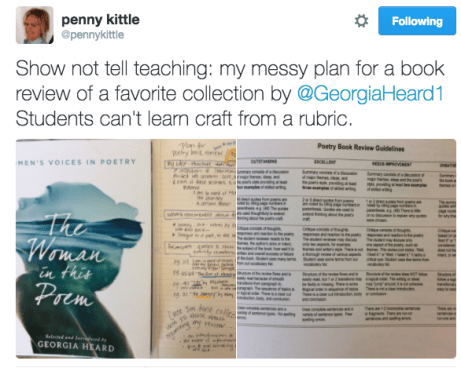
At the end of the unit, don’t destroy all of your hard work by trying to “grade” everything objectively with a rubric.  Our beautiful mentor Penny Kittle sums that up nicely:

Screen Shot 2016-11-14 at 10.06.44 AM.png

When best drafts land on your desk, ask:  how do I know students achieved what I wanted them to?  Utilize self-assessments, celebrate the writing, respond authentically.  Consider how each student advanced individually.

Our students deserve high quality instruction that offers them choice, volume, and authenticity.  They deserve units that will allow them to continue to build on their constantly-increasing mastery of their reading and writing skills.

I’ll be sharing more about planning units in an Ignite Session on Saturday morning, from 9:30-10:45, in room A412.  

And I’ll discuss how and why to build rigor into your workshop units in more depth on Sunday afternoon, from 1:30-2:45, in room B211.

Will you be at NCTE?  Please let us know in the comments.  We would love to meet you!

If you can’t make it to Atlanta, you won’t be missing out–tune in to Twitter using the hashtag #NCTE16 during our session times to join the conversation.


Try it Tuesday: Partnering Up for Reading Conferences

Sometimes inspiration strikes at the most opportune times.

One day last week I had the honor of hosting two small groups of teachers from a different high school as they observed my classroom, one class period in the morning and another in the afternoon. Many of the teachers on their campus have been exploring and practicing with the workshop model for a while now, and they wanted to see my workshop classroom in action.

After each lesson, we met to debrief and hold a kind of question and answer session. Talk about an awesome experience (except for the voice in my head that kept saying “When did you become the expert on workshop? Yikes.)

I think one of the best things we can do as teachers is invite others into our rooms to watch us teach. Talk about keeping on the A Game. That’s a Try it Tuesday suggestion all in itself.

Here’s another one:

During one of those debriefs, one teacher asked about the conferences I conducted as my students read for the first 15 minutes of class. “What questions did you ask?

I explained that it depends on the student.

If I go with “How’s it going?”

My students answer, “Fine.”

If I go with “What are you thinking?”

My students answer, “Nothing.”

So I usually lead with “Tell me a little something about …will ya?” And then I listen to see what direction the conference might take.

That’s pretty much the genesis of every conference with my readers.

Another teacher mentioned that she and a colleague had been thinking about asking students to bring a question, thought, or problem to their reading conferences. You know, kind of like we ask students to do when we meet with them about writing. I’d never thought about it for a quick reading conference though. She wanted to know if I thought it was a good idea.

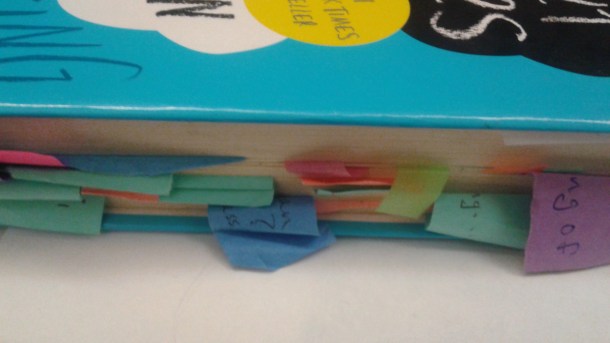
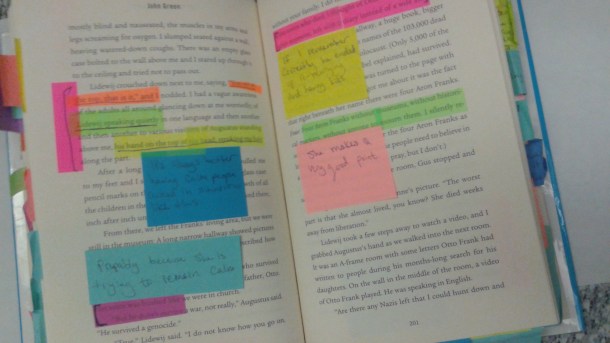
The image of this book came into my head. I found this copy of The Fault in Our Stars at a thrift store. It looked just like this:  plastered with sticky notes that reflect the student’s thinking. Now, I have no idea why this book is tattooed with notes, but I can imagine a not-so-great idea.

tfiosmarkup2tfiosmarkup

I hope a teacher didn’t assign this book and ask students to bring ideas to a reading conference. If that happened, I doubt this student got into reading flow. I doubt this student enjoyed this lovely, heart-wrenching book. I doubt she felt the beauty of the language and felt the loss of a beloved character. Maybe all that happened, but it wouldn’t have happened for me.

I want my students to love to read. I think we have to be careful with what we ask them to do with their independent reading books besides fall in love with the story and the language. Sure, they may recognize craft, they may recognize characterization. But the important thing is that they recognize that they are liking to read. That is so important to so many of my readers. They have to realize they like reading.

I do believe we can, and should, ask students to revisit passages — and maybe even the whole of a book — from time to time, even quite often. We can teach many important reading and writing skills that way, but we have to temper our desire to teach a book to death, even the books students choose to read themselves.

What I told my inquiring friend:  What if before independent reading time, on any given day, we ask students to read for a specific purpose.

Read to find interesting figurative language. Read to notice clever imagery. Read to discover how the writer shares an insight about a character. Read to find a beautiful or startling sentence. Or maybe a sentence that’s not really a sentence.

fabian

Fabian before class sharing his awe at the writing style of Jonathan Safron Foer in Extremely Loud & Incredibly Close

Isn’t this what readers do? I do. When I read a passage that strikes me in some way I want to share it. And let me tell you:  When my students start to do this on their own? That’s celebration time.

“What about the student who cannot find anything to share?” you might ask.

Well, that’s important information, isn’t it? I don’t know, maybe like the kind we might discover in a one-on-one reading conference.

Right?

I’d love to know your thoughts on this. What ideas do you have that work for your reading conferences? Please share in the comments.

Big thanks and shout out to @Sean_G_Hood and @mrs_friend and the inspiring teachers at Hebron High School!


Try It Tuesday: Cite the Research that Drives Your Practice

In a session at the NTCTELA Conference a couple of weeks ago, Cris Tovani began her session asking us to reflect on this statement:  I can site the research that supports the beliefs that drive my practice. This got me thinking — not just about Cris’ inspiring session but about how we make decisions regarding the best practices we bring into our classrooms.

Do we have research that supports the moves we make as we teach our students to become better readers and writers?

It’s an important question. And for those of us who instruct via  readers and writers workshop, the research can be a powerful motivator to keep doing what we know works for our kids.

My favorite go-to research? The article by Richard Allington and Rachael Gabriel: Every Child, Every Day. They outline six easy-to-implement essentials to effective reading instruction — and learning to teach reading is not something I got much of in my education classes to become a high school English teacher. But many high school students still need help learning how to read, especially my ELL population. Every English teacher can implement these six essentials.

If you’ve never read Every Child, Every Day, I challenge you to read it. If you haven’t read it in awhile, I challenge you to read it again. Then, give yourself a quiz:  Does this research support the moves you make as you teach your students to become better readers and writers? If not, what will you do about it?

The resources at the end of the article can lead us down a rabbit hole but not take us on a goose chase. These researchers provide us with important information:  We can read about effective practices and then bring those practices into our classrooms. We can share these articles with colleagues and administrators with the hope of garnering more support for instructional practices that our best for our students — and proven to work.

If you’ve ever wondered why student reading engagement and success begin to wane as kids begin to enter middle school, read You Can’t Learn Much from Books You Can’t Read, another text by Allington.

If you teach in a low SES school like I do, you may find “The Early Catastrophe: the 30 Million Word Gap by Age 3” by Betty Hart and Todd R. Risley interesting. It’s a popular read. It might spark some thinking as to why so many of our students read far below grade level — and give you a poke in the gut to do more about child poverty.

Then, because the validity of that article sparked lots of commentary by other educators who wrote other research articles, spend some time reading “Debunking the Word Gap.” (Aha and Aha. And lots of validation for my practice. Choice and voice matter!)

If you don’t follow the blog of Paul Thomas, The Becoming Radical, you may want to. Thomas gets me thinking with everything he writes. I especially appreciate his post of yesterday: “To High School English Teachers (And All Teachers).” (Where I found the Debunking article and so much more and had to update this original post.)

Remember that rabbit hole?  I read every link Thomas shares and added to my research storehouse, tweeting links to colleagues, and I found a text by Ralph Ellison I’ll use with my AP Lang class in the fall. Bonus.

Of course, if you really want to explore and extrapolate, look up the articles Penny Kittle cites in Book Love or Donalyn Miller cites in The Book Whisperer or any other of your favorite teacher-leaders cite in their books.

It’s summer. Time to enjoy a little (not so light) reading. I promise, the research is worth it!

Please leave your suggestions for other insightful research articles in the comments.

Finding Solace in our Students

IMG_2666

End of the year pics with friends and books.

The shooting in Orlando this weekend has weighed heavily on my mind for the past few days; it has settled into the back of my brain, penetrating my thoughts whenever I get a moment to rest between the hectic last days of school.  While I only know victims through six degrees of separation, I can’t help but see the images of friends, family, and students in the 49 faces of those murdered.

I’m not sure if it is the lockdown drills at school that make these tragedies feel all the more chilling and real, or if it’s the targeting of LGBTQ+ populations when I, oftentimes for the first time, watch young people finding their true identities in my classroom, but this time I feel nauseous and weak and powerless.

To think that this is the world my students are graduating into and growing up in, is frightening.

But as I scrolled through the profiles of the deceased, I found a statement from the father of victim Mercedez Flores.  He wrote, “We must all come together, we must all be at peace, we must all love each other, because this hatred cannot continue for the rest of our lives.”  That is what the workshop classroom allows me to share with my students—a corner of this peace and love.  It opens a door for me to connect with them on a personal level, allowing them to find not only acceptance but also stories, understanding, and success in their books.  Allowing them to open up to new literature and explore themselves as a reader sends the message that I not only value them as learners, but I value them as diverse people with a wide variety of needs, curiosities, and interests.  This avenue may only be minor, but in the wake of all the hatred and fear, I hope my classroom is a respite from the world.  A place where students can learn to at least respect one another’s differences without judgment or condescension, a place where we can explore the difficult themes and navigate challenging conversations in safety.

IMG_2693Everyday gives me a little more hope that this next generation has begun thinking about the innumerable struggles they will have to face.  As one of my students wrote about the universality of To Kill A Mockingbird, “For an innocent man to be found guilty is a miscarriage of justice, but for an innocent man to be found guilty for being black is a result of bigotry and prejudice, and shouldn’t happen…Sadly, as seen with Trayvon Martin, Mike Brown, and others, racism still does exist in this country. To Kill A Mockingbird is a constant reminder of how far we have come and how far left we still have to go when it comes to overcoming racism.”  Charlie’s words remind us that stories show us both the fallibility and overwhelming strength of the human condition.
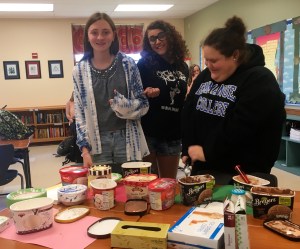
Yesterday morning, as I prepared for my last day of classes (we still have three more days of exams), I reminded myself that teaching allows me to model a life of acceptance and love, of caring and compassion, of concern and advocacy.  It may not be much in the general scheme of things, but it is the most productive way I can handle the tragedies our country continues to face.  Between cramming in grading and pulling together final assessments, I spent invaluable time writing notes to my classes, collecting ice cream toppings for our last day parties and signing the backs of photos of my students with the books they read this year.

The best part is that the love is returned as graduating seniors from years prior show

IMG_2701

Ice cream parties to finish up our yearlong adventure together.

up at my door to hug me good bye and have me sign their yearbooks.  College students visit to update me on their lives, current students voluntarily help me pack up my room, and former students spend their first summer afternoon organizing my bookshelves for future students.  For all the hate that exists in this world, there is far more kindness, far more compassion, and far more love.  I know because my students remind me of this every day.


#3TTWorkshop: End of the Year

Conversation Starter: What kinds of reflections do you have for your year? Let’s start with celebrations.

Amy:  Before I celebrate, let me say this:  I have two whole pages of notes written on the back covers of my writer’s notebooks with reminders of what to do new and differently next year. Why is it always easier to focus on the negatives that need improving versus the positives that worked well?

Lisa: This was a year of experimentation and excitement, and my celebrations come from student reflection and collegial collaboration. Our district has a clear vision that they want to move workshop from K-8 to K-12, so it was a year of exploration. Last year, workshop loomed. We had very little knowledge of what it would look like at the high school level, so I naturally…Googled. Having read Penny Kittle and talked with a few colleagues who were already embracing elements of workshop, I was excited. I loved the idea of choice and set about organizing some notes of “how to.” I knew, as department leader, I would be tasked with spearheading the shift with my colleagues, so I wanted to have some solid ideas of how best to proceed.

Original_5000If you Google “Readers workshop for high school English,” guess who comes up? Ta-da. I had found Three Teachers Talk. Specifically, Amy’s post with resources to make the move to workshop. I had struck gold. I read. And read, and read, and shared the blog with our literacy coach, and read, and started quoting sections of the blog and taking notes, and read some more. Real teachers, in real classrooms, with honest reflections on the work. I was elated.
Our district leaders moved forward, rolling out workshop with UBD training, visits to the middle school to see workshop in action, and reviews of Penny Kittle’s key principles. And while valuable and necessary for our progress as a department, it wasn’t until February when Amy and Shana came to Franklin, professionally developed us by teaching us in the workshop just as they would their own students, and let us experience workshop firsthand that workshop really took off. The department was excited. There was wild planning, replanning, reading, purchasing of books, collaborative meetings on the fly (five minute passing periods afford more than enough time for drive-by enthusiastim). And talk. So much talk. Though we weren’t expected to make the “official” move to workshop until next year, we were all trying new things (book talking, setting up writer’s notebooks, and shopping on thriftbooks.com), seeing incredible responses from students (readers spread out all over the building and students writing something, anything, every single day), and basically diving into the work to see what would help us float.

It hasn’t been easy, but as I wrote yesterday, the small (and for some of us BIG) moves we are making have us enthusiastic about what workshop will look like across our department. It’s been a great year to grow and see some incredible enthusiasm from students as choice changed their minds about the written word and its power.

The big takeaway from workshop this year? Do it. Now. You won’t regret it.

Shana:  This was a weird year for me, and I’m wistful.  I was just telling my mom that I feel like I barely taught this year, and I think I mostly feel that way because I didn’t have a firm end of the year (I was out on maternity leave from mid-April to the last day of school).  Instead of doing reflections alongside my students, studying their self-assessments and working with them on the year-end MGPs, learning from my own thinking and my reading of my students’ thoughts, I just…slowly drifted away from my classroom and saw most of my students for the last time at their graduation instead of for a celebratory last-day-of-school photo.  It made the end of my teaching career feel really nebulous.  I hated that.

But, there were lots of great things about this year.  I looped with my students, so I began the year knowing most of their likes and wants and needs already.  I was able to dive right back into helping some of my reluctant readers find new books, help my new students assimilate into a workshop culture more seamlessly, and leap into newer, more complex writing tasks with more confidence.  I loved that so many tenets of workshop were already norms in our classroom in September–book talks, conferences, notebooks, and just book love in general.  It was transformative to begin a school year without having to gain students’ trust with the workshop model, instead having the trust already established.

And my students did and wrote and created great things.  Carleen reassured me that workshop structures made her fall in love with reading again.  Jak showed me that having choice in reading helped him advance as a reader far further than any assigned text could have catapulted him.  Tyler showed me that even the most reluctant reader can fall in love with a complex classic.  And countless other kids helped me re-fall in love with reading and writing and teaching every day in my classroom, when they had miniature successes and failures and highs and lows.  I celebrate that act of falling in love with literacy all year long.

Amy: My biggest celebrations came in the form of one-on-one moments with students. I wrote about an experience with Diego previously. He ended up writing a well-constructed
and extremely personal multi-genre piece about his brother’s drug addiction. Our final conference was a powerful moment. Diego opened up about his love for music and showed me how to find his YouTube channel. He is a talented musician. His ability with poetic language suddenly made sense. I wish I had a do over with this talented young man.  I would have done things differently.

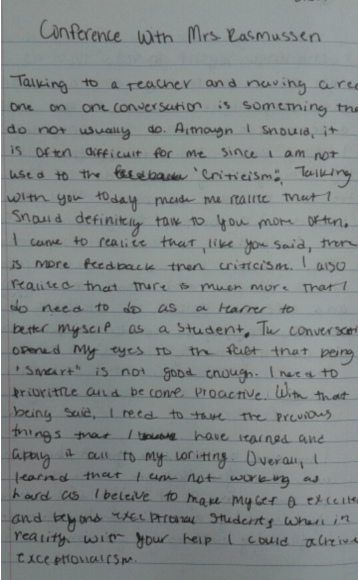
Another celebration came from a conference I had with Emerita in the spring. She was a Screen Shot 2016-06-07 at 9.10.40 PMtough student: smart, outgoing, talkative, eager — but she didn’t like that I wanted to
push her into writing even better, reading even better. We locked horns, and sometimes her silent attitude made me feel inept and out of sorts. (I know we shouldn’t take things personal, but I struggle with this. I want everyone to like me.) Finally, in a moment of
divine inspiration, I gave students to opportunity to do some extra credit. Anyone who wanted to improve their grade could research
the work of Carol Dweck on mindset and then write up an essay that answered specifics about the characteristics of Dweck’s work and how it relates to their attitudes in school. Emerita changed after that. She understood what I’d been trying to get her to see all along:  we can always work on our craft and improve. After our conference reviewing her extra credit essay, her work improved as did her attitude towards everything we did the rest of the year. I share a copy of her conferring notes here.

What are some things you know you want to do differently?

Amy:  Well, like I said, I have two pages of notes. Some of them relate to things I’ve done successfully in the past and just forgot to do this year like taking more time to allow students to decorate their writer’s notebooks. I’ve always allotted sufficient time for students to do this in class, but I didn’t this year, and as a result, I noticed quite early on that students did not have much attachment to their notebooks. They still represented “just another composition notebook for class” instead of a place to capture ideas and notes about themselves as writers. I’ve already got NOTEBOOKS clearly outlined on next year’s calendar.

I also need to be a better Reading Teacher. That might sound strange since I teach AP Lang, but many of my students struggle with reading, not to mention critical reading. I need to utilize strategies that will help them not only read more, which I already do quite well, but read better. I’m re-reading Cris Tovani’s books, and I will introduce Beers & Probst Notice and Note next year. I’ve used both in the past, but not with AP students. After two years in this position, I’ve learned that we’re going to need to practice some basic comprehension and some thematic work before we can go too far into rhetorical analysis.

Shana:  My hubby spilled an air freshener on my notebook yesterday, so from its ruined depths I’ve turned to my “teaching ideas galore” section for this question.  The first thing I’d like to shift into thinking about is ways to write or respond to reading nonlinguistically.  For years, much of my students’ writing was about reading.  Then I shifted away from that and toward making reading and writing activities independent and celebratory, while still asking what we could learn from one and apply to the other.  I’ve kind of gone back toward writing more about reading this year, but next year I’d like to see how we might tell stories through visuals, or write book reviews in doodles, or create collages to illustrate patterns in a text, or diagram similar story arcs across independent reading books.  I’ll be on the lookout for this theme during my summer reading of journals and books.

The obvious change I’ll be shifting to is toward working with preservice teachers rather than high school students.  Still, I’d like to keep many similar structures in place.  As Tom Romano began every class with two poems, I think it’d still be valuable to begin classes with two booktalks.  Writer’s notebooks are a must, as are things like book clubs, wide reading, and writing with an eye for mentor texts.  I’ll be asking myself, though, how to prepare a new generation of teachers for the wild world of high school learning.

Lisa: Give me a second, I need to gather the seven million post-it notes I have scattered across my existence and I can tell you the six million things I am ready to improve for next year (the other million notes are on books I want to read).  

One thing I am really looking forward to is the idea of total immersion. We’ve done a lot of standards based planning around this move to workshop, and I’m excited to blend the skills focus with the choice I’ve already dipped into.

I’m also excited about the creative aspect that Shana talked about above. While more and more skills based over the years, my instruction, up until recently, had really still focused on reading and then writing about that reading. Analysis is obviously important, but there are so many more authentic, thought-provoking, student-driven assessment tools and just plain exploratory modes of expression, that I really want to delve into. To think, I taught through a few years there where poetry was almost lost in my classroom. Thank goodness I rediscovered it for mentor work and had my students writing powerful verse over and over. What amazing modes discourse will I discover next year that I will eventually be appalled to have missed before? Geek alert. I am so excited to find out. 

Finally, better time management. A wonderful colleague of mine, Mrs. Leah Tindall (co-organizer of our high school’s incredible Literary Showcase) said of this year that we were stressing out because we were trying to balance new work with an old workload. This was so true. The work I need to be doing is talking with my students, reading with my students, getting organized enough to have conferences lead to more pointed minilesson work, and provide ongoing feedback that doesn’t require every extra minute of my existence to “grade.” Certainly, workshop is no easy way out in terms of time invested, but it’s time invested differently. Time invested with one-on-one feedback at the forefront and building our students up by our own examples as readers and writers. This certainly takes time, but it does so in a way that makes so much more of an impact than just red pen on paper. It’s honest communication. It’s investment. It’s caring.

I need to stop using reading time to take attendance, and get out there and confer with my students. I need to stop putting off the reorganization of my library, because really, how can I make solid recommendations if I can’t find the book I’m after? I need to stop providing the bulk of my feedback with a pen at all and start using my ears more – feedback after careful listening and reflection. That’s what I’m after next year. I want to hear my students talk from their hearts and their minds and on paper in ways my previous teaching didn’t account for. I can’t wait to hear all that they have to say.

Do you have topic ideas you would like us to discuss? Please leave your requests here