Category Archives: Readers Writers Workshop

To Confer is to Validate the Child

Question:  Do you have any tips or tricks for conferring for upper grade students

Answer:  Keep reading.

I love questions, especially questions about my practice and my passions. If you’ve been reading this blog for a while, you know that I’ve written quite a bit on conferring this past year. (Click the categories tab and go to conferring.)

Conferring with students is my on-going action research. He was the missing person in my workshop classroom for a long while. Then, he was the show-up-once-in-awhile, have a chat, and leave kind of guy. Later, he became a regular guest. Then, after my change and my constant focus, he finally moved in for good, and guess what? He transformed the learning in my classroom. i wish I would have invited him to stay much sooner. I missed a mountain of important talk time with my learners. Time I will never get back.

So, to answer the question I received in an email today, let me start with this:

Most of the strategies for younger grades work well for our older learners, too. Talk to elementary teachers. Use these experienced writing workshop teachers as a resource for your secondary writers workshop. They know how to talk to students, and we should follow their lead in many ways as we approach our writers.

Much of my study on workshop and conferring reveals similar approaches. I’ve found the work of Donald Graves, Nancie Atwell, Linda Reif, Penny Kittle and other workshop teachers rest on the same core principles of writing instruction:

1) students choosing what to write aboutt,

2) helping students discover ideas through writing,

3) talking to students regularly as writers,

4) modeling the struggle of writing,

5) using mentor texts to study the craft of writers.

Conferring fits into any and all of those principles, but it sits squarely at #3:  talking to students regularly as writers. This is different than talking to students about their writing.

So, I think the most important thing we have to do when we confer is validate the child as a writer (even if he is not a very good one — yet).

In his book Choice Words, Peter Johnston writes about the importance of helping students grow into the identity of readers and writers. In my experience teaching high school English, 9, 10, 11, on-level to AP Lang, most students do not put reader and writer as part of their identify. Few students will be successful readers and writers unless they do so.

This becomes my primary focus in conferences with my readers and writers: How can I help them have experiences where they can see themselves in these roles?

I find that getting students to talk to us about their thoughts, feelings, ideas, struggles, etc with their writing process is the same at every grade level. Perhaps the biggest difference is that teens do not always trust us like younger children tend to do — at least not at first. That is why validating positives with our writers has to come first — before any kind of one-on-one instruction. We have to remove fear and hesitancy. Let them write. Focus on what they do well.

This makes many red-penned teachers with a love of grammar crazy, but marking up a student’s paper is the worst kind of writing instruction — ever. We must respect the writer.

Today my friend and colleague Shana and I were discussing this very thing:

Conferring transforms differentiated instruction into individualized instruction.

So, as you think about conferring with adolescents, ask yourself:

How can I tap into the identity of the individual?

How can I help him see himself as a writer?

What writing experiences does he need to have to feel like he can be successful?

Start conferring there.

Dear reader, what are your thoughts on conferring? How do you answer my questions about conferring with adolescents?

 ©Amy Rasmussen, 2011 – 2015

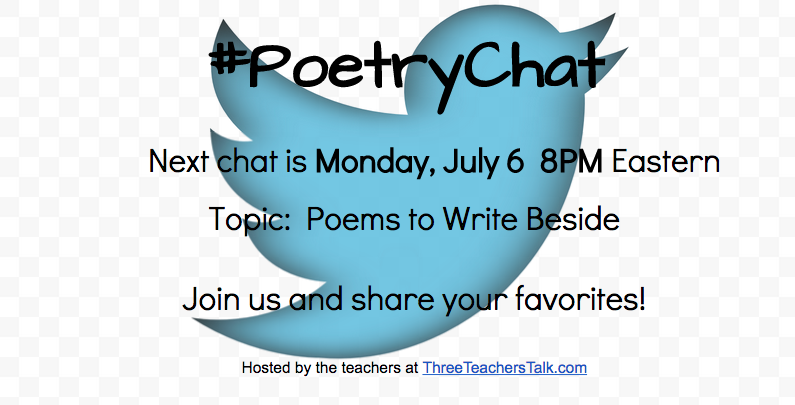
Poems to Write Beside is the Topic for #PoetryChat Monday, July 6, 2015 8ET

My friend posted a link on Facebook that took me to “Life While You Wait” by Wislawa Szymborska. I’d never read it before and loved it so much I stopped what I was doing so I could write it in my notebook. Then I wrote a page about why the poet reached into my heart this morning. That thinking led me to think about my mother who’s been gone over a year now. Bittersweet.

Then I explored a bit, and clicked the link that took me to “Possibilities,” and I pulled the cap off my pen again. I copied the poem in my journal as I listened to Amanda Palmer read it. then I wrote notes on how I might use this poem with my students. I could use it as a mentor text and ask students to write their own “Possibilities,” or I can use it the first week of school (maybe even the first day), and we’ll write a class poem. I like this idea best.

After we write a few lines together, I’ll give each student a line, maybe two, and ask him to think about what the poet does with language there: compare and contrast, advice, internal rhyme, repetition, personification, etc. Then, they will write their own lines, modeled after the poet’s.

We’ll piece our lines together and see what we come up with. Collaborative-type writing on the first day of school…with a poem. Might set the tone for the school year quite nicely.

My simple act of writing beside poetry gifted me with emotion and ideas this morning.

There are a million other ways that poems can bless us with inspiration to write, think, learn, change, mature, grow. . . and teach. Join us for #poetrychat and give and receive.

Questions for our chat:

1. What are you writing this summer?

2. How does poetry inspire you to write?

3. Who is your favorite poet to turn to for inspiration? or what is your favorite poem?

4. What poems inspire your students to write? Any no fail poems out there?

5. Please share links to your own poems and/or other writing.

Screen Shot 2015-07-02 at 3.18.41 PM

Wrapping up with book trailers

After a slew of snow days and an extended year that pushed the end of school into the second-to-last week of June, my students’ motivation lagged as we approached our final month together. They needed an engaging project that still proved to be challenging and fun. Inspired by Amy’s work, my students and I celebrated the end of the reader’s workshop with a final book trailer project.

The process was organic; students latched onto the idea of watching mentor texts and dissecting the craft to gain a firmer understanding of the writing genre. Over the course of a few days, we analyzed and discussed the differences between the book and movie trailers for John Green’s upcoming film Paper Towns, a class favorite. We combed through countless examples of professional book trailers, dissecting the craft of the films and looking at the cinematography, hook, pacing, script, music, and scene choices. Finally, after brainstorming and storyboarding, students used Stupeflix, WeVideo, Puppet Edu, or iMovie to generate stunning book trailers. The results blew me away.  Here is a small sample of some of the trailers I’ll be using to supplement my book talks next year.

**Make sure to unmute the video. In some cases, the sound doesn’t automatically play.

The Boys in the Boat by Daniel James Brown–Created by Matt

http://https://www.wevideo.com/hub#media/ci/410328553

Perfect by Ellen Hopkins–Created by Emily

Missing Pieces by Meredith Tate–Created by Alyssa

Looking for Alaska by John Green–Created by Tristan

There are years of innovation and then there are years of transformation

1506480_10102034229280020_1983828873_n

Emma was sunshine personified. She was salty hair and smiles and surfing. She was the student who sat in the front row, the one who showed up early to class just to chat. Emma died this past September in a car accident, one day after I revised her college essay, one day after she told me “one more concussion and I’ll be dead,” one day after she laughed off my nervous, “Be careful!”

When I first hear the news, I had been given the wrong students’ name, and I am ashamed to admit that for a moment I selfishly breathed a sigh of relief. But then her picture loaded, the pixelated image appeared line by line on my smartphone, her sandy blonde hair and smile, flashing section by section and I fell apart alone in my living room at 6:30am.

That was only the beginning.

Quickly students began unraveling. I am a second year teacher, a relative novice in the education world, yet I feel like I have lived a thousand lives. Had you asked me to reflect on my world after my first year, I would have peppered you with stories of passionate readers and personal successes, comedic performances of Macbeth, and classes that became family.

This year was different.

The questions weren’t the same, and while my first year had its own challenges, my second year was consumed with worst case scenarios. How was I supposed to deal with my seventeen-year-old students’ funeral? Where should I go when my student has an anxiety-induced nervous breakdown in the middle of class? How do I respond when my entire class just watched their classmate carried out in handcuffs? Or punched in the face in the middle of class? Or attacked by another student with psychiatric disorders and no impulse control? What do I do when my student disappears after being threatened with gang violence? Or because they attempted suicide? And these were only a handful of questions that I dealt with.

I have learned that there are years of innovation and then there are years of transformation. This was my year of transformation. No workshop or course could have prepared me to deal with the needs of my students this year. From them, I have learned unconditional commitment as a teacher. I have defended the rights of my students to remain in my classroom despite their disabilities. I have learned the value of opening my classroom as a safe space for those who have no place to go, whether that is at 7:00am or 4:30pm, to chat or just to read silently away from the prying eyes of peers. I have learned the value of openly modeling enthusiasm and empathy, of thanking them for filling my days with humor and love. I have learned the value of showing them that their words matter—that I will get their friend help immediately, that I will notice their change in disposition and book them an appointment with the school case worker, that I will sit with them in silence if that’s what they need.

I have a week-and-a-half left with my students, and while this year has saturated every ounce of my being, I will enter summer both as a stronger teacher and individual. As always, the end of our journey together is bittersweet, maybe even more so this year after the amount of time and personal energy I have invested into my students’ well being and success. This summer, I will delve into new novels and make lists of new lesson plans. I’ll attend multiple courses and collaborate on curriculum development, but I won’t forget that at the heart of my job is compassion. I can only hope that my students learn as much from me as I learn from them.

Good Writing Moves Us — THIS Writing Moves US

I want to include you in a celebration of the work of a student that represents several of my kids this year. If you teach, or have taught, ELL students, I know you will understand.

The last assignment was an intensive writing piece that we workshopped for about seven weeks. Writing in class almost daily, conferring regularly, and mini-lessons with mentor texts and modeling served as the routine. Students turned in their writing in three separate chunks, gave one another feedback at least three times, presented their final pieces (published on their personal blogs) as their semester exams. Formative assessments were student writing conferences and the checkpoints along the way. Summative assessments were a self-evaluation and a self-evaluation paired with my feedback from a rubric we crafted as a class.

Biak with the book she loved the most this year. She read 12.

Please read the writing of Biak Par. The poems are original, and the story is her own. Just before school was out, I had to call Biak to my desk and let her know that she failed the state English II EOC. Again. That was nothing short of heartbreaking — for both of us.

Take several minutes and read Biak’s story. You will read the words of an improving and authentic writer. These words are elegant, poignant, and powerful. Good writing moves us — this writing moves us. 

Now, take a look at Biak’s writing from the beginning of the year— her first blog post is here, and her second is here.

Now, think about her end-of-year piece of writing. I know it is narrative, but you will note what I do — improvement. So much improvement. Voice, coherence, organization.

I wish I had another year with Biak, and several of her friends. We’ve come so far, and this is the work she should be allowed to celebrate — not a test score.

I know — preaching to the choir.

©Amy Rasmussen, 2011 – 2015

#ShelfieShare – Growing Your Library

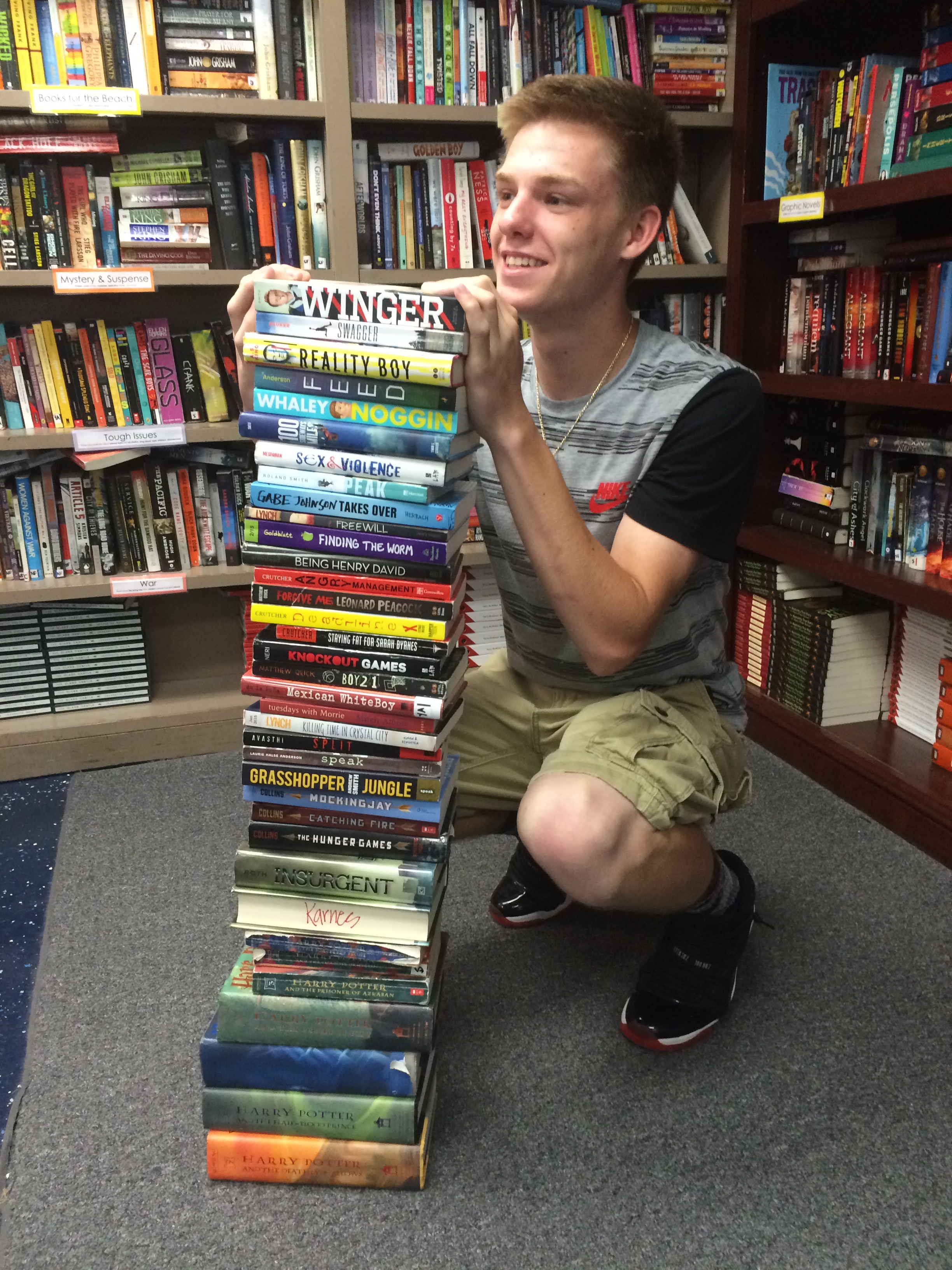
FullSizeRender[1]Yesterday was our last real day of school, and it was a busy one.  My students spent our last class periods together sharing their final multigenre writings with one another, clearing out their writing portfolios, and packing up their notebooks.

They also flooded me with classroom library books and sheepish smiles.

“Sorry,” Riley said, as she entered my classroom with a shopping bag full of books.  “I didn’t realize I had like 12 of your books at home.”

“I opened a cabinet and found like 20 of your books!” Emily said.

“If I bring back all your books, can I borrow like five for the summer?” Jordan asked.

“I found The Book Thief and almost just kept it, for the irony,” Hailey explained.

Now that all the books that are usually on kitchen tables, under beds, and piling on nightstands have begun to find their way back onto my bookshelves, things are looking a little crowded:

FullSizeRender

The five bookshelves in my classroom are mostly full of independent reading books–a class set of literature and grammar books, dictionaries, and book club collections provided by my department find their homes on the bottom shelves, but everything else has been a labor of love to build on my own.

FullSizeRender[4]I began building my library six years ago, and started with anything I could find at Half-Price Books.  I spent $20 a month in the clearance section, netting $1-2 finds that built my sci-fi and YA sections, and used my staff ID to get an extra 10% off.  During the holidays, HPB ran promotions for free $5 or $10 gift cards with the purchase of a $25 gift card, and I took advantage of those aggressively.

Next, I discovered Barnes & Noble‘s very generous 25% teacher discount, and shopped mainly in their clearance section, which was always well stocked with “former bestsellers.”  This was perfect, as a book had been out just long enough to generate buzz among my students.  I became a bit of a regular there, and began to ask the manager if he had any damaged, extra, or reject books he didn’t want.  He obliged, providing me with class sets of The Perks of Being a WallflowerWaiting to Exhale, and Tuesdays with Morrie–totally gratis.  I also got lots of hardcover books that were being replaced by paperback editions, again, for free.

Next, I discovered the generosity of my school’s PTA, which granted teachers up to $100 per year in classroom supplies.  Every year, my $100 was spent at Wal-Mart, Half-Price Books, or any other purveyor of cheap books.

FullSizeRender[3]By the time the summer of 2013 rolled around, my library was in decent shape–I had about 800 books, mostly paperback, mostly YA and general fiction.  I traveled to New Hampshire to take Penny Kittle’s course about informational writing, and fell in love with nonfiction.  I also met my amazing friends Amy, Jackie, Erika, and Emily, who told me about DonorsChoose.  I created, and funded, several projects–especially ones that helped me get lots of nonfiction–right away, which increased the number of books in my library up to about 2,000–all without a dime of my own money.

I also created DonorsChoose projects that were funded every October by U.S. Cellular, a partner of DonorsChoose.  Depending on your state, big businesses or even celebrities may fund your existing projects of up to $1000.  I used this partnership to fund two $1000 grants, growing my library up to about 3,000 books.

FullSizeRender[2]For my next brainstorm, I began to write letters to local big-box businesses, asking for donations of gift cards to purchase books.  Target, Sam’s Club, Kroger, and Wal-Mart all granted me gift cards, nearly monthly, of up to $50 per month.  Target in particular was wonderful, as their website offers a wide variety of books, especially great nonfiction finds, and free shipping on purchases of $50 or more.

When I finally got an iPhone in October of 2014, I joined Instagram and followed lots of bookish accounts.  Through these book fanatics, I learned about Book Depository, which offers discounted books with free shipping to anywhere in the world; Books-a-Million, which has a wonderful bargain section and an awesome used books market; and the glorious world of GoodReads giveaways, where free ARCs can be won by one and all.

This summer, I’ll take a week of rest, then begin to write book donation request letters, a DonorsChoose grant, and a variety of Morgantown-specific grants.  I’ll focus on replacing lost or stolen books, getting newly-paperback titles, and building shelves I think are a little weak.  I hope you’ll use this slew of resources to build your library, and your readers’ choices, too!

What are your favorite strategies for building your library?

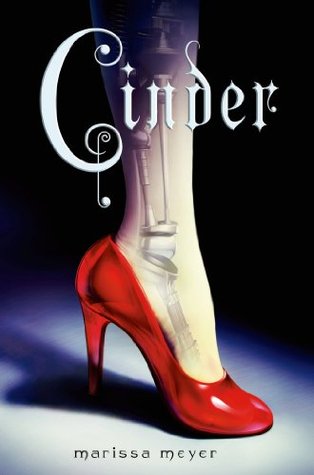
Cinder by Marissa Meyer

cinder

“Even in the future, the story begins with Once Upon a Time.”

Are you looking for a good old fashioned dystopian YA series to start your summer?

How about a modernization of a classic fairy tale?

Or, have you been craving a story about a cyborg mechanic, trying to avoid a plague, who’s got secret mental powers, a really crappy stepmother, and is actually a lost princess?

Well, if any or all of those books sound good to you, then look no further–this one will grant all your wishes.  Cinder by Marissa Meyer is book one of the Lunar Chronicles, a series incorporating futuristic versions of Cinderella, Little Red Riding Hood, Rapunzel, and more.  But it’s not just a book that retells a classic fairy tale–my boy readers love it too, because Cinder is a mechanic who works on androids in a post-WWIII future.  Complete with hovercrafts, bizarre medical technology, and sinister political plots, this story really has it all.

“But if there was one thing she knew from years as a mechanic, it was that some stains never came out.”

As a narrator, Cinder is complex, likable, sarcastic, and the embodiment of different.  In her society, cyborgs are considered less than human, and she battles this stereotype throughout the story.  Still, she responds to her critics with dry humor that made me guffaw as I read, and an unapologetic bent that made me know she’d be a great role model for my students.  Cinder defies convention in every way–a female mechanic, a plain princess, a cyborg in a human society–and yet her bioelectric backbone keeps her standing tall through it all.  I truly fell in love with her character by the heartbreaking, humiliating end of this first book, and immediately ordered the next two on Amazon.

“It is easier to trick others into perceiving you as beautiful if you can convince yourself you are beautiful. But mirrors have an uncanny way of telling the truth.”

Marissa Meyer crafts an incredible, fascinating future in the Lunar Chronicles, and writes with a style and flair that lend personality to the dystopian drama that unfolds in this series.  I highly recommend Cinder and its sequels for the science fiction shelf of your classroom library–scoop it up to enjoy before the magic wears off at midnight!

A Yearlong Community

The sense of camaraderie and fellowship in our workshop classroom has ebbed and flowed this year.  Some days, I watch with pride as the readers and writers in the room help guide each other to a higher level of understanding, appreciation, or excitement.  Other days, I see disengaged students annoyed with one another’s antics.

Getting this community established at the beginning of the year takes time, but once the foundation is laid, it’s easy to keep it in place.

…Until you have 15 snow days in a row.

Or a student teacher.

Or a six-day block of testing.

Or 75-degree weather with sunshine, just out the window.

All of those common interruptions can derail a classroom community.  This year, though, I feel as close to my students as ever, and they are as tight-knit a group as can be.  Here are four reasons why.

Passion.  I’ve written before about how fangirling helps create a community of readers.  But it’s not just being excited about books that helps a classroom community develop–it’s passion about the work we do here as a whole.

Jordan, a student who joined our class in September, told me yesterday, “I still remember the first time I came to this school.  Yours was the first class I came into.  You were yelling and all excited and stuff.  I thought, ‘Wow, is this how this school is?’  Then I went to the rest of my classes and I was like, awww, where’s the excitement at?”

The passion I brought to teaching stuck with Jordan for nine months, especially when he contrasted it to his other teachers’. Communicating our genuine excitement to our students models for them the lasting value of our content.  Without that enthusiasm, a classroom community may not seem worth building.  With it, students come to class ready to learn, which creates the first condition for a strong community.

Vulnerability.  Around my birthday in early September of each year, I share with my students a song my friend Joey wrote and recorded for me.  About a month after he gave it to me, he passed away.  I play the song for the students and we write, then, the soundtrack of our lives–which song it would be and why.  I write about Joey, my guilt and sadness over his suicide, how I slept with the lights on for months after his death.

Chelsea recently told me that at first, she wasn’t quite sure about me.  “Then you wrote that piece with us about your friend Joey, and that’s when I started to think differently about you.”  Modeling my vulnerability with my students encouraged them to do the same–they began to write about topics they once considered very private, and to share their writing in small groups, which I rotate monthly.

Sharing this story with my students, crafting and refining it alongside them, modeled for them not just vulnerability, but the writing process when it relates to a difficult subject.  I became, in their eyes, not just a model writer–but a model thinker, with emotions and difficult memories just like them.  Shifting from not just an English geek to a real human is the second condition for a strong community.

Guts.  This spring, I had a student teacher for eight weeks.  When she left, state testing began almost immediately.  After those two lengthy periods of disruption to our established routine, my students were sluggish and disinterested–frequently unprepared for class, slacking off on their reading, unenthused about their final multigenre projects.

Then, I shared with them my own multigenre piece for this year, about the miscarriage I suffered on Mother’s Day.  As I showed them my writing, the classroom became eerily quiet.  The stillness and silence was deafening.  After lots of hugging and passing around of tissues, the students worked with energy and reverence on their own writing once again.  Their enthusiasm was back.

“I thought it was cool that you would put that out there for the students to know,” Madison told me the next morning. “I was shocked that you wrote about it.”  The fact that I not only shared such a tough subject with them, but had the guts to write about it, was powerful.  This gave many students the boost of confidence they needed to confront a difficult issue and create beautiful writing about it–the third condition for keeping that sense of community strong right up to June.

DSC_7929

Two of my funniest students, Troy and Logan, smirk at me over lunch.

Humor.  We’re not morose all the time–we have lots of fun.  Whether it’s a humorous booktalk, a funny poem, or just a celebration of a student’s silliness, there is lots of laughter in our classroom.

A small whiteboard on one wall of our classroom is full of quotes that have made us laugh.  A word like “clementime” can crack us all up, remembering when Troy bemoaned the book Columbine‘s length but accidentally said, “Oh boy, Clementine, here we go.”  Or “overalls,” which calls to mind Kristen’s claim that “I woke up, put on my overalls, and everything just got really weird.”  These simple one-word phrases memorialized on the whiteboard can bring a smile to our faces when we need a lift, and remind me that my students aren’t just learners–they’re people, and pretty darn cool ones, too.

Talk.  Talk is such a foundation of workshop, but it’s important to talk outside of conferences, small groups, or minilessons.  Isaac, a student who has struggled with academic success in the past, has been sitting in my room during his lunch period all this month, working on his multigenre paper.  He chats at me as he writes, asking whatever questions come to mind, writing-related or not.  As a result, he is soaring.

“This is probably the first project in school I’ve ever worked this hard on,” Isaac keeps telling me. “This project is so awesome.”  I told our principal how hard he’d been working lately, and he complimented Isaac when he saw him in the hall.

“Oh my god, I can’t believe teachers talk about students outside of class!” Isaac exclaimed later.  I could tell by his little smile that he was secretly pleased that we had said nice things about him.  Talk has an impact far beyond its transient initial utterance.

Passion, vulnerability, guts, humor, and talk–all year long–make for a beautiful classroom community I’ll enjoy ending this year with.  What do you do to keep your learners unified?

What I Didn’t Teach This Year

The end of the year is upon us (finally!), and I’ve been reflecting as I always do.  This year, though, I’m thinking about something I’ve rarely considered before–not just what I taught, what worked, or what I want to do next year.  I’m thinking about all the things I didn’t teach this year.

There are 180 precious days in a school year, and the way my school is structured means I spend 90 days with each set of students.  That seems so fast.  There was no time to waste, so here’s what I didn’t fill that time with:

FullSizeRender

As Sabra stepped up for her reading ladder picture, she said, “This is pretty good for someone who didn’t finish a book until your class!”

Whole class novels.  This was a controversial choice for me, given that I love so many authors of American literature–Mark Twain, Walt Whitman, Nathaniel Hawthorne, etc.  But, no matter what novels I’ve chosen in the past, there’s always a student that book isn’t right for.  Fahrenheit 451, The Absolutely True Diary of a Part Time Indian, The Glass Castle, Maus–none of them is a perfect match for every child.  I’ve used a wide variety of strategies to get students to be able to read those books, and every ounce of passion I can muster to get them to want to read those books, but still–students have been conditioned to not read, to just get on SparkNotes, or ask an older sibling, or use Wikipedia.  When the stacks of matching novels come out, groans abound and engagement tangibly disappears.  I’ve seen this.  I’ve battled it.  No more.

So, I scratched whole class novels altogether.  Students worked in book club groups twice, and engaged in independent reading challenges two other times.  We read tons of short stories, articles, essays, and middle-length writings together.  But we didn’t read a single whole-class novel, and my readers still thrived.

IMG_8294

“I found myself as a reader this year,” Jordan writes.

Did my students grow as readers this year?  Yes.  I watched students who hated reading come to love it.  I watched students who couldn’t read well at all increase their stamina, passion, and skills related to reading.  I watched students who were good readers but bored with books fall in love with nonfiction, poetry, graphic novels, or award winners as they discovered new genres.  I watched students who loved to read flourish and challenge themselves with complex texts and childhood favorites alike.  Most of all, I watched a community of real readers spring up in my classroom–students recommending books to one another, self-selecting books and keeping long to-read lists, telling me all about their finds at Barnes & Noble.  These readers have become truly independent.  “Now,” Taylor writes, “I think I can read anything that’s put in front of me…and enjoy it.”

FullSizeRender

Isaac performs a poem for Nathan on poem-in-your-pocket day.

A movie.  As I’ve walked the halls this last week or so, I hear the unmistakeable sounds of cinema from behind closed classroom doors and darkened rooms.  I have no doubt that students are watching relevant films–movie adaptations of Romeo and Juliet in English, Forrest Gump in History, etc.  But this year, I felt I had absolutely no extra time…there was SO MUCH I wanted to do!  I used to love showing O Brother Where Art Thou with The Odyssey, and my students really delved into the symbolism of both texts.  But this year, my SmartBoard was full of YouTube videos, slam poets, or the still, quiet images of a document camera showing some writing.

I didn’t have time to show a movie, but I also wasn’t pressured by the crush of hours of grading that usually prompted me to show films in the past.  I’ve taken Kelly Gallagher’s rule about student work to heart–students should be doing four times as much reading and writing as we could ever grade.  So, I’ve read and responded to about a quarter of my students’ work, and let self-evaluations, peer conferences, and notebook passes do the rest.

Most of what I taught last year.  Last year was great, don’t get me wrong–but this year, my students were a new batch.  They’re different kids than last year’s group, so the same things won’t work for them.  After seven years in teaching, I know that.  I didn’t waste time trying to figure that out…I just started fresh.  I know I’ll do the same thing next year…out with the old, and in with the new.

IMG_0054

Shailyn read almost all of my YA fiction, and wrote reviews about nearly every book for our school newspaper.

Tests or formal essays.  Tom Romano likes to call the typical English essay a “five-paragraph you-know-what,” and it truly is a dirty little assignment.  At an NWP workshop I attended, each teacher was asked to bring some samples of student writing.  All around me emerged typed, double-spaced, Times New Roman, size 12, thesis-at-the-end-of-the-first-paragraph essays.  From my own bag came photocopies of messy scrawls in notebooks, multimedia This I Believes, strongly-voiced commentaries, poetic musings developed from quickwrites, and lengthy, involved, multigenre research papers.  No two pieces looked alike, and they certainly looked nothing like most other teachers’ samples.

I’d be lying if I said I didn’t feel a faint nostalgia for my own high school days, when I took pride in being able to punch out a perfectly formatted five paragraph essay in just under an hour, and which made absolutely no sense but looked great, and which constantly netted me As.  But I listened to my neighbors rant about poorly integrated in-text citations and incoherent thesis statements, I dismissed that nostalgia and read my own students’ work for what truly matters–good writing, heart and soul on a page, and authenticity at work.  As my husband said when he saw me dwarfed behind a pile of multigenre papers to grade, “I could read some of those for you.” “You wouldn’t know what to look for,” I said.

“Good writing is just good writing,” he replied, and he is right.  As the year ends, my students are good writers and good readers–not all of them are great, and there are kids I feel I could’ve pushed harder, but all are certainly better than they were when the year began.  I’ll look forward to our last day of class, when I’ll gift them each a new composition notebook and a pile of classroom library books to read over summer…and to months beyond, when I get to hear their stories of summer literacy in the fall.

Resources to Make Your Move to Readers and Writers Workshop

When you believe in the power of the workshop classroom, research that supports it starts jumping at you like my dog when he sees me put on my running shoes. “Okay, Jag, give me a second. You can go with me.”

So when educators ask me for resources that support my Readers and Writers Workshop instruction, I am happy to share. Come, go with me — and bring all of your students!

Of course, a pretty good resource is Three Teachers Talk, right? The four of us who write here all practice this pedagogy in our unique classrooms in WV, NH, NY, and TX respectively. Erika wrote a great post of our Year in Review that reads like a highlight reel.

Of course, we have different teaching styles, but we all value specific things that never change in our practice:  choice, time, talking, reading, writing, conferring, modeling, sharing, publishing. I wrote about these 7 Moves in My Workshop Schedule recently.

Our presentation at NCTE last fall was all about starting and maintaining workshop in high school English classes. Jackie shared A Reader’s Workshop Starter Kit to Jumpstart the Process. Erika shared Landscape of Workshop: We Have Arrived. Shana shared Non-negotiables Across the Landscape of Workshop. And I shared The Landscape of Workshop in AP English.  (Our proposal for 2016 was not accepted, but we are mostly over the bitter and will keep advocating for RWW every chance we get.)

If you need research to back the why of readers and writers workshop in addition to what we might share in our posts, you might start with Donalyn Miller’s blog post: “I’ve Got Research. Yes, I Do. I’ve Got Research. How About You?” — Donalyn shares a list of articles and books that support why readers workshop is the best pedagogy for all students.

My colleagues and I believe the best book for secondary readers workshop is Book Love by Penny Kittle. Her argument for independent, choice reading resonated with me the moment I read it.

Donalyn Miller’s the Book Whisperer is another great resource for readers workshop. Although Donalyn taught middle school, many of the ideas she shares work with my AP English Language and Composition students.

For writers workshop, Write Beside Them, also by Penny, is my favorite. That is the book that changed me as an educator.

Another excellent resource for writers workshop is Learning Through Teaching by Don Murray. This is the most recent book Penny recommended to me to help with my own writing. Oh, boy, is it helping!

So, yes, please ask for resources. And if you are already a workshop believer, please share them. Every student I know will thank you.

Do you have resources you share that we might find valuable here at TTT? Please leave your thoughts in the comments.