Category Archives: Readers Writers Workshop

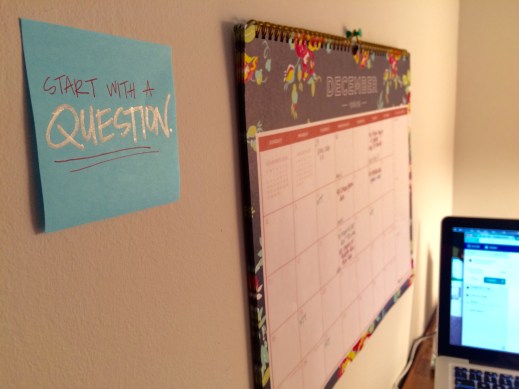
Start with a Question

“Questions are at the heart of it all.  Just start with the question.”

These were the first words I heard at NCTE, and they were from the mouth of our beautiful mentor, Penny Kittle.

Penny was opening a workshop honoring Tom Newkirk, a true beacon of hope in the sometimes desolate landscape of education.  A bevy of thinkers–Gretchen Bernabei, Ellin Keene, Tom Romano, Jeff Wilhelm, and more–spoke about the ways Tom Newkirk had helped them grow as teachers, thinkers, readers, and writers.

And you know what they all had in common?

Questions.

img_6078

Notes from Cornelius Minor’s portion of a session on equity in education

Ellin Keene, whose books were edited by Tom Newkirk, said that he never “wordsmithed” her writing.  Instead, he wrote questions in the margins.  She called him the “rare provocateur who asked questions because he genuinely wanted to know the answer.”

Jeff Wilhelm, who wrote book after book that was inspired by Newkirk’s work, said that he always found his book topics by lingering on a question he was wondering about.

Tom Romano framed Newkirk’s thinking in a “says who?!” style: the Common Core says narrative writing is for sissies?  Newkirk replies, “SAYS WHO?!” and writes Minds Made for Stories.

Vicki Boyd, Tom Newkirk’s editor and the general manager of Heinemann, said that Tom’s words led her to believe we should all “get curious about the stories that lead people to their stances and beliefs.”  We must ask questions to understand one another.

Questions prevailed as a theme: when speakers talked about their process for discovering their topics or planning their talks, questions were at the heart.  When I jotted something powerful in my notebook, it was usually a question.

img_6079

It’s not about the answers, I was starting to notice everyone saying. It’s about the questions.

Maybe we’ve known this for a while, and it just took some time for me to find the red thread of questions running through our work.

When I was planning for NCTE, I framed my thinking around questions.

Yesterday, Amy wished us “joy in the journey” in her post synthesizing her learning at NCTE.

I wrote about valuing process over product in this post.

Amy wrote about it back in 2013.

And apparently there’s a great new book out by Katherine Bomer called The Journey is Everything (sorry I missed that; it came out April 22, and I was busy having a baby right then…brb while I add it to my Amazon cart).

It is, apparently, about the journey, and the process, and the questions…not the finish, or the product, or the answers.

We spend so much time wondering how to get it right, when what’s important isn’t the getting it right part.  It’s the wondering.

And apparently I’ve known that all along, but I like to keep forgetting to keep questions at the heart of my thinking and teaching.

So, as we race toward the end of 2016, I will try to start with questions in everything I do: my talk with students, instructional design, grading, and even my ever-fluctuating educational philosophy.

I have the pleasure of being able to give only feedback, and no grades, on my students’ final projects for the semester.  These large-scale assessments are meant to go into their final portfolios that they’ll defend before graduating, so I am unencumbered by rubrics and numbers.  I’ll focus on the questions they ask, and ask them some of my own, as I read their work.

As I think about planning for next semester, I’ll wonder how I can get more students questioning themselves, one another, and all the many routines and philosophies they see around them.

And as I move forward with my writing here at TTT, I’ll remind myself, every time I sit down with my notebook:  start with a question.

img_6080

What questions are you asking? Please share in the comments. (Or ask some questions of your own!)

Team Right Now Literacy — Are you in?

I should have clicked the recorder app on. That was my thought as I left a session at NCTE presented by Kylene Beers, Pam Allyn, Ernest Morrell, and Kwame Alexander. I could not push my pen fast enough, and my notes are a mess. But their collective messages still echo in my mind a full week later.

My best buds already shared highlights from their #NCTE16 experiences. Shana calls for change, and Lisa gives thanks and speaks of passion. I am honored to call these educators friends. They are an integral part of why I am able to do what I do and teach the way I teach.

And so are educators like Kylene, Pam, Ernest, and Kwame. (Yes, I do believe first names are in order.) Their expert messages made me feel smarter, convinced me to write more and advocate louder, and validated the moves I’ve made in my career and in my classroom this fall. I revisited my notes and searched for all the resources they shared, and I share them with you here.

Their words are a mash up with mine in the pages of my notebook. I hope they will forgive me that my thinking and theirs blurs and blends in this blog post just like it does in my head, heart, and practice.

Here’s what I captured (and will return to again and again) from my favorite NCTE session, “Expert to Expert: The Joy & Power of Reading”:

I wrote:  “Find the quote on courage by Maya Angelou.” She spoke a lot about courage, screen-shot-2016-11-27-at-10-00-09-pmand I don’t remember if this is the quote shared, but it’s worth sharing anyway. It certainly relates.

Kwame:  references “Quilting the Black-eyed Pea” by Nikki Giovanni. We have to be able to find the hope, the power of language and literature, to find and share students’ voices. We need the courageousness to become more human.

Validation! For those of you in the Three Teachers Talk Facebook group, you may have seen the link to the resources I began collecting for the theme for my year, aptly named, Courageously Human. At the time, I thought this would make a nice unit. In reality, it’s become the theme for my year — and maybe the theme for the rest of my teaching life.

Ernest:  Courage is the willingness to take risks. Courage is maintaining self-love in a time of hatred. Right now it’s a time of belonging — and asking the question: “Who am I belonging with?”

Courage is not something you say but something you manifest.

Pam:  Teaching is social change. Courage is about optimism. Robert Frost said: “I never write about what I am  against. I write about what I am for.”

Kylene: shared a tender story of her father who stood up for desegregation with quiet and steady determination. “We just do what we need to do.”

What are you mustering courage for right now?

Kyleen quotes Kwame’s NY TImes article: “The mind of an adult begins in the imagination of a child.” If you haven’t read it, you’ll want to!

Kwame:  There’s this notion that we must bring literature to the poor, those in poverty, as if it will save them. This is true. But “the haves” need this, too! We have to make connections — to all kids on all sides. We also need to figure out how to keep all kids in the room — so many are “put out.” How is this helping?

Pam:  All the work of literacy is about story:  tell it, write it, share it. Loudly. Pam shares herstorycampaign.org and LitWorld. Her passion burns as brightly as the beauty of her message. Empower girls by giving voice to their stories. Open the Truth.

Literacy fuels what is already within.

Ernest:  On Critical Literacy. This must be empowering. How do we teach students to speak back to the book? We must bring multiple critical lenses to the text and read against the world. We need literary presencing:  all kids must see themselves in the books they read.

Enough with the marching. The real advocacy is in the classroom.

What kind of human dignity do we need to create in kids so they feel like they have a voice? 99.9% of what we do is based on the choices we make as educators.

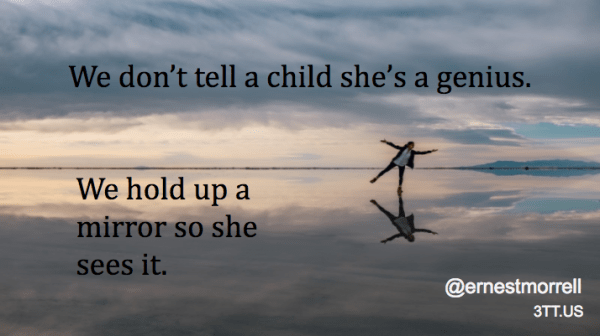
ErnestMorrell quote.png

Kylene:  We need a different way of reading and writing. We need transactional reading and writing — the research of Louise Rosenblatt. YES!

Kwame:  He reads a poem from Open a World of Possible and tells us the delightful news:  This poem is being made into a picture book in 2018.

Kylene asks the panel:  What type of reading should we be doing now?

Pam:  VORACIOUS. All kinds of texts all day long. We need to be immersed in a mash up of literacy.

pamallyn-quote

The read aloud should not only dwell in fiction. We think too much about the titles. Our students need all kinds of words — a mash up of so many things. The movement is a Celebration of Reading!

Ernest:  We are in a new classic movement in English Language Arts. It’s a need for right now literature.

We need students to read like writers. To read and share their own genius in production. Students should be reading each others’ works. They should be choosing their own books.

Let’s march for libraries and librarians!

Kwame:  Four books coming out next year:  Solo, a YA novel in verse; Out of Wonder, a picture book about poets; Animal Ark with National Geographic — will have haiku for each animal; The Playbook, 52 rules to aim, shoot, and score in the game of life.

Kylene:  Choice reading never begins with “What level are you?” Children are not levels.

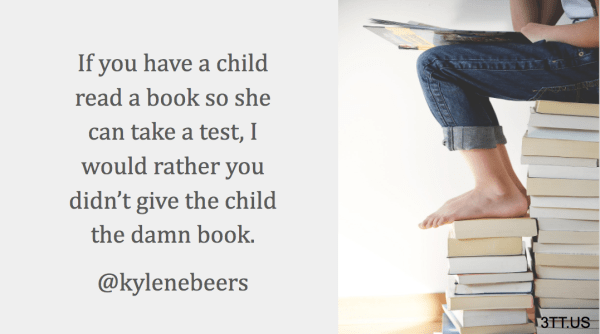
kylenebeers-quote

We have reduced literature to A, B or C.


I have a ton more thinking to do on all of this great thinking.

I’ll tell you this, my reader-friends, later that evening after an excellent afternoon of hearing other presenters, visiting booths at the exhibition hall, eating dinner with my TTT team, and trying to get my head wrapped around my own 15 minutes in a session the next day, I walked the mile to my hotel and sensed a glimmer of gold. I sat in the hotel bar (didn’t want to disturb my roommate) and wrote three pages of notes in my notebook — and maybe an outline for a book.

I’ll share that in another post.

Wishing you health and happiness as you move through this holiday season. May you find joy in the journey as you spread the love of literacy with young and old, far and wide.

Thank you for being a part of Team Right Now Literacy. Our children deserve to be literate in a startlingly illiterate world.

Amy


ftc-guideline-%22affiliate-links%22

Change is Good

Last week, I filled up more pages in my notebook in four days than I did in the last six months combined.

What the heck were you writing about, you ask?

Why, #NCTE16, of course.  The annual Mecca of English teachers, where we get to speak, listen, read, and write all about what we’re passionate about: students and learning.

I wrote down amazing ideas.

Pressing questions.

Inspiring quotes.

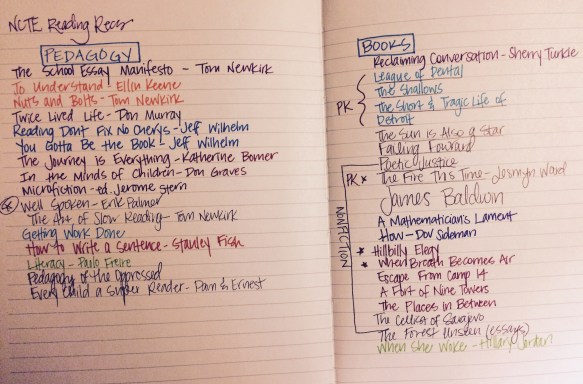
Endless book recommendations.

img_6042

I wrote down a lot of beauty and hope and happiness, but I also heard some scary things, and I wrote those down too.

Things like teachers reading To Kill a Mockingbird–OUT LOUD! THE WHOLE THING OUT LOUD!–to their classes over the course of eight weeks.

Things like spending six weeks on a memoir unit only to produce–wait for it–six-word memoirs, and nothing more.

Things like hearing Harvey Daniels questioning whether to let students talk with one another for fear that they’ll be too hard to quiet down.

raw

Aaauuuurrrrrrrggggghhhhhh.

I just read Peter Johnston’s Opening Minds, which centers on the philosophy of getting students into a dynamic frame of thinking–a mindset in which all things are changeable, and that nothing is static.  So, maybe I heard some things that troubled me about what’s going on in education in America, but if I think like Johnston wants me to, then I know we’re just not where we need to be…yet.

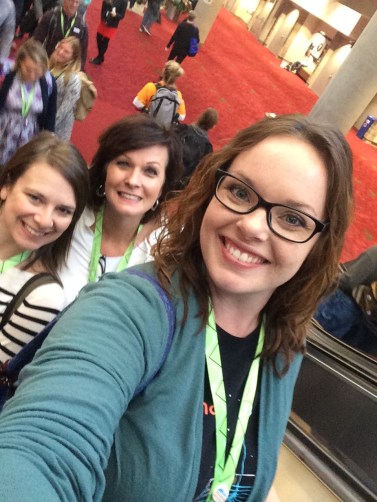
img_5964I talked with my writing friends about this.  Amy, Lisa, and I spent so many lovely hours together squeezing in conversation wherever possible–escalators, restaurants, hotel rooms, Ubers, the NCTE exhibit hall.  We thought, talked, wondered, worried, questioned, and quested.  We wrote down many pages of ideas for Three Teachers Talk.

In our conversation about those cringe-worthy teaching practices I overheard, we wondered this:  why are so many teachers afraid to change?  Why are we so glued to the ‘way we do school’ historically?  Why, when we brainstorm ideas, do we wonder what can go wrong instead of wondering what can go right?

Change is good, people!

We wondered–to reframe the thinking about what secondary English classrooms look like, what do teachers need?

We examined our own practices to answer this question.  We found that we each relied on four things to make decisions about the learning in our classrooms:

  1. Research-based best practices.
  2. Examples of other classrooms that look like ours.
  3. Specific strategies and assignments to try out.
  4. Conversations with like-minded friends about our ideas.

And we asked ourselves:  is Three Teachers Talk answering these questions?

Perhaps, incidentally, we were, but we wanted to be more deliberate.  So, we’ve made it our goal to approach those themes more regularly.

On Mondays, we’ll share our responses to the research we read, the quotes we hear from educators, or the ideas we have in our notebooks.

On Tuesdays, we’ll continue to share specific strategies, mini-lessons, and quickwrite ideas we’ve tried out.

On Wednesdays, we’ll converse together in a #3TTworkshop format and share writing from our friends in the form of guest posts to show a variety of perspectives on common ideas.

On Thursdays, we’ll share examples of what’s going on in our classrooms–stories about students, successes, failures.

We hope you’ll find our freshly-framed writing helpful and thought-provoking, just as we found the things we heard at NCTE to be.  Please join the conversation in comments, on our Facebook page, on Twitter, or via guest post.  We’d love to hear your voice!


Giving Thanks: NCTE 2016 and a Plate Full of Passion

The season is upon us, boys and girls. A time for calls to the Butterball Hotline (1-800-BUTTERBALL if you need it). A time to smile at Grandpa’s snoring after dinner. A time for gifts and giving and  possibly some figgy pudding.

After my first trip to the Annual NCTE conference, it’s also a time to be thankful.

It’s difficult for me to put into words how thankful I am for the opportunity to meet with and learn from so many amazing educators.

Amy, Shana, and Jackie, presenting with you was an incredible experience. Your passion and expertise around workshop is a gift that I will take back to my department as we continue our own workshop journey. Your believe in the power of choice, challenge, reading, writing, and speaking makes this shift in delivery easier and more rewarding each day.  ncte-1

Beyond our own presentation, the sessions we attended have my heart and mind bursting with enthusiasm for the work we do with kids. I am watching some of them read right now (I promise to confer in a moment) and the promise that they hold is the reason for all of this. NCTE 2016 refocused my attention on the core of my purpose in the classroom…to inspire connections. Connections to one another, to great texts, to authors, to the written word, to what they believe in.

As if that weren’t enough, the past few days has me thankful for:

Spending time with like-minded professionals.

My girl Shana Karnes introduced me to this phrasing over the weekend. Spending time with people who are pursuing a common goal is enriching, invigorating, and downright fun.

ncte-8My weekend started when I met Winifred as we were in line to pick up registration materials. One of the Coordinators for Special Education Services in Georgia, Winifred and I got to talking about her garden. She pulled out her phone and showed me a video of her abundant harvest and we talked about trips planned around picking your own food right off the tree/vine/stalk. She showed me pictures of her fiance, as she is getting married after being widowed for years, pictures of her grandchildren, and her salmon on the grill.

And then we talked about hope for the future (left turn). Using the opportunity of the weekend to fuel our hope around the power of education. Well, if Winifred’s passionate character is any indication of even half the educators this country employs, I have renewed hope too.

Then, this fangirl met some of the biggest names in education. Amy and Shana introduced me to Penny Kittle and Kelly Gallagher.

I sat between them at a table and had a cocktail. 

I repeat.

I casually chatted with Penny and Kelly (Can I say that? It feels weird), like I belonged there. Like I had anything of value to contribute to conversation.

And yet…once I got over my shock and awe at where I was sitting and who I was sitting with, Penny and I talked about the work I’m helping to lead in moving the Franklin High School English department to workshop. Kelly and I talked about the power of promoting educational philosophy and policy while still in the classroom, working each and every day with students in order to refine our own craft and reinforce our philosophies for the betterment of our kids.

When thought that benefits the advancement of students becomes purposeful practice, magical things can happen.

Maybe it was the Moscow Mule I was sipping, or maybe it was the fangirl phenomenon, but sitting with those great thinkers and discussing what’s best for kids, may be the professional development highlight of my career so far.

The Opportunity to Hear from Passionate Voices Who Support Our Work 

Over the course of the past several months, we have all dealt with division on a daily basis in a ways that feel intensified and frankly, frightening. Understandably, this is something many of our students have intensely felt too, some for a very long time.

During a session on Equality in Education, Cornelius Minor (who proclaimed himself a black nerd, but I think he might be one of the most powerfully tolerant and inspiring voices of our time – in fact, I hugged him after his session) suggested that it’s our job as educators to teach children how to “maintain partnerships” in order to “define our culture.” Among countless other profound and inspiring quotes from that session, this stuck with me.

My job as a teacher can be defined in countless ways: facilitator, psychologist, content specialist, reader, writer, engineer, surrogate mom, cheerleader, conflict resolution specialist, event coordinator, nurse, lesson planner, assessor, tour guide, bookkeeper, data systems specialist, actor, career counselor, bailiff.

But, at the moment, advocate is my personal goal. In my humble opinion, as teachers, we are charged with shaping the future (no small task), so the partnerships we build with students and the partnerships we help them create with one another, might be some of the very best work we can do to promote social change and unity.

I’ve long advocated for students to be readers and writers. In the workshop model, I’ve learned that choice and challenge are additional areas of advocacy I can promote.

However, teaching my students to advocate for themselves, as informed, collaborative, and responsible citizens is my most important task right now, and it starts with building partnerships that bring us together to work toward common goals of kindness, respect, and the respectful promotion of educated opinions.

The insights of incredible thinkers

Can I name drop, for a minute? Before I left for NCTE 2016, my best friend on the planet, and teaching neighbor Erin, congratulated me on Facebook for my upcoming speaking engagement at what she coined as the “Super Bowl of English teachers.”

It made me chuckle when I wrote it, because I think she might have been implying I’m super, but as it pertains to those that I heard speak at the convention, it was spot on.

ncte-last

I have a notebook filled with quotes from the likes of Jason Reynolds, Pam Allyn, Donalyn Miller, Kylene Beers, Kwame Alexander, Ernest Morrell, Tom Romano, Cornelius Minor, Penny Kittle, Kelly Gallagher, Amy Rasmussen, Shana Karnes, Jackie Catcher, and many, many more.

I will have to write more on these quotes. Dig into them. Flood my classroom with them. But here is a taste:

On issues with equality in education Cornelius Minor said,”It’s not the students that are disabled, it’s the curriculum.”

Speaking to our current national focus on division and divisiveness, Kwame Alexander said, “We [educators] have to be the manufacturers and purveyors of hope.”

Pam Allyn added, “Be vigilant and aware and active in defense of words that heal, not words that wound.”

Ernest Morrell incited that we must have students consider how they “speak back to the book.”

And one of my favorites, was Kyleen Beers suggesting that if your inclination is to test students knowledge on the content of a book. she would “prefer you didn’t give them the damn book” (Beers).

Food for thought. Food for fuel. Ideas to motivate and captivate. I love my job…

Free books

Have you ever seen the videos of The Running of the Brides? Matrimonially incensed women trampling each other to secure the dress of their dreams in a wedding dress-laden warehouse turned streets of Pamplona? A place where otherwise calm, rational, respectable people turn into Black Friday bargain hunters with cutthroat tactics  and pitiless elbowing skills?

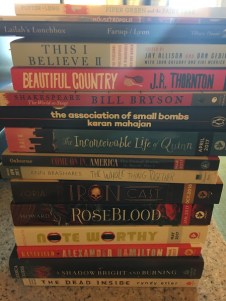
Now, swap out the brides for savings-fueled educators, who are not only passionate about saving money on books, but particularly prideful of stacking those free treasures into towers of savings that stand taller than the students they teach.
ncte-4

Add Curious George, countless authors signing their books (Matt De La Pena?  Neal Shusterman? Ann M. Martin?!), a hot dog stand, and free book totes, and you’ll see English teachers practically stab one another to get free texts.

It made me smile to see so many teachers literally fighting (friendly competition fighting, not literally throw a punch to grab a copy of  The Association of Small Bombs fighting) to support their classroom libraries and their commitment to putting books in the hands of teachers. ncte-3

So, Happy Thanksgiving everyone. I have enough notes, inspiration, and red hot passion for this profession right now to fuel another dozen or so posts on the incredible opportunity that was NCTE 2016. I’m so very thankful I could attend. So very thankful to my district for supporting this work. Thankful to my department members who are working their tails off to support our students as growing readers and writers. Thankful to my students for exploring their ncte-2deeper thoughts though books. Thankful that the Heros and Villains Fan Fest was starting, so we briefly shared the convention hall with roaming bands of beautifully costumed characters. Hey, we all have passion for different things. I find Thor’s passion to be particularly commanding.
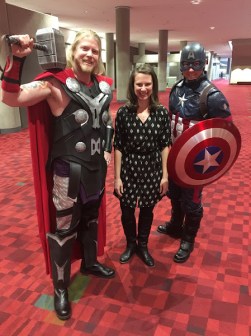
I emailed Penny Kittle to thank her for talking with me and for sharing her insights on this powerful, albeit extremely challenging move to workshop, and I want to leave you with a quote that I think we can all give a little thanks for as we walk down this workshop path and learn how to do what’s best for our kids. The message is…workshop is simple.

We just need to, as Penny said, “be sure that students have time to read every day so [we] can confer, write every day to build volume, and study texts that help them learn the craft.”

Amen.
Let’s eat.

If you attended NCTE, what are you thankful for? If you couldn’t join us, which of the quotes above speaks to your practice? We LOVE to hear from you. Please join the conversation in the comments below. 


Workshop Routines and Some Leopard Print Pajamas

Amy and Shana posted earlier this week about our upcoming presentation with Jackie Catcher at the NCTE Annual Convention in Atlanta. ncte

Amy is going to discuss perspective and assessment, Shana will share insights on unit
planning
, Jackie is focusing on mini lessons, and I’m going to try not to pass out from sheer terror/excitement/nerves/exhaustion/adrenaline.

If I can meet Penny Kittle without
incoherently mumbling some nonsense (Oh my goodness. I love Book Love. I mean love. Did I say love already ?), I’ll consider that a win too.

Or, perhaps most importantly, I’ll be speaking about workshop routines.

Establishing routines to support the non-negotiable components of workshop was one of the first considerations of my district when the high school ELA team started our move to workshop last year. We run on an A/B block schedule with 86 minute classes, and structure
is key to make sure all workshop components get their due time.

I was thinking about it tonight when I was putting my three year old daughter Ellie to bed (which, by the way has been going on now for over an hour because she’s needed several “one more” hugs). Every night, without fail, my husband and I work Ellie through the process of pajamas, books, teeth brushing, more books, several kisses (for Ellie and all nearby stuffed animals), one last story, several more kisses, and a hug.

I’d be lying if I said it went perfectly each night.

Case in point, Ellie just came out and asked what I was doing. I seized the opportunity and asked if she had a message for you all.

She’d like you to know that she is wearing leopard pajamas.

So…how to segue past that one?
I give up. That kid’s good. Yes, I gave her another hug too. Anyway…

Workshop routine. What’s its purpose?

In my opinion, it’s to provide comfort, consistency, and (hopefully) somewhat predictable outcomes.

When Nick and I take Ellie through her bedtime routine each night, she knows what’s coming. She knows we’ll be there with her, whether she’s cooperative or…spirited. She knows that each component of the routine has a purpose, because we make them clear. She knows, or at least experiences, the consistency that leads to that predictable outcome which is a warm bed and sweet dreams.

Yes, she fights it sometimes. Yes, she enjoys some parts more than others. Yes, it’s occasionally exhausting. But we know the net benefit. Our darling daughter is sent to dreamland with a positive experience, consistent expectations, and security.

Workshop routines are established for and run with the same outcomes in mind.

Students need daily practices, without fail, that strive to build capacity for critical thinking, community with peers, and rapport with instructors. They need a classroom structure that promotes a gradual release of responsibility so they can study craft in order to emulate that craft. They need time to practice. Time to explore. Time to be in control of their own learning. Time to be readers and writers.

In our district, that’s a pretty structured 86 minute class period, per Penny Kittle’s suggested breakdown of daily activities:

  • 10 minutes silent reading/conferring
  • 5 minutes attendance/agenda/book talk
  • 15 minute quick write
  • 15 minute skills based mini lesson
  • 38 minutes workshop time
  • 3 minute wrap up/sharing/homework

In my opinion, it’s the components that matter. The timing, especially in an even shorter class period (See Amy’s post on workshop in a 45 minute class period or Shana’s post with her ideas for workshop in a short class– it CAN be done!), are necessarily brief to allow for work in all areas, provide time for students to put into practice what they are learning, and maintain momentum around specific skills by linking components in a class period. For IMG_0684example, have students look for specific craft moves in their independent reading, write about them in a quick write, see them reflected in the mini lesson, and work to incorporate them into their own writing during workshop time. I’m even organized enough sometimes to tie my book talk directly to the craft move we’re discussing. Sometimes.
My students know what to expect each day. They know they can count on time to read, make choices in their learning, have guided instruction on college and career readiness skills, and workshop time to put those skills into practice.

Well, I know they have those things. Their perception of the class structure is often described as “fast.” As in, “Wow. That class period really went fast.” And it does. There’s always a lot to do. There’s always a lot to talk about, write about, read about, think about.

There’s, of course, always room to grow too.

Routines to add around writing fluency (weekly one pagers), mini lesson variety (demonstration, explanation/example, guided practice, etc.), use of writer’s notebooks, conferring, providing formative feedback, and the list goes on.

Workshop aims to empower students, teachers, and entire learning communities through a shared love of reading and writing to promote literacy.

Leopard pajamas or no, the routine of workshop provides a consistent safe place for all stakeholders to learn and grow. Sweet dreams.

I’ll be sharing more about moving to the workshop model and workshop routines in more depth on Sunday afternoon, from 1:30-2:45, in room B211.

Will you be at NCTE?  Please let us know in the comments.  We would love to meet you!

If you can’t make it to Atlanta, you won’t be missing out–tune in to Twitter using the hashtag #NCTE16 during our session times to join the conversation.

photo2


Designing a Unit in Workshop: Just Try It

The NCTE Annual Convention begins this week, and as always, its onset has prompted me to try and synthesize a year’s worth of thinking around one pressing topic.  What I’ve been considering this year is the value of units of study within a workshop classroom–the hows and whys and what ifs of planning for complex, themed units.

So, we know that teachers who engage in a workshop classroom often have many of the same routines in their schedules:  time to read, time to write, time to talk.  They often have many of the same components:  mini-lessons, booktalks, mentor texts, conferring.

These are all good things.

They are all engaging practices on their own, but to take on real power, they need to be strung together, applied again and again, over the course of units of study and throughout the year.

When I work with teachers who are diving into the workshop model for the first time, I model as many of these components as I can.  Teachers are engaged–they write, they read, they look at the craft of poetry, they analyze articles.  They are energized and enthused to try these strategies with their students.

But every time, I see one smart teacher, her brow furrowed, her face concerned, in the back of the room.  She tells me, either in person or on her evaluation card:  I don’t see the rigor in this model.

And she is right.  In one day’s work, students are only advancing incrementally.  If we just have fun every day playing with words in our notebooks, listening to podcasts to study their craft, or doing book passes ’til the cows come home, our students are not growing by leaps and bounds as readers or writers.

And that’s where designing strong units of instruction comes in.

Whether it’s reading or writing instruction, harnessing the daily moves of a workshop routine to build toward an authentic product is where rigor lives.

I like Kelly Gallagher’s words to sum up the idea of starting at the end when designing a unit:

Screen Shot 2016-11-14 at 9.53.49 AM.png

Begin by thinking about what you’d like your students to achieve.  Did you just hear an amazing commentary on NPR?  Wow, what a great writer that guy is–I want my students writing like that.

Start with your vision.  That’s where you begin.  Then you ask yourself:  what do my students need to know in order to write like that?

That’s where the workshop routines come in:  booktalk examples of strong nonfiction writing.  Teach mini-lessons that get at the craft of strong commentary writing.  Flood your students with mentor texts, both published pieces and each other’s work, so they can see both the process and the product.  Let them experiment with drafts in their writer’s notebooks–lots of ungraded, low-stakes practice should live there.

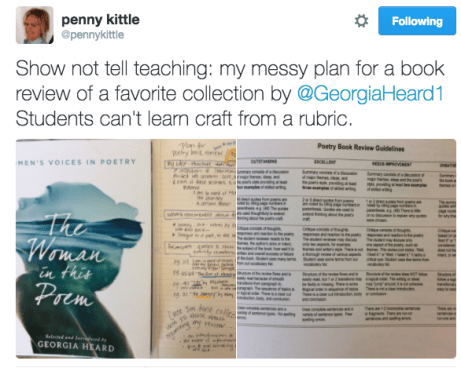
At the end of the unit, don’t destroy all of your hard work by trying to “grade” everything objectively with a rubric.  Our beautiful mentor Penny Kittle sums that up nicely:

Screen Shot 2016-11-14 at 10.06.44 AM.png

When best drafts land on your desk, ask:  how do I know students achieved what I wanted them to?  Utilize self-assessments, celebrate the writing, respond authentically.  Consider how each student advanced individually.

Our students deserve high quality instruction that offers them choice, volume, and authenticity.  They deserve units that will allow them to continue to build on their constantly-increasing mastery of their reading and writing skills.

I’ll be sharing more about planning units in an Ignite Session on Saturday morning, from 9:30-10:45, in room A412.  

And I’ll discuss how and why to build rigor into your workshop units in more depth on Sunday afternoon, from 1:30-2:45, in room B211.

Will you be at NCTE?  Please let us know in the comments.  We would love to meet you!

If you can’t make it to Atlanta, you won’t be missing out–tune in to Twitter using the hashtag #NCTE16 during our session times to join the conversation.


Mini-lesson Monday: A Matter of Perspective

I am thinking about the importance of perspective. Mine and others.

To truly understand how the world works, why decisions are made, what issues matter to individuals, when things do not go our way, we have to be willing to peer into the thinking of those who think differently than we do.

Sometimes — no, most of the time, this is hard.

It is especially hard for the sixteen year olds I teach. They wear their bias like badges, and they often silence those who disagree with them with blatant disregard. I fight against this every day, but last Friday we took a few steps forward. I want us to keep moving.

Objective: Students will formulate ideas while writing from a perspective other than their own: Who? What? Where? When? Why?; draw conclusions based on observations and interactions with peers.

Lesson: First, we’ll write. Students will take out their phones and take a photo of the person sitting across from them. They will then write for ten minutes, trying to convey that person’s point of view about their future. What do they want to do after high school? Where do they see themselves in five years?

We will then share our writing and discuss how difficult it is to know another’s thinking without ever having a conversation. We will tie this thinking into the conversations we had last week about stereotypes and making judgements.

Next, we will do the Crossing the Line activity as outlined here by Vanderbilt University. Of course, I will have to change some of the questions:  Coke vs Pepsi? Pshaw. This is Texas! I will have to say Coke vs Dr. Pepper.

This activity will inspire discussions about our similarities and our differences, and the poem will allow for even more discussion, analysis, and critical thinking around a text.

Follow up:  As we move into choosing topics for our Poetic Rhetoric unit, I will remind students of the importance of investigating all sides of a topic and the importance of considering alternate points of view as they compose their poems. I did not do this last year, and this will add a critical element to their arguments. Too many of the spoken word poems I’ve listened to seem like rants against some issue instead of including a shift or two that lead toward solutions.

In times like these, we definitely need solutions.

NOTE:  Shana, Lisa, Jackie and I are presenting at #NCTE16 this week. If you will be with us in Atlanta, we’d love it if you attend our session on Sunday, Nov. 20 at 1:30 pm. Room B211 of the GA World Congress Center. I will start our presentation with more on the value of perspective and how it relates to Advancing All Students in Readers-Writers Workshop.

screen-shot-2016-11-13-at-8-48-43-pm

‘Gray is the Only Way’: A Different Kind of #FridayREADS

It’s been a rough week.

Certainly an understatement. I know we are hurting, scared, worried.

My emotions have kept me mostly mute, and I struggled with what to write today. I’ve started over five times. Then, I found something that helped me put thoughts into words, so I’m going to try. I’m also going to ask you to read something.

Before you read any further, know this:  I am not a Trump supporter, nor am I a Clinton supporter. I am an American invested in finding solutions to the issues that divide us as a people.

I am an Army mom whose son pledged to die fighting for my rights, and yours.

I am a Christian, and I’m pretty tired of being called intolerant, a homophobe, a racist, a bigot, and the like. My life speaks the opposite every single day.

I am a teacher. Black, White, Hispanic, Asian, Indian, refugee, documented and undocumented, children enter my door every August, expecting to be taught critical thinking skills and to grow as readers, writers, and communicators. I am good at my job.

I love these children. These children are our hope.

But I wonder:  What kind of examples have we set for them lately? This election brought out the worst in so many of us.

I’m reminded of the TV commercial a few years ago where the little boy follows in the shadow of a man all day. Everything the man does, the little boy does. Cussing, smoking, drinking. I can’t remember, but probably giving people the bird, too.

I’m reminded of the book Forgive Me, Leonard Peacock by Mathew Quick where Leonard follows adults around — on the subway, through the mall, on the way to work –to see if anyone is truly happy.

What have our children seen in us this week?

Have they learned to graciously concede, even when they do not win or get their own way?  Hillary Clinton set a beautiful example when with composure and grace she delivered her concession speech. Of Trump, she said “We owe him an open mind and a chance to lead.” She urged unity. Not the protests and especially not the looting.

I believe we can be better than we have been.

I read this post last night, and my students and I read it together today. I urge you to read it and pass it along:  What a Gay, Muslim, Pakistani-American Immigrant Learned Traveling to Rural Alaska a Week before the Election.


Riaz Patel’s position gives me hope. What if every American “decided [they] needed to understand the election from a perspective other than [their] own”?

Imagine what we could learn “by listening. Listening. Not waiting to speak. Not waiting to disagree or refute.”

In our lightening-like, digital world, we have lost the art of listening.

What are the possibilities if we could all remember to practice Patel’s idea to “PERSONIFY the people we think we hate”?

I agree with him, maybe “Grey is the only way.”

Every American had skin in this election. Every American has skin in the country we choose to create.

We have to figure this thing out, or we may destroy one another.

The generalities and absolutes we have seen during the election  — and this past week — are opportunities for us to teach children that NOT ALL is sometimes more important than some.


My second period made a NOT All list as a way of thinking through the stereotypes and bias we see and experience every day:

Not all Mexicans are illegal

Not all white people are rednecks

Not all black people rob

Not all cops shoot black people

Not all Asians are smart

Not all Mexicans cut grass

Not all Asians are good at math

Not all white people are good at English

Not all Blacks have food stamp cards

Not all Blacks like chicken or watermelon

Not all Blacks are drug dealers

Not all Mexicans are rapists

Not all Muslims are terrorists

Not all Hispanics speak Spanish

Not all rednecks are racist

Not all black men are deadbeats

Not all Hispanics are Mexican

Not all Mexicans distribute drugs

Not all blondes are dumb

Not all black girls are ‘ratchet’

Not all black boys are gangsters

Not all Asian parents are strict

Not all Whites are drug addicts

Not all boxes are square


Not all boxes are square. And I think we can do better in proving that is so.

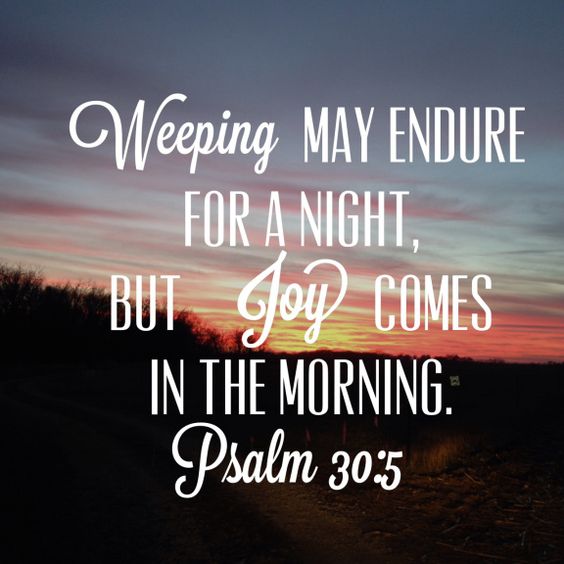
Enjoy the weekend, my friends. Joy cometh in the morning. Psalms 30:5

c6cc35ad437eea5556e1d854d1052910

Three Good “Ninja” Books About Children of Alcoholic Parents by Amy Estersohn

downloadI’m always on the lookout for ninja books – the kinds of books that address tough issues directly, but are also swift and subtle in how they go about doing it.  These are books that have middle school-appropriate characters, plot points, and pacing with some high school-ish themes.  See also: author Kerry O’Malley Cerra’s #mggetsreal campaign.

Without further ado… here are three terrific ninja books about children of alcoholic parents:

Shug by Jenny Han

Shug (nickname for Sugar) is stuck between being a child and being a teen, and she’s in the unfortunate situation of having a huge-o crush on her male best friend, Mark.  While Shug is primarily an optimistic if awkward tween relationship novel, astute readers will pick up on Shug’s mother’s social withdrawal and her tendency to rely on wine to solve problems.  This novel reminds us that chemical dependency can affect anybody without regard to class or gender.

The Seventh Most Important Thing by Shelley Pearsall

This book is about a boy named Arthur Owens who throws a brick at an old man’s head, nearly killing an old man. Whenever I booktalk this book, there’s always a reader who says, “Surely it was an accident that Arthur threw the brick.”

To which I smile and say, “No, Arthur really meant to throw that brick.”

The Seventh Most Important Thing just might be my favorite book ever, if I really had to choose a favorite book.  It’s a book that transformed me; it’s also transformed some of the readers I’ve worked with, readers who have never felt compelled by any particular text until THIS ONE.  (Note that this book isn’t some magic cure-all, as some of my readers find it a little too character-driven and not cliffhangery enough.  But still.  This book.)  

I won’t give too much else away here, but I will say that Arthur’s father did his best to be a good dad to his children despite a struggle with alcohol.

This Side of Home by Renée Watson

Watson has written a book I can only describe as a gentrification romance.  Twins Maya (named after Maya Angelou) and Nikki (named after Nikki Giovanni) are watching their Northeast Portland neighborhood change before their eyes.  It’s becoming more white, the stores are changing, and their neighbor and best friend Essence’s landlord has started remodeling the bathroom and kitchen … before raising the rent on their apartment.   Maya wants to go to Spelman with Essence, while Essence isn’t sure she’ll be able to leave Portland and her alcoholic mother, who constantly needs her help.

Each of these three books gives a different lens into how different characters may cope with an alcoholic parent, and each of these titles could appeal to younger and older teens.

Amy Estersohn is a middle school English teacher in Westchester County, NY.   She also reviews comic books for http://www.noflyingnotights.com.   Follow her on Twitter at @HMX_MSE.

Try it Tuesday: Building Fluency (And Relationships) One Page at a Time

I got to know Bennett because he “grew up” in my classroom.

I got to know Kathy because she discovered how much reading could challenge her thinking.

I got to know Austin because his sense of curiosity,  coupled with his sense of humor, brought him back after graduation to share his insights on college level critical thinking with my students last year.

I got to know Trevor because he had lost his love of reading, and workshop helped him find it again.

I got to know Abbey because I unknowingly played a part in developing her confidence.

We get to know our students in countless ways and through countless circumstances. Through conferences, writers notebook entries, overheard conversations, questions, books in their hands, and sometimes simple nods and smiles, we better understand the humans we as teachers are blessed to work with everyday.

And it is my belief that understanding (connecting with, acknowledging, listening to) students is the component that makes true growth and learning possible. As in life, building relationships breeds understanding, compassion, insight, tolerance, empathy…the list goes on and on (and as I’m typing this, is strikingly similar to a list of reading/writing benefits as well. Coincidence? I think not).

Yet, there are plenty of students I feel like I never get to know as I should. In fourteen years of teaching, I’ve had the opportunity to know roughly 2000 students. That’s 2000 unique life experiences, desires, learning styles, and needs, and I’d be lying if I said I connected, to the degree I might have wanted to, with each and every one, or even most.

But workshop does bring me closer. I talk more with students than at students now, and it makes a world of difference. I’m also offering up more opportunities these days for students to have real and honest connections with the classes I’m teaching. They share who they are in what they choose to read, how they respond to it, and what they write in far more meaningful ways, because the personal connections they create with the material allows for more depth.

My task now is to match those personal connections to learning through assessment of their acquisition of skills.

Sounds simple.
Not simple. Not at all simple.

But you know this. I’m pushing at an open door.
And yet, I would wager, it’s rarely easy for any of us.

So. How to keep students honestly sharing, deeply thinking, connecting to their reading, and growing as writers?

The one pager.

Shana wrote about weekly one pagers about a year ago, and I first started them with my AP students last January. It’s a simple concept. Students write every week. They write what they think, feel, and want to explore.

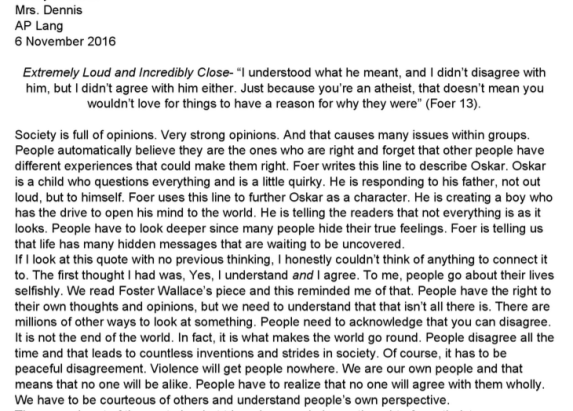
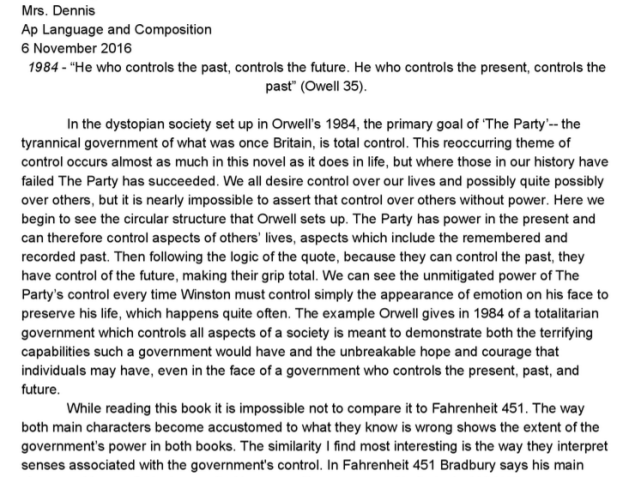
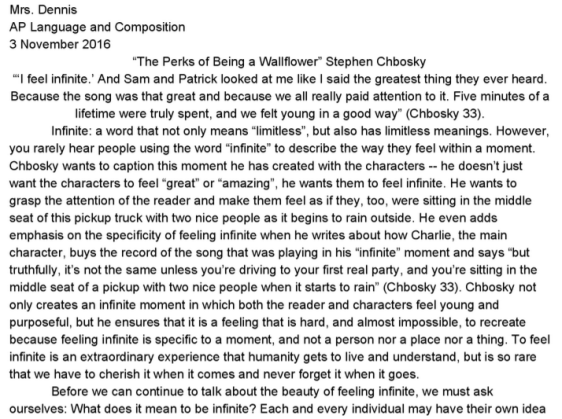
My modification for my AP students is to have them write weekly about what they are reading independently or specifically for class. The emphasis is to contextualize a chosen quote that they find impactful in some way and then react to it. Part craft study, part reflection, part magic. Beyond that, I encourage students to let their writing flow. 500 words (ish). Single spaced. Analysis. Reflection. Once per week. No exceptions.

Since the point is to write more (and more, and more, and more), I try to keep in mind that I don’t need to read every word. With four sections of AP Language this year, totalling 81 students, I’d be in way over my head. So instead, I keep the scores formative, rotate through the classes to comment on one section of the four per week, and give completion scores for those I skim over. Students use turnitin.com to submit the writing each week, so it’s organized and in one place. Occasionally, we’ll discuss our quotes in small groups and/or use the writing for some craft study in class.

sample-3

sample-2

sample-1

Those are the logistics.

My favorite part of this practice, however,  is the way it provides a safe place for my writers to grow, and when they really embrace the exercise, fantastic things happen.

At the start of this school year, I received an email from Simrah, a former student who finds herself in college this year:


Mrs. Dennis,
     I hope you are doing well. I’m having a wonderful time in college and have been meaning to email you to say thank you for having us write one pagers. In English these first two weeks of school, we have been writing one pagers on different readings. Doing so last year was very helpful. We continue to write one page type essays in my class as a grade and being able to do it without question has been great! You can tell you AP Lang students I said this. Thanks again and I hope you have a wonderful school year. Hopefully I’ll stop by the school some time to say hello personally 😉 ❤

Sincerely,
        Simrah —– (a very thankful one pager writing college student)


Just this week, as I introduced my AP Language students to their upcoming “opportunity” to grow as writers, I received an email from Charlie, a young man whose heart is big, his desire to learn is bigger, and unfortunately, this week, he had an unexpected topic emerge for his one pager that turned his piece into an outpouring of emotion that he desperately needed and brought tears to my eyes.

Charlie lost his grandfather this past weekend. Up to this point, Charlie and I have laughed together, as he is a wonderfully personable young man, but I wouldn’t say we had particularly connected. Then he emailed me Sunday to (can you believe) apologize for going over the word limit on the one pager and share with me a picture of how striking the resemblance is between his grandfather at the same age Charlie is now.

Charlie’s writing touched me. He quoted Dr. Seuss in saying, “Don’t cry because it’s over. Smile because it happened,” and went on to detail the events of the past week and his deep thinking/feeling about them.

When I hugged him this morning, he smiled again, and then hung back for a few minutes after class to tell me more about his grandpa, how the family was doing, and how he was doing. It was a conversation he needed to have and I was honored to share it with him. He joked on his way out the door that it would be hard to top his first one pager this coming weekend, but he would try.

Earlier in the weekend, Charlie had ended our email exchange by saying, “I am so lucky to have a teacher like you who cares so much.”

Well, Charlie, you’re sweet to say, but really,  I’m the lucky one.

Because I’ve gotten to know Charlie, Bennett, Kathy, Austin, Trevor,  Abbey, and I’m learning more and more ways to know more and more students.

I’m getting to know them in ways that truly matter.

As readers.
As writers.
As learners.
As people.

As writers of one pagers. Simple assignments that can be simply amazing.

Have you tried “one pager” writing in your classroom? How do you work to build fluency in your students’ writing. Please share in the comments below.