Category Archives: Readers Writers Workshop

Thank you…

Reading the posts over the last week or so have completely filled my work cup. Shana is gifting, Amy is reminiscing, Katie is contemplating summer reads… I hadn’t realized how heavily I have come to rely on this blog. The advice, the ideas, the questions have given me a community that is excited about innovating the English Language Arts classroom. It is a place I can come and get lost in what others are doing to change how we ELAR.

Thank you! Thank you to everyone who has posted and to everyone who is reading the posts. Thank you for wanting more for our students.

I am 21 days (max) from giving birth to our first child, and I’ve found my thoughts wandering to what school will be like for him. Granted, I’m at least five years away from my first-born stepping into a classroom, but it doesn’t stop my hope for what those classrooms will look like. My husband and I are both in education and there is a lot of edu-speak in our house. We talk about where our son will go to school; my district, his district, our zoned district. We talk about involvement in his school community. We talk about who our favorite teachers have been and why. It makes me hope that our son is fortunate enough to get ELAR teachers like you. ELAR teachers who want to inspire reading and writing. Teachers who want to teach students to think and ask questions and know how to navigate the world after they leave us. And, maybe it’s the hormones that have me all sentimental, or that it’s the end of another school year, but the overwhelming feeling I just can’t kick is gratitude. I am BEYOND fortunate to work with teachers and administrators that have a common goal when it comes to teaching English, and for that my hope burns bright. My son will fall in love with reading and writing because of YOU.

I hope summer gives you what you need, so when August comes around you are ready to get back to the trenches. Our students need teachers like you.

IMG_0785

3 Ways to “Wrap Up” Your School Year

I am an unabashed gift giver.

I love tangible ways to express my appreciation for friends, students, family, colleagues, and anyone else I count as important.

…I also love shopping.

But with an impending move to Wisconsin on the horizon, I don’t love clutter in my home–so I am gifting left and right. That was part of the inspiration this year for how I wanted to finish the semester with my students–students I’ve been with for multiple years, in some cases, and others who I’ve only gotten to know and learn with for one semester.

Like any ending, this one tended to color the ups and downs of our school year into a tone more rosy than reality may have painted. With two kids under two, a hectic semester of required assignments, and the ever-present student mood swings offered by snow days, spring break, and finals week, we all struggled at times to stay committed to our work. No school year is ever smooth, or perfect, or simple–but I still like to celebrate its end annually with something tangible. As such, I give each of my students a gift at the end of every year, and have every year since I began teaching.

Here are three ways I “wrapped up” the ending of this school year–literally.


The Gift of Reading

Two groups of my students and I have been together for two years now, and in those two years, I’ve gotten to know these kids (I mean, they’re adults, but I will always refer to my students as “kids” when I think of them) incredibly well. They will be teaching in all content areas, in all grade levels, but still–I can’t seem to turn off my English teacher brain long enough not to say, hmmm, I know exactly what book that forward-thinking history teacher would like.

So this year, I pulled from my own bookshelves one or two books for each of my students–for their personal reading, for their classrooms, or both. In each book, I wrote the student a note, then wrapped each book individually. This time-intensive gesture has been rewarding in spades as my students contact me to tell me they’ve read and loved their books.
The Gift of Writing

We use Google Docs quite frequently, and one of my favorite activities to have students work on is to respond to a writing prompt on a collaborative Google Doc and proceed to write, think, and argue together on one page.

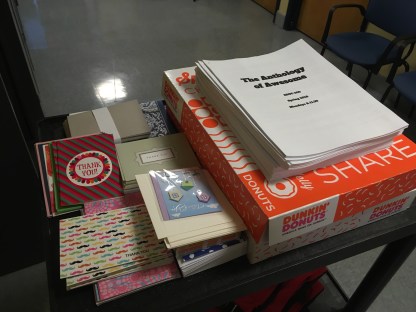
So this year, I printed out every collaborative Google Doc, group-written book review, team-created list of strategies, or class-crafted series of ideal classrooms, social justice non-negotiables, and pedagogically challenging teaching moves that we’d created and bound them together into a class “Anthology of Awesome,” which each student received.

On our last day of class, we shared the anthologies with donuts and coffee. I also brought thank-you notes for students to write to one another–personal messages they hand-wrote and hand-delivered to their critical friends, who had helped read and respond to their work all semester long.

With these pieces of writing in their pockets, my students left class with tangible reminders of the intellectual portion of our time together.

The Gift of Family

For better or for worse, with the end of each school year together, a class is like a family. Some members are dysfunctional, some are estranged, but in general, we’re a bunch of former strangers who now love, appreciate, and respect one another more than we did four quarters ago.

To help us remember this time together, I wrote my classes each a letter that highlighted each student by name, and comprised some of our memories together, our shared goals, and our funny moments. I added this letter to the beginning of our class anthology to serve as a reminder of our Screen Shot 2018-05-30 at 7.11.46 AM.pngstudents’ names and personalities. For my future teachers, I created our ideal school, in which we’d all teach and get to work together forever. In past years, I simply wrote a letter of well-wishes to my kids, and included each student’s name and a little compliment toward them all.


As we wrap up this school year, these simple gifts are things you might consider crafting to help end your year with students on a high note. It’s easy to get caught up in the end-of-semester hubbub of grades, exams, and packing up classrooms, but I hope you’ll pause to commemorate a year of learning as a group in some way with your students, as well.

Please share how you “wrap up” the school year meaningfully with your students! We’d love to know in the comments, on Facebook, or on Twitter!

Shana Karnes will soon be leaving the wild and wonderful mountains of West Virginia for the great lakes of Wisconsin. She is excited to continue her involvement in Appalachian education by leading institutes with the National Writing Project at West Virginia University this summer, but will otherwise be relaxing and devouring as many books as she can during her two daughters’ nap times. Connect with Shana on Twitter at @litreader.

What’s Your Book?

I spent most of Monday trying to organize my books. It’s a bigger deal than it sounds. I love books. My husband loves books. Together we have a massive book-loving marriage. And a problem:  Room.

Recently, we moved across town into a space that is just a tad bigger than the one room apartment we lived in as newlyweds almost 33 years ago. So, today we’ve sorted, remembered, donated, and pledged.

“I read more when the books are our in front of me,” my husband said as he put his favorite sales and marketing books on the shelf. “These are the ones I read again and again.”

“I think you should read this book,” he said, showing me Paradigms. “It’s a fundamental

Toberead

Just one of my to-read-next towers. I’ve also got the AP Lit and Book Love Summer Book Club towers.

book for anyone who is an innovator.”

It’s now atop my to-read-next tower.

“What’s the one book that hooked you as a kid?” he asked as I tried (and failed) to narrow my children’s book collection.

Anne of Green Gables. Easy. ” I said, “Yours?”

My Side of the Mountain.”

Most readers know that one book.

And isn’t it a treat that by definition of our jobs we get to help kids find their books — the ones they want to read, the ones that helps them fall in love with reading — if they haven’t fallen yet?

Today, I’d like to ask you:  “What is your book, the book that made you want to read?”

Our books

Amy Rasmussen lives and works in North Texas. Her classroom library is home to books, books, and more books — all selected to help inspire a love of reading in every single student. Btw, she and her husband have had numerous conversations about the books that made them readers. It was pretty much a first date prerequisite.

Summer Reading: Mentor, Memoir, Music

As any audience of teachers in late May can understand, we’re in that real-time–time warp: The current school year may still be in progress but we are living in the planning of the next. So, in the interest of looking forward — and being inspired by Amy Estersohn’s recent post about book club choices and Lisa Dennis’s about a summer reading list — I thought it might be helpful to share a few titles from my inventory of “Books I Meant to Read This Year but Didn’t” as well as “Books I Knew I Would Have No Chance to Read until Summer.” (By the way, I have no personal or professional stake in promoting any of these books other than inspiring conversation among and providing potential ideas to 3TT readers and beyond.)

Mentors of Our Own180Days_notes

Kelly Gallagher and Penny Kittle, 180 Days Duh. As you can see I couldn’t help but already start this much-awaited piece of pedagogical brilliance. With their perfect balance of philosophy and practicality, Gallagher and Kittle have managed to land directly in the sweet spot of books about practice. What they offer is just general enough to imagine it happening in our own classrooms and just specific enough for it to be highly practical.

beyond_literary_analysisAllison Marchetti and Rebekah O’Dell, Beyond Literary Analysis I will never forget this question that one of my very first mentors taught me to ask: Do we seek to cultivate aspiring English majors or an informed, critical-thinking citizenry? (I know, I want both, too. Alas.) Lisa Dennis discusses in this post the limitations — and, even detriments — to student writing that the traditional literary analysis imposes. Even without having read it, just knowing this book exists fuels my determination (on students’ behalf and my own) to refuse that pain and suffering for even one more year.

Potential Book Talks (or not): Memoir

When They Call You a Terroristpatrisse khan-cullors & asha bandela
The Girl Who Smiled BeadsClementine Wamariya

cultural_memoirWho says we shouldn’t judge books by their covers — and their titles? I won’t apologize for instantly loving these books for their beautiful, ethereal covers and alluring titles. What a happy coincidence that each is filled with the pathos of personal experience that makes memoir so compelling in addition to an earnest and essential reminder about the human beings that live and struggle behind the headlines and the hashtags.
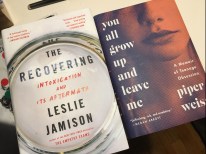
The Recovering (Leslie Jamison) and You All Grow Up and Leave Me (Piper Weiss)memoirs_reading.jpg

Based on what I’ve read so far (30–50 pages of each), neither of these would be near the top of a classroom book-talk or mentor-text list for my classes. But man are these stories irresistible (in this amateur reviewer’s opinion). Weiss’s craft is most apparent in her arrangement of alternating time periods and varying expression of voice, while Jamison’s tends toward stylistic elegance. Due to their “mature” subject matter and in the interest of healthy boundaries, I’m likely to continue reading these not as a teacher but as a regular, private citizen-bibliophile.

Music-Inspired Mentor Texts

abdurraqibThey Can’t Kill Us ‘Til They Kill UsHanif Abdurraqib. The provocative cover of this collection of music/cultural criticism has been taunting me from my shelf all year, even more so after I read an excerpt from Beyond Literary Analysis (see above) in which Marchetti and O’Dell write incisively about channeling students’ love of music into analytical writing. In the book’s introduction, Eve L. Ewing writes, “Abdurraqib makes you realize that the music you listen to isn’t about People Like Us, because it turns out all of us are People Like Us. All of us are frightened and heartbroken and ecstatic and mourning and in love and driving fast down the interstate, and we are blessed enough to live in a time when there are plenty of artists adept to holding that mirror.” Just from this mentor sentence alone, students can practice the power of polysyndeton! From there, I can’t help but imagine students building analytical bridges between the music they love and the qualities that give the music that power.

Creative QuestQuestlove. questloveI’m pretty sure many of my students in Advanced Writing left the course still skeptical of the notion that artists — even accomplished ones — still turn to the work of other artists to inform or inspire their own. So, next year if they don’t believe me, maybe they’ll believe Questlove. In a section of this inspiring and accessible book called “Reduce, Reuse, Recycle,” he celebrates this practice and discusses “covering” the work of other artists not only as a way to work through an artistic slump but as an act of creativity in itself. Thanks, Questlove, for a refreshing take on the concept of mentor texts. He explains, “That’s another thing that creativity is–taking the existing world and making something new from it.” (BTW, I know that’s going on a handout somewhere.) I really loved his discussion of the MTV series Unplugged, which features popular (and typically “plugged-in”) musicians in a stripped-down, acoustic format. I’m determined to figure out a way to use the series to demonstrate the impact of form and tone.

If any of this summer reading evolves into meaningful, practical lessons, I’ll be sure to post the details. In the meantime, though, I hope there might be something here to inspire you or to add to your own never-ending lists (which I’d love to hear about)!


Saying Goodbye

Today is the last day of school in my system, and as always, we have had a busy week of celebrating the seniors who are graduating and heading off to college or military service or to careers. It’s hard to believe that these young people who (it seems) just needed so much help and guidance at the beginning of the year are about to walk through our doors and out into the world as adults.

GraduationHatsThrownIntoTheAir-1400x891

This particular group of seniors are near and dear to my heart. I taught them for two years–Sophomore year and Junior year–and half of them call me Mom once a week. I’m the one they come to when they’re sad or when they have good news to share or when they need a safety pin or a band-aid or when they just need a place to hang out. (I’m not the only one–our school is blessed with many amazing teachers. These kids just seem to be especially MINE. 🙂 ) I’m not sure how we bonded so much–maybe it’s because as Sophomores many of them didn’t drive and needed a place to hang out while they were waiting for practice or their parents or whatever. Maybe it’s that I was their only female teacher Junior year and 1 of 2 female teachers Sophomore year. Maybe it’s because about half of them have been on our school/youth group trip to Washington, DC, for the past 3 years. Any of those reasons could be the reason or part of the reason. The bigger reason, though, I think, is that as an English teacher, I’m talking about life. Whatever we’re reading, I’m working to help them connect it to their lives. Because we share our thoughts and our feelings and our loves and our concerns, I think that we also share our hearts, and these kids got two years of that with me. So we’re bonded. (If you’d like to read more about the bonding we do with our kids, check out these posts from Gena and Pam.)

Every year, our seniors choose a speaker for their Senior Day celebration, and this year they chose me. I joked with them that they just wanted to see me cry in a big public way because, you see, I cry at them a lot. I cry about happy stories and about sad stories. I lost it when we read “Richard Cory” and again when we read Brian Doyle’s “Joyas Voladoras .”   It’s what I do–it’s the Irish in me. 🙂 They know me so well now that, whenever there’s something emotional going on, they all turn to look at me to see if I’m crying yet. On Monday, there was apparently a pool going to see when I’d start crying during the Senior Day festivities. Ha! If you’ll indulge me, I’d like to share a little bit about what I shared with them on Monday. I managed to make it through without ugly-crying, but there were certainly moments when I had to stop to compose myself and quell the rising emotion. 🙂

Some of you are nervous to be leaving the familiar and stepping out on your own—how will you fare in a new environment with brand new people—not the same kids you’ve been in school with since K4 or 7th grade or even freshman year? What will it be like on a campus of 1500 people or 5000 or -gulp- 30,000? It’ll be awesome. It will—it’ll be awesome. And sometimes, it’ll be awful. Sometimes you’ll long for those moments when you’re with the people who have known you since First Communion or who watched you through those awkward Middle School years. Sometimes it’ll be sad and lonely and scary. 

Here’s what I know, though. You—and only you—are in control of all of that. No, you can’t control the environment around you. You can’t control when bad things or even good things will happen to you. Sometimes bad things will happen and you’ll feel lost or confused or sad or worried. What I know is that you will always have a choice. Your choice lies not in some magical ability to keep the bad things away but in the manner in which you choose to handle things. You can choose to let the hard things crush and crumble you or you can use them to learn something  and grow. When rocks start to pile up around you, they can either bury you or you can use them as a foundation for the next step forward. That choice is up to you. That doesn’t mean that it’ll always be easy, but you can find something positive in every experience, even if you can’t see it at the time. 

As you say goodbye to your students this school year, celebrate those successes that you had–the little moments of growth and the big steps forward. Celebrate the student who found a new favorite author and the non-reader who has begun to turn the corner. Celebrate the student who moved from barely writing a full paragraph to writing a full essay and the one who comes to you excited about the new poem she’s working on. Celebrate the perpetual student who is always looking for ways he can improve his work and that student who comes to school just because it’s better than sitting outside cold and alone. But what if you have had a year of struggles–maybe you had a tough course load with lots of preps or maybe you had a particularly difficult group of students or maybe you had some tough circumstances in your own private life that sometimes made teaching hard. We don’t live in a bubble–all of these things affect us and inform our teaching and our interactions and who we are. What if that was your year and you don’t feel much life celebrating?

Well, just like I told my seniors…when the boulders start crashing down all around you and when it feels like you’ll be crushed by the weight of life, that’s when you have a choice. You can either let these experiences bury you…or you can find a way to dig through that rubble and start again and use the experiences of this year as a starting point and a foundation to grow upon. That’s the beauty of education. Even though this school year is over and everything is coming to a close, that doesn’t mean that we have to stop and close up, too. Once we have rested and recovered a little bit (thank God for Summer Break!!), we’ll dust ourselves off, shake off the debris, and figure out what we’ll use for building blocks for next year. And then we get to do it all over again.

Happy Summer, friends. You deserve it!

(And for those of you who are still in session for several weeks, please know that I’ll be thinking about you! We go back in mid-August, so our time will come, too. Hang in there–you can do it!)

What Should I Read Next? – How to Further Fuel Your Bibliophilic Ambitions

Hypothetically, this post will offer upwards of 387,993 book recommendations for your ‘To Read Next List.” Honestly, I’m terrible at math, so that number may be a bit hyperbolic, but I bet it got your attention. Realistically, you may be cursing me by the end, because summer is NOT going to be long enough to explore all of these texts, even the mere fourteen I’ll link up to below may give me a run for my money (not in number, but I already have a lengthy “to read” list!), but oh my, my, did I hit the book recommendation jackpot.

My gal Shana who texted me just a few days ago suggested a podcast that has quickly become my latest obsession. Shana knows what’s what. She’s up writing at 5:00 A.M. almost daily, has rearranged her extensive personal book collection in a color-coordinated bliss that reminds me of High Fidelity, and is moving her family to Wisconsin to be closer to me. Ok, she may be moving to Wisconsin because of her lovely husband’s medical career, but she will be in the same state as I am. In short, she’s all kinds of awesome and I trust her recommendations implicitly. When she told me I needed to listen to this podcast, because it reminded her of me, I was tickled.

My husband is likely glowering as he reads this, knowing he has been trying with little success to get me hooked on podcasts for nearly a decade, but Shana’s suggestion that I check out the What Should I Read Next? podcast with Anne Bogel has my book list laden with enough literary lovelies that I’m going to need to take a sabbatical.

what should i read

Ms. Bogel is the author of the hugely successful, and likewise entertaining, blog Modern Mrs. Darcy, that explores countless angles to life as a modern woman.

Readers Beware If you click on the above link, you will land down a delcious rabbit hole of reading guides for book clubs, summer book lists, links to works of major authors, not to mention over one hundred podcast episodes talking about books and reading. It’s a biliophiles delight for sure.

After listening to only one episode of her podcast,  I wanted to someday be able to claim to have known Anne Bogel for years and chatted with her about books over a big bowl of Chex Mix with Peanut M&M’S, and I had a list of fourteen books that I want to check out. That’s a book recommendation every four minutes in a fifty-two-minute podcast. (My list from the followup episodes I’ve digested is likewise lengthy).

On this episode (one of four I have listened to in just the past three days), Annie Jones, owner of The Bookshelf bookstore in Thomasville, Georgia, chats with Bogel about recommendations for summer reading and the joys and trials of reading for a living.

As my workshop teacher senses apparently never go off, I not only mentally cataloged a lengthy list of book recommendations, but some advice I wanted to share with my students next year as we set reading goals and look to the future of our reading lives in the 2018-2019 school year: Never allow your reading life to be bogged down by a number. Whether you feel overwhelmed because your goal is so lofty that you end up flying through books instead of relishing them, or you nervously look at your elbow partner’s number and yours is nowhere near the depth, breadth, or drive of his/her reading life, don’t get discouraged.

Reading is all about finding balance.

The balance of goals with other parts of our lives.
The balance of genres.
The balance of what we feel we should read vs. what we want to read.

So, without further ado, here are a few suggestions from episode 132, “The books we can’t wait to read this summer”:

  1. I’m a huge fan of historical fiction. Last Christmas break it was America’s First Daughter by Stephanie Dray and Laura Kamoie (and their latest, My Dear Hamilton). In episode 128, Tracie Haddock recommends I Shall Be Near to You by Erin Lindsay McCabe. A woman disguising herself as a man to fight in the American Civil War? I’ll raise the flag for that!
  2. I often feel like I’ve got to read what’s hot. Well, what about what was hot a few years ago? Jump back a few years and check out these biographies of some seriously awesome women. Abigail Adams by Woody Holton and Wrapped in Rainbows by Valerie Boyd.
  3. Looking for a super hot memoir?  Educated by Tara Westover fits the bill. I had a student scoop this one up, but I am going to make sure to get it back and read it myself over the summer.
  4. Looking for last year’s super hot memoir? Try The Sound of Gravel by Ruth Wariner.
  5. That Kind of Mother by Rumaan Alam was named one of the most anticipated books of 2018 by everyone from Buzzfeed to Vogue. A text classified as “Women’s Fiction” that’s written by a man and recommended by Celeste Ng. I feel like name-dropping, in this case, is what it’s all about.
  6. The Royal We by Heather Cocks is the ultimate Kate Middleton fanfiction. So…yeah. Beach read, anyone? This is a quick downhill on the Penny Kittle reading roller coaster for sure.
  7. Station Eleven by Emily St. John Mandel was one of my favorite reads this year and disappeared from my classroom the day I book talked it with the quote “Hell is the absence of the people you long for.” Post-apocalyptic symphony, pandemic flu, and multiple plotlines make this a truly powerful read.
  8. For musicians, lovers of music, and those that buy books based on their covers comes The Ensemble by Aja Gabel.
  9. A Place for Us by Fatima Farheen Mirza arrives in June and introduces Sarah Jessica Parker’s new imprint, SJP for Hogarth.
  10. Tangerine by Christine Mangan is a delicious Gone Girl type historical mystery. And to take it up a notch…
  11. Social Creature by Tara Isabella Burton is apparently the R-Rated version coming out this summer.
  12. The Hazel Wood by Melissa Albert will most definitely be in my classroom library next fall as a YA fairy tale about fairy tales.
  13. The Widows of Malabar Hill by Sujata Massey follows a young lawyer in 1920’s Bombay as she tries to execute the will of a man who leaves behind three young wives. This book is a multicultural adventure that introduces a sharp new sleuth for mystery lovers.
  14. Coming in July, The Incendiaries by R.O. Kwon which is a “powerful, darkly glittering novel about violence, love, faith, and loss, as a young Korean American woman at an elite American university is drawn into acts of domestic terrorism by a cult tied to North Korea.”

There is certainly something here for everyone, and the few episodes of this podcast that I’ve listened to would suggest that there is something for everyone at What Should I Read Next? too. It’s quickly become my go to as I twiddle my thumbs and wait for my Libby library holds to catch up with my ambitions.

Happy listening and happy reading, friends! Summer IS just around the corner.

What’s on your summer reading list? Have you read any of the books in the recommendation list above? What did you think? Please comment below!


Lisa Dennis teaches English and leads a department of incredible English educators at Franklin High School near Milwaukee. Her current read is A Gentleman in Moscow by Amor Towles and she’s eagerly awaiting her next Libby hold, Stephen King’s On Writing.  Follow Lisa on Twitter @LDennibaum. 

Shining the Spotlight on Classroom Success

All too often, as the year comes to an end, our focus tends to be on reflecting about what we will change or tweak next year. With several different ways to evaluate teachers, analyzing student performance, and finalizing grades, does it ever occur to us that our focus should begin with what went well? If you are anything like me, the answer, most likely, is no. It can be difficult when our minds are caught up in how we can do more, did we do enough in the first place, and where can we go from here.

Improvement and growth are fantastic ways to ensure we don’t become complacent. However, sometimes it is equally, if not more important, to shine a spotlight on lessons that worked, and student growth and successes, no matter how large or small. Before we dive head first into rethinking next year, here are some key reflection questions to help us shift our focus, instead, to what made our classrooms successful this year. 


  • What all did my students do well this year? My students read, listened, collaborated, discussed, participated, created, researched, wrote, considered, but most of all, they learned. They learned about Shakespeare’s influence in literature and how to have accountability in their peer discussions. They learned about rhetorical strategies and about their personal stances on important, global issues. They analyzed speeches, made connections to their personal lives, made complex assertions, and practiced defending their opinions with support from a multitude of texts.


  • How did they show growth? My students showed growth in the risks they took in their writing. For some, it was that they came to class and participated at least 4 times a week. One student in particular increased engagement in class and asked constructive questions in order to facilitate her own learning. Every student is educated in growth mindset and has the tools (whether they choose to act or not) to take responsibility for his or her own contributions to their own learning.


  • What did I do to improve instruction this year? With 3 brand new preps, I focused on attending training that would directly benefit my classroom. I set goals and frequently monitored my progress in order to help me stay consistently motivated and accountable. On my campus, I utilized the expertise and creativity of my colleagues in order to keep students engaged and positively influence their learning.


  • How did I grow as a professional? I collaborated with my colleagues in my PLC, researched ways to target specific student needs, contributed to a pretty fabulous blog (if I do say so, myself!), and took risks by putting myself out there and consistently stepping out of my comfort zone. All of my experiences this year have contributed to my growth professionally in one way or another.


  • What was my most successful lesson or strategy? The lessons that impacted my students the most were the ones in which they had freedom and choice to demonstrate their learning. These ranged from anticipatory class discussions, creative writing pieces, and Socratic Seminars.


  • What was my most memorable moment this year? My most memorable moments were seeing my students receive their college acceptance letters, writing letters of recommendation, helping my kids sort through issues that had nothing (yet everything) to do with our classroom assignments. Specifically, all of the letters and cards I received for Teacher Appreciation Week that are hung on my bulletin board from past and present students, and some of whom I have never had, personally, but crossed my path in some way this year.

The answers to your own personal responses should fill you with pride, awe, and accomplishment. We are all human and no school year will ever mirror another. After all, that IS the beauty in this extraordinary opportunity to make a difference that we GET TO call a career. I encourage every educator to pause and consider all of the many things we have done this year that positively impacts kids. Keep those ideas in mind when planning and build upon that as you continue to grow professionally.

Please share your successes in the comments. Let’s end our school year recognizing all of the positive aspects of teaching! What were some examples of success in your classroom this year?

images (1)

Gena Mendoza teaches High School English in San Antonio, TX. All of the successes of students in her classroom have motivated her to keep striving for excellence and to further her own personal education by pursuing a Master’s Degree in Curriculum and Instruction. She invites you to connect and share your brilliance and expertise with her on Twitter at @Mrs_Mendoza3. 

Vindication of Choice in the AP Classroom

Every May, my panic that I have not taught my students enough for the AP® Literature exam, pride and concern as I send my “little ducklings” to fly alone into the exam room, and eager anticipation of the memes flooding Twitter from the East coast testers (which I never, ever re-tweet), is quickly followed by the nervous energy of my students as they visit my classroom after the test.

Of course, human nature dictates that they want to relive every moment and consult with their peers about how they answered different questions, but my duty to the College Board prompts me to remind them not to discuss specifics about the exam itself. Instead, I urge them to talk through their feelings and reflect on what they might feel good about, such as writing 3 complete essays. Each year offers its unique triumphs and hair-pulling challenges. “The Juggler” poem a couple years back stumped even my most adept analyzers, but they did have fun crafting juggling metaphors for the remainder of their senior year. Thus, I have come to anticipate the perplexed reactions to one or more of the essay prompts on the exam. A safe question I often ask to avoid specific test-discussion is: what book did you choose to write about for the Q3 essay?

While I’ve learned that it is difficult to gauge how students actually performed on the exam based on their immediate self-assessment, I know that over-confidence – “it was easy” – is almost as bad as total pessimism – “I only wrote 2 of the 3 essays and the multiple choice was killer.” But that one question about book choice tells me a lot. It tells me about their overall confidence level, sense of preparedness, and even what level of enjoyment they experienced during the test. Yes, enjoyment. As my course moved away from a model in which I assign specific texts (so we can experience them together) and toward choice (so students can shape their own experiences, with support), my students have increasingly come back talking excitedly about which book they wrote about on the exam.

This year, because my students brought friends from different, more traditional, AP® classes with them to eat lunch in my room after the exam, I could hear the difference in the way they spoke about the books they referenced on that Q3 essay. My students said things like: “I thought I was going to write about Wuthering Heights because it fits so many prompts, but when I read the prompt, it screamed The Handmaid’s Tale to me. I’m so psyched that I got to write about that!” Another student enthusiastically described how he wrote the “best essay [he’s] ever written, and it was about Frankenstein.” Students went on to discuss the variety of books they wrote about, from The Art of Racing in the Rain to Les Miserables. Students from the other class sullenly and universally explained how they wrote about Beowulf because it was the text they had “been taught” the most thoroughly and therefore “knew the best.”

And there it was. A vindication of choice in the AP classroom. Scores will not be made available for a couple of months, so maybe all those passionless (and I’m going to guess, formulaic) essays about Beowulf will be strongly written and score higher, but what about the passion for reading? My students chose to read those rich texts, and when push came to shove during the exam, they chose to write about them because they saw the value in the book – not because someone told them of the book’s value.

Choice continues to be a source of contention in many English departments, but I cannot understand why. Choice does not mean that students cannot read from the canon. In fact, my students always choose both canonical and contemporary works “with merit” through the course. Teachers can set parameters for choice by offering text sets that connect by literary era, theme, heroic journeys, archetypes, and so on. Choice can be applied to shorter text selections instead of novels. So much has been written on why choice works by bigger fish in the English sea than me, so I will just leave you with this: my students were joyous when they spoke about writing the 3rd essay on a mentally exhausting, hand-cramping exam, and it is because they chose what to read and experienced the autonomy of deciding which of their books they felt they could write their best essay on. Since my goal is to create readers and writers, I could not ask for better evidence that choice helps them toward this goal.

Image result for book choice

Books instead of Bullets

SF StrongIn my short time here as a regular contributor to Three Teachers Talk, this was the latest I’d waited before composing a post.  Though, that’s not really true.  I had a post mostly written last week where I reflected on this year we had and looked forward to a new start next year at a new school.  It would have been similar to this recent and amazing post by Sarah Morris.

Then Friday happened- 10 lives gone and countless others changed forever.

I struggled this weekend with how this post was going to go.  I’m not looking for sympathy here because obviously the 10 families who lost loved ones or the kids who watched their classmates be gunned down in front of them are truly the ones deserving of our hearts.

Like so many not directly affected by this tragedy, though, I struggled.

I struggled to stay composed when a student quietly sat down next to me at 7:55 am and said, “Coach, did you see this?” His phone showed a social media post about students being shot a high school not too far from us.

FullSizeRI struggled because I realized how comfortable I am using the term “active shooter” in a text message to my wife at 8:11 Friday Morning. This was the text message I sent her after I pulled up a local news website to see if it was true or anther false alarm.

I struggled because when my student council president told me she was scared walking down the hall at 1:00 that afternoon, the only response I could muster was, “I am too, and I think its going to feel like this for a while.”

msd

I struggled remembering that I wore my #msdstrong t-shirt to visit the Sequoias at spring break hoping to send a little bit of support to those in Parkland, Florida who lived through this earlier in the semester.

(Side note: I was at exactly this point in writing my post when my student council president called and asked if we can sell t-shirts to help support Santa Fe High School.)

I struggled because when my babies, a 2nd grader and a 5th grader, got off the bus at 3:30, I felt obligated to sit them down and tell them that a boy at a local high school decided he needed to kill his classmates. I couldn’t hold back the tears and my daughter, in her innocence, asked if my school had had to go into a “lock down.” She’s very familiar with what that means.

I struggled early Friday evening when, sitting in a colleague’s living room, myself and several other teachers celebrated the retirement of a woman who gave 44 years of her life to this profession.  I looked at the teachers sharing stories and laughs, at the sleepy dog on the floor, and the nine month old baby that kept stealing everyone’s attention. I wondered how I could balance feeling thankful to have spent the last 11 years working with this amazing person and at the same time think about how thankful I was to be alive.  I felt thankful that my school wasn’t the one to lose lives that morning, and that made me feel horrible.

I struggled when, an hour and a half later I was sitting in a quiet backyard celebrating the upcoming graduation of two of the most amazing people I’ve ever known. They are twins and I got to be the boy’s position coach in football for four years and the girl is my previously mentioned student council president.  Their parents are amazing too and as I sat there visiting with them, I couldn’t wrap my head around how our society can produce these kids and also produce a mass killer less than 13 miles away.  He took the lives of  innocent kids, like these, that morning.  Kids who who had so much to look forward to and didn’t do anything to deserve death.

I struggled because, once again, I had to think about whether or not I would be able to protect my students if bullets flew at my school.  I asked my self the questions: Am I doing the best I can to stop this from happening again? Is there really anything I can do?  Is there anything anyone can do?

I struggled because I knew we can’t take up all the guns and I’m not sure, if asked, that I would give up mine.  We can’t eradicate mental health issues.  We can’t hold schools inside of solid-steel sealed boxes.

I didn’t just struggle. I also hoped.

I hoped that instead of turning inward, we can turn outward.  That maybe we can intervene in these students’ lives in ways that goes beyond dress codes, GPAs and graduation rates. Perhaps we can instill a sense of urgency in our young people, our future, that causes a change in them where instead of acting out their demons on one another, they look to each other for acceptance, love, or even just help. Maybe we can be more like the players and coaches of the Clear Springs Baseball Team who dedicated their game Friday night to Santa Fe.

I hope that even though I’m not sponsoring student council at my next school, I can help build on what we did this year.  I was lucky enough to be chosen to present at our district’s upcoming Character Conference on June 6th. I’m sure there will be presenters at Clear Lake High School that day who can help make change. I won’t technically be presenting, just facilitating what I think might be the only student presenters at the conference.   The student council officers of Clear Springs High School will share their stories of reaching out to our elementary feeder schools in an effort to build leadership and pass on the lessons they’ve learned to the next generation.  Maybe more students like them can make connections that help prevent massacres.

I hope more teachers and administrators realize that our students can do amazing things when we give them the space and the resources they need.  When we keep them free of the burden the adults choose to carry.  But the adults can help too.  I can’t think this would have happened if shooter had more access to books and less access to guns.  I can’t help but wonder if we treat our students with more gravitas then they just might tell us when they think something like this is going to happen and maybe we can have the chance to stop it.

I hope the teachers at my new school get used to a man (who’s been mistaken for a grizzly bear) telling other peoples’ babies that he loves them.  I hope I’m not the last person to tell them that.

Charles Moore is a teacher in League City, TX.  He is enjoys welcoming his kids off the bus with a smile and a hug every afternoon and making sure the dishes, laundry and other household needs are met before his wife gets home from work. The student council he sponsors will, hopefully, be selling t-shirts these next two weeks to support the Santa Fe community. Please email him if you are interested in helping and follow his twitter @ctcoach for more information.


Book Clubs: It’s All About the Book

It’s hard to keep up with reading teen and young adult books, and it’s hard to know how to prioritize the precious time we dedicate to reading the books that teens are reading.


My first priority for reading books that teens are reading is finding new books to offer for book clubs.  I focus my reading on possible book club books because:


  • I’ll be making an investment in 5-7 books at a time
  • Students who read the book in a book club will then recommend them to their friends, so peer referral power is multiplied in book club form if my book club choices are more careful
  • I feel less pressured to read the latest “hot” book and more freedom to explore what publishers call the “backlist” – books that have been around for a few years and aren’t front and center in bookstores anymore
20180513_075958

A sample of my book club backlist.  I picked these titles up for free at the Scholastic Warehouse Sale after I volunteered a shift.

And when I read these books, I’m not just reading for writing quality or story, I am reading for:

  • Rhythm of story.  Does the story take off?  Does it drag anywhere? How long are the chapters?  What are the page designs like? Will the reader get that satisfaction of flipping through pages?
  • Power of story.  On the most literal level, is the story engaging and absorbing?  Does it relate to the emotional age and emotional life of the readers I am giving it to?
  • Meaning of story.  What additional connections and meanings are going to emerge in a book club conversation?  Why is this book worth talking about or wrestling with?


My two favorite resources for book club scouting are seeing what’s on offer through Scholastic Book Clubs and looking at the Young Adult Choices reading lists from the International Literacy Association.  


Below are a few of some of my favorite book club books:


Piecing Me Together by Renee Watson

25566675

Rhythm:  The first chapter on the first page is three sentences long.  Renee keeps her chapters crisp with the occasional foray into poetry, making the pages turn quickly.

Power: The story of Jade, a black scholarship student at a wealthy private school, resonates with my student readers who understand what it’s like to feel left out for one reason or another.

Meaning: Readers who slow down and discuss this story are rewarded by understandings of how gender, race, and class influence character choices, and how well-intentioned characters don’t always do the right thing.


Orbiting Jupiter by Gary Schmidt

23714521

Rhythm: This book is slender and the margins and spacing in the text is generous.  Gary Schmidt is economical with his words

Power: Readers are introduced to Joseph, a teenager and foster child whose reputation precedes him as he moves into a new town.  Teachers and bus drivers avoid him. His foster family does their best to show him love.

Meaning: Most readers hang on to themes of reputation and prejudice easily.  Careful readers will be thinking about the meaning of the title and the events that contribute to the end of the story.


Ghost Boys by Jewell Parker Rhodes

34647324

Rhythm: With chapters and spaces separated into “alive,” and “dead,” this book goes backwards and forwards in time before Jerome was shot by police accidentally and after his death, when he is a ghost roaming around.

Power:  The parallels to  Trayvon Martin’s death and the Black Lives Matter campaign are made clear in the story.

Meaning: Careful readers will come away thinking about the purpose of Jerome’s ghost, who can see him, and why.  


What are some of your favorite book club choices? Why?


Amy Estersohn is an English teacher in New York.  She is also on YALSA’s Great Graphic Novels for Teens committee for this year and encourages readers to follow YALSA’S HUB for talk about new teen titles.