Category Archives: Readers Writers Workshop

Making Grammar Tangible: Designing Ways for Students to Interact with Tools & Rules by Tosh McGaughy

As a seventh grade writing teacher, I adored conferencing with student writers but I struggled with the lack of impact that those conferences had on my students’ understanding (and application) of grammar concepts. I modeled; I provided mentor sentences; I corrected (with non-red Flair pens); I even… assigned a few grammar workbook pages that came with our textbook. (Yes, I was that desperate.) I knew that I needed to teach grammar and conventions within their writing, but I also knew that the things I was doing weren’t working for the majority of my seventh graders (especially my students who were not avid readers.)

The Impetus

Fate intervened and my own daughter transferred to my campus and landed in my English class. Having the benefit of knowing this particular seventh grade learner since birth, I was privy to a depth of understanding about how she learned best which equipped me to design learning tailored for her. A dancer since an early age, she communicated and learned through movement. Though exposed to many books and rich text experiences, reading did not involve enough physical activity to be one of her passions and she had not “absorbed” grammar through prolific reading. Knowing all this, I was presented with the challenge of designing grammar experiences that would actually “reach” this learner because if I was only going to get this one year to be her teacher, I wanted to make the most of it.

The Action Research aka. trial & error

So, I threw out everything I had done previously with grammar and approached it from a different perspective: how can I make the nitty-gritty and fascinating tools of grammar something that students can physically touch, move, and manipulate? This led to me nailing down a process to identify what my students needed to understand, through our writing conferences and formative writing tasks in our journals, and then creating “tangible grammar” tasks that I could use with students during small group instruction based on their specific needs. The lesson components I found most effective with my students were manipulative, cooperative, personal, and memorable.

The Process

The process that evolved was centered around answering four core questions related to those components. 1) How can I make this concept touchable and moveable? 2) How can I get students to discuss and work together on this concept? 3) How can I help students connect the concept to their own writing and usage? 4) How can I design an experience that students will remember as they learn this concept?
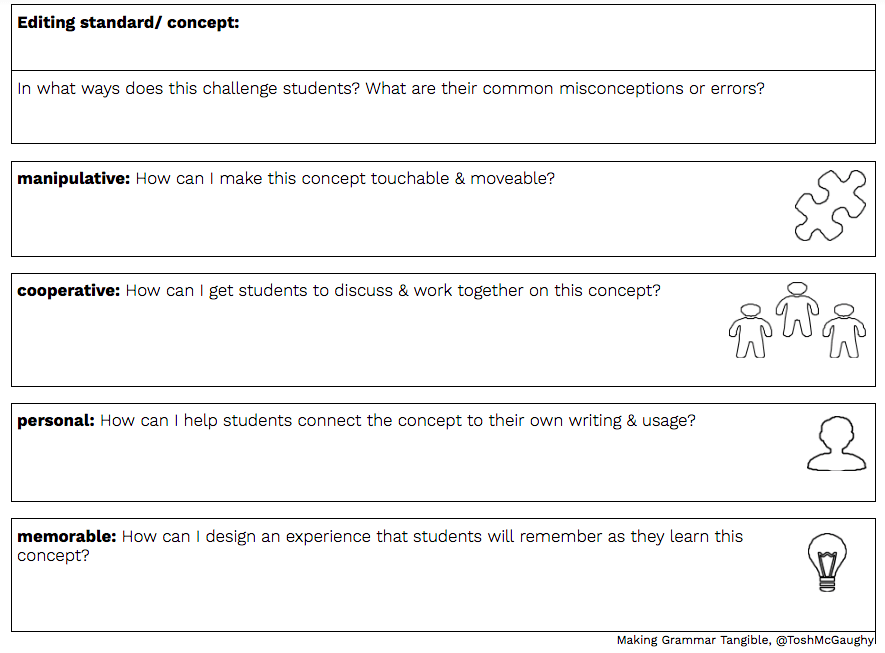
Chart with hyper link

The Successes

One successful mini-lesson that came out of this process was “Punctuation Clothespins Dialogue“. Hearing students repeatedly say that they didn’t “see” the punctuation in sentences and that they felt that punctuating was largely an arbitrary process, I wanted to create a lesson that made the tiny pieces of punctuation BIG while providing opportunities for discussions and revisions to punctuating choices.

HOW: I took colored card-stock and printed out the different pieces of punctuation, with end punctuation printed on one color, and all other punctuation printed on another color. Then, I hot glued (okay…my family members hot glued) the punctuation to inexpensive full-size wooden clothespins. In class, I provided my small group with a mentor sentence from a read aloud text that included punctuated dialogue. (The inclusion of the comma in relation to the quotation marks was baffling my students.) They created their own imitation sentences on paper and then re-wrote them, without punctuation, on large sentence strips. Next, they exchanged with one another and used the punctuation clothespins to punctuate each other’s sentences. The author of the sentence would then check the punctuating and discuss any differences in how their peer punctuated and how they punctuated the sentence. Because the clothespins were moveable, they would just clip and unclip to move them around during these discussions. The whole thing took only 15 minutes, but they engaged with a mentor text, wrote their own imitation sentence, punctuated multiple imitation sentences, and discussed punctuation choices with multiple peers. One of my favorite overheard comments was, “these are top punctuation and these are bottom punctuation” when one student explained where the quotation marks and commas went in a sentence. In all my years of teaching grammar and punctuation, I had never thought of the physical position of these things in relation to a sentence, but that was important to these learners and the clothespins helped facilitate that discussion in a way that my proofreading marks and writing conferences never had.

The “Hot Messes”

I’ll admit, not all all of my “tangible grammar” ideas were a hit. My brutally honest daughter would get in the minivan after school and pointedly ask, “How do you think that went?” Ouch. One particularly spectacular miss was “Punctuation Pasta”. Though having the many shapes of pasta for students to sort, choose, discuss, and use to punctuate their own imitation sentences seemed like a creative idea, it devolved into a crunchy pasta-on-the-floor debacle with seventh graders eating raw pasta (that other classes had touched) and few students (if any) leaving with a better handle on the nuances (and beauty) of correct hyphen use.

The Shift

But, my daughter’s incisive and reflective feedback did push me to take more risks that year, and I kept trying new things to reach those learners that I came to realize I had not been designing for: my kinesthetic students and my students who did not read for pleasure. It also pushed me to research the science of constructivism and concept building in order to tap into the pathways of learning that I had previously ignored. (Visible Learning for Literacy by Hattie, Fisher, & Frey was particularly helpful.) Moving away from “covering” grammar rules in my mini-lessons to truly “teaching” the tools of grammar with chunked, explicit, and very tangible tasks helped my students build understanding in multiple ways, which showed in their writing and improved the quality of our writing conferences.

Layering Notice and Note Signposts over the Plot Triangle

Teaching seventh grade is both a challenge and a joy. Students are inquisitive, silly, maturing . . . and in the seventh grade. Until last year, I hadn’t taught this grade for about eighteen years, and I wasn’t expecting to. But, life can be unpredictable, and in a strange and wonderful turn of events, I have found myself teaching seventh grade students.

I couldn’t be happier.

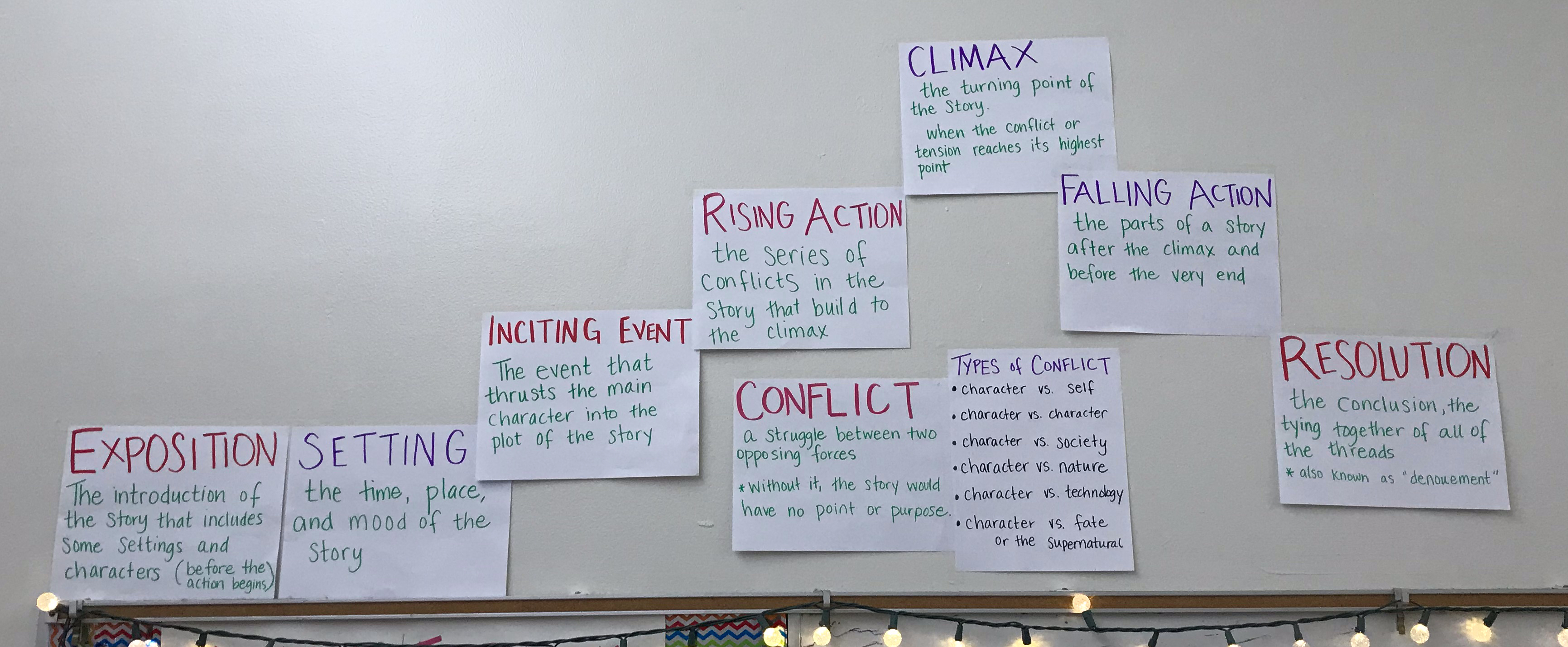
Recently, because of some standardized testing they were involved in, the concept of the plot triangle was raised. My students, for the most part, stared at me blankly, not understanding what it was. I realized that the plot triangle is a simple diagram, but can be a difficult concept.

It was really perfect timing because we were starting to read some short stories together as a class, and we needed some common language for when we discuss and write about them.

I created a chart I and posted it on our classroom wall.

plot triangle

As the students digested the ideas in the plot diagram, I was peppered with eager questions.

Why is the climax so close to the resolution? 

What is the falling action? 

How many events belong in the rising action? 

We talked it through, and students started to feel more comfortable with the ideas, but the next question was one that made me smile. Why does the plot triangle matter?

Fair question. Why? is always a fair question in my classroom, and I had a proud teacher moment.

In trying to explain why the plot triangle matters, I tried to share that a visual representation of a story helps us to understand more deeply.

We made the connection that the fiction signposts also help us to more deeply understand a story. Since we’ve been studying the signposts as we study short stories and narratives, it was a great connection to make.

IMG_6285

So, after class I annotated our wall chart with the fiction signposts. It took some thinking, and I’m hoping I got it right.

I didn’t want to limit anyone’s thinking by suggesting that a signpost might only be found in one part of the story, but I did want to let them know where they might start noticing them.

They started to create plot triangles with some of the stories we had recently read together, and then layering some of the signposts into the plot triangle.

  1. Charles by Shirley Jackson
  2. Thank You, M’am by Langston Hughes
  3. The Medicine Bag by Virginia Driving Hawk Sneve
  4. Fourteen by Alice Gerstenberg

Here are some examples of what they did right at first:


My students aren’t done creating their plot triangles, and they aren’t done thinking about how the layering of the plot diagram and the signposts complement one another, but so far their thinking is going in the right direction.

They are asking questions and making connections. They are talking to each other and challenging each others’ thinking. They care more deeply about the stories and the characters they are reading about.

I’ll call it a win.

Update: I had another “aha moment” and asked my husband to help add another layer to the wall chart. What do you think?

plot triangle w tape

Julie has been teaching secondary language arts for twenty years, spending the first fifteen in rural Central Oregon,  four in Amman, Jordan, and the most recent school year in Managua, Nicaragua. 

Follow her on twitter @SwinehartJulie

Not Averse to Verse: Using Novels in Verse to Engage English Learners #ILA2019

This is a guest post by Dr. Helen Becker, and I owe her a big apology. I had agreed to run this post before her presentation at ILA. I have a million excuses:  None will do. So I publicly I say, “I’m sorry for not following through,” and if you are reading 3TT today, know this:  Helen is one of the smartest educators I know.   ~Amy

To understand the instructional power of novels in verse in the high school English classroom, you must first know a bit about my former school. Clear Creek High School, a comprehensive high school in Clear Creek ISD in southeast Houston, serves 2500 students in grades 9-12. According to Texas Academic Performance Reports (TAPR) published by the Texas Education Agency (TEA), in the last five years, the campus has experienced a steady rise in the number of English Language students. Many of these students have come from Latin American countries.

What you must also know is that our district advocates student choice reading in a reader/writer workshop setting. Furthermore, to provide students greater choice in reading material, the district invested nearly a million dollars to flood classroom libraries with high-interest books. Self-selected independent reading has become a constant in the changing school landscape at Clear Creek High School.

Fast-forward to my fifth period Reading class two years ago: a group of thirteen boys and one girl who, despite the best of intentions and instruction, had still not passed both End of Course (STAAR) exams in English. Enrollment in a Reading course, coupled with co-enrollment in grade level English class, was meant to close the gaps in their reading and writing lives. This is where the workshop model and classroom libraries intersected with my fourteen EL students. When the District ELA coordinator brought a stack of newly released novels in verse to my fifth period Reading classroom, the students devoured the books. Thanks, Billy Eastman.

And so began my quest to know more about the power of using novels in verse in the EL classroom. I knew I had found a topic that I needed to know more about – for not only my use in my classroom but use in the classrooms of others as well. While researching the topic further, I encountered a noticeable lack of research-based information about using novels in verse with EL students.

In fact, the only direct source of data I located was from Farish (2013) who writes based on her first-hand work as a librarian at a school with a large population of EL students. Farish writes in School Library Journal that the poetic form of novels in verse mimics folksongs and tales that are part of many foreign cultures. As a result, EL students feel comfortable with the novel in verse genre because of this similarity.  Farish (2013) adds, “Many who work with English-language learners and others who struggle with reading seek novels that promote fluency and a sense of competence in readers.” Verse novels accomplish just that. They can move fast and offer readers at any level a feeling of completion.

I broadened my research scope to consider the transferrable skills all students, not just ELs, could practice with novels in verse as an instructional medium. The arrangement of words and a sheer abundance of white space on the page makes these books, well, friendly and approachable. EL students have fewer words to decode. Furthermore, Young Adult novels in verse often involve a protagonist with the same issues the EL students themselves are encountering. In short, novels in verse promote student agency (Garud, Hardy, & Maguire, 2007; Oakeshott & Fuller, 1989; Tran & Vu, 2017), and self-efficacy (Bandura, 1977).

But my experience with novels in verse really concerns one Fifth period Reading student in particular: Emerson. Emerson moved to our community from Guatemala five years ago and had difficulty finding books in English to read in my class. He experimented with books at a lower Lexile (I, for one, feel that Lexile level hinder rather than encourage literacy. This Literature Review from ALA provides data to support my stance on Lexile levels), but he was quick to abandon them, shrugging and saying, “They are boring, miss.” When I put Booked by Kwame Alexander in his hands, I totally mean it when I say that I didn’t see Emerson’s nose for a long time…it was in his book the entire time. In fact, I’m pretty sure Emerson read the book several times over. When I asked him about the book and why he liked it so much, Emerson said, “It speak to me.”

I cried those tears you cry when a student finally connects with a book.

As a result of my experience with ELs, I authored and co-presented a workshop at TCTELA on using novels in verse to engage English Learners in the high school classroom. In the session, fellow teacher and now Instructional Coach Megan Thompson and I delved into ways to leverage this popular genre to encourage reading comprehension and improve writing craft. I reworked the presentation for the International Literacy Association (ILA) conference this month in New Orleans, and Megan and I and invited our fellow teacher and TCTELA High School Section chair, Charles Moore, to join the presentation team. Both Megan and Charles brought their expertise as literacy leaders to the presentation.

Helen Charles Megan at ILA2019

If you were not able to attend the presentation but want more information on novels in verse in the EL classroom, reach out to me at hbecker@ccisd.net. I’d love to share my learning with you.

P.S. I gave my copy of Booked to Emerson as his graduation present.

For research citation see here.

Helen Becker has taught all levels of English Language Arts as well as AP Capstone Seminar in her seventeen years teaching secondary English. Today, Dr. Becker teaches Senior English at Clear Brook High School in Clear Creek ISD. Any day now, a suitable replacement for her will be found, so she can transition to her new job in the CCISD Office of Assessment and Evaluation. Until then, every day is a workshop day. Which means every day is a good day in Room 406.

Book Snapchats

While I’m a little bummed I’m not attending NCTE in Baltimore this year, NCTE 2018 in Houston was awesome–I’m still going through my notes nearly a year later!  Not only did I get to meet a handful of Three Teachers Talk contributors in person, snag new books, fangirl favorite authors, and catch up with former colleagues from Lousiville and Houston, I headed home challenged by new ideas and armed with new activities to implement in my workshop.  NCTE is truly a magical event for educators–enjoy if you’re heading to Baltimore next month!

Like many of us, I am always seeking different, engaging ways students can interact with and analyze a text.  One such activity from Charles Youngs (@Charles_Youngs), an educator and instructional coach in Pennsylvania, was Book Snaps.  Students are tasked with finding a significant page in a text, then creating an analytical “snap” via Snapchat.  While we work on annotating and sketchnotes throughout the year, Snapchat opens the arsenal of analysis tools students can access to create meaning.  There are stickers, filters, animated gifs, color tools, stamps, and other features I don’t even know about which students can use to digitally annotate.  Last year, I used the activity to study the minor characters and themes in The Bluest Eye in small groups.  This past week, my students created a snap about their independent reading book as the quarter comes to a close.

As students spent time finding the page that would “sell” their book, the discussion surrounding gifs and stickers turned analytical.  Students asked one another for advice on the features and, in the process, discussed the characters, conflicts, and themes with one another.  I didn’t expect to hear such thoughtful commentary while students were creating.

If students did not have Snapchat, I offered the opportunity to take a picture of the page then edit it on Google Slides.   Once students completed and downloaded their Snap, we compiled them on one Google Slide deck.  Don’t worry if you’re not Snapchat savvy–your students definitely are!

Maggie Lopez only sends snaps of her dog Bounder to her husband and is currently reading The Spy and the Traitor by Ben MacIntyre.  You can find her on Twitter @meglopez0.

A Picture Book for Your High Schoolers

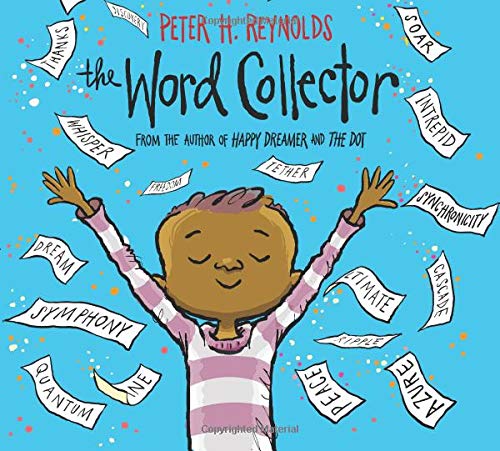
Image result for the word collector

I’ve always been a little puzzled by my dichotomous love for both classic, canonical literature and…….unabashedly romantic, sometimes risque, always happily-ever-after……..romance novels.

But as I thought more about it, I realized that what I love about the classics is their lasting potency, the punch that their language and stories deliver, no matter when they’re read. And what I love about romance novels is watching the classic, timeless journey of a fall into love.

And, thanks to a coffee-fueled epiphany in my notebook, I realized that being a teacher of readers and writers was the perfect career for those two passions of mine: I love to see my students falling in love with reading and writing.

Last week, I read a new book to my daughters that struck me as the perfect illustration of that journey into love with words: The Word Collector by Peter H. Reynolds.

As I read, I was struck by what a perfect picture book this would be to share with my high schoolers. Not only is it chock-full of SAT vocabulary words (which, while that is a concept I loathe, I do admit is a lovely list of cool words), it shows the power and joy of language and all that it offers to both readers and writers.

If you have this book, I urge you to read it with your students. If you don’t, the video linked above does a great job telling the story as well. The possibilities for linguistic play and discovery as you study the text are endless, and endlessly enjoyable–and don’t we all need that kind of joy in our classrooms, as often as possible? Try this text out for one way to bring some sunshine into this dreary Friday.

Shana Karnes lives and works with teachers in Madison, Wisconsin. Her two daughters push her to discover new texts and sneak in the reading of grown-up ones as often as possible. Connect with Shana on Twitter at @litreader.

Increasing Writing Volume with NaNoWriMo by Sarah Krajewski

Over the past few years, I’ve worked hard to help my high schoolers increase the volume of reading they do. I book talk popular titles. I give them time to read a book of choice in class. I’ve incorporated student-led book clubs. All of this gives my students what they need to increase their reading volume, but what about their writing volume? Over the summer, I spent some time thinking about ways to increase their amount of writing.

I already incorporate quick writes each day. Students receive independent work time so they can make some progress on a writing piece, but I usually have my own requirements for that piece. Currently my seniors are finishing up college application essays, and my freshmen are adding a second scene to their single-scene narratives. I’m telling them what genre to write in. Though they can choose the topic, I am assigning a task and giving them a rubric. My students need a challenge. They need to push themselves to writing independently outside of class just like I encourage them to do with their reading. Enter National Novel Writing Month (or NaNoWriMo, for short).

What is NaNoWriMo? National Novel Writing Month began back in 1999, and its goal was to encourage participants to write 50,000 words throughout the month of November. I’ll admit that I did not know about NaNoWriMo until a few years ago when I read Vicki Meigs-Kahlenberg’s The Author’s Apprentice. Her 8th graders participated in it, and she was so impressed with the results that it became a staple in her classroom each year. If her 8th graders could do it, couldn’t my 12th graders? I decided that this year would be the year to try it.

Preparation

The Author’s Apprentice: My seniors will finish up their college application essays this week, and then we will begin preparation for NaNoWriMo. In order to prepare myself, I am rereading The Author’s Apprentice. Meigs-Kahlenberg has her students prepare by starting with weekly writing challenges. These challenges push students to read like writers and eventually imitate what writers do to improve their own writing. This way, if students get writer’s block during the process, or are just stuck for an idea of where to go next, they know they can visit the worlds of the authors they love for ideas.

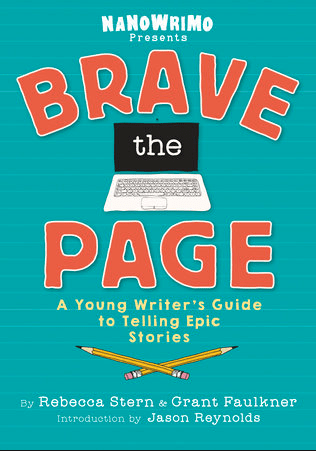
Brave the Page: I also just finished up NaNoWriMo’s book, Brave the Page, which is written more for student writers, but I got some great ideas from it. The introduction is written by none other than Jason Reynolds, one of my students’ favorite authors every year. He gives a great pep talk to young writers. The section that follows reminds students that all of them are already writers. The inspirational quotes and tips will motivate all readers, no matter the age. Be sure to check out the audio version too! Authors like Jennifer Niven, Marissa Meyer, and Daniel José Older give their own pep talks as well. I plan to use them throughout the month when I see students needing more than just my encouragement.

NaNoWriMo Website: NaNoWriMo has a Young Writer’s Program for educators that we will be using. Teachers can create groups, which I did for each class. Students can chat with one another, and provide inspiration that sometimes a teacher cannot. As their teacher, I can make challenges to push them along. If desired, there is a whole high school curriculum that educators can use. With all of their resources, educators’ minds will be eased.

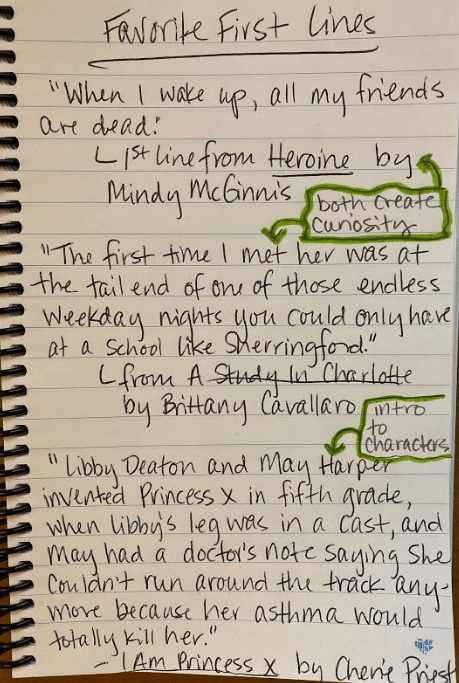
Some of my “favorite first lines.”

Mental Prep: As teachers of writing, we often know that simply getting started is the hardest part for many students. Next week, my seniors and I will begin preparing by starting to bring our notebooks with us everywhere. (I say “we,” for I will be writing along with them.) When an idea comes to us, we will write it down. We will use our quickwrite time to create lists about past events in our lives, things that made us laugh, things that made us upset, etc. We will collect “favorite first lines” from the books we love. We will talk about giving ourselves goals, and planning out when our “writing time” will be outside of class. We will talk about those all-important deadlines, but also remind ourselves that we are not failures if we don’t meet them. We already have writing routines, but we will create new ones to prepare for the amount of writing that is coming our way. In other words, we will mentally prepare for 30 days of consistent dedication to writing.

Time to Get Started!

So, I think we are ready! Well, we are as ready as we’re going to be. I know I cannot plan for every single issue that could arise, but I’m thankful that my students have a trusted writing community that will encourage and assist them every step of the way. When November 1st hits, my students will begin writing more than they ever have, and I can’t wait to see the results! My hope is that this experience will inspire many of my students to create independent writing routines, even after November ends.

NOTE: I look forward to sharing how NaNoWriMo is going for us next month.

Sarah Krajewski teaches 9th and 12th grade English and Journalism at Cleveland Hill High School near Buffalo, New York.  She is currently in her 18th year of teaching, and is always looking for new, creative ways to help her students enjoy learning, reading, and writing. At school, she is known for dedicating her time to helping students become lifelong readers, and for being a devoted reader herself who “knows her books.” At home, she is a proud wife and mother to three readers.  You can follow Sarah on Twitter @shkrajewski and her blog can be viewed at http://skrajewski.wordpress.com/.

Getting to Know You: Beginning of Year Conferences by Sarah Esberger

I know, it’s not the start of the school year anymore. We’re in, and there’s no going back. Still, I wanted to share how beginning of the year conferences went for me this year, so your next year can get off to a great start. Just tuck this idea away until then. 

We all know it’s important to build relationships with our new students. We also know that, in a writing classroom, it’s especially important to develop a classroom community. If students are going to share their writing and give and receive useful feedback, they have to feel comfortable. Like me, I’m sure your year often starts with get-to-know-you activities that introduce the students to each other, maybe help them problem-solve a little, and also introduce some low-stakes writing activities. 

This year, however, I knew I would be conferencing with my students on a regular basis about their writing and reading, so this process also needed an introductory activity. 

The Process

During the first full week of school, I asked the students to prepare to meet with me one-on-one. These were the directions I gave them: 

I would like to be intentional about conferencing regularly with all of you, usually about your reading and writing. While you work with your groups today and the next two days, I would like to also meet with each of you individually for about 3-4 minutes. I will not conference with the entire class, so if your group has a question about your project, please come see me. I will also come around and check on you.

Obviously, these will be short conversations. I would like you to come ready to tell me about any of the following:

  • What’s really important to you – in or out of school
  • How you feel about this class so far – concerns or worries/excitements
  • Anything you think I should know about you that might affect your performance in this class
  • Any questions you have for me 

Throughout the next couple of weeks (this took longer than the few days I imagined), any time students were working in groups or working individually, I held conferences with students at my desk. I keep a writer’s notebook throughout the year with my students, so I simply created a section for each class period and added each student’s name, leaving space for notes from future conferences.

When they came to speak to me, I set a timer on my phone for 3 minutes, letting them know that this would be a clue to wrap up our conversation, and then I just simply asked, “What should I know about you?” 

We would talk for a few minutes with me taking notes, and then I would move on to the next student. 

Thoughts

I had asked students to complete a Google form asking much of the same information I asked for these conferences, but students told me so much more when we talked in person. I learned who really loved English class and who had other passions. I was able to talk books with my readers and assure my science-minded students that there was a place for them in the research we do in AP Language and Composition, especially when it comes to choice reading. I learned who worked long hours at night and on weekends and who had little siblings to take care of after school. I could connect with them over favorite musicals, traveling, and video games. 

Perhaps most importantly, students revealed mental and emotional issues that they would not likely share in a survey. I learned how I could help my students with PTSD cope with feelings of distraction during class. I learned who may need to see the counselor for anxiety issues. I learned who was a cancer survivor and who had just started seeing a therapist. 

These were important discoveries that may have taken me the whole year to learn. Perhaps most importantly, I established that I cared about my students, their learning, and their lives in the first few weeks. I have noticed that my students have seemed more invested in my class this year. They are taking the assignments seriously, doing their best work, and communicating regularly about their progress even without my prompting. Perhaps this is all because I showed them that I was invested in them.

Sarah Esberger teaches AP Language and Composition and Sophomore English at Central Magnet School in Murfreesboro, TN where she lives with her second-grader, her husband, three furry friends, and a bearded dragon. She also runs her school’s student-tutored Writing Lab and is always seeking new ways to incorporate James Britton’s concept “reading and writing float on a sea of talk” into her teaching.

Text Talk: Speak by Laurie Halse Anderson

Speak, by Laurie Halse Anderson, has been on my radar for years, but it burst into my classroom last year after Pernille Ripp’s Global Read Aloud inspired me to do a read aloud of Anderson’s text in my class. With some heavy groundwork laid for trigger warnings and difficult subject matter, the text spurred conversation, self reflection, and some seriously intense quick writes.

So, during my latest jaunt to Half Price Books, I was beyond tickled to see the graphic novel version of the text with illustrations by Emily Carroll. Though it’s been out for well over a year, I missed its release, and I’m so sorry I didn’t snag it sooner.

After some perusal, I find it to be an absolutely gorgeous visual text. It’s full of gripping images that convey not only the raw emotion of the pain and uncertainty Anderson’s main character Melinda experiences, but the formatting of the text itself is also a work of art.

Ways I Have Used Speak and Its Graphic Novel Version:

  • Character Analysis: Especially early in the book, the protagonist Melinda is a wealth of character development through thoughts, actions, dialogue, and mysterious backstory. Students (especially my freshmen) can relate to her struggles on the first day of high school and as the book progresses they see the reasons for her struggle as raw and real.
  • Prose as Poetry: The formatting of the graphic novel highlights specific words and phrases, literally drawing the depth of the text into a mentor for rhetorical analysis in a way that helps struggling students see the emphasis and emotions without quite so much inference. For some of my language learners, this is key to both understanding and engagement.
  • Narrative Mentor Text: As students transition from studying narrative to writing their own, this text serves as a mentor with clear and engaging voice, rich story lines, realistic dialogue, and relatable characters.

Have you used Speak as a mentor is your classroom? Have you read and enjoyed it yourself? Feel free to leave a comment below and share your enthusiasm for this awesome text!

Lisa Dennis spends her school days teaching AP Language and English 9, while also leading the fearless English department at Franklin High School, just outside Milwaukee, Wisconsin where she lives with her husband Nick, daughter Ellie, and beagle Scout.  She now tries to live life based on the last pieces of advice her dad gave her – Be kind. Read good books. Feed the birds. Follow Lisa on Twitter @LDennibaum

Being Changed

baby-changing-chest-of-drawers-4518766_1920Before I became a teacher, I was a district manager for a women’s retail chain. One year the company went through a major change in their customer service program that included hours of new training. Our management team was under enormous pressure to perform, and no one was happy about the change. Marilou, our human resource manager, told us, “The only people who like to be changed are babies.” That quote has stuck with me all these years.
As a teacher, I have gone through so many changes. From grade levels to buildings and administrators to teaching partners and new standards to new testing and to the next how-to-get-higher-test-scores program. These changes add additional stress to already stressed-out teachers.

Change is simply a part of education; however, being changed is more accepted by reflective teachers. As I look back at the changes I have made in my classroom, implementing reading and writing workshop has been my most challenging, yet also the most rewarding.

In the early stages of this journey, I read books and blogs and attended conference sessions on reading and writing workshop. I met educators on social media who have been using workshop successfully for years. They made it appear so easy. In their perfect (in my mind) classrooms, independent reading was at the forefront, writing mini-lessons moved seamlessly into work time, and conferring with students was productive. I thought this was how teaching was supposed to look and was how I wanted my classroom to be.

I started my teaching career as an elementary “basal teacher” because that was what I knew and was how the other teachers taught. Prompt writing was our curriculum because that was how writing was tested. After moving to middle school and becoming a mentor teacher, I knew this would be the perfect time to make a change toward the workshop approach.

Independent reading has been the heartbeat of my classroom for many years and was already in place. Once I made the commitment to try the workshop approach, my mini-lessons became focused on the skills and strategies my students needed to become successful readers and writers. Conferring became routine, and reading and writing became engaging and authentic for my students. None of these changes happened overnight, and I am still changing.

If you have decided to make the change to workshop, then I encourage you to think about these three ideas to get you started:

  • Think Big–Start Small  When deciding to implement reading and writing workshop, see the big picture. Have a goal of where you want to be but begin with little steps to get there. Implement small pieces of the workshop model. I began with choice–giving students choice in the topics to write about and the books to read. I slowly began creating mini-units that included a series of mini-lessons with work time and conferences built in. You could begin here, or you might begin with collecting mentor texts or focusing on making your mini-lessons “mini.” The important part is that you take that first small step.
  • Allow Failure and Accept Grace  Many days I wanted to quit and go back to what was easy. I wanted my workshop to look, sound, and feel perfect. Most days it wasn’t. But then I realized I needed to give myself some grace because change takes time. My students were beginning to see the connection between reading and writing and that the work was authentic. It was what real readers and writers do. I knew I was going in the right direction.
  • Make Connections  I come from a district that does not use workshop, so any learning has always been on my own. Making connections with mentors made it easier. Three resources that I read at the beginning of my journey were Donalyn Miller’s The Book Whisperer and Book Love and Write Beside Them by Penny KittleThese three books gave me the courage to do what I knew in my teacher’s heart was right, and I never turned back.

The Three Teachers Talk blog has a wealth of resources on implementing reading and writing workshop. Penny and Donalyn were the “big picture” and Three Teachers Talk has been the “small steps” I needed for my own professional development. 

My journey is far from over as I continue to learn, reflect, and change every day. I am no expert, but I share with you what I have learned in hopes to make your journey to workshop teaching a little bit easier.

I think I may need to revise Marilou’s quote to: “The only people who like to be changed are babies and reflective teachers.”

Change is hard; being changed is amazing.

As teachers, we are all on a journey, but we don’t have to go it alone. Please share your journey with us in the comments section.

Leigh Anne Eck teaches 6th grade English language arts in Southern Indiana and loves to learn. She recently recieved her Master’s degree in Curriculum and Instruction at the young age of 55. She loves partnering with her husband in parenting their young adult children. Connect with Leigh Anne on Twitter @teachr4.

Embrace the Chaos – How Getting Lost in a Corn Maze Brought Me Some Clarity

This past weekend, I found myself unexpectedly lost. An innocent trip to the pumpkin farm to enjoy a beautiful fall day in Wisconsin quickly deteriorated to a literal Children of the Corn situation as my six-year-old and I spent almost 45 minutes lost in a corn maze. It was a maze of maise, as it were, and the two of us were no match for its twists, turns, or other cleverly landscaped stalks of doom.

As our enthusiasm for our new adventure began to wane, my panic level began to rise. It was no surprise that my daughter needed to go to the bathroom. It was no surprise that we hadn’t had lunch yet and were both starving. It was no surprise that the stalks of corn kept thwapping me in the face. I started having visions that we might be stuck in there for quite a while. What if it started to get dark? What if we turned in circles for hours and couldn’t find the entrance or the exit? What if the mini donut stand closed before I could make my way out?

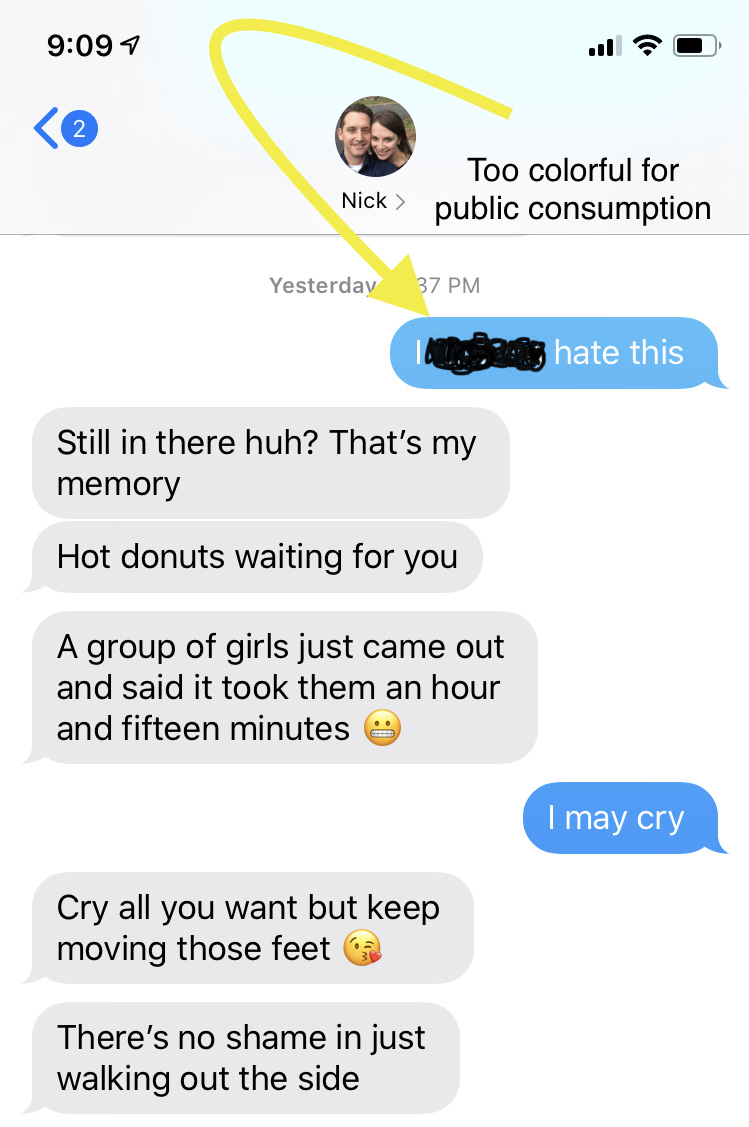
In desperation, I texted my husband. Using some inappropriate words, I conveyed how disappointed I was that I had thought this would be a good idea and that I was getting sincerely scared about how long it would take us to find our way out. Thus far, my daughter and I had been rather innocently complaining about wanting to be done. Thankfully she hadn’t caught on yet to my growing concern about our situation.

A few moments later, we passed a young couple, headed the opposite direction. Trying to defuse tension with humor, as I often do, I smiled brightly and quipped, “Been in here long? Feels like we may have to spend the night in a corn field!”

“Yeah, we’re sort of stuck too,” the woman replied with a sigh. “We’ve been in here almost 90 minutes.”

***Insert Awkward Fake Laughter Here***

As my panic reached a fever pitch, a text came in from my husband.

“There’s no shame in just walking out the side…”

There might not be shame…but there’s a bit of fear for sure.

What if I pull my daughter off the path and into the corn only to lose my bearings completely? What if we walk toward a landmark that just happens to be in the middle of more corn? What if I have to utter the word “corn” one more time and I lose my mind?

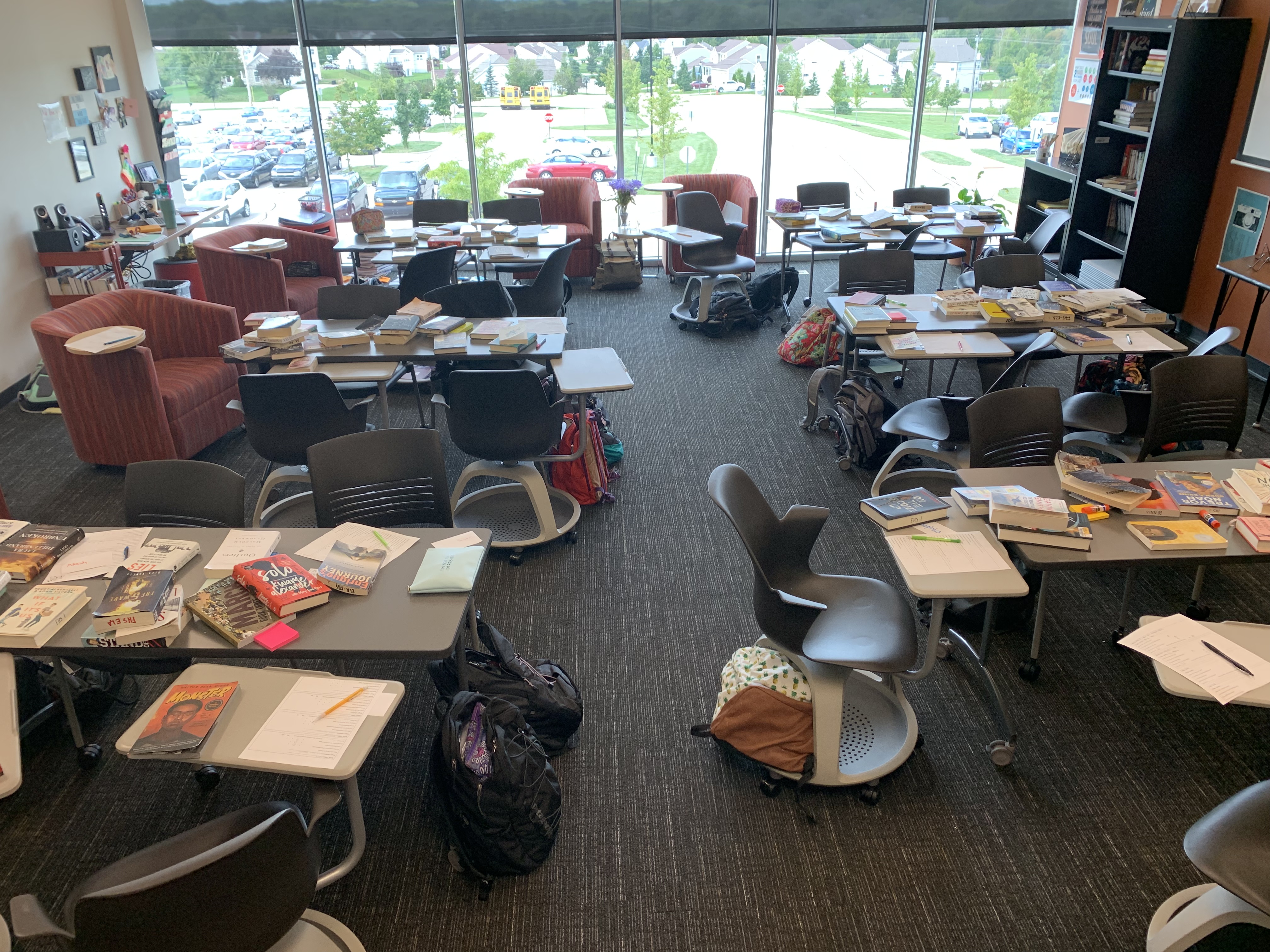
Speaking of losing one’s mind. How’s the start of hour school year been for you? (Nice segway, hmmm?) If it’s anything like mine, there is a very thin line between the enthusiasm of this beautiful fresh start, and the disorienting chaos of being lost in the middle of what is indeed familiar, but no less overwhelming. 30 freshman (13 of whom have professed to hate reading. Hate.), will do that to a person. And that’s just one period.

Split lunch makes for quite the scene

But short of diving for the exits (or the pandemonium of a course forward without a path) what’s a passionate educator to do?

  • Routines – Remember to fall back on the routines of workshop when in doubt. When the crazy of homecoming week has your students climbing the wall, starting the class with 15 minutes of silent reading is not only beneficial, but a soothing balm of calm. I don’t compromise on this time – ever. We read no matter what and we read because no matter what, it’s one of the most important things we do. It gives my students time to change the crazy, amped up rhythm of their day, it gives me time to confer with kids, and it sets the tone for the whole class period of learning. Chaos be gone (eventually, as freshmen are still learning this quiet skill).
  • Build relationships – When I take some time to reflect on what’s causing me anxiety in the classroom, it is rarely the students. It’s the grading, the planning, the politics, the meetings, the everything that takes my time away from getting to know my students. So, when I’m struggling (this time it just happened to be in a field of corn), I try to remind myself that knowing my kids (academically and personally) makes all the difference. We can get through the tough together when we’ve established a connection as a class that makes us a community. When that community is focused on building readers and writers, all the better.
  • Self Care – I texted the Three Teachers last night with a bit of a plea/cop-out/desperate cry for help. I wasn’t sure I could post today. Last week saw PD on Monday, a department meeting Tuesday, School Improvement Team time out of the classroom on Wednesday, English Department Review Thursday morning (also out of the classroom) and PLC on Thursday afternoon. Then I got lost in corn. I’m behind and feeling disconnected from my kids. Amy’s simple advice “Self care, self care, self care” reminded me of a very important fact. One, I’m not alone in this treading water scenario and that brings some comfort. Often, in panic, we feel very isolated. In the community of educators, however, there is a lot of support for the over-committed, overtired, over-stimulated teacher. Instead of wallowing in it though, the mindful practice of self care and acknowledgment of our feelings can go far in helping us seek the balance we need.

In these reminders, there is nothing new. And in that, should be the calm in the chaos we all need. When the rows of corn feel stacked against you, choose a path and head in one reassuring direction. You will emerge. You will be in one piece. You will avoid corn mazes from now on, but in terms of the analogy…you’ll have come out the other side with a new appreciation for seeking the type of calm that can positively impact your day, your teaching, and your sanity.


Lisa Dennis spends her school days teaching AP Language and English 9, while also leading the fearless English department at Franklin High School, just outside Milwaukee, Wisconsin where she lives with her husband Nick, daughter Ellie, and beagle Scout.  She now tries to live life based on the last pieces of advice her dad gave her – Be kind. Read good books. Feed the birds. Follow Lisa on Twitter @LDennibaum