Category Archives: Readers Writers Workshop

Reel Reading: Crackback

20130207-190708Brandon’s asked me every week if I had any books about football. Sadly, my classroom library is lacking in sports books. Then, while shopping at the EF book sale, I found this gem. I’d like to put Brandon’s name on it, but I won’t. I’ll show the trailer and let him beg for it in front of the class. I’m mean like that.

Crackback by John Coy

Prior Knowledge: Helping our Struggling Readers

book depository

Every day we must make decisions, and somehow, whether we realize it or not, we are accessing our prior knowledge to make these decisions.  For example, there is a restaurant that I will never eat at again. 15 years later, I still remember the time I got violently ill after consuming one of their calzones. Now, someone brings up that restaurant–I cringe.

Sometimes my prior knowledge doesn’t come from real life. Sometimes it comes straight out of a book. A few weeks ago I had to make a really tough decision. As I sat weighing the pros and cons of my choices, Beatrice, from the book Divergent, and the struggle she had making a difficult choice came to mind. I found myself relying on her experience because that in fact was exactly how I felt.

Prior knowledge can come from a multitude of places, but it is the experiences I have had–along with the books I have read– that fill my storehouse of prior knowledge.  So what about prior knowledge and our struggling readers? Their storehouse of prior knowledge is barren. In talking specifically about early literacy, Nancy Lee Cecil explains that, “What readers bring to the activity in terms of prior knowledge … determines how well they will be able to derive a rich meaning from the text,” (Cecil, 2003). So, what about our students who do not have a rich background of prior knowledge? Whether it be a lack of experiences or a lack of reading–my question is:

What are we doing as educators to support students creating a bountiful array of prior knowledge experiences?


The most important thing teachers can do to help equip their students with a wealth of prior knowledge is provide opportunities for them to read–and read a lot. It isn’t about assigning book after book as a whole-class novel. It is about Independent reading. “Independent reading is all about capacity building,” (Kittle, 2012). By allowing students the time to vicariously live through the lives of characters in books, we in turn are allowing them to store up experiences. As teachers it is our responsibility to, “pay attention to the quantity as well as the quality in their reading lives (Kittle, 2012).” If students are to truly live culturally rich lives, then we must be more intentional about how we are making this happen in our classrooms.

Cecil, N. L. (2003). Striking a balance: best practices for early literacy (2nd ed.). Scottsdale, Ariz.: Holcomb Hathaway, Publishers.

Kittle, P. (2013). Book love: developing depth, stamina, and passion in adolescent readers. Portsmouth, NH: Heinemann.

Photo credit: TunnelBug / Foter.com / CC BY-NC

It’s Monday What Are You Reading? ONCE, THEN, NOW

Mon Reading Button PB to YA


Once I escaped from an orphanage to find my Mum and Dad.

Once I saved a girl called Zelda from a burning house.

Once I made a Nazi with toothache laugh.

My name is Felix.

This is my story.


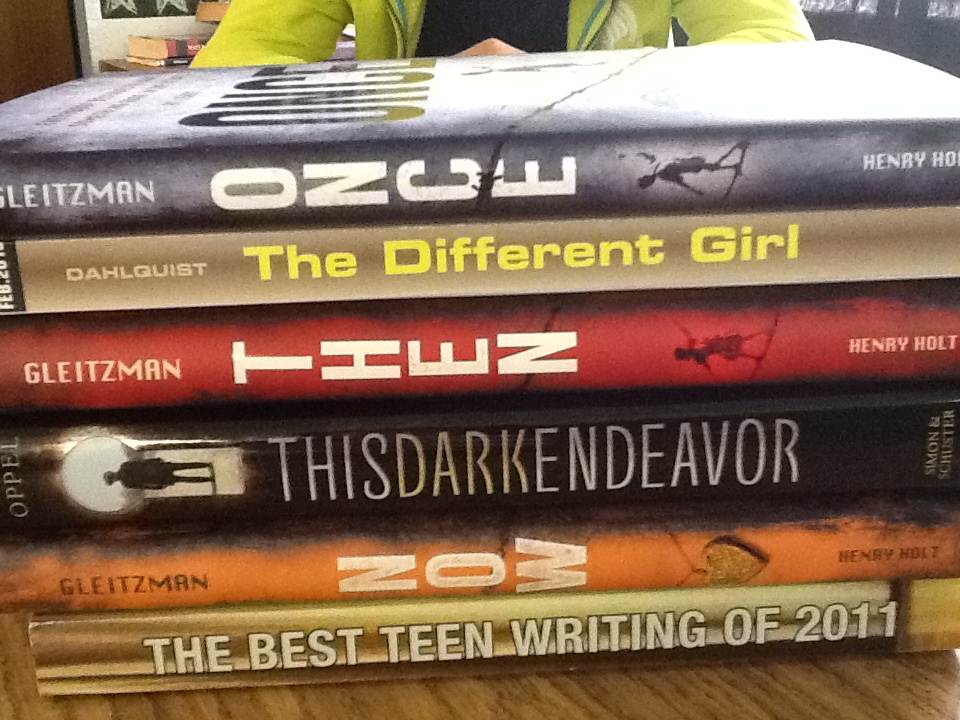
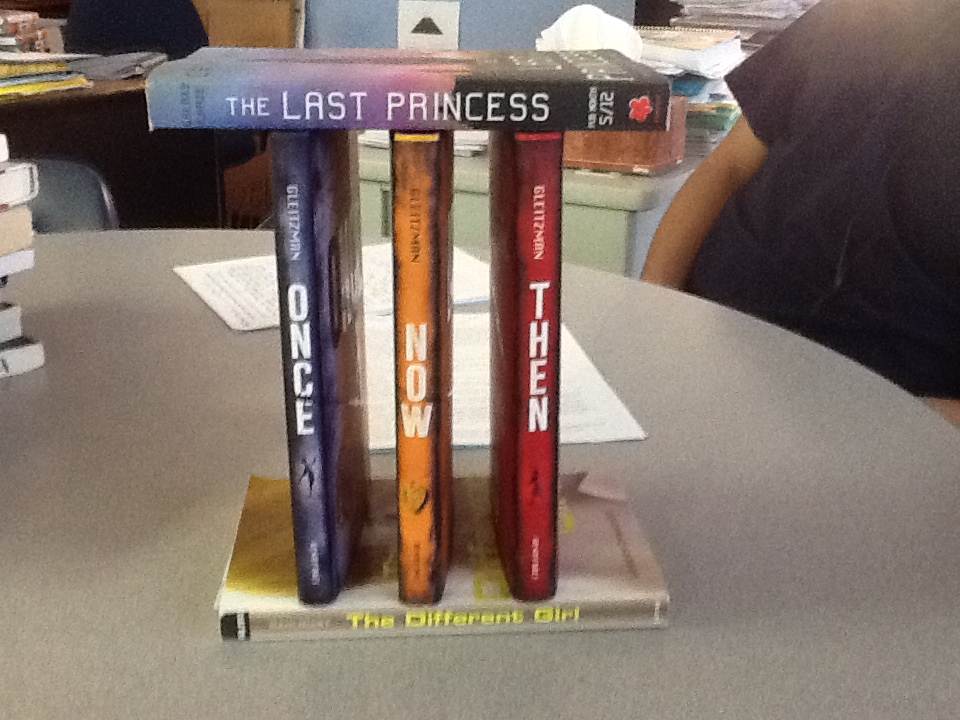
A friend told me about these lovely books a long while ago. I love the covers. The simplicity, the intrigue of the soft pictures: a boy on a barbed-wired tightrope,  a boy and a girl on that same tightrope, a locket in the shape of a heart. Heather, you should have tied me up and forced me to read these tender books much sooner?

I want to expand my students’ thinking and get them thinking about the world beyond their neighborhoods. I want them to learn what empathy is and the value of it in their own lives. In past years, I’ve taken students to the Holocaust Museum in downtown Dallas. These books are a sweet reminder of why that is such a worthy activity.

The author reads the first chapter: “Once I was living in an orphanage

Reel Reading: Fat Angie

20130207-190708“There was a girl. Her name was Angie. She was happy.” ~E.E. Charlton-Trujillo

How can you not love a book with a cool title? My Sister Lives on the Mantlepiece is my favorite book title of all time. The book itself was pretty good, but oh, that title!

Fat Angie has rested on my whiteboard rail for some time now. I decided I needed to make it move and found this awesome book trailer. I know the perfect student for this book, but I’ll show the trailer and let her see why it screams “Read me!” for herself.

Close to the top of my favorite things to do:  match the perfect book with the perfect kid. Hoorah!

Spine Poetry: A Hit and a Bonus

I didn’t carefully read this post Wanted: Any and All Book Spine Poems, but I took the idea and ran with it. Now, I need to let 100 Scope Notes know about our fun as we kick off National Poetry Month.

The Friday before spring break I needed something engaging to do with students whose hearts, minds, and souls were already on vacation. Classes were short, and we only had 35 minutes.

Creating spine poetry did a few key things:

1. Students had to read book covers–and, BONUS, some kids even checked books out from me after class.

2. Students had to think about words that would create topics and themes in order for their poems to make sense.

3. Students had to read their poems aloud, making sure that even without punctuation, their poems could be read with some kind of rhythm.

4. Students got a little introduction to the much more rigorous study of poetry we will do this month.

The Process:  I have eight round tables in my room. I took a big stack of random books from my classroom library shelves and stacked them on each table. I showed the one model in the link above, and told students to get to work.

  • Create a poem, using only the words on the spine of the books.
  • Your poem must make sense–if it has a theme, even better!
  • You must use at least five books.
  • Someone in your group must read your poem aloud to the class.
  • Let me know when you are finished creating, so I can take a picture of your stack of books to show the class.

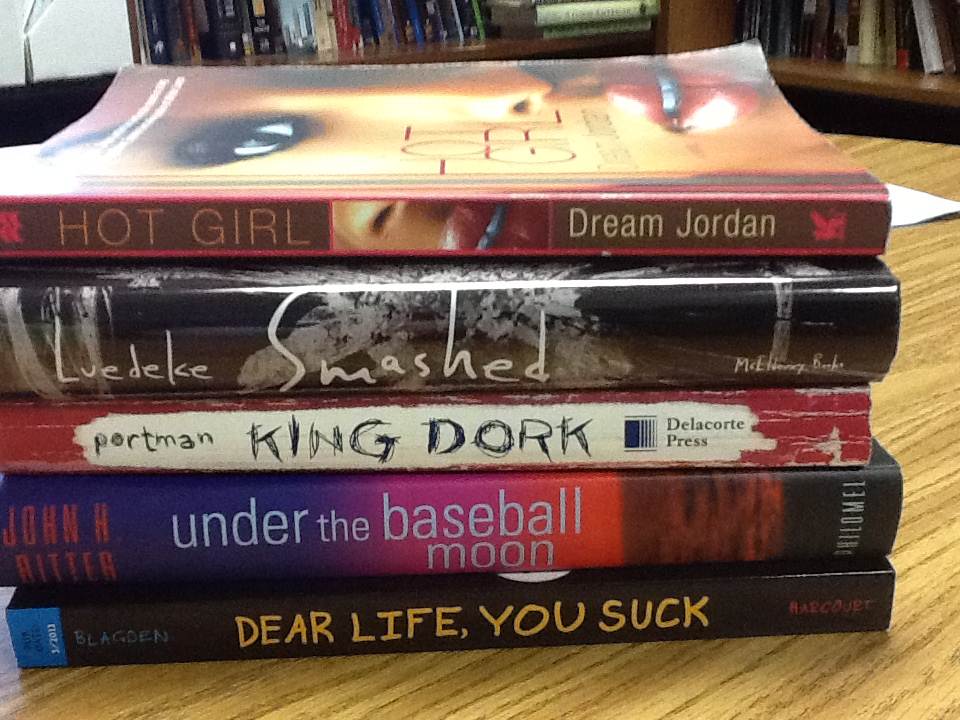
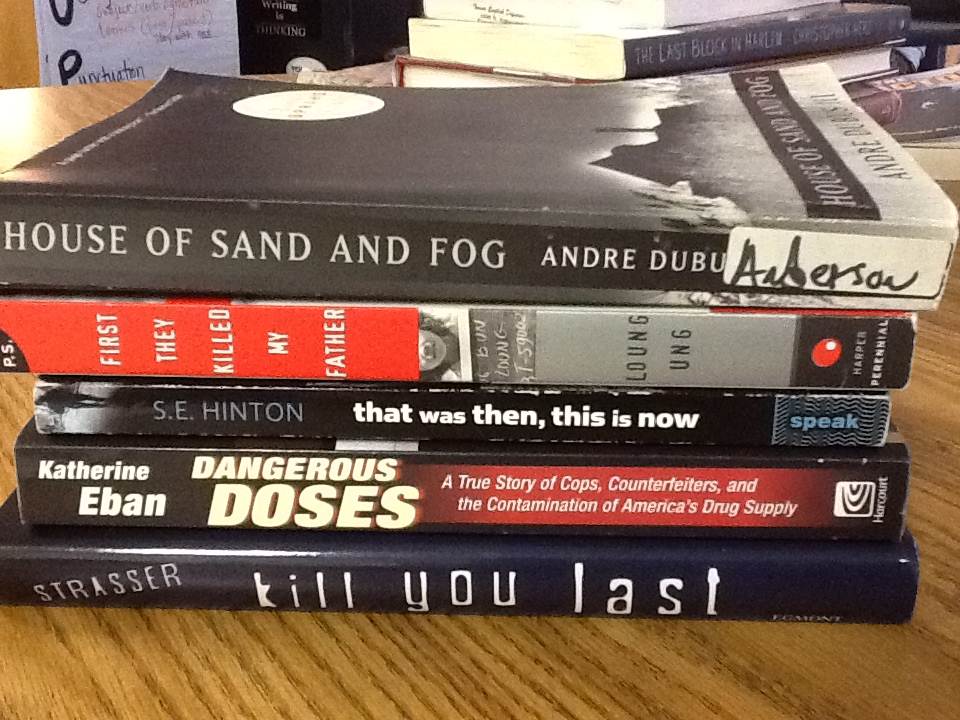
Here’s what my 9th graders created. Some make me proud.

Picture1

Picture2Picture3Picture4Picture5Picture6Picture7Picture8

The Beast That Was the Socratic Seminar

Guest Post by Tess Mueggenborg

The first time I heard of a Socratic Seminar, I was in early high school.  My history teacher gave us a copy of Plato’s “Allegory of the Cave,” arranged the desks in a circle, and instructed us to start talking.  It didn’t go well.  Perhaps if we’d had time to read the text before class, or if the teacher had explained what an “allegory” is, or explained the rearrangement of the room, or provided any instructions or expectations, we might have had a chance.  But none of those things happened–so the class flustered, floundered, and flopped.  Not a positive first exposure.

Fast-forward two years, and I’m in AP Literature.  In the midst of studying poetry, muddling through Donne’s sonnets and Keats’s odes (anyone else ever have a nightmare about “Batter My Heart Into A Grecian Urn”?), I walked in on a Wednesday to find an ominous circle of desks.  The instructions were vague and only marginally more helpful than the first go-around:  just talk about the poems, there will be no “moderator” so just jump into the conversation. . .and this is for a grade.

Strike two for the Socratic Seminar.

One more jump forward:  I’m in college, taking a class on Plato.  If you’ve read anything by Plato, you know that to read Plato is to read Socrates. . .and I finally made the connections between Socrates, this thing called the “Socratic Method,” and the beast that was the “Socratic Seminar.”

I figured it out:  the purpose of a Socratic Seminar is to ask questions.

Questions and discuss lead to learning.  If you ever get any answers out of a Socratic Seminar, great; but answers are not the goal, and not the signs of a “successful” seminar.  It’s not about demonstrating what you know:  it’s about declaring what you don’t know and traipsing through the tall grass together.  In that first Socratic Seminar, I should have broken the deafening silence by asking a simple question:  anybody know what “allegory” means?

In the next few guest posts, I’ll explain more about the Socratic Method and the Socratic Seminar, including:

  • the basics – what a Socratic Seminar is, and what it isn’t
  • the Socratic Seminar in the classroom (and not just an AP English classroom!) – including set-up and assessment
  • tips and tricks for managing the Seminar with real students (ie – how to find balance with the verbose students and the reluctant speakers)

Have any specific questions you want answered about Socratic Seminars?  Email me: mueggenborgt@cfbisd.edu.

“Professor” Tess Mueggenborg teaches English (and anything else with which her students need help) at RL Turner High School.  Her academic passions lie in comparative language and literature.  The Professor lives in Dallas with her husband, Jeff. Tess’ on Twitter @profmueggenborg

Reel Reading: Great Expectations

20130207-190708The students I teach this year are not into reading anything–much less the classics, but that doesn’t mean I will not expose them to these great books and let them know there is wonder and wisdom in these works. I’ve already pulled in a stack of graphic novels: Frankenstein, Dracula, The Greatest Works of Poe, Call of the Wild, and The Red Badge of Courage. Several of my football players devoured these short reads. The boys chose the books because the pages were slim. They didn’t know I had a master plan:  just read.

I  remember sitting to book chat with Robert after he read Frankenstein. “What’s one thing you didn’t know about the story that you thought you did before you read it?” Robert told me four. When we talked about theme we discussed the idea of creation and “playing God” and “finding love and acceptance” –conversations few people have with this 6′ fullback.

Then Robert told Fernando about the graphic novel of Frankenstein, and Fernando told Brandon, and Brandon told David. They all read the classics in graphic novel form. Did they learn to analyze literature? No. Did they study style and characterization? No.

Did they learn universal stories about universal truths? Yes.

And, guess what? My table of 9th grade football-playing boys talked about the classics. (I might have done a happy dance.)

I think my guys–and maybe a few other students–are ready to try harder reads than they’ve tried thus far this year. I will introduce them to the first classic book I ever read. Mind you, I read it in 7th grade over 30 years ago, and honestly, I did not appreciate it until I read it on my own years later–after I had a degree in Literature.

I’m not worried though. The movie clips make the book look accessible, the characters real, and the story-line engaging. Maybe a kid or two will become friends with Pip or fall in love with Estella or at least think Miss Havisham is a loon.

It’s Monday, What Are You Reading?

I’ve said it before. I wish I’d never have to say it again. But– I have reluctant, sometimes hostile, readers.

Mon Reading Button PB to YALast year I won a grant from the Carrollton-Farmers Branch Education Foundation, and with the money I purchased a whole set of these gritty, urban, teen-angst filled books that my students will at least smile (sometimes smugly) and commit to read. I know some lie, but every single student who finishes one of these roughly 120 page books has rated it at least an eight on a scale of 1 to 10. That’s pretty good, right?

I am grateful for the folks who’ve helped me get some of my chronically fake readers to at least try a book. ORCA Soundings, you are my hero.

I know to have the most success getting my students to read, I have to match books with students’ lives and interests. The only way to do that is to read books. Lots of books. My goal is to read every book in this 65+ title set. I have a long way to go, so this Monday? Here’s what I am reading:

Overdrive by Eric Walters


 Exposure by Patricia Murdoch                                                                             Bull’s Eye by Sarah N. Harvey

Reel Reading: Engaging Boys with Mixed Martial Arts Books

20130207-190708I have this one student who tells me almost every day, “I don’t read.” He doesn’t say, “I hate to read.” He proudly says, “I don’t read.”

I want to say, “Yep, kiddo, it’s obvious,” but I bite my tongue.

So, today I said, “G., I know you don’t like to read, but surely you like stuff. What stuff do you like?” Without a pause, he said MMA. Now, I am getting on in years, but I have teenage sons. I thank them today that I know that MMA stands for Mixed Martial Arts. Score for this mom!

I told G. that I didn’t have any books dealing with that intense and mean fighting genre, but I’d find some. I quickly emailed my awesome librarians with the request, and within an hour an aid walked seven books to my room.

No surprise that I haven’t read any of them.

Here’s what’s in the stack– I found no book trailers for any of them, which makes me a little sad, but I found a solution. Wait for it.

One Shot Away , a Wrestling Story by T. Glen Coughlin

The Long Shot by Katie Kitamura

My Father, the Angel of Death by Ray Villareal

Uncaged–My Life as a Champion MMA Fighter by Frank Shamrock

Headlock by Joyce Sweeney

Wrestling Sturbridge by Rich Wallace

BUT, the one that got my attention, and the one that will get my own sons’ reading is:

Heart for the Fight– A Marine Hero’s Journey from the Battlefields of Iraq to Mixed Martial Arts Champion by Brian Stann with John R. Bruning.

Check this video out. It’s better than a book trailer.

Reflection: I Really Want to Have That Bad*** Celebration

I sat in the conference room with eight other educators as we tried to figure out how to save one kid. He’d been recommended for special education services, but it was clear within the first few minutes of the meeting that he did not qualify. He rarely attends class– and so many other factors. There are gaps in his learning wider than should ever happen in the life of a child.

“He says he didn’t attend third grade,” one teacher said.

“I thought he repeated third,” another said as she flipped through his file. “He jumped to fifth,” she finally says.

“He spent most of one year out of the country. Never was in school.”

“Father was deported.”

“Foster care for a while.”

“How did this child ever get through middle school?”

Silence. No one has the answer.

He’s 15, and he can barely read and write. He’s easily five years behind his peers in basic skills. No wonder he doesn’t want to be in class. 

kunalnagi.blogspot.com

kunalnagi.blogspot.com

This is the tall and husky, bright eyed young man who told me a month ago that he’d never read a whole book. I got him to try one: 4 grade reading level. He gave it 10 minutes before he started messing with his headphones. When I asked him why he gave up, he told me he’d read the first two pages three times, and it didn’t make sense. I gave him another book: 2.5 reading level. He agreed to try. He read for 20 minutes. The longest I’ve ever seen him attempt anything remotely academic.

At the end of class he asked me if he could take the book with him. “Sure, I said, will you really read it?” He told me yes with a shy smile, and he tucked that Bluford High book into his backpack. “How do you think it will feel when you finish that book?” I asked. “It will be badass” was his honest reply, and he waited to see how I would respond. I told him that if he’d finish that book and have a talk with me, we’d have a celebration– a badass celebration. He grinned his approval.

Sadly, I’ve only seen him twice since that conversation. He came to class once, but we were in the middle of a district assessment, and he sat playing with his new red headphones. The other time I saw him was in passing–literally. He passed by my room instead of coming in for class. Sigh.

I left that meeting today feeling like a failure, but I know it’s not my fault. This child needs one-on-one instruction. He also needs a mentor, a tutor, a life coach, a sponsor, a guide, a therapist. I am just one teacher who gave a $1 book to a kid who can barely read.

It’s a bit unsettling. And it’s quite disturbing. What happens to this child? What does his life look like when he’s gone from here? And, always the question: Could I have done more?

Somehow, someway, I really want to have that badass celebration.