Category Archives: Community

Guest Post: How a High School Improved Reading by Building Little Free Libraries

busLast summer, I became a Penny Kittle convert. I originally didn’t know what I was signing up for, but something kept driving me to be sure I was where she was. Turns out, it’s been the best hunch of my teaching career. The mind shift I was searching for. A complete game-changer. And this is year eighteen.

After 2 ½ days with Penny, I spent the rest of my summer trying to keep up with my churning brain. I wrote more than I have since I was a slightly over dramatic, totally drowning-in-love teen. I read. And I read. And I read. I rediscovered that lust for story I had almost forgotten. I freed myself from the idea that pleasure reading was fluff and gripped the concept of reading what speaks to me as a means of improvement – just like I would soon ask my students to do.

In the midst of my mid-career crisis (maybe crisis is too harsh?), I found a tweet about the site littlefreelibrary.org. The various clever wooden boxes built for books captivated me. I loved the idea of a take-one-leave-one system designed to build community. What fun! I wanted one! Maybe a home project with my own children? Then, I had a thought. What if we put these book boxes in the hallway at our high school? What if this could be the reading take-over Penny Kittle encouraged? So, on my wild whim, I retweeted the link with that very suggestion.

Soon (which means mere seconds in the Twitter world), my teacher peers of all disciplines — math, sharkscience, history, technology, world languages — responded with enthusiasm! They wanted to build wooden cubbies! They wanted to donate books! They were all on board! So, the fun began…

In an August inservice session, I presented the idea to the full faculty, highlighting the importance of choice-reading in ALL classrooms. I used so many of Kittle’s words in an effort to begin a movement. We have to get all of our kids reading – the rich, the poor, the gifted, the challenged, even the ones who don’t eat their vegetables. And, in a school as diverse and unique as ours, we couldn’t wait another second. Of course, there was one small glitch; I didn’t know or have the means yet to build the little libraries. But I knew we could.

Following my first session, our new theater tech teacher immediately approached me, and he offered to have his tech class build the first set! I cried. I usually do at most sentimental things, but I just didn’t expect this outpouring. Books began to appear in my classroom from teachers and then parents. Some opted to write an inscription inside their favorite books, explaining to the future reader the special significance of that particular tale.

#hebronreads was born.

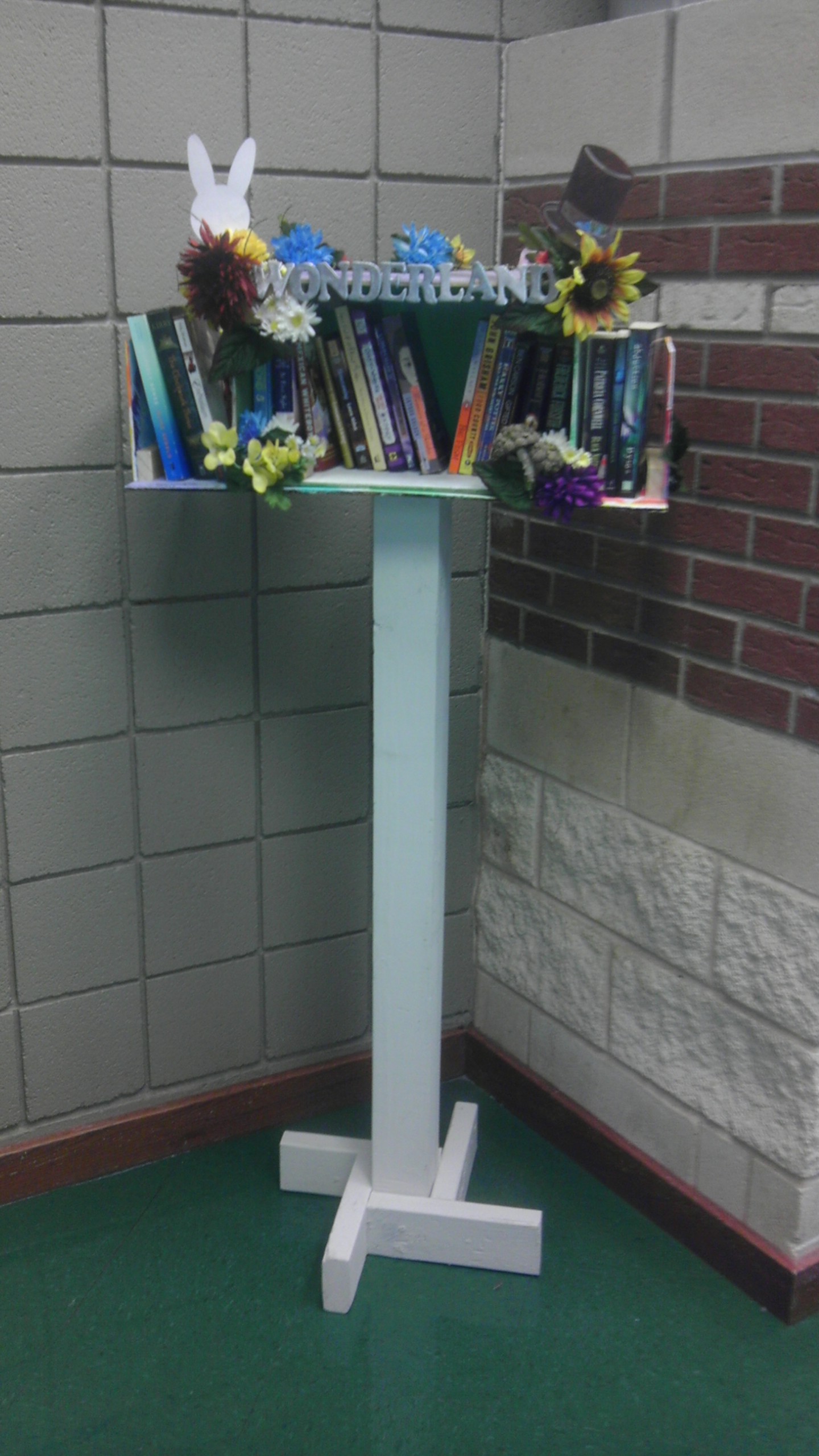
The theater tech class created the first five Book Nooks, as they are now called, from lumber and Slide2supplies donated by our community. In true theater style, the Nooks have flare – a shark, an Alice in Wonderland, a school bus, the Parthenon, and, of course, a book! All student created! All on pedestals in various niches in our halls. At our fall open house night, books poured in from parents who heard our call to promote literacy, and books continue to appear in my classroom like gifts from the Tooth Fairy.

Students in our advertising and marketing classes competed to create a campaign for the program. On World Read Aloud Day in March, we paused to read to our students, and we passed out bookmarks and talked books during lunches. Students have daily choice-reading time in math classes and business classes in addition to English classes. Another book drive is slated during our spring football game in May. A spring literacy night with former Hebron High School grad now YA author Lindsay Cummings is in talks.
alice


This is only the beginning.  

In my hopes and dreams, we will build more Book Nooks and litter the building with choices. We will continue the book drives until all classrooms have some sort of libraries. We will keep talking reading and promoting ideas via @hebronreads. And one day, when we are feeling pretty confident in our literacy push, we will make Nooks and take them filled with books to neighboring schools who need more stories in their lives too. Hebron High School is now a thriving community of readers, and it is truly glorious!

Parent quote:

“My son has always loved to read (‘loved’ is probably an understatement), so when he found these books in Hebron’s hallways, he was very excited.  He came home telling me what a neat thing this was — books for the taking, any book, all kinds. Once he understood the program, he commented on what a great idea . . . read a book, replace a book, or just bring it back. Great idea, Hebron!”    Carolyn Sherry

Donna Friend teaches at Hebron High School in Carrollton, Texas. She is making readers out of English III students and leads her department into the chaos of educational risk-taking. Currently, she is honored to be her campus as well as the Lewisville Independent School District’s Secondary Teacher of the Year, an accolade that, despite her 18 years of teaching, she doesn’t yet feel old enough to have earned! Her current favorite book is Jandy Nelson’s The Sky is Everywhere, and she is practicing being a regular reader and writer along with her students. She has a 9 year old son, a 6 year old daughter, a hubby, two cats, and a few fish. She once dreamed a young adult novel and still regrets not writing it down immediately after waking. Find Donna on Twitter @mrs_friend

Glory O’Brien’s History of the Future by A.S. King

17453303John Green says that “A.S. King is one of the best Y.A. writers working today,” and who doesn’t trust everything John Green says?  (Except for when you trust him for 246 entire pages, and then your trust is shattered, and you ruin a book with your tears, but I digress.)

Having fallen madly in love with A.S. King’s writing during Everybody Sees the Ants, I have been waiting for my students to return Glory O’Brien’s History of the Future to my library so I could read it.  Without ever having booktalked it, its catchy cover caught students’ eyes and enticed them to dive right in.

Finally, yesterday, I spotted it on the shelf and took it outside in the sun with my class to begin reading.  Surrounded by seniors mere weeks before their graduation, I was in the perfect setting to immerse myself in Glory’s story, which takes place over two weeks bracketing her high school graduation.  She’s a photographer for the yearbook, keeping herself distant from her peers by hiding behind a camera.  Her only “friend” is her neighbor Ellie, who’s lived beside her ever since Glory’s mother committed suicide thirteen years ago.  Ellie doesn’t understand the worry Glory has that she’ll end up like her mother–and Glory is terrified of, dreading, trapped by, her own uncertain future.

That all changes after a wild night, after which Glory and Ellie can suddenly see the future.  Glory begins to record these transmissions, in which, upon eye contact with anyone, she can see the actions of their distant ancestors and descendants.  The glimpses of the future reveal a future American Civil War, the complete reversal of feminism, and a tangled web of people she knows mixed up in all of this.

“We were fed onto the stage like machine parts.  We were a conveyor belt of future.  We were an assembly line of tomorrow.  We were handed our diplomas and stood to face the audience and they were asked not to clap until the end, but some did anyway. … I stood and faced the crowd and heard a static of epic proportions.  Chatter of a thousand infinities all at once.”

Deciding to chronicle her transmissions through a scrapbook modeled after one of her mother’s creation, Glory writes her own “History of the Future,” and it’s bleak.  As the novel progresses, the darkness of the future becomes more certain, but so does Glory’s understanding of herself–a trade-off she’s not sure how to handle.

With beautiful language, dark humor, powerful lessons, and themes of mystery, love, redemption, friendship, and foreboding–all set against the backdrop of high school graduation–I can see now why this book is never on my shelves.  I’ll be happy as it continues to remain in the hands of teens getting a refresher on feminism, individuality, and the pursuit of happiness.

“Sounds so convenient, right? Me not having a mom and my dad being all great about it and stuff.  But it wasn’t like that.  The air was tense.  We still had no oven.  My cobbler still tasted like radiation, no matter how much ice cream I piled onto it.  I could feel the secrets in the soil here. … Something was about to sprout and grow from that soil.  I could feel it the same as I could see the mourning dove into infinity.”

Dumpster Diving for a Book Shelf

shelfieMy husband called, “Hey, there’s a book shelf by the dumpster. Do you want it?”

Funny that he asked. I know he knew I’d say yes.

I put the tall black shelf by the door to my room, which was pretty much the only open spot. But most of my classroom library sat cozy on the opposite side of the room. I did not know what books to put on this new shelf.

It sat empty waiting for three months.

There’s nothing quite so unsettling as an empty shelf in a bibliophile’s classroom, but my husband made me promise not to buy any more books. This is hard.

Finally, I got smart and labeled the shelves “1st period Suggests You Read,” “2nd Period Suggests You Read,” etc.

Slowly, I started moving books that students talked about, the ones they told me they liked. Then I Favorites book shelvesnoticed that a few students started returning their books to these shelves, and after we did Speed Dating with a Book a few weeks ago — we put all of our to-read-next titles on these shelves.

Now, instead of having most of our book choices on the bright green wall across the room, students walk past this shelf as they come and go.

Pretty good deal for a dumpster find.

©Amy Rasmussen, 2011 – 2015

Hey, Do You Want to Hear a Good Poem? #poeminyourpocket

What makes a good poem?

I like to ask my students this question. They usually fumble with an answer.

That is what makes reading poetry with students rewarding. Eventually, even the hardest teenage heart will come to at least appreciate the complexity of language — maybe she’ll never appreciate the beauty of it, but she will appreciate the craft of the poet.

Sharing good poems with students on a regular basis proved a hard goal for me this year. (Better than last; not as well as I wanted.)

One go-to book is Garrison Keillor’s collection of Good Poems, as Heard on the Writer’s Almanac. It is a must for every English classroom. My wish list includes two other volumes:  Good Poems for Hard Times and Good Poems: American Places. 

I especially like how Keillor sets the tone of the selection with poetic lines in the introduction that describe what makes a good poem:

Stickiness, memorability, is one sign of a good poem. You hear it and a day later some of it is still there in the brainpan.

What makes a poem memorable is its narrative line. A story is easier to remember than a puzzle.

[Poems] surprise us with clear pictures of the familiar.

And this beautiful paragraph, an epigraph for Emily Dickinson, really:

To see poetry finding an existence that its maker never imagined, visit Emily Dickinson’s grave in Amherst. Here lies the white-gowned virgin goddess, in a cluster of Dickinsons, under a stone that says “Called Back,” and here, weekly, strangers come as grieving family, placing pebbles on her big stone, leaving notes to her folded into tiny squares, under small stones. Dickinson was a famous recluse who camped in the shadows in the upstairs hall and eavesdropped on visitors, and now there are few graves in America so venerated as hers. She is mourned continually because the quickness and vitality of her poems maker her contemporary, and when you make flies buzz and horses turn their heads and you declaim Wild Nights! Wild Nights! and give hope some feathers, you are going to have friends in this world for as long as English is read.

I just love that, and Dickinson isn’t even my favorite.

I am finding favorites though. So far, my favorites are the poets I know in person: Dawn Potter, and  Meg Kearney.

My students need the chance to find favorites, and that is why I must expose them to good poems. Reading aloud poems on a regular basis has the same effect as talking about books regularly.

Today is Poem in Your Pocket Day.  Will you participate?

Because I know I need to be more consistent with poetry, and even though we are in the middle of a giant writing project, my students and I paused this week and talked poetry. We read and questioned and laughed and loved being immersed in beautiful language.

We pulled the poetry books off the shelves, (I only have about 15, so far, so we had to share) and we wrote out poems on pretty paper to put in our pockets. I challenged students to share their poems throughout the day.

Some balked.

Some said sure

but meant no way.

Others will follow my lead:

“Hey, do you want to hear a good poem?”

©Amy Rasmussen, 2011 – 2015

Behind Barbed Wires

sticker,375x360.u1In honor of the recent Holocaust Remembrance Day, I find it befitting to share Room 382’s shelf comprised of pieces in which those, who experienced the nightmare, share their stories.  Each piece on this shelf is dedicated to bringing awareness, and hopefully shed light on how history truly can repeat itself, if we do not prevent it.

While this shelf hosts stories of tragedy, suffering, and insurmountable pain and loss; it serves a purpose. Aside from the devastating, these pieces share with us the true essence of humanity.  Often, this is the first time students are diving into this 80-year-old genocide and trying to make sense of it. Many times we can’t; and other times we are able to connect over the beauty that surfaced. It’s all very complex.

Elie Wiesel’s story (and bravery) is shared via his trilogy starting with Night then moving us through Dawn and eventually through the Day.  See what he did here?

Anne Frank shares her experience as a young woman budding into adolescence in a time where her beautiful spirit defeated the confines of her attic.  Various types of literature have been compiled so IMG_20150424_083609students (and all readers) can experience Anne’s story in various ways: her published diary, actual footage restored via the Anne Frank House (a gift from a friend’s visit to Amsterdam), the play, and many others.

Maus, an incredible two-part graphic novel, utilizes the “Cat and Mouse” metaphor to portray the Nazis
vs. the Jews during the Holocaust.  This two part series is detailed and brings to life the realities of the inner workings; the emotional turmoil yet amazing perseverance of those living through this moment in history.

Those are three pieces among many.  There are books here (and ones that are currently signed out) that chronicle voices of the children of the Holocaust, novels that use real-life situations yet tell a fictional story, perspectives from a Nazi’s Jewish wife, the bravery of a journalist who swapped places with a Jew to ultimately expose the hidden…

Students are typically surprised, fascinated, uncertain, saddened and sometimes hesitant when it comes to this shelf.  Understandably.  This shelf asks us to inquire and then sit with our findings.  Yet, the conversations and rich discussions that float around this shelf are beautiful; truly beautiful and strengthen our understanding of what it truly means to be human.


In Search of Hope

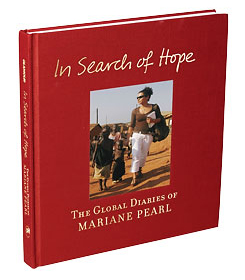
mariane pearl book coverI first fell in love with Mariane Pearl’s writing when I read her memoir: A Mighty Heart where she chronicles the events leading up to her husband’s murder in the Middle East.  It was devastating.  Tragic, really.  Yet, her voice sang from the pages even while sharing the most intimate moments associated with a murder that was so incredibly public.

So, to no surprise, when I came across In Search of Hope: The Global Diaries of Mariane Pearl,  I was thrilled. Pearl, a journalist for Glamour Magazine, took on the world – visiting twelve different countries. She was escorted through these countries by powerful women that are all on missions to bring positivity, safety, and change to countries that are broken.

Pearl visits with courageous women who share the most private details of their work – and passion.  She learns about a Cambodian sex slave’s liberation; Liberia’s presidency from the perspective of President Ellen Johnson Sirleaf (2006); an AIDs orphan turned healer in Uganda; a New Yorker who leads children needing guidance; how justice is getting a voice in Mexico…and so much more.

As you read these short stories full with dynamite photographs, writing that is powerful, and experiences that shed light on women fighting through the injustices associated with their countries, culture, and neighborhoods; you can’t help but to feel as though you are on a year long excursion around the world – one that authentically changes your core as a human being.

Students love this piece.  They are awed by the bravery of these women; Mariane for exposing truths that do not get adequate recognition and the women who are willing to risk their own safety in order to save others.  For every reader, Pearl puts life into perspective.

The richness found within these pages comforts you.  It makes you believe that anything truly is possible.  Well, because it is.  It provides students access to beautiful moments experienced within other cultures and propels them to reflect on their own morals and values – what are they really willing to fight for?

In Search of Hope is a piece that leaves you feeling compelled to explore.  Travel.  Find your own truth.  And when you do, write about it.

Everywhere You Turn

Over the last three years, our Francis Gittens Memorial Lending Library has grown literally by thousands of books.  And, it’s a beautiful sight.  One in which provides comfort, challenge, and dialogue among students and educators.  It propels interest in reading and provides options and choice; students sometimes pull up a chair and use the edge of any given shelf to rest their Writer’s Notebook while they write and find inspiration.  It’s our staple here in room 382.

But, as more and more donations come through the door, I panic: Where will they all go?!  We are currently wall-to-wall with bookshelves (many that tower over us) and the remaining space is either wall-to-wall windows or full of technology.  So, I started to utilize every open surface: our computer cart, window sills, filing cabinets, my own desk.  Now, literally everywhere you turn, your gaze lands upon books…stacks and stacks of books.

Initially I felt overwhelmed by having books everywhere; I thought it felt chaotic.  But, the perceived chaos actually provides students even more choice and an innate awareness of their surroundings. Students have started to become even more in-tune with their reading journeys and have been feeling more compelled to explore.  For more reluctant readers they have access to books without it feeling as though there is the need for any sort of grandiose gesture; trekking across the room to the wildly overwhelming library.  It’s subtle yet powerful beyond measure.  Everything is within their reach.

IMG_20150421_093753

Books resting on technology…

Everything.  Even our mobile technology cart full of laptops. The books on top are stacked in four piles; they are our newest additions.  Because the cart find its way across the room, near different seats, and at various different spots depending on the day; it’s equivalent to an ice cream truck making its rounds – no one is to be missed.  These piles change as the new additions continue to stream through the door.  Many students, as they are accessing the cart for a computer, find themselves pausing for a moment because a book title…or cover…or piece they realized was on their next-to-read list…has caught their attention.  I love the irony that’s often captured here when a student is simply going to return their computer, hears the bell ring, and runs to their Writer’s Notebook to jot the title down; yet forgets to put the computer back!

IMG_20150421_094028

Here is one of three window sills adorned with literature – and some added nature.  During the winter months in room 382 the heat tends to be unbearable (hence the cactus) which is quite unfortunate.  Yet fortunately, students like to get a breath of fresh air.  So, while doing so they find themselves multi-tasking – breathing in the fresh city air while perusing through the new titles that greet them at the window.  Many times, a lesson or writing workshop will be interrupted with, “Miss Bogdany, I found another book about XXX!”

Books decorating ugly steel surfaces...

Books decorating ugly steel surfaces…

Many students have just recently begun to proudly embrace their love for graphic novels. Typically,they believe that they’re for ‘young kids’ because of ‘all the pictures and stuff’.  I whole-heartedly disagree.  So, in the vein of supporting students’ interest in visual literacy, many are found atop an industrial filing cabinet adding color, texture, and accessibility.  Because this surface is also used for additional supplies, students access it often.  Every time they are wanting to find their zen (see butterfly book box on the top left) they happen upon literature that excites them.  Many times, the zen garden and a new book escorts them back to their seat.     

IMG_20150421_093914

Exhibiting my literary interests. The left stack is comprised of pieces I want to read. The ones on the right are my absolute favorites. And, the ones in the middle are a fantastic mix of professional resources, gifts, and tools.

I know students will not produce work if they are not comfortable; both physically and in feeling safe within a community.  I create a visually stimulating space at my desk because it’s what fuels my passion for all things literacy. I also know, when a student needs their own unique space, they tend to gravitate toward wherever it is that I’ve set up shop.  It has been labeled ‘their corner office’ – and yes, they get right down to business!

There are other times when I conduct 1:1 conferences and ask a student to engage in dialogue in our bright back corner.  I watch their eyes drift from their writing to the options resting atop my wooden workspace.  Students will reach across the desk to pick up a piece they have never seen there before and while I try to get their attention refocused on our conference, sometimes the book they’ve chosen is much more convincing than whatever it is I’m trying to do.  I also think some of the intrigue is that students know that what they find there are pieces I can really talk about because I’m passionate about them.

So, as the year starts coming to an end and we start thinking strategically about how we are going to start minimizing our inventory and organizing it for our summer packing; please don’t!  Keep moving things around and keeping it fresh.  Put books in places you haven’t before – students will find them trust me.  Play around with what you have displayed in your area and invite students to engage in conversation wrapped around them.  But, most importantly, enjoy these remaining few months with our inquisitive and dedicated readers as they continue to look around our learning environments and find exactly what they didn’t even know they were looking for.

Where do you keep literature aside from your library shelves?  What successes have students found when they happen upon a book in the most unlikely of places?


Craft Study for a Monday: Billy Lynn’s Long Halftime Walk, again

For now, my new favorite book is Billy Lynn’s Long Halftime Walk by Ben Fountain. 

This surprises me. Maybe it’s the setting — Dallas Cowboys’ Stadium. Maybe it’s the protagonist — Billy, a 19 year-old-soldier. (I have twenty-year-old twin sons who want to join the military in a few years.)

Maybe it’s Fountain’s poetic language. It startles and soothes. It makes my mother’s heart shake.

I’ve dog-eared pages and underlined lines. I’ve even posted about this book in February.

Here’s the part I will share in class this week. My students are working on a major writing project. They chose their own topics. They’ll write in a variety of forms. But, even with only a few weeks left in the school year, I still need to show them beautiful language. I still want them to work on their craft.

“Look at Fountain’s style,” I’ll say. “What do you notice just on this one page?”

And we’ll talk about word choice and repetition. We’ll talk about lists and mood. We’ll talk about intentional fragments and why an author might make that kind of choice when writing a sentence.

My students will notice many things in this short passage. There are so many things to notice.

That’s probably why I am in love with this book. Thank you, Mr. Fountain.

excerpt from Billy Lynn’s Long Halftime Walk 

Don’t be scared, Shroom said. Because you’re going to be scared. So when you start to get scared, don’t be scared. Billy has thought about this a lot, not just the Zen teaser of it but what exactly does it mean to be scared out of your mind. Shroom, again. Fear is the mother of all emotion. Before love, hate, spite, grief, rage, and all the rest, there was fear, and fear gave birth to them all, and as every combat soldier knows there are as many incarnations and species of fear as the Eskimo language has words for snow. Spend any amount of time in the realms of deadly force and you will witness certain of its fraught and terrible forms. Billy has seen men shrieking with the burden of it, others can’t stop cursing, still others lose their powers of speech altogether. Lots of sphincter or bladder control, classic. Giggling, weeping, trembling, numbing out, classic. One day he saw an officer roll under his Humvee during a rocket attack, then flatly refuse to come out when it was over. Or Captain Tripp, a pretty good man in the clutch, but when they’re really getting whacked his brow flaps up and down like a loose tarp in a high wind. His soldiers might feel embarrassed for him, but no one actually thinks the worse of him for it, for this is pure motor reflex, the body rebels. Certain combat stress reactions are coded in the genes just as surely as cowlicks or flat feet, while for a golden few fear seems not to register at all. Sergeant Dim, for example, an awesome soldier who Billy has seen walking around calmly eating Skittles while mortars rained down mere meters away. Or a man will be fearless one day and freak the next, as fickle and spooky as that, as pointless, as dumb. Works on your mind, all that. The randomness. He gets so tired of living with the daily beat down of it, not just the normal animal fear of pain and death but the uniquely human fear of fear itself like a CD stuck on skip-repeat, an ever-narrowing self-referential loop that may well be a form of madness. Thus all our other emotions evolved as coping mechanisms for the purpose of possibly keeping us sane? And so you start to sense the humanity even in feelings of hate. Sometimes your body feels dead with weariness of it, other times it’s like a migraine you think you can reason with, you bend your mind to the pain, analyze it, break it down into ions and atoms, go deeper and deeper into the theory of it until the pain dissolves in a flatus of logic, and yet after all that your head still hurts (114-115).

Note: The book is being made into a movie with a Veteran’s Day 2016 release date. Rarely, do I like the movie as well as the book, but I still go see them.

©Amy Rasmussen, 2011 – 2015

Shelfie Saturday

sticker,375x360.u1While my last name is Catcher, I’m far from a natural athlete. In fact, my high school softball career ended after I “caught” a stray throw with my forehead, landing me in the ER with a swollen eye and thirteen stitches. Still, I can appreciate a brilliant sports story, the type that moves beyond the game and captures the essence of teamwork, leadership, and friendship. The “Sports” section of my classroom library does just this.

Over the past year, I have cultivated the sports section to reflect the varied abilities, ages, and interests of my students. I teach freshmen, juniors, and seniors ranging from struggling to gifted readers. Because of my diverse students, my library must appeal to 14-year old freshmen and 18-year old seniors alike. Fortunately, sports can oftentimes bridge this age gap while also pushing students to gradually engage with more complex texts.

My somewhat anemic-looking sports section.  Many of the books (particularly the ones not pictured here) have waiting lists and won't return to this shelf until the end of the year.

My somewhat anemic-looking sports section. Many of the books (particularly the ones not pictured here) have waiting lists and won’t return to this shelf until the end of the year.

My younger students (and even some of my older) tend to gravitate towards popular young adult novels at the beginning of the year, like those written by Matt de la Pena and Mike Lupica. After they exhaust the options on my shelves, they inch towards lengthier and more complex analytical or historical books like Moneyball: The Art of Winning An Unfair Game by financial journalist Michael Lewis or The Punch by sports writer and commentator John Feinstein. More than any other genre, these brilliantly crafted pieces serve as strong mentor texts for a wide variety of mediums including nonfiction, narrative, research, and persuasive writing. This year, books like Ice Time by Jay Atkinson inspired many of my hockey players to explore their sport through personal narratives while Shoeless Joe by W.P. Kinsella served as the basis for one of my freshman student’s research papers on the Black Sox Scandal.

Sports hold leverage within our society, particularly amongst teenagers. From die-hard fans to benchwarmers, both athletes and non-athletes can appreciate a sports story, particularly when it transports us into a world packed with suspense and action.

Join the conversation by posting your own shelfies!  Share a shelfie with #shelfieshare and let us know if it’s a #classroomshelfie, #bookstoreshelfie, or other miscellaneous find.

Persepolis by Marjane Satrapi

persepolisIn honor of ALA’s recently released 2014 Banned Books List, I can’t help but recommend the second most banned book Persepolis by Marjane Satrapi.   Persepolis was one of the three graphic novels that made the top ten list this year. The book is criticized for its use of gambling, offensive language, and political viewpoints as well as for being “politically, racially, and socially offensive” and for having “graphic depictions.” In reality, this graphic memoir isn’t afraid to tackle the horrifying and at times comedic realities of growing up in a community faced with political turmoil. After all, Satrapi wanted readers to recognize that Iranians are normal people, just like everyone else. They enjoy music and parties and clothes; the difference is that the characters in Persepolis are living during the Iranian Revolution. Satrapi begins her narrative at six years old, relaying the stories of every day life as the Shah’s regime is overthrown, the Islamic Revolution takes hold, and the war with Iraq destroys her community.

What I love most about Persepolis is its ability to attract my reluctant readers, particularly my students who would otherwise steer clear of the international shelf in my classroom library. These students are drawn to the simple black-and-white cartoons and the rebellious teen protagonist. They love her quirky sense of humor and her obsession with American music icons like Michael Jackson. Like many of our students, she is an angsty teen coming of age. The difference is that she grows up during political conflict and war. Her world is changing around her, war has becomes standard, and she, as a teenager, is attempting to find normality in completely abnormal circumstances. But it’s Marji’s ability to navigate this morbid world and go through complex transformations that make her come alive on the page.

I tend to use graphic novels towards the beginning of the year when my students are becoming acclimated to analyzing writer’s craft (or even when they need a refresher on it). Oftentimes students are more in tune to looking at the details of drawings than of writing; they find it easier to pick out the eccentricities of images yet rarely do they question why the artist made the choices they did. Graphic novels give them the opportunity to do just this.

I have students work in small groups to analyze the artistic decisions of the illustrator. For example, in Persepolisthe scene to the right, Marji has been taken into custody by the Women’s Branch of the Guardians of the Revolution, a group in charge of monitoring women’s wearing of the veil. When they stop to study the images, students notice the repetitive stern expression of the guardian and the way Marji’s face appears to melt into squiggly lines as the frames progress. They notice the transition of the lines surrounding the word bubbles from smooth curved lines to sharp zig-zags. They recognize changes in font size and effects as well as the underlying narrative strand at the bottom of the frame that shows internal dialogue. As they analyze these details, they also begin questioning the choices that lead to the depictions of these conversations and emotions and what they ultimately mean in the context of the story. By the end, the graphics take on a more complex tone. The images come alive, the artist’s intentions become clearer, and they have immersed themselves in a new lens that allows them to take a second look at literature.