Category Archives: Community

#ShelfieShare – Growing Your Library

FullSizeRender[1]Yesterday was our last real day of school, and it was a busy one.  My students spent our last class periods together sharing their final multigenre writings with one another, clearing out their writing portfolios, and packing up their notebooks.

They also flooded me with classroom library books and sheepish smiles.

“Sorry,” Riley said, as she entered my classroom with a shopping bag full of books.  “I didn’t realize I had like 12 of your books at home.”

“I opened a cabinet and found like 20 of your books!” Emily said.

“If I bring back all your books, can I borrow like five for the summer?” Jordan asked.

“I found The Book Thief and almost just kept it, for the irony,” Hailey explained.

Now that all the books that are usually on kitchen tables, under beds, and piling on nightstands have begun to find their way back onto my bookshelves, things are looking a little crowded:

FullSizeRender

The five bookshelves in my classroom are mostly full of independent reading books–a class set of literature and grammar books, dictionaries, and book club collections provided by my department find their homes on the bottom shelves, but everything else has been a labor of love to build on my own.

FullSizeRender[4]I began building my library six years ago, and started with anything I could find at Half-Price Books.  I spent $20 a month in the clearance section, netting $1-2 finds that built my sci-fi and YA sections, and used my staff ID to get an extra 10% off.  During the holidays, HPB ran promotions for free $5 or $10 gift cards with the purchase of a $25 gift card, and I took advantage of those aggressively.

Next, I discovered Barnes & Noble‘s very generous 25% teacher discount, and shopped mainly in their clearance section, which was always well stocked with “former bestsellers.”  This was perfect, as a book had been out just long enough to generate buzz among my students.  I became a bit of a regular there, and began to ask the manager if he had any damaged, extra, or reject books he didn’t want.  He obliged, providing me with class sets of The Perks of Being a WallflowerWaiting to Exhale, and Tuesdays with Morrie–totally gratis.  I also got lots of hardcover books that were being replaced by paperback editions, again, for free.

Next, I discovered the generosity of my school’s PTA, which granted teachers up to $100 per year in classroom supplies.  Every year, my $100 was spent at Wal-Mart, Half-Price Books, or any other purveyor of cheap books.

FullSizeRender[3]By the time the summer of 2013 rolled around, my library was in decent shape–I had about 800 books, mostly paperback, mostly YA and general fiction.  I traveled to New Hampshire to take Penny Kittle’s course about informational writing, and fell in love with nonfiction.  I also met my amazing friends Amy, Jackie, Erika, and Emily, who told me about DonorsChoose.  I created, and funded, several projects–especially ones that helped me get lots of nonfiction–right away, which increased the number of books in my library up to about 2,000–all without a dime of my own money.

I also created DonorsChoose projects that were funded every October by U.S. Cellular, a partner of DonorsChoose.  Depending on your state, big businesses or even celebrities may fund your existing projects of up to $1000.  I used this partnership to fund two $1000 grants, growing my library up to about 3,000 books.

FullSizeRender[2]For my next brainstorm, I began to write letters to local big-box businesses, asking for donations of gift cards to purchase books.  Target, Sam’s Club, Kroger, and Wal-Mart all granted me gift cards, nearly monthly, of up to $50 per month.  Target in particular was wonderful, as their website offers a wide variety of books, especially great nonfiction finds, and free shipping on purchases of $50 or more.

When I finally got an iPhone in October of 2014, I joined Instagram and followed lots of bookish accounts.  Through these book fanatics, I learned about Book Depository, which offers discounted books with free shipping to anywhere in the world; Books-a-Million, which has a wonderful bargain section and an awesome used books market; and the glorious world of GoodReads giveaways, where free ARCs can be won by one and all.

This summer, I’ll take a week of rest, then begin to write book donation request letters, a DonorsChoose grant, and a variety of Morgantown-specific grants.  I’ll focus on replacing lost or stolen books, getting newly-paperback titles, and building shelves I think are a little weak.  I hope you’ll use this slew of resources to build your library, and your readers’ choices, too!

What are your favorite strategies for building your library?

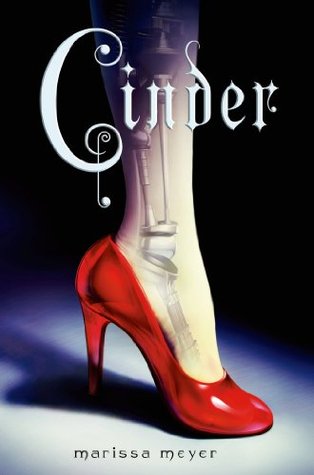
Cinder by Marissa Meyer

cinder

“Even in the future, the story begins with Once Upon a Time.”

Are you looking for a good old fashioned dystopian YA series to start your summer?

How about a modernization of a classic fairy tale?

Or, have you been craving a story about a cyborg mechanic, trying to avoid a plague, who’s got secret mental powers, a really crappy stepmother, and is actually a lost princess?

Well, if any or all of those books sound good to you, then look no further–this one will grant all your wishes.  Cinder by Marissa Meyer is book one of the Lunar Chronicles, a series incorporating futuristic versions of Cinderella, Little Red Riding Hood, Rapunzel, and more.  But it’s not just a book that retells a classic fairy tale–my boy readers love it too, because Cinder is a mechanic who works on androids in a post-WWIII future.  Complete with hovercrafts, bizarre medical technology, and sinister political plots, this story really has it all.

“But if there was one thing she knew from years as a mechanic, it was that some stains never came out.”

As a narrator, Cinder is complex, likable, sarcastic, and the embodiment of different.  In her society, cyborgs are considered less than human, and she battles this stereotype throughout the story.  Still, she responds to her critics with dry humor that made me guffaw as I read, and an unapologetic bent that made me know she’d be a great role model for my students.  Cinder defies convention in every way–a female mechanic, a plain princess, a cyborg in a human society–and yet her bioelectric backbone keeps her standing tall through it all.  I truly fell in love with her character by the heartbreaking, humiliating end of this first book, and immediately ordered the next two on Amazon.

“It is easier to trick others into perceiving you as beautiful if you can convince yourself you are beautiful. But mirrors have an uncanny way of telling the truth.”

Marissa Meyer crafts an incredible, fascinating future in the Lunar Chronicles, and writes with a style and flair that lend personality to the dystopian drama that unfolds in this series.  I highly recommend Cinder and its sequels for the science fiction shelf of your classroom library–scoop it up to enjoy before the magic wears off at midnight!

A Yearlong Community

The sense of camaraderie and fellowship in our workshop classroom has ebbed and flowed this year.  Some days, I watch with pride as the readers and writers in the room help guide each other to a higher level of understanding, appreciation, or excitement.  Other days, I see disengaged students annoyed with one another’s antics.

Getting this community established at the beginning of the year takes time, but once the foundation is laid, it’s easy to keep it in place.

…Until you have 15 snow days in a row.

Or a student teacher.

Or a six-day block of testing.

Or 75-degree weather with sunshine, just out the window.

All of those common interruptions can derail a classroom community.  This year, though, I feel as close to my students as ever, and they are as tight-knit a group as can be.  Here are four reasons why.

Passion.  I’ve written before about how fangirling helps create a community of readers.  But it’s not just being excited about books that helps a classroom community develop–it’s passion about the work we do here as a whole.

Jordan, a student who joined our class in September, told me yesterday, “I still remember the first time I came to this school.  Yours was the first class I came into.  You were yelling and all excited and stuff.  I thought, ‘Wow, is this how this school is?’  Then I went to the rest of my classes and I was like, awww, where’s the excitement at?”

The passion I brought to teaching stuck with Jordan for nine months, especially when he contrasted it to his other teachers’. Communicating our genuine excitement to our students models for them the lasting value of our content.  Without that enthusiasm, a classroom community may not seem worth building.  With it, students come to class ready to learn, which creates the first condition for a strong community.

Vulnerability.  Around my birthday in early September of each year, I share with my students a song my friend Joey wrote and recorded for me.  About a month after he gave it to me, he passed away.  I play the song for the students and we write, then, the soundtrack of our lives–which song it would be and why.  I write about Joey, my guilt and sadness over his suicide, how I slept with the lights on for months after his death.

Chelsea recently told me that at first, she wasn’t quite sure about me.  “Then you wrote that piece with us about your friend Joey, and that’s when I started to think differently about you.”  Modeling my vulnerability with my students encouraged them to do the same–they began to write about topics they once considered very private, and to share their writing in small groups, which I rotate monthly.

Sharing this story with my students, crafting and refining it alongside them, modeled for them not just vulnerability, but the writing process when it relates to a difficult subject.  I became, in their eyes, not just a model writer–but a model thinker, with emotions and difficult memories just like them.  Shifting from not just an English geek to a real human is the second condition for a strong community.

Guts.  This spring, I had a student teacher for eight weeks.  When she left, state testing began almost immediately.  After those two lengthy periods of disruption to our established routine, my students were sluggish and disinterested–frequently unprepared for class, slacking off on their reading, unenthused about their final multigenre projects.

Then, I shared with them my own multigenre piece for this year, about the miscarriage I suffered on Mother’s Day.  As I showed them my writing, the classroom became eerily quiet.  The stillness and silence was deafening.  After lots of hugging and passing around of tissues, the students worked with energy and reverence on their own writing once again.  Their enthusiasm was back.

“I thought it was cool that you would put that out there for the students to know,” Madison told me the next morning. “I was shocked that you wrote about it.”  The fact that I not only shared such a tough subject with them, but had the guts to write about it, was powerful.  This gave many students the boost of confidence they needed to confront a difficult issue and create beautiful writing about it–the third condition for keeping that sense of community strong right up to June.

DSC_7929

Two of my funniest students, Troy and Logan, smirk at me over lunch.

Humor.  We’re not morose all the time–we have lots of fun.  Whether it’s a humorous booktalk, a funny poem, or just a celebration of a student’s silliness, there is lots of laughter in our classroom.

A small whiteboard on one wall of our classroom is full of quotes that have made us laugh.  A word like “clementime” can crack us all up, remembering when Troy bemoaned the book Columbine‘s length but accidentally said, “Oh boy, Clementine, here we go.”  Or “overalls,” which calls to mind Kristen’s claim that “I woke up, put on my overalls, and everything just got really weird.”  These simple one-word phrases memorialized on the whiteboard can bring a smile to our faces when we need a lift, and remind me that my students aren’t just learners–they’re people, and pretty darn cool ones, too.

Talk.  Talk is such a foundation of workshop, but it’s important to talk outside of conferences, small groups, or minilessons.  Isaac, a student who has struggled with academic success in the past, has been sitting in my room during his lunch period all this month, working on his multigenre paper.  He chats at me as he writes, asking whatever questions come to mind, writing-related or not.  As a result, he is soaring.

“This is probably the first project in school I’ve ever worked this hard on,” Isaac keeps telling me. “This project is so awesome.”  I told our principal how hard he’d been working lately, and he complimented Isaac when he saw him in the hall.

“Oh my god, I can’t believe teachers talk about students outside of class!” Isaac exclaimed later.  I could tell by his little smile that he was secretly pleased that we had said nice things about him.  Talk has an impact far beyond its transient initial utterance.

Passion, vulnerability, guts, humor, and talk–all year long–make for a beautiful classroom community I’ll enjoy ending this year with.  What do you do to keep your learners unified?

Shelfie Saturday: My Ideal Bookshelf

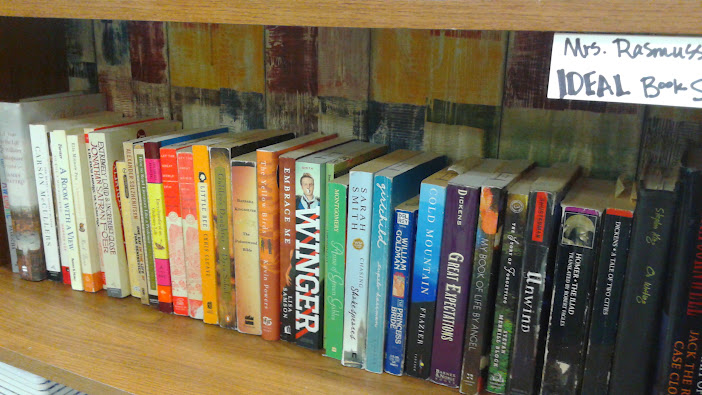
shelfieAT UNH Literacy Institute 2014, Penny Kittle gave us a handout so we could create a depiction of our Ideal Bookshelf. The idea comes from a lovely book that features articles where “100 cultural figures” describe the books they read and love.

Here’s a sampling from Brainpickings: My Ideal Bookshelf: Famous Artists and Writers Select Their All Time Favorite Books.

I keep an Ideal Bookshelf in my room. This is a place for my favorite, books. They touched me, molded my thinking, changed me in some way.

I talk about these books often, and many of my students read them. We share what we like and what we don’t. I encourage them to craft their own shelf of favorites.

From Awesome to Shakespeare to Girlchild and Great Expectations to On Writing and Portrait of a Killer by Patricia Cornwall — this is my personal canon, my Ideal Bookshelf.
What do you keep on your Ideal Bookshelf?

Please leave your favorite titles in the comments. They might just fill the next shelf in my classroom library.

©Amy Rasmussen, 2011 – 2015

Book Clubs in AP English: Just let them talk

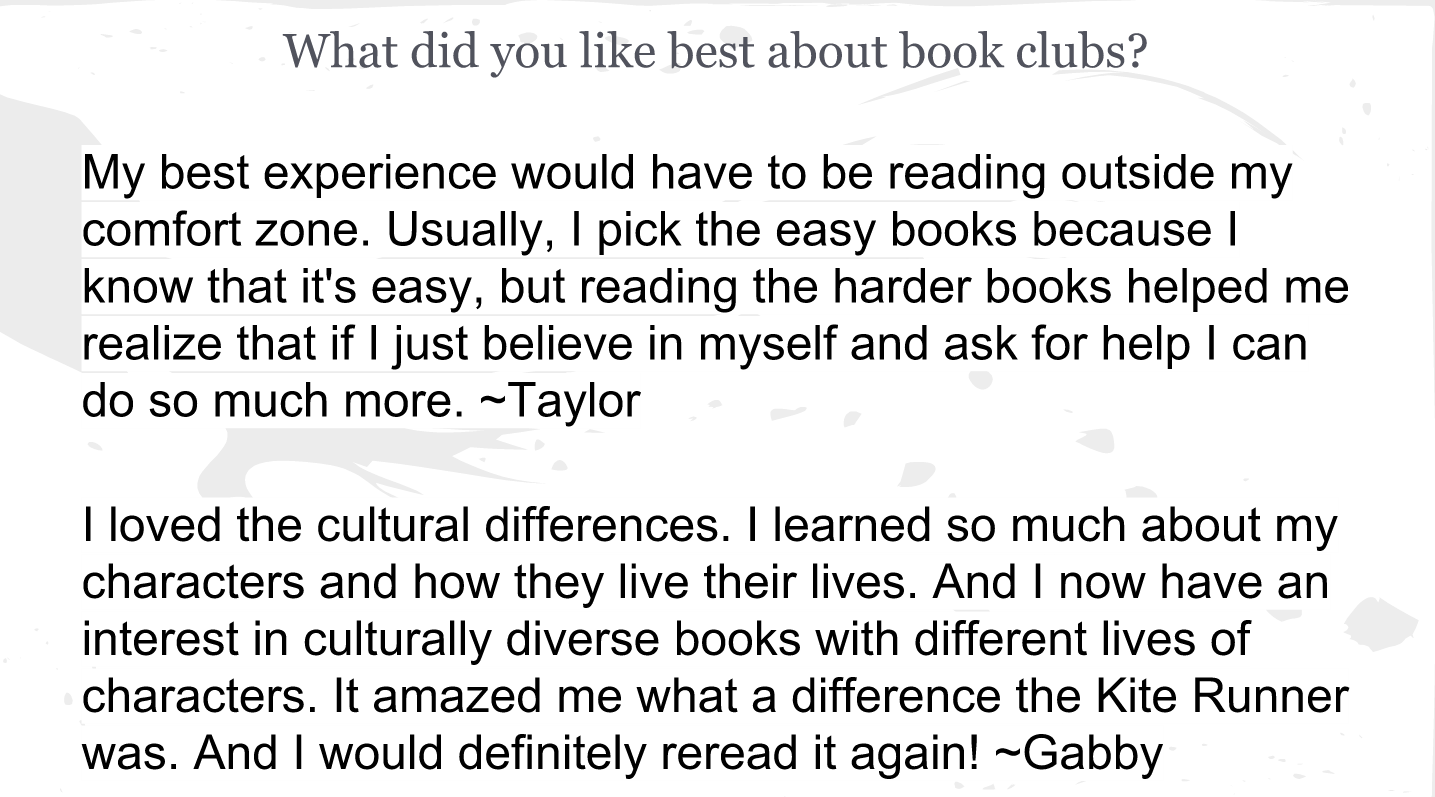
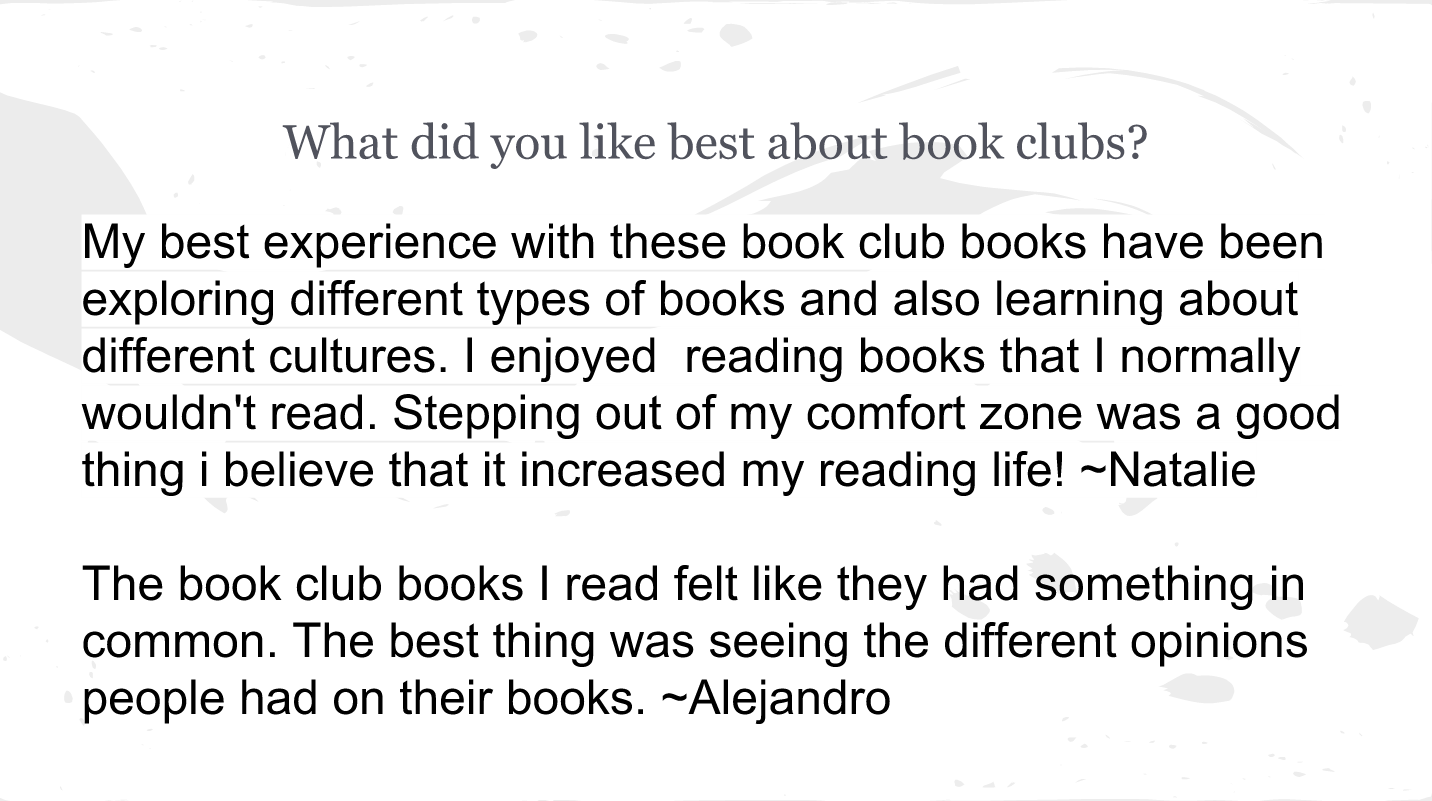
Some of it was great. Some of it not so much. I’m talking about the book clubs in my classroom this Screen Shot 2015-05-02 at 5.42.03 PMyear. The great was actually my students reading and talking to one another about that reading. The not so much — the way I did assessment.

This is what I learned and what I will change for next year:

Book Clubs serve as a way to challenge my readers into the more complex books that many of my students would never choose for themselves. Book Clubs also allow my readers to talk about books in an authentic way without the strictures of guided reading questions or anything else that might lead to Readicide. (‘Read-i-cide: noun, the systematic killing of the love of reading, often exacerbated by the inane, mind-numbing practices found in schools” –Kelly Gallagher) I wrote about the importance of balance literacy and how book clubs fit into that in this post.

I provide a short list of titles that I know contain fantastic stories of resilience, survival, hope, courage, and any other trait that prods readers to relate to the human experience. I introduce the books, usually with book trailers or video interviews of the author’s, and I include either on paper or a projected slide the synopsis and ratings from Goodreads or Amazon.

Students select their books, often talking with one another and making selections together. I ask students to purchase their own books, so they can annotate anything “interesting, intriguing, puzzling, contradictory, or you just plain do not understand.” Since most of my students come from less affluent families, we talk about the importance of libraries and surrounding ourselves with texts that can inform and influence our thinking. Often, students will purchase more than one of the books I introduce for book clubs. I also have a few copies of the texts in my room that students may check out if they cannot purchase their own. I always think my copies will be used more than they are, but I’ve learned that my readers like to buy books. Most feel the sense of ownership that I want them to feel.

Our first book club this year, I gave students a choice of the following titles, all centered around themes of family and parents and how they influence our upbringing and our choices:

Extremely Loud and Incredibly Close by Jonathan Safron Foer

Swamplandia by Karen Russell

The Curious Incident of the Dog in the Night Time by Mark Haddon

Girlchild by Tupelo Hassman

The Glass Castle by Jeanette Walls (literary non-fiction)

More students read The Glass Castle than any of the others, but every book was represented in at least one book club of three to six students. Students loved The Glass Castle, and they told me that they could relate to much of Walls’ upbringing.

Screen Shot 2015-05-02 at 5.42.19 PMAssessment:  For this first book club, I asked students to read with an eye looking for theme. They would work with their book clubs to craft a mind map that included numerous quotes from the book that contributed to the theme, and they would analyze these quotes as part of the mind map. They could create the mind map as a paper poster or online. As they read the book, they were to mark the text like I had taught with the short passages of text we’d read together in class, and they were to also look for sentences and phrases and passage that pointed to theme.

My students did not have a clue how to do that. Most did not mark their books, so when the project time rolled around, they ended up scouring through the book or searching for quotes on Goodreads or elsewhere to find enough quotes that they could plop into their mind maps. I needed to provide more guidance in annotating, and in reading for beautiful sentences, and in making thematic connections, and so much more.

Also, I allowed students to work in groups to create their mind maps. This did not work because no one in the group would rise up and be the leader. They were new in the class and new in their friendships with one another. Group work is a topic for another post, really. This time it failed, and I’ll need to do a lot more prep work before I spend as much class time on this kind of project ever again (if I ever do).

Our second book club, students choice a title from this short list, all centered around themes of culture and how these cultures influence us:

The Namesake by Jhumpa Lahiri

Little Bee by Chris Cleeve

Sarah’s Key by Tatiana de Rosnay

The Kite Runner by Khaled Hosseini

A Thousand Splendid Suns by Klaled Hosseini

More readers chose Sarah’s Key than any of the others. Students find stories of the Holocaust fascinating, and that shelf is a popular one in my classroom library. (Erika’s, too.)  Many students read The Namesake, and at least one book club read each of the others.

Assessment:  This one was even more lame than the first. Sometimes I feel the pull to get back to a Screen Shot 2015-05-02 at 5.42.33 PMmore traditional pedagogy. I am the only one on my campus who fully implements readers and writers workshop, so I listen in often to what other teachers have their students do. If you teach AP English, at some point, you have probably had students write a hexagonal writing over a piece of literature. (Hexagonal because student write thinking about their knowledge, comprehension, application, analysis, synthesis, and evaluation as it relates to the book. It sounds like a great assignment.)

It was the worst writing my students completed this year — if they completed it at all.

I know why. There was no authenticity in it. Follow the structure I gave you. Each paragraph should be about this… No wonder they didn’t care about writing well. I was their only audience, and I was making them write something worse than a book report.

We wasted a lot of time. (The grading policy in my district requires that I reassess major grades. Hey, let’s write this paper again since you cared so much about it the first time. Right.)

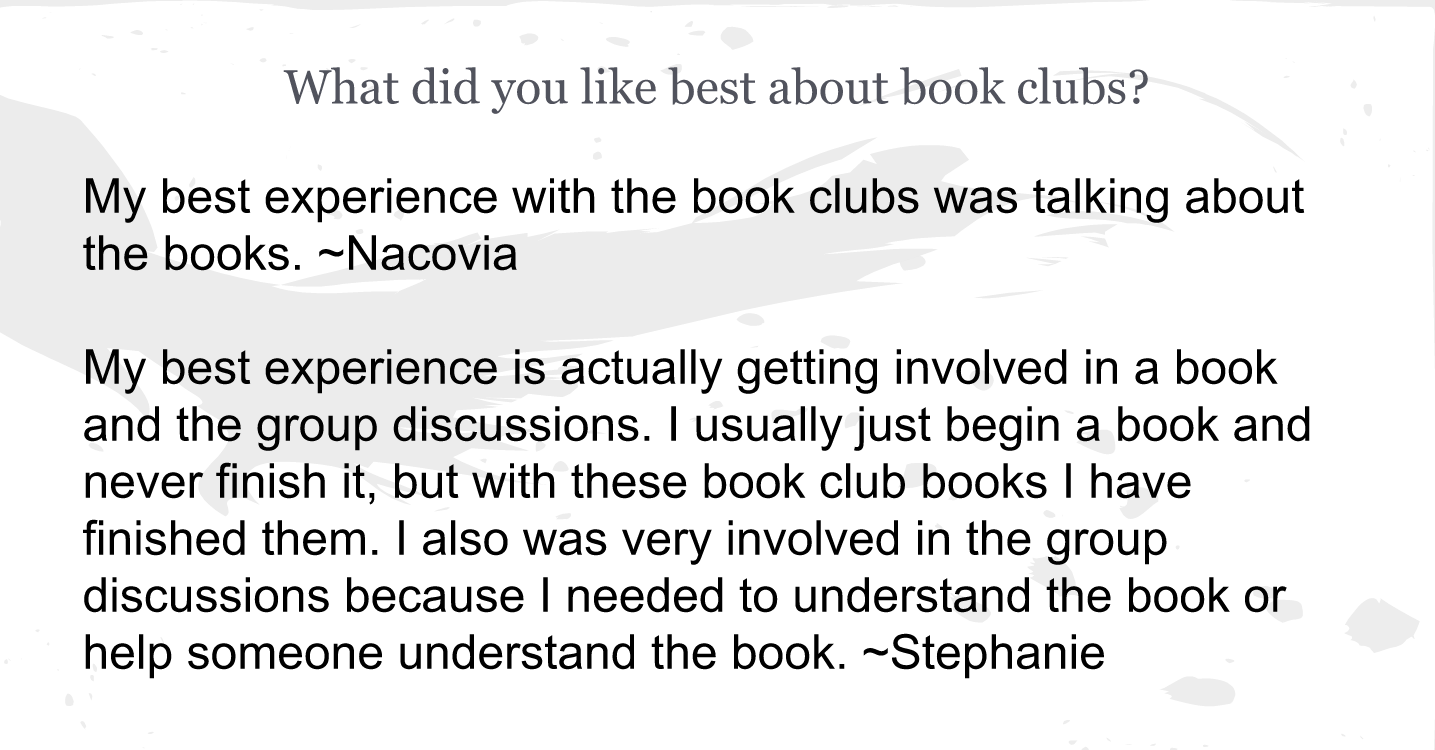
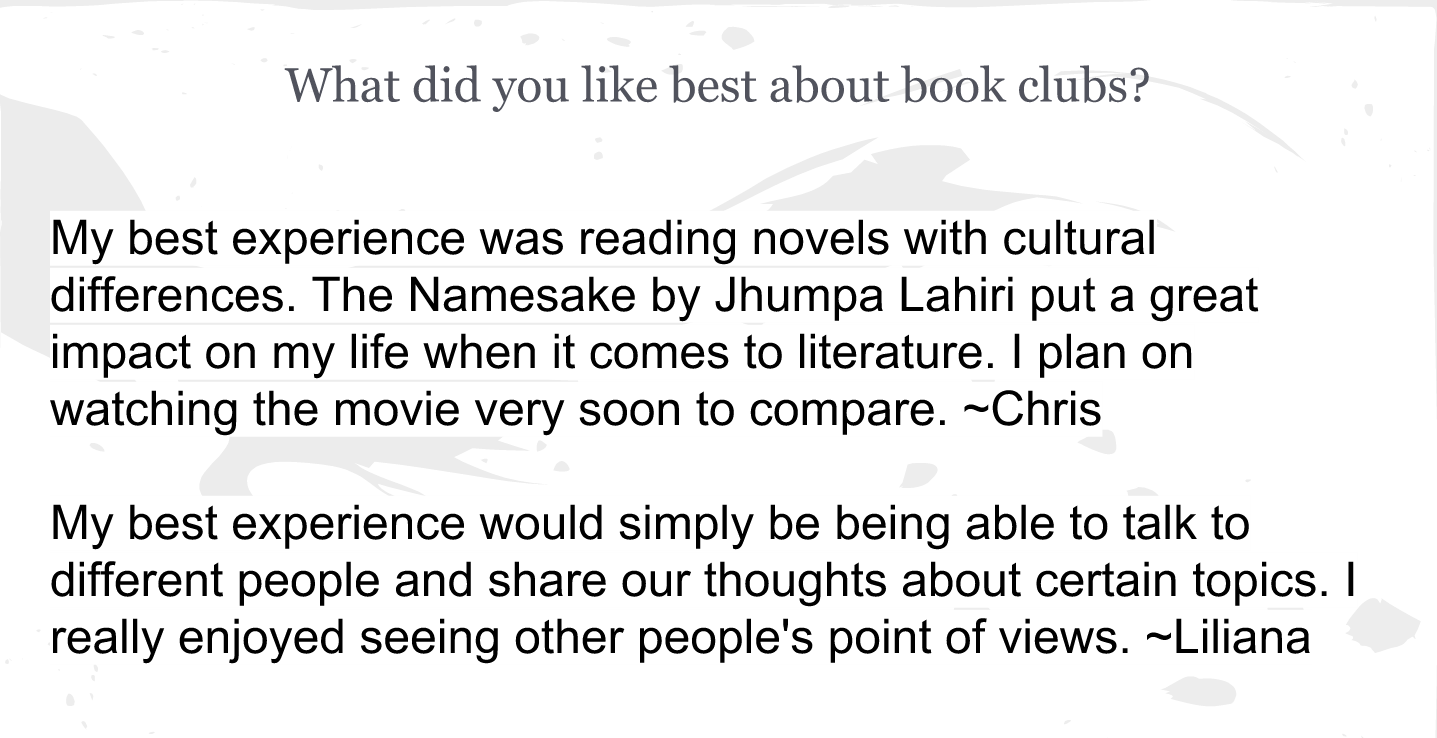
Screen Shot 2015-05-02 at 5.42.45 PMMy readers would have benefitted more from a gift of time to talk about the books more. Shana posted about the value of book clubs for talk earlier this year, and after two subpar experiences I began to agree:  “asking students to keep the conversation [about their books] going for 20 straight minutes provides valuable time for students to build relationships [around conversations about their reading.]”

I would just let them talk.

Our third book club students selected titles from this short list, all centered on war (or internal war) and its influences on individuals and humanity:

The Yellow Birds by Kevin Powers

Room by Emma Donoghue

Where Men Win Glory by Jon Krakauer (literary non-fiction)

The Bell Jar by Sylvia Plath

The Things They Carried by Tim O’Brien

The majority of my readers chose to read ROOM or The Bell Jar. They loved Room, and didn’t think The Bell Jar lived up to its hype.

I scheduled more opportunities for students to talk about their books. I wandered the room, sitting at Screen Shot 2015-05-02 at 5.42.57 PMgroups and listening in as conversations circled in and out and back again. Often, I placed a stack of TableTopic cards for book clubs in the center of their table, and students used these to guide their discussions. (Looks like the book clubs version of TableTopics is no longer available. Sad.)

Next year, I will do this again. I might ask students to look for significant passages so they can practice analysis on a page they select for themselves. Here’s a post that I’ll probably show them with a sample passage for craft study.

I might have them create a found poem or a black out poem.

Or I might just let them read and talk and read and talk some more.

That’s what I do in my own book club.


If you have your own suggestions for improvement, please share them in the comments.


©Amy Rasmussen, 2011 – 2015

Okay, I Will Share My AP Testing Data

A new friend asked me if I would share any AP testing data that I’ve gathered since embracing Readers and Writers Workshop. I had to think about it since I rarely think about it. I do appreciate the question though because it led to this post.

I need to tell you right up front:  While I appreciate the AP exam as a high-stakes test, I do not lay a lot of value on testing data for many reasons.

So many factors figure into how a group of students tests each year, and looking at figures from one year to the next, and trying to compare numbers with different groups of students has never made sense to me. The only real valid data is the growth I measure from the fall when students walk into my door until they leave me in the spring. However, I can tell you that the first year I implemented Readers and Writers Workshop and gave up whole class novels in favor of encouraging students to read books of their choice and taught skills with short, sophisticated, complex texts, my students’ scores were 12% higher than my students’ scores the year before.

The best I can do to respond to your question is to quote Stephen Krashen in the article “Free Reading:”  “. . .research strongly suggests that free reading is the source of our reading prowess and much of our vocabulary and spelling development, as well as our ability to understand sophisticated phrases and write coherent prose. The secret of its effectiveness is simple: children become better readers by reading.”

And…  “Research has . . .shown that SSR is at least as effective as conventional teaching methods in helping children acquire those aspects of reading that are measured by standardized tests, and pleasure reading provides a great deal that these tests don’t measure.”

The first two years I taught AP, I tried to do it like I learned at my APSI. I assigned the traditional novels taught in American literature: The Scarlet Letter, Huckleberry Finn, The Great Gatsby, The Awakening, The Grapes of Wrath — because the other AP teacher on my campus did. I can tell you, my students did not read. They even told me later that they didn’t — lots of joking about that on Facebook a few years after they left me. They knew how to play the fake-reading game perfectly.

I know Krashen’s research centers on much younger grades than our students in AP English; however, reading is reading, and students gain skills by doing it — skills that improve their lives far beyond those tested on one day in May as they sit for the AP English exam.

My students just wrote end-of-year reading evaluations on their blogs. Here’s a few of the highlights about reading this year in their own words. This is the kind of data I value:

“Being apart of a reading community has benefited me deeply within my entire life. Even though I didn’t read as much as I wanted to, the reading that I did do was very beneficial. Reading helped me expand my vocabulary a lot. Sometimes when I would speak to my mom I would use a word that I learned from the book I was reading and she would just look at me like she didn’t know who I was. Reading also helped me become a better writer. So many different books that I read helped me use different structures, understand how to use rhetorical devices, and use my upper level vocabulary.”  DeDe, currently reading Thirteen Reasons Why by Jay Asher

“Being part of a reading community as a student opened my mind how others thought of the book we were currently reading together. Occasionally, I’m an ostrich that’s always in the ground; thoughts to myself, ideas to myself, and the “this is what this means” mentality. I’ve slowly learned how to use the point of view of others by implementing it into my own work. In addition, this year’s English class did not feel like a burden compared to previous years. The freedom of choice we were given provided us with the decision to pick a book we enjoyed.” Doreen, currently reading The Goldfinch by Donna Tartt

“I believe the place I need to improve as a reader is being able to find the hidden meanings or putting everything together in order for me to understand a book. Sometimes without me noticing I just read to read and I forget what I read and have to read the paragraph or page again in order for me to understand it. I need to read and take everything under consideration and understand what it is that I’m reading and at the end put it back together. Maybe my problem is that I try to read too fast.” Johnny, currently reading The Alex Crow by Andrew Smith

“Being part of a reading community benefited me because I always felt like I needed to be reading a book. It felt splendid being a part of something, especially something I would of never thought I would be a part of.  I understood the importance of reading. The more you read, the better writer you will become. I realized what genre of books I liked and which ones I didn’t. Most importantly I explored a different variety of books and read a minimum of 12 books. Something I had never done before. Usually I would read a minimum of 3 books every year.” Lizbeth, currently reading Playing Dead byJulia Heaberlin

“My journey began with Escape From Camp 14. I moved through different genres and difficulty levels thereafter: Anna and the French kiss, Allegiant, High School Bites, The Glass Castle, The Curious Incident of the Dog in the Night-Time, Where’d You Go Bernadettte, The Art of Secrets, The Hot Zone, Little Bee, The Joy Luck Club, Down the Rabbit Hole, Room, Incendiary, The Wright 3, and most recently, Y. During this time, I abandoned The Kite Runner, The Thirteenth Tale, Ready Player One, Saving Fish From Drowning, Telegraph Avenue, and Station Eleven.   Even I find it odd, that out of the entire list, I enjoyed The Joy Luck Club more than any other. I say this because I’m not the patient type- I like constant action, fueled excitement. The Joy Luck Club almost counters that expectation, and if I had to describe it, I might even consider calling it boring.” Nawoon, currently choosing — just abandoned Station Eleven

This evaluation by Jasmine is too good to not share the whole of it. And this one by Shaniqua.

I just need to share one more thing, a little gift I got today as I read student reading evaluations. I know most teachers get these at one time or another.

It is the thing that keeps us going.

Laura wrote:

“I still need to improve on not judging a book by it’s cover. For us to GROW as people, we must get out of our COMFORT ZONE and pick up a shattered book because it needs someone to appreciate it’s language. As much as reading conference were sometimes nerve wrecking for me, they helped me get a second opinion on my progress in class as a human and not merely as a student. I can never thank Mrs. Rasmussen enough for dedicating chunks of her life to her students. Positivity in a world were criticism is many people’s issue is so rare and pure. She truly cares about each of us and sees past our struggles and attitudes and tries her best to help us understand it’s okay to have emotions and display them for others to see.  I’ve learned it’s more important to turn our conflicts into beautiful gifts instead of becoming a bitter person.”

Don’t you think that is better than any testing data?

©Amy Rasmussen, 2011 – 2015


7 Moves in My Workshop Schedule

Quite often teachers ask me what the daily schedule looks like in my workshop classroom.

This is a hard one. I think mainly because it is not about the schedule as much as it is about the routines, or manners, we start putting into place at the beginning of the school year.

I’ve had a lot of adapting to do this year. Moving to a new school and adjusting my lessons to fit 85 minute class periods where I see my students twice a week for sure and every other Friday — sometimes. This is quite a change from 50 minute class periods where I saw my students five days a week.

Our normal routines  — and these are non-negotiables that make workshop work — consist of reading, conferring with readers, talking about books, writing in our notebooks, revising in our notebooks, sharing a bit of our writing, and learning or reinforcing a skill, then….it all depends on our workshop task. That’s why writing about my daily schedule is hard.

Here’s the best I can do without going into a long explanation — that has to wait for my book (Penny keeps telling me that my book will never get written if I keep writing on this blog, and I know she is right. Only so much time.)

READ — 10 to 15 minutes. This is sacred and silent reading time. Students choose books that interest them. I CONFER with my readers, always with a specific focus, depending on my reader.

TALK about books. Sometimes I do a book talk, reading a few pages of the book, or holding a book interview like Erika does. Sometimes a student does a book talk, if I’ve talked to her first and know she’s passionate about the book she’s just read. Sometimes I ask my students to just talk about the books they are reading. Shana wrote about the Value of Talk, and I agree completely: “Talk is one of the most valuable tools at work in my classroom.”

WRITE in our writer’s notebooks. Everyday we need to have our students thinking on paper. When I forget, or think we do not have time, to open our notebooks and write — in response to a poem, or a video, or a story, or about the book students are reading, or about whatever — I regret it. Discussions are richer when we write first. Discoveries are more insightful when we write first. Writing is better when we write, just thinking about our ideas, first.

Then, something I learned from Penny Kittle, we always read what we wrote and REVISE. Penny modeled revising with a different color, and I ask my writers to do the same. I simply say, “Read over what you just wrote. How can you make your writing better? Maybe add a phrase or two that develops your thinking more. Maybe change a word or two that adds a punch. Maybe you can remove some words and make your thinking more concise. Where can you add figurative language or a list or an interesting style move?” (When I check writer’s notebooks, I always look for evidence of revision. We work on establishing the habit of revision, daily.)

SHARE some of our thinking. Sometimes we pair up and read our writing to a shoulder partners. Sometimes I ask for volunteers to share out their writing. Sometimes I randomly call on someone (and I usually allow them to opt out at least once if they are uncomfortable reading aloud). Sharing is an important part of our community, and from the first day of school we work on establishing a safe and respectful environment where we can all grow as readers and writers.

Learn or reinforce a skill via MINI-LESSON. (If I introduce something totally new, like one of the AP English Language exam prompts, obviously the mini-lesson will not be so mini. On these days, the mini-lesson time and the workshop time allotment swap places. Sometimes I need the focused direct instruction time because it saves time in the long run.)

Our routines usually take about 35 to 45 minutes. That leaves us about half the class period to hold a workshop. This might be a readers workshop if we are practicing close reading or if we are preparing for a Harkness discussion. This might be a writers workshop if we are composing a piece of writing or studying the moves of a favorite author.

Of course, if we are writing, I change my hat and confer with my writers.

I would love to know the workshop routines you establish with your readers and writers. Please share in the comments.

©Amy Rasmussen, 2011 – 2015


Shelfie Saturday: Book List Bookmarks

shelfieThis year, I am convinced that the patron saint of libraries has arrived at EHS in the shape of a silver-haired spitfire. Kathy Vetter and her crew of library assistants have managed to shift the culture of our library from a stuffy prison in which students got kicked out all too often (for eating, sleeping, talking, breathing) into a warm, inviting space of relaxation. Surprisingly, this transformation and the allowing of food in the library have also ignited students’ interests in reading.

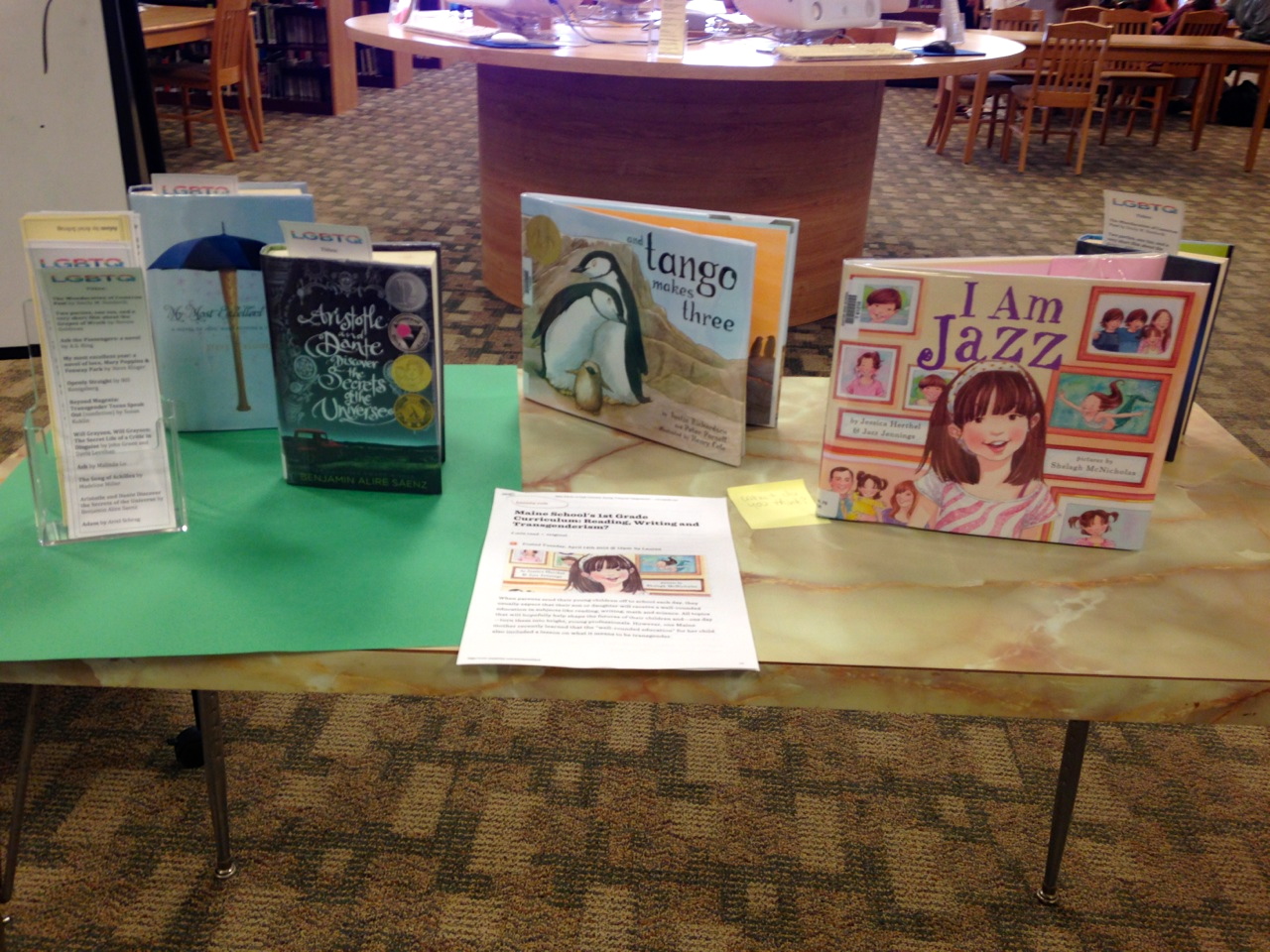
One of the library’s greatest programs for engaging readers has included setting up simple displays to attract students’ attention. While the displays aren’t flashy or ornate, they expose students to a wide variety of books. For example, in honor of June being LGBTQ month, the library set up a small table with a selection of LGBTQ literature. The selection included I Am Jazz, a book about a transgender child that recently sparked controversy in Maine (ourIMG_2153 neighbor) after an elementary school teacher read it to her class. In addition to the display, the library also provided copied articles about the I Am Jazz dispute to educate students. Talk about a teachable moment!

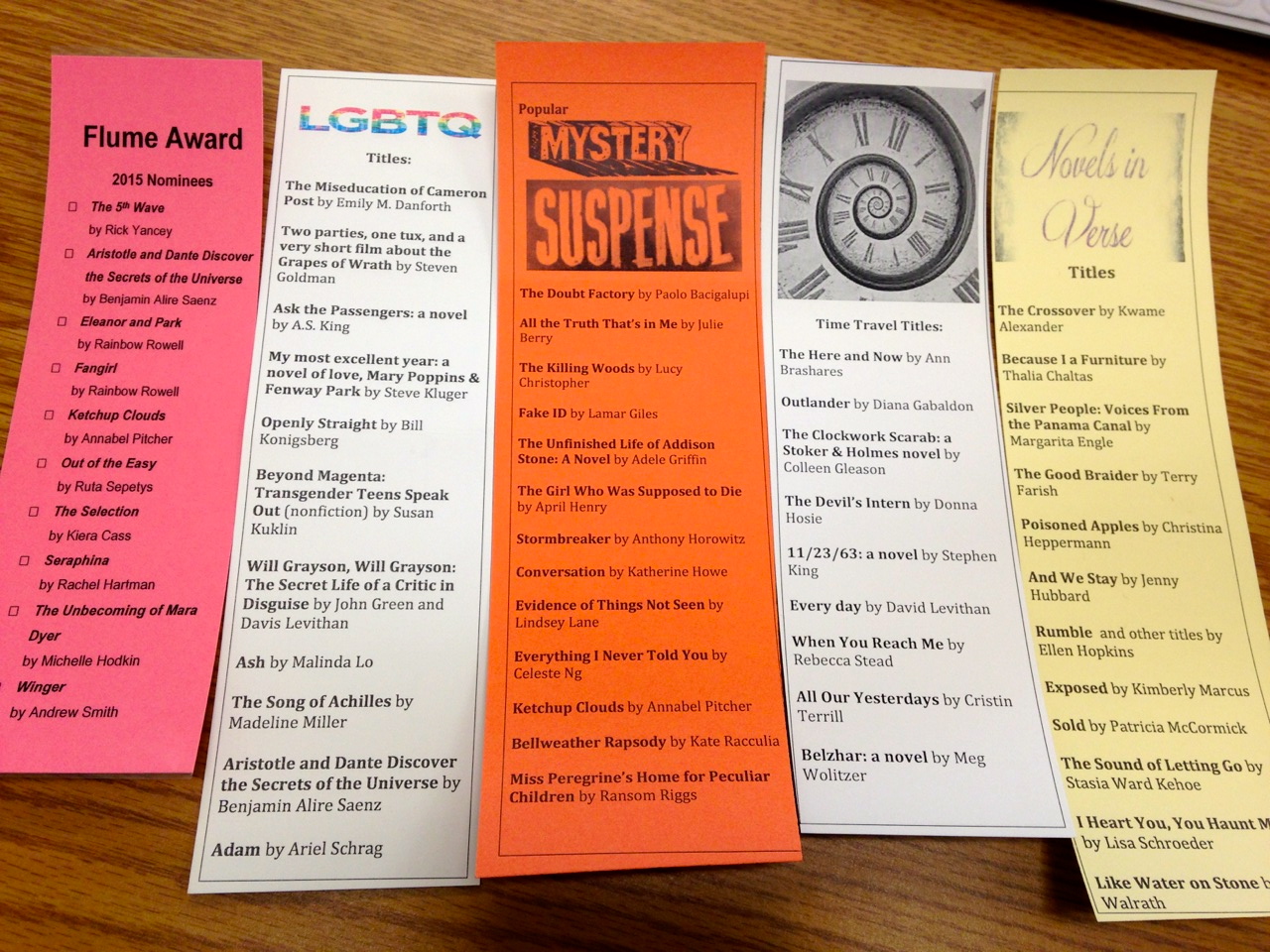
What I love most though is the increasedIMG_2154 availability of book list bookmarks. Throughout the year, the librarians have managed to set up an elaborate display of bookmarks including lists of Flume Award nominees, time travel titles, and novels in verse. Many bookmarks even include suggestions based off popular books; for example, one reads, “If you liked The Fault in Our Stars, you might like…”

As I reflect on my currently library, I look forward to aligning with the library and using their model within my own classroom. I currently use plate stands I bought from a craft store to display books on top of my bookshelves. I am planning to not only steal some book list bookmarks to provide to my students (who are always looking for bookmarks), but I am also going to use these bookmarks to help me develop my book displays

and even my classroom library shelves. In the meantime though, I will certainly count my blessings that such an angel of books not only appeared at EHS but changed the environment that surrounds one of our greatest school resources.

Missing Pieces by Meredith Tate

24903132I love receiving e-mails from students—not the “Is this due tomorrow?” or “Why do I have a zero in PowerSchool?” e-mails—but the ones that are written bleary-eyed, late at night (or sometimes early in the morning) from students who have just finished a book. Recently, Alyssa, one of my Advanced Composition juniors e-mailed me at 10:30pm after finishing Missing Pieces. She wrote:

“Wow, I just finished the book and I am completely shocked! Was definitely not expecting…[Can’t put this in because I don’t want to spoil it!]…I am extremely happy the way it ended! This was most certainly one of my favorite books that I read this year and if any of my friends ask for a recommendation I would without a doubt recommend it.”

As a teacher, finding a book students can connect with is a victory! But in this, case the victory was even sweeter. I grew up with Meredith Tate, the author of Missing Pieces, and even as children playing in the sandbox at our tiny four-classroom elementary school, Meredith knew how to weave a story.

Missing Pieces is the story of Tracey (Trace) and Piren, two best friends growing up in a dystopian world where they are matched with their spouses at six years old based on genetic compatibility. Despite Trace and Piren’s undeniable friendship and eventual attraction, they are paired with different partners. It is a fight between fate and free will.

While the plot might sound generic, resembling the many dystopian romances novels we’ve seen lately, Meredith succeeds in weaving together a distinctly unique story. Trace and Piren are flawed and frustrating and real. They live in a world of messy mistakes. As a social worker, Meredith doesn’t skirt around issues of alcoholism and abuse—instead she confronts them head-on, addressing the harsh, debilitating nature of addiction. I love that this book doesn’t cleanly fit into any distinct genre—it’s a romance, but it isn’t mawkish; it’s categorized as “new adult” but it begins when the protagonist is 14 years old; it’s dystopian yet it distinctly resembles modern society. Despite the numerous questions posed throughout the book (including those in the excerpt below), we learn that life is a series of difficult decisions; it’s the pure beauty of this rawness that makes this book relevant to teenagers.

“What if the one you’re supposed to be with, and the one you want to be with, are two different people? My entire life was mapped out for me before I was born. Is my only choice to silently follow the course already plotted? To blindly accept my future and walk that trail until I die? To smile and pretend everything is okay and I’m happy and in love with my Partner when I’m spiraling downward and drowning in my loneliness? I’m drowning, like in my childhood nightmares. Only this isn’t a nightmare; I can’t wake up from this life.”

Shelfie Saturday: Nonfiction #ShelfieShare

shelfieAs a young reader, I was a library-only kinda girl.  I browsed the mystery, fiction, and teen sections looking for distinctive spines–ones that had a pink “Classics” sticker, or an orange “Award-Winner” sticker, or a blue “Librarian’s Choice.”  These little guides led me to Jane Austen, Matthew Quick, and John Grisham, whose spines were not only colorful with library stickers but also well-worn from the hands of readers.

The thing about those spines was that none of them were in the nonfiction section, which loomed large with encyclopedias, reference books, and lots of sections about science, technology, or car repair.  Being a middle schooler who didn’t know about the Dewey Decimal System, I had no idea how to find interesting biographies, beautiful memoirs, or fascinating historical accounts.

Now that I’ve begun to love nonfiction and learn a lot from it, I’ve tried to simplify the search for great true stories in my classroom library.  We have one Nonfiction shelf and two Memoir & Biography shelves.  I try to keep collections, histories, and statistics-into-stories books all together on the Nonfiction shelf, while I move the stories of people’s lives onto the M&B shelves below it.  Sometimes the titles that belong on the Nonfiction shelf wind up on the Award Winners, Unique Teens, or Death & Dying shelves–because I love to mix true and imaginary stories in our library when they share themes.

FullSizeRender

You can see that our shelf is varied–topics range from sports to how the mind works to humor.  Some authors are dominant–Jon Krakauer, Malcolm Gladwell, Daniel Pink–but others are one-hit wonders whose titles are very popular–Mary Roach, Michael Lewis, Dave Cullen.  Their respective Stiff, Moneyball, and Columbine are three of my library’s most popular titles.

Our nonfiction shelf is also the home of the “Best American” series, which includes topics such as science, travel, and sports writing, but also a collection of simply “essays” from each year.  This series is a fabulous way to find a huge variety of good nonfiction mentor texts when students are doing informational or persuasive writing–there is always something to match any student’s interest.

This shelf is an eye-level shelf for good reason.  Students who wouldn’t normally gravitate toward the nonfiction genre find their eyes caught by interesting covers, titles, or topics–such as Missoula and It’s Not About the Truth, both of which deal with college rape culture, or The Sociopath Next Door, which attracts all my Sherlock fans, or Lost in the Meritocracy, which gives both motivated and disengaged students much to consider.  Once students discover this shelf, they often move toward the Memoir & Biography or Award-Winners shelves, which contain more sophisticated nonfiction structures.

I encourage all teachers of literature to build up their nonfiction shelves–their titles have much to teach our students.