Category Archives: Classroom Library

Beyond Hillbilly Elegy: Books for Country Boys

IMG_1959

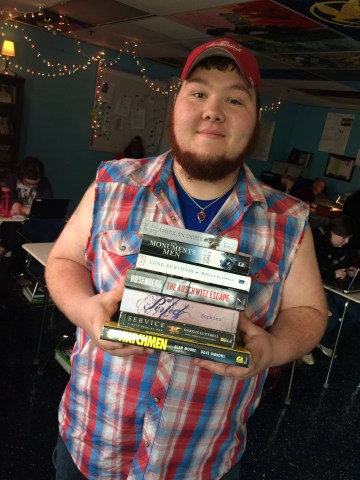
Bull with a few of his favorite books

I’ve been thinking about one of my former students recently, wondering how he’s doing.  His name was Logan, but everyone–his family included–called him Bull.

I’ve been thinking about him because I had him in class for two years, and it took me a long time to realize I’d been recommending all the wrong books for him.

With the recent popularity of a book like Hillbilly Elegy (which has caused quite a stir here in Appalachia) I’m reflecting on how it’s a book I probably would’ve recommended to Bull.  Like the many other “country” books I’d offered him, figuring the text had a character he could actually relate to, I think Bull would’ve hated it, as many of my friends here in West Virginia have.  I haven’t had a chance to read it, but my peers and students alike who have say it’s too much of a stereotype of Appalachian culture, that it paints Appalachia much too negatively, and that it in no way captures the beauty of our mountains, music, or lifestyle.

I had a hard time getting Bull interested in reading, but boy, he’d write.  He wrote beautifully about the country he lived in, the simplicity of his family life (he showed me videos of teaching his barefooted three-year-old brother how to operate a push plow on their farm), and his love of hunting.

I think no book can capture the kind of love that a kid like Bull has for his own heritage, and I didn’t realize that when I offered him book after book that I thought had a “similar” kind of character for a protagonist.

But, in his reading life, Bull was a different kid last year.  He was a senior, about to enter the real world and acutely aware of his need to be prepared for it.

When I talked to him at the end of last school year, he described his junior year reading life as “shitty.”  I asked him why, and he said, “cuz I was lazy.”  He read two books all year, and when I talked to him about this, he laughed sheepishly.

Last year, he’d read 13 books and was in the midst of his 14th–Monuments Men by Robert Edsel–when I went on maternity leave.  I think he read 17 books by the end of the school year.  Before I left, I talked with Bull about his reading life.  We’d discovered his love of war books with American Sniper.  “My great grand-pap was in Vietnam, and I want to read about what he went through,” Bull explained, gesturing to his stack of books.

I also asked him how he felt about reading.  “It calms me,” he told me.  “It gives me something to do.”

It calms me.  I still remember him saying that to me, sitting in my classroom with the back door open, where a spring breeze wafted in and the sounds of kids eating lunch outside could’ve been a huge distraction.  But as Bull reflected on what reading did to him, the act of thinking about books took him away from our classroom and into a place of relaxation.

I loved watching reading transform Bull.

From war biographies, Bull moved to war fiction, then to books in verse, then to graphic novels, then to a variety of nonfiction titles.  He eschewed books about country life, popular fiction, and YA novels all year.

I’m thinking about Bull now as I reflect on the mirrors, windows, and doors we ask students to walk through in their reading lives.  I’m thinking about him as I reflect on Pernille Ripp’s plea for us to stop grading independent reading.  I’m thinking about how I approached Bull first with books I thought of as mirrors, but he was craving windows and doorways all along.  I’m thinking about how his whole junior year, he got 2/10s on reading logs, and I’m thinking about what a colossal mistake that was on my part.

So, last spring, I asked Bull to compile a list of his favorite books, and the draft has been sitting in my WordPress sidebar ever since.  I share it with you now to remind you that this list, a list for “any country boy,” in Bull’s words, is a list of books set far beyond the mountains of Appalachia–and represents a story that can never be told with an independent reading grade.

  1. Lone Survivor by Marcus Luttrell – “This was an amazing book.  It was a true story of a Navy SEAL, and his whole team got attacked in an ambush and he was the only one that lived.  Just the things that he gives you is like standing in war–it’s just amazing how something can give you so much detail that it seems to be real.”
  2. Article 5 by Kristen Simmons – “It was the end of the world basically, and there are a few kids running away from the people who were going to kill them.  It was also a really detailed book so I could imagine what the new world looked like.  I liked that book a lot.”
  3. Perfect by Ellen Hopkins – “This book was all about everything people give up to be perfect.  The whole time I was reading it, I just thought, nobody’s perfect–what is wrong with these people?  But it made me understand everybody else better.”
  4. The Auschwitz Escape by Joel Rosenberg – “Hitler ruled this book.  It was about war from a prisoner’s point of view, and it gave lots of detail about what he went through and what Hitler forced him into.  I would never have wanted to be part of World War II as a soldier or a prisoner.  That was some crazy shit.”
  5. Symphony for the City of the Dead by M.T. Anderson – “This one was really hard to understand compared to the other WWII books I read.  I picked it for my challenge book, and it was about what happened in Russia during World War II.  It taught me more about writing than about war, honestly.”
  6. Watchmen by Alan Moore – “This was my first graphic novel and I liked that it was and was not about war, at the same time. It was kind of about the cold war, but through the fighters’ eyes and not the politicians or the history books.”
  7. The Blind Side by Michael Lewis – “Well this book was nothing like the movie, but I wanted to read the book after I saw the movie.  It’s about a football player that came right out of the Bronx, basically had no mom, and he just went from clear down to about nothing to making millions of dollars a year playing in the NFL.  I got inspired by him how you can come from nothing to the NFL and you can do anything you put your mind to.”

Bull now works for the water company here in West Virginia, still lives on a farm…and still reads.  And the song of his reading life is so much broader than a hillbilly elegy.

Shana Karnes lives in West Virginia and teaches sophomore, junior, and senior preservice teachers at West Virginia University.  She finds joy in all things learning, love, and literature as she teaches, mothers, and sings her way through life.  Follow Shana on Twitter at @litreader or join her for the Slice of Life Writing Challenge here.

Booktalk this now: THE PLOT TO KILL HITLER by Patricia McCormick

The story behind the story.  At this year’s ALAN workshop (you should go!!! free books!!!! lots of authors!!!!!!)  I heard Ryan Graudin, author of Wolf By Wolf, talk about her research of Dietrich Bonhoeffer.  


Dietrich who??!!!


Oh, you know, this guy who was part of a larger group planning to publicize Hitler’s misdeeds to the broader world and to kill him.


Ryan’s book is all about an underground resistance that planned to kill Hitler.  Her book is fantasy.  


The Plot to Kill Hitler, Patricia McCormick’s biography of Dietrich Bonhoeffer, is as real as it gets.

plot-to-kill-hitler

Whom this book is for.  Readers who have a basic, elementary school-level understanding of Hitler and concentration camps know enough to follow this story from beginning to end: McCormick takes care of readers from there.


The topic is heavy, but the short chapters and brisk pacing make this 150-page piece perfect for middle and high school readers as well as mature elementary school readers.  If your school already does a holocaust unit, this book will provide a new point of view.


More sophisticated readers will make connections between Bonhoeffer and Martin Luther King and can debate the relative merits of a pure nonviolent approach to more direct and retributive forms of protest.  One of the most fascinating parts of this book for me was seeing how Bonhoeffer, a deeply religious emotional young man, transformed from a social justice scholar and Gandhi acolyte to a subversive and aggressive warrior.


How to booktalk it. Not too much preamble.  Just read the 2-page prologue out loud to the class, where Bonhoeffer knows he is about to be captured by Nazis and races to hide his incriminating papers in a ceiling panel and leaves a deliberately fake diary to throw the Nazis off his path.


You should also know… I struggle to match quality middle grades nonfiction with readers.  Some of the most fantastic middle grades nonfiction titles require a lot of patience and background knowledge.  Some are so laden down with information that there isn’t enough of a story to keep readers going.  Other terrific nonfiction titles are awkwardly sized and aren’t easy to carry down the hallway.  This book avoids all of those possible pitfalls.


Amy Estersohn is a middle school English teacher in New York.  Despite her observations that nonfiction books tend to be harder to carry around than fiction books, she has seen students lug around the 10-pound “Hamilton” book — you know, the one with all the pictures of the original cast.    Since you were asking, she won lottery tickets to see “Hamilton” during its first week on Broadway.  Really.  Twitter handle: @HMX_MSE

5 Middle School-Friendly Fiction Books About 9/11

I was still a teenager in 2001, and an immature teenager at that.  On 9/11 I wrote a poem in my diary about watching people jump to their deaths on television.  By September 13, 2001, I was back to writing in my diary about getting the silent treatment and missing allowance money.  I didn’t have a way to process 9/11 back then. 

So it’s no wonder to me that I seek out middle school-friendly books about 9/11, because a middle school book about 9/11 is exactly what I needed when I was… you know… in middle school.

And, interestingly, all of these books emphasize the importance of connections to others in the face of tragedy — not just our family and close friends, but also those neighbors we never talk to, the strangers in our lives, and the people we don’t even know we know.  


Some notable 9/11 fiction books for teen readers include:


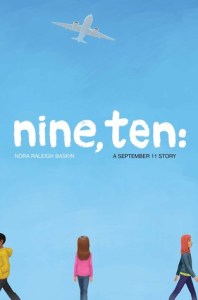
  1. Nine, Ten by Nora Raleigh Baskinnineten

Baskin’s lyrical, concise book follows four different young teens in the hours leading up to the terrorist attacks on the United States.  The emphasis here is on the importance of community rather than the tragic events, and our characters are removed from Ground Zero.  Given the brisk pacing, the age of the characters, and the gentle treatment of the terrorist attacks, this book is probably a best fit for readers in grades 5-6. However, the topic gives this book significant crossover appeal to a middle school or even a high school classroom.


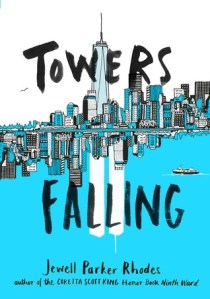
  1. towers-falling  Towers Falling by Jewell Parker Rhodes

This book begins in present-day Brooklyn and works backward, as our main character Deja attempts to understand her father’s emotional fragility.  While younger readers will probably be surprised to discover Deja’s connection to the 9/11 attacks, older readers will be able to make reasonable predictions about where the story is heading from the generous hints Jewell Parker Rhodes gives us along the way.  I appreciate this book not only as a 9/11 book, but also as a book that brings in diverse characters, homelessness, PTSD, Islamophobia, and other social issues.  Recommended for grades 5-7.


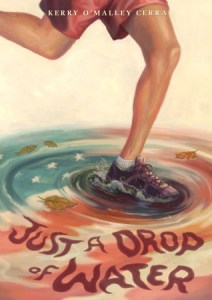
  1.  Just a Drop of Water by Kelly O’Malley Cerrajust-a-drop-of-water

Before 9/11, Floridian Jake Green’s only cares in the world seem to be  becoming captain of
the eighth grade track team and his grandfather’s war medals.  But 9/11 affects everybody, even in this sleepy town, and all of a sudden Jake’s best friend’s father is taken into FBI custody.   Cerra presents a traditional middle school friendship novel introduces tough topics like the unfair detainment of innocent Muslims and the role of war in international relations.  Recommended for grades 6-8.


  1. memory-of-things  The Memory of Things by Gae Polisner

On the morning of September 11 Kyle Donohue evacuated Stuyvesant High School, blocks away from the World Trade Center, and walked home to Brooklyn
with a large group of refugees.  On the way he sees a girl with angel wings who seems lost and confused and brings her to his apartment.  This dual perspective story (Kyle’s narrative is straight prose, the girl’s narrative is fractured poetry) is wholly immersive in 2001 period details and is more about people than politics.  Recommended for grades 7+


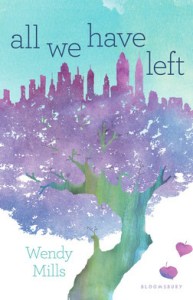
  1. All We Have Left by Wendy Millsall-we-have-left

Hand this book to the reader who wants to be INSIDE the towers as they come falling down.  Readers go back and forth between the story of Jesse, who is 2016 was only 2 years old when her older brother Travis died in the World Trade Center, and Alia, who in 2001 was one of the last people to see Travis alive.  This book is heavy, but its messages of healing and redemption make it palatable to a wide range of readers.  You’ve been warned: bring tissues.  Recommended for grades 7+.


Amy Estersohn is a middle school English teacher in New York.  Her taste in music is very 2001.  Visit her on Twitter @HMX_MSE

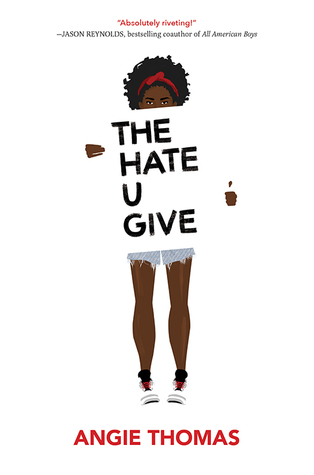
Booktalk this now: THE HATE U GIVE by Angie Thomas

The story behind the story.  I received an early review copy of this book when I attended the ALA Mid-Winter meetings in January and asked extra-nicely at the HarperCollins booth if there were extras.  


(Pro tip: Check to see if there are any ALA meetings happening near you and block those days off on your calendar now.  Free books.  Lots of them.)


I started reading it about 6:10 AM over breakfast before leaving for school.  By about 6:50 AM I was reluctant to leave the house and get to school.

thehateugive

The book talk. I told students that this was the rare book that made literally want to drop everything and read.  Starr is at a spring break party when gunshots go off and she and childhood friend Khalil leave the party by car in search of safety.  Police pull Starr and Khalil over and end up killing Khalil in what might be a case of mistaken identity.


Why do you think the cops had reason to be suspicious of Khalil?  I asked.


Students responded:

Well, he’s a teenager and the people who were at the party were teenagers too.

He was near the scene of the crime when it happened.

Was he speeding away when cops pulled him over ?  (The book makes it clear: he wasn’t speeding.)

Was he black?


That’s when I covered up all but the first letters of the acrostic so students could read the title down the page: The Hate U Give or THUG.  


“Ohhhhhhh,” students said.  “Khalil was probably stereotyped because he looked like a thug.”


Building empathy and understanding for the Black Lives Matter movement.  While this book covers a lot of tough teen topics, be ready for readers to proke, prod, and question its support of Black Lives Matter.


Be ready for readers to say, “What about all the cops that keep everybody safe?  You can’t be anti-cop.”  And “I don’t understand why Black Lives Matter people have to make it about black people.  What about white people who just want everybody to get along?”  Thomas pre-emptively responds to these readers by giving this book a strong moral core, where there are supportive police officers, kind family members, a grassroots nonviolent community organization, and a terrific white boyfriend along with some villain characters of both races.  


Starr is a teenager of the moment.  She’s a tumblr addict, she wants you to know that she considers Beyonce a cousin, she nae-naes and hits the quan.  She embodies contemporary teens in general and contemporary black teens in particular.  In 25 years she’ll appear fuddy-duddy, just as her Jodeci and Juvenile-loving parents are right now.


Patience and stamina.  The action happens in the first few dozen pages, and what follows is reaction and rebuilding.  This book felt more slowly paced to me than readalike All-American Boys by Jason Reynolds and Brendan Kiely.  Some readers, particularly middle school readers, might find the pace discouraging, so if you include this in a classroom, I’d recommend that readers find a book partner to talk about the book as they read.  


Where to buy it.  You can buy signed copies from Lemuria Books in Jackson, Mississippi.  The book goes on sale tomorrow!


Amy Estersohn is an English teacher in New York.  There are as many seasons of Survivor as there are books in her To Be Read pile.   Follow her on Twitter @HMX_MSE

What Will You Read Next?

I’m always on the lookout for ways to keep moving my readers forward. To stave off the lethargy that unrelenting mid-forties temperatures and 17 weeks of gray skies (winter makes me hyperbolic) can leave in a classroom. The novelty of a new year, with its resolutions and fresh semester, has succumb to the bleak midwinter pall of third quarter and we need something that says, “If that groundhog claims six more weeks of winter (rat-face that he is), we’re going to need a plan…and a good book or two.”

Well, thank goodness I have an unhealthy addiction to Twitter (Ummm…Cornelius Minor just started following me last night. I’m going to need to step up my game. Significantly).  Years ago, it was Pinterest, but that was back when I had time to scroll and save ‘Best Brunch Recipes to Feed a Hangry Crowd’ and ’19 Ways to Burn Booty Fat’ (not to say I couldn’t still use both).

My scrolling these days, however, is far more literary in focus and professional in nature (19 Ways to Burn Booty Fat for Educators – Conferring as Cardio). Seriously though, Twitter has led me to countless quick write topics, mentor text ideas, blogs to follow, inspirational quotes, professional development opportunities, booklists, laughs, collegial exchanges, and pedagogical articles to stretch my practice. #TrachersWin, #LoveToLearn, #StrongThumbs, #TwitterScrollingSavesLives.

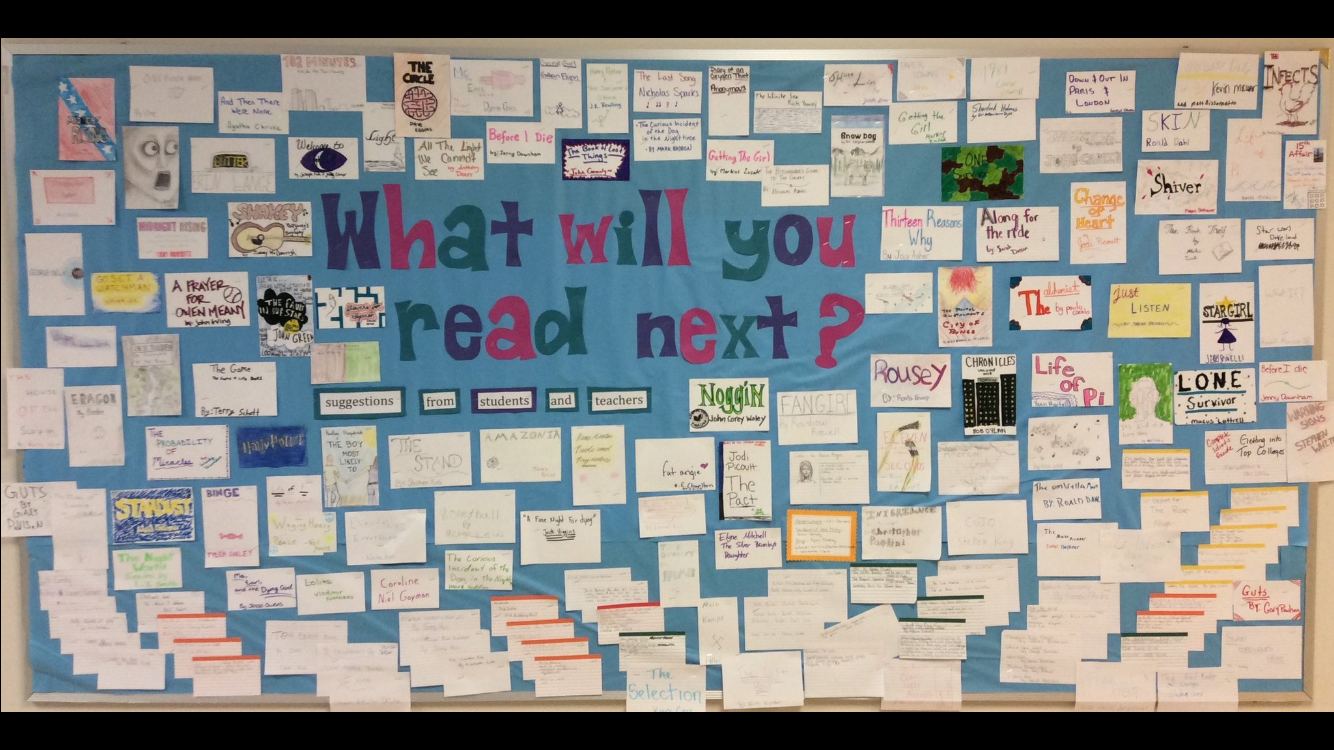
A few days back, Penny Kittle posted this photo:

I quickly screenshotted the image to replicate in my room. This visual reminder of where we’re headed (another book and/or a swing toward spring) will provide the push forward we need. Get it on the wall!

My students needed something to set their sights on, so I asked them to take a look at their ‘I Want to Read List’ and choose what their next reading would be. This wouldn’t just be a goal to finish our current texts, but would also give us something to look forward to.

I encouraged students to take this as an opportunity to challenge themselves outside what they have been consistently reading, either in complexity or genre, and select a book they were excited to get their hands on.

Each student then took an index card, on which went the name of the book, the author, and the date they plan to start this next text.


My aide, an artistic genius, drew the book that would be the center our our display (It even has dozens of book titles written on the first page – I LOVE it, Hailey!) and started arranging the ‘Next Text’ cards around it. The whole back wall of my classroom is going to be a sea of texts we can look forward to.

I’m loving my current read (Shout Out: #3TTTBookClub – Jodi Picoult’s Small Great Things), but I too will be adding a card: In Cold Blood by Truman Capote.

(A freak and serious arrest of my artistic development in the second grade prevents me from sharing my card with you. Please imagine it’s simplistic beauty and that might help me create something wall worthy)


Let’s Get Excited About Where We Are Heading! What Will You Read Next? Please leave your text choices in the comments below. Happy Friday. 


Lisa Dennis spends her school days teaching AP Language and Honors/Pre-AP Sophomores, while also leading the fearless English department at Franklin High School, just outside Milwaukee, Wisconsin where she lives with her husband Nick, daughter Ellie, and beagle Scout.  She is a firm believer that a youthful spirit, a kind heart, a big smile, and a good book can ease most of life’s more troublesome quarrels. Follow Lisa on Twitter @LDennibaum.

Books Can’t Be Bullied

Books: “They don’t get tired and give in, they don’t rearrange their words to soothe their reader’s ego or get a better position on the shelf, and they can’t be bullied”  – Josh Corman for Book Riot.

I’m not going to get political here. I promise.

I’m quite frankly exhausted by, though no less involved in, politics these past few weeks, but when I saw this quote, I knew I needed to explore it. It does (fair warning) come from a pretty politically charged piece that you can seek out and read, if you like, but I first saw this quote completely out of context and feel that it’s a powerful statement in and of itself.

The push and pull of it intrigues me.

I first pictured a book: proud, immovable, and cool. Spine bent ever so slightly, tantalizing a reader with the ideas inside, like the love interest in a dark romance who reads Goethe in tiny coffee shops and spells color with a “u”:

I’ve got what you need, but I’m in charge here. We go at my pace. Turn my pages to see where I will lead you. You aren’t the first and you won’t be the last. 

Aloof in the face of need, careful not to promise too much. If you come to this book looking for fulfillment, it won’t permit you to find it. Too easy. It’s not about you. It’s about the message.

I can also see this book as a soldier on the front lines, battling to retain pride in its themes. Beat down by two star Amazon reviews, milk spilled across its pages, and the misrepresentation of translation, reprinting, and censorship. Not desperate, but insistent:

See me. See what I really am. What I have to offer. I am not what you purport me to be. I am not what others say I am. Think. Judge for yourself. 

But what does any of this mean for our classrooms?

For my students, It means we are going to write about it. I want to know what they think. What identity this quote suggests books have, and thereby what role in our lives? What impact?

See, in an age that not so subtly suggests that books are made better by individual interpretation, I would argue we sometimes give ourselves too much credit.

I might go so far as to suggest that we need books to be a bit immovable these days.

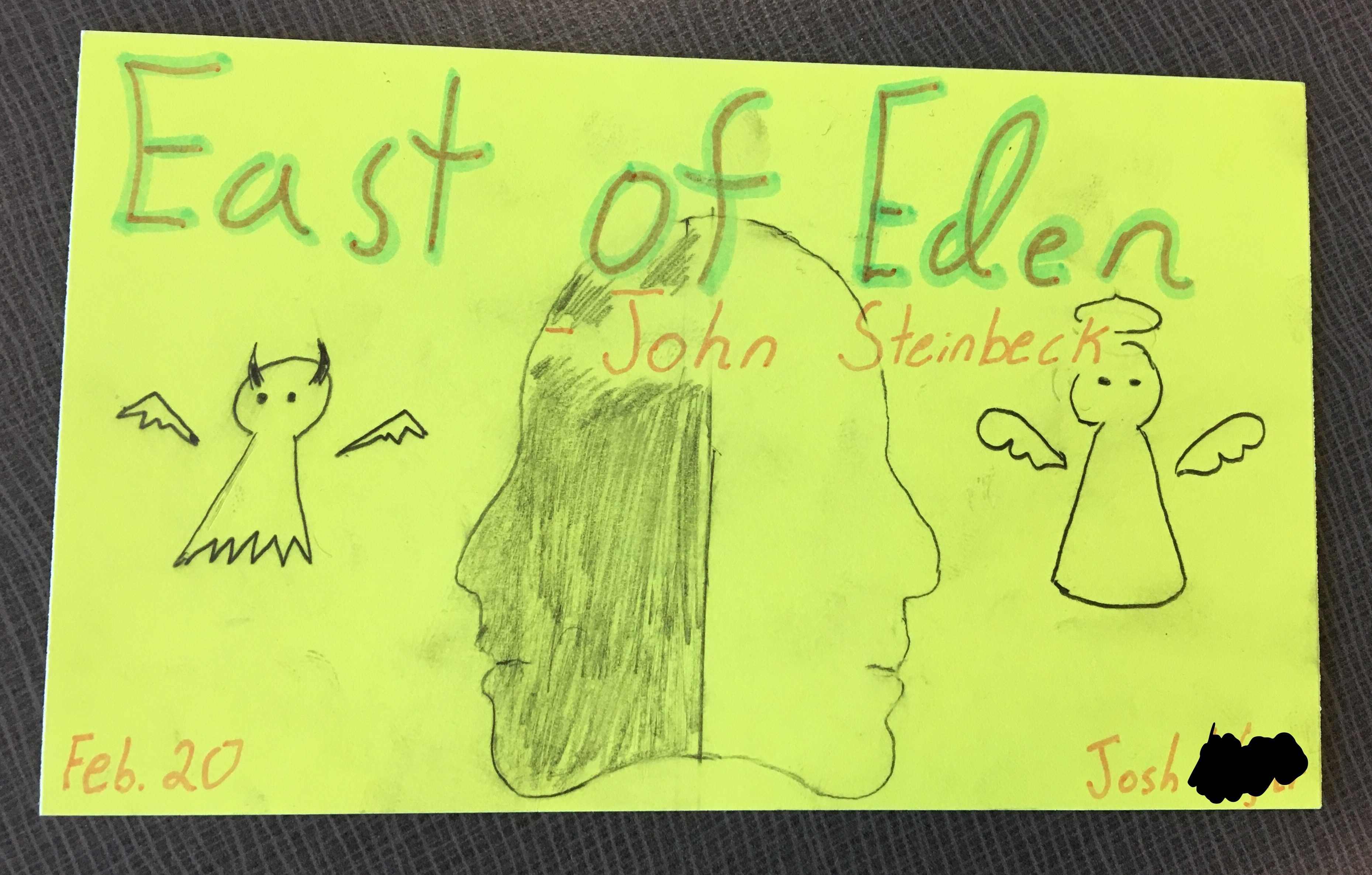
It’s not all about us. What we like. What we need. What we get out of an experience.  Of course, authors need to make money to keep writing books, but on the back of my copy of East of Eden, Steinbeck is casually smoking a cigarette and weaving a tale of good and evil. Is there really so much room for interpretation there? Should there be?

Yes, we, and our students, benefit immensely from challenging conventional thought and learning to build meaning from difficult texts through personal connection, but at the end of that journey, the book remains. The nuance may be up for debate, but the message, perhaps not.

Books offer us a place to see that which does not grow old. The words are pressed between the pages, meaning what they did when they were published. It is we who change and must work to balance how perception influences theme.

Tweets scroll past in soundbites on the screen. Facebook spins and updates with a thousand new ideas with every pull of a thumb. Books remain what they always have been. They cannot be bullied to change with the times. They are timeless, and as such, essential to our survival in the era of eight second attention spans.

So as we bring ourselves to a text, we must be willing to meet it halfway.

It’s not about you, or not only about you.  It’s about the two of us. Book and reader. We can only succeed if we work at this together. 

What better lesson for these times, political or no, than to meet in the middle and align our unchangeable past with the possibilities that carefully crafted ideas can suggest for our future? A book, afterall, still needs a reader.

Let’s produce millions of resilient readers, hungry for truth, who will open books and listen, because a book is always ready to talk, and frankly, we could all stand to listen a lot more than we do.

I’d love to hear your reflection on the quote. Please feel free to join the discussion below in the comments. 

Lisa Dennis spends her school days teaching AP Language and Honors/Pre-AP Sophomores, while also leading the fearless English department at Franklin High School, just outside Milwaukee, Wisconsin where she lives with her husband Nick, daughter Ellie, and beagle Scout. She is a firm believer that a youthful spirit, a kind heart, a big smile, and a good book can ease most of life’s more troublesome quarrels. Follow Lisa on Twitter @LDennibaum.


Finding New Books: A Lesson from Rachel the Book Bandit

I have a lot of awesome students this year.

A LOT.

img_6200One of my preservice teachers is the hilarious Rachel, who, when she stopped by Allen Hall to turn in her writer’s notebook for the semester, was carrying a copy of Chimamanda Ngozi Adichie’s excellent book Americanah.
“Ooooh,” I said.  “That’s a great book.”

“It is, so far,” Rachel agreed.  “I’m only about 40 pages in.”

“Is it for one of your classes?” I asked.

Rachel laughed a little and said no.  “It’s on the African American Literature syllabus, though.”

Well, that was exciting to me for two reasons.  One was that the African American literature class was going beyond Ralph Ellison and Richard Wright and Zora Neale Hurston into the realms of contemporary.  And the other was that clearly, Rachel had been talking to others about books.

I love me some contagious book love!

“Do you have a friend taking the class?” I inquired.

imagesRachel looked sheepish.  “Well, you see,” she explained, “at the beginning of the semester I always go around to all the different English classes and just stay for the first class so I can get a copy of their syllabus.  Then I put all the titles in my Amazon cart and my mom sends me a few books every month!!”
She was gleeful, and I was giddy.  Rachel was…a book bandit!

“Wow,” I said, impressed.  “So you discover all kinds of new titles this way.”

“Yeah,” she agreed.  “I don’t have time to take every single English elective offered, but I need to know a lot of titles if I’m going to be a good English teacher.  So I do this instead.”

I was so impressed that Rachel had discovered, and independently read, award-winning literature this way.

And, I was even more impressed that Rachel knew that to be a successful teacher of readers, you have to know lots of titles so you can match the right kid to the right book at the right time.

Now that winter break is approaching, I’m looking for some new books to read.  So I took a cue from Rachel and discovered the following amazing titles on the syllabi (found through the online university bookstore) for various English courses at our university.

Popular American Culture, ENGL 258:

  1. Do Androids Dream of Electric Sheep? by Philip K. Dick
  2. Fledgling by Octavia Butler
  3. I am Legend by Richard Matheson
  4. The Walking Dead, Vol. 1: Days Gone By by Robert Kirkman

Sexual Diversity in Literature, ENGL 288:

  1. Rubyfruit Jungle by Rita Mae Brown
  2. Fun Home: A Family Tragicomic by Allison Bechdel

Fiction for Adolescents, ENGL 405:  (this one was a gold mine!!)

  1. The Book Thief by Markus Zusak
  2. Fallen Angels by Walter Dean Myers
  3. The Absolutely True Diary of a Part-Time Indian by Sherman Alexie
  4. The Crossover by Kwame Alexander [I bought this, read it one sitting, and cried in public while finishing it]
  5. Simon vs. the Homo Sapiens Agenda by Becky Albertalli
  6. Brown Girl Dreaming by Jacqueline Woodson
  7. Bone Gap by Laura Ruby
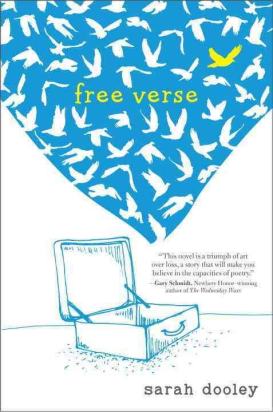
  8. Free Verse by Sarah Dooley [I bought this one ASAP; it’s set in a West Virginia coal mining town]
  9. We Are the Ants by Shaun David Hutchinson

Multiethnic American Literature, ENGL 255:

  1. The Namesake by Jhumpa Lahiri
  2. American Born Chinese by Gene Luen Yang
  3. Everything I Never Told You by Cynthia Ng
  4. Underground Railroad by Colson Whitehead
  5. Make Your Home Among Strangers by Jennine Capo Crucet

Thanks to Rachel for inspiring me with a way to find all of these great new titles!  I hope you’ll find some great new titles this way, too.  Please share them with us in the comments so we can all enjoy!

2 Ways to Prioritize Student Talk in the Classroom

Workshop affords so many opportunities to explore with the students in front of me as opposed to present a set curriculum to whomever happens to be seated in my classroom. It’s teaching through interaction, and in this case, it’s teaching straight from the kids themselves.

We see it in workshop all the time. Students given the tools to explore the world as readers and writers, and encouraged through personalized learning, quite often take their learning to places our old lesson plan books didn’t always accommodate.

One of the best opportunities for this classroom growth is having students do more and more of the talking. With the right modeling and specific expectations around that student talk, the classroom becomes a place students lead through inquiry, as opposed to follow through completion of teacher set tasks.

discussion-2

Morgan quotes Judy Brady’s “I Want a Wife” to analyze how the repetition supports the sarcastic tone and proves the point that since they do SO much, everyone should want a wife. LOL!

It happened yesterday morning, in fact. My AP students were participating in small group graded discussions. Just reading the last sentence makes me cringe (yes we use a rubric, no, the conversations don’t have to be formulaic as a result), but with choice in which readings from our unit they wanted to discuss and some guiding questions throughout the discussion, our conversation about gender and the implications of historical stereotypes on a modern world (their direction for the discussion, not mine) took an interesting turn.

“Mrs. Dennis…you’re smiling weird. What did I say?”

I stop furiously typing comments and look up. “I’m sorry?”

“You had a look. Did I say something wrong?”

“Sarah, you said nothing wrong,” I smile and glance around the table. Seven intrigued faces look back at me. “In the last few minutes this group has, largely unprompted, connected several essays through the lens of analysis, used terminology we’ve not discussed since September, Trinity uttered the words, ‘I don’t believe gender pronouns are even really necessary anymore,’ and then supported her opinion with specific text evidence, and several of you actually just murmured sentiments of excitement to shift the discussion to Judy Brady’s satirical 1971 piece ‘I Want a Wife.’ I’m smiling because I was just thinking about how I used to give short answer reading comprehension quizzes on these pieces.”

“Oh,” said Sarah, “This is way better.”

Yup.  This was a discussion they wanted to have. This was a discussion I wanted to hear. They took the lead, in fact one of our rubric bands demands that, and they came to the

discussion

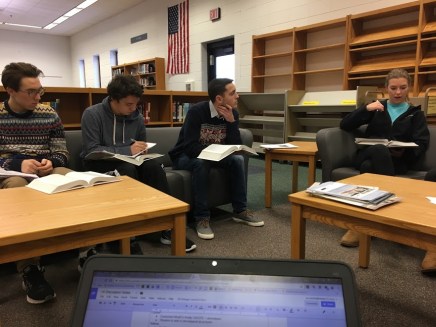
Part of a small group discussing racial stereotyping colliding with gender stereotyping in the Brent Staples piece “Just Walk On By”

discussion prepared to drive conversation from the perspectives of authors like Brent Staples, Deborah Tannen, John and Abigail Adams, and Judith Ortiz. Perspectives that regard gender through stereotype, race, satire, narrative, an exchange of letters almost 250 years ago, and visual texts.

Did I just sit back and let them talk, free-for-all style? No. This conversation took practice, feedback, and correction over the past few months. Today, it took redirection on some occasions and additionally it took specific intervention for those students reluctant to participate. Additionally, had it been a lower-level class, I would have been a bit more actively involved to start. But as you well know, students at any level are capable of, and actually far more likely, to get actively involved if their efforts for comprehension are supported and their exploration of the text is encouraged. We work specifically on ways to communicate both agreement and polite disagreement, so students can help clarify the text as well as analyze it.

Like any solid workshop component, it involves careful teacher planning and modeling, but equal parts careful student leading as we gradually release them to own their own education. 

We assess students on their preparation for the discussion with visible notes and use of specific text to support their points and their leadership within the group. That leadership can be exhibited through meaningfully involving others to bring them into the discussion with a question, synthesizing ideas they have heard so far, and/or including insights from additional research on a particular topic to extend discussion beyond the reading.

I spend a whole class period for discussions, breaking the class into groups of 7-10 students so all voices have more opportunity to be heard. Students not in the discussion have specific work to complete, sometimes by the end of the hour. For feedback, I type comments and insights while the students are speaking, so I can quickly copy/paste them into the comment section of my feedback form (A Google form emailed directly to students with 2 Common Core based rubric bands as dropdown tabs so I can just click the score for each band, include specific typed feedback, and often get that feedback out to kids the same day).

Another opportunity for seriously impactful student talk, is handing over the daily book talk to the class.

One of the many benefits of this scenario is that I can tap into growing student enthusiasm about books and have my kids spread the book love directly with each other. Don’t get me wrong, my book talks are something to behold. Part forensics piece, part reader’s theater, and part screentest for the literary loony bin, I sell books much like I would envision the traveling vacuum salesmen of yore putting food on the table with a pitch of salvation not just for the home, but the soul. It’s not just going to clean your carpets, it’s going to change you life, Ma’am. Your life. 

But, let’s be real. Though I sprinkle my classroom with good will, good cheer, and good books, I’m not the best salesperson in the room. If you’re going to sell the vacuum with radial root cyclone technology (I Googled that), or the book with 389 scary looking pages on dystopian fantasy rooted in a chromed society, you need to know your audience. You need to relate to your audience. You need to be one with your audience.

There are plenty of reasons to get kids doing your book book talks, not the least of which is I can’t read fast enough these days to keep up with the need for the type of really passionate and informed book talks that come from having read the whole text (Books do sell themselves sometimes, just by reading the back cover and a page or two at the start, but I love to hook kids with a section from the middle to show the impact of the rising action or depth of character development).

book-talk

Priyanka book talking Stitches, a graphic novel by David Small, under the document camera.

  • Students trust one another’s opinions. Yes, often more than mine. I sell hard, but at the end of the day, I’m usually still the biggest book nerd in the room, and therefore I think I am occasionally regarded in much the same way  as the Dancing Grannies in a holiday parade: Enthusiastically adorkable, but a bit of an anomaly to be trusted only at a distance.
  • They find titles, authors, and series that aren’t yet on my radar. Despite my best efforts, I can’t read fast enough or comb enough best of lists to meet the recommendation needs of over 120 kids. But when the classroom experiences a new student perspective on reading each class, additional book talks at their tables after reading, speed dating with books,  and an invitation to help grow our classroom library with tax free, gluten free, guilt free donations of gently used books, everyone wins and the depth of our classroom repertoire grows.
  • Their enthusiasm is relatable and often focused on books that don’t speak to my own bibliophilic tendencies, but can ignite the reading sensibilities of their adolescent peers. For example, I took several YA Lit books home at the start of last summer. Two days in, I was already struggling with the voice. It grated on me (no offense scholars) after hearing it all day in person for 180 days. So when a student book talks The New Guy (and Other Senior Year Distractions) by Amy Spalding, and two sophomores in my class (who have struggled to meet reading goals week after week) add it to their “I Want to Read List”s, that’s another win, because we can’t push kids to deepen their reading if they aren’t reading. First hook them, then book them with more challenging pieces.
  • I offer up the option to produce their book talks digitally and for some students, this is what makes the entire experience meaningful. Students sell their books through book trailers, compilations of related imagery and voice over to meet the same requirements of a live book talk. I’ve had kids include clips of author interviews, live action fight scenes with voiced over dialogue directly from the text, and this year, I have a student who wants to read over the top of a mannequin challenge he plans to shoot to represent some of the major action in the text.

What results is growing book lists, renewed enthusiasm as students go back to books they’ve read and revisit their love for the text, and involving each and every single student as a valued reader in our classroom community.

We’d love to hear from you! What tips and tricks for student talk make their way into your daily workshop practice? Please comment below! 

Book Birthdays by Amy Estersohn

img_20161006_115756265Tuesdays are bar none the best day of the week.  Tuesdays are when most new books are released.  On Tuesdays, you can run to the bookstore, go to the library, or wait eagerly for a package to arrive.  If you love reading new books, Tuesdays are nothing short of wonderful.

I have a Book Birthdays list in my room to help my readers and I track upcoming and highly anticipated new releases.  I use chalk ink (more on how much I love chalk ink another time) and a section of my blackboard for this list.  Though I don’t spend much, if any, class time talking about books that are on the list, I sure get a lot of questions, requests, and (occasionally) demands from readers as to which birthdays we should be celebrating.  

I also update this list about twice a month.  For example, I booted off the second book in Rick Riordan’s Magnus Chase series after its October 4 release date in order to make more room for the social media thrillers of Sarah Darer Littman and Stuart Gibbs’s goofy mysteries.

Creating a customized list of upcoming releases can seem like a daunting task, but with the right tools it’s easy enough to build and maintain over time.

Step 0.  Gather a list of authors that your students already enjoy reading.  Sprinkle that list with authors you hope your readers will discover.    My readers come in knowing and loving Margaret Peterson Haddix, Rick Riordan, Raina Telgemeier, and Jeff Kinney.  By the end of the year I also want them to read Jason Reynolds, Gary Schmidt, Marie Lu, Renee Watson, Pam Munoz Ryan, Gordon Korman, and Jennifer Nielsen, among others.

Step 1.  Create a Goodreads.com account.

Step 2. Visit these authors’ pages on Goodreads to “follow” the author.

Step 3. Go to your “account settings” under your avatar and click on “e-mails.”  If you scroll to the bottom of the page, you’ll notice an opt-in settings for New Releases e-mails and e-mails from authors you follow.

Step 4. Wait for e-mail notifications to come to you.

Depending on the age and independence of your students, you may even consider opening up this task and invite students to help build a list of highly anticipated books.  

Amy Estersohn is a middle school English teacher in Westchester County, NY.   She also reviews comic books for http://www.noflyingnotights.com.   Follow her on Twitter at @HMX_MSE.

11 Nonfiction Titles to Use Across the Curriculum

We’ve been saying it for years–teaching reading isn’t just the job of English teachers.  In an ideal world, it is a nationwide cultural endeavor to produce a literate citizenry who is both able to decode words and passionate about responding to their meanings.

The Common Core, for all its flaws, attempts to get students there–the standards say that kids should be reading 50% nonfiction altogether (that’s not just in English class; it’s across the curriculum).  In that vein, here are 11 nonfiction titles that could be used across the curriculum–or booktalked by any teacher in an English class.

img_5198Science

The Double Helix, a fascinating biography by one of the discoverers of DNA, hooks me every time by bringing the textbook personas of Watson himself and his partner Francis Crick to life.  Many of my students interested in a career in the biological sciences were hooked by this text immediately.

Being Mortal forces the reader to ask some tough questions–should I really prolong my life as much as medicine enables me to, through decades of pain and suffering?  Or does that run counter to the human spirit?  Gawande uses all of his knowledge as a practicing surgeon to get the reader to question the industry that is medicine.

Into Thin Air, an oldie but a goodie, is Jon Krakauer’s harrowing first-person account of the deadliest season on Mt. Everest in history.  Its early promise that most of its characters would soon be dead grabs my students’ attention every time.

A Short History of Nearly Everything, aka the longest but most interesting book about science ever, explains everything I never understood about the subject from The Big Bang to the possibility of someday colonizing Mars.  Students are always wildly impressed when I flip through the list of Bryson’s references in the back.

Social Studies

Hiroshima is John Hersey’s unflinching masterwork, a journalistic symphony of six survivors’ stories of the dropping of the first atomic bomb.  It is powerful and devastating and horrifying and beautiful all at once, and just reading the first page aloud to students gets them wide-eyed and entranced right away.

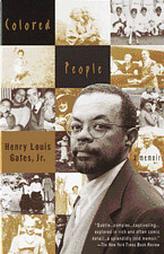
henrylouisgatesjr1Colored People, Henry Louis Gates Jr.’s biography of growing up black in rural West Virginia during the Civil Rights movement.  It’s a book that hooks my students because of its ties to our home state, but it’s universally appealing in that Gates creates a colorful cast of characters early on in the book, most of whom he defies in order to graduate summa cum laude from Yale University.
To Sell is Human is a favorite for students in Psychology class as it brings the social sciences to life in a very Malcolm Gladwell-esque way–short stories and then quick aphorisms make complex ideas simple to digest in this quick, fascinating read by Daniel Pink.

English

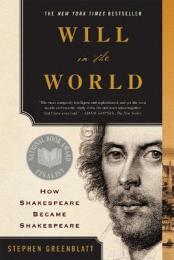
137717Will in the World, written by everyone’s favorite long-winded Shakespearean scholar Stephen Greenblatt, brings William Shakespeare to life in this detailed biography of both the playwright and his Elizabethan London.  I love reading this book as a shameless English nerd and London-lover, but my students love it because it’s a classic tale of an average guy succeeding against all odds.
The Mother Tongue, the second book by the excellent Bill Bryson on this list, is a glorious history of the English language.  My students especially adore the chapter on swear words.

Math

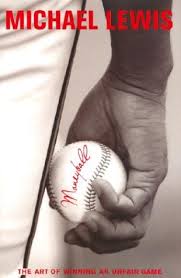
imgresMoneyball, one of Michael Lewis’ earliest books, hooks students often because it has a great movie adaptation to accompany it.  But when you sit down with the book itself, it blends both narrative and statistics, the least “mathy” part of math that I can understand.

The Hot Zone, a terrifying account of the origins of the Ebola virus, will give you actual nightmares if the ideas of biological warfare or global pandemics freak you out.  It’s a very detailed narrative of the virus’ structure, symptoms, and Hail Mary-type treatments that “proves that truth really is scarier than fiction.” (Tell that to Stephen King.)

What titles do you use to introduce your students to subjects across the curriculum? Please share in the comments!