Category Archives: Classroom Library

Building My Library Around My Students

My first time at NCTE, I played supermarket sweep alongside the other teachers. I didn’t have one of those grandma-rolling-carts to gather my goods in, but the victory was still sweet as I tossed book after book into my free bags. But lo and behold, as I returned home with my goods, I realized that some of the books were middle grade, a tad too young looking to impress my high schoolers, while others were sequels to books I didn’t own. My humble pile was quickly halved as I weeded out and gave away the books that just wouldn’t fit into my classroom library.

This year I took a different approach; I arrived at NCTE with certain students and issues in mind. Suddenly my mission to collect free and heavily discounted books turned into a mission to fill the holes in my classroom library. This not only narrowed my search but also made it easier to discuss potential titles with booksellers. The following are some of the gems I scored at NCTE 2014:

What I needed…Books that help students cope with a friend’s suicide

20726924Sadly, suicide is a tragedy that has touched my school a few times over the past few years. I am reminded of this at the beginning of every year when I receive personal narratives relaying the stories of students’ past friends or relatives. The wounds are deep and raw and fresh, which is why my students need literature to help them cope with such atrocities. This year, I left NCTE with two books that filled this niche: Rumble by Ellen Hopkins and The Last Time We Say Goodbye by Cynthia Hand. I have a growing group of Ellen Hopkins devotees who bask in the poetic prose of her books as well as the gritty subjects. Rumble attacks heavy issues through the story of Matt Turner, whose younger brother commits suicide 17285330after being bullied for being gay. The Last Time We Say Goodbye, which is due for publication in February 2015, tackles similar themes, only in this book, the female protagonist Lex loses her brother. Lex struggles to cope with her brother’s death and can’t let go of a text message she received from her brother the night he died.

This is unfortunately a topic that will continue to ripple through and impact my students as I receive students who are impacted by the deaths of friends and family members they have lost to suicide. There are no answers to such a devastating event, but I do hope that these books will help show students that they are not alone.

What I needed…Books that are low level but high interest

I fervently believe that students need a dose of success to give into reading. Too often my students 8011arrive turned off to reading simply because they haven’t been exposed to books that interest them. Furthermore, the students who are most resistant tend to be those who are not proficient or only partially proficient in reading and can’t seem to find books that are at a lower reading level yet a high interest level for their age group. My greatest find was a small bookstall towards the back of the convention room that included books from the Sidestreets and Real Justice Series. These books involve gritty stories with heavy hitting topics such as drug abuse, mental health issues, and social problems. While the books I received were between third to fifth grade reading levels, the sepia and black and white photo covers leant a more mature tone to the story—a strong selling point for low level, reluctant readers. I walked away with Jailed for Life for Being Black by Bill Swan, Blow by Jodi Lundgren, and Off Limits by Robert Rayner, all books I’m looking forward to introducing to my reluctant readers.

What I needed…Books that discuss LGBTQ Issues

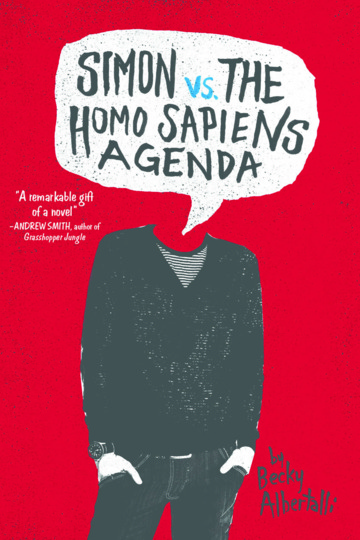
openlystraight_cvThis is the first year I have had openly gay students who have written either personal narratives or stories about homosexual relationships. The more I read their papers, the more I began to evaluate what sorts of LGBTQ mentor texts I had available. While I had a modest collection of book including Shine by Lauren Myracle, Everyday by David Levithan, and Will Grayson, Will Grayson by John Green and David Levithan, I needed more. That’s when I stumbled upon Openly Straight by Bill Konigsberg in which Rafe, an openly gay teenager, transfers to a New England boarding school where he decides to keep his sexuality a secret. A funny read, this book forces Rafe to question who he is and what it means to fit in. 10015384In a similar vein, I also procured an advanced reader’s copy of Simon vs. The Homo Sapiens by Becky Albertalli, which is due for publication in April 2015. This book follows 16-year-old Simon who is not openly gay. Simon is blackmailed after one of his flirty e-mails to a boy he has been talking with falls into the wrong hands. These books diversify my library and address issues that many of my students are both facing and writing about.
These are only a few samples from the stacks of books I received, but as I returned to the classroom on Monday, I told all my students about the exciting run-ins I had with famous authors like James Dashner and David Levithan and Ally Condie. I spoke with the students I had “shopped” for, letting them know what books I had bought and how I had them in mind when I purchased them. While I hope the books leave an indelible mark on my students, I know that ultimately my students leave an indelible mark on the growth and construction of my library.

What books did you bring home from NCTE? Are there any holes that need filling in your classroom library? What might you be searching for?

A Mini-lesson on Extended Metaphor

The Good Luck of Right Now is the first book by Matthew Quick that I read. It is a good book. I love the quirkiness of the narrator’s voice. It reminds me a little of the narrator in The Curious Incident of the Dog in the Night Time. I don’t know which I like better.
I am not sure this is a book that my students will want to read, although I will share it with them with my high praise. I do know that there are several passages that I can use for mini-lessons. I especially like this one with an extended metaphor. I think students will be able to write their own, and maybe add it into their narratives, once we take a close look at the way Quick uses this one here:


The Good Luck of Right Now by Matthew Quick, p111

(I have to say that everything seems to be unraveling lately. Or maybe it seems as though I am a flower myself, opening up to the world for the first time. I don’t know why this is, and I’m not really in control of it either. Flowers do not think. Okay, it is now May, so I will reach up toward the sun and relax my fist of petals into an open hand. They do not think at all. Flowers just grow, and when it is time, they shoot colors out of their stems and become beautiful. I am no more beautiful than I was when Mom was alive, but I feel as though I am a fist opening, a flower blooming, a match ignited, a beautiful mane of hair loosened from a bun –that so many things previously impossible are now possible. And I have been wondering if that is the reason I did not cry and become upset when Mom died. Do the colorful flower petals cry and mourn when they are no longer contained within a green stem? I wonder if the first thirty-eight years of my life were spent within the stem of me — myself. I have been wondering a lot about a lot of things, Richard Gere, and when I read about your life I get to thinking that you also have similar thoughts, which is why you dropped out of college and did not become a farmer like your grandfather or an insurance salesman like your father. And it’s also why so many people thought you were aloof, when you were only trying to be you. I read that you used to go to the movies by yourself when you were in college and you’d stay at the movie house for hours and hours studying the craft of acting and storytelling and moviemaking. You did all of this alone. This way maybe when you were in the stem–before you exploded into the bloom of internationally famous movie star Richard Gere. Such vivid colors you boast now! But it wasn’t easy for you. I have been learning by researching your life. So much time spent acting on the stage. You lived in a New York City apartment without heat or water, one book reported. And then you made many movies before you became famous –always trying to beat out John Travolta for roles, and being paid so much less than him. But now you are Richard Gere. Richard Gere!)


Do you have other passages that work well to teach extended metaphor?

Two Wes Moores?

Here’s what I love about literature; when there’s not one but two options that propel me through the exploration of a writer’s story.  It gives me options, varied yet similar journeys, and choice.  I love choice.

IMG_20141105_162445

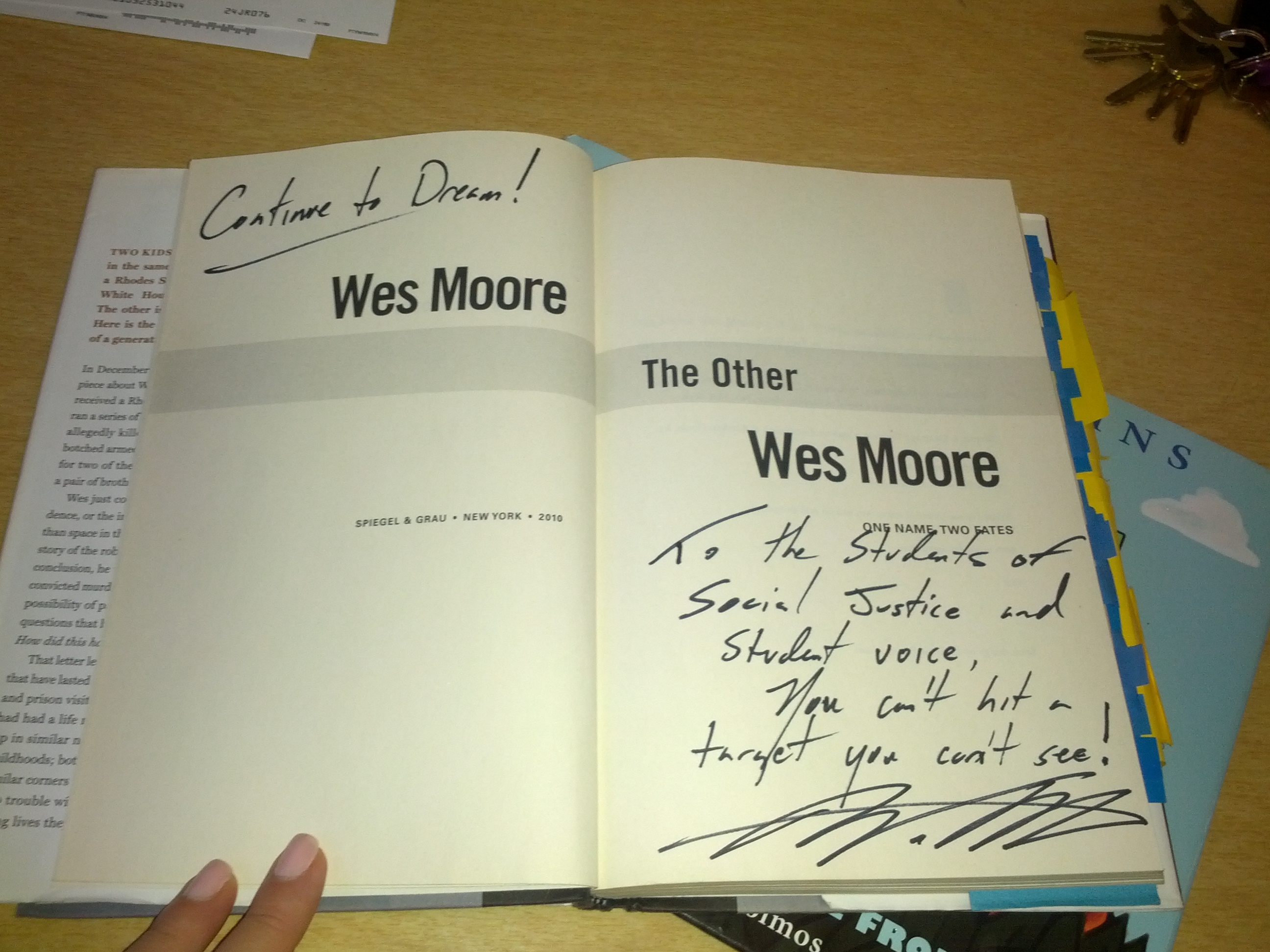
To the students of Social Justice and Student Voice, You can’t hit a target you can’t see. Continue to dream! -Wes Moore

I also love when I get to meet an author and hear him speak about his story; both in the writing and in his account of the events.  What better way to be introduced to another’s extraordinary life?

And, an extraordinary life it is.

In The Other Wes Moore by Wes Moore, upon realizing that Wes was not the only Wes Moore residing (as a youth) on the streets of Baltimore, he felt compelled to connect with the other man sharing extraordinary similarities; the same name, fatherlessness, and navigation through the world the best way they knew how.

And, so the story begins.

By taking a leap of faith and contacting the other Wes Moore (while jailed for a crime that put him behind bars for a lifetime without parole) Wes opens the door for connection, dialogue, and an unbreakable bond.  Human connection at its core.

I introduce students to the significance of the dividing gray line - the shift from Wes Moore to the Other Wes Moore (and vice versa).

In The Other Wes Moore, I introduce students to the significance of the dividing gray line – the shift from Wes Moore to the Other Wes Moore (and vice versa).

That’s all I share with students when introducing them to this piece.  And then the questions swirl: Wait!  What do you mean they have the same name but live such different lives?  Does the other Wes answer Wes’s request to communicate?  Wes visits the other Wes in jail, huh?  What does he mean when he says (compliments of the cover), “The chilling truth is that his story could have been mine.  The tragedy is that my story could have been his.”?  If he’s not in jail, how could it be a tragedy for the other Wes Moore to live Wes’s life?   This is wild!

And now, Discovering Wes Moore (the Young Adult adaptation) provides access to readers who are intrigued by (as the title suggests) discovering Wes Moore, the author.  This piece brings readers through the linear journey of the author’s life, struggles, ah-has, life choices, and incredible realizations.

Both Wes Moores on display in room 382

Both Wes Moores on display in room 382

Here’s what I love about this piece, students do not enter into the potential complexity of following two stories interwoven; they simply get to focus on one story line.  For readers who are interested in autobiographical narratives, this provides them access to a story not to be missed.

Some students enjoy reading both pieces simultaneously by the means of an author study; while others enjoy choosing only one piece to explore.  Students of all reading levels and interests find themselves consumed by these pieces – the craft, reality, and unbelievable story that is oh-so-honest.

The Other Wes Moore and Discovering Wes Moore are continually transient. They don’t stay on our shelves for any extended period of time. As soon as students realize they’re back and available for the taking, they do just that while others’ Next-To-Read lists grow.

I love that both Wes Moores find themselves in the hands of inquisitive learners because, to date, not one student reader has been untouched by their story.

It goes far beyond your Everyday story

51i318LHixL._SY344_BO1,204,203,200_If you doubt, question, or undermine the complexity or rigor of young adult literature, read Everyday by David Levithan. Despite the book’s bland beige and gray cover, there is nothing dull or colorless about this story. It is a philosophical and, in my opinion, a political statement that calls into question what it means to be an individual in today’s world.

In the book, A is a genderless soul that inhabits a different body everyday (hence the title). The conflict is that A, in the first chapter, falls in love with Rhiannon, the girlfriend of a boy whose body A currently inhabits. Don’t worry; it isn’t as confusing as it sounds. This simple love story leads its readers to question what defines gender and even love as A inhabits different bodies throughout the book. Furthermore, A questions what the difference is between the soul and the body and how they can function as one or even two distinct beings.

David Levithan captures the beauty and innocence of being human through the simple yet straight forward perspective of A, an old soul with deep knowledge: “If there’s one thing I’ve learned, it’s this: We all want everything to be okay. We don’t even wish so much for fantastic or marvelous or outstanding. We will happily settle for okay, because most of the time, okay is enough.” A goes on to one of my favorite passages of the book, a passage that is great for book talking and providing a brief teaser without giving anything away.

I am a drifter, and as lonely as that can be, it is also remarkably freeing. I will never define myself in terms of anyone else. I will never feel the pressure of peers or the burden of parental expectation. I can view everyone as pieces of a whole, and focus on the whole, not the pieces. I have learned how to observe, far better than most people observe. I am not blinded by the past or motivated by the future. I focus on the present, because that is where I am destined to live.

“I learn. Sometimes I am taught something I have already been taught in dozens of others classrooms. Sometimes I am taught something completely new. I have to access the body, access the mind and see what information it’s retained. And when I do, I learn. Knowledge is the only thing I take with me when I go” (Levithan 6).

As a teacher, it is easy to love this passage. After all, it ends with the value of learning, but beyond that, this page (the entirety of page 6) shows A’s struggle with defining him/herself as an individual. Not only is there minimal diversification in the sentence starters, but A uses the personal pronoun “I” 25 times in just one page: “I would,” “I took,” “I felt,” “I am,” etc. This practice goes against the rule of what we oftentimes teach to young writers—stray away from using I at the beginning of every sentence. Levithan’s willingness to break the rules and question the norm is what makes this piece both a masterful mentor text and thought provoking must-read.

Starting with the Ending

I am not one of those people who jumps to the last few pages to read how a book ends before I’ve ever started it. I do not understand those people. At all. I like to savor a good book, take it slow, breathe in and out the beauty of the language. OR, I like to devour it in one sitting, holding my breath and wanting more. So, it’s a little surprising that I’ve pulled the last paragraph of a book to use as a craft study.

I promise it gives nothing away. I also promise:  you may just shudder at the loveliness of the language like I do.

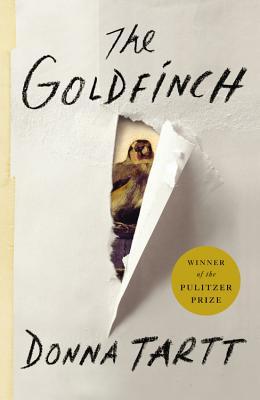
If you have not read The Goldfinch by Donna Tartt, you must. Find the time. It’s worth it.

I don’t know if I can motivate my students to read this lovely book though– it is thick with 771 pages, and the story itself is long, and there are times your love/hate relationship with the main character makes you want to shout the house down. But I’ll try. Because I love it.

This is why:

The Goldfinch by Donna Tartt P771

Whatever teaches us to talk to ourselves is important:  whatever teaches us to sing ourselves out of despair. But the painting has also taught me that we can speak to each other across time. And I feel I have something very serious and urgent to say to you, my non-existent reader, and I feel I should say it as urgently as if I were standing in the room with you. That life — whatever else it is — is short. That fate is cruel by maybe not random. That Nature (meaning Death) always wins but that doesn’t mean we have to bow and grovel to it. That maybe even if we’re not always so glad to be here, it’s our task to immerse ourselves anyway:  wade straight through it, right through the cesspool, while keeping eyes and hearts open. And in the midst of our dying, as we rise from the organic and sink back ignominiously into the organic, it is a glory and a privilege to love what Death doesn’t touch. For if disaster and oblivion have followed this painting down through time — so too has love. Insofar as it is immortal (and it is) I have a small, bright, immutable part in that immortality. It exists; and it keeps on existing. And I add my own love to the history of people who have loved beautiful things, and looked out for them, and pulled them from the fire, and sought them when they were lost, and tried to preserve them and save them while passing them along literally from hand to hand, singing out brilliantly from the wreck of time to the next generation of lovers, and the next.


Let’s just take it sentence by sentence. Then let’s choose a sentence we like and respond to it. That’s enough for now.


I Am Malala…Too!

From the moment I learned of Malala Yousafzai, she captured my heart.  Two short years ago, this young woman was targeted by the Taliban in Pakistan for her activism in support of accessible education for females.  She went to great lengths to ensure she, and her female classmates, were granted the right to their education.  And that was all before her life changed drastically on that fateful day when the Taliban tried to silence her through unthinkable violence.

Yet, she lives to tell about it.

Not only does she live to tell about it; she writes about it, campaigns about it, continues to fight for it.  So, it is no wonder that just yesterday, Malala was granted the honor of a shared Nobel Peace Prize for her unshakable efforts, astounding heroism, and courageous bravery.

Here’s what I love even more:

IMG_20140908_143856

There are two versions of her story!

In the more complex version (right) aside from learning the intricacies of Malala’s extraordinary life, it chronicles the inner workings of Pakistan, its politics, its back story, and so much more.  It vividly weaves us through the timeline of events taking place in a country that Malala (til this day) calls home.  We visit her classroom, accompany her while doing chores at home, meet her family, join her while eating the foods of the land, watch fearfully as the Taliban circles the streets…This is the piece I read.  Students willing to take on a piece sprinkled with higher level vocabulary and concepts, also enjoy it thoroughly.

And in exposing students to Malala and her cause, we visit her on Facebook at: MalalaFund, on Twitter at @Malala, and on the internet at http://www.malala.org.  We also support the “I Stand with Malala” initiative by sharing our love for literature with the world!

IMG_20130418_155448

So, when Patricia McCormick decided to pair up with Malala to create a YA version of her story, I (and students) could not have been more thrilled.  This piece (left) is written in a more linear fashion.  While it would be remiss to alleviate all of Pakistan’s intricacies, it focuses more on Malala and her journey.  It is a narrative that provides students an opportunity to learn about this incredible young woman, be motivated by her desire to push agendas in the most positive of ways, and gently guides them through an understanding of what life is like for those fighting for their basic right to education.  This piece pairs beautifully with students who have a thirst for knowledge yet are still diligently building their literacy skills.

And so I recommend Malala finds her way (in both forms) into each one of our classrooms.  Let her spark a fire within our students.  Let her show us the way to having the world hear our voices.  Let her age be only a number.  As Malala so eloquently states at the end of the Prologue:  Who is Malala?  I am Malala and this is my story.

And, what a story it is.


Painting With Words: Sold

c_soldPatricia McCormick is a painter. Not literally, but she might as well be given the way she writes. Her vivid imagery and poetic prose paired with her short vignettes make Sold a must-read.

Somehow, Patricia makes the heavy subject of sexual slavery both approachable and manageable. Whereas many of my heavier books on women’s rights or international affairs sit dormant in my classroom library, Sold has made it through many hands. I believe there are multiple reasons for this: first, Sold isn’t intimidating in length or size. It feels manageable for many students. Second, Sold is written in short vignettes with wide spacing between the lines. Students can find themselves ten or twenty pages into the book with minimal effort.

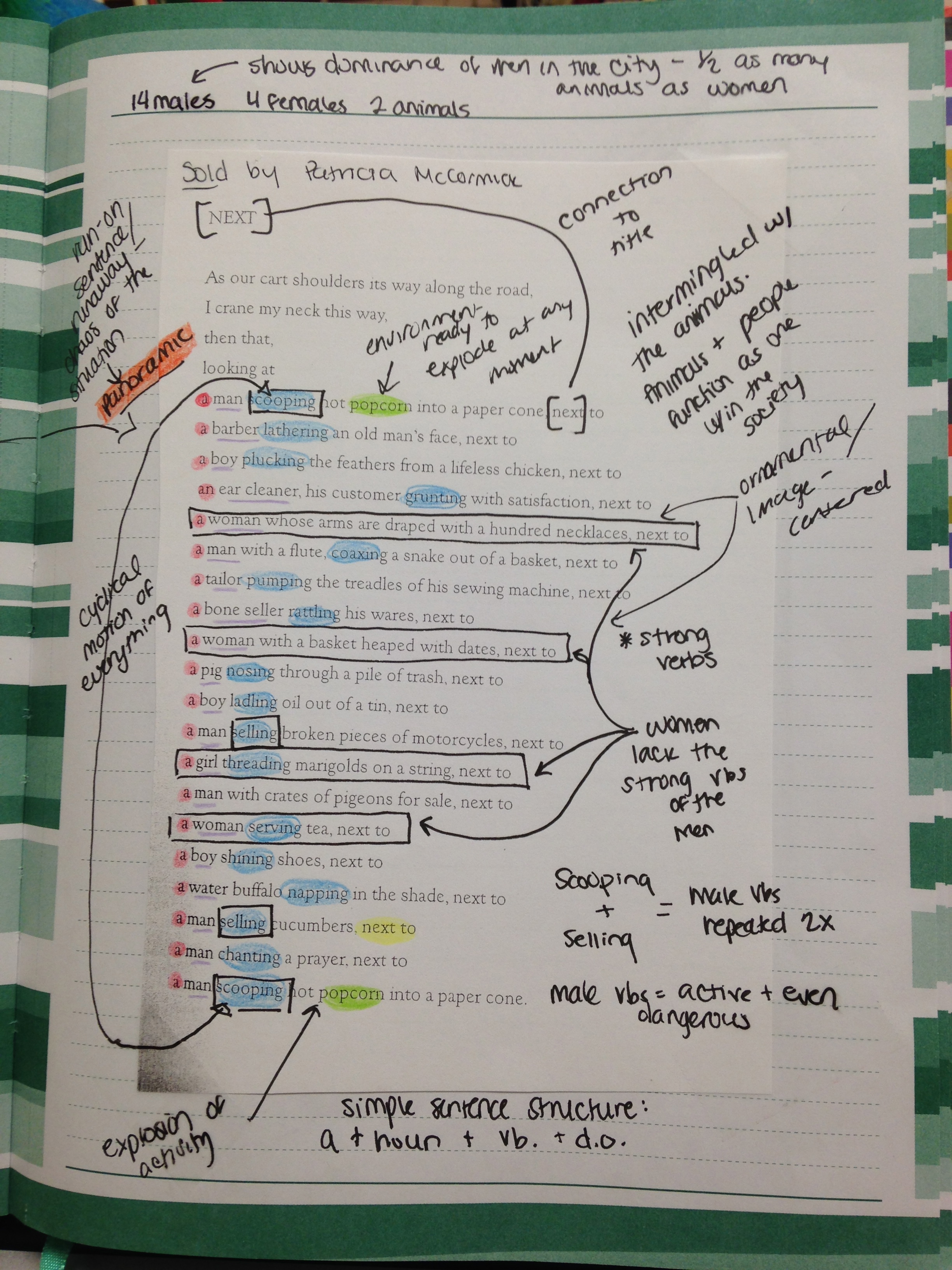
Furthermore, the book lends itself to close reading and craft study. Each vignette is chock full of exceptional writing as Patricia McCormick plays with diction, descriptions, repetition, and a wide variety of craft marks. In turn, I can’t pick only one example, so bear with me as I walk you through two of the many passages with which I am obsessed:

Everyday, students walk into my classroom burdened by mammoth backpacks and equally sized worries. It’s tough to be a teenager, which is why I love the vignette “What I Carry.” I hope to use this as a quickwrite to find out what students carry with them throughout the

One of the many passages I have photocopied and dissected in my writer's notebook.

One of the many passages I have photocopied and dissected in my writer’s notebook.

day.

WHAT I CARRY

Inside the bundle Ama packed for me are:

my bowl,

my hairbrush,

the notebook my teacher gave me for being the number one

girl in school,

and my bedroll.

Inside my head I carry

my baby goat,

my baby brother,

my ama’s face,

our family’s future.

My bundle is light.

My burden is heavy.

In the second passage, “Between Twilights,” I love McCormick’s use of sensory details. This is an excellent passage to model the concept of “show don’t tell” in writing.

BETWEEN TWILIGHTS

Sometimes, between the twilights.

I unwrap my bundle from home

and bury my face in the fabric of my old skirt.

I inhale deeply,

drinking in the scent of mountain sunshine,

a warmth that smells of freshly turned soil and clean laundry

baking in the sun.

I breathe in a cool Himalayan breeze,

and the woodsy tang of a cooking fire,

a smell that crackles with the promise of warm tea

and fresh roti.

Then I can get by.

Until the next twilight.

A Lesson in Craft: The Yellow Birds

If you have not read The Yellow Birds by Kevin Powers, go buy it and start reading it today. It’s that good. Maybe I loved it because Powers is a poet, and his poetry flows into the language on every page. Maybe I loved it because I have similar fears as the mothers portrayed in this book. At least one of my sons will join the Army in a year.

Whatever the reason, I love this novel, and I know many of my students will appreciate the beauty of it, too.

Many passages are worthy of study, but when I read myself into this one, I knew that the discussion around it in class would be powerful. What do you think students might discover about language by reading this?

I hadn’t know what I was doing then, but my memories of Murph were a kind of misguided archaeology. Sifting through the remains of what I remembered about him was a denial of the fact that a hole was really all that was left, an absence I had attempted to reverse but found that I could not. There was simply not enough material to account for what had been removed. The closer I got to reconstructing him in my mind, the more the picture I was tying to re-create receded. For every memory I was able to pull up, another seemed to fall away forever. There was some proportion about it all, though. It was like putting a puzzle together from behind: the shapes familiar, the picture quickly fading, the muted tan of the cardboard backing a tease at wholeness and completion. I’d think of a time when we sat in the evening in the guard tower, watching the war go by in streaks of read and green and other, briefer lights, and he’d tell me of an afternoon in the little hillside apple orchard that his mother worked, the turn and flash of a paring knife along a wrap of gauze as they grafted uppers to rootstocks and new branches to blossom, or the time he saw but could not explain his awe when his father brought a dozen caged canaries home from the mine and let them loose in the hollow where they lived, how the canaries only flitted and sang awhile before perching back atop their cages, which had been arranged in rows, his father likely thinking that the birds would not return by choice to their captivity, and that the cages should be used for something else: a pretty bed for vegetables, perhaps a place to string up candles between the trees, and in what strange silences the world worked, Murph must have wondered, as the birds settled peaceably in their formation and ceased to sing. And I’d try to recall things until nothing came, which I quickly found was my only certainty, until what was left of him was a sketch in shadow, a skeleton falling apart, and my friend Murph was no more friend to me than the strangest stranger.

Viral Titles

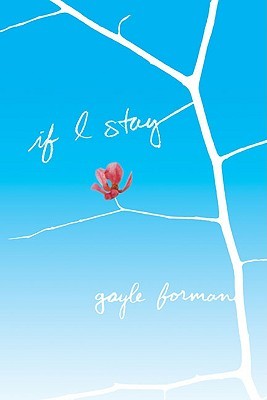
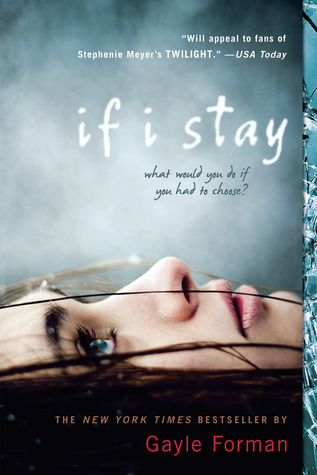
ifistay1Every year, one or two books go viral. The Fault in Our Stars by John Green, Lone Survivor by Marcus Luttrell, and Hate List by Jennifer Brown have all held the Viral Title award in the past.  I couldn’t keep those books on my shelves, and students couldn’t read them fast enough.

This year, If I Stay by Gayle Forman is everywhere I look.  All of my students want this book–AP, on level, male, female, black, white, readers, non-readers.  I have six copies and all are checked out.

I got into bed Tuesday night with my Nook, where I’d recently downloaded If I Stay.  It’s been about a month since I’ve read a book for pleasure, so I intended to just read a chapter or two and then go to sleep after my 14-hour day.

I stayed up ’til midnight and finished the book.

Silent tears dripped down my face around page 15, when Mia’s family is destroyed in a car accident.  Forman’s writing shoves me into the moment and I am right there with Mia, feeling her anguish as she sees her parents strewn across the road.  I agonize with her over the whereabouts of her younger brother, Teddy, and I hear the eerie quiet of a post-collision highway.

I was captivated from that moment onward, terrified for Mia as she watches her own injured, unresponsive body be flown to the hospital.  Watches her now-daughterless grandparents in the waiting room.  Watches the surgeons and nurses frantically try to save her.  She vacillates between wanting to stay in this world, and wanting to leave it behind.

NPR calls this story “achingly beautiful,” and I would agree.  Its language, its structure, haunts me, days later, and I know my students and I will study Forman’s craft soon…the way she brings us into a moment, frozen in time, and suspends our disbelief as we stay beside Mia’s spirit, watching all of this unfold.  Please read this book, and get it into the hands of your students, too.

ifistay2

If I Stay, Gayle Forman, pp. 15-16

You wouldn’t expect the radio to work afterward.  But it does.

The car is eviscerated. The impact of a four-ton pickup truck going sixty miles an hour had the force of an atom bomb.  It tore off the doors, sent the front-side passenger seat through the driver’s side window.  It flipped the chassis, bouncing it across the road and ripped the engine apart as if it were no stronger than a spiderweb.  It tossed wheels and hubcaps deep into the forest.  It ignited bits of the gas tank, so that now tiny flames lap at the wet road.

And there was so much noise.  A symphony of grinding, a chorus of popping, an aria of exploding, and finally, the sad clapping of hard metal cutting into soft trees.  Then it went quiet, except for this:  Beethoven’s Cello Sonata no. 3, still playing.

Sometimes There’s This One Book

Before the first day of school this year, I learned that a student who was to attend our campus took her own life. She was 15. This would have been her 16th year. It should have been a shining time for her:  a junior in high school, a driver’s license, maybe her first job, and if her family was like mine, her first date (I had to be 16).

Her family, of course, is devastated. I didn’t even know this child, and I am devastated, as I am every single time I hear of the awful reality of suicide.

We have to do something.

I don’t know what, really. I do know that the world should be a hopeful place. I also know that so often adults refuse to act like it is. I am as guilty as the next guy of going through the motions, mirroring the depressive nature of my Bad Day. But I vow to stop.

I want to be an example of hope. I want to smile more. Love more. Laugh more. I want my students to see that I love my job. I cannot wait to get there. (That’s what being at a new school has done for me this year. I’ve let the negativity that I let nag at my soul so long go, and I feel new, reborn, liberated. Strange to use those words, I know, but they describe the “freeing” best.)

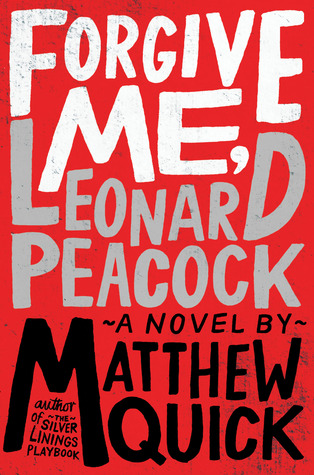
Recently, I read Matthew Quick’s book Forgive Me, Leonard Peacock, and it rocked my world. Seriously. You know when you read a book, and then it haunts you — like forever? This is one of those books for me. I am, and will be, a better teacher, friend, wife, mother, daughter, colleague, leader, consultant because I read this book.

Here is a bit that I will use in class. Maybe we’ll use this passage for close reading. It’s a good one for tone or sentence structure. Maybe we’ll use it to launch a class discussion about hopes and dreams and how to hold on to them. I don’t know yet. But there’s something important here — for us and our students. Read it. You’ll see what I mean.

Forgive Me, Leonard Peacock by Matthew Quick, p46-47

The whole time I pretend I have mental telepathy. And with my mind only, I’ll say– or think?–to the target, “Don’t do it. Don’t go to that job you hate. Do something you love today. Ride a roller coaster. Swim in the ocean naked. Go to the airport and get on the next flight to anywhere just for the fun of it. Maybe stop a spinning globe with your finger and then plan a trip to that very spot; even if it’s in the middle of the ocean you can go by boat. Eat some type of ethnic food you’ve never even heard of. Stop a stranger and ask her to explain her greatest fears and her secret hopes and aspirations in detail and then tell her you care because she is a human being. Sit down on the sidewalk and make pictures with colorful chalk. Close your eyes and try to see the world with you nose–allow smells to be your vision. Catch up on your sleep. Call an old friend you haven’t seen in years. Roll up your pant legs and walk into the sea. See a foreign film. Feed squirrels. Do anything! Something! Because you start a revolution one decision at a time, with each breath you take. Just don’t go back to that miserable place you go every day. Show me it’s possible to be an adult and also be happy. Please. This is a free country. You don’t have to keep doing this if you don’t want to. You can do anything you want. Be anyone you want. That’s what they tell us at school, but if you keep getting on that train and going to the place you hate I’m going to start thinking the people at school are liars like the Nazis who told the Jews they were just being relocated to work factories. Don’t do that to us. Tell us the truth. If adulthood is working some death-camp job you hate for the rest of your life, divorcing your secretly criminal husband, being disappointed in your son, being stressed and miserable, and dating a poser and pretending he’s a hero when he’s really a lousy person and anyone can tell that just by shaking his slimy hand–if it doesn’t get any better, I need to know right now. Just tell me. Spare me from some awful f******fate. Please.”


Note:  There are two footnotes in this passage. I left them off quite simply because I do not know how to format them in WordPress. Sorry, Mr. Quick.