Category Archives: Books

Craft Study for a Monday: Billy Lynn’s Long Halftime Walk, again

For now, my new favorite book is Billy Lynn’s Long Halftime Walk by Ben Fountain. 

This surprises me. Maybe it’s the setting — Dallas Cowboys’ Stadium. Maybe it’s the protagonist — Billy, a 19 year-old-soldier. (I have twenty-year-old twin sons who want to join the military in a few years.)

Maybe it’s Fountain’s poetic language. It startles and soothes. It makes my mother’s heart shake.

I’ve dog-eared pages and underlined lines. I’ve even posted about this book in February.

Here’s the part I will share in class this week. My students are working on a major writing project. They chose their own topics. They’ll write in a variety of forms. But, even with only a few weeks left in the school year, I still need to show them beautiful language. I still want them to work on their craft.

“Look at Fountain’s style,” I’ll say. “What do you notice just on this one page?”

And we’ll talk about word choice and repetition. We’ll talk about lists and mood. We’ll talk about intentional fragments and why an author might make that kind of choice when writing a sentence.

My students will notice many things in this short passage. There are so many things to notice.

That’s probably why I am in love with this book. Thank you, Mr. Fountain.

excerpt from Billy Lynn’s Long Halftime Walk 

Don’t be scared, Shroom said. Because you’re going to be scared. So when you start to get scared, don’t be scared. Billy has thought about this a lot, not just the Zen teaser of it but what exactly does it mean to be scared out of your mind. Shroom, again. Fear is the mother of all emotion. Before love, hate, spite, grief, rage, and all the rest, there was fear, and fear gave birth to them all, and as every combat soldier knows there are as many incarnations and species of fear as the Eskimo language has words for snow. Spend any amount of time in the realms of deadly force and you will witness certain of its fraught and terrible forms. Billy has seen men shrieking with the burden of it, others can’t stop cursing, still others lose their powers of speech altogether. Lots of sphincter or bladder control, classic. Giggling, weeping, trembling, numbing out, classic. One day he saw an officer roll under his Humvee during a rocket attack, then flatly refuse to come out when it was over. Or Captain Tripp, a pretty good man in the clutch, but when they’re really getting whacked his brow flaps up and down like a loose tarp in a high wind. His soldiers might feel embarrassed for him, but no one actually thinks the worse of him for it, for this is pure motor reflex, the body rebels. Certain combat stress reactions are coded in the genes just as surely as cowlicks or flat feet, while for a golden few fear seems not to register at all. Sergeant Dim, for example, an awesome soldier who Billy has seen walking around calmly eating Skittles while mortars rained down mere meters away. Or a man will be fearless one day and freak the next, as fickle and spooky as that, as pointless, as dumb. Works on your mind, all that. The randomness. He gets so tired of living with the daily beat down of it, not just the normal animal fear of pain and death but the uniquely human fear of fear itself like a CD stuck on skip-repeat, an ever-narrowing self-referential loop that may well be a form of madness. Thus all our other emotions evolved as coping mechanisms for the purpose of possibly keeping us sane? And so you start to sense the humanity even in feelings of hate. Sometimes your body feels dead with weariness of it, other times it’s like a migraine you think you can reason with, you bend your mind to the pain, analyze it, break it down into ions and atoms, go deeper and deeper into the theory of it until the pain dissolves in a flatus of logic, and yet after all that your head still hurts (114-115).

Note: The book is being made into a movie with a Veteran’s Day 2016 release date. Rarely, do I like the movie as well as the book, but I still go see them.

©Amy Rasmussen, 2011 – 2015

Shelfie Saturday

sticker,375x360.u1While my last name is Catcher, I’m far from a natural athlete. In fact, my high school softball career ended after I “caught” a stray throw with my forehead, landing me in the ER with a swollen eye and thirteen stitches. Still, I can appreciate a brilliant sports story, the type that moves beyond the game and captures the essence of teamwork, leadership, and friendship. The “Sports” section of my classroom library does just this.

Over the past year, I have cultivated the sports section to reflect the varied abilities, ages, and interests of my students. I teach freshmen, juniors, and seniors ranging from struggling to gifted readers. Because of my diverse students, my library must appeal to 14-year old freshmen and 18-year old seniors alike. Fortunately, sports can oftentimes bridge this age gap while also pushing students to gradually engage with more complex texts.

My somewhat anemic-looking sports section.  Many of the books (particularly the ones not pictured here) have waiting lists and won't return to this shelf until the end of the year.

My somewhat anemic-looking sports section. Many of the books (particularly the ones not pictured here) have waiting lists and won’t return to this shelf until the end of the year.

My younger students (and even some of my older) tend to gravitate towards popular young adult novels at the beginning of the year, like those written by Matt de la Pena and Mike Lupica. After they exhaust the options on my shelves, they inch towards lengthier and more complex analytical or historical books like Moneyball: The Art of Winning An Unfair Game by financial journalist Michael Lewis or The Punch by sports writer and commentator John Feinstein. More than any other genre, these brilliantly crafted pieces serve as strong mentor texts for a wide variety of mediums including nonfiction, narrative, research, and persuasive writing. This year, books like Ice Time by Jay Atkinson inspired many of my hockey players to explore their sport through personal narratives while Shoeless Joe by W.P. Kinsella served as the basis for one of my freshman student’s research papers on the Black Sox Scandal.

Sports hold leverage within our society, particularly amongst teenagers. From die-hard fans to benchwarmers, both athletes and non-athletes can appreciate a sports story, particularly when it transports us into a world packed with suspense and action.

Join the conversation by posting your own shelfies!  Share a shelfie with #shelfieshare and let us know if it’s a #classroomshelfie, #bookstoreshelfie, or other miscellaneous find.

Persepolis by Marjane Satrapi

persepolisIn honor of ALA’s recently released 2014 Banned Books List, I can’t help but recommend the second most banned book Persepolis by Marjane Satrapi.   Persepolis was one of the three graphic novels that made the top ten list this year. The book is criticized for its use of gambling, offensive language, and political viewpoints as well as for being “politically, racially, and socially offensive” and for having “graphic depictions.” In reality, this graphic memoir isn’t afraid to tackle the horrifying and at times comedic realities of growing up in a community faced with political turmoil. After all, Satrapi wanted readers to recognize that Iranians are normal people, just like everyone else. They enjoy music and parties and clothes; the difference is that the characters in Persepolis are living during the Iranian Revolution. Satrapi begins her narrative at six years old, relaying the stories of every day life as the Shah’s regime is overthrown, the Islamic Revolution takes hold, and the war with Iraq destroys her community.

What I love most about Persepolis is its ability to attract my reluctant readers, particularly my students who would otherwise steer clear of the international shelf in my classroom library. These students are drawn to the simple black-and-white cartoons and the rebellious teen protagonist. They love her quirky sense of humor and her obsession with American music icons like Michael Jackson. Like many of our students, she is an angsty teen coming of age. The difference is that she grows up during political conflict and war. Her world is changing around her, war has becomes standard, and she, as a teenager, is attempting to find normality in completely abnormal circumstances. But it’s Marji’s ability to navigate this morbid world and go through complex transformations that make her come alive on the page.

I tend to use graphic novels towards the beginning of the year when my students are becoming acclimated to analyzing writer’s craft (or even when they need a refresher on it). Oftentimes students are more in tune to looking at the details of drawings than of writing; they find it easier to pick out the eccentricities of images yet rarely do they question why the artist made the choices they did. Graphic novels give them the opportunity to do just this.

I have students work in small groups to analyze the artistic decisions of the illustrator. For example, in Persepolisthe scene to the right, Marji has been taken into custody by the Women’s Branch of the Guardians of the Revolution, a group in charge of monitoring women’s wearing of the veil. When they stop to study the images, students notice the repetitive stern expression of the guardian and the way Marji’s face appears to melt into squiggly lines as the frames progress. They notice the transition of the lines surrounding the word bubbles from smooth curved lines to sharp zig-zags. They recognize changes in font size and effects as well as the underlying narrative strand at the bottom of the frame that shows internal dialogue. As they analyze these details, they also begin questioning the choices that lead to the depictions of these conversations and emotions and what they ultimately mean in the context of the story. By the end, the graphics take on a more complex tone. The images come alive, the artist’s intentions become clearer, and they have immersed themselves in a new lens that allows them to take a second look at literature.

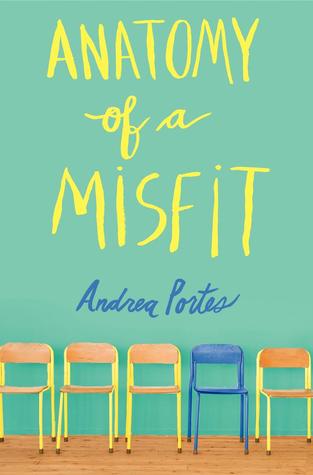
Anatomy of a Misfit by Andrea Portes

18340210This young adult novel was recommended to me by a fellow teacher of reading workshop who said it was immensely popular in her room. I downloaded it on my Nook and began to read it late one night before bed, and stayed up all night to finish.  I laughed on one page, clenched the covers in tension on the next, then cried, then laughed again, thanks to Portes’ masterful narrative skill.

The narrator, Annika, was a unique take on the typical YA protagonist, describing herself as the “third most popular girl in school,” whose Romanian father she calls “Count Chocula.”  Still, Annika finds herself in a number of classic YA conflicts–torn between two boys (Logan, who is unique and thoughtful, but social suicide, and Jared, who is magnetically attractive and popular) and torn between two friend groups (Becky Vilhauer and her evil “mean girls”-esque clique and the victims of that clique’s hurtful gossip).  Annika authentically struggles with these choices in a way I think most teenagers would, so this felt much more real than a John Green book, for example, to me.

As Annika’s unique voice kept me laughing and intrigued, the story grew darker, spiraling into a series of painful climaxes, as the book progressed.  While reflecting on one of these situations, Annika writes:

We tried to be less self-involved.  We tried to look up from our dumb obsessions and notice other people.  We tried to be open, for once.  We tried not to be just another vaguely racist family.  We tried to be enlightened.  We tried to be good.  We tried to be all of the things…we are not.

This beautiful excerpt reflects not just on Portes’ cut-to-the-quick analyses of common situations, but also her writing skill.  My students and I looked at that passage for craft and they created beautiful imitations filled with similar repetitive phrasings.

Portes’ beautiful language made me love this book, but I loved it even more when I read the afterword, which explained the inspiration for the book–Portes’ own high school experience.  Once you read the heart-wrenching conclusion, you’ll understand why I so vastly admire Portes’ blend of autobiography and gorgeous writing skill.


Shelfie Saturday

sticker,375x360.u1


I love Monday mornings.

Monday signifies a new week, new possibilities, and new literature!  At the start of every week, I take time to display different books on each themed shelf.  This provides readers an opportunity to explore new titles on an ongoing basis.  Some books are brand new to Room 382 while other books have occupied our shared space for years; yet feel fresh and enticing when they are uniquely displayed.

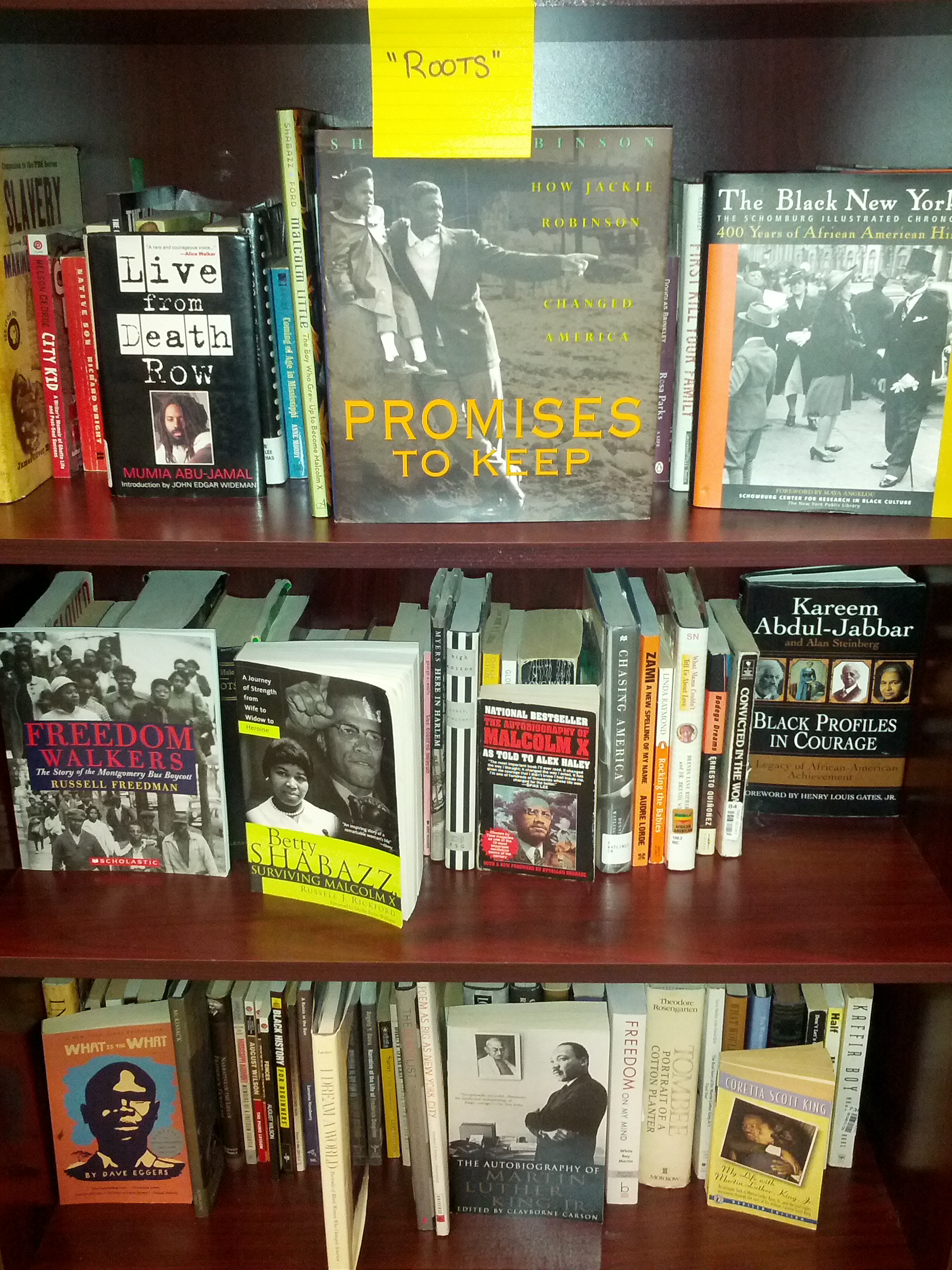
Students (and guests) are continually gazing at our Francis Gittens Lending Library and enjoy, not only the vast array of literature to choose from, but how easily accessible it is to find what they are looking for. Gone are the days of ‘genre shelving’ and in are the days of ‘theme shelving’.  Whether students are just emerging into the world of literature or they are deeply rooted in their love for reading; our scholars need to feel supported.  By clustering books via theme, students (regardless of their comfortability with literature) know exactly where to go to get more of what they want!

Many students find their heritage fascinating and want to explore it beyond their current ideologies, beliefs, and familiarities.  So, they peruse the shelves in which they see themselves; racially, culturally, geographically, athletically, and so on.  They find comfort in exploring the lives and stories of those they’ve met before in history class or via conversations taking place within their homes.  They also take pleasure in learning more about who they are within the context of society, and on an even larger scale, within the world; simultaneously honing in on their more localized and individual existence.

All adolescents are searching.  They search for identity.  They seek to understand.  They thrive on building connections.  They strive to be enlightened.  And many times, students stumble upon exactly what they didn’t know they were looking for!  I love that.

Be it non-fiction, fiction, poetry, fantasy, science-fiction, auto/biography, graphic novels, screen plays, what have you; genre holds much less weight when the stories, characters, and settings transcend our students into a world full of exploration.

Here, our ever growing and ever evolving “Roots” shelves allow us to embark on a genre free yet culturally rich journey!

Some of our collective favorites include: Mumia-Abu Jamal, Jackie Robinson, Malcolm X, Betty Shabazz, Dr. MLK, Jr. and his lovely wife


Join the conversation by posting your own shelfies!  Share a shelfie with #shelfieshare and let us know if it’s a #classroomshelfie, #bookstoreshelfie, or other miscellaneous find.

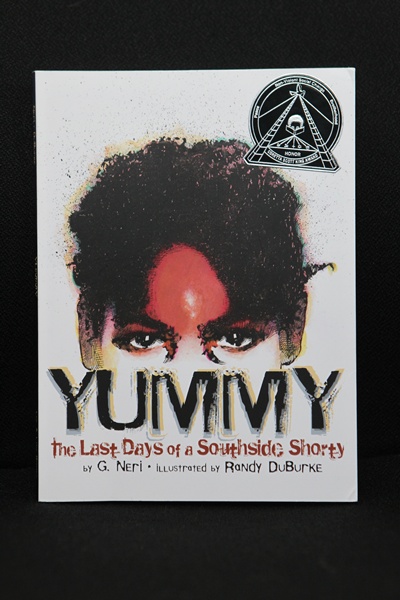
G. Neri’s Yummy


yummy

Synopsis

In this award-winning graphic novel, Robert “Yummy” Sandifer’s life becomes interwoven with other true events from a period in time where Chicago’s south side was running rampant with gang activity and violence. The year: 1994. Yet, its relevance still holds weight today in urban communities throughout our country. Unfortunately.

Narration and Writer’s Craft

Through third person narration, eleven year old Roger, guides us through the ongoings, thoughts, chaos, family ties, brotherhood, fears, ponderings, love, realities and insecurities most young adolescent males experience.

Roger lives on Normal Street.  He addresses what many readers are already thinking:  But I guess “normal” is different to different folks.

In studying craft, this one liner opens up dialogue, the use of language and repetition, and the importance of quotation marks in varying situations.  Throughout the entire story, you are greeted with on-point vernacular, literary devices, and a storyline that pulls at the heart strings.  (Just ask my students.)

Additionally, the incredible illustrations allow us the luxury of experiencing Yummy’s journey through his eyes, Roger’s eyes, and the eyes of all of those that take part in the journey.

It’s pretty loaded.

 Essential Ideas and ThemesYummy: The Last Days of a Southside Short

This gritty exploration of Yummy’s life forces readers (of all ages) to question their own understandings of good and bad, right or wrong, yes vs. no.

It searches for truth.

It provides us with the inner-workings of [the downfall of] self-worth and naturally asks us to question it.

Ultimately, we are challenged to think on a macro level about society; why are so many of our youth feeling forced into a life where statistics are alarmingly glaring?


Yummy is a piece that everyone needs to read.  It’s important.  It’s relevant.  It affords us a window into the lives of so many of our youth.  No wonder it has won just under 30 honors and awards.  This is one piece of literature you cannot afford to miss.

For more books by G. Neri feel free to visit his website: http://www.gregneri.com

——-

Yummy Time

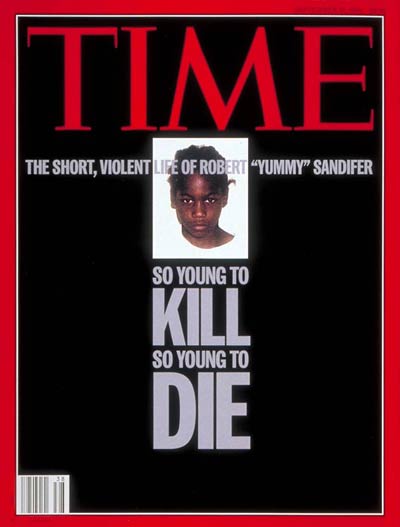
Here is the cover of TIME Magazine’s issue detailing the story of Robert “Yummy” Sandifer.  Tragic and important.

Shelfie Saturday

One of the foundations of a strong reading and writing workshop is providing students access to a wide variety of excellent mentor texts.  You may provide access to those books through your classroom library, school media center, or public library–but how do you know which books to purchase?  How do you predict which titles will be most popular with teens?  How do you know which authors will teach your students the most about writing?

sticker,375x360.u1We hope to offer you a few answers to these questions on Shelfie Saturdays.  Here, we’ll share shots of our classroom library shelves, bookstore tables, yard sale treasures, and more.  We hope these will act as examples of which books to buy, how to shelve them, and which ones to get into the hands of your readers.

So, to get us started, here’s one of my most popular library shelves–the Award Winners shelf.  This shelf houses winners of the Printz Award for Young Adult Literature, the Pulitzer Prize, the Man Booker Prize, the National Book Award, and more.  I also include nominees for all of those awards, as well as honorable mentions.  The genres are varied–YA, nonfiction, general fiction, even multigenre.  The books are at a range of difficulty levels–some have complex narrative structures, others are very long, and others are tough only because of their dense topics.

FullSizeRender[1]

I asked a few students why they liked this shelf so much.  Mylana said, “I want to challenge myself sometimes.  Whenever I read for fun I usually choose fiction, so I like to pick a nonfiction book that’s long but not boring.  I know I can find that on this shelf.”

I asked Garrett how he chose books on this shelf.  He said, “I pick books on this shelf because I hear about them on GoodReads or because they’re made into movies.  So I go to this shelf and pick the ones with the coolest covers.  The length is challenging, but if I get far enough in I won’t give up as a point of pride.”

Students gravitate toward The Goldfinch, Jellicoe Road, Grasshopper Jungle, The Round House, and Why We Broke Up more than any other texts on this shelf.  Again and again, I hear the same refrains during conferences regarding award-winning books–this book was hard, but I finished it because I just couldn’t put it down.  Award winners are shelved so for a reason–they’re the best writing has to offer in a given year, and are incredibly valuable teachers for the young readers and writers in my classroom.

Join the conversation by posting your own shelfies!  Share a shelfie with #shelfieshare and let us know if it’s a #classroomshelfie, #bookstoreshelfie, or other miscellaneous find.

The Talk-Funny Girl by Roland Merullo

10460266Marjorie Richards could be my student. In fact, she could be anyone’s student. The seventeen-year-old main character of The Talk-Funny Girl by Roland Merullo haunted me for weeks after I finished the book. I had seen her before, lingering in the eyes and mannerisms of some of my teens. The fact that she was so relatable yet so distant was disturbing.

Marjorie’s story is complex and multilayered. She lives in rural New Hampshire where teen girls are being abducted. Her abusive parents are so isolated from society that they have developed their own obscure dialect of language, a language that earns Marjorie the name “the talk funny girl” amongst her classmates. And her town has fallen under economic hardship with the closing of the local mill; in turn, she is forced to take on a job with a stonemason building “a cathedral” to support her unemployed parents.

Marjorie’s transformation is raw, inspiring, and cathartic. Her story is riddled with poetic lines that provide this quiet character with a strong internal voice. In one passage she says, “I had my protective shell of funny talk and shyness, but underneath that lived a wilder me, a girl who would take punishment, and take it, and take it, but who would never let go of herself all the way, never completely surrender” (Merullo 87). As a reader, I both relished and resented her authentic responses to her surroundings. At times she was open with her emotions, clear and contemplative. Other times I struggled yet understood her willingness to stand silent. This ebb and flow made her even more real.

Merullo found balance between maintaining a plot that lasts over years while also intertwining a thread of suspense. I began the book expecting one storyline and was forced to revise my predictions with the turn of every page. In the end, Merullo’s vivid writing, unique dialogue, and brilliant character development left an indelible mark.

March Book Madness for Choice Reading Books

Can you believe it’s already the middle of March!?  This school year is flying by…and so is the list of titles I’ve booktalked so far.  I’ve exhausted the bestsellers of YA, dystopian sci-fi, classics, books for the beach, war books, and sports books.  At this point in the year, I’m starting to booktalk new purchases, which means I’ve often not yet read them–which means that sometimes, the quality of my booktalk decreases.

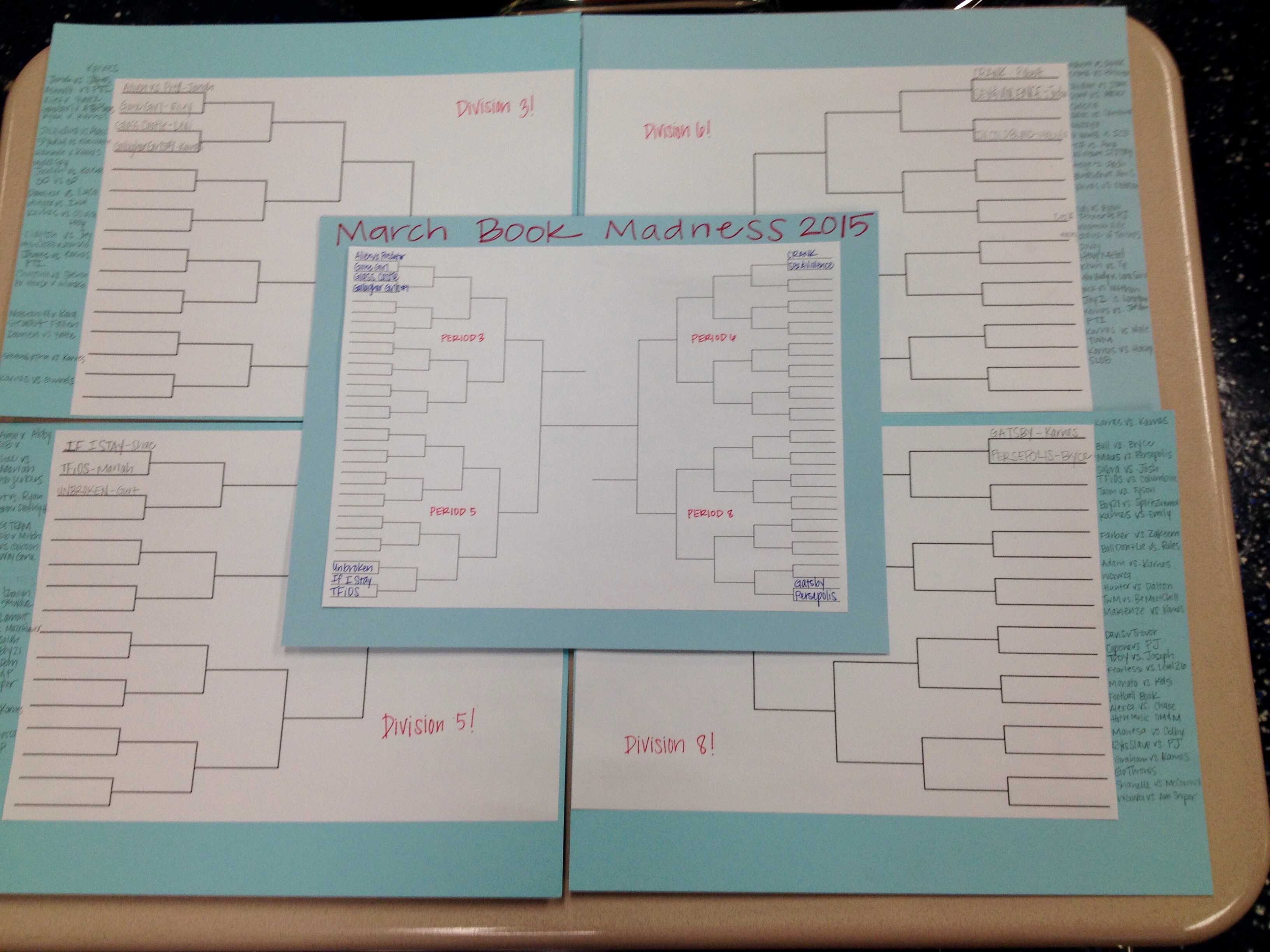
FullSizeRenderSo, because I want to shift the balance of not just grading from myself to my students, but also some of the teaching, I’ve turned to my own version of March Book Madness.  I heard about this competition from Tony Keefer’s Nerdy Book Club post, and I pitched it to kids, but they wanted to choose their own titles for the bracket.

So, blank brackets were printed, and to fill them, the guidelines were broad:  in each of my four English classes (which worked out well because they each get one corner of the bracket), students could choose a book and a partner to face off against.  Simple.

That was all I said, but as students began penciling in round one of the brackets, I was impressed mightily–they intuitively paired related books together, much like I do during booktalks.  Two boys in 8th period paired the excellent graphic novels Persepolis by Marjane Satrapi and Maus by Art Spiegelman.  Two girls in fifth period paired John Green’s The Fault in Our Stars and Gayle Forman’s If I Stay–two viral tearjerkers.  The Absolutely True Diary of a Part-Time Indian by Sherman Alexie will face off against Mexican White Boy by Matt de la Pena in sixth period.  And so on.

FullSizeRender (1)

Shae vs. Mariah in the Battle of the Tearjerkers…TFiOS vs. If I Stay

As book battles began, I laid out equally simple guidelines for voting.  Each student in a faceoff would give a short (1 minute) booktalk about their chosen text, and audience members could vote for one title based on any criteria–their own experience reading that book, the person’s booktalk, the presenter’s enthusiasm, the book’s stats on GoodReads behind the presenters, etc.

This modification to our daily routine–which is that students begin with reading, then hear my booktalks–has accomplished several wonderful things in our classroom.

First, students’ what to read lists, which had recently plateaued, are lengthening rapidly once more.  The sheer social capital of having a kid share his or her own reading experience of a book makes certain titles more tantalizing than I ever could.  Matthew Quick’s Sorta Like a Rock Star, for example, never quite flies off the shelves after I booktalk it.  It’s only after one or two kids read it and enthusiastically share it that it goes viral–and it does–year after year.  I see the same thing happening now during March Book Madness with lots of other books.  Kids are clamoring, suddenly, for several of the same titles.

FullSizeRender[1]Second, students are learning more about one another’s reading tastes.  They look at the brackets from other classes every day to see which books are advancing, and are sometimes surprised by who’s booktalking what.  “Huh…I didn’t know Jordan loved A.S. King too!”, I heard Hannah say yesterday.  “You read that book too!?  Wasn’t it awesome?!” Tyler said to Hunter, as he stood up with Ned Vizzini’s Be More Chill.  Despite my efforts to make their reading lives transparent with reading groups and notebook passes of book blogs, some of my larger classes haven’t quite unearthed the darkest corners of one another’s reading preferences.  MBM is fixing that quickly.

Third, this is not for a grade.  This is just a semi-structured celebration of books, with bragging rights as the purely intrinsic reward of the whole endeavor.  The five or so minutes we spend on this in class daily are a worthy time investment for the revelatory feel they bring to the start of our learning.  Kids are excited and upbeat after the two daily faceoffs, and excited to often add one or more of the four daily books discussed to their to-read lists.  The post-winter doldrums are quickly lifting…and the sunshine certainly isn’t hurting, either.

Is anyone else doing a version of March Book Madness?  How’s it going?  Please share in the comments!

In Defense of Food: An Eater’s Manifesto

315425I grew up as a reader, but I was a steadfast reader of fiction only–especially series.  I remember receiving my PSAT score report in high school, which strongly suggested that I begin reading more nonfiction in order to improve my vocabulary and reading comprehension.

So, not being informed about the wonderful nonfiction tomes I now know about, I began to read the newspaper.  That probably contributed to my majoring in journalism, and now teaching that subject in addition to English.

But it wasn’t until I took Penny Kittle’s class at the UNH Literacy Institute in 2013 that I fell in love with nonfiction (pardon me, Mr. Lehman and Ms. Roberts!).  I read Malcolm Gladwell’s Outliers and was enamored of his use of narrative to help me understand seemingly disparate facts.  I quickly read all of Gladwell’s other books, then devoured the rest of the booklist from Penny’s class–The Emperor of All Maladies by Siddhartha Mukherjee, The Immortal Life of Henrietta Lacks by Rebecca Skloot, Behind the Beautiful Forevers by Katherine Boo, Zeitoun by Dave Eggers, and plenty more.

However, it’s not since Gladwell that I’ve found another nonfiction author whose collected works I’m dying to devour…until now.

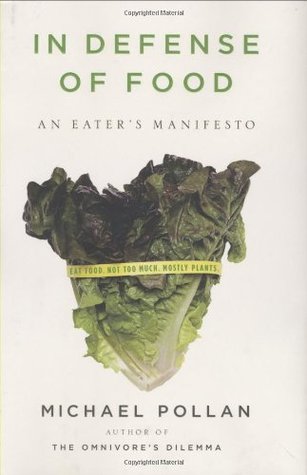
I recently asked my students to brainstorm as many nonfiction genres as they could, then select three for us to focus on for this quarter.  One of their selections was a recipe.  I wanted to show my students lots of examples of writing about food, so I purchased Michael Pollan’s In Defense of Food: An Eater’s Manifesto and The Omnivore’s Dilemma: A Natural History of Four Meals.  I picked up In Defense of Food first, and was left defenseless.

This book rocked my world, and my worldview.  It’s a book about the food we eat, where it comes from, how it’s different than other cultures’ foods, and how it’s good and bad for us.  I learned about the wild inaccuracies of food science, the nutrient-depleting process of processing food, and the government’s allowance of all this because of their dependence on food marketers’ money.  I also learned about the evolution of America’s food culture–from farm fresh to TV dinner to fast food–and its deleterious health effects on our population.

So, after Pollan sufficiently freaked me out and made me swear to myself that I’d never eat any processed food again in my life, he presented a clear solution to my fretting and outlined some rules for eating healthily (the subtitled Eater’s Manifesto).  I learned how to shop smart, defy the American diet’s unhealthy customs, and consider my foods in the contexts of their meals, which can completely transform their nutritional value.

It wasn’t just the topic that fascinated me (admittedly, I love to cook)…it was the writing.  From knee-slappingly incredible food puns like “let them eat Twinkies” and “the silence of the yams” to his deft skill at citing other writing to support his own arguments, I was convinced.  The clear organization of the book mirrors his three basic rules about eating well, which he states in sentence number one:  “Eat food.  Not too much.  Mostly plants.”  The complex narrative he weaves makes perfect sense, but is incredibly layered.  Through it all, Pollan made his claims and supported them sturdily, leaving me not only swept up in a great story, but thoroughly knowledgeable about what real food is and isn’t in America today.

I can’t wait to bring this book to my students through book clubs, a reading challenge, or a craft study mini-lesson…so I’ll booktalk it tomorrow to my Funyun-munching students with as much fire and brimstone as I can manage, and hope they hop on the Pollan diet with me.