Category Archives: Books

Shelfie Saturday: My Ideal Bookshelf

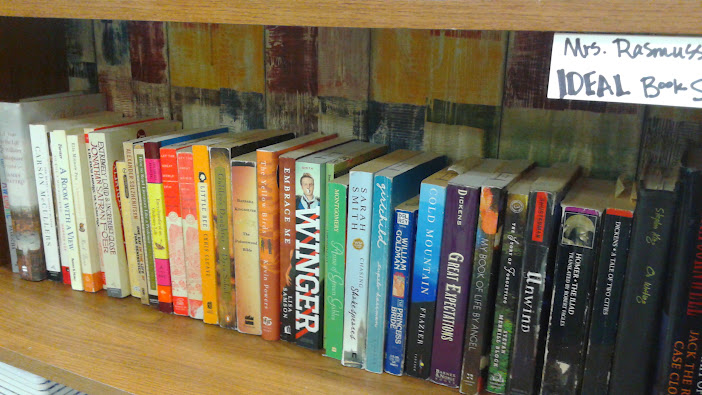
shelfieAT UNH Literacy Institute 2014, Penny Kittle gave us a handout so we could create a depiction of our Ideal Bookshelf. The idea comes from a lovely book that features articles where “100 cultural figures” describe the books they read and love.

Here’s a sampling from Brainpickings: My Ideal Bookshelf: Famous Artists and Writers Select Their All Time Favorite Books.

I keep an Ideal Bookshelf in my room. This is a place for my favorite, books. They touched me, molded my thinking, changed me in some way.

I talk about these books often, and many of my students read them. We share what we like and what we don’t. I encourage them to craft their own shelf of favorites.

From Awesome to Shakespeare to Girlchild and Great Expectations to On Writing and Portrait of a Killer by Patricia Cornwall — this is my personal canon, my Ideal Bookshelf.

What do you keep on your Ideal Bookshelf?

Please leave your favorite titles in the comments. They might just fill the next shelf in my classroom library.

©Amy Rasmussen, 2011 – 2015

Shelfie Saturday: Book List Bookmarks

shelfieThis year, I am convinced that the patron saint of libraries has arrived at EHS in the shape of a silver-haired spitfire. Kathy Vetter and her crew of library assistants have managed to shift the culture of our library from a stuffy prison in which students got kicked out all too often (for eating, sleeping, talking, breathing) into a warm, inviting space of relaxation. Surprisingly, this transformation and the allowing of food in the library have also ignited students’ interests in reading.

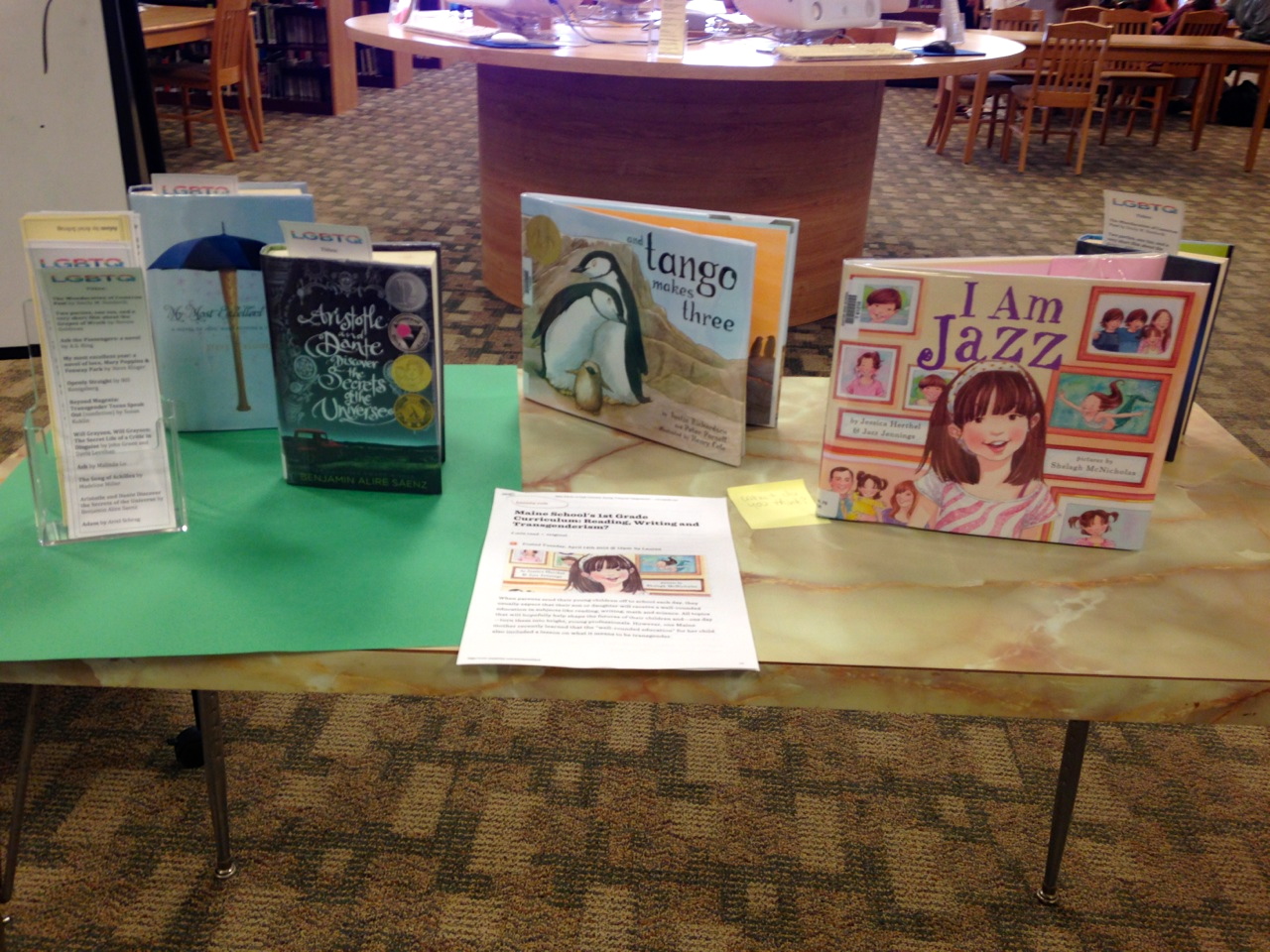
One of the library’s greatest programs for engaging readers has included setting up simple displays to attract students’ attention. While the displays aren’t flashy or ornate, they expose students to a wide variety of books. For example, in honor of June being LGBTQ month, the library set up a small table with a selection of LGBTQ literature. The selection included I Am Jazz, a book about a transgender child that recently sparked controversy in Maine (ourIMG_2153 neighbor) after an elementary school teacher read it to her class. In addition to the display, the library also provided copied articles about the I Am Jazz dispute to educate students. Talk about a teachable moment!

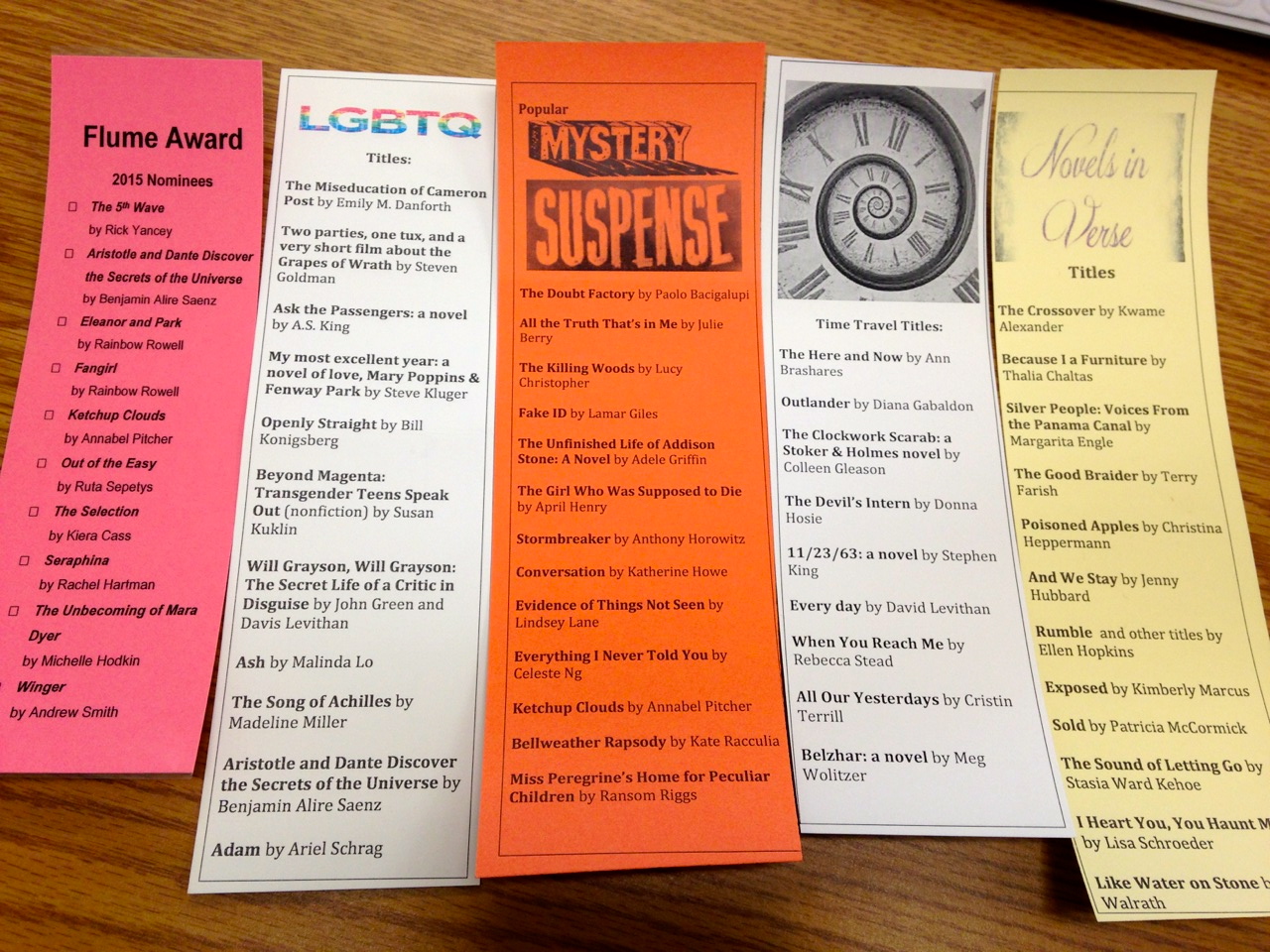
What I love most though is the increasedIMG_2154 availability of book list bookmarks. Throughout the year, the librarians have managed to set up an elaborate display of bookmarks including lists of Flume Award nominees, time travel titles, and novels in verse. Many bookmarks even include suggestions based off popular books; for example, one reads, “If you liked The Fault in Our Stars, you might like…”

As I reflect on my currently library, I look forward to aligning with the library and using their model within my own classroom. I currently use plate stands I bought from a craft store to display books on top of my bookshelves. I am planning to not only steal some book list bookmarks to provide to my students (who are always looking for bookmarks), but I am also going to use these bookmarks to help me develop my book displays

and even my classroom library shelves. In the meantime though, I will certainly count my blessings that such an angel of books not only appeared at EHS but changed the environment that surrounds one of our greatest school resources.

Missing Pieces by Meredith Tate

24903132I love receiving e-mails from students—not the “Is this due tomorrow?” or “Why do I have a zero in PowerSchool?” e-mails—but the ones that are written bleary-eyed, late at night (or sometimes early in the morning) from students who have just finished a book. Recently, Alyssa, one of my Advanced Composition juniors e-mailed me at 10:30pm after finishing Missing Pieces. She wrote:

“Wow, I just finished the book and I am completely shocked! Was definitely not expecting…[Can’t put this in because I don’t want to spoil it!]…I am extremely happy the way it ended! This was most certainly one of my favorite books that I read this year and if any of my friends ask for a recommendation I would without a doubt recommend it.”

As a teacher, finding a book students can connect with is a victory! But in this, case the victory was even sweeter. I grew up with Meredith Tate, the author of Missing Pieces, and even as children playing in the sandbox at our tiny four-classroom elementary school, Meredith knew how to weave a story.

Missing Pieces is the story of Tracey (Trace) and Piren, two best friends growing up in a dystopian world where they are matched with their spouses at six years old based on genetic compatibility. Despite Trace and Piren’s undeniable friendship and eventual attraction, they are paired with different partners. It is a fight between fate and free will.

While the plot might sound generic, resembling the many dystopian romances novels we’ve seen lately, Meredith succeeds in weaving together a distinctly unique story. Trace and Piren are flawed and frustrating and real. They live in a world of messy mistakes. As a social worker, Meredith doesn’t skirt around issues of alcoholism and abuse—instead she confronts them head-on, addressing the harsh, debilitating nature of addiction. I love that this book doesn’t cleanly fit into any distinct genre—it’s a romance, but it isn’t mawkish; it’s categorized as “new adult” but it begins when the protagonist is 14 years old; it’s dystopian yet it distinctly resembles modern society. Despite the numerous questions posed throughout the book (including those in the excerpt below), we learn that life is a series of difficult decisions; it’s the pure beauty of this rawness that makes this book relevant to teenagers.

“What if the one you’re supposed to be with, and the one you want to be with, are two different people? My entire life was mapped out for me before I was born. Is my only choice to silently follow the course already plotted? To blindly accept my future and walk that trail until I die? To smile and pretend everything is okay and I’m happy and in love with my Partner when I’m spiraling downward and drowning in my loneliness? I’m drowning, like in my childhood nightmares. Only this isn’t a nightmare; I can’t wake up from this life.”

Shelfie Saturday: Nonfiction #ShelfieShare

shelfieAs a young reader, I was a library-only kinda girl.  I browsed the mystery, fiction, and teen sections looking for distinctive spines–ones that had a pink “Classics” sticker, or an orange “Award-Winner” sticker, or a blue “Librarian’s Choice.”  These little guides led me to Jane Austen, Matthew Quick, and John Grisham, whose spines were not only colorful with library stickers but also well-worn from the hands of readers.

The thing about those spines was that none of them were in the nonfiction section, which loomed large with encyclopedias, reference books, and lots of sections about science, technology, or car repair.  Being a middle schooler who didn’t know about the Dewey Decimal System, I had no idea how to find interesting biographies, beautiful memoirs, or fascinating historical accounts.

Now that I’ve begun to love nonfiction and learn a lot from it, I’ve tried to simplify the search for great true stories in my classroom library.  We have one Nonfiction shelf and two Memoir & Biography shelves.  I try to keep collections, histories, and statistics-into-stories books all together on the Nonfiction shelf, while I move the stories of people’s lives onto the M&B shelves below it.  Sometimes the titles that belong on the Nonfiction shelf wind up on the Award Winners, Unique Teens, or Death & Dying shelves–because I love to mix true and imaginary stories in our library when they share themes.

FullSizeRender

You can see that our shelf is varied–topics range from sports to how the mind works to humor.  Some authors are dominant–Jon Krakauer, Malcolm Gladwell, Daniel Pink–but others are one-hit wonders whose titles are very popular–Mary Roach, Michael Lewis, Dave Cullen.  Their respective Stiff, Moneyball, and Columbine are three of my library’s most popular titles.

Our nonfiction shelf is also the home of the “Best American” series, which includes topics such as science, travel, and sports writing, but also a collection of simply “essays” from each year.  This series is a fabulous way to find a huge variety of good nonfiction mentor texts when students are doing informational or persuasive writing–there is always something to match any student’s interest.

This shelf is an eye-level shelf for good reason.  Students who wouldn’t normally gravitate toward the nonfiction genre find their eyes caught by interesting covers, titles, or topics–such as Missoula and It’s Not About the Truth, both of which deal with college rape culture, or The Sociopath Next Door, which attracts all my Sherlock fans, or Lost in the Meritocracy, which gives both motivated and disengaged students much to consider.  Once students discover this shelf, they often move toward the Memoir & Biography or Award-Winners shelves, which contain more sophisticated nonfiction structures.

I encourage all teachers of literature to build up their nonfiction shelves–their titles have much to teach our students.

Guest Post: How a High School Improved Reading by Building Little Free Libraries

busLast summer, I became a Penny Kittle convert. I originally didn’t know what I was signing up for, but something kept driving me to be sure I was where she was. Turns out, it’s been the best hunch of my teaching career. The mind shift I was searching for. A complete game-changer. And this is year eighteen.

After 2 ½ days with Penny, I spent the rest of my summer trying to keep up with my churning brain. I wrote more than I have since I was a slightly over dramatic, totally drowning-in-love teen. I read. And I read. And I read. I rediscovered that lust for story I had almost forgotten. I freed myself from the idea that pleasure reading was fluff and gripped the concept of reading what speaks to me as a means of improvement – just like I would soon ask my students to do.

In the midst of my mid-career crisis (maybe crisis is too harsh?), I found a tweet about the site littlefreelibrary.org. The various clever wooden boxes built for books captivated me. I loved the idea of a take-one-leave-one system designed to build community. What fun! I wanted one! Maybe a home project with my own children? Then, I had a thought. What if we put these book boxes in the hallway at our high school? What if this could be the reading take-over Penny Kittle encouraged? So, on my wild whim, I retweeted the link with that very suggestion.

Soon (which means mere seconds in the Twitter world), my teacher peers of all disciplines — math, sharkscience, history, technology, world languages — responded with enthusiasm! They wanted to build wooden cubbies! They wanted to donate books! They were all on board! So, the fun began…
In an August inservice session, I presented the idea to the full faculty, highlighting the importance of choice-reading in ALL classrooms. I used so many of Kittle’s words in an effort to begin a movement. We have to get all of our kids reading – the rich, the poor, the gifted, the challenged, even the ones who don’t eat their vegetables. And, in a school as diverse and unique as ours, we couldn’t wait another second. Of course, there was one small glitch; I didn’t know or have the means yet to build the little libraries. But I knew we could.

Following my first session, our new theater tech teacher immediately approached me, and he offered to have his tech class build the first set! I cried. I usually do at most sentimental things, but I just didn’t expect this outpouring. Books began to appear in my classroom from teachers and then parents. Some opted to write an inscription inside their favorite books, explaining to the future reader the special significance of that particular tale.

#hebronreads was born.

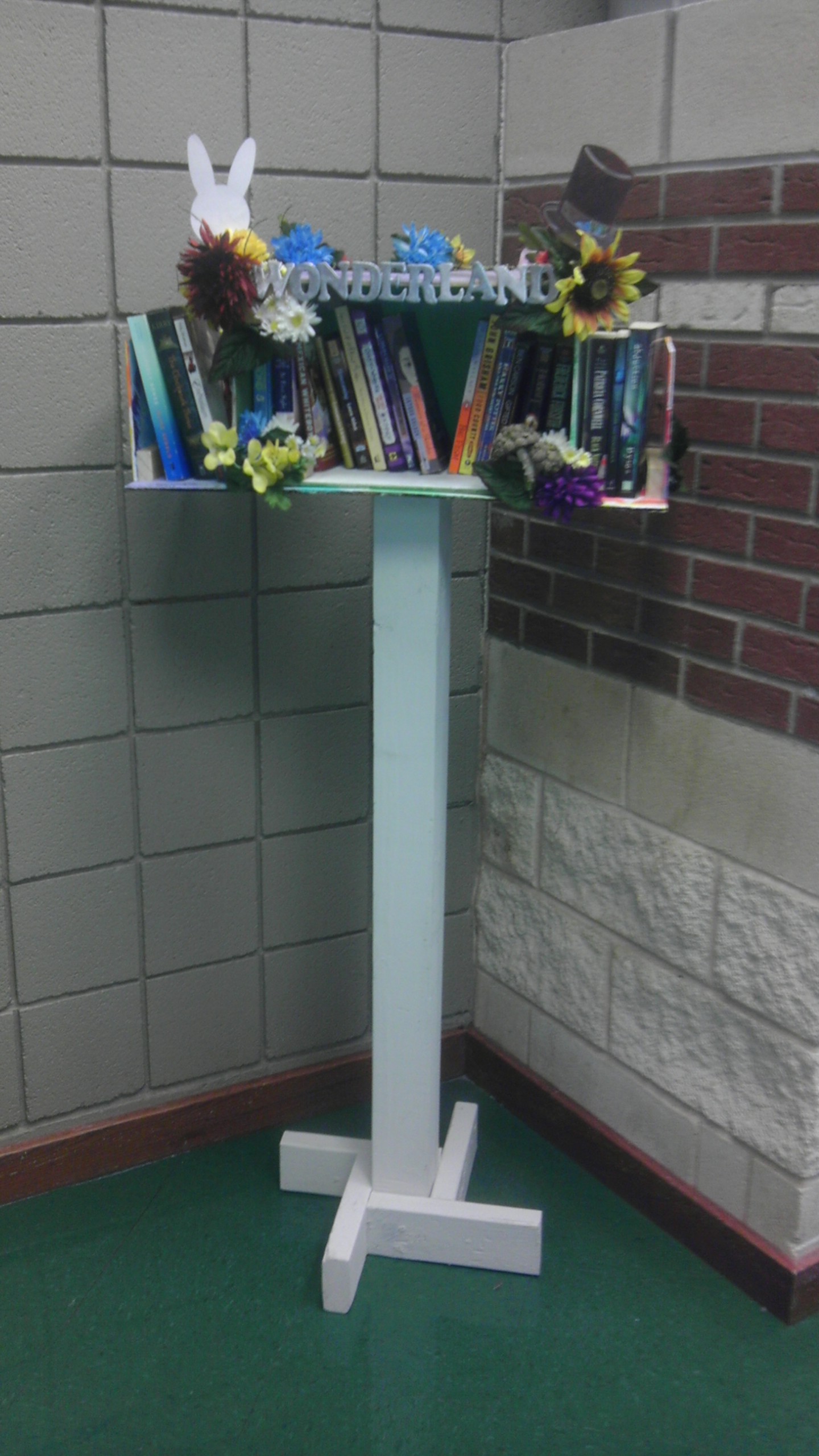
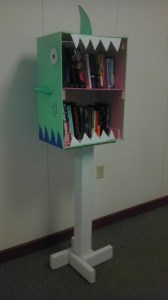
The theater tech class created the first five Book Nooks, as they are now called, from lumber and Slide2supplies donated by our community. In true theater style, the Nooks have flare – a shark, an Alice in Wonderland, a school bus, the Parthenon, and, of course, a book! All student created! All on pedestals in various niches in our halls. At our fall open house night, books poured in from parents who heard our call to promote literacy, and books continue to appear in my classroom like gifts from the Tooth Fairy.

Students in our advertising and marketing classes competed to create a campaign for the program. On World Read Aloud Day in March, we paused to read to our students, and we passed out bookmarks and talked books during lunches. Students have daily choice-reading time in math classes and business classes in addition to English classes. Another book drive is slated during our spring football game in May. A spring literacy night with former Hebron High School grad now YA author Lindsay Cummings is in talks.

alice


This is only the beginning.  

In my hopes and dreams, we will build more Book Nooks and litter the building with choices. We will continue the book drives until all classrooms have some sort of libraries. We will keep talking reading and promoting ideas via @hebronreads. And one day, when we are feeling pretty confident in our literacy push, we will make Nooks and take them filled with books to neighboring schools who need more stories in their lives too. Hebron High School is now a thriving community of readers, and it is truly glorious!

Parent quote:

“My son has always loved to read (‘loved’ is probably an understatement), so when he found these books in Hebron’s hallways, he was very excited.  He came home telling me what a neat thing this was — books for the taking, any book, all kinds. Once he understood the program, he commented on what a great idea . . . read a book, replace a book, or just bring it back. Great idea, Hebron!”    Carolyn Sherry

Donna Friend teaches at Hebron High School in Carrollton, Texas. She is making readers out of English III students and leads her department into the chaos of educational risk-taking. Currently, she is honored to be her campus as well as the Lewisville Independent School District’s Secondary Teacher of the Year, an accolade that, despite her 18 years of teaching, she doesn’t yet feel old enough to have earned! Her current favorite book is Jandy Nelson’s The Sky is Everywhere, and she is practicing being a regular reader and writer along with her students. She has a 9 year old son, a 6 year old daughter, a hubby, two cats, and a few fish. She once dreamed a young adult novel and still regrets not writing it down immediately after waking. Find Donna on Twitter @mrs_friend

Glory O’Brien’s History of the Future by A.S. King

17453303John Green says that “A.S. King is one of the best Y.A. writers working today,” and who doesn’t trust everything John Green says?  (Except for when you trust him for 246 entire pages, and then your trust is shattered, and you ruin a book with your tears, but I digress.)

Having fallen madly in love with A.S. King’s writing during Everybody Sees the Ants, I have been waiting for my students to return Glory O’Brien’s History of the Future to my library so I could read it.  Without ever having booktalked it, its catchy cover caught students’ eyes and enticed them to dive right in.

Finally, yesterday, I spotted it on the shelf and took it outside in the sun with my class to begin reading.  Surrounded by seniors mere weeks before their graduation, I was in the perfect setting to immerse myself in Glory’s story, which takes place over two weeks bracketing her high school graduation.  She’s a photographer for the yearbook, keeping herself distant from her peers by hiding behind a camera.  Her only “friend” is her neighbor Ellie, who’s lived beside her ever since Glory’s mother committed suicide thirteen years ago.  Ellie doesn’t understand the worry Glory has that she’ll end up like her mother–and Glory is terrified of, dreading, trapped by, her own uncertain future.

That all changes after a wild night, after which Glory and Ellie can suddenly see the future.  Glory begins to record these transmissions, in which, upon eye contact with anyone, she can see the actions of their distant ancestors and descendants.  The glimpses of the future reveal a future American Civil War, the complete reversal of feminism, and a tangled web of people she knows mixed up in all of this.

“We were fed onto the stage like machine parts.  We were a conveyor belt of future.  We were an assembly line of tomorrow.  We were handed our diplomas and stood to face the audience and they were asked not to clap until the end, but some did anyway. … I stood and faced the crowd and heard a static of epic proportions.  Chatter of a thousand infinities all at once.”

Deciding to chronicle her transmissions through a scrapbook modeled after one of her mother’s creation, Glory writes her own “History of the Future,” and it’s bleak.  As the novel progresses, the darkness of the future becomes more certain, but so does Glory’s understanding of herself–a trade-off she’s not sure how to handle.

With beautiful language, dark humor, powerful lessons, and themes of mystery, love, redemption, friendship, and foreboding–all set against the backdrop of high school graduation–I can see now why this book is never on my shelves.  I’ll be happy as it continues to remain in the hands of teens getting a refresher on feminism, individuality, and the pursuit of happiness.

“Sounds so convenient, right? Me not having a mom and my dad being all great about it and stuff.  But it wasn’t like that.  The air was tense.  We still had no oven.  My cobbler still tasted like radiation, no matter how much ice cream I piled onto it.  I could feel the secrets in the soil here. … Something was about to sprout and grow from that soil.  I could feel it the same as I could see the mourning dove into infinity.”

Dumpster Diving for a Book Shelf

shelfieMy husband called, “Hey, there’s a book shelf by the dumpster. Do you want it?”

Funny that he asked. I know he knew I’d say yes.

I put the tall black shelf by the door to my room, which was pretty much the only open spot. But most of my classroom library sat cozy on the opposite side of the room. I did not know what books to put on this new shelf.

It sat empty waiting for three months.

There’s nothing quite so unsettling as an empty shelf in a bibliophile’s classroom, but my husband made me promise not to buy any more books. This is hard.

Finally, I got smart and labeled the shelves “1st period Suggests You Read,” “2nd Period Suggests You Read,” etc.

Slowly, I started moving books that students talked about, the ones they told me they liked. Then I Favorites book shelvesnoticed that a few students started returning their books to these shelves, and after we did Speed Dating with a Book a few weeks ago — we put all of our to-read-next titles on these shelves.

Now, instead of having most of our book choices on the bright green wall across the room, students walk past this shelf as they come and go.

Pretty good deal for a dumpster find.

©Amy Rasmussen, 2011 – 2015

Behind Barbed Wires

sticker,375x360.u1In honor of the recent Holocaust Remembrance Day, I find it befitting to share Room 382’s shelf comprised of pieces in which those, who experienced the nightmare, share their stories.  Each piece on this shelf is dedicated to bringing awareness, and hopefully shed light on how history truly can repeat itself, if we do not prevent it.

While this shelf hosts stories of tragedy, suffering, and insurmountable pain and loss; it serves a purpose. Aside from the devastating, these pieces share with us the true essence of humanity.  Often, this is the first time students are diving into this 80-year-old genocide and trying to make sense of it. Many times we can’t; and other times we are able to connect over the beauty that surfaced. It’s all very complex.

Elie Wiesel’s story (and bravery) is shared via his trilogy starting with Night then moving us through Dawn and eventually through the Day.  See what he did here?

Anne Frank shares her experience as a young woman budding into adolescence in a time where her beautiful spirit defeated the confines of her attic.  Various types of literature have been compiled so IMG_20150424_083609students (and all readers) can experience Anne’s story in various ways: her published diary, actual footage restored via the Anne Frank House (a gift from a friend’s visit to Amsterdam), the play, and many others.

Maus, an incredible two-part graphic novel, utilizes the “Cat and Mouse” metaphor to portray the Nazis
vs. the Jews during the Holocaust.  This two part series is detailed and brings to life the realities of the inner workings; the emotional turmoil yet amazing perseverance of those living through this moment in history.

Those are three pieces among many.  There are books here (and ones that are currently signed out) that chronicle voices of the children of the Holocaust, novels that use real-life situations yet tell a fictional story, perspectives from a Nazi’s Jewish wife, the bravery of a journalist who swapped places with a Jew to ultimately expose the hidden…

Students are typically surprised, fascinated, uncertain, saddened and sometimes hesitant when it comes to this shelf.  Understandably.  This shelf asks us to inquire and then sit with our findings.  Yet, the conversations and rich discussions that float around this shelf are beautiful; truly beautiful and strengthen our understanding of what it truly means to be human.


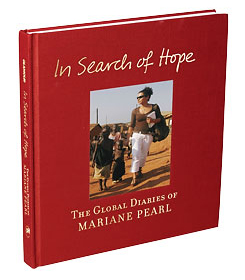
In Search of Hope

mariane pearl book coverI first fell in love with Mariane Pearl’s writing when I read her memoir: A Mighty Heart where she chronicles the events leading up to her husband’s murder in the Middle East.  It was devastating.  Tragic, really.  Yet, her voice sang from the pages even while sharing the most intimate moments associated with a murder that was so incredibly public.

So, to no surprise, when I came across In Search of Hope: The Global Diaries of Mariane Pearl,  I was thrilled. Pearl, a journalist for Glamour Magazine, took on the world – visiting twelve different countries. She was escorted through these countries by powerful women that are all on missions to bring positivity, safety, and change to countries that are broken.

Pearl visits with courageous women who share the most private details of their work – and passion.  She learns about a Cambodian sex slave’s liberation; Liberia’s presidency from the perspective of President Ellen Johnson Sirleaf (2006); an AIDs orphan turned healer in Uganda; a New Yorker who leads children needing guidance; how justice is getting a voice in Mexico…and so much more.

As you read these short stories full with dynamite photographs, writing that is powerful, and experiences that shed light on women fighting through the injustices associated with their countries, culture, and neighborhoods; you can’t help but to feel as though you are on a year long excursion around the world – one that authentically changes your core as a human being.

Students love this piece.  They are awed by the bravery of these women; Mariane for exposing truths that do not get adequate recognition and the women who are willing to risk their own safety in order to save others.  For every reader, Pearl puts life into perspective.

The richness found within these pages comforts you.  It makes you believe that anything truly is possible.  Well, because it is.  It provides students access to beautiful moments experienced within other cultures and propels them to reflect on their own morals and values – what are they really willing to fight for?

In Search of Hope is a piece that leaves you feeling compelled to explore.  Travel.  Find your own truth.  And when you do, write about it.

Everywhere You Turn

Over the last three years, our Francis Gittens Memorial Lending Library has grown literally by thousands of books.  And, it’s a beautiful sight.  One in which provides comfort, challenge, and dialogue among students and educators.  It propels interest in reading and provides options and choice; students sometimes pull up a chair and use the edge of any given shelf to rest their Writer’s Notebook while they write and find inspiration.  It’s our staple here in room 382.

But, as more and more donations come through the door, I panic: Where will they all go?!  We are currently wall-to-wall with bookshelves (many that tower over us) and the remaining space is either wall-to-wall windows or full of technology.  So, I started to utilize every open surface: our computer cart, window sills, filing cabinets, my own desk.  Now, literally everywhere you turn, your gaze lands upon books…stacks and stacks of books.

Initially I felt overwhelmed by having books everywhere; I thought it felt chaotic.  But, the perceived chaos actually provides students even more choice and an innate awareness of their surroundings. Students have started to become even more in-tune with their reading journeys and have been feeling more compelled to explore.  For more reluctant readers they have access to books without it feeling as though there is the need for any sort of grandiose gesture; trekking across the room to the wildly overwhelming library.  It’s subtle yet powerful beyond measure.  Everything is within their reach.

IMG_20150421_093753

Books resting on technology…

Everything.  Even our mobile technology cart full of laptops. The books on top are stacked in four piles; they are our newest additions.  Because the cart find its way across the room, near different seats, and at various different spots depending on the day; it’s equivalent to an ice cream truck making its rounds – no one is to be missed.  These piles change as the new additions continue to stream through the door.  Many students, as they are accessing the cart for a computer, find themselves pausing for a moment because a book title…or cover…or piece they realized was on their next-to-read list…has caught their attention.  I love the irony that’s often captured here when a student is simply going to return their computer, hears the bell ring, and runs to their Writer’s Notebook to jot the title down; yet forgets to put the computer back!

IMG_20150421_094028

Here is one of three window sills adorned with literature – and some added nature.  During the winter months in room 382 the heat tends to be unbearable (hence the cactus) which is quite unfortunate.  Yet fortunately, students like to get a breath of fresh air.  So, while doing so they find themselves multi-tasking – breathing in the fresh city air while perusing through the new titles that greet them at the window.  Many times, a lesson or writing workshop will be interrupted with, “Miss Bogdany, I found another book about XXX!”

Books decorating ugly steel surfaces...

Books decorating ugly steel surfaces…

Many students have just recently begun to proudly embrace their love for graphic novels. Typically,they believe that they’re for ‘young kids’ because of ‘all the pictures and stuff’.  I whole-heartedly disagree.  So, in the vein of supporting students’ interest in visual literacy, many are found atop an industrial filing cabinet adding color, texture, and accessibility.  Because this surface is also used for additional supplies, students access it often.  Every time they are wanting to find their zen (see butterfly book box on the top left) they happen upon literature that excites them.  Many times, the zen garden and a new book escorts them back to their seat.     

IMG_20150421_093914

Exhibiting my literary interests. The left stack is comprised of pieces I want to read. The ones on the right are my absolute favorites. And, the ones in the middle are a fantastic mix of professional resources, gifts, and tools.

I know students will not produce work if they are not comfortable; both physically and in feeling safe within a community.  I create a visually stimulating space at my desk because it’s what fuels my passion for all things literacy. I also know, when a student needs their own unique space, they tend to gravitate toward wherever it is that I’ve set up shop.  It has been labeled ‘their corner office’ – and yes, they get right down to business!

There are other times when I conduct 1:1 conferences and ask a student to engage in dialogue in our bright back corner.  I watch their eyes drift from their writing to the options resting atop my wooden workspace.  Students will reach across the desk to pick up a piece they have never seen there before and while I try to get their attention refocused on our conference, sometimes the book they’ve chosen is much more convincing than whatever it is I’m trying to do.  I also think some of the intrigue is that students know that what they find there are pieces I can really talk about because I’m passionate about them.

So, as the year starts coming to an end and we start thinking strategically about how we are going to start minimizing our inventory and organizing it for our summer packing; please don’t!  Keep moving things around and keeping it fresh.  Put books in places you haven’t before – students will find them trust me.  Play around with what you have displayed in your area and invite students to engage in conversation wrapped around them.  But, most importantly, enjoy these remaining few months with our inquisitive and dedicated readers as they continue to look around our learning environments and find exactly what they didn’t even know they were looking for.

Where do you keep literature aside from your library shelves?  What successes have students found when they happen upon a book in the most unlikely of places?