Category Archives: Professional Learning Community

Book Clubs to Move Readers is the topic of this week’s #APLangchat

I volunteered to host #APLangchat this week. My reason stemmed from these three things: 

1.  Some of the best PD I’ve experienced has come from Twitter chats.

2.  I am hit and miss when it comes to regularly engaging in chats. Being facilitator should make me show up.

3. Many of the questions left in the comments on my post a couple weeks ago, Aim Higher: A Case for Choice Reading and a Whole Lot More in AP English, can be answered in a chat about book clubs; however, by no means do I have all the answers. I need help, too, so a discussion with my PLN is the best place to turn.

If you are available Wednesday evening at 7:00 CT, join in. You do not have to teach Advanced Placement to contribute. Every educator’s voice matters. You do have to remember to use the hashtag #APLangchat.

Here’s the plan for a finger-flying, Twitter frenzy of idea sharing on Wednesday:

Topic:  Book Clubs to Move Readers in AP English

To spark some thinking, consider these texts:

Not Reading: The 800 Pound Mockingbird in the Classroom” by William Boz, English Journal (2011)

Boys and Reading” video interview with male students by Penny Kittle (2013)

Why Book Clubs Matter” English Language Teaching, University of Michigan Press

From a Classroom to a Community of Readers: The Power of Book Clubs” by Jessica Cuthbertson, Center for Teaching Quality Blog (2013)

Book Clubs: NYC Department of Education” Unit of Study

To ponder and prepare, consider these questions:

Warm Up:  What are your habits as a reader? What do you read? When do you read? Who do you talk with about the books you read? #APLangchat

Q1 MC on the exam =hard, esp for non-readers. Besides close reading activities in class, how do we move kids into complex texts? #APLangchat

Q2 Many teachers have moved to balanced literacy w/choice reading as core. How might book clubs engage this pedagogy in AP? #APLangchat

Q3 Logistically, what do book clubs look like in a class of 35? #APLangchat

Q4 What book club book choices lead to the most reading, insightful discussions, best growth in student readers? #APLangchat

Q5 What does assessment look like during and after book clubs? individual and/or collaborative assessments? #APLangchat

Q6 What else do you need to know to feel comfortable facilitating book clubs with your students? #APLangchat

7 Ways I Read for Resolutions

I’m pretty sure I started making New Year’s Resolutions in about 1976, the year I got my first notebook for Christmas. I was 12. I’m pretty sure that every list of resolutions since then had “lose weight,” and “keep closet organized” penned on the page. Thanks to my daughter and her contagious 5K-junkie attitude, in 2014 I lost a lot of the weight I’d been lugging around the past several years, but I’ve given up on the closet. (That’s what doors are for.)

This year? I hesitated even thinking about my goals. I simply did not know where to start.

With the hope of getting ideas, I turned to my Personal Learning Network, some I know personally and some online.

1. I read my online-friend Elizabeth Ellington’s “Top 10 Reading Goals of 2015” and got a tiny inkling of ideas and a little overwhelmed. Elizabeth is a sharp educator and a brilliant and prolific blogger. I learn from her often.

2.  I read this post, which I saw Sir Ken Robinson tweeted. It begins like this: “This New Year’s day I will not be trying to moderate Sancerre consumption, cut back on Nicorette gum, exercise more or aim to finish my next book by Easter. I have decided to postpone all resolutions until February 19th which according to the Chinese calendar is the ‘ Year of the Sheep.’”

“Year of the Sheep?! Hmm. More time to think of good resolutions,” I say to myself.

3. I read my colleague Erika Bogdany’s post “Cliche No More,” and it takes me to my knees. Erika writes:

“. . .every morning with the heat blasting . . . there’s an essence that is viscerally undeniable.  I walk into a space, a quiet and waiting space, that invites risk, mistakes, setbacks, and quite frankly – the undeniable ugly.  Yet, there is no judgement, discerning undertone, nor slight anticipation that today there will be no progress.

Why would I want to leave all of that in 2014?!”

The last few weeks before the break were hard. My failure rate was out the roof, and after contacting parents via email and a translator, and meeting with an assistant principal for an hour and a half, and forcing myself to leave a stack of 120+ essays on my desk at the demands of my worried husband, I began to question everything I’d accomplished in the fall. All that choice reading. All that critical writing practice. All the relationships with my students. All of it.

I’ve grown because of my challenges. My students have grown as readers and writers. Why would I leave all of that in 2014?

For some reason God wants me teaching in high poverty schools. (This article helped a few things make more sense: “What if Finland’s Great Teachers Taught in U.S. Schools“)

4.  I read at Electric Lit, one of my favorite new sites: “Writers and Editors on Their Literary Resolutions.” Read it. You’ll see why it made me feel better.

5. I read Seth’s blog: “Used to Be.” And these words resonated:

“Used to be,” is not necessarily a mark of failure or even obsolescence. It’s more often a sign of bravery and progress.

If you were brave enough to leap, who would you choose to ‘used to be’?”

I repeat to myself, “Who would you choose to ‘used to be’?”

6. I read my poet-friend Dawn Potter’s “New Year’s Letter,” and felt the burn of my own candle. Dawn reminded me of my love for words. She sent me back to The Frost Place and the hope I had last summer.

Tweet this: I can do this. I can set goals for the new year. I can push through the closet and other things that annoy and exhaust me. I can be better. Do better.

7. I read a message from my friend Whitney Kelley. She asked if I followed Poets & Writers and got their daily prompts. I do now.

Today’s poetry prompt:

Screen Shot 2015-01-01 at 5.57.16 PM

I pulled out a new notebook that Whitney gave me for my birthday in December. I uncapped a new pen. And I wrote.

I don’t even care that it’s not very good. Just like this new year — It is a beginning.

I’d hope for world peace but

inner peace matters more to me right now

My daughter left this morning

She’s driving to her new life 2,000 miles from mine

I want her to go

Until I don’t —  I can be selfish like that.

I hope for greater love and

out-of-my-way kindness that he needs

That I need

I hope for burning lights and blurring lines and bold declarations

Be me. Be you. Be decisive and strong.

Let’s live a little and live a lot

Seek for understanding and

Understand for seeking


I’ll meet you at the airport with the camera

Finding A Teaching Family Outside of School

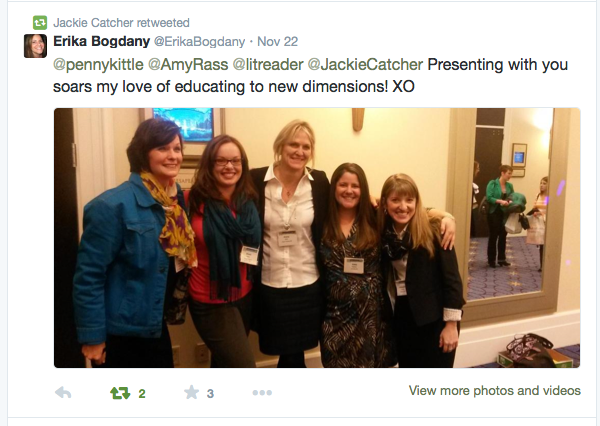
“It’s funny how my closest friends live states away,” Amy said to me as we crossed the convention center’s atrium during NCTE. I agreed; our group of four, Amy, Shana, Erika, and I, might live in different parts of the US, but we share a unique bond, one that has carried me through both the highs and lows of teaching.

Teaching is an anomaly: for being such a social career, it is also quite isolating. I learned this my first Screen Shot 2014-11-26 at 9.37.08 AMyear when I went from sharing a classroom during my yearlong internship to suddenly being by myself at the end of the hall. I found that while my colleagues and I would sit down for lunch everyday, we struggled to find common times to chat about our work or pedagogy outside of professional development days or staff meetings. Despite being within the same building, we’d oftentimes take to the Internet to discuss our plans and work with one another. Over the summer I would receive messages from Jenn about a fantastic new book we could incorporate into our academic English curriculum or recently I received a Pinterest pin from Kristina pointing out a fun way to teach sentence diversification.

Social media has changed the face of my professional learning network. While many of my teacher-friends are at my school, my core group doesn’t just involve those within my state anymore. I have discussed pedagogy with teachers in Canada, talked shop with friends in Washington D.C., and connected with educators across the country. Teaching is no longer the isolated occupation it once was. Over the past two years, these discussions have had a profound effect on my development as a teacher. Many teachers have helped to shape the workshop model within my classroom by being honest about their successes and struggles. My PLN has given me a place to geek out over reading, writing, and discussing literature. And ultimately, this passion online translates into my enthusiasm within the classroom.

With Thanksgiving right around the corner, I cannot be more thankful to my online peers as well as to Screen Shot 2014-11-26 at 9.33.43 AMthose teachers who I have met at conventions and in classes. I am grateful for the relationships I have garnered via social media and e-mail. No teacher should feel alone in this occupation—there are countless resources to uplift and inspire even the most isolated. After all, teaching is an occupation composed of charismatic, committed, and loving individuals who not only see the best in their students but also search for the best in each other.