Category Archives: AP English

Guest Post by Amanda Penney: The Workshop Classroom and YOU!!!

Note: This post signifies quite a milestone for the ELA 1 team I had the privilege of joining this year.  As of this morning, and thanks to the graciousness of this blog’s creators, the entire team has now published on this site.  To see a post by our department chair Megan, click here. Austin posted this summer, here. Sarah, our team lead posted a few weeks back, and my one year anniversary as a regular contributor is in January. This agency affords us power.  It gives us a voice in our fight for literacy.  To the creators of this blog, Thank You.

The workshop classroom is undoubtedly overwhelming to embrace at first. It is difficult to find information on how to properly implement this pedagogy, and there are many misconceptions of what workshop actually looks, for instance, on sites like TeachersPayTeachers. It’s a lot of work to be a workshop classroom. You actually have to read and write yourself if you want your students to benefit from this structure. You need to learn how to identify a solid mentor text from a variety of works and know what you can do with them successfully.

But the work pays off. It gives you, the teacher, so much more than you could ever have imagined. To keep your students engaged in their choice reading, you have to keep up with the never-ending influx of newly published works. You are forced to venture into genres of writing that you would not normally reach. For instance, I read Matt de la Pena’s We Were Here, and I can assure you, it is not historical fiction (my typical go-to). My students were writing about their foster care experiences and retelling their mishaps that placed them in alternate schools. Matt de la Pena provided an avenue for me to better understand these students, who in turn, helped broaden my reading interests.

For me, this shift has been monumental. As a workshop teacher, I actually get to read what I want to read and have picked up books I wouldn’t normally and enjoyed them! I get excited when I stumble upon a passage that might as well jump off the page and into my computer, so I can begin identifying my mini lesson and therein construct my fantastic lesson cycle. It is fun and exciting, and I have such a unique opportunity in my profession to be creative each and every day.

Writing has been the most exciting shift for me personally. I had lost a lot of confidence in my abilities as a writer when I entered college. I will never forget attending Texas A&M’s orientation for new students and the very blunt speech we were given. Simply put, the speaker stated that the five-paragraph-essay would lead to nothing more than a failing grade, so we better learn something new now or “See you later!” I was terrified, of course, because I had been taught nothing other than the five-paragraph-essay. The only piece I had ever written that did not follow that god-awful structure was my college admissions essay. Little had I known, I had “workshopped” my most proud piece of high school writing to which my first line stated “I am crazy.” However, one piece did not shake the terror I felt upon beginning my first day of classes the following week.

As a transfer student my sophomore year, I took an Advanced Composition course and a Shakespeare course. I held a solid A in my Advanced Composition class with helpful pointers and typically positive feedback from my professor. Yet, I could barely hold a low C in my Shakespeare class where I was regularly criticized for my writing style. I spent most of my time in the writing center, and at one point, the graduate assistant was so baffled by my C- paper over Shylock’s speech “I am a Jew” that he asked for the opinion of his “boss” who returned with a shrug and said, “I’m sorry, I don’t know why you got a C…. it looks like he just dislikes how you write and is grading you accordingly. Good luck.”

I spent the rest of my English degree pursuit frustrated and confused. I concluded that writing was a painful process, which would typically yield disappointment from my readers. I would never truly be able to improve because I, unfortunately, did not and would not inherit the mutant skill of mind-reading from Professor Xavier or Gene Grey.

Then, I began to teach. My first year, our campus did not have workshop at all, and teaching was painful day in and day out. My students really did not benefit from The Odyssey or the tragedy of Romeo and Juliet, and to be honest, neither did I. My second year began with the introduction of workshop, which was difficult to understand, considering I not only had never taught this way with my meager one-year experience under my belt, but I also had not learned this way. So, I struggled through what I learned and still could not get my students to engage. They always referred to their “I give up” phrase of “I don’t know what to write about,” and it left me frustrated and exhausted each day.

I had heard about writing along with my students, but I was afraid to do this. I did not identify as a writer and had long since decided I wasn’t very good at it. My students could never know this of course… But I was getting nowhere, and it was time for a shift.

So, one day, half-way through my second year of teaching, I tried something new. I chose to write with my students. I had been flipping through the pages of Kelly Gallagher’s Write Like This and stumbled upon his “1 to 18 Topics” lesson cycle. I embraced my fears of writing with my students and took the dive head-first the next day.

I started safe with soccer and intended to choose a new topic to expand each class period. To my astonishment, every single student had their pens to their papers and were scribbling madly as if they had been starved of this freedom for too long. Conferring revealed a vulnerability I had not anticipated, and I became inspired to show my own vulnerability as the day continued. I realized I had a lot to say, and I wanted to “say” it through my writing. I had starved myself of this freedom for far too long, and I was eager to continue writing.

My third-year of teaching is when workshop really kicked off in my classroom. I was searching for an engaging mentor text that utilized simple sentences as my students struggled (and still do) with sentence boundaries.  An excerpt from Dune stood out to me and I was eager to write beside it with my students in class. The excerpt is as follows:

penny1

Each student wrote for 10 minutes and were asked to begin their piece with “I must not __.” We then pulled a Penny Kittle and revised it to ensure it was only constructed of simple sentences. My students wrote some incredible pieces, and I am convinced their success is a result of my own enthusiasm for the lesson itself. Their writing inspired my writing and in turn began to reconstruct my identity as both a writer and teacher. I was embracing myself as a writer, and my students, in turn, began to embrace themselves as writers.

Workshop has transformed my perspective of writing and provided a unique platform for me to embrace myself as a writer. It has exposed a variety of genres to read but also has provided a variety of genres I can choose to write.

Prior to workshop, I used to hate poetry. Yes. I used the word “hate” … as an English major and teacher…. It was this daunting task and an awful entity that lurked in the dreary school hallways. My teachers never taught me to write beside a poem and always found the most difficult poetry to “interpret” in class. In Ohio, my freshman English teacher appeared to enjoy watching us squirm in confusion and insisted we leave his classroom never ever knowing what the author’s message actually was. I despised poetry’s very existence because of this and determined its purpose was a cruel joke on the reader.

Workshop completely shifted this perspective of poetry for me. I would never had guessed in a million years that I would currently be reading not one, not two, but THREE poetry books at once. The thought of writing my own poetry was a complete joke as well. Yet, here I am, writing beside poetry in my classroom and encouraging my students to do the same. It has a completely different purpose now than it ever did before. Its purpose is no longer to torment my being but to excite my creativity and provide an avenue for expression I never would have known existed if it wasn’t for workshop. The first poem I wrote beside was a Rudy Francisco piece and it looks like this:

Mentor Text:

When people ask how I’m doing

I want to say,

my depression is an angry deity, a jealous god

a thirsty shadow that wrings my joy like a dishrag

and makes juice out of my smile.

I want to say,

getting out of bed has become a magic trick.

I am probably the worst magician I know.

I want to say,

this sadness is the only clean shirt I have left

and my washing machine has been broken for months,

but I’d rather not ruin someone’s day with my tragic honesty

so instead I treat my face like a pumpkin.

I pretend that it’s Halloween.

I carve it into something acceptable.

I laugh and I say,

“I’m doing alright.”

-Rudy Francisco, Helium


My Version:

When people ask how I’m doing

I want to say,

leave me alone, please, now and forever while

my anxiety leaps and jumps throughout my body

and makes me cringe.

I want to say,

standing here is an allusion of sanity,

a trick I feel I will never truly perfect.

I want to say,

this fear is my only possession I have ever had

and I want someone to destroy it so it cannot return,

but I’d rather not burden someone’s day with the demon that encircles me

so instead I treat my face like a canvas.

I paint with bright colors.

I create something mundane.

I smile and I say,

“I’m doing alright.”

-Ms. Penney


I felt so freed of my previous misconceptions with this one piece, and as a result, my class and I enjoy our daily “Poet Moments” inspired by my colleague Charles Moore. I revel in this peace and tranquility and am grateful for workshop with each and every poem I have the privilege to write with my students. This joy has completely altered my initial definition of poetry, and I will forever be indebted to workshop and this genre of writing.

Workshop has given me the opportunity to grow as a reader and writer. It has given me a purpose and a drive to find new and exciting ways to engage not only my students but myself. I no longer feel as if writing is a painful process and the nagging frustration of how my invisible readers expect me to write has long since passed. I have a voice and a means of expressing that voice, as do you, every single day.

Amanda Penney is a bit of a perfectionist and is grateful for the patience that her colleague, Charles Moore, has for her and her ever-changing blog post. She plays soccer whenever she can and loves exploring nature with her only child (her dog who she considers her child) Shanti. She is a complete nerd when it comes to anything comic book oriented and is currently exploring the possibilities of her favorite series, The Uncanny X-Men from the late 1960’s, becoming an exciting and invigorating mentor text. She hopes this will be the topic of her next guest post, that is of course, if Charles is willing to embrace another bought of Penney and her procrastinating-perfectionism.

Nothing New Under the Sun?

So many thoughts came up as I read Maggie’s post last week, the same day the American people, indeed the whole world, had a chance to witness our judicial process unfold in TheCrucible_940x470-678x381real time. My very first thought was, “I’m going to read The Crucible aloud with my AP students, too.” Miller’s play is one of the core texts of the junior English curriculum. Having promised myself that this year, I intended to provide my AP students with as much of the RWW as I could while still “covering” everything, this idea was perfect.
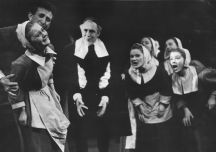
the-crucible-3360718-59ac57cf0d327a0011aa0fe9My next thought … politics. In the play, Reverend Hale is one of the few characters who exhibits any change in thinking. He observes. He listens. He struggles to negotiate his worldview when what he sees and hears doesn’t fit. Reverend Hale — indeed the whole village — experiences the crucible of accusation, doubt, and disintegration.

By definition, a crucible is “a situation of severe trial, or in which different elements interact, leading to the creation of something new.” The “something new” in Salem? Miller concludes, “To all intents and purposes, the power of theocracy in Massachusetts was broken.”

My hope is that our study of this play will evoke conversation about our current democracy, about whose voices are heard, about whose voices are (at the risk of further mixing david-butow-brett-kavanaugh-senate-vote-friday-1literary allusions) a little more “equal” than others. And how can this “interaction of elements,” lead to the creation of something new, perhaps some power structures that need to be broken? 

So, what to do with this as teachers of writing, and to glean something practical from our own real-time crucible? My students will write an “Open Letter” essay as we study The Crucible to explore concepts of voice and audience. (McSweeney’s is a great source for open letter examples of all kinds. I want to provide an opportunity for them to give voice — their own — to what matters to them, directed to the audience that most needs to listen.

Writing Conferences: Stories, Schemes, and Strategies

Conferring is hard brain work. When do I listen? How do I listen? When do I talk? How much? How do I anticipate what a student needs? When do I step back and let them problem solve? Am I even conferring right? (Maybe not. So put your Judge-y McJudgers pants away while you read this.). As Shana explained in this post back in January, there’s so much value in talk, in engaging our students in conversation, in encouraging them–as Amy framed here— to tell the story of how their writing is going.

Because (as Tom Newkirk suggests) we have minds made for stories, over the years I’ve begun to recognize some common schemes while conferring. Recognizing these patterns frees me to listen and to respond. Perhaps you’ll recognize the stories of your own students in the stories I share. Perhaps you’ll pick up a strategy or two. 

The What-Did-I-Do-to-Myself Conference

This conference may typically begin from a position of fear–mine because my student’s eyes have suddenly become two daggers, piercing my helpful, loving heart. This occurred in a recent conference, where my student who chose ice cream as her multi genre research project topic hurled at me these words: “I don’t know how I’m supposed to write an argument about ice cream.” Was she complaining about lack of direction? Instruction? I took a deep breath to let go of any defensiveness I felt. Then I reflected on her question. Oh. Oh! The fear was not mine to have.

My student needed:

  1. to hear that to write about this is, indeed, possible.
  2. to understand the possibilities for executing the writing.

Conference next steps:

  1. I confirmed the correctness of my reflection by paraphrasing (So, what I think you’re saying is that you’re feeling pretty uncertain if you can, and if you can, what it looks like?).
  2. Once confirmed, I chose another seemingly tiny and narrow topic like tacos and verbally processed some options for how I could craft an argument for an audience on tacos. I did not do any written modeling or reach for any mentors at this point. My role in this early phase conference was to dispel fear, to affirm possibility, and to confirm faith in my student’s ability.

Student next steps:

Following this verbal modeling, my student disarmed with affirmation and a smile, she continued working in her notebook, mapping her argument and the rest of the multi genre.

The I-Need-to-Change-My-Topic Conference

This conference may typically begin from a declarative statement: “Just so you know, I’m changing my topic.” I’m being put on notice here.  But I delight in these William Carlos Williams “this is just to say” moments almost as much as ripe-n-ready plums. So, curious now, I say, “Tell me about why you abandoned the old topic” (I’m always thinking we can learn something from discarding topics) and “Tell me about the new topic.” That’s when my student in this case explains that the topic is music but that’s all he has. Hmm.

My student needed:

  1. To narrow his topic by sinking his teeth into the best tidbits of it.
  2. To get moving. And fast. IMG_2711.JPG

Conference next steps:

  1. With the topic so broad, I asked the student to tell me a story that shows his relationship with music.
  2. Once the student shared his story–one that involved him writing his own music and performing several songs at a local concert venue (Our students do amazing things!)–we mapped out a plan for the different parts of his multi genre text.

Student next steps:

With a story in his head (and probably a song) and a general plan mapped out, this student left for the day, ready to focus on more specific planning.

The So-Can-I? Conference

This conference may typically begin and end within a very short burst of time; a meteor shower during the Perseids, this conference starts with a short burst of light from the student, a recognition of how to apply a resource. In a recent case, the student examined a resource on possible argument structures I shared with the class, and ingenuity bursting forth, queried, “So, I can use the pro/con structure? And, can I make this modification to it?”

My student needed:

  1. To know that he has more freedom than he’s using.
  2. To have the affirmation necessary to keep burning bright.

Conference next steps:

  1. I replied,” Tell me a little more about that” and followed that with paraphrasing, “So, what you want to do is . . .?”
  2. Then I simply said, “Yes.” 

Student next steps:

Following this all-of-sixty-seconds-conference, the student returned to mapping out writing, synthesizing his own ideas with the resource. And, I spent five minutes with the next person instead of three.

The I-Know-I-Need-to ______ , But . . . Conference

This conference may typically begin with candor from the student. Like the first sip of lemonade on a hot summer’s day, it’s so refreshing to hear in response to my opening questions (How’s the writing going? What roadblocks are you running into?), “I know I need to _______, but I’m having a little trouble.” Ah. This can become an opportunity to model for the student or offer a micro-lesson; sometimes–like in a recent conference where my student wanted to build a more humorous tone–I help the student find or use mentors. **Note to self–I should probably start asking my students to tell me about mentor texts they’ve turned to when they’re tackling challenges. 

My student needed:

  1. To resolve gaps in skill level (impressively, one’s the student recognized).
  2. To access additional resources  for strategies.

Conference next steps:

  1. For this student working on narrative writing, I pulled David Sedaris’ “Let It Snow” and a couple of others.
  2. Then we talked through typical strategies a writer uses to develop humor.

Student next steps:  

Time well-spent, smiling now, my student worked on reading and studying the mentors.

 
The I’m-Avoiding-Letting-You-Read-My-Writing Conference. May also sometimes appear as the I-Don’t Have-Any-Writing-to-Show-You-Yet Conference

This conference may typically begin, well, haltingly–like a first time driver slowly circling around the empty high school parking lot. I’ll ask, “How is the writing going? What roadblocks are you hitting?” “Doin’ fine. No roadblocks.” Okay. Next approach. “Why don’t we look at a section together? Show me a section you feel really good about. Let’s celebrate what’s working!” Sometimes that gets us turned in the right direction (a smile and an oh, sure and we’re underway); sometimes we skid (uh, so, um, I don’t really have much yet. Uh-oh.). When I most recently tried this approach, my student offered, “Well, I really like this paragraph; but I’m not sure about how to develop it more.” 

My student needed:

  1. to feel safe enough–safe enough to embrace the opportunity or safe enough to admit to lack of progress.
  2. to have re-direction for what conferring might look and sound like. Sometimes they just don’t have the mechanisms down.

Conference next steps:

  1. In the first situation, I generally point out the parts that are really working in the section the student chose to share. I thank them. Then I ask if there’s anything else they want to share or questions they have. And, sometimes I get to look at more writing. I did in this particular case. And, had I not pressed gently, I don’t think I would have (I was kind of impressed that it actually worked!).
  2. In the second situation, I paraphrase what they might be feeling. I might say, “I imagine you might be feeling ___________ (stressed for not having more done; frustrated by how to begin; confused about the direction of your writing; etc.). They typically correct me if I’m wrong and we work together to plan next steps, even if it’s breaking down the process further.

Student next steps:

In the first situation, the student began applying feedback; in situation two, the student typically articulates what’s getting in the way and what resources are needed and then begins tackling a small goal (drafting a paragraph versus drafting the whole thing).

When I’m conferring, I’m listening, paraphrasing, questioning, re-teaching, modeling, affirming, finding resources, building possibility, and showing my students that what they write matters. No wonder my brain hurts.

Kristin Jeschke remembers with fondness the many teachers that encouraged her writing but especially Greg Leitner who always listened more than talked. And who always inspired her to keep writing. Now as an AP Language and Composition teacher and senior English teacher, Kristin appreciates the gift of moments spent conferring. Follow Kristin on Twitter @kajeschke.  


Choice Reading Shouldn’t be a Choice Not to Read

I love that silence that permeates our reading time. A certain peace settles over the room as thirty souls lose themselves in the pages of their books, the only sounds: rustling pages, tapping feet, or contented sighs.  I also love that groan they emit when, after ten minutes, an eternity of silence, I implore them to mark their page and pause their reading for now.  That’s exactly what I say to them, “Alright kiddos, lets pause our reading and get out our reader’s/writer’s notebook.”

While we’ve practiced that transition dozens of times, they still plead begrudgingly, “Can we just have more reading time!!!”  “You can,” I tell them, “on your time.”  Some of them, the truly committed, make time for their self-selected independent reading, but most, for now, do not.  This reality, jarringly disturbing to committed readers like you or me, is something that keeps me up at night.  It prompts old teacher/football coach friends to text me on Sunday morning, asking for some kernel of knowledge that might help them move readers.  For this problem, though, there is only one short and fast answer: Hard Work.

I wrote about the difficult task of moving seniors into reading lives last year: here and here. The results, transformative for some, middling at best, and woeful for many, read like a Picasso.

I promise you this: We can’t afford not to give them everything we’ve got.  That thought spurred this tweet from me earlier in the week:

Tweet1


We know reading and writing dovetail to form literacy.  If we instruct using whole class novels, we run the risk of alienating many who can’t engage with something in which they have no interest and as a result, we get nothing. If we encourage choice reading and we allow the kids to choose not to read, we get nothing.

We must engage in their self-selected reading lives and I believe that I can’t do that if I’m reading while they read.  While they read, I’m moving around the room, tracking pages read, asking the reluctant about their reluctance, asking the readers when, where, and why they are reading on their own, simultaneously serving both ends of the reading spectrum.  You won’t ever find me sitting behind a desk, because my desk is shoved up against the wall, relegated to table status, as a place where papers pile.

It’s hard work, like everything about our roles as literacy advocates.  It takes planning,  reflection, and intention to match every kid to the perfect reading conference question.

That’s part of it too.  One question does not fit all.  If a student isn’t reading, they can’t reach into their reading experience to share with me their opinion on the effectiveness of setting, for instance, in their selection.

Also, I have to give them the sobering news that this lack of reading life may hinder their writing life as well, and while I don’t take grades for self-selected reading, I do take grades for writing and their engagement from one directly affects their success in the other.  I need to tell them that, before their grades do.

Charles Moore loves conferring with readers, even struggling ones.  He loves concerts with his wife and when his son texts during the concert, he texts back, “We are having fun without you.”  He’s loving the new adventure with Pre-AP students and his freshman are growing on him; they are adorable.  Check out his book review blog at www.mooreliteracy1.wordpress.com and his far too frequent twitter rants at @ctcoach.

Elvis had it wrong: a little MORE conversation

End-of-the-school-year-Sarah is so hopeful, so starry-eyed, so confident that this will be the summer that it all gets done. See, at the end of every school year, I make a giant list of all of the ways I want to improve for next year. I go through all of my chicken scratch post-it notes on old lesson plans, through the emails I’ve sent myself throughout the year (often-times labeled “this” as if that’s helpful or useful), and the articles I’ve saved to my feedly account. I shove all of this nonsense into a google doc and then start working my way through this mess of things that briefly inspired me last year but was marked as not important enough to look at or implement in the moment.

I wade through the torrent of ideas throughout June. I keep some of it. I toss a lot of it. I look for trends.

This year I noticed that a lot of my ‘save for laters’ focused on feedback and building community – so many of my post-its from past-Sarah (who really over-estimated present-Sarah’s with-it-ness) focused on how community improves feedback and how both of these are built through conferencing. Feedback, building community, conferencing: these aren’t new topics for this blog. I’m just looking to add on to the wealth of information you can already find here from these fine people, like here, and here, and here.

I’ve approached conferencing in two distinct ways this year.

First, introduction conferences. We’ve been in school for three weeks, and in this time, I’ve conferenced with 95 of my 96 students for about ten minutes. Our conferences were simple. Students came prepared to answer five questions I gave them in advance, and I came prepared to listen/pepper them with lots of questions. Here’s a quick run down of those questions.

Question Follow-ups Intentions Realizations
How would you describe yourself as a reader? What have you read lately? What did you read for your summer reading book of choice?

Oh, you like this (genre/book)? Have you read ___? I hated/loved that book, what did you like/hate about it?

This is a softball question – it’s a simple yes or no but there’s a lot of room for impromptu discussions. For some of my students, we spent almost our whole conversation talking about our shared love/frustration with The Kingkiller Chronicles. I liked the opportunity to low-key assess who had already finished their summer reading. Some of their insights also prompted interesting conversations as well. I also liked that this first question highlights one of the most important parts of our class: reading. A lot of my students labeled themselves as “avid middle school readers.” They were big readers until the time demands of high school forced them to make some tough decisions. This conference, honestly, reinforced for my why choice is so important for high school students.
How would you describe yourself as a writer? Have you written anything lately? What does it feel like when you write? What about in-class writing? Or writing for fun? What did you write last year that you were proud of? When you sit down to write do you have a lot of ideas but it’s hard to get them out or…? I teach AP English Language so the majority of our class is writing focused. This allowed me to see who already thought of themselves as writers. We also had interesting conversations about idea generation which wasn’t intentional but it was useful information. Students’ perceptions of themselves as writers are deeply ingrained. Their definitions of what a “writer” is are also often limited. It will be fun to change some of those perceptions as the year goes on.
How do you learn best? What kind of learner are you? (For example, I’m a visual learner.) Not very many follow-ups here. This is a quick question. I want to group them by kind of learner homogeneously and heterogeneously throughout the year. LOTS of visual learners and, oddly enough, a lot who go home and rewrite their notes.
Last year, typically, how much time did you spend on homework? Why that amount of time? What other demands do you have on your time? What does your schedule look like this year? Honestly, I wanted to see what all these kids have on their plates. Some were very full:4 or 5 AP classes, jobs, sports, clubs. Some were less full. This also opened the conversation to talk about their interests as well. I teach at a Magnet school, and while I know that it can be a demanding school, sometimes I forget how demanding it can be. This reminded me to check with the APUSH and APCHEM teachers and make sure that we’re not doubling up or tripling up major assignments with students.
Do you have any questions or concerns or anything else that you’d like to share? No follow ups- just tried to ease some anxieties. My class has a reputation for being “worth it, but difficult.” I wanted to get ahead of any anxieties or nerves. This was so helpful. One, it allowed me to talk over strategies with kids BEFORE the strategies were needed. Two, it allowed me to walk through several accommodations with students BEFORE their IEP/504 meetings.


This was a highly time consuming endeavor, but I’ll never go back to not having these conferences in person. They were investments that have already started paying off – students are more willing to ask questions, to participate, to follow-up on assignments.

Secondly, I’m changing the way I grade in-class essays. Previously, students would write, we would workshop, I would grade, they would revise and then we’d all move on with our lives. Inspired by Catlin Tucker’s discussions of station work, I’m differentiating between grading (with feedback) and scoring (just the grade) this year. Students will write two AP English Language prompts in a six week period in class. For the first prompt, students will sign up for conferencing times during station time or before or after school, and I’ll grade the essay in front of the student, verbalizing my thinking, offering suggestions, answering questions. I’ll hold off on the grade (which goes into the grade book as a formative grade) until they have their conference with me. This will be a lot of time – ten minutes give or take for 96 students. BUT, I won’t take home a single essay. Then, after everyone conferences and I reteach as needed, students will write a second in class essay which I will only score (summative grade). Just scoring without the feedback will make grading these essays faster, but I’m also hoping that sitting down one on one will mean that we’re doing more with less, that more of the feedback will transfer to the student, that growth happens sooner.

Good teaching is about good relationships, and conferencing definitely helps to build relationships. What have you tried that’s worked for you?

Sarah Morris teaches AP English Language & Composition and Film as Literature in Murfreesboro, Tn. She has recently fallen down the rabbit-hole of Fallout 4, and she tweets at @marahsorris_cms.

Saying Yes

Over the last several months, I’ve been learning how to say yes. I know, I know. I should be learning to say no, right? When I run a Google search for articles about just that, it returns 571,000,000 results. Pressure, amiright? But I’m not talking about the kind of yes that over-commits me and zaps my time and energy. I’m talking about the kind of yes that disrupts the status quo, altering the time space continuum of my classroom. Here’s the snapshot of HOW I’ll be saying yes. 

Day Structure Notes
Mon. Deep Dive (1) with Reading: 40 minutes free reading, 40 minutes deep reading instruction Maybe start with a thinking puzzle or something that gets their brains going for a Monday.
Tues.-

Thurs.

Typical: Individual Writing Goal Work; Notebook Time (2); Reading Instruction; Writing ML; Independent Writing (3)

Special: Watch/discuss Othello, reading assessments, etc.

This is flexible.
Fri. Deep Dive with Writing: 40 minutes of writing, 40 minutes of collaboration (4) and reflection, 10 minutes of celebration (5) Maybe start with a class meeting or something that sets the tone of reflection and looking ahead.

Specific Ways to Say Yes

(1). Independent reading is important in my classroom: student reflections indicate the time dedicated to this reading helps some of my seniors (and my AP Lang. and Comp. students!) fall into books again. Recently, though, my students have clamored for more time. While ten minutes daily can significantly impact students’ reading skills, it is difficult for students (for a variety of reasons) to get into a state of flow with their books.

The yes: So, this fall my colleague and I are saying yes to Deep Dive Reading Monday’s, where students read independently selected books while we confer with them. We believe this may help us improve reading conferences as well (where I’ll continue to practice yes by not looking for correctness but rather conveying openness. Tell me more about that, I’ll say.). Deep study of reading skills–like closing reading a text or looking for dissonance in the text–follows. We want their thinking to flow

(2). Since we teach on the block schedule, too many transitions in a block prevent students from reaching a state of flow on anything. It’s a reason why I’ve struggled to integrate notebook time meaningfully and consistently. Embarrassment and the Emotional Underlife of Learning by Tom Newkirk along with Gallagher and Kittle’s 180 Days and Linda Reif’s Quickwrite Handbook challenged us to invent a schedule that allows for both deep flow and quick bursts. In particular, Newkirk notes the importance of thresholds, moments where we can invite our students to enter into writing without worry. If we want our students to build writing and thinking skills, we need to write– sometimes quickly and without censor.  

The yes: consistently integrating notebook time into our class schedules (I’m trying this for the first time, too, in AP Lang. Maybe it will help them generate ideas for Question #3 on the AP exam.).

(3). Of course there’s extended time for writers to write and for us to confer. Of course! Typically, I feel satisfied with the nature of conferences. An early stage conference this past spring gave me pause, however. When conferring on this student’s topic, I challenged the student to demonstrate his authority and knowledge on the topic, wanting only for him to successfully grapple with it, but mostly thinking to myself NO, NO, NO. He pushed back (NO, NO, NO.). I relented and said yes. Conferring a few days later, the student confessed he was in over his head and began a more open dialogue with me about next steps.

The yes: saying try it, try it and see what happens. In this case, the student discovered for himself, testing for himself whether or not his idea would work. There’s so much more power in that.

(4) Feedback is a critical part of empowering my writers. Yet with class sizes swelling, providing that nourishment becomes a greater challenge. I need to help my students improve the quality of the feedback they provide one another.

The yes: Friday Feedback groups. I’ll place my students into writing groups where students will choose some work from the week to share, critique, and ultimately celebrate. Yes, my students will receive feedback from others and from me, yet I’m optimistic that this consistency of the grouping will lead to feedback that truly feeds writers.

(5). In my last post, I wrote about ways to celebrate writing and reflected that I needed to regularly celebrate the progress of student writers, especially in the small moments. I intend to verbal high-five my way through conferring with students this year, yet I also want them to celebrate each other. We’re a family of writers, after all.

The yes: celebration. On Friday’s we’ll have students celebrate their writing–their words, phrases, moments. We’ll recognize the power and beauty and vulnerability in what they share, appreciating their progress, hearing how it starts to come together, in concert. 

The biggest yes, though, isn’t visible in this framework. This year we’re asking our seniors to create a multi genre research project. That in itself isn’t novel, not a new way to saying yes to possibilities for our writers. What we are saying yes to is time on the calendar that is only loosely planned by us, time for us–as Allison Marchetti notes in this post–to listen to our students. This is time to help them ideate, to help them plan, to help them read, to help them write, to help them think, to help them grow. How could we say no to that?

Kristin Jeschke actually says yes a lot, too much, in fact. She’s working on that. In between, she teaches College Prep English to seniors (soon to be re-named English 4) and AP Language and Composition. Follow her on Twitter @kajeschke.  

Assigned Reading Works as well as Assigned Flossing

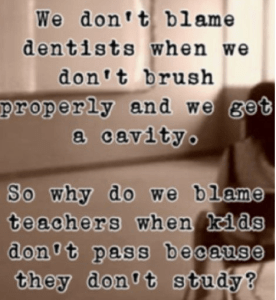
Every few months, I notice a meme recirculate with some variation of “Judging teachers on their students’ test scores makes as much sense as judging farmers on their crops without accounting for drought, freezes, or disease.” Still reflecting on my students’ lackluster AP scores as I sat down in the dentist’s chair this morning, I considered this meme. Then, like most teachers I know, I still wracked my brain trying to figure out what I could do differently to help my students score higher on that exam. As I mused, and chastised myself for taking their scores harder than I should, I endeavored to distract myself a bit by trying to remember the other meme out there that connected the professions of dentistry and teaching based on clients’ results. Ultimately, I looked it up when I got home, and it reads: “We don’t blame dentists when we don’t brush properly and we get a cavity. So why do we blame teachers when kids don’t pass because they don’t study?” Or read enough prior to twelfth grade, I thought.

Screen Shot 2018-07-24 at 1.57.38 PMMy cleaning ensued – painfully, I might add, as my technician was unnecessarily rough, and I wanted to ask her if she remembered that a person was attached to those teeth, but I found it too difficult to ask such questions with someone’s hands in my mouth. I waited for the post-cleaning check-up with the dentist, knowing the only question I had for him was about the dark staining I’ve been experiencing lately despite my careful brushing and (sometimes) flossing regimen.
During the 3 minutes he spent with me (I see why he earns the big bucks compared to me, I thought cynically) he responded to my question with one of his own.

“Do you drink a lot of tea?”

“Well, I guess so. I gave up soft drinks a couple of years ago, and tea became my go-to beverage.”

“Well then, that’s why your teeth are stained. You should expect that if you drink tea. It’s the worst thing you can do to stain your teeth. It’s worse than drinking coffee for stains.”

I didn’t hear the rest of what he said because it devolved into chastisement. I didn’t Screen Shot 2018-07-24 at 1.55.01 PMexpect him to congratulate me on the steps I’d taken for my overall health in giving up on sodas, and I didn’t expect him to have sympathy for how hard that habit must have been to break, and I didn’t even expect him to think logically about how much less acid was wearing away at my enamel now that I don’t drink soft drinks, but I also didn’t expect to feel as though I had done something so very wrong.
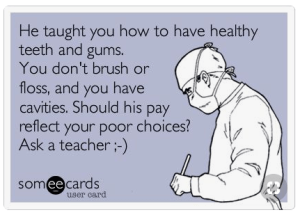
That’s when my English teacher brain went back to thinking about what we do (or fail to do) for our students. I thought about how many students have been made to feel “less than” when they want to read a YA book instead of a classic text. Just as my dentist was so set on his vision of how I should live solely focused on the effects on my teeth that he forgot about the person attached to them, how many well-meaning English teachers are so hyper-focused on their well-chosen texts that they forget about their students’ needs? How many forget or do not understand what can be gained with YA or self-selected books?

Screen Shot 2018-07-24 at 1.58.46 PMMy teeth will continue to stain, I guess. I’ll brush with baking soda once a week to combat that. But I’ve gained better health and energy. I’ve lost the migraines I used to get when I drank colas all the time. And if we allow our students to read what they want and need to read, they might lose content knowledge of some of the classics that we read (or fake-read) in high school, but they will gain an authentic love of reading. They will find connections with characters in their books. They will connect with each other as they enthusiastically discuss their books. They will feel empowered and in control of their lives as readers. Their reading levels will improve. And yes, the test scores will follow.

Prescribing all the texts our students read, even when doing so comes from a place of good intentions, works as well as prescribing flossing. Everyone does that at least twice a day, right?

Amber Counts teaches AP English Literature & Composition and Academic Decathlon at Lewisville High School. She believes in the power of choice and promotes thinking at every opportunity. She is married to her high school sweetheart and knows love is what makes the world go around. Someday she will write her story. Follow Amber @mrscounts.

Persisting in the Face of Criticism

I have a confession to make…my AP scores were not what I was hoping they would be–wait, let me rephrase that: my students’ AP scores were not what I was hoping they would be. That’s the temptation; to take on the blame when the test scores aren’t what you hoped. I notice that most of us don’t take credit when the students do well, though. Interesting…

At any rate, back to my confession. This was our 2nd year of AP Lang at my school. Last year, my students scored fairly well–pretty similar to the national average–and I was pleased. This year, they had more 4s than they had last year but there were also more 1s. The average score dropped by .1. That doesn’t sound like a big deal, does it? In this age of high stakes testing, though, it is. There is always pressure to do better and better, to demonstrate that you are effective and that you’re doing the “right” things. I’m largely removed from that pressure because I teach in a private school, but the pressure comes from other places in that situation. Instead of pressure coming from admin or a central board, there’s pressure (real or perceived) from parents. I can make all of the arguments–different set of kids, 2nd year of AP (supposedly it takes 5 to really know the AP material and get “good” at it), etc. The arguments don’t matter, though; I want to give my kids the best opportunities that they can get, so it’s reflection time.

800px_COLOURBOX3156107

As I look forward to next year, I have to think about what worked and what didn’t, and already the pressure to drop my independent reading has begun, at least for my AP kids. Here are some of those questions and my responses to them:

  • How can you sacrifice 10 min of instructional time every day in an AP class?
    How can I not? My AP kids especially are so overloaded with classwork (plus athletics and extracurriculars–at my school, it tends to be the AP kids who do or join everything)–that they have precious little time at home to read. These kids see reading as a chore that has to be accomplished, something to mark off before they move on to the “real work” of AP Calc or AP Bio. They’re reading in a grind but not at all for pleasure. How can I not carve out a little time every day (from my 53 minute class periods) to help them reconnect with that love of reading just for the joy of reading?
  • What about more multiple choice practice? You could do that in the 10 minute reading time!
    I could, but I feel that building the reading lives of my students will pay off dividends, even on those multiple choice sections. After all, there’s a degree of that that’s based on reading comprehension, so I think reading is a pretty essential skill for them to work on. Sure, I probably do need to build in more m/c practice, but I’m not doing it at the expense of my independent reading time.
  • If you’re going to let them read, shouldn’t you make them read on-level AP-worthy books?
    First of all, what exactly is an AP-worthy book? On the AP Language exam, students are expected to make connections in their writing and to use evidence from their reading, among other things, to support their connections and observations. Nowhere in the instructions or scoring guidelines does it say that only “worthy” texts can be utilized. A student can make an insightful connection between a prompt on civil disobedience and Nic Stone’s Dear Martin or Bryan Stevenson’s Just Mercy (one a YA novel, one a contemporary non-fiction) just as easily as he might refer to Henry David Thoreau. One more argue that the connection to the newer pieces could be even more effective because they may not be used as frequently as Thoreau’s essay. In addition, there is much research to suggest that adding choice to a reading program (check out Donalyn Miller’s post “I’ve got research. Yes I do. How about you?” for more on this) does more to promote an increase in reading skill and reading volume than anything else. My kids are Juniors, which means they’ll be going off to college in 2 years. These kids who have largely fake read to survive their work load (yes, even the honors and AP kids fake read) will be expected to read 200-500 pages a week when they’re in college, and too many of them are NOT ready. One of our 2018 graduates is taking a couple of classes of summer school before the full academic year starts, and she was shocked that the material on her sociology test came from the textbook chapters that she was assigned and not from the class notes that she studied meticulously. Yep. Welcome to college.
  • Well, don’t you at least have to test them or monitor them? How do you KNOW they are reading?
    This one gets me because it’s such evidence of the educational climate right now. I KNOW that they are reading because I’m talking to them. I talk to them every day about what they’re reading and the connections they’re making and about what they’re going to read next. They stop me in the hall to tell me that they’re mad at this character or that I’ve got to read this new book they just discovered. I have them write about their reading, using whatever they’re reading as support for their points. And I see the growth in their reading–it’s a pretty powerful thing to watch a student who states that she’s never done more than skim or fake read a book since elementary school dive into a new series and then, when she’s done, ask me for a suggestion because she feels like she wants to challenge herself and read something with more bite.

So while I am thinking about what tweaks and changes I’ll make for next year, I know for certain that independent and choice reading will continue to be an important part of my classroom plan.

What about you? What challenges do you face in your reading program? How would you answer these questions? If you’re looking for more support for your reading choices, check out these posts by Amber Counts here and here. And these by Amy Rasmussen here and here.

Thinking About Next Year – Already?

black and white blackboard business chalkboard

Photo by Pixabay on Pexels.com

Confession: I really struggled with where to take this blog post. I was worried that the onset of summer would bring fewer ideas or less will to write. Instead, I’m starting week three of my break, and my teacher brain hasn’t shut off once. I have too many zipping thoughts percolating upstairs to just focus on one. I’m constantly jotting down ideas for next year. I find my friends zoning out as I bring conversations (sometimes gracefully, oftentimes not) back to my new plans for next year. My TBR list is full of books about teaching (Teaching Argument, anyone?). I’ve jammed my summer schedule full of teaching activities: working with the College, Career and Community Writers Program; attending the AP English Language Reading, AP English Literature training, and summer AP PLC meetings (fondly called AP Allies). The list goes on and on. I might be obsessed with my job.

Confession: That obsession wasn’t always the case. The 2014-2015 school year almost did me in. Long hours, too many responsibilities, too few ‘wins,’ and an overwhelming certainty that I was both doing too much and not enough at the same time had me considering other kinds of employment. The kinds where you can go home at the end of the day and just be home. The kinds that don’t have you bringing home stacks and stacks of papers to grade, that don’t have you dumping hours of planning time into the job, the kinds that allow you to leave the problems of work at work. I’m not a quitter, and I came dangerously close to quitting the profession. I know that I’m not the only one who’s ever felt this way.

Enter the Middle Tennessee Writing Project. Recommended by a fellow teacher, this program rejuvenated my love for teaching, changed the way I approach the profession, reminded me of why I love the calling. We were required to choose from a list of best practices (I chose student agency) and work on improving that aspect of our craft for an entire year. Having just one overarching goal to focus on made the  upcoming year so much more approachable, made measuring any growth I achieved so much easier to ascertain. Focusing on student agency put the students front and center in my classroom again, right where they belong.

In the years since, I’ve continued to work on improving just one best practice every year. Instead of splitting my 100% between various small projects and doing a lot of tasks decently, I try really hard to do one task really well (I’m paraphrasing Ron Swanson here…). I’ve worked on incorporating more writing workshop in my AP classes and offering better feedback.

This year, inspired by the slowchat #DisruptTexts, my PLC is moving away from the whole class novel and implementing more independent reading choice. While brainstorming how this change would affect our writers notebooks and socratic seminar discussion schedule, we came to a few practical realizations:

  1. Modeled after AP argument questions, our essential questions are fairly broad, allowing students can take the questions in lots of different places. This broadness means that we need to spend some time teaching students how to break down each questions into all of its parts and permutations before they can begin to answer the question. This approach models what students are expected to do with each argument question (and to some extent synthesis questions as well).
  2. To address this broadness, we’re building in “intro days” where we spend a short 45 minute period breaking down the question into all of its parts: stakeholders, universal nouns/themes, “so whats,” other questions, connections to the real world, places along the argument spectrum. All essential pieces to consider before beginning to answer the question. We want to demonstrate in our teaching the value of listening, thinking, and planning before speaking, writing, answering.
  3. To highlight each beginning “intro day” for each unit, we plan on giving students colored paper to insert into their writers notebooks and ask them to do their notetaking/brainstorming for that question on that piece of paper. The colored paper will cause each beginning of the unit to stand out in their notebook, clearly separating each unit from other units.
  4. We plan on ending each unit with a socratic seminar and an in class writing – an assessment pairing that will pull together all the rabbit trails and threads we’ve chased throughout the unit. Honestly, we have no idea where these units will go yet. Hopefully, into deeper and deeper questioning and thinking, so we need some way to track the journey. We’ll ask students to collect their final noticings, observations, and remaining questions on another similar colored sheet of paper in their writers notebooks, giving the unit a clear, visual beginning and end.
  5. As we’re introducing choice into student reading and moving away from the whole class novel, we’re asking that students work with a classic American novel, a work of fiction, a podcast, a documentary, and a book of their choice at least once throughout the year. Helping students choose selections will undoubtedly present its own unique problems, but we’re expecting that students will work closely with our amazing librarians, book talk their books in small groups and with the whole group. After each unit, we will ask students to include their book on a class wide google document organized by question, with each selection tagged with universal nouns/themes and a short review. Hopefully this will help other students choose future selections while also crowdsourcing a “if you like this, you might like this” text.
  6. We’re supplementing those independent reading selections with lots of smaller mentor texts. Because we’ll have more room for smaller texts for in-class discussions and the small texts sometimes get lost in the shuffle of the year, we’re going to ask students to create and keep a bibliography for each small text in the beginning of their writers notebooks. They’ll provide the citation for each smaller work and answer two small questions for each entry:What is useful about this text for rhetorical skills/writing? What universal nouns/themes/real world events does this text connect to? Hopefully, this will give students more practical knowledge to pull from for the synthesis/argument questions of the AP test and a way to organize their mentor texts.
  7. Finally, we need to model and practice on a smaller scale what we expect students to do throughout the year with these essential questions and independent reading choices. We can’t just toss kids into the deep end of our new approach to English. So, at the beginning of each semester, we will pose a smaller question and have students go through each step with more in-class support. We will use these smaller questions to teach independent reading selection and question brainstorming while substituting novels, podcast series and documentaries with essays, short stories, and individual podcast episodes.

MTWP’s insistence on best practices and focusing on one improvement a year was a game changer for me. This post is a very small glimpse into what those changes will look like for my classroom. And, to be honest, I feel a little bit like Tantor stepping into the river, but I’m ready to take the plunge. I imagine that if you’re reading this blog on your summer break, you, too, find it hard to turn off your teacher brain even on breaks. As you continue to plan for next year, my wish for you is rest, relaxation, and rejuvenation. But… if you, like me, can’t turn your brain off and you want to share, the comments and Twitter are open. We can tiptoe into that water together.


Sarah Morris teaches AP Language & Composition and Film as Literature in Murfreesboro, Tn. She has been binge watching The Wire and wishes she hadn’t waited this long to start the show.  She tweets at @marahsorris_cms. Happily posting from the AP Reading in Tampa, Fl.


Vindication of Choice in the AP Classroom

Every May, my panic that I have not taught my students enough for the AP® Literature exam, pride and concern as I send my “little ducklings” to fly alone into the exam room, and eager anticipation of the memes flooding Twitter from the East coast testers (which I never, ever re-tweet), is quickly followed by the nervous energy of my students as they visit my classroom after the test.

Of course, human nature dictates that they want to relive every moment and consult with their peers about how they answered different questions, but my duty to the College Board prompts me to remind them not to discuss specifics about the exam itself. Instead, I urge them to talk through their feelings and reflect on what they might feel good about, such as writing 3 complete essays. Each year offers its unique triumphs and hair-pulling challenges. “The Juggler” poem a couple years back stumped even my most adept analyzers, but they did have fun crafting juggling metaphors for the remainder of their senior year. Thus, I have come to anticipate the perplexed reactions to one or more of the essay prompts on the exam. A safe question I often ask to avoid specific test-discussion is: what book did you choose to write about for the Q3 essay?

While I’ve learned that it is difficult to gauge how students actually performed on the exam based on their immediate self-assessment, I know that over-confidence – “it was easy” – is almost as bad as total pessimism – “I only wrote 2 of the 3 essays and the multiple choice was killer.” But that one question about book choice tells me a lot. It tells me about their overall confidence level, sense of preparedness, and even what level of enjoyment they experienced during the test. Yes, enjoyment. As my course moved away from a model in which I assign specific texts (so we can experience them together) and toward choice (so students can shape their own experiences, with support), my students have increasingly come back talking excitedly about which book they wrote about on the exam.

This year, because my students brought friends from different, more traditional, AP® classes with them to eat lunch in my room after the exam, I could hear the difference in the way they spoke about the books they referenced on that Q3 essay. My students said things like: “I thought I was going to write about Wuthering Heights because it fits so many prompts, but when I read the prompt, it screamed The Handmaid’s Tale to me. I’m so psyched that I got to write about that!” Another student enthusiastically described how he wrote the “best essay [he’s] ever written, and it was about Frankenstein.” Students went on to discuss the variety of books they wrote about, from The Art of Racing in the Rain to Les Miserables. Students from the other class sullenly and universally explained how they wrote about Beowulf because it was the text they had “been taught” the most thoroughly and therefore “knew the best.”

And there it was. A vindication of choice in the AP classroom. Scores will not be made available for a couple of months, so maybe all those passionless (and I’m going to guess, formulaic) essays about Beowulf will be strongly written and score higher, but what about the passion for reading? My students chose to read those rich texts, and when push came to shove during the exam, they chose to write about them because they saw the value in the book – not because someone told them of the book’s value.

Choice continues to be a source of contention in many English departments, but I cannot understand why. Choice does not mean that students cannot read from the canon. In fact, my students always choose both canonical and contemporary works “with merit” through the course. Teachers can set parameters for choice by offering text sets that connect by literary era, theme, heroic journeys, archetypes, and so on. Choice can be applied to shorter text selections instead of novels. So much has been written on why choice works by bigger fish in the English sea than me, so I will just leave you with this: my students were joyous when they spoke about writing the 3rd essay on a mentally exhausting, hand-cramping exam, and it is because they chose what to read and experienced the autonomy of deciding which of their books they felt they could write their best essay on. Since my goal is to create readers and writers, I could not ask for better evidence that choice helps them toward this goal.

Image result for book choice