Author Archives: Shana Karnes

Implementing Readers Workshop by Shelby Scoffield

Teaching high school English is a difficult job. In a world overrun with cell phones and gadgets, getting students to actually sit down and read a book seems like an impossible task.  Every year that I taught the classics, students would depend on outside sources to get them through the reading, and sometimes completely ignore the book. 

It was when a former student came back to me and proudly declared “Ms. Scoffield, I never read one book in your class!” that I decided to restructure my class and implement a Readers Workshop. While researching, I heavily relied on books by Nancie Atwell and even traveled to Maine to see her school first hand. 

After implementing the workshop in my classroom, I have eventually come to the conclusion that allowing students to pick their own books in the English classroom drastically increases student interest and allows them to take a more active role in their learning. 

During the introductory unit, I hold a book tasting in my classroom. I hold conversations with the students and direct them to genres they would be interested in.  Between my classroom and the library, they find their top three books. 
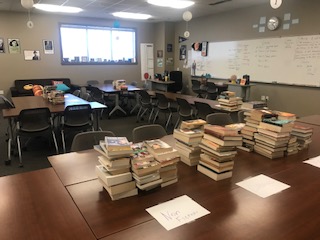
After finding their selections, I introduce them to Goodreads and have them read the reviews of their chosen books. Once they make a final decision, we are finally able to launch into the unit. The process of choosing books takes several days.

Topics that we cover in the unit are: 

  • How to read your book
  • Characters
  • Elements of a Plot
  • Analysis of major passages 

In my classroom, we use the Station Rotation model of Blended Learning. When a student walks into my classroom, they look at the board and decide what assignment they want to complete that day. They are required to come to “Table One” sometime throughout the week, because that is a teacher led and often the hardest assignment for the week. 
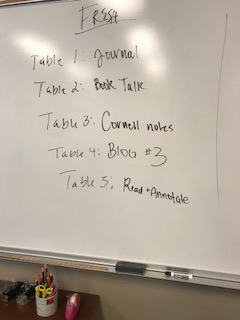
What do the assignments usually look like?

Book Talk: For this assignment, students are required to start a Twitter conversation with a classmate on Twitter. They have specific questions they answer and a hashtag we use for the class. Check out #mhhsfreshies for ideas! This is also a good way for the students to ask authors questions. You never know who might respond!

Journal: Using excerpts from a mentor text, we practice skills like analyzing passages or creating a character profile. Once the skill is practiced, they apply it to their own books.

Blog: Students work on a blog post once a week. The question focuses on what is currently being discussed that week in class. Students are required to respond to other classmates. This is also a great opportunity to connect with other classes across the globe. 

Supplemental activity: This can be an assignment that the teacher uses to help students learn the skill that is being discussed. I have used it as an opportunity to do Cornell notes, make videos, or create Buzzfeed character quizzes. 

Because I allow my students to choose their own books, a love of reading has been developed throughout the classroom. I have students zooming through books and talking about  them with their peers. I even have two students going through a book a week. 

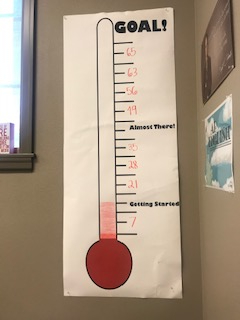
As a class, we have a class goal of reading 70 books by the end of  the semester. Students are constantly checking the thermometer on the board to see our progress and they are excited to see the number go up.
One of the biggest concerns I hear about this way of teaching is students not being able to read a piece of text deeply and get an analytical experience with a piece of text. While this concern is valid, I would like to state that I have never had students read more deeply.

Give your students time to read and make their assignments worthwhile. Fewer and yet more meaningful assignments are more impactful. It also gives students more time to read in class and hold meaningful conversations with the teacher. 

I also believe that teachers need to remind themselves who their audiences are. Teaching kids in the 21st century is hard and it is vastly different from our own high school experiences. We need to think carefully about our students and what will help them be the most successful. For me, it means implementing a readers workshop.

Shelby Scoffield is a high school English teacher. She loves reading, writing, and playing with her nieces and nephews. You can find her on Twitter at @sscoffield.

Writing Workshops Modeled on Writing Center Theory

Image result for writing center

I was a writing center tutor when I was in graduate school, and my current school allows me to run a student-tutored writing lab for our population during the school day – a dream come true! 

Anyone who has worked as a writing tutor knows that it changes how you see yourself as an instructor. You see beautifully and poorly constructed writing assignments and equally helpful or unhelpful commentary on written work. Helping students navigate an instructor’s expectations makes you better at setting expectations for your own students. 

Perhaps the most powerful pedagogical contribution of writing center theory is the focus on the writer over the writing. A good tutor’s job is to improve the writer, not the paper, a concept described in Stephen North’s 1984 essay “The Idea of a Writing Center.” This is often done through questioning strategies that force the writer to think about her writing rather than commands of how to “fix” it. 

After training my tutors in writing center theory each year, it occurred to me that these ideas could transform writing workshops in my classroom. Now, before my first writing workshop each year, I make sure to teach all my students on a foundational writing center concept: HOCs and LOCs. 

Higher Order Concerns (HOCs) and Lower Order Concerns (LOCs) are how we set the agenda of a writing center appointment. In our writing lab, we have roughly 20 minutes for an appointment, so we need to quickly choose a focus. How do we decide? HOCs and LOCs are our guide. 

HOCs are typically big-picture questions related to revision. Does the paper actually fit the assignment? Is the author’s purpose clear? Does the author need better or more evidence? Has the author provided enough explanation? Would the ideas be better structured a different way? 

These ideas are higher order because, if they are not meant, nothing else really matters. The paper can have beautiful imagery and perfect grammar, but if the message is not communicated, who cares? 

LOCs are often editing issues. I prefer to call them “later” order concerns rather than lower. They are still important, but they should be addressed later in the writing process or at least after the HOCs. These include punctuation, spelling, correct citations, and word choice. Of course, any issue can become a HOC if it interferes with meaning too much. A student whose grammar is incomprehensible may need a lesson on basic sentence structure first. 

In my experience, left to their own devices, students focus first on LOCs, regardless of the goals of the workshop. It is so much easier to tell someone where to add a comma or that “effect” is misspelled than it is to find out what someone was actually trying to say. For my students to be able to have useful workshops, I need to push them beyond what is easy. 

To train my students, we first outline the HOCs and LOCs on the board. Then, together we read a sample paper out loud, and I have them determine what area should be worked on first and why. What are the most pressing issues in the paper? If you really want to challenge them, make sure the paper has some glaring grammatical problems but even bigger issues with argument. 

Then, we discuss our process and rules for writing workshop. 

  1. Start with the author’s concerns. Most authors know what they are having trouble with, so ask the author first. This also puts the author in control of her own paper. 
  2. Read each paper out loud with everyone in the group listening. Ideally, the author should read his own paper. This keeps busy hands from adding commas all over. Students are never allowed to simply pass papers around in my classroom. 
  3. Have a conversation about the paper. I encourage my students to ask questions, such as “What did you mean here?” or “I thought what you were trying to say was … Was that correct?” or “Why did you choose to put this example in this paragraph?” Questions force the writer to think about his own choices and be an active participant. 
  4. Brainstorm possible solutions to problems together and make sure that the author writes them down. 

Over the course of working on a paper, we will eventually get to those LOCs, but again, we do not just want good papers but better writers. Students discussing the decisions behind their writing will inevitably lead to more fluent writers. 

If you’re interested in reading more about writing center theory, a great place to start is The Allyn & Bacon Guide to Peer Tutoring

Sarah Esberger teaches AP Language and Composition and Sophomore English at Central Magnet School in Murfreesboro, TN where she lives with her second-grader, her husband, three furry friends, and a bearded dragon. She also runs her school’s student-tutored Writing Lab and is always seeking new ways to incorporate James Britton’s concept “reading and writing float on a sea of talk” into her teaching.

A Picture Book for Your High Schoolers

Image result for the word collector

I’ve always been a little puzzled by my dichotomous love for both classic, canonical literature and…….unabashedly romantic, sometimes risque, always happily-ever-after……..romance novels.

But as I thought more about it, I realized that what I love about the classics is their lasting potency, the punch that their language and stories deliver, no matter when they’re read. And what I love about romance novels is watching the classic, timeless journey of a fall into love.

And, thanks to a coffee-fueled epiphany in my notebook, I realized that being a teacher of readers and writers was the perfect career for those two passions of mine: I love to see my students falling in love with reading and writing.

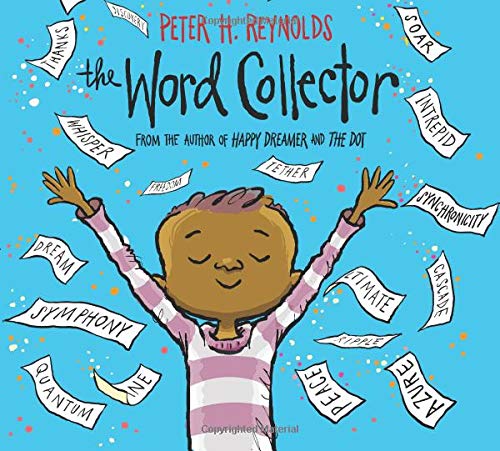
Last week, I read a new book to my daughters that struck me as the perfect illustration of that journey into love with words: The Word Collector by Peter H. Reynolds.

As I read, I was struck by what a perfect picture book this would be to share with my high schoolers. Not only is it chock-full of SAT vocabulary words (which, while that is a concept I loathe, I do admit is a lovely list of cool words), it shows the power and joy of language and all that it offers to both readers and writers.

If you have this book, I urge you to read it with your students. If you don’t, the video linked above does a great job telling the story as well. The possibilities for linguistic play and discovery as you study the text are endless, and endlessly enjoyable–and don’t we all need that kind of joy in our classrooms, as often as possible? Try this text out for one way to bring some sunshine into this dreary Friday.

Shana Karnes lives and works with teachers in Madison, Wisconsin. Her two daughters push her to discover new texts and sneak in the reading of grown-up ones as often as possible. Connect with Shana on Twitter at @litreader.

Getting to Know You: Beginning of Year Conferences by Sarah Esberger

I know, it’s not the start of the school year anymore. We’re in, and there’s no going back. Still, I wanted to share how beginning of the year conferences went for me this year, so your next year can get off to a great start. Just tuck this idea away until then. 

We all know it’s important to build relationships with our new students. We also know that, in a writing classroom, it’s especially important to develop a classroom community. If students are going to share their writing and give and receive useful feedback, they have to feel comfortable. Like me, I’m sure your year often starts with get-to-know-you activities that introduce the students to each other, maybe help them problem-solve a little, and also introduce some low-stakes writing activities. 

This year, however, I knew I would be conferencing with my students on a regular basis about their writing and reading, so this process also needed an introductory activity. 

The Process

During the first full week of school, I asked the students to prepare to meet with me one-on-one. These were the directions I gave them: 

I would like to be intentional about conferencing regularly with all of you, usually about your reading and writing. While you work with your groups today and the next two days, I would like to also meet with each of you individually for about 3-4 minutes. I will not conference with the entire class, so if your group has a question about your project, please come see me. I will also come around and check on you.

Obviously, these will be short conversations. I would like you to come ready to tell me about any of the following:

  • What’s really important to you – in or out of school
  • How you feel about this class so far – concerns or worries/excitements
  • Anything you think I should know about you that might affect your performance in this class
  • Any questions you have for me 

Throughout the next couple of weeks (this took longer than the few days I imagined), any time students were working in groups or working individually, I held conferences with students at my desk. I keep a writer’s notebook throughout the year with my students, so I simply created a section for each class period and added each student’s name, leaving space for notes from future conferences.

When they came to speak to me, I set a timer on my phone for 3 minutes, letting them know that this would be a clue to wrap up our conversation, and then I just simply asked, “What should I know about you?” 

We would talk for a few minutes with me taking notes, and then I would move on to the next student. 

Thoughts

I had asked students to complete a Google form asking much of the same information I asked for these conferences, but students told me so much more when we talked in person. I learned who really loved English class and who had other passions. I was able to talk books with my readers and assure my science-minded students that there was a place for them in the research we do in AP Language and Composition, especially when it comes to choice reading. I learned who worked long hours at night and on weekends and who had little siblings to take care of after school. I could connect with them over favorite musicals, traveling, and video games. 

Perhaps most importantly, students revealed mental and emotional issues that they would not likely share in a survey. I learned how I could help my students with PTSD cope with feelings of distraction during class. I learned who may need to see the counselor for anxiety issues. I learned who was a cancer survivor and who had just started seeing a therapist. 

These were important discoveries that may have taken me the whole year to learn. Perhaps most importantly, I established that I cared about my students, their learning, and their lives in the first few weeks. I have noticed that my students have seemed more invested in my class this year. They are taking the assignments seriously, doing their best work, and communicating regularly about their progress even without my prompting. Perhaps this is all because I showed them that I was invested in them.

Sarah Esberger teaches AP Language and Composition and Sophomore English at Central Magnet School in Murfreesboro, TN where she lives with her second-grader, her husband, three furry friends, and a bearded dragon. She also runs her school’s student-tutored Writing Lab and is always seeking new ways to incorporate James Britton’s concept “reading and writing float on a sea of talk” into her teaching.

3 Ways to Help Students Tell a Story They’ve Never Told

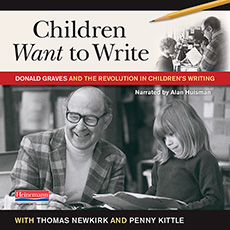
This morning, with the new audiobook release of Don Graves’ Children Want to Write (narrated by two of our teacher heroes, Penny Kittle and Tom Newkirk!), I’m thinking about that true fact: children do want to write. We all do. Our minds are, after all, made for stories.

Children Want to Write (Audiobook)

But to tell our stories is a challenge in so many ways. We live in an age of distraction, many of us are often silenced by society, or we struggle to find an audience we trust.

But most of all, many of us don’t know how to tell a story if we’ve never seen a story like ours told before.

Stop and think about this concept, etched in my mind by Dr. Rudine Sims Bishop with her concepts of books as windows, mirrors, and doors. I’ve spent a good deal of my planning time outside of school finding books that can act as windows, mirrors, and doors for my students to either see through, see themselves in, or walk beyond.

But I’m interested today in the way we go further with that discovery. Once you find yourself in a story, how can you tell your own? I realized years ago that I wasn’t just reading voraciously to find my own story; I was looking for a storyteller with whom I could identify: a living, breathing mentor text. I found it when I met Penny Kittle at the New Hampshire Summer Literacy Institutes, a teacher-writer-mother who counseled me on sustainable ways to balance my young children with the work of teaching well.

Until I met Penny, and was bolstered by her support and willingness to share her own story of struggling to be a mom-slash-teacher, I didn’t know how to tell my story. And until I did, I couldn’t be a living, breathing mentor text for my own students, who were thirsting to tell their own stories.

As English teachers, we are blessed to have the opportunity to be that mentor text for our students: teacher-writers who practice, every day, finding and telling stories that resonate. It’s my favorite part of this work, the joy of getting to read and write powerful stories alongside our students. We can offer space for storytelling in our classrooms in three key ways–with vibrant mentor texts, opportunities for playing with genres, and the time to tinker and devote our study to narrative.

  • A well-stocked classroom library, frequent and varied book talks, and mentor texts that flood our students with diverse voices and stories offer our students windows, mirrors, and doors through which they can discover empathy for others and themselves. Seeing a range of stories disrupts the concept of “normal” and helps students see the world in shades of grey, rather than just black and white.
  • Quickwrites and mini-lessons that allow students to play with genre offer possibilities for storytelling they may not have considered: poems, lists, fiction, memoirs, vlogs, podcasts, and multimodel texts show how we can allow the concept of story to flourish in any medium.
  • Time to write: every day, in quickwrites and in workshops, but also over time–when we devote more than just a unit, or a quarter, or a set of standards to the idea of story. We put our money where our mouths are when we return to story again and again, through concepts of argument, informative writing, or creative fiction and nonfiction.

When we offer our students these ingredients, we create a recipe for storytelling that brings authenticity, relevance, and power to our classrooms. A community of readers and writers can be transformed into a workshop of storytellers, who speak and listen through the powerful lens of narrative.

We invite you to share in the comments how you bring story into your classroom!

Shana Karnes loves to read, write, and find stories everywhere in Madison, Wisconsin alongside her two young daughters, hardworking husband, and inspiring teacher friends. Connect with Shana on Twitter at @litreader.

Put Down Your Phone; Pick Up a Poem

Last year, for the first time in 10 years, I taught a collection of middle schoolers whose energy and hormones knocked the wind out of me every day. But there was something different about these 7th and 8th graders and the ones I’d taught in 2008: between classes, there was no physicality, no leaping across the room to gossip, no noisy giggles between huddled heads. Instead, there were searches for a phone charger, quiet smirks over the latest Snapchat, screens quietly being double-tapped as teens scrolled Instagram.

Image result for distracted

I worry about what the constant presence of technology does to our brains. But I worry far more about what we are missing out on when we spend every free moment on our phones rather than just seeing the world around us. In line at the grocery store, sitting at a stoplight, on a treadmill at the gym, I see everyone around me on their phones.

No one looking up. Looking out. Noticing. Absorbing. Living.

I realize I sound a little old and crotchety here, but it’s a real concern of mine: that the beauty of life is fading because no one is seeing it. That at the least we aren’t noticing what’s around us; that at the worst, we feel isolated and alone, disconnected, hopeless.

Early on in each school year, I read a number of articles, poems, or excerpts from books with students. I booktalk The Shallows: What the Internet is Doing to Our Brains by Nicholas Carr and Walden by Henry David Thoreau. We study excerpts from Reclaiming Conversation by Sherry Turkle and Brain Rules by John Medina. I ask students to look at their screen time use in their settings and reflect a bit on their habits by attempting to journal their activities for 24 hours.

More deeply, we read the poem “A World of Want” by Tina Schuman, and the article “The Eight-Second Attention Span” by Timothy Egan, together. Schuman’s poem laments “the phone[‘]s chirp” and the “conga-line of cravings” presented us by society and technology in concert; Egan’s article advocates for deep, meaningful activities like reading a book or gardening to help us focus our attention.

The combination of these readings, the journal, and our in-class discussions that spark stories of distraction help students see an authentic need for disconnecting from their phones and reconnecting with the world. We then read the poem “Rereading Frost” by Linda Pastan, which drives the point home: we talk about noticing and “decide not to stop trying.”

I then propose a resolution: putting away our phones not just in class, but beyond, when we’re reading, when we’re noticing, when we’re composing. This habit-forming feeling of connectedness spurs students to be stronger thinkers, readers, and writers, and builds our classroom community as well.

Please share any readings or practices you share with students to help them be better noticers and digital citizens in the comments!

Shana Karnes lives in Wisconsin with her children, husband, and cats. In her spare time she endeavors to put down her phone so she can read, write, and think about the world. Connect with Shana on Twitter at @litreader.

How Healthy is Your Practice?

It seems like self-care, wellness, mindfulness, and balance are all the buzz these days. Yet, too often, I see self-care employed as a marketing technique or a rationalization tool: buy this face mask! Do some mindfulness coloring! Treat yo’self to that $6 latte! Schedule a 6-night, 7-day spa retreat in Switzerland! IT’S FOR SELF-CARE!!

Yeah, no.

I admit, I bought into the hype a little bit and splurged at Target a few weeks ago in the “self-care” beauty section. But when I struggled mightily to successfully peel off the peel-off face mask that was supposed to “refresh” me, I didn’t feel refreshed. I just felt like a moron when I looked at my patchy, half-green face in the mirror. Instead of feeling satisfied, I felt, “wow, I can’t even PEEL OFF A FACE MASK.”

Not helpful, y’all.

Instead of having a teaching-life balance that somehow makes me think a peel-off face mask will help me feel less stressed (but instead makes me feel like a Halloween makeup artist), I need to have a teaching-life balance that is rejuvenative all on its own.

As a teacher, it’s a constant struggle not to get to the point in a school day where I don’t feel overwhelmed. When I think about the orientation courses in my inbox, the IEP feedback forms sitting in a folder on my desk, the messy disaster that is my classroom library, the toppling stack of writer’s notebooks students submit for feedback every other Friday…I don’t feel the need for some little moments of self-care. I feel the anxious, grasping need for escape to that spa in Switzerland, except I never really want to return from the spa to my real life.

We cannot let ourselves get to this point.

As teachers, we have to cultivate a practice that is more responsible, more sustainable, more respectful to the fact that we are HUMANS, and that we should feel ABLE to do our jobs, to do the work of teaching because we love it, and not because we’re suffering from some teacher-as-martyr delusions of grandeur and existential suffering.

A tweet about this very feeling from Dulce-Marie Flecha stuck with me–so much so that I still remember it, word for word, nearly five months later:

This sentiment struck me, forcefully, in mid-April: when tests were looming and assemblies were rampant and the science fair kept interrupting my carefully-crafted multigenre lesson schedule. I was so stressed out by the daily practice of teaching middle schoolers, on top of having two kids under the age of three and a life in general, that I really felt I could not do the work of teaching. I knew I had to make a lasting change that was more sustainable than trying to survive on coffee and weekend laundry marathons and naps.

Tami Forman writes in Forbes that self-care is actually kind of boring: it’s boundaries, it’s saying no to things we know we shouldn’t take on, it’s turning off the TV so we can actually get some sleep. It’s the little things, the simple habits that make our lives manageable.

Image result for onward elena aguilar
I’m reading Onward this year with a group of colleagues, which offers guidance for how to know yourself and your limits as an educator, so you can design a sustainable teaching practice more successfully.

And as an English teacher, it’s crafting a curriculum, a classroom, and a culture at school that don’t require me to give feedback on every single paper, to grade every single page a student reads, to be on every committee or lead every after-school activity.

We have to do what we can, the best we can.

If you’re spending too much time stressing out about your inadequacies as a teacher, consider how you might revise your teaching practice to be more sustainable, more balanced, more enjoyable. It’s more than just throwing that stack of papers you meant to grade in the recycling bin: it’s thinking carefully about how you might shift the cognitive load in your classroom toward student self-assessment, conferences, and peer feedback rather than just being all on you. It’s something that’s beneficial for teachers and students alike.

Ask yourself: how healthy is my teaching practice? And let us know in the comments how you’ve made shifts to keep your work and life in balance, so you have time to read all the latest and greatest YA, doodle in your own writer’s notebook, and daydream poetry.

Shana Karnes lives and works in Wisconsin alongside many smart, thoughtful, inspiring English teachers via the Greater Madison Writing Project. She enjoys reading, writing, and poem-ing in any spare time she gets when she’s not with her two baby girls and hardworking husband. Connect with Shana on Twitter at @litreader.

My Antiracist Reading List

Many years ago in my teaching career, I acknowledged a gaping hole in my pedagogical knowledge that’s rooted in an unchangeable part of my teacher identity: being a white woman.

The implications of this were both large and small. I realized that the students in my classroom who were most successful were the white females. I realized that the students I had the most trouble suggesting books for were the students who were not white females. I realized that my family phone call log was full of communication with male students and students of color.

I knew I needed to make a change. And I realized that the one and only variable of my classroom that I could ever control or change was myself.

It was then that I began to look critically at the systems and norms and institutions I had in place or held in place. I examined my curriculum critically and saw a slew of white authors. I found a canon of classics that were long and uninteresting and irrelevant to my students. I found a syllabus, a classroom contract, and a school handbook of rules that privileged a definition of behavior and compliance defined by white people.

So, I did what I considered an extension of my education program: I read theory, reflected, put it into practice, reflected some more; read more theory, reflected, practiced, repeat.

And I got better. My curriculum became more diverse (adios, dead white guys; hello, @diversebooks), my methods became more student-centered (goodbye, long tests; hello, conferring), my critical reflection became more astute (sayonara, mindless grading; hello, assessment for learning). And my students experienced more successes in reading and writing because I was addressing some of the inequities and inadequacies in my teaching.

Here we are, ten years after that realization, and I’m optimistically hoping antiracist teaching has become an educational aspiration that is normative. And, three states and four schools later, I’m still working to grow and improve.

So this summer, thanks to #cleartheair, #educolor, #disrupttexts, and #thebookchat friends on Twitter, my TBR list has been filled with books about antiracist, equity, and inclusive teaching. It’s been hard to find those books alone, and it’s been especially difficult to find voices of color in books specifically tailored to secondary English pedagogies and methods:

After that conversation, I was left with two things: an impressively wide to-read list filled with BIPOC authors discussing equity, and a distressingly narrow slice of books by BIPOC authors who were writing about literacy methods in high school classrooms. Here’s a short list of titles:

  • Not Light, But Fire by Matthew R. Kay
  • Fearless Voices by Alfred Tatum
  • Writing Instruction in the Culturally Relevant Classroom by Maisha T. Winn and Latrise Johnson
  • Total Literacy Techniques by Persida Himmele
  • The Write Thing by Kwame Alexander
  • Linking Literacy and Popular Culture by Ernest Morrell

I wondered why there weren’t more books like this out there, so I did some broader reading, too: Paolo Freire, bell hooks, Gloria Ladson-Billings, James Baldwin. At Cornelius Minor’s suggestion, I read Baldwin’s “A Talk to Teachers.” At my entire Twitter timeline’s suggestion, I read Robin DiAngelo’s White Fragility, and ordered Ibram X. Kendi’s How to Be An Antiracist.

These readings stirred my thinking in hundreds of ways, but it really boiled down to one change I wanted to make: elevating voices that have historically been silenced.

I specifically want to find and read texts by authors whose perspectives have been marginalized, to amplify those voices and others’ whose have been oppressed, and to help students tell stories they’ve not been able to tell before (but that’s another blog post). This cycle, to me, involves considerable struggle, but it is worth it to help change the narrative of who and what matters in classrooms. This is our tireless work, and my goal this year is to keep at it unflaggingly, with boundless energy, because it matters.

I hope you, too, have dug deep this summer into the changes you hope to make in your students, your teaching, and yourself. I wish you strength this school year as you internalize Baldwin’s words in his talk to teachers: “The obligation of anyone who thinks of himself as responsible is to examine society and try to change it and to fight it.”


Please share your thinking in the comments: who might you add to this reading list? What changes are you hoping to make this school year? Please also consider joining our writing team!

Shana Karnes lives, learns, and teaches in Madison, Wisconsin, with her husband and babies. This year she’s working with the Greater Madison Writing Project at the University of Wisconsin. Connect with Shana on Twitter at @litreader.

A Poem to Start Your Notebook

Each morning, I receive two poems in my email inbox: one from The Poetry Foundation, and one from The Writer’s Almanac. One morning in July, I received “More of Everything” by Joyce Sutphen, read it, and thought, wow. That would be so powerful to write beside with students.

As it turns out, some pretty brilliant thinkers receive these same poems in their inboxes, and they took the same poem and ran with it in a beautiful direction:

I often have my students write beside poetry inside our notebooks, but Linda Rief and Penny Kittle have inspired me to bring poetry to the personalization process. I love the idea of having students glue this poem into their personal photos and collage pages we create: it prioritizes an individual, emotional response to literature that is valued in the workshop classroom…and the results of the thinking around this text are beautiful, too.


As you and your students begin the school year and personalize your writer’s notebooks, perhaps you’ll consider adding a text to the start of your journals. Will you share any poems or short texts you frame your year with in the comments?

Shana Karnes lives in Wisconsin with her husband, daughters, and cats. She is teaching and learning alongside amazing teachers through the Greater Madison Writing Project this year. Connect with Shana on Twitter at @litreader.

Will You Write With Us?

Six years ago, Amy Rasmussen looked at me and said, “I’d love for you to write for our blog.” 

It wasn’t a casual offer–it was said with levity, marking me as a Writer, a Teacher With Things to Say. At first, I wanted to shake my head and demur, as so many teachers are taught to do: fade into the background and let our students shine.

But something in me made me say yes. I felt honored, nervous, and purposeful as I worked in my classroom that year, beginning to think about my instruction through a new lens: how I might write about what I was doing, what pedagogy was informing my instructional design, what artifacts of learning my students were producing. I had to start thinking more critically about why I made the instructional decisions I was making, and exactly how they impacted students. Then, I wrote about my thinking, which led to new critical reflection, new thinking, more writing…and the cycle continues.

In six years, I’ve written over 200 posts at Three Teachers Talk. That’s 200 think-critique-write cycles. And I know that every one of them has made me a better, more reflective, more thoughtful educator. 

If being a better, more reflective, more thoughtful educator sounds like someone you’d like to be, then we extend that same invitation to you, with the same sense of levity: write with us. Find your voice. Hone it. Amplify it.

We invite you to join us as a regular contributor if you —

  • Are a high school teacher, instructional or literacy coach, or administrator who advocates for choice via readers-writers workshop practices, including self-selected reading and authentic writing instruction
  • Your thinking is guided by our mentors, namely, Penny Kittle, Thomas Newkirk, Donalyn Miller, Kelly Gallagher, Cornelius Minor, Tom Romano, and the tenets of National Writing Project 
  • Can commit to sharing writing that highlights details from your instructional practices, your personal and/or professional reading, and everyday teaching experiences

If you are interested in growing your own thinking around readers-writers workshop, strengthening your writing through authenticity, reflection, and publication, and amplifying the voices in our conversation about workshop, please fill out this Google Form. I hope you’ll join us in contributing writing around student-centered literacy practices. As someone who has enjoyed the benefits of this practice for more than half of my teaching career, I can say with confidence that becoming a teacher-writer is one of the best professional decisions you can ever make. I know that you, your students, and our readers will benefit from your leap of faith.

Please consider joining our writing team and spreading the word to your trusted colleagues and professional learning communities. We hope to have a diverse representation of voices sharing and growing thinking about readers-writers workshop best practices in schools and communities everywhere.