It’s my last full week of summer vacation, so of course my mind is on the coming school year. I’ll admit, I’m a bit nervous. I still don’t know what school will look like. However, instead of focusing on what could be, I’m going to focus on what I can control.
I can listen. From Day One, I will get to know my students as best I can. My first goal: learn at least 5-10 things about each one of them within the first few weeks. When they share something personal, I’ll be there.
I can be flexible. When students sound overwhelmed, I’ll extend deadlines. When I see reteaching is necessary, I’ll make time for it. I won’t put pressure on myself to complete a unit by a certain date. Instead, I’ll let whatever is needed, happen.
I can put my mistakes out there. I won’t assert the “teacher power” I have, but instead prove I am just like them: a reader/writer/human being that makes mistakes. I’ll allow myself to be vulnerable by sharing my own blunders with classes and how I attempt to fix them. I’ll share personal learning experiences, and how we can unpack tough topics that often make some of us uncomfortable.
I can speak my truth, which is one of the four agreements I learned from Glenn E. Singleton’s book, Courageous ConversationsAbout Race. I’ll speak honestly about the various pieces we read, including many that are about races and cultures different from my own. By modeling this first, my students will hopefully to do the same. We’ll explore our own identities throughout the year by reading various poems and excerpts one day, and sketching our thoughts the next. I’ll introduce “radical empathy” (from Isabel Wilkerson’s book Caste), and we’ll discuss how to find humanity within ourselves and others so we can face problems together, be better informed about the world, and listen to each other with love (#IREL21).
I can write with my students. Writing is so much more than just following a task or completing a worksheet. We’ll write everyday to build stamina, trying out new moves, studying mentor texts, and revising consistently to make our writing better and our voices heard.
I can focus on joy. There are so many different forms of joy. By getting to know my students, I’ll learn what brings them joy. I’ll share pieces of writing that bring me joy, and ask students to share some of their own. We can focus on our accomplishments to push ourselves to do more.
By focusing on what I can control, we can become communities that thrive.
Texts that inspired this post (besides those that were already mentioned above):
The Antiracist Writing Workshop: How to Decolonize the Creative Classroom by Felicia Rose Chavez
Being the Change by Sara K. Ahmed
Black Boy Joy edited by Kwame Mbalia
Risk. Fail. Rise. by M. Colleen Cruz
Sarah Krajewski teaches high school English and Journalism near Buffalo, New York. She is about to begin her 20th year of teaching, and is always looking for new, creative ways to encourage her students to read and write. At school, she is known for helping students become lifelong readers, and for being a devoted reader herself who “knows her books.” You can follow Sarah on Twitter @shkrajewski
This year has been a long one, but one thing that went well is the amount of reading my students and I did. As of today, I have finished 69 books, and I still have about three weeks to go. Find calling a title a “favorite” is difficult for me, I have narrowed down my list to a “top ten.” The order below depends on the day. (I’ve already changed it at least 12 times, and there are other titles I’m reading now that could have made the cut.)
10. Starfish by Lisa Fipps(realistic fiction in verse)
“Whale.”
“Splash.”
These are just some the awful nicknames Ellie hears often from an early age, even from her own mother. It seems almost everyone in her life believes her weight is a problem, except her father. Her mother hides her food and makes her try various diets, and even considers bariatric surgery. At school, no one sticks up for her, especially after her best friend Viv moves away. Ellie knows she must follow her self-created Fat Girl Rules if she wants to survive, and she does. Ellie has her pool, where she can be a starfish and just float, a place where she’s weightless. After a particularly horrible incident at school, Ellie’s dad takes her to see a therapist, who helps her begin to heal, as well as use her gorgeous, powerful voice.
I’ll truly never forget Ellie. She’s a beautiful human being, inside and out. An empowering book to teach all readers that size doesn’t matter, as well as how debilitating words can be.
9. Grown by Tiffany Jackson(mystery)
17-year-old Enchanted Jones wants to be a famous singer, so when the legendary R&B superstar Korey Fields sees her audition one night, he immediately takes her under his wing. Months later, Enchanted wakes up groggy with blood all over her, and Korey Fields is lying next to her, dead. What follows is what happened before the murder: an inside look into what Enchanted thought would be her dream come true. Instead, she was sucked into a hell she couldn’t get out of, no matter what she, or her parents, attempted to do.
Another gripping read from Tiffany Jackson! This story was oh so difficult to read, for Jackson doesn’t hold back on the descriptive details when it comes to the horrific abuse Enchanted suffered through. But, this story must be read. It must be shared. Time for some tough conversations about rape culture and older men who prey on teenage girls.
8. We Are Not Free by Traci Chee(historical fiction)
14 Japanese American teens weave a story together, starting three months after the bombing of Pearl Harbor. 14-year-old Minnow begins with the harsh, appalling racism that many Japanese-Americans faced during this time. Soon executive orders are given, and anyone of Japanese decent, including those that look Japanese but aren’t, are rounded up and sent to internment camps. At times, the teens stay strong, for they have each other. Other times, they witness such atrocities that they don’t know how to go on.
This book taught me so much, from the stories, to the photos, to the author’s note. Yes, I knew about the internment camps, but Traci Chee made me feel like I was there. I cried, I laughed, and I even felt anger and shame, for so many Americans committed such horrific acts against their own people.
7. Stamped (for Kids) adapted by Sonja Cherry-Paul(nonfiction)
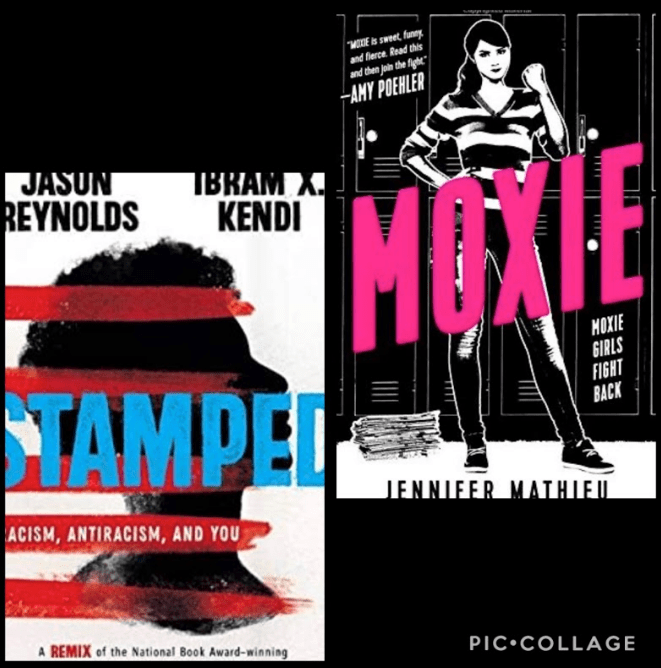
“RACE. Uh-oh. The R-word.” This nonfiction title, which is adapted by Sonja Cherry-Paul from Jason Reynolds and Ibram X. Kendi’s Stamped, tells the 400+ year story of racism in America in a way young readers can understand. My son, who’s 11, and my daughter, who’s 9, both understood the majority of it and had a lot of great questions. By the end, it was my children telling me they learned so much. More importantly, they want to learn more.
6. Four Hundred Souls edited by Ibram X. Kendi and Keisha N. Blain(nonfiction)
It began in August of 2019, when the first 20 enslaved African men and women were delivered in Jamestown, Virginia. What follows in 400 years of true African American history, oppression, struggles, and achievements, from the British ships that stole Africans from their homeland to the Black Lives Matter movement of today. This collection of 90 essays and poems–edited by Ibram X. Kendi and Keisha N. Blain and written by many famous historians, scholars, and poets–tell the real stories. The ones that our white-washed history textbooks left out. “But as the narratives in Four Hundred Souls reveal, Black people have never stopped dreaming, or fighting for those dreams to become a reality.” These stories capture “a spirit of determination,” as Blain stated. These 90 powerful pieces share how much Black people have overcome, as well as how much work still needs to be done.
5. Flight of the Puffin by Ann Braden (realistic fiction)
Meet Libby. She is a budding artist who is tired of most people–teachers, classmates, and neighbors–assuming she is a bully just like the rest of her family. In fact, Libby is far from it, and she knows it. To prove this to herself, she uses her artistic ability to make colorful notecards with positive messages on them, and leaves them for others to find. Little does she know that her words set off a chain reaction that will lift up three other kids who need her encouragement at that time.
Libby and the three other children are all unique and imperfect, but there’s so much to love about each of them. This powerful book that will encourage readers to pay it forward. My own two children created notecards just like Libby did and posted them around our neighborhood.
4. The Sum of Us: What Racism Costs Everyone and How We Can Prosper Together by Heather McGhee (nonfiction)
Heather McGhee, an expert in economic and social policy, shares why the economy often fails its people. After extensive research into many aspects of it, she found one root problem: racism. Though many of us may not realize it, over centuries, racism has seeped into every aspect of our lives. They’re all interconnected, from public education, to integration, to the housing market. The question is, can we fix this? McGhee argues yes. She introduces the zero-sum policy–the idea that progress for some must come at the expense of others–and proves it wrong. McGhee’s compassionate, yet honest account introduces us to the tremendous challenges our country still faces. Racism has cost us so much, but reminds us that there is reason for hope. We can still prosper together, and honestly, we have no other choice right now. As McGhee says, “We need to refill the public pool of good for everyone.”
3. Concrete Rose by Angie Thomas(realistic fiction)
17-year-old Maverick Carter is the proud son of King Lord legend, Adonis Carter. Life in Garden Heights isn’t easy, but Maverick has a smart, beautiful girlfriend, and a cousin who is more like a brother. He doesn’t want to sell drugs, but when he finds out he is a father himself, he doesn’t have a choice. He’s got to provide for his son, for money is tight at home, even with his mother working two jobs. After getting a part-time job at a local store, Maverick begins realizing that being a King Lord is keeping him from being the man, boyfriend, and father he needs (and wants) to be. But you can’t just leave the King Lords, and his part-time job doesn’t pay what selling drugs does. But just when Maverick thinks he has the right plan, a murder in the Garden changes everything.
I finished this book within 24 hours! Maverick’s story is beautiful, powerful, and oh so important. I loved seeing all of the connections to The Hate U Give, and even to another YA author’s book as well (see if you can find it!). You’ll fall in love with Big Mav all over again, and you’ll have that much more sympathy for him when he makes mistakes, and sometimes learns from them.
2. Caste by Isabel Wilkerson (nonfiction)
Award-winning author Isabel Wilkerson introduces readers to the American caste system, “a rigid hierarchy of human rankings” that’s hidden under race and class. Wilkerson masterfully links our caste system with those of Nazi Germany and India, often showing how the American caste system influenced theirs. She explains the cruel logic of caste, for there must always be a “bottom rung” that’s subjected to little respect, and rarely gets the benefit of the doubt and access to important resources. It’s a cruel system that shows what Black people are truly up against.
Wow. Where do I even start? Wilkerson’s research is quite extensive; she weaves facts in with engrossing stories from real people, like Satchel Paige, Dr. King, people she interviews, and many of her own, showing the numerous ways caste is experienced every single day. Oprah’s right: “This is required reading for all of humanity.”
1. In the Wild Light by Jeff Zentner (realistic fiction)
Cash Pruitt lives in Sawyer, Tennessee, a small town filled with gorgeous rivers and rolling hills, but also addiction. He already lost his mother to drugs, and his Papaw is dying from emphysema. The only positive that addiction brought into his life is Delaney Doyle. She’s a scientist at heart who teaches Cash so much about the world. They provide one another distractions, and are each other’s lifelines.
On one of their trips into the wild, Delaney makes a scientific discovery that changes their lives: she earns both Cash and herself full scholarships to a Connecticut boarding school. Deciding to go, Cash can’t help but wonder what this school will do for him. His experience ends up being more than he could ever have imagined.
This book truly has it all! I laughed, cried, and took about eight pages of notes because of all the beautiful language I wanted to save. Jeff Zentner has a remarkable talent for creating realistic, lovely, unforgettable characters. I fell in love with so many of them for the oddest of reasons. Zentner has truly outdone himself, for this is a literary masterpiece. Be sure to grab a copy when it comes out in August.
So that’s my top ten of this school year. I would love to hear what others are reading (and loving), so please share your favorite(s) in a comment below.
Sarah Krajewski teaches high school English and Journalism near Buffalo, New York. She is currently in her 19th year of teaching, and is always looking for new, creative ways to encourage her students to read and write. At school, she is known for helping students become lifelong readers, and for being a devoted reader herself who “knows her books.” You can follow Sarah on Twitter @shkrajewski and her blog can be viewed at http://skrajewski.wordpress.com/.
My 11-year-old son is a ball player. Baseball is in his blood. He loves everything about it–playing third base, staring down the pitcher at the plate, the camaraderie.
But game days are a different story.
Last week, Game One finally arrived. He woke up nervous, fearful of what was to come and already feeling the pressure. The pressure he puts on himself.
That first game was just like the others. The closer we got to the field, the quieter he became in the car. When we parked, he got out, grabbed his bag from the trunk, and hurried off to the dugout without a word to any of us. My husband and I were lucky to get a head nod. He was already inside his head, and he stayed there the entire game.
Now, I’ve seen my son practice. He is an impressive third baseman, and makes contact with the ball often. Last year, however, he had only one hit, and that was in his first game. After that, it was either a walk or strike out. His level swings I’d see at practice disappeared during the game. The more often this happened, the more he thought he was a failure. He saw his ability in all the games played, not the practice he did during the week. He didn’t see the growth and progress his coaches saw.
As we drove home from Game One in tense silence, I couldn’t help but be reminded of my student writers.
My students are all writers. Some, however, don’t believe it. They’ve heard, year after year, words like “struggling” or “weak” and they begin to think just that. By the time they get to my class in 9th or even 12th grade, it can takes months to change those negative thoughts.
Last September, they came into class nervous, fearful of what I would ask of them. The classroom was a playing field with an audience–a teacher–that could judge them.
To students, the first bit of writing they did felt no different from years past. As I walked the room, I watched hands cover papers and eyes look down. They were inside their heads, remembering times when their work was deemed subpar.
But with time, there were bits of progress. Writing volume began to increase on each page. More voices spoke up during sharing time. But when words like “essay” or “story” were mentioned, old memories returned. Blank screens stayed empty as minds whirled. That may have been due to previous years of seeing low grades, or red pen that focused more on what was wrong than right. With patience and persistence, we eventually all got started, for there is nothing without trying.
This past Sunday was Game Two. My son was ready again, for he loves the sport and aims to keep trying. Not only did he connect with the ball, but he did so multiple times. He made a double-play at second base and helped get another out at first. He earned a game ball, but, more importantly, he saw his own hard work pay off. He made progress.
We must show our students that, with time and practice, they can do the same.
Sarah Krajewski teaches high school English and Journalism near Buffalo, New York. She is almost finished with her 19th year of teaching, and is always looking for new, creative ways to encourage her students to read and write. At school, she is known for helping students become lifelong readers, and for being a devoted reader herself who “knows her books.” You can follow Sarah on Twitter @shkrajewski and her blog can be viewed at http://skrajewski.wordpress.com/.
Last June, I wrote a blog post while in the middle of rethinking how I grade in my classroom. At the time, I was in learning mode. I knew what I wanted to change, and I thought my workshop classroom would fit my ideas quite well.
Last August, as I attempted (and often failed) to plan for a year of unknowns, I decided that I would look at the 2020-2021 school year as an opportunity.
An opportunity to try teaching strategies I was always too intimidated by.
An opportunity to focus on joy and autonomy.
An opportunity to lessen my students’ stress level (and mine) in an already stressful time.
Yes, this year was the perfect time to go gradeless.
Sure, my students were a bit confused at first. No number on an assignment but they still had to do it? As one student put it, “how will I know what’s important in this class?” One student even asked why he should do any work at all. These were important questions, I thought, so we spent the beginning of year discussing them. We couldn’t go gradeless if my students didn’t understand their role in the learning process.
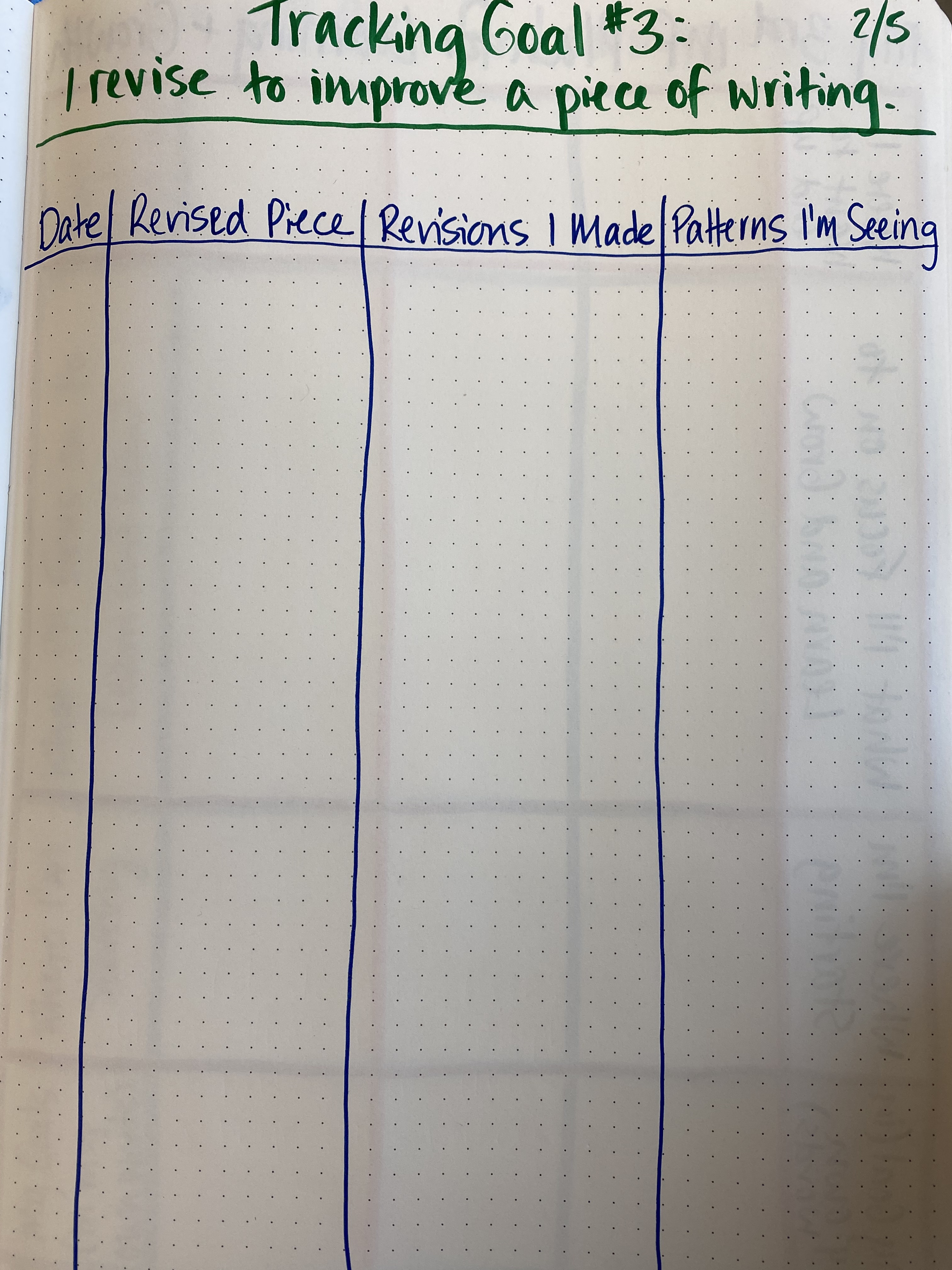
To help my students organize their thinking, we got into our notebooks. Using a list of ten learning goals (I modeled mine after the ones Sarah M. Zerwin included in her book Point-Less), students created plans to meet two goals each marking period. We created tracking charts in their notebooks (see mine below), and each week they took time to record their progress. Along the way, I shared my own progress, as well as my setbacks. My struggles helped them realize that some weeks would be easier than others. By the end of the first marking period, they wrote letters sharing their stories of strengths and successes, where improvement was still needed, and then based on both, what grade they believe they deserved.
One of my planning charts, and two tracking charts. I keep track of my learning, just like my students.
Yes, going gradeless was terrifying at first. It was such a big change for us all. One aspect that many students struggled with was their “grade” in our online grading application. They still saw a number there, so wasn’t that their English grade? Not quite. I was still required to put numbers in a grade book, but what they saw were their “completion grades.” This was one of the many ways students received feedback, but in the form of a 0, 5, or 10. A 0 meant the assignment was missing, a 5 meant it was incomplete or completed incorrectly, and a 10 meant it was fully completed. At first, my students only looked at those numbers, so I had to change their thinking by giving them additional feedback on their assignments and in conferences. Students soon learned that receiving a 10 didn’t mean that an assignment was finished. I would share strengths I noticed, but also push for more revision. This way, no matter the ability of the student, I could always challenge them. Soon, I began to see more revision than I had ever seen before.
Now, as I write this post, my students are in the process of reflecting on their 3rd marking period of learning. As I read over their letters, I can see their obvious growth and honest reflection. This senior shared some honest thoughts about a tough marking period: “At times it was hard to find motivation and complete assignments on time. But for this class I believe I gave good effort and expressed myself in my writing. As far as reading goes, I’ve read more consistently this marking period and have put aside more time to read.” One of my other seniors found something he enjoys: “My strength in English is writing stories. It’s something that I could do all day if I could.” A ninth grader shared that she gained confidence in her reading from participating in a book club: “The book club helped me to improve my reading skills by sharing my ideas and my thoughts with my classmates in my group.”
Next week, we begin conferences where I will meet with each student to discuss the content of their letters and the grades they are asking for. I must say, so far their self-assessments have been pretty accurate! Some students are even too tough on themselves.
I still have more to learn about going gradeless, but I do know that this is the path I am meant to be on. My students are cognizant of their own learning now, so this gradeless journey is a welcomed one.
Sarah Krajewski teaches high school English and Journalism near Buffalo, New York. She is currently in her 19th year of teaching, and is always looking for new, creative ways to encourage her students to read and write. At school, she is known for helping students become lifelong readers, and for being a devoted reader herself who “knows her books.” You can follow Sarah on Twitter @shkrajewski and her blog can be viewed at http://skrajewski.wordpress.com/.
Distance learning is over, and I don’t know about you, but I’m finally able to take a deep breath and reflect on the most unique three months of my 18-year teaching career. Yes, it was tough, but I learned a lot.
In my previous post, I shared my thoughts about the right kind of feedback our students need in order to be successful students. The kind that leads to learning, not compliance.
Growth over numbers.
Over the past three months, it was my conversations with kids that fostered learning and growth, not any numerical grade I gave them. My students didn’t even see a numerical grade until they wrote me a letter in June to argue for their final average. When I looked back at my notes, I saw real, helpful data proving my students learned a lot about reading and writing, as well as themselves as learners. No number could have shown me, or them, that. I knew then that I couldn’t go back to a traditional grading method.
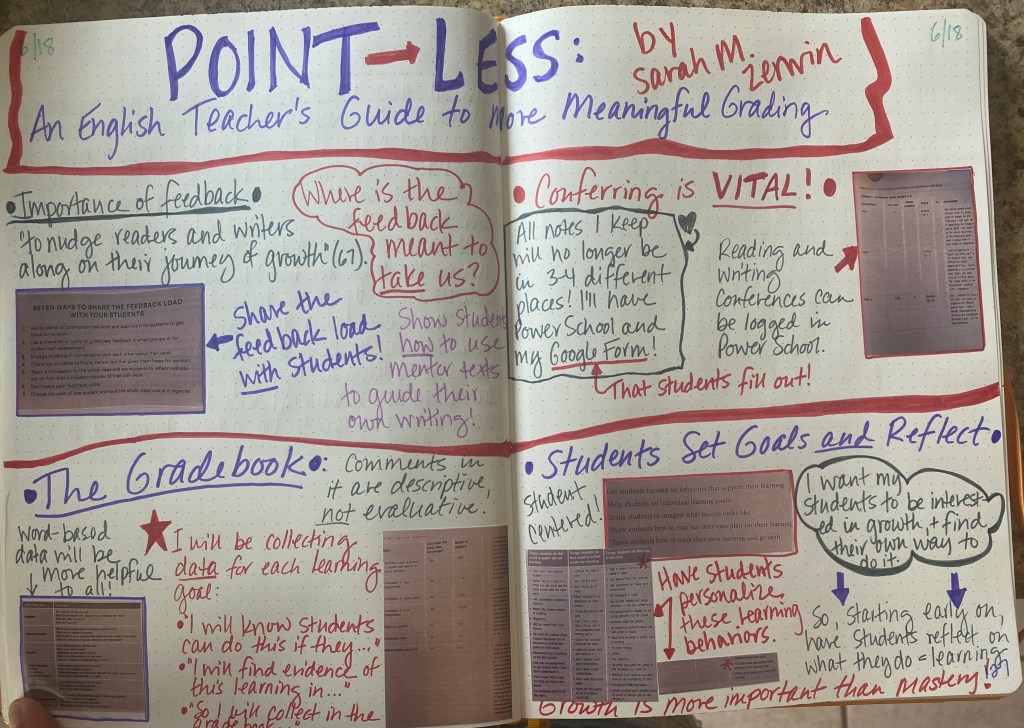
My notes while reading the end of Sarah M. Zerwin’s book.
So, I continued reading. Learning. I searched for proof that not only were points no longer needed, but my students were more successful without them. After finding and finishing Sarah M. Zerwin’s book, Point-less: An English Teacher’s Guide to More Meaningful Grading, I had all the information necessary to prove why this change was essential.
What does going pointless, or gradeless, actually look like? To me, it’s a student-centered, feedback-driven classroom. Students read, write, revise, and reflect often. They take risks, for a number is not attached. Teachers serve as a model and coach, not an authority figure. Conferences are a regular occurrence. Open communication is visible in the school grade book where teachers, parents, students, administrators, and counselors can see written feedback. In other words, it’s everything children need to learn and grow.
So, will a change like this be possible? I’m going to argue yes. It must. When it comes to education, our country has been obsessed with the wrong kind of data for far too long. Our country’s grading system is an archaic one of oppression that needs to go. Teachers, it’s time to speak up and change that. It’s time to obsess over learning and growth, and going pointless will allow for that.
For more information about going pointless, start by checking out these sources:
Point-less: An English Teacher’s Guide to More Meaningful Grading by Sarah M. Zerwin
Reimagining Writing Assessment and Rethinking Rubrics by Maja Wilson
The Schools Our Children Deserve and other books and essays by Alfie Kohn
Hacking Assessment: 10 Ways to Go Gradeless in a Traditional Grades School by Starr Sackstein
Sarah Krajewski teaches 9th and 12th grade English and Journalism near Buffalo, New York. She just finished her 18th year of teaching, and hopes to get back to her classroom in September. You can follow Sarah on Twitter @shkrajewski and her blog can be viewed at http://skrajewski.wordpress.com/.
This morning, I opened my email to find that a student of mine was the topic of a long chain of emails. She is a senior that has not completed any work throughout our 6-plus weeks of distance learning, so she is failing every class for the 4th marking period. As I scrolled through the various responses, I noticed a pattern. There was no mention of her mental or physical health, or any thoughts about her current situation at home. Grades were the concern, not her.
Are grades themselves all that vital to a student’s success? I’m going to argue no. From what I’ve seen, grades often create more problems for both teachers and students. Students have been taught to rely on them. That at the end of the day, a number matters most. Instead, grades are hindering learning. I’ve watched talented writers do a minimal amount of work, knowing they are capable of so much more, but still earn 100s. Other students have jumped numerous hurdles only to be kicked in the shins with 65s. Why? Because the rubric said so. Yes, our public education system perpetuates the problem, but I think there are ways that we teachers can push back. We can teach our students to value the learning, and it all starts with the right kind of feedback.
Think about one of those days you returned pieces of graded writing that you devoted countless hours to. You left those margin filled with ink. Suggestions galore! Do your students even read the comments at that point? Take them to heart? I doubt it. By then, the assignment is over and done with. The guidance, nudges, and praise we give our students throughout the writing process is where the learning takes place, not at the end when an assignment is returned.
This is where conferring comes in. Though we may have to get creative in our techniques, conferring can still take place during distance learning. First, a time to check-in. How are you? I miss you. Can I help you with anything? Then we can slowly pull–sometimes drag–out the various talents hidden inside every child by offering up a brief amount of time for more chat about the piece of writing. What was your goal with the piece? What do you need help with? We search for a place of beauty to highlight and an area that, with a nudge, could inspire growth.
So, back to my senior. We spoke today. I miss you. How are you? Her response shook me. She needs help, not a reminder about her failing grades. We shouldn’t be worrying about a number, but instead finding new ways to motivate and help each child.
This week, I’m setting up private Zoom conferences with each of my students. We will meet for 10-15 minutes sometime within the next two weeks, and just talk. I’ll listen, question, and coach. I’ll highlight accomplishments and encourage risk-taking. Oh, and grades? Yeah, I know I still need to give one. That will come from a discussion between me and each student at the end of the year.
Sarah Krajewski teaches 9th and 12th grade English and Journalism near Buffalo, New York. She is currently in her 18th year of teaching, and hopes to get back to her classroom soon. You can follow Sarah on Twitter @shkrajewski and her blog can be viewed at http://skrajewski.wordpress.com/.
This is the third week away from my students and classroom, and it feels like three months. I miss my kids. I miss our daily conversations. I miss seeing that little spark in their eyes when that light bulb goes on. I miss just…well…everything. “Teaching” from home, though better than nothing, just isn’t the same.
Back on March 16th, I didn’t know where to begin. Sure, I had begun planning for this in my head, but my ideas were a jumbled mess. The two things I knew my kids needed? Daily reading and writing. I’ve read countless studies–like this one–that prove the volume students read and write has everything to do with their gains. Like with any sport, they need that daily practice to improve. We let our children choose the sports they want to play so they will practice more. The same should go for reading and writing.
As I continued my planning and searching, I found help in two very likely sources: Penny Kittle and Kelly Gallagher. They put on paper what I had been trying to organize in my head. They also started daily “digital conversations” with one another that they shared via Twitter. (Click here to view the padlet that Penny put together.)
Once I had my idea, I pushed it out to my students, along with the beginning of my own notebook work. I was hesitant to do this at first, but, yes, I’m putting my own notebook on display. Though I have shared many entries with them in the past, I have never given them complete access to my notebook. This is a different time though. My students need me to be brave, courageous, bold. They need to see my struggles and mistakes, as well as all that I am proud of. More than anything else, I want them to feel like I am still there with them, for I am, but in a much different way.
So, after giving my students time to peruse through the guidelines, I posted photos of all my daily notebook entries, along with my “Reading Record” (pictured above) that shows them what, and for how long, I was reading. My students had a lot of questions. (I was ready for that.) They asked how I got my ideas. (I was ready for that too.) We even had a virtual chat so we could catch up, and I had a “think aloud” about what I do when I have writer’s block. (We all get stuck sometimes.)
Are there still kinks we need to work out? Sure. Are there students who I am still trying to connect with? Yes. There are so many road blocks in this very new process, but over time those blocks will begin to flatten. All we can do is keep trying.
Sarah Krajewski teaches 9th and 12th grade English and Journalism near Buffalo, New York. She is currently in her 18th year of teaching, and is always looking for new, creative ways to help her students enjoy learning, reading, and writing. You can follow Sarah on Twitter @shkrajewski and her blog can be viewed at http://skrajewski.wordpress.com/.
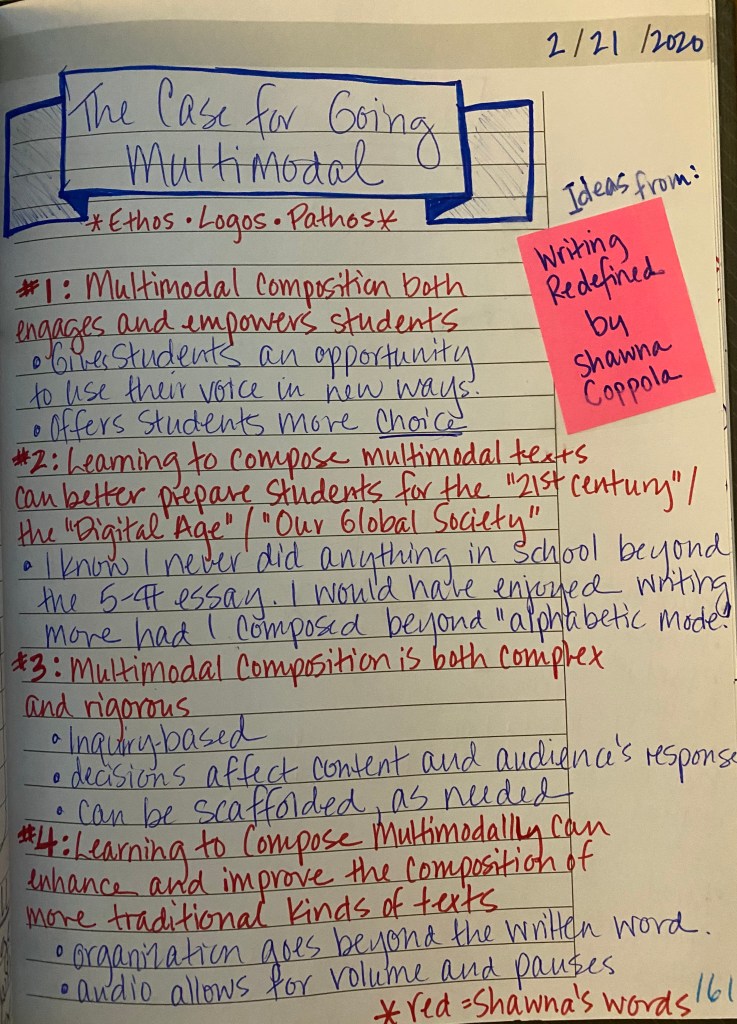
I’m always looking for new ways to change things up in my classroom, and this year my plan was to revise my research units. Both my 9th and 12th graders have to incorporate research, and in the past, that always meant writing a paper. Recently, however, I read Shawna Coppola’s latest, and highly recommended book, Writing Redefined: Broadening Our Ideas of What It Means to Compose. This book made me rethink what my research units could look like.
Why go multimodal?
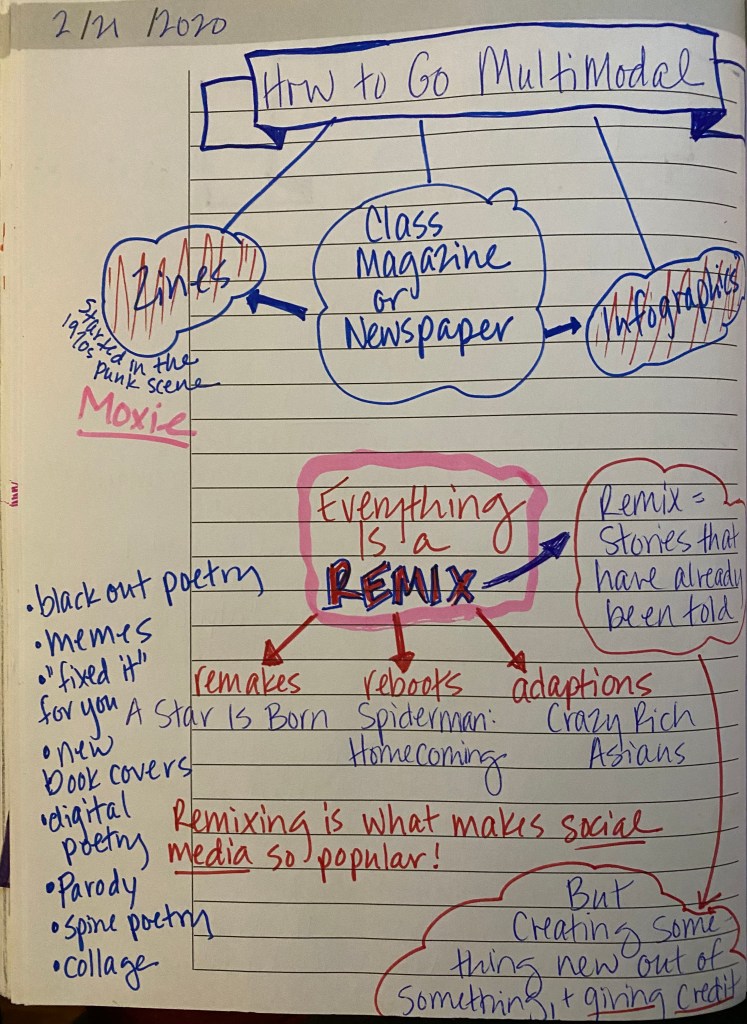
Coppola makes the case for incorporating “multimodal compositions,” which incorporate more than one mode instead of just the traditional alphabetical form. Instead of leaving these other modalities behind in early elementary school, students of all ages can (and should) incorporate illustrations like sketches and maps, or digital components like infographics, photos, and audio. The more modalities, the more decisions our students are making. Talk about rigor!
So, how could one go multimodal? Though my seniors and I are still in the early stages, here’s what we’ve done so far:
Begin by Taking an Inquiry Stance – As Coppola says, taking an “inquiry stance” allows students to “coconstruct and better retain knowledge” (23). Start by assessing what students already know, and then immerse them in that multimodal text. For my 12th grade research unit, we immersed ourselves in various multimodal mentor texts (like this one) in order to study how to put our own together. After sharing our noticings, I looked for patterns to create mini-lessons my students would find helpful.
Work with Your School’s Tech Integrator – I don’t know if all schools have one, but my tech integrator is fabulous! After explaining how I wanted to incorporate multimodal compositions into my curriculum, she introduced my students and me to Google Sites (see my sample below). Our interests were peaked! We are now in the application stage, so my students are in the midst of creating their own Google Site. As we move along, I often direct them back to our mentor texts so they can further explore.
My Google Site
Ways to go multimodal
You May Already Incorporate Multimodal Compositions – After reading Coppola’s book, I realized that I already incorporate multimodal compositions quite often. I do, however, plan to add more. With my upcoming 9th grade research unit, we will create infographics and work in audio. My students will still learn all the necessary research skills, but they will present their findings in more than just the alphabetical form. Afterward, I look forward to exploring many other modes of learning, for there are endless possibilities.
After writing my last post about my desire to add more joy into my classroom, I have found that multimodal compositions do just that. I see that creative spark in my seniors’ eyes as they venture beyond the typical research paper to create their Google Sites. They are making myriad decisions than the typical research paper would allow for. They feel empowered as they prepare themselves for the digital world they will soon go into on their own. Our students need more opportunities like this.
Sarah Krajewski teaches 9th and 12th grade English and Journalism at Cleveland Hill High School near Buffalo, New York. She is currently in her 18th year of teaching, and is always looking for new, creative ways to help her students enjoy learning, reading, and writing. You can follow Sarah on Twitter @shkrajewski and her blog can be viewed at http://skrajewski.wordpress.com/.
When I was in high school, I planned to become an architect. I took all the technology classes I could and found joy in them all. Why wouldn’t I, when I had a teacher like Mr. Johnston. His passion for his subject was palpable, and his sarcastic sense of humor made me want to crack the quiet shell I had formed around myself. Each day, I entered that room knowing I would be working, but it wasn’t the kind of “working” I was used to at school. I was building and drawing as I bopped along to music, and, yes, I was still learning. I felt true joy in that room.
When I think back to the other classes I loved in high school, they, too, incorporated joy. I savored the variety in those safe, energetic rooms. I created projects, performed chemistry experiments, and utilized the artistic freedom I was given. I had fun.
Here’s how I attempted to replicate that joy in my classroom:
Liven up the look of the room. Students need to walk into a classroom and feel joy. Recently, I saw Ingrid Fetell Lee’s 2018 TED Talk called “Where joy hides and how to find it,” and she mentions “sensations of joy,” which focus on bright colors, round objects, and symmetrical patterns. I needed that in my tiny, cramped room, so I asked my students to share their suggestions. Now, I have a gorgeous, vivid book mural and round tables instead of desks. Bookshelves line the walls with a wide variety of titles. My classroom is certainly a work in progress, but when my students tell me they enjoy spending time in it, I know I’m doing something right.
Autonomy is a must. When my students know they have choice in what they read, they read more. When they have choice in what they write, they write more. They will see reading and writing as joyful. It really is that simple. I can still challenge my students, but in a mode that works best for them.
Connect through talk. Choice can lead to an innovative, and often powerful, voice. We must talk to our students. I ask mine questions, but, more importantly, I encourage them to ask me more. As proven in this UK study, young elementary students are full of questions, but that curiosity often disappears by the time I meet them in high school. I aim to bring that curiosity back. It all starts with making connections. I put myself on display, often writing on the fly, right in front of them. They know my struggles are real, but that’s what makes me human. When a student has a rough day, we talk. We discuss. We connect.
Add elements of surprise. Though Spring in Buffalo is often not until late April or early May, I can’t wait to take my kids outside to read and write. Yep, I’m talking about high school freshmen and seniors. Let me tell you, beautiful, tangible joy is on every face! We all need a change of scenery sometimes. It’s a welcomed surprise. When I am not the one who can be the “expert” on a given topic, I bring one in who is. Authors, activists, and journalists have come in to speak with my students. They enlighten, encourage, and inspire them.
When joy is apparent in a learning environment, we will see growth and success in our students.
Sarah Krajewski teaches 9th and 12th grade English and Journalism at Cleveland Hill High School near Buffalo, New York. She is currently in her 18th year of teaching, and is always looking for new, creative ways to help her students find joy in learning, reading, and writing. You can follow Sarah on Twitter @shkrajewski and her blog can be viewed at http://skrajewski.wordpress.com/.
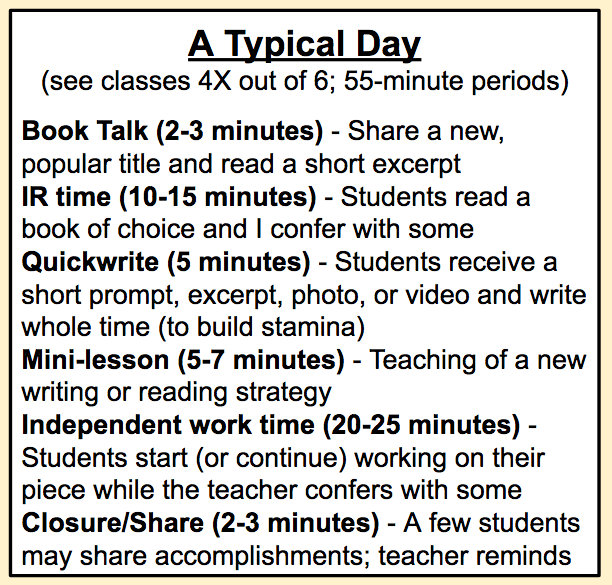
My daily schedule, which is based off of an example in Penny Kittle and Kelly Gallagher’s book, 180 Days.
I know the importance of listening, mainly because I know what it feels like to be ignored. To share an idea, only for someone else in a group to quickly move on to something else. What happens next? Silence. This is exactly what I don’t want in my classroom. I want my students to feel comfortable enough to speak up and write about topics that matter to them. I want them to see that I care, and I am listening.
This is where the freedom of the workshop model comes in handy.
Two recent book talks.
For book talks, I choose titles that are written by authors that students love, or need to be introduced to. (I have students complete a survey at the beginning of the year so I know what they like and dislike right away.) I choose excerpts that they can connect with, and others that will shock them. Their to-read lists grow longer and longer.
During independent reading, I can confer with students. Sure, it’s often about the titles they are reading, but sometimes it’s my way of letting them know that I see something is different, and possibly wrong. I can check in and see what I can do to ease a worried mind. Or, maybe it’s my chance to applaud them on a job well done.
Quickwrites can incorporate poems, video clips, and excerpts that connect to topics students long to discuss. School should be a place where students can speak freely about topics like anxiety, current events, racism, the difficulties of growing up, and so much more. The possibilities are endless.
Mini-lessons may be brief, but I can work in some of my own writing here. This is where I put myself on display, and students can see I am a struggling writer just like them. Comfort and ease are added to our classroom.
Independent work time provides another opportunity for sharing ideas, whether it be through talk or writing. Students can write a piece with a peer, or one that’s all their own. Students can share their passions and frustrations in small-group or whole-class discussions. I can check in with them. I ask questions, if they need assistance, and what’s something they are proud of.
Finally, we share. Students share a new idea, a line they are proud of, or a word they’ve never used. We applaud one another. We build our community.
In today’s world, I am proud that I can give my students a classroom that is safe and inviting. Workshop makes that possible.
Sarah Krajewski teaches 9th and 12th grade English and Journalism. She is currently in her 18th year of teaching, and is always looking for new, creative ways to help her students enjoy learning, reading, and writing. At school, she is known for dedicating her time to helping students become lifelong readers and writers. At home, she is a proud wife and mother to three readers. You can follow Sarah on Twitter @shkrajewski and her blog can be viewed at http://skrajewski.wordpress.com/.














 Three Teachers Talk