Author Archives: sarahkrajewski

The Importance of Story: Our NaNoWriMo Conclusion by Sarah Krajewski

On November 30th, the last day of National Novel Writing Month, I decided to sit down and reflect on how it went. As a teacher participating in NaNoWriMo for the first time, I was disappointed that I didn’t meet my word count goal. I didn’t even come close! And during NCTE 2019, I didn’t write everyday like I hoped to. At the same time, I was proud of how much I did write. I had never written a story of that length before. I never spent so much time planning a story out, and falling in love with my characters, scenes, and their purpose. Most of all, I learned so much about story writing and just being a writer. Yes, I am a writer.

A slides from A.S. King’s NCTE 2019 presentation called “Emotion at the Center: Narrative, Vulnerability, and Community in the English Classroom.”

As I walked back into school on December 2nd, I expected to hear a lot of students sharing they were thankful November was over, but I also had hope that many had the same experience I did. Sure enough, the vast majority of my seniors loved their stories, and many of them now want to continue writing into December. Others shared they were so proud that they made time to write outside of class. (I was not hearing that in the beginning of November!) So, what changed?

My notes from a NCTE 2019 presentation by Kylene Beers, Lester Laminack, Ernest Morrell, and Gholdy Muhammed called “The Joy and Power of Story: Why Raising and Teaching Readers, Storytellers, and Writers Will Change the World.”

My students started seeing themselves as writers. Most of them did not need (or want) my reminders to write. By the end of the month, I was receiving messages from them sharing how proud they were when they wrote. Writing had become a habit, and for many of them, therapeutic. Students fell in love with their characters and stories, and shared them with family and peers. I couldn’t be more proud.

Comments from my seniors as they reflected on their NaNoWriMo experience:

” I have learned to space out my time, and not cram everything together. Taking my time with things will allow the end result to be much more developed and thought out.” – Shymaa

“I am most proud of my progress within the second half of the NaNoWriMo month because I genuinely wanted to write and that is a big step for me.” – Kathleen

“I kind of see the similarities in how I do dialogue to how Jason Reynolds does his dialogue which shows improvement from the last time I tried to write a story…I feel like there’s a lot to pick up from how someone moves, looks, stands or the actions they do in real life and in a novel.” – Torien

“…I can say I am very proud of what I’ve wrote and how much I wrote. I never would have though of myself wanting to write a story of my own but it was something I did enjoy.” – Kiara

“I have plans for the story, to get more done with it. In the end it was just the want, the want is the important part of writing. I learned as a writer if I put my mind to it I can get it done.” – Anonymous

“…maybe there’s a kid who’s going through some stuff, and doesn’t have anywhere to turn to, to vent or talk. Then they go through NaNoWriMo and find the perfect place where they can take all these emotions and put them into something to make them feel  better. It’s definitely a fun and new experience, and I’m glad I got to experience it.” – Kylie

“I’m proud of the relationship that I’ve developed with the two main characters I have…this whole unit made me feel more confident in my writing even though it was a big challenge for me.” – Marisa

“…through this process, I have discovered that I genuinely enjoy writing. It’s a fantastic way to unwind at the end of the day, or to get something off my mind if I need to.” – Ashton

“I learned that when I put time and dedication into writing, I can really write something special.” – Hassan

After looking over their rationales, revisions, and reflections–and wiping away many tears–I know NaNoWriMo will be a staple in my classroom for years to come. My students and I entered nervous and self-conscious about our story-writing abilities, and we came out writers. Now that’s a win in my book.

Sarah Krajewski teaches 9th and 12th grade English and Journalism at Cleveland Hill High School near Buffalo, New York.  She is currently in her 18th year of teaching, and is always looking for new, creative ways to help her students enjoy learning, reading, and writing. At school, she is known for dedicating her time to helping students become lifelong readers, and for being a devoted reader herself who “knows her books.” At home, she is a proud wife and mother to three readers.  You can follow Sarah on Twitter @shkrajewski and her blog can be viewed at http://skrajewski.wordpress.com/.

Is NaNoWriMo In Full Effect? by Sarah Krajewski

Last month, I shared the preparation my seniors and I were doing to get ready for National Novel Writing Month. My goal was to help them creating writing routines to increase the volume of writing that they do. Now, we almost halfway through the month of November, but I’m just not seeing much of an increase in volume yet.

We Should Have Planned More

I thought we were ready for NaNoWriMo, but in actuality we were just ready for those first few lines. How am I discovering this? Through my own writing for NaNoWriMo. When I began writing, I thought I had a great idea, but after a page or two, I got stuck. The little basic planning page we did wasn’t enough to guide my thinking. I needed more of a structure for my story, so that meant my students probably did too. It was time to make some changes.

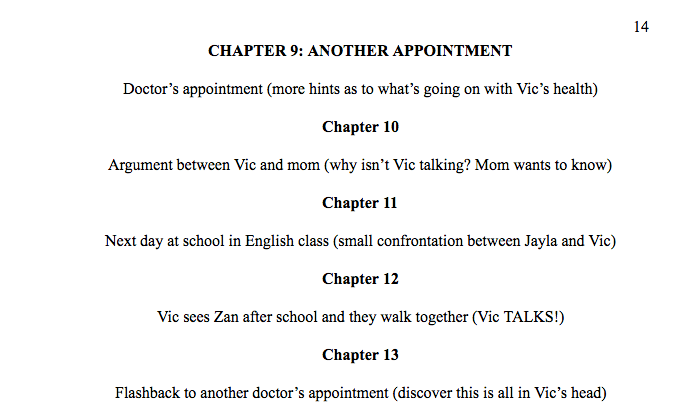
Some additions I added above my NaNoWriMo draft.

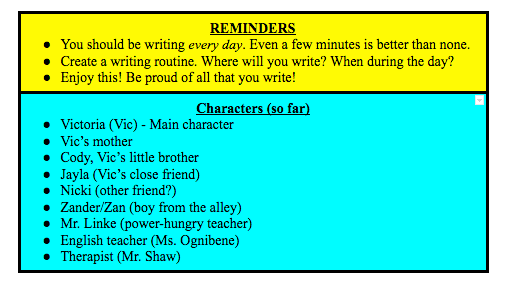
I started by noting what has been helpful to me during the writing process. We teachers really won’t know what our students are going through unless we are writing ourselves. The yellow “Reminders” box to the left was on every student’s draft page, but the blue “Characters” box wasn’t. I realized that I needed a place to write my characters so I could remember who is who. Sure enough, when I showed it to my students, a lot of them did the same thing. I also found that in order to get “unstuck,” I had to plan out my ideas more so each scene had a purpose, and I needed my students to see this too.

Some single-scene planning, so each one has a purpose.

Enter YA novelist J. Elle, whose first book, Wings of Ebony, comes out in 2021. She loves sharing writing tips with up-and-coming writers, and she was kind enough to make a video with some writing tips for my students. Yes, I could have shared some of these tips, but it means so much more when a published author shares them. Even before J. Elle suggested it to my students, they were taking notes! Her ideas made so much sense to them, so many reluctant writers had their creative juices flowing again after this video. This worked out so well that I am already looking to bring in another local author.

Other Road Blocks

Besides planning, some students just didn’t see themselves as creative writers. One senior’s comment summed up many of their feelings quite well when she said, “Mrs. K, can you just give us another essay to write?” That was proof that they needed the NaNoWriMo experience more than ever. They were so used to those five-paragraph-test-prep essays that they didn’t know how to write anything else. They were scared, and as I shared with them, so was I. This was my first time writing a story of this length too, so I knew my students needed see all my struggles to know they were not alone. I shared when I got stuck, and when I saw a need to rearrange scenes. I shared a picture I added to help me imagine my setting, and a scene I hated so much that I deleted it. I showed my real struggles, hoping my students would see me as a writer just like them.

Inspired by Pernille Ripp’s “Reading Action Plan”

As we ventured into NaNoWriMo, I also discovered that some students didn’t write outside of class. After conferring with them, I found out that many students just didn’t have a computer or device to write at home. We discussed how this writing time could happen during school hours (besides just in class). We began creating our own writing action plans that worked for us. For me, all of my writing was at home, since I spent in-class time conferring. My students found writing time during their Homerooms, after school, and in study halls. I even encouraged them to write during their mentor time with freshmen, since the 9th graders would benefit from seeing their mentors as writers. For those students that still struggled to find time with a device, I encouraged them to hand write.

Next Step: Keeping Up with Communication

For the rest of the month, I will only see students four more times. I know it’s only November 13th, but that’s because I have two workshops, one being NCTE and ALAN. We also have parent teacher conferences. Yes, I’m not going to be in the classroom much, so I need a way to show my students that they can still communicate with me. We use the Remind app, so I send daily writing reminders to them. I also encourage them to use the “private comment” function in Google Classroom, since their stories are all there. Students will also have “accountability writing partners” (thanks to Debbie Myers for the idea). They will have someone who will try to push them to write, and thus hold them accountable for reaching their goals. My hope is that, with these communication tools in place, more writing will occur.

Sarah Krajewski teaches 9th and 12th grade English and Journalism at Cleveland Hill High School near Buffalo, New York.  She is currently in her 18th year of teaching, and is always looking for new, creative ways to help her students enjoy learning, reading, and writing. At school, she is known for dedicating her time to helping students become lifelong readers, and for being a devoted reader herself who “knows her books.” At home, she is a proud wife and mother to three readers.  You can follow Sarah on Twitter @shkrajewski and her blog can be viewed at http://skrajewski.wordpress.com/.
Increasing Writing Volume with NaNoWriMo by Sarah Krajewski

Over the past few years, I’ve worked hard to help my high schoolers increase the volume of reading they do. I book talk popular titles. I give them time to read a book of choice in class. I’ve incorporated student-led book clubs. All of this gives my students what they need to increase their reading volume, but what about their writing volume? Over the summer, I spent some time thinking about ways to increase their amount of writing.

I already incorporate quick writes each day. Students receive independent work time so they can make some progress on a writing piece, but I usually have my own requirements for that piece. Currently my seniors are finishing up college application essays, and my freshmen are adding a second scene to their single-scene narratives. I’m telling them what genre to write in. Though they can choose the topic, I am assigning a task and giving them a rubric. My students need a challenge. They need to push themselves to writing independently outside of class just like I encourage them to do with their reading. Enter National Novel Writing Month (or NaNoWriMo, for short).

What is NaNoWriMo? National Novel Writing Month began back in 1999, and its goal was to encourage participants to write 50,000 words throughout the month of November. I’ll admit that I did not know about NaNoWriMo until a few years ago when I read Vicki Meigs-Kahlenberg’s The Author’s Apprentice. Her 8th graders participated in it, and she was so impressed with the results that it became a staple in her classroom each year. If her 8th graders could do it, couldn’t my 12th graders? I decided that this year would be the year to try it.

Preparation

The Author’s Apprentice: My seniors will finish up their college application essays this week, and then we will begin preparation for NaNoWriMo. In order to prepare myself, I am rereading The Author’s Apprentice. Meigs-Kahlenberg has her students prepare by starting with weekly writing challenges. These challenges push students to read like writers and eventually imitate what writers do to improve their own writing. This way, if students get writer’s block during the process, or are just stuck for an idea of where to go next, they know they can visit the worlds of the authors they love for ideas.

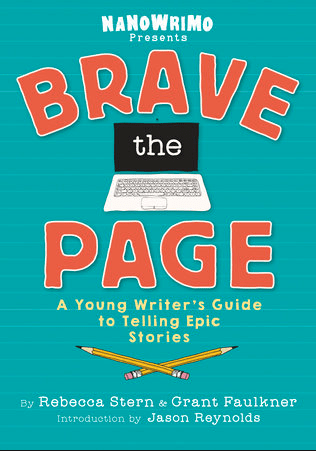
Brave the Page: I also just finished up NaNoWriMo’s book, Brave the Page, which is written more for student writers, but I got some great ideas from it. The introduction is written by none other than Jason Reynolds, one of my students’ favorite authors every year. He gives a great pep talk to young writers. The section that follows reminds students that all of them are already writers. The inspirational quotes and tips will motivate all readers, no matter the age. Be sure to check out the audio version too! Authors like Jennifer Niven, Marissa Meyer, and Daniel José Older give their own pep talks as well. I plan to use them throughout the month when I see students needing more than just my encouragement.

NaNoWriMo Website: NaNoWriMo has a Young Writer’s Program for educators that we will be using. Teachers can create groups, which I did for each class. Students can chat with one another, and provide inspiration that sometimes a teacher cannot. As their teacher, I can make challenges to push them along. If desired, there is a whole high school curriculum that educators can use. With all of their resources, educators’ minds will be eased.

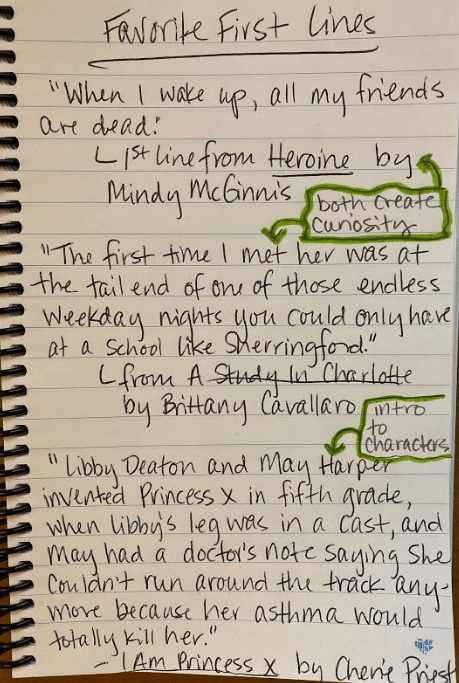
Some of my “favorite first lines.”

Mental Prep: As teachers of writing, we often know that simply getting started is the hardest part for many students. Next week, my seniors and I will begin preparing by starting to bring our notebooks with us everywhere. (I say “we,” for I will be writing along with them.) When an idea comes to us, we will write it down. We will use our quickwrite time to create lists about past events in our lives, things that made us laugh, things that made us upset, etc. We will collect “favorite first lines” from the books we love. We will talk about giving ourselves goals, and planning out when our “writing time” will be outside of class. We will talk about those all-important deadlines, but also remind ourselves that we are not failures if we don’t meet them. We already have writing routines, but we will create new ones to prepare for the amount of writing that is coming our way. In other words, we will mentally prepare for 30 days of consistent dedication to writing.

Time to Get Started!

So, I think we are ready! Well, we are as ready as we’re going to be. I know I cannot plan for every single issue that could arise, but I’m thankful that my students have a trusted writing community that will encourage and assist them every step of the way. When November 1st hits, my students will begin writing more than they ever have, and I can’t wait to see the results! My hope is that this experience will inspire many of my students to create independent writing routines, even after November ends.

NOTE: I look forward to sharing how NaNoWriMo is going for us next month.

Sarah Krajewski teaches 9th and 12th grade English and Journalism at Cleveland Hill High School near Buffalo, New York.  She is currently in her 18th year of teaching, and is always looking for new, creative ways to help her students enjoy learning, reading, and writing. At school, she is known for dedicating her time to helping students become lifelong readers, and for being a devoted reader herself who “knows her books.” At home, she is a proud wife and mother to three readers.  You can follow Sarah on Twitter @shkrajewski and her blog can be viewed at http://skrajewski.wordpress.com/.