The school supplies are coming! The school supplies are coming!
You’ve seen this, right? You walk around the corner, minding your own business with a cart full of summer clearance items (I know, I know…there’s a reason the summer items are on clearance) and BAM! Pencil themed signage and endless bins designed to heighten  the appeal of protractors, highlighters, and color coordinated glitter glue. (That last one should sell itself, no?)
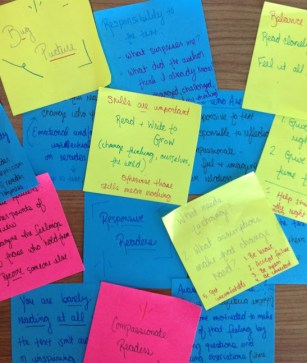
Don’t get me wrong. I love me some school supplies. I still get excited to line them all up, to organize them, to dream of a perfectly categorized school year when I can find everything I need, revolutionize my post-it note-taking system (They are everywhere. Every. Where.), and create the equivalent of a zen garden on my desk with pretty pen holders and file folders.
But, I’m not ready. Hear that, corporate America? I’m not ready to go back.
You’re stressing me out. Your Hello Kitty backpack pushing, pink eraser wielding, bento box my lunches mid-July attack on my summer is not welcome.
Truth be told, I need more time. I need more time for two very important things:
- To get lost. A few weeks back, I wrote about remaining calm through mindfulness and embracing summer by being kind to yourself. When I will actually get around to taking my own advice remains to be seen, but thankfully, I have great friends, and one of the best said something just this past week that reminded me of something I really needed to hear: “There’s plenty of time to get lost.” He is so right. There’s plenty of time to get lost in more books, lost in the garden, lost at the movies, lost in my writer’s notebook, lost on the patio with great friends, lost in thought about nothing at all.
- To be found. Despite everything I’ve written so far, or maybe because of it, I do get excited to get back to the classroom. Honestly, the rejuvenation I seek isn’t about checking out, it’s about checking back in with fresh eyes and a full heart for the coming year. I love to lose time on Twitter searching the ideas of amazing educators. I love the stack of pedagogy books I get to tackle, and after Shana’s post last week, I think I need to add Rewriting by Joseph Harris. I love learning alongside educators whose enthusiasm for choice, talk, and student voice will inspire me the whole year through.
So summer is a balancing act. A mix of letting go of school, to again embrace it as a teacher who is grounded in passion and emboldened by a capacity to grow, change, and reinvent myself. To be both lost and found, I return again and again to the possibilities presented to teachers and students when the classroom focus is to build readers and writers.
I find myself thinking this week, post emotional meltdown in front of a Target employee, about a piece I read from
“Our students need to be taught how to see, not what to say.”
 This thought has been ringing in my ears for days. In context, I found it to be a brilliant way to suggest a necessary departure from formulaic writing instruction. Beyond that, I find it resonating with my continued desire to be both lost and found during this blessing that we call summer vacation.
The duality of a “vacation” that often serves as just more time to work and prepare for the upcoming school year in the traditional (formulaic) sense, can also be a time to stop and look around at how experience, observance, and appreciation can mold our practice in the coming year.
The same duality exists in workshop. The rules for school (the guidelines, the philosophies for best practice, etc.) need to apply to all stakeholders in the literacy education of our students, not just to the students. As Amy said a few weeks back, “Every Teacher of Reader. Every Teacher a Writer.” In this case, it’s every teacher a seer too.
I’m taking time this week to really see (and again, mindfully appreciate) the possibilities: The English Journal read out on the patio in the sunshine, the extra time to write about everything and nothing at all, the planning meetings at a coffee shop instead of deep in the windowless conference rooms many of us are familiar with. I want to really reflect on how these more relaxed approaches to learning can inspire some of what I will ask my students to do and how I want them to see getting lost and found in our time together. I want them to see reading, writing, and talking about their ideas as opportunities to lose themselves in reflection, and find themselves there too.
So, no. I am not ready to go back, but I am ready to see both the lost (escaping into some poetry writing inspired by Iron and Wine’s Endless Numbered Days album) and the found (I just read Anne Whitney’s piece on authenticity in the classroom in the July release of the English Journal – blew my mind in a thousand amazing ways) of this summer.
The school year may loom large, and in truth, much of what I want to work on the rest of the summer does have to do with school, but I’m not on anyone else’s timetable yet. The bins of washable markers can wait. I still have a stack of books to get lost in, moscow mules to sip, and animal-shaped clouds to count, and even that (at least the first one) will make me a better teacher come fall.
Breathe in. Breathe out. Enjoy. Again, you deserve it.
How are you leaving time to get lost and enjoy? How are you ramping up for the start of school?
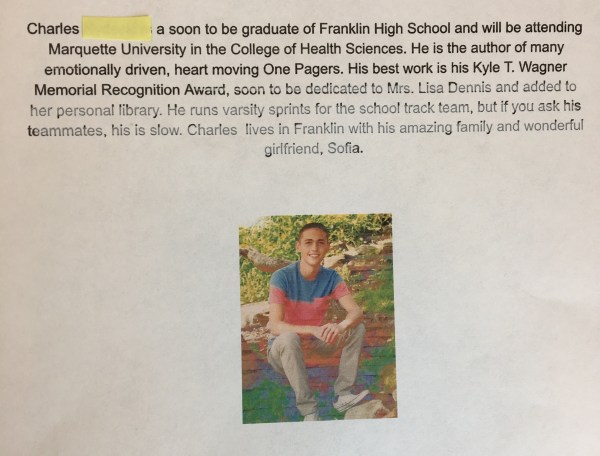
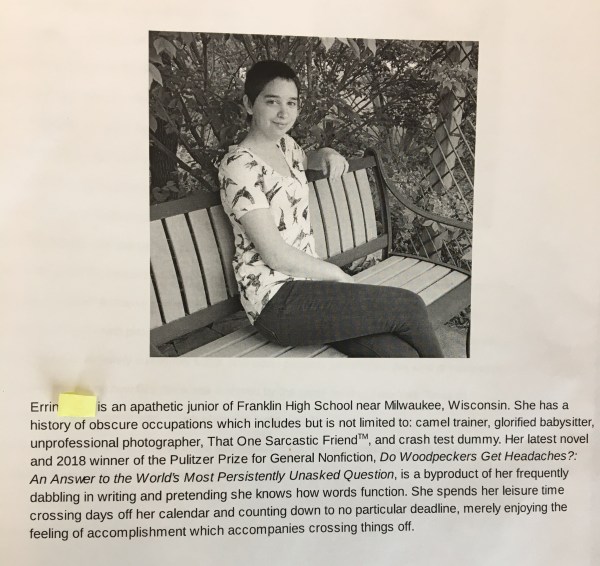
Lisa Dennis teaches English and leads a department of incredible English educators at Franklin High School near Milwaukee. This post was finished in front of a bonfire in our backyard, after a day spent reading at the pool. Cheers to summer. Follow Lisa on Twitter @LDennibaum

 (which I’d need 289 pages to dig into, so I’ll avoid that angle) and emotionally (which I will explore, but just a bit. My daughter and I are heading to the park, because I’ve been working on prioritizing). It’s a myth that was making me downright twitchy, because I thought I was “doing summer wrong.”


 to ask me to reach up and adjust the air vent for her, replying to my action on her behalf with a long and drawn out, “Bless you.”

 rules to keep the wheels turning. There was no student choice, just multiple choice. No discussions, just lectures. No collaboration, just eyes tracking the teacher.



 Hinton’s beloved classic celebrated fifty years of resonating with readers of all ages around the globe.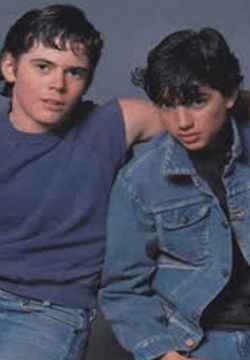


 who need it.” Meanwhile, they thought, “Hey. I’m here. What more do you want?”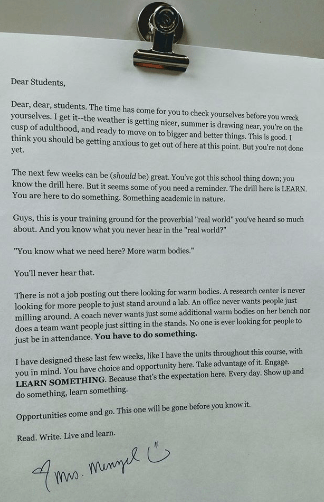






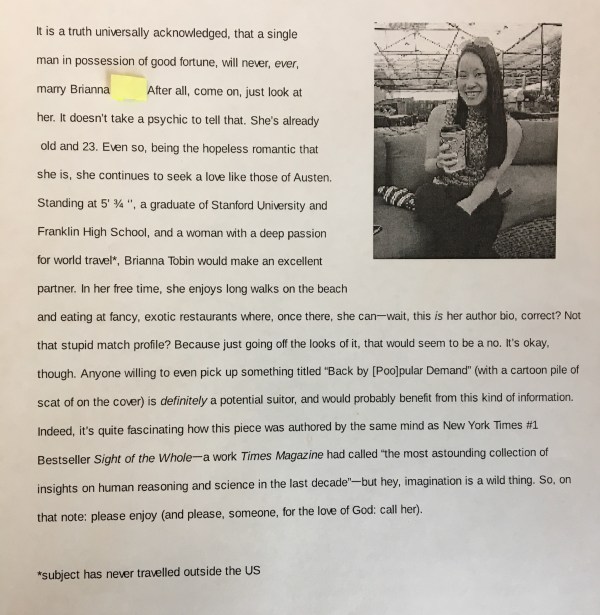
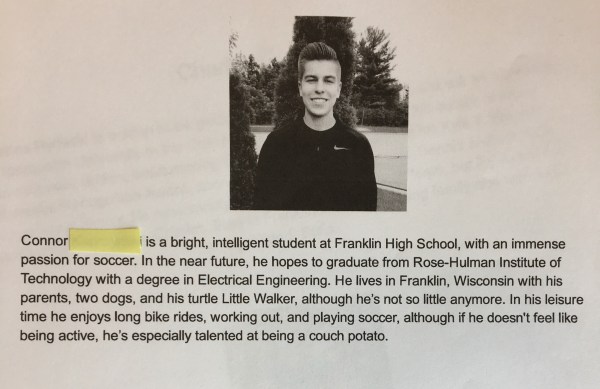
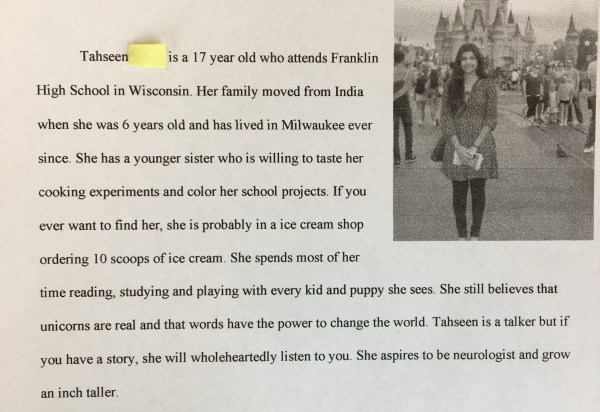

 year was a time to have students start summarizing work that we had done in order to demonstrate cumulative knowledge, as if a project could encompass all we’d learned together. In the past, I believe I was missing the point.


 I like to organize my thoughts this way. And, in no way am I suggesting that pulling ideas from a text is malpractice. At the end of the day, of course we need students to think deeply about their reading and demonstrate that thought through talk, written reflection, and/or analysis of some kind.


 Three Teachers Talk