Author Archives: Charles Moore

The End is the Beginning

EDIT: Five minutes after scheduling this post last night I got the email from the Book Love Foundation informing me that I won a Book Love Grant. So….didn’t sleep much last night. Too full up with excitement to write this into the post in a more elegant way. My apologies.

Hello Friends,

Today is the 4th of June and this year, my sixteenth yearly journey through teaching, came to its inevitable conclusion. This “end” though is not only about the end of the school year, but the end of a major part of my life. It was a difficult year, full of hard realizations and tough decisions, floods of water and floods of bullets. Yet…I look forward to a new opportunity in August.

If you traced the path from my house to my school you’d see the tracks my tires have worn in the pavement.  For the past 11 years I’ve driven to the same address every morning and traced that route home every night.  For more than a quarter of my life Clear Springs High School felt like home.  Change, I’ve learned, is/was necessary.  Thankfully, I’ve been given the opportunity to transfer to another high school in our district and  i I eagerly anticipate building a new beginning with a new team.

This is a season of change for me as I’m not just leaving the safety of the only high school in which I’ve ever taught-  I’m leaving coaching.  I can’t begin to list all the reasons why I’ve made that decision, but I will share that time with my family is no longer a commodity upon which I’m willing to negotiate.  Its not a matter of letting go of “the dream” of coaching.  I lived the dream, invested time helping so many boys grow into men, and felt the heat under the lights on Friday nights.  Coaching was like poetry.  Poetry can be happy or sad…devastating or celebratory.

While so much will change, a lot will not. I won’t forget where I came from.  The thousands of hours I spent sweating on the grass still inform my instruction just like the classroom helped me be better on the grass.  I’ll still watch football like a coach; I’ll just do it from the stands holding hands with my daughter or with my arm around my wife.

I’m still insatiably hungry; more eager to learn and grow than ever before.  I’ll continue to seek out opportunities to meet people more knowledgeable than I am and who know a better way of doing things that I do. There are so many of those people out there. From national conferences, to team planning periods, its all new to me and couldn’t be more excited.

I will continue seeking the most effective means of maximizing the power of my instructional practices.  I will continue devouring professional texts and building collaborative relationships with the teachers around me.  I’ll keep applying to present at every possible venue from the campus level to the national level.  I will spread the gospel of literacy and hope to help make a small change in this big world.

I will find ways to empower those around me to love what they do as much as I do. I’ll also seek those that already love it as much as I do and can empower me to share in their energy.

I will read and write because it makes me a better teacher of reading and writing.

What stands out when I look back?

  1. Our “Rooted in Reading” tree is one of the most successful moves I’ve ever made in the classroom.  My students BEAMED when we talked about how many books they recorded on the leaves of that tree. Even when it was transplanted at semester, it continued to grow.
  2. I poured my heart into the kids more than ever before.  The other evening when I asked a colleague when he was going to write his book, he replied: “I don’t know, but its going to be about how it is to build strong relationships with kids.”  I couldn’t agree more.  I would guess that I had a 97% success rate of telling each class that I loved them as the bell rang to release them to their next class.  Next year = 100%.
  3. We all moved as readers and writers.  Some more than others.  Some of us (me) had further to move than others.
  4. Sponsoring Student Council was a massively formative experience for me.  I could write a book about our year and how much we accomplished.  Working with kids that signed up for the class, rather than other reasons, was incredible. These kids changed the world for the better.  They changed me too.

What stands out when I look forward?

  1. The CCISD Literacy Institute!!! I can’t wait to get started (this morning) on this very important work.  Cohort 2 gets to stand on the shoulders of giants.
  2. Life Changes: Not just the song by Thomas Rhett (which is great, btw) but I’ve made some big decisions about what is important to me and who are the people that I want to learn from and grow with.
  3. Making changes in this profession that give young people the tools to stave off the yoke of tyranny. (too idealistic?)
  4. Teaching Pre-AP classes.  I’ve never taught anything but on-level classes so I’m thrilled for this opportunity.

The best stories are the stories of discovery.  Its time to write Act II of my story.

Charles Moore is excited to join the faculty of Clear Creek High School.  He recently discovered the joy of writing curriculum.  He loves going to the movies with his wife, driving his classic Corvette and hates building gates (Its the worst). He just finished reading Ten Things We Did (and probably shouldn’t have).

Books instead of Bullets

SF StrongIn my short time here as a regular contributor to Three Teachers Talk, this was the latest I’d waited before composing a post.  Though, that’s not really true.  I had a post mostly written last week where I reflected on this year we had and looked forward to a new start next year at a new school.  It would have been similar to this recent and amazing post by Sarah Morris.

Then Friday happened- 10 lives gone and countless others changed forever.

I struggled this weekend with how this post was going to go.  I’m not looking for sympathy here because obviously the 10 families who lost loved ones or the kids who watched their classmates be gunned down in front of them are truly the ones deserving of our hearts.

Like so many not directly affected by this tragedy, though, I struggled.

I struggled to stay composed when a student quietly sat down next to me at 7:55 am and said, “Coach, did you see this?” His phone showed a social media post about students being shot a high school not too far from us.

FullSizeRI struggled because I realized how comfortable I am using the term “active shooter” in a text message to my wife at 8:11 Friday Morning. This was the text message I sent her after I pulled up a local news website to see if it was true or anther false alarm.

I struggled because when my student council president told me she was scared walking down the hall at 1:00 that afternoon, the only response I could muster was, “I am too, and I think its going to feel like this for a while.”

msd

I struggled remembering that I wore my #msdstrong t-shirt to visit the Sequoias at spring break hoping to send a little bit of support to those in Parkland, Florida who lived through this earlier in the semester.

(Side note: I was at exactly this point in writing my post when my student council president called and asked if we can sell t-shirts to help support Santa Fe High School.)

I struggled because when my babies, a 2nd grader and a 5th grader, got off the bus at 3:30, I felt obligated to sit them down and tell them that a boy at a local high school decided he needed to kill his classmates. I couldn’t hold back the tears and my daughter, in her innocence, asked if my school had had to go into a “lock down.” She’s very familiar with what that means.

I struggled early Friday evening when, sitting in a colleague’s living room, myself and several other teachers celebrated the retirement of a woman who gave 44 years of her life to this profession.  I looked at the teachers sharing stories and laughs, at the sleepy dog on the floor, and the nine month old baby that kept stealing everyone’s attention. I wondered how I could balance feeling thankful to have spent the last 11 years working with this amazing person and at the same time think about how thankful I was to be alive.  I felt thankful that my school wasn’t the one to lose lives that morning, and that made me feel horrible.

I struggled when, an hour and a half later I was sitting in a quiet backyard celebrating the upcoming graduation of two of the most amazing people I’ve ever known. They are twins and I got to be the boy’s position coach in football for four years and the girl is my previously mentioned student council president.  Their parents are amazing too and as I sat there visiting with them, I couldn’t wrap my head around how our society can produce these kids and also produce a mass killer less than 13 miles away.  He took the lives of  innocent kids, like these, that morning.  Kids who who had so much to look forward to and didn’t do anything to deserve death.

I struggled because, once again, I had to think about whether or not I would be able to protect my students if bullets flew at my school.  I asked my self the questions: Am I doing the best I can to stop this from happening again? Is there really anything I can do?  Is there anything anyone can do?

I struggled because I knew we can’t take up all the guns and I’m not sure, if asked, that I would give up mine.  We can’t eradicate mental health issues.  We can’t hold schools inside of solid-steel sealed boxes.

I didn’t just struggle. I also hoped.

I hoped that instead of turning inward, we can turn outward.  That maybe we can intervene in these students’ lives in ways that goes beyond dress codes, GPAs and graduation rates. Perhaps we can instill a sense of urgency in our young people, our future, that causes a change in them where instead of acting out their demons on one another, they look to each other for acceptance, love, or even just help. Maybe we can be more like the players and coaches of the Clear Springs Baseball Team who dedicated their game Friday night to Santa Fe.

I hope that even though I’m not sponsoring student council at my next school, I can help build on what we did this year.  I was lucky enough to be chosen to present at our district’s upcoming Character Conference on June 6th. I’m sure there will be presenters at Clear Lake High School that day who can help make change. I won’t technically be presenting, just facilitating what I think might be the only student presenters at the conference.   The student council officers of Clear Springs High School will share their stories of reaching out to our elementary feeder schools in an effort to build leadership and pass on the lessons they’ve learned to the next generation.  Maybe more students like them can make connections that help prevent massacres.

I hope more teachers and administrators realize that our students can do amazing things when we give them the space and the resources they need.  When we keep them free of the burden the adults choose to carry.  But the adults can help too.  I can’t think this would have happened if shooter had more access to books and less access to guns.  I can’t help but wonder if we treat our students with more gravitas then they just might tell us when they think something like this is going to happen and maybe we can have the chance to stop it.

I hope the teachers at my new school get used to a man (who’s been mistaken for a grizzly bear) telling other peoples’ babies that he loves them.  I hope I’m not the last person to tell them that.

Charles Moore is a teacher in League City, TX.  He is enjoys welcoming his kids off the bus with a smile and a hug every afternoon and making sure the dishes, laundry and other household needs are met before his wife gets home from work. The student council he sponsors will, hopefully, be selling t-shirts these next two weeks to support the Santa Fe community. Please email him if you are interested in helping and follow his twitter @ctcoach for more information.


Guest Post – Chronicles in Conferring

4

I was so excited when Charles Moore asked me to write a guest post for The Three Teachers Talk community.  After meeting Amy Rasmussen and reading posts like Writing Heals. Writing Assignments Do Not and How to Confer Like a Ninja, I continue to learn solid strategies for engaging my students in authentic writing activities that matter to them.  I am an avid reader and writer; so, it is no surprise that my favorite part of this job is conversing with students about their own reading and writing lives!

In the past, my conversations with students tended to be informal and sporadic; I would only focus on the more traditional feedback like formatting, conventions, and organization. But, with no end-goal or clear means to measure if these conferences were improving my student’s abilities to really think like writers, I would often feel lost and underwhelmed.

3

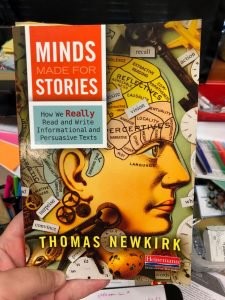
Luckily, I found some real direction after reading, Minds Made for Stories, by Thomas Newkirk and Writing with Mentors, by Rebekah O’Dell and Allison Marchetti.

Both books inspired me to weave together genuine writing advice with mentor texts the students could use as unique needs emerged during their writing journey.

I am so thrilled to share my experiences with other teachers because I love workshop now, and each day is a new opportunity to promote passion and purpose through writing. Charles Moore showcases some great resources for similar strategies in his post, Formative Assessment Works!!! 

A Look Inside My Classroom; Conferencing & Sharing Mentor Texts

Setting the Scene: Sarah, a music enthusiast, has been working on a song analysis essay for a few weeks and she started getting frustrated with her lack of progress. I met with her on several occasions, narrowing her choices in artists and songs, until she had a solid

2plan for her draft. Suddenly, she felt like “it just wasn’t going anywhere,” and she was ready to abandon the project entirely. I think we’ve all seen this before; it was a classic case of “I know what I want to say, but I don’t know how to say it.” She was also suffering from the mind-numbing effects of having more material than she could manage. What to do?
The Intervention: In response to Sarah’s crises and hearing similar angst from other students, I decided to have them all conduct a peer-to-peer conferencing activity. Students would read each other’s drafts and provided feedback that both praises the connections made and presses the writer to stretch a little more.

The Sharing Magic: Sarah decided to exchange her draft with another student who is really into writing poetry and has published several poems during Workshop this year. The two writers discuss, and Sarah is immediately rejuvenated by her partner’s comments and recommendations.  Her partner suggests that she use lines from the songs she has analyzed to write her own epic poem.

5

My Teachable Moment: As she is emphatically exclaiming her eureka moment, I turn to the bookshelf behind me and grab an annotated translation of Dante’s Inferno. I hand her the book, explaining how Dante created elaborate allusions in his poem that are illuminated by the translator’s detailed footnotes.

I never get tired of having moments like this with my students! Sarah now had a mentor text to help guide her through the treacherous depths of poetry composition and analysis.

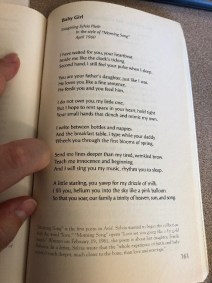
The next day I brought her a copy of  Your Own, Sylvia by Stephanie Hemphill.  A portrait of the poet’s life told in a collection of verse. Each poem includes insightful footnotes that Sarah could use as a model for her own writing.

1

The Final Act: I was so happy to see a copy of Dante’s Inferno and Your Own, Sylvia on the desk of a student who had spent the entire first semester fighting me to read anything other than mystery novels. Not only is she growing as a writer, she is also growing as a reader. Funny how it works like that.


Jenna Zucha teaches English II Pre-AP at Clear Springs High school. She is currently reading Trevor Noah’s Born a Crime and is looking forward to spending more time with her dog, Scout, and devouring her summer reading list! Follow her on twitter @MsZucha and There’s a Book for That

One Concept That Makes Me a Better Teacher: Tempo

Earlier in the Spring I spent a Saturday morning at the new football stadium in Katy, Texas listening to football coaches speak about various aspects of the sport.  That’s right, in January, high school football coaches get together to talk football… for fun.

The speakers presented their philosophies of offense or defense and talked about schemes and personnel.  I loved how, universally, they were: bright, confident, and eager to share their knowledge.

Just like with teachers, collaboration helps grow the profession. Coaches know the importance of sharing insight.  Its something I love and appreciate about the profession.

One speaker, from a school down here by us, presented on the topic of “Tempo.”

Tempo is the offenses ability to change how fast or how slow they snap the football.  In layman’s terms, its a way for an offense to give themselves an advantage over the defense and can be brutally effective when used to full effect.  Often times, tempo can dictate who is going to win or lose a contest.

The same can be true in our classrooms.

Often times, I find myself racing along, pushing the students through this concept or that; when necessary circling back around to re-teach when needed or tie-in an idea that supports our current work. I like to think of workshop pedagogy as weaving a tapestry made of many different threads of many different types and colors.  Sometimes we pull in this string or that one.  Whichever combination of threads that most effectively addresses our students’ needs.

I’m continuously amazed at how well the students facilitate this complexity in their learning.

Penny Kittle and Kelly Gallagher talked about their process in ” target=”_blank” rel=”noopener”>this amazing podcast. They explain it far better than I ever could.

Momentum

I am a big believer in using momentum in my instruction.  When the students see success in their literacy, I want to capitalize on those feelings of success by moving on to the next idea quickly. Any lull or pause in our movement forward is an opportunity to stop and lose focus. I don’t like “catch up days.”  Every day, in my mind, we should move our literacy forward.

Tempo

What I don’t do often enough, is take a deep breath and slow down.  I’ve found, this year, that I don’t take time to do the “fun” workshop activities. I’m talking about activities that build morale and allow the kids to laugh and, dare I say it…. play.

When they get to approach an activity as “play,” they can find success they haven’t found before:

Or they might find a fun way to learn its okay to come up a little short:

Either way, they are engaged in facilitating their own growth!!!

The assessments I’ve asked them to complete show me so many gaps in their skill sets that I can’t ever find enough time to address them all. But being hard-headed and driving forward without ever taking a moment to relax, we miss out on some of the fun that workshop can facilitate.

I have quantitative data that shows my students are reading and writing more than my previous senior classes and I have the anecdotal information they share with me about reading and writing more than any previous year in their education.  This is important to consider and it is valuable data to analyze as I work towards the end of this year and start thinking about next year.

The data tells me something else.  My students are burned out.  They are done; not just with their writing and reading, but with their thinking. Maybe I moved them too fast through our work in the fall and early spring.  Maybe the world they exist in is so far removed from the one I experienced at that age, that I have no real understanding of their stress levels.

I have to ask myself, what am I trying to accomplish and can I get that done operating the way I operate right now.

“Tempo,” I tell myself, “slow down.”

I have to do a better job keeping our tempo in mind as we finish out their high school education.

I’ll mix in more Poet Moments.  I’ll take more time to let them explore their own voices through narrative work that isn’t for a grade and is for fun.  I’ll change the mode from individual drafting of language to more group feedback. Generally, I’ll ratchet down the intensity of our work and lighten up on the speed with which we attack it.

What are some of the “fun” workshop activities that I can mix into my lesson plans that still hold value and have rigor?

Charles Moore is currently reading Before We Were Yours and The Glass Sword. He spends his newly freed up afternoons waiting to get his kids off the bus and tending to his beloved pool.  He just completed the GRE and hopes to start graduate school in the fall at U of H. One more thing, he recently took his Student Council class to a ropes course leadership facility and it was one of the best days of his teaching career.  Two of the many videos he took are included in this post.

Formative Assessment Works!!!

For those of you who haven’t taught Seniors, trust me on this:  Formative assessment during the second semester is challenging.

If you’ve taught seniors, then you might understand where I’m coming from:  Sometimes it’s hard to tell if they aren’t grasping a concept, or they are just too tired of school to have the energy to engage.

I hurts my heart to even consider that my precious learners are worried about bigger issues than Comparative Literary Analysis essays or finding examples of bias in their self-selected texts.  Prom looms five days away and graduation seven weeks after that.  They work, they compete in extra curriculars, they deal with the adults and peers in their lives.  I forget, sometimes, that their plates are filled with important thoughts.  I remind myself I’m not doing their stress levels any favors by point out that we still have important work to do before June 2nd.

Last Monday we reviewed an excerpt from Niel Schusterman’s Thunderhead as a mentor text for practicing literary analysis through all the lenses that should be crystal clear to these literate learners.  I needed to assess their understanding and thinking so that I could make decisions about the instruction leading up to the summative assessment.  That’s the point of formative assessment; to “form” a plan for instruction.

I read the short selection with them, and asked them if they would, please, mark their thinking on this first lap through the text.  They should, as they’ve done many times before, underline or highlight what they noticed about the words the author chose through the lenses of diction, bias, author’s purpose…literally anything they noticed within the realm of literary analysis. It’s the last nine weeks of their public education career. They should be able to look at a text through a variety of lenses.

Some of them made some marks on the page while others wrote notes next to highlighted lines or words.  Others, though, marked nothing.  [Alarms wiggle and stir in my head. Something’s not right.]

I asked them to share within their groups what they noticed.  Muted whispers of ethos, tone, and metaphor struggled out of some groups, but again, most said very little.  Very few connections were being made. For them and for me, the picture was as clear as mud. This, by itself, is important formative assessment. This wasn’t working. [Def Con 55- Full tilt klaxons at maximum volume!]

Yet, I refuse to blame them.  I fully believe that it is solely on me, the teacher, to facilitate engagement with the text.  Somehow I need to do a better job inviting them to take all those useful tools out of their tool belts and dissect this very meaningful text.

New England Patriots at Washington Redskins 08/28/09

I bear a striking resemblance to Tom Brady.  Photo by Keith Allison

In football parlance, I needed to call an audible in the middle of the game. What I had hoped they would do; they won’t or can’t.  It’s time for me to jump in and scaffold this concept to a place where they can see the connections they can make and I can assess their thinking.  I’m not going to put them in a position to fail on the summative assessment if I know they aren’t ready for it.

In a whole class mode, I read over the text, mark what I notice and verbalize my analysis.

Now I ask them to talk about what they notice.  There it is…an increase in discussion, an inflation in dialogue. The alarm volume turns down a notch, but it doesn’t turn off.

I wrap the class period up with an invitation to write about what moves the author is making and as they do I confer with a few students who seem completely flabbergasted.  The bell tolls, signaling an end to their literary torture session.


Thus was the source of my salvation:

book

I only saunter.

Jumping into this book reminded me of a few important tenets of writing instruction that I let myself forget:

  1. Give them choice- I was allowing no choice in the subject of their analysis.  I know better than to restrict their reading and writing experiences and I let my, and their, end of the year exhaustion affect my decision making.
  2. Show them, not tell them, what you want to assess.  I wasn’t showing them examples of literary analysis and again, I know better.  I was expecting, wrongly, that Senior English students would confidently engage in literary analysis and move forward with their thinking in a way that shows me they can write a response in essay form.

After school, I tore up my lessons plans for the next four days and re-wrote them to reflect what I SHOULD do to support my students in this exploration.

On page 5 of their amazing new book Marchetti and O’Dell introduce a mentor text written by Joe Fassler from The Atlantic.  His recurring series “By Heart” is a collection of responses from a diverse group of thinkers and writers and is an amazing resource.  A simple Google search returned a link to this series of essays. I scanned the list of the titles and discovered an article from September titled, “What Writers Can Learn From Goodnight Moon.”   In it, Celeste Ng describes her feelings of the children’s book and how it “informs” her writing.

Perfecto!!!

This checked so many of the boxes of what I was looking for in a mentor text.  And…I get to read a children’s book to “big” kids.  I know enough about my students to know they will love this.

Also, I used Marchetti and O’Dell’s five part descriptions of literary analysis on pages 11 and 12 to create a glue-in anchor chart for their readers’/writers’ notebooks that helped to clarify what exactly we should look for when reading and writing literary analysis.

Confidence restored! Disaster averted… kind of.

We Ng’s reflection and discussed how this was a perfect example of literary analysis.  They asked questions, we laughed about Goodnight Moon.  I saw their confidence grow and I knew we were back on track and ready to move toward our essay.

Thursday, we started the drafts and I hope to see many of them tomorrow.

Being responsive and intentional is a crucial part of the workshop pedagogy.  I can’t stress enough how this one piece can make our break my teaching.  My lesson planning skills have finally reached the point where I plan for and anticipate opportunities to change up what we are doing to match what the students need. This was an opportunity for which I hadn’t planned, but we made the adjustment and made it work.

Sometimes, that’s how it goes.

Let me know in the comments below when you’ve had to make big changes on the fly to support your students’ learning. I know I can’t be the only one.

Charles Moore is neck deep in Children of Blood and Bone.  He’s spending the day taking his daughter to school and then having lunch with her.  It might be the best day of his life.  His summer TBR list is growing uncontrollably; feel free to add to it in the comments.

Standing, spellbound, among Giants…

So that’s that. I’m almost exactly two years in.

I jumped head first into workshop practice at the start of the fourth grading quarter of the 2016-2017 school year. This was about the same time I asked to try my hand at sponsoring our Student Council on top of coaching football in the fall and soccer in the spring.

I learned I’m a glutton for punishment.

Two years of workshop practice elapsed and I still quake at my lack of knowledge and experience.

I’m still a novice; yet I’m motivated now more than ever before.

Thinking about starting the journey? Look here.  Also, check out this amazing post! This blog contains a wealth of knowledge and when it was introduced to me two years ago, I was smitten.

I think we can all agree that Workshop is both exhilarating and terrifying. It’s kind of like standing in front of one of the largest living organisms on the planet.

Recently, I traveled across California on a site seeing adventure that shared some symbolism with my workshop journey.

As my family and I wound upward in elevation through a mountain forest ten days ago, we started noticing giants. They stood out from the other bits of foliage not just in their massive size, but also in their presence. The sensations reminded me of the amazing teachers I’ve met. Have you ever noticed how some teachers have almost an aura about them? I feel it every day before school, between classes, at meetings or even just walking down the hall.

tree3

Standing among those behemoths was exhilarating. I’m a big guy and these ancient giants made me feel like a tiny speck, a flea at their feet. I’ve never felt so insignificant, small, or helpless. If you haven’t stood next to one, you can’t possibly understand the deep sense of awe, unless you know truly transcendent teachers, as I do.

The same feelings that massive trees evoke pour out of my mind as I reflect on my journey with workshop; which I do often.

Maybe you are like me and sometimes feel overwhelmed by the complicated and time consuming process of delivering workshop style instruction day in and day out.

Many of my peers tell me how much they love this pedagogy, but also remark how much preparation is necessary to be true to what the students need most. They are so right!!!

Despite the struggle.  Despite the time and stress…in me:

bane

So the following ideas are what work best for me:

  1. Engage the professionals around you – I learn more from the professionals around me than I do from anywhere else. Our impromptu hallway discussions are invigorating and refreshing.  Teachers learn best from teachers.

  2. Engage the professionals in your professional library – There exists an avalanche of information for us to access.  Of course Kittle, Gallagher, Romano, Newkirk, Anderson, Atwell and so many others should be studied and reviewed yearly.  There are many new and notable books that I’ve experienced just this year:

  3. Engage the professionals on social media- For so long I was afraid of social media and its potential impact on my professional life.  I felt it was for the kids and better left alone.  Boy was I wrong.  Social media leverages collaboration in a way that nothing else has ever done.  Twitter chats are so much fun to follow, much less participate in.  Check this out.

  4. Engage in reflecting on your own work- Take time to write about your experience.  I’ve found writing about this journey to be cathartic and energizing.  Its more than writing though, its recording my place in this movement.  We are changing the world by advocating for literacy to emerge in the forefront of education.

Charles Moore is currently neck deep in Fates and Furies and is engrossed finding more books for his library. 

Say it Ain’t So! Poetry Can’t Help Readers with Non-fiction!

I know, I know. I write about poetry ad nausem.  Poetry has been a focus for me this year I’m constantly finding ways to fold poetry into my instruction all the time. I wrote about it here.

Don’t single me out; Amy included her own poetry thoughts in this post.

I’ve noticed that my students don’t connect their emotions to non-fiction pieces as well as they do with poetry.  That’s unfortunate because real world issues should elicit an emotional response…but in most cases they just don’t.  I think its important, in literacy instruction, that we try to bridge that gap.

Recently, I found an opportunity to integrate a little poetry with some non-fiction.

One of several non-fiction pieces that I brought into the classroom was this one from the New York Times written by Carl Wilson. The piece talks about Rupi Kaur and her popularity compared to those who published poetry before the avalanche of social media.

Our focus was not only to look at these non-fiction pieces in order to see the moves that authors make, but also read with the thought that we could respond to the articles in the form of a Letter to the Editor.

I chose this response format because I saw that it might facilitate and opportunity for us to talk about citations, embedding quotes, and responding to nonfiction in a way that might appeal to my students.  Not only did the student struggle to connect to the pieces, they struggled to keep their eyes open the first time they read through.

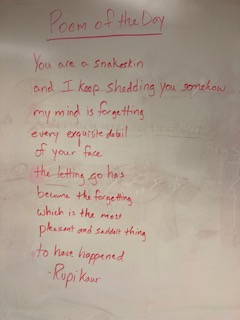
Not coincidentally, the poem of the day was by Rupi Kaur herself.  It was about how when we let go of someone to whom we are connected, it can be cathartic. At least thats what it means to me.

 poem

(I know its hard to read, but I hand write the poem on the board every day.)

I invited the students to respond to the poem in one of two ways: either by using the poem as a mentor text that could engage their poetic thoughts and help them write a poem of their own, or by responding to the poem about how it makes them feel or think.

We group talked our emotional reactions and shared how so many of us could relate to the poem.  Most of us connected with it in some way, but we discovered that those connection vary widely from person to person.

The next day, we came back, read the articles, began our letters to the editor, and completely failed to connect with the pieces on an emotional level.

There had to be a way to show them that we can have an emotional response to non-fiction. So, in a move stolen directly from Kelly Gallagher, I wrote a model Letter to the Editor in which I roasted the author and his article for being wrong-headed and totally missing the point of Rupi’s poetry.  The students perked up as we went through my example noticing elements like formatting, structure, embedded quotes and properly cited sources. Most importantly, they saw how I was able to show an emotional engagement with another author’s non-fiction piece.

We brainstormed some reasons that they struggled to make the same connections to non-fiction and talked about how they can have the same kind of emotional reaction across genres.

By the time we ended our discussion, they blasted off on the trajectory of writing their own letters to the editor, providing blistering commentary or thankful praise to writers they’d never even heard of before.

The writing I read was authentic, heartfelt, and emotional.  Something about weaving the poem and the article about the author of the poem allowed them to carry that connection to other pieces and release their feelings in a way that showed a real connection to something they otherwise would not have paid a second glance.

What I was reminded of once again, was that this isn’t about non-fiction texts or thoughtful poems.  It was about the students embracing their potential as writers and having the confidence to express their voice. This is a lesson that I’m sure I’ll have to learn over and over, but I won’t stop treating students as writers, even when they don’t believe that they are. 

 Charles Moore fell in love with Sing, Unburied, Sing by Jesmyn Ward and no one has seen him since.  Rumors persist of sightings out in Phoenix and even San Francisco. Please visit his hourly musings @ctcoach or visit his instagram account @mooreliteracy1.

Making the Leap: How one text supports another.

cactus2

This past summer I took advantage of an extraordinary opportunity. I mentioned it in my first ever blog post and my thoughts about that experience are unwavering.  The Summer Institute reinforced some of my already held readers/writers workshop beliefs and clarified many others.

One experience was particularly profound.  Meggie Willner and I found it so evocative that we based an entire professional learning presentation around it that we presented at our district  Profession Learning Day in August and even submitted a similar presentation for consideration at TCTELA this year.  Unfortunately, we weren’t selected for TCTELA, but Meggie and I still talk about how much this lesson taught us and how we still reach back to that lesson as this year moves forward.

On Day 7 of the institute, Amy presented us with a piece called “The Cactus,” by O’Henry.  I’m not intimately familiar with O’Henry’s works, but Meggie is and her opinion is a favorable one.  Amy took us through the exercise of discovering the beautiful language and writer’s moves that exist in the piece and we shared our thoughts and “workshopped” the text the way we should with our students.

At some point, Amy stated that this was a text we needed to present to our STAAR Camp students and Meggie and I simultaneously turned to each other in fear.

Meggie 2

Our initial thoughts were identical.  We knew our students very well and we knew that this text was far too difficult for them to conquer.  Meggie and I weren’t sure that we could shepherd them through this text and as soon as the session ended, we hustled up to our classroom to find something with which we were more comfortable and something we felt would engage the kids.

We quickly found a story called “Checkouts,” that was both easier to dig through and thematically similar to “The Cactus,” and away we went.  The lesson went beautifully, the students engaged with the story and we were able to guide them through discovering the writer’s moves and the thematic ideas in the text.  Meggie and I both agreed that we made the right decision for our kids.

Early on Day 8 Amy said something to the effect of: “I noticed many of our teacher teams chose not to use “The Cactus” in their lessons yesterday and went with texts that were less complex.” (I’m paraphrasing this because I don’t remember the exact words Amy used, but I remember feeling my face turn red and Meggie and I slow-turning to each other with matching looks of horror.)

Meggie1

Amy continued her thought by telling us how important the complexity of the text was to our readers and how texts that our kids would encounter on the STAAR test would match the complexity of “The Cactus.”

As soon as that morning’s session ended, we scurried up to our classroom with our tails between our legs and sat down to develop a plan to present “The Cactus” to our students.

We planned the activities that are typical of workshop to go with this piece. We drafted  questions that we thought might prompt their thinking and help them engage the text.  We looked at the text with an eye towards anticipating the places they would struggle with the language.  Looking back, we prepared well for this lesson.

Our preparation paid off when the students dug into the text. If you haven’t read “The Cactus,” please take my word for it that there are many difficult to understand words and this is what made us feel apprehensive. To our great joy, a piece that we thought would stump them turned out to be accessible and engaging and they found insight and nuance in its words. They floored us!!!

We discovered something too: our idea to present them first with “Checkouts” provided a scaffold to “The Cactus.”  They were able to digest the complexity of the more difficult text because they were comfortable and familiar with its thoughts and themes.  They trusted us because we built that relationship with the more easily accessible text. They learned that they don’t have to have understanding of every single word in the text to experience mastery of the text.  They can still engage in the nuance of theme and voice and other important skills. Once they found success engaging “The Cactus,” we could see their confidence build and they were able to enjoy the text in the same way as the adults in the room; as readers.

This is such an important lesson for me to learn.  Often, I take for granted that the students will engage with a text or just assume that they won’t.  My thinking, instead, should be about I can move them into a text by using what they already know or what they are interested in.  This may be obvious to other teachers, but I’m not a trained reading and writing teacher and I still have many lessons to learn.

Charles Moore still can’t figure out how to stay off of Amazon.com on snow days.  He is currently reading Warcross by Marie Lu and Truly Devious by Maureen Johnson and keeps his eyes open for suggestive cacti. His almost daily musing can be found on his twitter page @ctcoach

Research in These Times

We all love those days when everything goes perfectly.  I’m not talking about getting your grading done and entered, sending all the emails you meant to send, or making sure you’ve made the requisite parent contacts.

I’m talking about days where your lesson planning paid off and the students engaged in a meaningful learning opportunity. Think about those days where the kids work bell to bell and it feels like all you did was confer with as many writers as possible (Amy wrote about the importance of conferences here). I’m slowing building toward a place where this happens more and more and it’s both exciting and rewarding.

Teacher Book Talk:

Maja Wilson’s book,  Reimagining Writing Assessment: From Scales to Stories, is introducing me the ideas of John Dewey, someone who’s thinking I need to know more about. Its also a well-written book with some amazing insight.

When talking about Dewey’s phrase, “growth in the right direction,” Maja suggests, “I have to be transparent about my primary aim: the healthy and sustainable growth of young writers within an inclusive and equal democracy.”

meme

….Um, wow.


Growing young writers….within an inclusive and equal…democracy.

 Lesson Talk:

Our English IV classes are investigating research through several modes this year.  We’ve read, talked about, and written: Letters to the Editor, Op Eds, Infographics, and now we are looking at TED Talks.

I wanted this exploration to be as pure to the workshop pedagogy as possible.  Instead of giving them an anchor chart or watching a TED Talk as a whole class, I asked them what they already knew about the medium and invited them to create a list of traits they looked for when consuming media.  Each class period was slightly different in what appealed to them and what they wanted to see in a TED Talk. Of course I guided them through this process of discovery, but one way I formatively assess them is by noticing what they already know and planning my lessons around filling in the blanks or extending their experience.

We laid the ground work of noticing by accessing our schema and I set them loose to seek out TED talks that appealed to their thinking.  The students engaged themselves in media that appealed to them.  They wrote about what they saw in their self-selected TED Talks that engaged the media as learners. I gave up control and gave them choice.

Of course, our forward looking thoughts aren’t just towards making us more savvy consumers of digital media.  Our thoughts should guide us toward being savvy producers of media as well.

 Growing young writers….within an inclusive and equal…democracy.

By late February, the seniors at my campus will produce a research project.  The fun part is that they will have choice in how they publish it.

I think the choices that we made as teachers are facilitating the, “sustainable growth of young writers within an inclusive and equal democracy.”  I’m proud of this work.  I’m also thankful for the teachers I have the pleasure of working with every single day.

How have others set free their students to explore their place in our democracy? What are other modes within which we can explore the research process?  Please share your successes; they are powerful.

Charles Moore has now totally lost control over his book spending habits. So much so that the cashiers at Barnes and Nobles don’t even ask for his teacher discount card and Amazon chose his house for their newest headquarters.  He loves the sound of a classroom full of readers and he likes to imagine word counts ticking higher as they hover above the students’ heads during reading time. His sometimes humourous musing can be viewed on his twitter page @ctcoach and his embarrasing short form poetry and, eventually, book recommendations are on instagram @mooreliteracy1

TCTELA 2018: Professional Learning in Style on the Isle

I like to think I know about teaching.  Then I go hang out with hundreds of brilliant educators and I realize how much I have to learn.

(I hope Helen and Megan see what I did there)

Teachers

I just got home from the TCTELA Conference.  The 30 minute ride north on I-45 allowed me a brief opportunity to reflect on this weekend and think about the experiences that I encountered and the people I had the pleasure of meeting.

Collaborative Conversations:

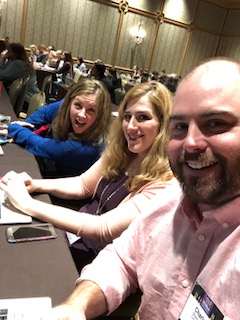
Spending time in different sessions with different people from our District rejuvenated me. I enjoyed sitting with Adam Glasgow and taking in a presentation on curriculum development from two teachers from our district: Helen Becker and Megan Thompson.  I loved hearing them speak the workshop language.  It’s nice to take in a lunch with teachers from other schools in our district and really get to know them. There were also impromptu twitter education sessions and conversations about snacks.

Mary Margaret

Super Star Speakers:

Alfred Tatum is brilliant.  His presentation was first thing in the morning on Friday and was a perfect start to the conference.  His ideas about texts belonging to all students perfectly echo the words of Atwell, Kittle, and Gallagher.  Here is a video of Dr. Tatum talking about self-selected reading.

Pernille Ripp is inspiring and passionate.  She is one of the most ardent speakers I’ve ever heard and when she said, “Our fidelity should be to the students, not the programs. See the children and hear their voices,” I knew I had a new teacher-crush (Sorry Kelly Gallagher).

Donalyn Miller made me continue to think about my role in the classroom and as an advocate for literacy.

Chris Lehman closed out the conference this morning and his ideas about close reading should be standard practice for all of our reading teachers.

Chris Lehman

Looks like I’ll be spending money on more teacher books soon.

Harvey Panel:

Diane Miller of U of H Downtown set up this panel of amazing educators.  Unfortunately, our time slot worked against us and more people sat on the stage than in the crowd.  In that aspect, it kind of reminded me of the JV soccer game the night before.  That wasn’t really the point though.  The point was that these educators shared their uplifting stories and shared some of their emotional baggage.  It’s important to give a voice to those who are thinking and acting outside the box to help kids.

Call to Action:

Get involved.  Connect with innovative people on social media!!!  NCTE is in Houston this year.  Meet up with us!!!! If you are a Texan, Join us at TCTELA next year in San Antonio!!!

Charles Moore’s students sometimes revolt when he tells them to quiet down and all they want to talk about is their writing.  He can’t wait for the weather to warm up so that he can enjoy craw fish and his pool and maybe even devour craw fish while in the pool.  You can find his frequent thought bursts and his passive aggressive treatment of trolls by checking out @ctcoach on twitter.  His poorly executed instapoem collection can be seen @mooreliteracy1 on Instagram.