Author Archives: Jessica Paxson

Easing into Mentor Texts

its-complicated-cover

I am the queen of wanting a do-over.  I will probably say this a million more times before we get to June.  The truth is, I teach Seniors.  Senioritis may be a made up excuse for laziness and longing for Summer, but I think it’s starting to rub off on me!

When I’m feeling like February is never going to end, like my students are better off with a Sub for the rest of the year since I’m teaching them NOTHING, or like I need an IV of caffeine just to function as a normal–forget about extraordinary–human, I turn to my wonderful colleagues on this blog.

Last week, Lisa taught me that great teachers don’t wait for a new school year to make changes.  This struck me especially with my current, slightly flawed approach to PD books.

Writing with Mentors wrecked my Christmas Break, in the best way.  I ordered it out of curiosity, hoping I could implement some practices here and there with my new batch of Creative Writers.  Instead, I found it whispering answers and solutions to all of the buzz-worthy issues that haunt teachers in their dreams of evaluations and students moving on and forgetting about their class and everything they taught forever.

Mentor Texts offer ways to differentiate, they offer real-world/relevant writing situations, they require readers who not only appreciate a text, but closely analyze and pick it apart, they offer engagement.

However, just because something is offered, doesn’t mean it comes naturally.

I could have let the overwhelm of such great and fundamental teaching ideas squash my ambition to the point that I would table it until my “do-over” arrived.  Lisa reminded me that small changes are best, and are mandatory.

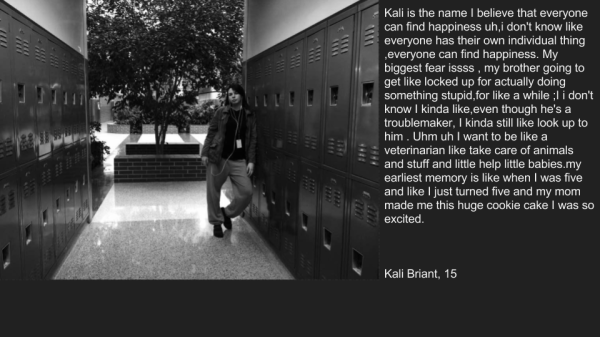
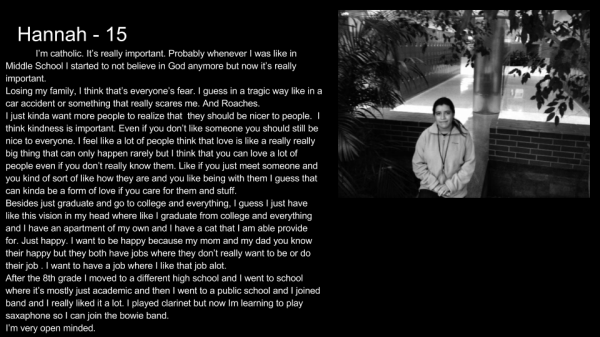
This idea was 100% from Writing with Mentors, but I was so astounded at the products my students came up with, I had to share the success!

Mentor Text: It’s Complicated: The American Teenager

Objective: Students will be able to articulate the difference between reading like readers and reading like writers, and will imitate craft moves to create their own product.

Products:

These blew me away.

1%2f19%2f17sally-interviewkali-brianthannah-15

Reflection:

The first thing we did was read like readers.  We perused the website, evaluated, reacted.  Then we read like writers.  I asked them, “How did this author go about developing these pieces?”  They noticed some specific moves, such as conversational language.  After we talked a bit, they really started to dig in.

“It seems almost like she recorded them speaking and then typed from that.  How else could it sound like real talk?”

“She must have asked them what they fear the most, and what they believe in.”

From simply studying the mentor text, we found our form, tone, and interview questions.  After they interviewed a partner, I let them go “out into the wild” to take pictures.

I literally just told my students to “go.”  I gave them some guidance, but mostly when they asked me about a specific requirement, or how I wanted something, I would usually say, “What does the mentor text do?”

This gave me a great diagnostic as their very first assignment, and allowed students to get to know each other as they got to know how our class is going to work.

I was so happy with this process and product, and I was especially happy that I could steal it from someone smarter than me!  Sometimes the best ideas are the ones we steal from our colleagues.

How do you introduce your students to mentor texts?  What works?  What doesn’t work?

Jessica Paxson is an English IV and Creative Writing teacher in Arlington, TX. She also attempts to grapple with life and all of its complexities and hilarities over at www.jessicajordana.com. Follow her on Twitter or Instagram @jessjordana.

#BookLove and #BookPride

give-books

Angel slept with Trash in his hand for almost the entire first semester.

I hope you caught the italics in that last sentence, but nevertheless, Andy Mulligan’s tiny novel was his first choice for the semester, and Angel would not put it down until he finished.  No, he didn’t even put it down when he dozed off.

We battled the whole first semester.  It was a whispering battle which I tried to handle delicately. I nudged him during reading time.  I conferenced with him.  I suggested new books that he might have found more interesting.  In our conferences, he would say, “Mrs. Paxson, I’m just not much of a reader.”  It wasn’t the usual tone of determination and resistance I heard coupled with this sentence.  I have the occasional student gripping the desk or running in the other direction for fear the Love of Reading will catch them.

That wasn’t Angel.

Instead, he shook his head and hung it with disappointment–even embarrassment.  It was as though this wasn’t something he thought, but something he was told.

He finished Trash at the end of the first semester and started The 5th Wave over the break.

When we came back this semester, I noticed Angel kept leaving his book at home, and picking up Noggin’.  He said two things that caught my attention at the beginning of the semester.

First, he asked me, “Mrs. Paxson, you mean it’s okay if we switch books?”  I emphatically said, “OF COURSE you can switch books!  Your reading life is too important to read what you don’t like.”  It seemed like he was afraid to mess reading up, to defile it or do it wrong in some way.

Second, when I asked the class what they’ve noticed about reading throughout the year, he reluctantly raised his hand, saying, “You know, I’ve actually noticed I read a lot faster now.”

A few weeks later, I extended an opportunity to my ever-drowning sufferers of Senioritis.  I proverbial life-preserver was an opportunity to drop a low daily grade if they had accomplished at least three reading challenge squares.

Again, reluctantly, Angel walked up with a half-finished Noggin’, and asked, “If I finish this book and one more, a total of three, I can have a grade dropped, right?”  This imperfect teacher had some doubts, considering Angel’s history of finishing books and also considering the tendency for seniors to game an opportunity like this.  I said “yes,” but made sure to clarify a few points.

About three days and an equal amount of frantic e-mails later, Angel came into class having finished his books.  He was so eager to talk to me about his ‘feat that he begged for a reading conference.  He beamed from ear to ear as he said, “This book looks old, and it IS. My middle school teacher recommended it to me and I threw it under my bed and never read it.  I pulled it back out and I couldn’t stop reading till I was finished.”  He spoke of the book .  Second, when I asked him about his second book, Noggin’, he detailed the story and the surprise ending with such confidence and nuance, I had no question he read and LOVED the book.  After our conference he said, “Don’t worry, I’ll send you a summary of the books so you don’t think I cheated and didn’t read.”  I explained to him that the conference was all I needed.

Besides, didn’t he give me so much more than he would achieve in a summary?  Angel showed me an enthusiasm, a drive to learn, and a new-found fervor to read that would not quickly fade, but would likely grow in the years to come.  Angel showed me Book Love.

angel

I asked Angel one more question as we walked back to the bookshelf to find his next read. Me: Hey, have you ever read three books in a matter of months before?

Him: (Trying to hide a smile of pride) No ma’am, I haven’t.

Me: Feels pretty amazing, right?

Him: Yes, it really does.

Jessica Paxson is an English IV and Creative Writing teacher in Arlington, TX. She also attempts to grapple with life and all of its complexities and hilarities over at www.jessicajordana.com. Follow her on Twitter or Instagram @jessjordana.


Honoring Culture and Voice Through Code-Switching

One of the most beautiful things about workshop teaching is flexibility.

I know you’re thinking, What’s that?  The Type-A Personality talking about flexibility?  Yes.  I’m floored.  I’ve grown to love the ability to change plans at a moment’s notice because something pops up on my Twitter feed or a student has a great idea.  It only slightly gives me anxiety now, rather than entirely.  That’s progress, people.

During our current focus on Elements of Drama, including some Shakespeare and some Hamilton, the most frequent point of conversation has been language and translation.  In the wake of political and social tsunamis currently taking place, my students are constantly coming back to ideas of connection, or lack thereof.

In one of his interviews with NPR, Lin-Manuel Miranda discusses the fact that he’s “been code-switching since he was five.”  He uses this term to refer to his social predicament growing up between nights and weekends in a Hispanic, immigrant neighborhood and daylight hours at a school for the gifted on the Upper East Side.  This idea seemed to be what my students and I were discussing, so I decided to do some Googling.  Was anyone else talking about this idea?

I came across this TED Talk by Jamila Lyiscott: 3 Ways to Speak English.  Aside from causing me to further lament that I haven’t yet begun to moonlight as a spoken word poet, it also took me aback at how little I’ve honored my students and their own culture and voice in writing.

language-world

The truth is, many have felt like strangers in their own land long before this current administration took hold.

In an effort to facilitate my students’ ability to “speak academic,” I never realized just how much it feels like a foreign language.  I also never considered, by default, this deemed their language “unacademic.”  This classification might feel belittling, or at the very least, may cause them to put their own culture and language on a shelf while they’re at school, and as a result, while they’re writing.

The beauty of language is connection.  Insecurity happens when you feel your words skip over or go right through whoever you’re around.  The art of language is mastering each of your dialects so completely, that you can connect with many different types of people at once.

The thing I hate about flexibility is that you often find things around which you want to plan an entire unit.  Unfortunately, I found it too late this time around.

Here’s what we actually did:

Each student imagined a story they might tell in a friendly setting and an academic setting.  The only requirement was to write the SAME STORY in TWO DIFFERENT WAYS.  This hit so many skills, I don’t know if I can list them all.  We discussed purpose, but also discussed the need for knowing audience before you can likely get to purpose.  We played with word choice, and we experimented with plucking words from friendly dialect and plopping them into academic dialect to amp up connectivity and relatable tone.  We obviously discussed tone.  We discussed brevity/length and how it relates to purpose.  I could teach an entire semester of English skills with this single theme.

Here’s what I would do for a unit:

  • Begin with Amy’s Matter of Perspective and Crossing the Line activity.
  • Notebook writing and discussing about how language has made us feel out of place in the past.
  • Explore the question: Can their truly be connection without separation?
  • Watch 3 Ways to Speak English & challenge students to write either a two-voice poem or a spoken word poem like Jamila’s in which they integrate all of their languages together, using her performance as a mentor text.

The goal in this unit, and in the single writing I managed to facilitate this year, is that every portion of a person’s identity should be honored and valued.  It is all these facets that make a writer with true voice.  I want to grow writers with voice, not just writers who learn to regurgitate and operate within the box that academia occasionally presents.

Jessica Paxson is an English IV and Creative Writing teacher in Arlington, TX. She also attempts to grapple with life and all of its complexities and hilarities over at www.jessicajordana.com. Follow her on Twitter or Instagram @jessjordana.