Author Archives: Amy Rasmussen

Excuses: Why I can’t write

no-excusesAfter carefully reading and agreeing to the terms & conditions of wordpress.com, this blog was officially birthed in a tiny hotel room on January 21, 2010 at the annual TCTELA conference. In that time, and really over the last two years, there have been close to 20,000 views of the blog, 10 guest bloggers, and 200 posts.

I account for less than 20% of those posts.

Since August, we have stepped up our blogging efforts and generally are posting consistently four times a week. Four posts a week for 4 months is approximately 64 posts.

I account for 5 of those.

Some may be starting to think, “Gee, Heather, you aren’t pulling your weight around here! Amy should kick you off, or at least ground you until you write some more blog posts.” But before Amy goes and punishes me, I have several reasons, really good reasons I might add, as to why I haven’t been blogging.

1. The Dog Ate My Homework – Ok, I don’t have a dog, but the last several weeks have been littered with catastrophes. From packing up an entire house and moving to a new one, a husband with a chronic tooth ache (heaven forbid he go to the dentist), and me dislocating my kneecap when I fell walking across the street, it seems like there is always something that is getting in the way of my writing.

2. I Don’t Have Time – This year it seems like everybody needs my time. Between family, church, work, friends, my alone time, etc. there simply isn’t enough hours in the day to get it all done.

3. I Have Nothing To Say – I took a new job this year, and it just seems like every time I do sit down to write I have nothing to say. My perspective has changed. I look back on my teaching experience and think it was so much easier to write when I was in the classroom, would try something out, and then reflect on it through my writing.

4. My Writing Isn’t Good Enough – This is probably reason enough to go to counseling and certainly a blog post for another day, but every time I go to type a single word or even get so far as to press the PUBLISH button, I have a voice inside my head (my seventh grade English teacher’s voice actually) saying that not only is my writing not good enough, I’m not good enough.

It is actually quite funny. Knowing I was supposed to post today, I texted Amy last night and joked with her about what my excuse might be for why I wouldn’t get a post done today. Forget the fact that in Texas we have been iced in for the last four days, and I have had more than ample time to get something posted. It made me start to think:

What about the learners that sit before you everyday in your classroom? 

What are their excuses for not writing?

It is easy to look at the monumental amount of standards that have to be covered in a given year, and then start assigning essay after essay after essay. Between the demands pushed down a campus and the looming state test, educators quickly turn from teaching the art of writing to merely assigning writing.

Again, what about your learners? When might they have some of the same excuses I have? If we as educators overlook the excuses of our learners, or maybe even blame them for these excuses, I venture to say we are not really doing everything we can to create a classroom of writers. At the heart of everything we do, we must first look at it through the lenses of the learners that sit before us and carefully craft experiences where they can feel safe enough to not have to make excuses. As educators it is not only our responsibility to teach standards, it is also our responsibility to help break down barriers that hold a student back from learning and being successful.

As an adult, I have to break down my own barriers and excuses. Not having time and having things come up are universal excuses that could be given for anything in life. You have to make time to have time, right? Feelings of inadequacy aren’t always just about writing for me. Truth is though, when you look at the facts my top two posts had over 500 readers each! Now, why would I ever think no one wants to read what I write?  And the excuse about how my perspective has changed, I still have a story to tell and should be brave enough to share that story.  

What are your excuses for not writing? How might a reflection of your own excuses help you to guide learners to break down their excuses?

Reel Reading for Real Readers: Meta Maus

ReelReading2The book Maus by Art Spiegelman made me a believer in graphic novels. Maus II was just as influential.

One year I applied for a grant and got the funds to create a whole set of various war-themed graphic novels for literature circles in a gifted/talented humanities class. I no longer teach that class, but my friend Tess does, and she’s the owner of that box of beautifully written and illustrated graphic novels. I remember the first year we used them, our student Claudia said, “I got a question right on the AP World History exam because of something I read in the book about Gaza.” I had no idea at the time that graphic novels could be so powerful and so important. Now a few years later, I have a small collection that a few students eventually work themselves into.

This is a trailer for Maus completed by some students (not my own) using DSI Flipnote Studio. It’s cool, and now I want to download the software. The trailer is well done, too.

He read ZERO books before he came to me. Not Good Enough.

He came to me pretty much hating to read. This tall freshman, eager to talk and laugh, and constantly wanting to do anything else but open a book. He admitted that he read zero books his 8th grade year.

The first book I got him to attempt was Game, a chapter book of about 160 pages that took him four weeks to get through. Every day I had to put a hand on his shoulder and whisper “Get to reading.” Next, he tried Gym Candy, and while he seemed to read it faster, he couldn’t tell me much about the plot or the characters.

Finally, with a stroke of luck, this young man picked up Stupid Fast by Geoff Herbach. I had book talked it a week or so before, reading the first few pages to the class. At the time, R.J. wasn’t interested. When I saw him with this book, I hurried over and practically begged him to give it a try. “Okay,” he shrugged and moved away from the bookshelf toward his table.
Every day for two weeks, R.J. came to class and told me how much he had read. “I like this book,” he smiled at me more than once. He finished this book in two and a half weeks, and then took himself to the bookshelf to find I’m with Stupid. (At the time, we thought this was the next in the series.)

When I finally made it over to kneel by R. J.’s table and conference with him about his reading, he told me that the beginning was hard to read because the main character’s family was “weird,” but he really liked the parts about football. We talked about character development and how the main character Felton changes throughout the book. “He grows up,” R.J. notices. I asked him what kinds of questions he would ask the author if he had the chance, and then I remembered:  I follow this author on Twitter.

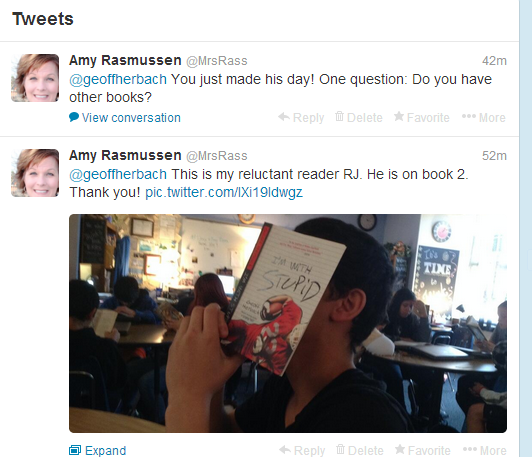
“Hey, R.J., let’s take a picture of you reading this book and tweet it to the author. I bet he’ll respond.”

“No way…. Oh, okay.”

So we did.

RJ tweets to author

RJ tweets to author responses


R.J. left class that day feeling pretty special. He will finish his fourth book this week. His personal reading goal for the whole year was only FIVE.

Now, here’s the really cool thing:  While wondering the exhibition hall at NCTE in Boston, I struck up a conversation with the representatives from Sourcebooks Publishers. They asked if I knew of the books by Geoff Herbach, and, of course, I had to tell them about R.J. Then one of those very sweet insightful women reached under the table and handed me this:

Fat Boy cover

She understands the value of nurturing readers. She’s helped me make a difference in the life of this young man. I wish I could describe the yelp I got when I told R.J. he’d been gifted with an ARC of an ARC — how cool is that?

I’d love to hear your best “Conquering the Reluctant Reader” story. Please share.

Multi-purposing My Quickwrites

Photo Credit: Jennifer

At NCTE last week, Penny Kittle reminded me of the need to consistently share beautiful language with my students. If I ever want them to be able to read it, understand it, and use it in their own writing, I must make conscious choices about voicing that which is lovely. I do a fine job of this right until my students choose their own topics and begin their compositions. Then the room gets stale, and the feeling of “what a chore” begins.

No wonder. I stop sharing short texts and poems. I stop having students respond in their notebooks. I stop allowing them to share their thinking.

While in Boston, I stole a moment with Penny and asked her about my problem, and she simply said, “I keep sharing beautiful language every day.” I must do this, too.

I made a list in my notebook of the things I need to do better when I return to the classroom. Continuing to share poetry and short passages that students can respond to sits at the top of my list, but I want to try to multi-task this activity.

My students are in the process of writing a feature-length article. They chose topics and began drafting before the break. I want them to think about ways to make what they are writing pop into 3D on the page; I want them to see vivid verbs and colorful word choice, and all kinds of devices that they might include in their own writing. My goal is to use poems and passages from now on that will serve several purposes:

1) rhythms of beautiful language,

2) models for sentence structure,

3) examples of figurative language,

4) built-in book talks,

5) questions that aid student thinking about things that matter in their lives.

We will read, and we will respond. We will notice author’s craft as we craft ourselves.

I know, I know, I am slow on this boat. Good planning would make this possible with all my quick writes.  I get that. Thus far, I’ve been a bit disjointed because I struggle with doing it “all:” Independent reading time, quick writes, mini-lessons on craft, grammar, mechanics, student-to-student reading response, reading and writing conferences, book talks. . . I keep most plates spinning, but more and more are crashing lately. My #nerdulation is to do better. (Search that hashtag on Twitter if you don’t have a clue.)

Here’s the passage I will use today. I think it’s appropriate to read a beautiful passage about books since I got a ton of new ones at NCTE. My classroom library welcomes them, but it’s screaming “crowded.” I gotta get a new shelf.

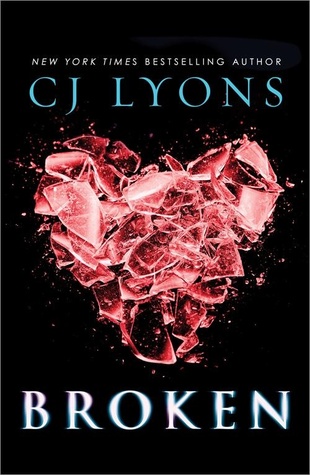
From Broken by C.J. Lyons: 

Kids fill the hall from wall to wall. Despite the unfamiliar press of bodies, I don’t panic. Instead, I let them steer me, like running with a herd of wild, untamed horses. At the end of the corridor, the herd separates into two, leaving me alone in front of a high glass wall.

The library.

Footsteps and lockers banging and voices colliding barrage me. Then I open the door, cross over, and step inside. I’m greeted not by silence, but instead by a hushed burble, relaxing, like the sound of a water fountain. I stand, enjoying the sensations, and take a breath.

School smells so much better than the hospital. And the library smells the best of all. To me, a good book is hot cocoa on a stormy winter day, sleet battering the window while you sit inside, nestled in a quilt.

A room filled with books?

I inhale deeply, a junkie taking her first hit. Sweet, musty paper. Ebony ink so crisp it threatens to rise off the pages and singe my nostrils. Glue and leather and cloth all mixed together in a menage a trois of decadence.

Another breath and I’m drunk with possibilities. Words and stories and people and places so far from here that Planet Earth is a mere dust mote dancing in my rearview mirror.

Hugging myself, containing my glee, I pivot, taking in books stacked two stories high, couches and chairs strategically positioned to catch the light from tall windows lining both sides of the corner, like the bridge of a battle cruiser, broad, high, supremely confident, and comforting. In here, I dare to imagine that I might just survive high school after all.

Respond in your notebook:  Describe a place where you find  peace or refuge?

How do you revision your instruction when you know something isn’t working?

Reel Reading for Real Readers: Girl, Stolen

ReelReading2I picked up this title at the thrift store, and the moment I talked about it in class a young woman grabbed it and wouldn’t let go. Later, I found out that this is a popular book in some of my colleague’s classroom libraries. I don’t know why teenagers like books with disturbing themes, but they do. I guess it’s part of the psyche trying to make the plight of others worse than their own. Or something. Right now there is a waiting list for it in my room for this book. Maybe someday I’ll get to read it.

Girl, Stolen by April Henry

Do As I Do

The importance of modeling with students in the classroom.

Reel Reading for Real Readers: The Collector by Victoria Scott

20130207-190708I’m really not sure what to make of this, but I think my female students are going to clamor for this book.

I got an email from my school librarians inviting me to bring my students to a panel discussion with YA authors who would be visiting the CFBISD Literacy Night. Of course, I said yes. I didn’t even care who the authors were. I did ask for a list of names though, and then I searched for their books.

This is the first cover I saw:  Can you hear the girls whispering?

Then I did a search for a book trailer and came upon this great site called the “Teen Fiction Fiend.” Although the book was released last April, it will be brand new to my students–my copy arrived from Amazon last weekend, and the clever reveal here will have my girls who loved Perfect Chemistry falling all over one another as they clamor for the check out clipboard.

See for yourself:  Alice Marvel’s for theTeen Fiction Fiend

From the back cover:  “Dante is the kind of guy I wish I’d met when I was seventeen. And the kind of guy I’d kill if my daughter brought him home.” ~Mary Lindsey, author of Shattered Souls

Oh, brother… to be young again. *scurrying off to read (this book)*

Finding the Gems at #NCTE13

Today is National Writing Project Annual Meeting in Boston, MA, and NCTE will rev up tomorrow.  Heather and I sit in the hotel lobby watching the time remaining tick on the “free” internet access on the public computers. We plan to meet our friend Donalyn Miller for breakfast in ten minutes. She’s famous in the Readers/Writers Workshop world now, especially with the publication of her new book Reading in the Wild. We first met Donalyn when she spoke when we were fellows at our North Star of Texas summer writing institute in 2009. We trust her.

Choosing conference sessions is arduous. There are  over a billion sessions at NCTE alone. It can feel like throwing darts in the dark as we try to select sessions in which we feel we’ll learn the most.

We thought we had a plan. First, we searched the program for our trusted and favorite presenters:  Penny Kittle, Cris Tovani, Gretchen Bernebei, Linda Reif, Kelly Gallagher, Terri Lesesne, and, of course, Donalyn. We used the nifty conference app and put those on our schedule. Some of their sessions conflict with others, so we are left to choose yet again. Dang.

We still have lots of gaps and time to fill in — knowing we must walk the exhibit hall at least three times so we can gather and gather books.

So, readers, if you are in Boston, or if you are a regular conference attendee, what are your tips for choosing which sessions to attend? How do you decipher and choose amongst all the billions of presentation offerings.

How do we find the gems?

Psst. We are presenting with North Star of Texas Writing Project site leaders on Saturday morning at 8:00.

Always an English Teacher: Have Red Pen Will Travel

So Heather and I are eating lunch at a Chili’s in the St. Louis Airport because hungry.*  We are on our way to NCTE in Boston, and we haven’t been together in person for a couple of months, so we are talking talking talking about English teaching, YA books, best practices, job interviews, transformation, old practices, new practices, motivating the masses, and, of course, writing our book.

Heather takes a bite of her hamburger and notices that the couple at the table next to us is composing some kind of letter on the man’s cell phone. She mutters, “They aren’t doing a very good job of it, maybe we should help.”

I hardly notice as I continue scribbling notes of our conversation in my writer’s notebook with my favorite green pen. Until. . .

He says:  “I am writing this letter to inform you that. . .”

She nods in agreement.

He says:  “Words can hardly express my feelings about . . .”

She nods in agreement.

He says:  “I will certainly miss meeting with you to hear about all of the progress that is taking place within the company and its growth.”

[Heather and I both reach for my RED pen.  j/k — but we really wanted to]

We pay our bill and leave the restaurant before we can see the lady nod her head in agreement.

Heather:  “Quick, before we teach them how to write.”

Amy:  “No kidding, talk about wordy.”

Heather:  “Talk about how NOT to pass the STAAR writing test.”

Amy:  “They exceeded 26 lines.”

Here’s the thing:  Those people were practicing real world writing. But did anyone ever teach them how to write?

Although we are not questioning the ability of their 10th grade writing teacher, we do have to question what they took away from their formal writing instruction. As educators we must think about practical skills and strategies that learners can internalize, similar to universal truths, so when they need those skills, be it reading, writing, thinking, etc., they will be able to recall and then apply them to real world tasks— like writing a resignation letter in an airport restaurant.

Three simple tips that would help our new friends:

1. Purpose should be carefully crafted within the context of the piece, not explicitly and immaturely stated in the first sentence.

2. Word choice, even when saying meaningless nothings, matters. If words can’t express feelings, what can?

3. Say it, and say it as concisely as possible.

*See English has a New Preposition, Because Internet

Acceleration — Is Your Model Worth It?

Let me state the obvious: There are certain students who do not like school. You know some of them. I know you do. Maybe you were even one yourself.

There are numerous reasons for this dislike, and sadly, some of the negative feelings have their claws in deep by the time these students get to high school. In my experience, most students who claim to hate school are struggling readers; therefore, their writing suffers, and they score low on most assignments–if they are willing to do them at all. These students just don’t feel smart — or capable.

Every day I make a concerted effort to reach them, to help them like learning, to encourage them to practice reading and writing. And sometimes I succeed.

But success comes hard when outside forces inflict unnecessary roughness.

Take tutorials for example. “Mandatory” tutorials in order to “prepare” for standardized testing. You know the kind.

The date for the re-take of the STAAR EOC looms, so schools go into panic mode. Students need extra support, and the state mandates we give it, so schools figure out how to provide this accelerated instruction. In my humble opinion, the mode of this instruction does nothing but give students who already struggle, already dislike school, another bucket of reasons to hate the whole deal.

Pass out reminders during regular classes:  students feel dumb for being singled out.

Call students from class early to escort them to tutorials:  teenage students get angry for being treated like young children.

Pull students our of class during the day and put them in a room with a teacher they do not know:  students feel angst for being forced to be yet another place they do not want to be with a teacher that doesn’t know their names. The lessons are a whole other story.

I’d say we’ve done our duty. Not.

When will we change the model of this “necessary” tutoring? When will we put the student first instead of never?

The same old same old tutorial sessions just do not work, and they probably do more harm than good– at least when done like the model I describe. It’s painful for students who struggle anyway. All we do when we go through the motions of acceleration is hurt the young people we claim to be helping.

Okay, probably not every program, but that’s my take on what I’ve seen this year.

And it makes me very sad.


For a new idea check out how North Star of Texas Writing Project, in partnership with innovative districts, is figuring it out. See  Finding True North: Accelerated Camps for Students at NorthStarofTexasWritingProject.org, celebrating students’ writing instead of disparaging the student writer.


How does your school handle acceleration?