Author Archives: Amy Rasmussen

Questions about Readers/Writers Workshop

I just got the fourth request in two days for how I set up my readers/writers workshop classroom. I love getting these requests because it makes me reflect on my own practice, and it means that others are moving into allowing more choice for students. Happy day!

I thought it might be a good idea to share some of my responses and some of the questions I get from educators who want to create a culture of workshop in their own classrooms. If you are thinking about workshop at the secondary level, or if you just have questions, please leave a comment and ask.

Holly says that she’s been given permission to “go rogue” and do something different than the other teachers in her department. She’s been granted her desire to create a readers/writers workshop classroom, but she needs support. I love that she asks me for it.

Here’s my response:

Dear Holly,
How exciting for you! Sure, we can find a time to talk. I am in Minneapolis at an NCTE Affiliate conference this weekend, and next week if filling up fast. If it’s okay, let’s do a little thinking here first.
First, what is the shape of your classroom library? That is huge for a successful rwworkshop. Of course, you can utilize your library, but research says that to surround students with books, you should have a minimum of five books per student. So say in a class of 30, you need at least 150 books in your classroom library. How does yours look? That’s our first start.
If it’s sparse, consider creating a project for books at DonorsChoose.org. I’ve had two significant books projects funded. You can see a past project here.
Next, if you have not read Book Love by Penny Kittle, put it at the top of your reading list. Take notes. Everything I’ve learned about doing a workshop classroom I learned from PK — almost.
Think about how you want to structure your class time. Here’s what mine will look like with 85 minute classes every other day. Remember, I teach AP Lang, but much of this worked with my 9 and 10 graders last year, too.
10 min choice reading
     I conference with kids quietly during this time. We must mandate silence, and this takes lots of practice for many kiddos!
Three types of reading conferences: 1. Get kids into a book (This one gets repeated over and over and over again at the beginning of the year.), 2. Teach a reading mini lesson (The lesson is dependent on the needs of the student.), 3. Move kids into more complex reads (Again, this is dependent on the need of each student). All ideas from Book Love by Penny Kittle.
3-5 min poetry (new for me this year since I learned a TON at the poetry conf at the Frost Place I just attended)
     I will dictate a poem, or read aloud a poem, or ask a student to read a favorite poem. Mostly we will just savor the language of poetry. “To write well, students must be immersed in the beauty of language.” –Penny Kittle
2-4 min book talk. I book talk everyday, one of each fiction and non-fiction. Students record in their writer’s notebooks titles that they might want to “Read Next.”
10 min mini lesson on whatever writing we are working on, or max of 20 min direct instruction, if I am introducing something new.
Workshop time. Students work either independently, or in small groups, on their writing as I work the room talking with students as writers more than talking to them about their writing.
Last 5 minutes. Exit thoughts. Might be a whip around with a sentence from students work. Might be thoughts on a sticky note as they exit. Just something for closure.
More on Reading:  Besides choice reading all year, I include four Book Clubs where students choose a book from my short list. All books have similar thematic elements. Book choices include nf, fiction, classics, poetry. They read their books with a small group and discuss craft. We also conduct a whole class discussion around all of these books. When we shoot above comprehension, we get students to think at higher levels — reading like writers. (With my 9 and 10 graders I only did one book club, not four.)
Writing. We move through genres, one primary genre per quarter:
1. Narrative, includes description
2. Informational, might include compare and contrast, process analysis
3. Argument, includes persuasive, definition, examples
4. Multi-genre, includes poetry, all of the above, and more
That’s enough for now. Why don’t you make a list of questions, and we’ll go from there?
Oh, and it is so important to remember that a reading workshop classroom is all about process. And it’s a process, your own, as you figure it out. It’s taken me years to get where I understand the theory behind why all this works, not only to engage students, but to move them as readers and writers. Take it step by step, morph it to work for you and your kids — and you don’t even know who they are yet.
Blessings,
Amy


Another NH Summer: PD with Reading Theory. Who knew?

Today my class Book Love, taught by Penny Kittle, at the University of New Hampshire Literacy Institute came to an end. My classmates have gone home, but my flight isn’t until tomorrow, so I find myself in the hush of the library on the eve of July 4 when the campus will be closed, alone.

There’s a quiet here like reverence in church on Sundays. A great time and place for me to reflect on my learning this week, and last.

Explaining to Penny Kittle how I finally feel confident doing research and citing sources.

It was anything but reverent. More like a fire hose without a turn off switch. In a word:  revitalizing.

I knew it would be. I came to this same institute last year and learned from Penny. But the powerful learning for me this year happened because she pushed us into reading theory.

Why did I never have to do that in my education classes? You’d think it would be at the top of every class syllabus.

In four days we read a stack of articles about the importance of choice in reading and access to books and the influence of a teacher in the reading lives of children. We read close to half of the essays in Making Meaning with Texts by Louise Rosenblatt. Penny calls her the leading reading theorist of the century, and after reading and discussing Rosenblatt’s work, I believe her. We also wrote three papers that reflected on and infused the reading into our own thinking about our the practice in our classrooms and in our schools.

I am inspired to keep doing my own research as I continue to write what I think will benefit other teachers as they engage their students in authentic and personal reading and writing experiences, a must Rosenblatt says.

I learned many things this week, and I have a list of Ideas to Implement in the back of my notebook that I am determined to carry into my new classroom in the fall.

Isn’t it great that learning continues, improvement continues?

That’s what I love about summer pd — the opportunity to reflect, learn, and get better.

My Ideas to Implement (which include those inspired at the Frost Place Conference on Poetry and Teaching.)

  • Skype in poets and authors to speak to my students about their writing and their works
  • Use “Go World” videos by VISA as mentors for mini-narratives; have students edit their first narrative into a “Go World” video
  • Ask students to analyze their writing process, write it out (perhaps creatively), and turn that in with every major writing task
  • Use My Ideal Bookshelf as a mentor when students complete their beginning and end-of-year personal reading evaluations
  • Watch for students with “social capital” and use their examples to promote reading
  • Be more purposeful in my conferences with students. I could have moved more students up reading ladders this year.
  • Include a reminder about vocabulary study within the books students are reading at least once a week
  • Bring in college syllabi to show students of their need for greater reading stamina
  • Create an anchor chart with a hard test that guides students in habits of complex reading
  • Do black out poems early in the year as a means of getting students to look closely at language and create their own meaning with literature
  • Select books for Book Clubs that are more closely theme related
  • Make topic writing notebooks (again) for a place for students to write casually about their choice reading
  • Remember story boarding will work for writing stories and for analyzing them rhetorically
  • Include Author Talks in book talks to introduce students to an author’s work without having to book talk each one
  • Create a reading sign for my new room:  YES! You have homework tonight:  READ!
  • Create a literary category wall, so as students finish books they write a Title Card and place it in the era the book is most like, romanticism, transcendentalism, etc
  • Read a poem every day, mostly just for the pleasure of it
  • Tell students it is okay to not like a poem; it is also okay to not understand it
  • Remember in revision conferences to use the phrase “What are the possibilities?”
  • Remember the peace you’ve felt here in New Hampshire in June

Thanks, my friends, for another amazing summer learning experience. Yes, experience. (It has new meaning now, doesn’t it?)

Erika Bogdany, Sam McElroy, Shana Karnes, Amy Rasmussen, Jackie Catcher, Penny Kittle


Poetry at The Frost Place: Don’t Stop Believing

The Frost Conference on Poetry and Teaching is over. Those who didn’t leave yesterday left today after the Teachers as Writers workshops. The hugs good-bye were those of life-long friends, sad to part, but a little eager to get on the way. The small community grew so quickly. Sharing a love of language will do that to people.

I pull into the Kinsman Inn where I have shared a roof and a home-sized breakfast every day this week with, as Margaret said, “The kindest people I have ever met;” and the gravel lot is full with the cars of total strangers. I walk inside and even Sue the innkeeper says it is not the same. We feel it. The magic of the week is over.

I never cared for poetry. Looking back I know that attitude stems from the way I was taught. I never experienced the simplicity of words that I’ve experienced here. Even when I’ve taught poetry in class, especially those two years with my G/T students, I tortured them with bad teaching. I’m embarrassed to say I gave them a packet, and we read through the poems ‘analyzing’ as we went, never stopping to just listen. Listening is the secret I learned this week, but the secret was never meant to be locked a way so no English teacher could find it. It’s not even a secret really. Poetry is art; art has to be experienced. A packet doesn’t offer that to anyone. I’ll argue no matter the content, but that is an topic for another day.

Imagine this scenario:  Each morning you walk into the small Frost barn. You pull out your pen and wait

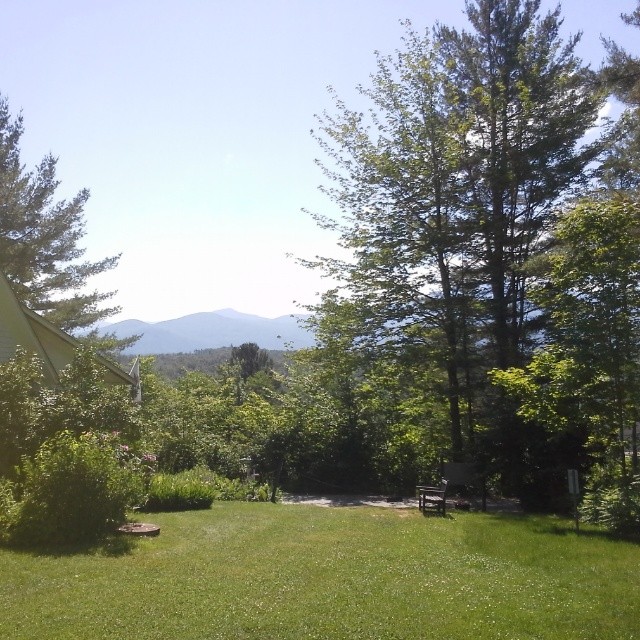
At the evening poetry readings at Frost's barn, the audience is invited to turn around and appreciate the view. Inspirational.

At the evening poetry readings at Frost’s barn, the audience is invited to turn around and appreciate the view. Inspirational.

for the morning’s dictation. Alyssa slowly reads a poem in her soft con-alto, stopping every so often to state a word that is capitalized or where to place a comma or period. You listen, and you write. You focus on the voice, the words, the phrases — the silence created by the pauses. You fill the page with this focused thinking.

After everyone arrives, you welcome the morning, and Teresa opens Robert Frost’s notebook and shares a significant line. “I don’t change my watch every time I see a watch it differs from.” We talk about living in the discipline — not in the product. Dave with a voice to rival God himself finally speaks out:  “We do not live in a culture that embraces silences.” We all nod.

We talk about poetry and teaching and teaching poetry. Then we share presentations filled with classroom practice or philosophy. Again we discuss — “civil engagement,” as Dawn coined it. Our notebooks filled with ideas we can use to give our students similar experiences.

The most impressive thing? We talk to each other like poets.

And that is what needs to happen in the classroom. So often we teach poetry and reading and writing when we should be teaching poets and readers and writers. Of everything I’ve absorbed this week, and this is saying a lot, I believe this simple thing will make the most change in mine, and anyone’s, classroom. 

Today several of us sat around in a circle and shared original poems that we’d composed yesterday. The only instruction for feedback:  What are the possibilities? No critiques. No corrections. Just suggestions on how the poet could play with words.

“If you do not play, you will never know,” Dawn reminds us. Isn’t that the best revision strategy ever? Just play with words, phrases, stanzas, rhythm, structure.

I want my students to play. I want them to have a tiny bit of the silence I’ve experienced this week. I will have them practice dictation — a sure way to quiet the mind and prepare for inspiration. I will continue to allow choice in reading and writing topics, and we will play.

Nicholas told me he never read a book on his own until college, but now he has an MFA and a knack for words. I can’t help but wonder if his gift might have come quicker — not the long sidetrack he took to get here — if in all his English classes he had been spoken to like the poet he is. That is worth a thought. Or two.

Today when I left The Frost Place for the last time, I turned the opposite direction on the road. I’d not gone this way all week. The lane was longer, but the view quite the same. But God must have been the one to turn the wheel because as I came to the T in the road, there stood the stop sign telling me “Don’t STOP believing.”

Don’t STOP believing. Can it be any clearer?

I won’t. I found the seat of my soul, and it is steeped in poetry.

Here’s my poem from the writing time today. I imitated the structure of Hayden Carruth’s poem “Twilight Comes.”

Twilight comes to the busy town

As season’s start. The tree tops

brown with leaves, which colored

And began falling during the heat,

Are moving again, and crack

under the wind’s breath. The buildings

from their place across the highway

crowd close again, as if for a

threatening glare, and with malice

An exposition as the sun slips

low. It is my fiftieth year. Horns

blare out one by one with a clashing

dullness, like the unfelt prayer

in church. I hear the dogs barking

pushing their noises into my peace —

I touch — and clearly — I am quite certain —

tightening muscles; perhaps hot iron

on the right side under my shoulder

or unusable rope on a sea-stuck ship.

It’s true. My man is on the phone,

there inside the living room. Clients

will close soon. I crack my paining neck

And bow my eyes to study the dead

root-bound pot on the patio

in the shadows. I sigh. Then

sigh again, just because it’s true.

I am going to be old. Too soon.

Zen and the Art of Conferences

Last year I needed to find zen or I would die. My muscles were in such knots at the end of the school year my chiropractor prescribed regular massages, hot baths, and as many vacations as I could manage.

I went to New Hampshire.

Here I am again. This time I am at the Conference on Poetry and Teaching at the Frost Place in Franconia, a tiny little place where the air is clear and the nights are darker than I’ve experienced in a long time.

This conference is different: Only 14 participants this year. All focused on the art of poetry. Some are frost place signworking poets. Most are working teachers. I heard about this conference on a Twitter chat, and since my return trip to the UNH Literacy Institute, which was already planned, happened to be on the calendar for next week, the stars aligned. I find myself here, staying at a gorgeous bed and breakfast listening to rain fall gently on the old but sturdy roof.
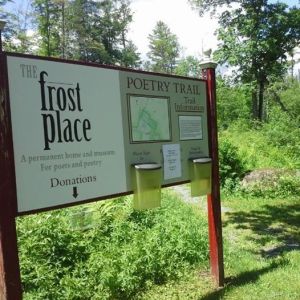
It is day four, and I’ve learned more about poetry and poets and revision and analysis than I learned in all the classes leading up to my degree in literature. Oh, to give this kind of learning to my students!

Here’s some highlights and why you will want to come to this place as soon as you are able:

1. Guest poet workshops. Iain Hailey Pollock visited first. He shared lessons from his classroom, his experiences as a writer, and the most engaging Poetry Death Match, a contest with one poem survivor. That evening Iain read his work. If you are not familiar with his poetry, order the collection Spit Back a Boy immediately. Next, Meg Kearney, poet and author of two YA novels in verse:  The Secret of Me and The Girl in the Mirror, taught some creative writing activities with a selection of extended metaphor poems, and we wrote our own (or tried.) Meg read a piece she’d been asked to write about her evolution/revolution as a poet, which stung my heart — her hope and search for her birth mother, her raven dreams. So beautiful and haunting. When she read that evening my heart was on fire. I know why people fall in love with poems and poets.

2. Teacher presentations. Each day individuals have 20 minutes to share ideas. Might be something from their classrooms, something they are reading, some questions they just want to ask. Lisa from Indiana shared a packet with titles and descriptions of YA novels in verse. (Can you guess what the next shelf I’ll build in my classroom library?) Nicholas read an argument he wrote about the need to introduce students to contemporary, accessible poetry, before they meet the master, William Shakespeare. Michael shared a random word activity, and we all wrote random poems. Here’s mine:

(thunderstorm, mouse, moose, faster, shark)

Like a thunderstorm during a shark attack

my heart beat faster and then exploded

like a mouse with the soul of a bull moose.

I present tomorrow. Before I came I was nervous. Poetry was never my thing. Now, I am confident. A community can do that to a person.

3. (Although I haven’t done it yet) Each participant was challenged, just short of pressured, to read a poem tonight at the evening reading. Talk about scary and intimidating. The director Dawn Potter is a working poet. Read her poems and you will see why my knees are already shaking. Her collection of poems is Same Old Story. You will want to own it. And Teresa Carson’s My Crooked House, too. Teresa read on Sunday.

Encouraged and inspired by Teresa and Dawn’s work, and Meg’s awesome poem “Creed,” I wrote my own that I will share tonight. It’s modeled after Meg’s in form, but I only lifted three of her lines.

I believe in heaven and hell

although hell seems easier to believe in. I believe

writing is a key to knowledge earned

through paper and pen; I believe peanut M & Ms

are good for stress; I believe I am a petite

in a full-sized dress, which does not

make me weak, indulgent, brazen, or fat.

I believe “mother” is the greatest name

on the planet; I believe my hands

have the power to heal tho words

soothe wounds much swifter. I believe in dancing;

I believe in email; I believe in knocking on wood, we make our own luck,

and if I finally have the perfect hair day, it

will rain — not because I am vain, but

because life is often a pain. I believe in pain:

kidney stones, a grandma’s death, a small child’s heartache,

child birth, child birth, plus four more. I believe in the long tight

hugs of my friend Kenny who holds on like each moment is 

the last. I believe in drinking the last can of Coke, and

it’s a good idea to hide the evidence. Holding grandbabies

is a blessing of the good life unless they live too far away.

I believe marriage should be between a man and a woman, and 

the foundation of my Faith rests on it. I believe in God, and if I pray enough,

everything is easier. Do you know He loves you? Do you know His son?

I believe the day my mother died her mom and dad were there to greet her,

and when I felt her squeeze my shoulder from

an earthlife away, I knew the spirit goes on living. 

We never got to say goodbye. The disease robbed much more

than her words. I believe that’s why I have this ache

in my heart. Sometimes it’s a whisper. Sometimes it’s a

tornado. I believe I will miss my mother every day of my life.

I believe that holy scripture is the best kind of poetry. I believe

good teachers plan, great teachers plan with students, and if I’d only stop trying to

control everything I’d need less massage. I believe

fathers should be present; I believe plants are better gifts than flowers. I believe milk 

should be pink on Valentine’s Day, and “There’s a Right Way to Live and

Be Happy,” Cowboy Stadium could have bought a billion books, and the best frozen custard

is in St. Louis. I believe in action movies, White Christmas, Michael Buble, and 

Friday Night Football, and that my future grandchildren

are my guardian angels. I believe in the honest work of my children, and if you touch me

righthere, right here at my heart, you’ll feel the

wholeness of a mother’s love and the completeness in my marriage.


I have fallen in love with poetry. You, dear reader, should meet me at this conference at the Frost Place next year. Simply amazing.

I am blessed.

Are you Part of a Writing Project?

My friends and colleagues Whitney and Amber started the Summer Institute with North Star of TX Writing Project this morning. The school year just ended last Friday, and here these two educators sit ready for a daily and almost month-long professional development event.

I couldn’t be more proud.

Amber was my student teacher a few years ago, and Whitney was my all-time favorite ‘coachee’ the one year I tried off-campus instructional coaching. Both are dedicated, engaging, inspiring educators.

I’ve learned so much from them–definitely more than they ever learned from me.

When I attended my own SI, my teaching style turned on its head. I learned about readers/writers workshop and authentic writing instruction. I sat next to Mrs. Cato, a digital native in the truest sense, and learned about transforming instruction through the infusion of technology. I wrote. I shared what I wrote. I cried.

I changed — personally and professionally.

“Thank God,” so many of my students would say, if they only knew they should.

I am grateful for National Writing Project and especially for my own site — North Star of Texas. What a blessing to be a part of such a powerful group of educators who know what it means to be teachers as writers who teach writing.

Here’s a link to Whitney’s first blog post. She reflects beautifully on writing with her students this year.

Building Trust in the Classroom.

Friends, who read this blog:  How many of you are part of a writing project? Tell me more.

Ending Our Year with 60 Second Shakepeare

Sometimes we just need to celebrate. My sophomores just finished their Shakespeare projects, and a few of them are so fun!

Small groups chose one of Shakespeare’s plays. They read the graphic novel of it, read the summaries to be sure the graphic novel hadn’t left out any crucial information, read all the most familiar quotes from that play, and then had to get to work.

We watched examples of 60 Second Shakespeare found here. And we laughed and talked about our plays and the messages Shakespeare conveyed in them. We discussed topic vs. theme. (Mistaking the two is close to the top of my list of pet peeves.)

As a whole class we decided on the elements that we would need to include in our own 60 Second Shakespeare project. Students took ownership.

This is the guide they created that lead to their learning:

60 Second Shakespeare Project

I’m sharing a student project that surprised me. Two young women, both ESL,  who have struggled all year, made this four part set of GoAnimate.com movies for their project. Of course, five parts (Acts) would have been better, but still.

Twelfth Night

Part I

Part II

Part III

Part IV

Lest anyone think we didn’t give the Bard his due and read critically, analyzing symbols, word choice, and more, we did. We just did it with sonnets and speeches from a couple of his works.

All the Worlds a Stage argument essay ties the skills and the content for the unit together.

Thanks to students who were willing to take a risk with some Shakespeare, we’ve ended the year in Pre-AP English II with some laughs and deep learning. And they can for sure tell you why we read Shakespeare so many centuries after he wrote this great literature.

“It’s all about humanity and how we relate to one another,” said one student. He gets it!

P.S.  This one got presented late, but it’s too great not to share:  Hamlet

Reel Reading for Real Readers

ReelReading2For about two years now I’ve posted book trailers, author interviews, and a few other online resources (like the amazing Pinterest boards for The Goldfinch and Alice Bliss) as a way to help guide my students into the world of reading.

I’ve found there are two prime ways that students get interested in a book.

1. I have to love it. If I read a short passage and share my experience while reading a certain book, and students see how it made me think or made me feel, without question, at least one student asks immediately to check it out from my classroom library. Usually there’s a waiting list.

2. I have to help them “see” the book. If I show books trailers, even movie trailers, and help students visualize the story line or the characters or the action, even my struggling readers are more likely to at least give a book a try. Sometimes that’s all it takes.

I have had great success in developing readers this year, especially this year. Maybe I finally figured out how my personal passion for books can work to accelerate student interest in books. More likely it’s the time I allowed for my teens to explore the bookshelves, talk to each other about what they are reading, and the time I gave them to read. Every. Day.

My students will evaluate their reading lives next week as the last task I ask of them. They will interview each other and think about our growth as readers. I know that talking about books, showing book trailers, (and investing a lot of time and money in a phenomenal classroom library) is why I am going to smile all the while as I read their evaluations.

Reel Reading post will take a break this summer.

I’d love to hear of your successes with students and reading this year.

Reel Reading for Real Readers: Going Bovine

ReelReading2There’s something about the cover that bothers me. Maybe I just don’t get it.

But as I pulled this book from the box of new ones, a student reached for it eagerly.

“Please read that book and tell me what all the fuss is about,” I said.

And off she went.

Here’s a cool trailer for Libba Bray’s Going Bovine.

Have you read it? What’s the deal with the cover?

Reflection on the Year

SUMMER

I know it is hard to believe, but the school year is almost over. I am sure some of you are counting down the days before you can run screaming and yelling from the building, but before you do I encourage you to take just a minute or two for a bit of self-reflection.

Here are a few simple prompts to guide your thinking:

1. Think back to the beginning of the year, what is one thing that you were determined to do better this year. — How did it go?

2. Looking to next year, what is one commitment you want to make regarding an area in which you want to improve? — What will you do this summer to be ready to tackle your challenge this fall?

There is nothing magical about my questions, but what is magical is taking a minute or two for yourself to reflect on your practice. I am sure you have some great stories to share and know we would love to hear them! Feel free to add a comment below.


Photo credit: Lotus Carroll / Foter / Creative Commons Attribution-NonCommercial-ShareAlike 2.0 Generic (CC BY-NC-SA 2.0)

Reel Reading for Real Readers: The Goldfinch

ReelReading2This is by far the coolest thing I’ve seen in a long time. Check out this Pinterest board with all the art mentioned in the new Pulitzer Prize winning book The Goldfinch by Donna Tartt.

Oh, my lovely!

Art in the Goldfinch

I tried an audio book for the first time, and I am kicking myself for waiting so long to “read” this way. Maybe it’s this book. I don’t know, but the descriptions fascinate me. Maybe that’s why the artwork posted on this Pinterest board fascinates me so.

I love this novel, and I cannot wait to share it with students. At one point the narrator even refers to his AP English class. I have some students who will love this book as much as I do.

I cannot wait for us to talk about it — oh, and all this art!