Author Archives: Amy Rasmussen

What is the “soundtrack of your rebellion?”

I liked this book in a lot of ways, and I hated it in others. Maybe because my heart is too soft for all the heartache and suffering of these children. The mother in me couldn’t stand it. Maybe because my Christian heart couldn’t stand the hypocrisy of so many people calling themselves Christian, the parents included. My friend raved about how her students devour this book. It has left me unsettled, but I do think many students will like the emotion this book evokes. It’s just not my kind of emotion.

This is a passage that I think my students will be able to make a connection:

Jesusland by Julia Scheers P159

That day I realized I wasn’t immune to my father’s violence. For years, while my brothers were whipped and I was spared, I thought I had some kind of biological privilege — that my father wouldn’t harm his own genetic material. But in their absence, my father didn’t have anywhere to train the spotlight of his rage on but me.

So when my parents left for another missionary meeting in California and the nurse from my dad’s clinic who was staying with me caught Scott climbing out of my bedroom window one morning, I left home. If my father wanted to choke me over a forgotten milkshake, what would he do to me for losing my virginity?

I moved in with my brother Dan and his three roommates at Purdue and found a part-time job as a busgirl at the Howard Johnson’s Hotel on Highway 52. I biked to work, and to Harrison –an hour’s ride away–if I couldn’t find someone to drive me. I didn’t go to school if I wasn’t in the mood for it, and a couple of teachers threatened to flunk me before passing me with D’s.

Although I was dirt poor–I paid half of Dan’s rent, and frequently resorted to eating off the room service trays I was sent to collect from the hotel hallways–I was happy. I didn’t have to go to church, spent hours watching MTV, and didn’t need permission to do anything. I was free.

I listened to Van Halen’s “Running with the Devil” on my Walkman as I rode through the streets of Lafayette on my bike, rewinding the cassette tape again and again.

It was the soundtrack of my rebellion. That was me, running with the devil. Doing bad things and liking it.


I wonder how students would respond to this question:  What is “the soundtrack of [your] rebellion”?

The Power of (very short) Stories

As soon as I created my own very short story, modeled after VISA’s Go World videos, I knew I would have my students create their own.

For our introductions at the Book Love class I attended with Penny Kittle this summer, she had us watch a few of the Go World videos, and then imitate one of the structures. This is harder than it seems.

Here’s a few of the ones I watched and transcribed. They all represent moments that matter in the person’s life, and they are only in 35 to 60 words.

Lopez Lomong started running when he was six. And he didn’t stop for three days and three nights as he escaped life as a child soldier. Twenty years later he was still running; he just had a different thing driving him every step of the way.

Hours before his race in ’88, Dan Jansen’s sister Jane passed away. He’d promised her he’d win gold. He didn’t — until six years later. Then he skated a victory lap with his daughter — Jane.

Derek Redmond didn’t finish in first place in the 1992 400 meter. He didn’t finish in second or third or fourth. He, and his father, finish dead last. But he and his father finished.

People had been leaping over the high jump bar the same way since the sport began until one day when Dick Fosbury came along and moved the whole sport forward by going over the bar backwards.

You should watch a few of you own. Then write down the words and look at the structure of these very short stories. Then, I challenge you to write your own.

Think about your writing process as you write. Revise in your notebook. Pay attention, so you can share your process with your students. I’ve learned that the best thing I can do as a writing teacher is let them see me struggle as I try to make meaning.

I ended up writing four different versions with four different structures before I wrote a version that pleased me.

Here’s mine:

I am introducing this writing activity to students next week. I thought about having them write a full-blown narrative first and then having them cut their stories down to their own Go World stories. That would be an interesting exercise in word choice. I decided instead to have students write and create their own videos first — then we will tackle descriptive writing and work on exploding our very short stories into ones with a little more substance.

I opted for the fast-track to build community.

Story does that, you know.

Any ideas on how you might use this type of mentor text with your students? or any others you’ve had success with?

Beautiful Sentences

Sometimes we just enjoy the beauty of the language. I don’t usually write in my novels, but I did mark “I love this sentence” in the margins when I read this book.

I do not know how many of my students will read this novel, although it is a Pulitzer Prize winner, I am not sure many students will be interested in the musings of a dying Calvinist minister as he writes letters to his young son. They might.

I will show them the lovely language.

Like this sentence on page 71 of Gilead by Marilynne Robinson:

“As you read this, I hope you will understand that when I speak of the long night that preceded these days of my happiness, I do not remember grief and loneliness so much as I do peace and comfort — grief, but never without comfort; loneliness, but never without peace. Almost never.”

Teacher friends, do you have favorite beautiful sentences that you share with students?

Read Like a Writer

Katie Wood Ray quoteI didn’t know what it meant to read like a writer until I stumbled upon Teaching That Makes Sense. I love that site, and I printed out every pdf doc available, reading everything as I punched three holes and secured them in a big fat binder. Honestly, I do not remember half of all those helpful things, but I am grateful that the light finally dawned, and I realized that reading like a reader and reader, and reading like a writer, are not the same.

How did I make it through my higher education and not know that? OR maybe I did, and I just didn’t flip the switch that made me realize the need to ‘pay attention’ and explicitly teach it to my students.

I am sure the simplicity of TTMS helped. I thank Steve Peha for that.

Reading like writers is the basis for analysis. I’d learned the importance of teaching students to analyze at the numerous Pre-AP workshops and AP Summer Institutes I’d attended. I’d never learned about how to teach students how to teach themselves how to analyze — quite simply by paying attention to how the author constructs meaning.

I’d been pulling passages from the classic texts we were (not) reading. I’d given released prompts and

asked students to complete timed writings. I’d done all kinds of cruel and unusual assignments because I didn’t get that to read like a writer is the crux of good writing instruction. (It’s also the crux of good reading instruction.)

Now, I teach my students to pay attention. As we read our self-selected books, we watch for the ways the author crafts meaning. We notice imagery and what it does for the author’s message. We notice figurative language that helps create this imagery. We might underline sentences that speak to us boldly or whisper to our souls. And we talk about how these elements create tone and theme. But more importantly, we talk about why these sentences speak to us as people.

In my class at UNH this summer, a classmate asked Penny Kittle if there was a list of examples from books to use for this study that Penny calls “play.” Penny shook her head and said:

“No list of books will ever teach this for you. You must change the way you read.”

I agree. Now, when I read, I look for gold. I read because I love the story, but I also read to find beautiful language that I can share with my students. I project passages on the board that we read together. Sometimes we just read and enjoy the language. Sometimes we write a response to the meaning of the text. Sometimes we analyze the elements, talking about why the author used the device and how that device affects the meaning.

Sometimes students model this language in their own writing. Most learn to pay attention as they read. Because once they get it, they are the ones projecting the passages they find, and sharing their own golden language.

Every other Monday on this blog I will post examples of the types of texts I use in my class for craft studies. If you have your own favorite passages, some kind of gold you’ve found in your reading, please share in the comments.

Cultural Literacy on the Front Porch

Screen Shot 2014-07-29 at 12.12.57 PM

So this weekend we hosted a block party on our street. While it was great fun, I’d be remiss if I didn’t take the event and apply it in some way to education. 😉

Here we are sitting in front of my house chowing down hotdogs, wishing away the summer heat when I thought to myself, “Well, this certainly doesn’t compare to one of Gatsby’s parties, but we sure are having a nice time!” WAIT – no I actually thought, “If Bradbury could just see us now! All these people hanging out together and not one of them mindlessly on a technological device! We sure are showing him!” WAIT – no, as I looked upon the diverse ethnicities of those represented in my yard I thought, “Man tolerance like this certainly didn’t exist for Atticus and even Scout growing up. What a shame.” And what is more embarrassing is that I know that had I verbalized my thoughts not one of my party goers would have known what I was talking about. – Such a shame!

GET REAL!

Not one of those things even remotely crossed my mind for a second! And even if they had would it seriously have mattered if no one knew what I was talking about because they themselves hadn’t read The Great Gatsby?

For over the last year much of my time has been spent in conversation around trying to get a real handle on cultural literacy. One sticking point teacher proponents of teaching the classics keep coming back to is that they want to equip their learners with key literary references so that as adults, they can be “in the know” when such references organically come up in social situations.

Let me just say, for over three hours we laughed, talked, told stories at the party and not once was a book quoted or referenced – directly or indirectly. In this case, not one hour that I had spent reading all those books of Cliffs Notes  about the classics in high school paid off.

But now, let me tell you what would have come in handy:

1. More geographic, economic, and cultural awareness of other countries. 

One lady and her husband had recently moved from the Dominican Republic. I hardly known where that is much less anything worthy to contribute to the conversation. I wish I had more context about her culture in order to find out from her what it was like growing up there.

2. The current state of American currency. 

One gentleman is a passionate coin collector and the only thing I could think to contribute to the conversation was some shallow joke about collecting the 50 stated quarters when I was a kid.

3. Anything about cats. 

I can’t say that I like cats, but learned that one of my neighbors is the crazy cat lady on the block. She has 10 cats! And while she wanted to talk to me about the importance of getting your animals spaded and neutered, I honestly had nothing of substance to contribute. The only thing I could think about was no wonder there are so many cats loitering around my house!

In all of these situations I was the one that felt uncultured and uneducated and I just couldn’t help but think that there is so much more to life than a classic piece of literature. Don’t get me wrong, there is a lot to learn from a classic text or any text for that matter, but if your only real reason for picking a classic text to teach is so that your students will have that experience in their back pocket for a “just in case opportunity,” you might want to have them read something else.

Sharing What We Know and Do

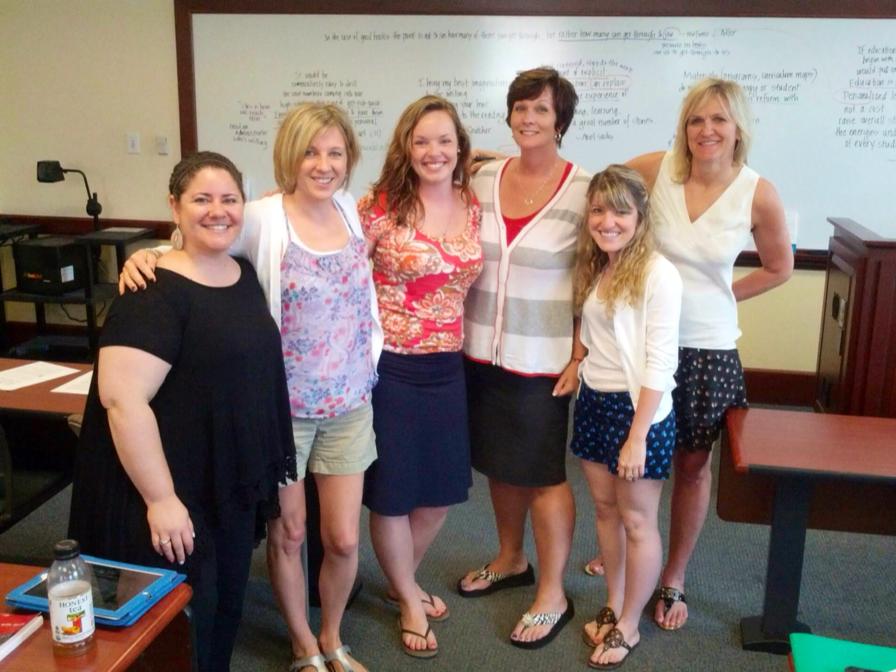
I’d like to introduce you to my friends who have validated my thinking and taught me how to think more clearly. They are my zen when I need support or encouragement or recommendations for books. They are classmates from the past two courses I’ve taken from Penny Kittle at the University of New Hampshire Literacy Institute. We bonded again this year over Book Love.

How often do we feel like we are an island? Not just on an island but the island itself? We understand what it means to be a workshop teacher, to allow and encourage students to choose what they read and what they write about, to build classroom libraries that rival the ones down the hall, to spent our own money on books because “It might be the right one for (boy/girl name) this time.”

Often we are alone. Alone on our campus, in our grade-level teams, during our planning time. Alone because while we admire many of our colleagues, they just don’t get it.

#UNHLIT14 Book Love

Erika, Samantha, Shana, Amy, Jackie, Penny

Shana Karnes, Erika Bogdany, and Jackie Catcher get it, and Heather and I invite them to be regular contributors to our blog. They each have unique stories of how they run their workshop classrooms and how this pedagogy works with their students. While Shana and Erika contributed last year, like me, they know that the learning to ‘get it right’ never ends.

Workshop takes practice, and it take patience. Having friends to share with, and blogging about what we learn, is a way we’ve found to be the reflective, thoughtful, writers we hope to inspire our students to be. (See the About page for more on our bios.)

Thanks for reading.

Oh, and if you’ve been following along for a while and would like to be a guest blogger, send me a message. We’d like to read about how workshop works for you and your students.

Writing as Imitation

Before you go judging me for referencing Weird Al in a sophisticated professional blog, please stick with me till the end – then you can judge me.

So, I’m sure most of you have seen the latest parody of Robin Thicke’s Blurred Lines by Weird Al. If not here it is for your viewing pleasure.

WORD CRIMES


Clearly, it is nerdy English teacher humor (as my husband would call it). And although it was funny, what actually intrigued me was a video of Weird Al that I stumbled upon after viewing his latest parody. The video was an interview that centered around his motivation as an artist and how he goes about composing his work. As I watched the video there was a brief part that struck me. See if you hear the same thing I noticed. (hint fast forward to 53 seconds into the clip)


See if you heard the same things I heard:

  • “It is sort of an exercise”
  • “I pretend like I’m them (the musicians) and I study their body of work.”
  • I pick it (the music) a part musically and figure out what are the little idiosyncrasies that make them tick stylistically.”

I know for many students the fear of the blank page is paralyzing. Just a thought, but what if we had learners imitate the writing of other great writers – even just as, “sort of an exercise.” I know I sure would be elated if I had learners carefully picking a part piece of writing in order to study stylistic elements and then turn around and try to use those same elements in their own writing. There is no question that Weird Al had to put a lot of work and thought into making the lyrics of his song parody work together just like the actual song and I’m confident that we would be pretty impressed with what our learners came up with if given the opportunity.

Not sure where to start? Don Killgallon has a great resource for any grade level that just might be what you need to try it out!


Sentence Composing for Elementary School

Sentence Composing for Middle School

Sentence Composing for High School


Why Workshop? It’s All Very Simple

Attending the University of New Hampshire Literacy Institute for the past two summers has been one of the best blessings in my teaching career. I’ve remembered what it means to be a student, replete with pages and pages of reading assignments, almost nightly research papers, and the expectation that I will participate in class.

Sure, I earned graduate credit, but more importantly, I sat as a student. I remembered what it feels like to have a teacher present a task, encourage a discussion, require I read something. I remembered what it means to be the pupil. And I wanted to learn.

I think all students want to learn. I also think that many of them do not know how.

Last week I met with my new friend Holly. We shared ideas about our plans for August and how we will more fully implement readers/writers workshop in our classrooms. We discussed what it means to struggle as a student in an English class where English is not our first language, and reading books is a new idea, and the lack of food in our home is just one component of the lack of security we feel every single day. We talked about what it must feel like to these children to fail state tests year after year. Because they do. Holly will be teaching 10th grade for the first time, and her ESL background will benefit her students immensely. I will be teaching AP English Language, and all my students will be in the AVID program. I am convinced the AVID philosophy is one every teacher should embrace:

Hold students accountable to the highest standards,
    provide academic and social support,
 and they will rise to the challenge.

It’s a philosophy every good teacher I know applies in his classroom. It’s also why so many of us choose the pedagogy of Readers and Writers Workshop. Our high standards might be the same for all students, but the support we must give them to help them rise to the various challenges with reading and writing must be individualized. Their needs are different; therefore, we must differentiate. One-on-one reading and writing conferences become daily events. We encourage, and nudge, and teach the skills that a student needs at that moment, during that task. This is authentic instruction. And it invites authentic learning.

As I think about this new school year on a new campus in a new district with new colleagues, new administrators, and new schedules (block days versus the traditional eight period days), I want to remember what it feels like from the student perspective.

“I need you to notice me, support me, show me how to learn.”

I had a colleague ask me recently, “Which is harder to plan:  teaching the traditional way with teachers making choices, or your way with students making the choices?” I should have said, “Is that really the right question?” which would have been a better response than the one I gave him.

It is hard work being a teacher in a workshop classroom. I have to know my students. I have to talk with them and know what they do with their time outside of school, who their friends are, what their dreams are for after high school. I have to be a reader, and I often have to read books I’d never read except to try to match the right book with a student who hates reading. I have to allow choice in topics, and get used to feeling uncomfortable. I have to give up control, and let teens be real in an environment that invites their opinions, and sometimes their scorn. I have to write in front of them and show my vulnerability. They have to see me struggle because all writers do. I have to love moving students as readers and writers because ultimately, if I am their English teacher, and I am not moving readers and writers, I am not doing my job.

Is it hard? Absolutely.

But here’s the thing: It’s really not a have to as much as it’s a get to.

“Simple can be harder than complex: You have to work hard to get your thinking clean to make it simple. But it’s worth it in the end because once you get there, you can move mountains.”  ~Steve Jobs

“It’s all very simple. But maybe because it’s so simple, it’s also hard.” ~Natuski Takay

My AP Scores are Down, Now What???

The comment on my post said: “I have been book talking, conferring, doing mini lessons, and incorporated the workshop approach, yet my AP Literature scores went down dramatically. Now what???”

My initial response sounded something very Donalyn Miller-like when she said to me a few years ago:  “It’s not all about the test, is it?” At the time, I thought it was, and her remark stung.

Now, I know better.

The letter below is how I responded to this very dedicated teacher who is doing her best to help her students be successful, not just on an exam, but in life. I can feel her earnest desires in first this comment and then in an email message. Chin up, my new friend, you are doing right by students because you are taking them beyond test prep and into adult learning. I applaud you.

Hello,
I feel your pain. I thought my students would do much better than they did, but then again — I think that every year.
Right after exam scores were released, I got a message from my colleague:  “My AP Lit scores are the worst they have ever been.” Although she is a good teacher, and I trust her ability to educate teenagers, she is not a workshop teacher. She allows little choice, and students only do the kind of writing in her class that they will do on the AP exam. My advice to her:  Choice Reading.
Now, I hear from you, and you say your scores plummeted. You have been doing elements of workshop, and my advice is the same but more:  More choice reading.
While I guess my voice is emerging as ‘an expert’ — probably because I post and talk about this so much, I must tell you:  I cannot base my expertise with readers/writers workshop in advanced classes on qualifying exam scores. I can only base it on my research on reading and on the personal experiences I’ve had with moving my students as readers and writers and preparing them for the kinds of reading and writing they will have to do in college. My evidence is the growth of my students, and that cannot always be measure by an exam — it rarely can.
I am used to teaching at a high poverty school that embraces the College Board’s Open Enrollment with no prerequisites. Pretty much any student who says she wants to take an AP class can — and does. I agree that every child should have the opportunity to take advanced classes, but I also think we do them a disservice by allowing them to attend a class when they do not have either 1) the reading and writing skills to engage in the learning, or 2) they do not have the work ethic to push themselves into engaging in the learning. Skill and will sit on that scale so precariously.
I know you know this already:  the AP exam represents one day of the student learning journey for that whole year. Students might be hot or cold or sitting in a luke-warm bath on exam day. I know that the majority of my students enter that room and take that exam as confident writers because I’ve seen them move from sometimes a -1 to a 5, or even a 6, on the writing rubric. But I cannot get non-readers to read the complex texts they must in order to get at least 50% correct on the multiple choice part of that exam. Of course, I cannot be certain because the score report does not show the break down between the essays and the multiple choice, but I know in my gut (and from what I’ve seen on mock tests), that my students who do poorly on the exam do so because they bomb the reading portion.
That is the basis of where I am coming from when I share with you what I think. It’s hard not to compare my scores with my colleagues’, but I have to remember:  it’s the luck of the draw which students end up in which sections with which teacher. It is rarely a fair balance of students’ abilities prior to them ever walking in my door.
Please know that I trust you are a fine educator. If you were not, you would not be seeking help to improve. And I will be honest, you have more years experience teaching AP English than I do.
I am going into my sixth year teaching AP, but I can tell you, I had disengaged kids, and I never moved more than a few readers and writers in those first couple of years. I made the choices, and most of them faked their way through the classic texts I selected. I just re-read the journal article “Not Reading: the 800-pound Mockingbird in the Classroom” by William J. Broz, and I wonder why I allowed those students to pass my English class. Broz says, “Not reading should mean that those students fail the course because they have no assignments to turn in.” I get that now.
Like you, I am a fan of Penny Kittle. For the past two years I have gone to the University of New Hampshire and taken a graduate course that she’s taught. This year she had us study reading theory. It was hard. But I am even more confident that allowing students choice in what they read and what they write is more important that the scores on the AP exam. That thinking takes a little getting used to, especially if you are used to getting high scores. We have to remember that the change in students’ lives, primarily because of their use of technology, has changed their willingness to engage with a book, and often their willingness to even attempt deep thinking, homework, and the like. Mark Prensky and Alan November’s work supports this. Prensky even asserts that students brains may be wired differently. I think I might believe that.
If you have not read the essays of Louis Rosenblatt, especially one titled “The Acid Test for Literature Teaching,” it will reinforce why you’ve tried to model Penny’s pedagogy to begin with — because you ‘get it’. At the end of her essay Rosenblatt asks these questions (the acid test):
Does this practice or approach hinder or foster a sense that literature exists as a form of personally meaningful experience?
Is the pupil’s interaction with the literary work itself the center from which all else radiates?
Is the student being being helped to grow into a relationship of integrity to language and literature?
Is he building a lifetime habit of significant reading?
I say that if we can answer with an honest yes to these questions — how much do our exam scores really matter?
The pedagogy of a readers/writers workshop classroom is in constant motion, continually fluctuating, because we plan and teach and move around the needs of our students. It is hard work because it is differentiation at mach speed. In her class Penny reminded me of a several things that I need to do better. I went through my notebook and made this list. Maybe this will help you, too (in no specific order of importance):
1. The pedagogy in a workshop classroom is 1/3 teacher talk and 2/3 student talk. Am I talking too much, or am I creating opportunities for students to think and debate and discover meaning with one another?
2. “Process is as important, or more important, than our product.” –the theory of Don Graves & Don Murray, UNH. How can I focus more on the process that students undergo to become writers than the writing itself? Do I talk with them as writers, or do I talk with them about their writing?
3. Have students think and analyze their process. “My process changes with genre.” Penny Kittle. If hers does, and mine does, then my students’ should. How do I help them understand why thinking about their process will lead to more accomplished writing?
4. One effective strategy when students say they “do not know”: Define yourself by what you are not. (This is a form of argument, taking on the counterargument from the get-go.)
5. “The hardest part of the writing process is figuring out what to say — when we give kids prompts we take away the hardest part.” Penny Kittle. How can I create a better balance of exposing students to AP essay prompts and free writing and quick writes that generates thinking for essays about topics students want to write about?
6. “Vocabulary from SAT word lists is a waste of time. The SAT draws from a bank of over 5, 000 words, even 25 words a week that you make kids memorize will never get them there.” PK. How can I help students create their own dictionaries, based on the ‘hard words’ they discover in their choice reading books? PK has her students find four a week.
7. Richard Allington’s research says that volume matters for struggling readers. He suggests that they should be reading at least 25 books a year. If that is true for struggling readers, how many books should college-bound students be reading?
8. Multi-tasking has been proven to be a myth. At least 10 minutes of silent reading time per day stills the silence, and a. helps students learn to focus, b. shows students that reading can become a habit.
9. Workshop classrooms are grounded in “Transactional Experience” theory. How do we invite students to have an aesthetic experience with a text?
10. “The success of our teaching is the willingness of kids to engage when we aren’t with them.” PK. How can I set up the learning expectations better so students know the end-goals more clearly? If colleges require 200-600 pages of independent reading a week, and most of my students will go to college, how can I help them engage in the practices that will help them do that now? [This year a group of students practically rebelled. They actually accused me of wasting their time because I refused to do test prep every day.]
11. “No amount of explicit skill instruction can replace the experiences of hearing, reading, learning, and living in a great number of stories.” Ariel Sacks. How can I helps students read like writers so they discover the explicit skills writers use on their own or in small groups? More talk.
12. “Independent reading should deepen thinking for writing.” PK This is where I fell short this year:  I didn’t have my students write about their reading. I didn’t make the learning connected enough. I need to have students write informal responses to their reading occasionally in their notebooks, and then they may choose one response to write into a more formal paper. What specific skills can I model as students write their formal responses? Remember Pk’s strategy with quotes across the board and how as students we made connections and then wrote about them. This was synthesis.
13. Mentor texts matter. What additional mentor texts can I have students study prior to major writing tasks? Need maybe 3-5 per genre– or more.
14. With each writing task, students must know the ‘end game.’ The end game is for them to demonstrate their learning. It’s about growth, so even the best writers must show growth, even those who come in my door as A-student readers and writers. How can I score more on process rather than product?
15. There are three types of conferences:  1. monitor the student’s reading life, 2. teach reading strategies, 3. challenge/increase complexity. I do #1 well. How can I improve the other two? If I can focus more on #3, I believe I can move readers into becoming the kind of thinkers they must be on the AP exam.
16. To analyze a text, we must read like writers. How can I teach over comprehension and get students to read as writers regularly? I must model what this means more clearly. This is where regular text studies with short passages matter.
17. “Students should talk regularly about their thinking both before and after writing. They will hear the thinking of others and this will help them extend their own.” PK.  How can I work more time for this talk into my daily lesson plans? Scripted questions?
18. “Model your writing. Let students see your struggles.” PK. I need to do this more. Idea from Penny:  project two run-on sentences from famous books on the board, i.e. The Goldfinch & ?. Ask:  These authors knew better. What was their intent in writing these run-on sentences? This will inspire thinking and talk, then students may write about their thinking. Better than writing “run-on” on their side of their papers.
19. Storyboards can be used to map a chapter, to read it rhetorically, not just for planning a narrative. How can I use storyboards to help students deconstruct a chapter? Then assessment is only looking for evidence of rhetorical reading (how &why).
20. “Put structures in their heads, so they read like writers.” PK. I just need to talk about this a lot more!
21. Ask:  “What have you learned about living from this book?” Leads students into reader’s response. This will tie into the human condition and the work as a whole that is needed for the AP exam.
22. Writing conferences. Writers control the conference; they say what they want help with. How can I get students to take ownership of this time to talk with me about their craft? “If you don’t leave a conference wanting to write more, there’s a problem with the feedback.” Don Murray
I hope you find these thoughts and questions helpful. Like you, I am always looking to improve. Every year I hope to open that webpage with exam scores and see all 3, 4, and 5’s. So far, those are a bit spotty, but I admit I am pretty proud of my 2’s. They’ve grown as readers and writers, and I’m okay with having some of my students just College Ready.

More about Readers/Writers Workshop

(See my post yesterday for the backstory of all this, if you missed it, and you’re interested.)

More on my exchange with Holly who is dedicated to moving readers and writers in her new workshop classroom. I am so impressed with her questions and reflection on her practice!

Her: I am slightly fearful but I’m trying to put “the test” out if my mind and work on creating readers and writers. Then the test will take care of its self. I hope!

Me (My heart singing because she gets it! It is not about a test; it never should be.): The first  year I jumped ship and swam my way in Workshop was scary. I didn’t do much that year except get kids writing more. That was the autumn after I did my Invitational Summer Institute with North Star of TX Writing Project. I know I didn’t hurt my students, but I didn’t help them become better readers and writers, although they did do a lot of writing. I’ve learned more about balance since then.

Her: My classroom library is in pretty good shape, but I could always use more. I’ll take advantage of donorschoose.org for part of my overall plan that I need help with. 

Me:  Your library looks lovely; however, how do students know which books to choose?

One idea I got from a friend:   if you will label the shelves, organize by topic or theme, turn some of the titles out — then students will treat your shelves like a library.  Also, I just got new “favorite YA books” from some of my classmates at UNH. I will [post] that list in another message.

Her: This is my work in progress…. Begin with 15 minutes of SSR. 2-4 Book talk or students share an interesting part of what they are reading to encourage others. . . .

Me:  15 minutes is a good idea; however, it is a LONG time for students who are not readers — yet. I am sure you know that already. I learned from my experiences that I cannot push too hard too fast, until everyone is matched with a book.

Her:  I also want to incorporate reading logs to have a functional use to teach literary terms and have students be responsible for adding 5 words a week to their own vocabulary journal.

Me:  Reading logs? What do you mean by that exactly? The research by Krashen, Allington, and others shows that readers who are able to read without a lot of demands will read more and move faster than those who have to document their reading all the time. Holding regular reading conferences with students and asking them about what they are reading about is formative assessment without them feeling bogged down about having to justify their reading in logs.

Do students need to write about what they are reading? Yes, sometimes. But we do not want to kill the love of just reading. (Thank God I do not have to log my reading life.)

Yes! to students creating their own vocabulary journal. I call them Personal Dictionaries. Same idea. Penny Kittle has kids find four words a week (she requires 2 hours of reading homework per week, based on each student’s individual reading rate). I am changing to this model.

Her:  Then I want to read aloud a chapter from an engaging YA novel or a piece of poetry everyday. (I’m struggling to think of novels to use. The ones that I have success with are being used in reading.) 

Me:  Besides the research-based benefits of reading aloud to students at all levels, WHY do you want to devote time to this? If you can answer that question, you will be able to find what to read.

Have you thought of doing craft studies with poems and short passages? Every book I read I watch for passages that strike me with their beauty. Every time, these passages are loaded with some kind of literary or rhetorical devices I can use for mini-lessons. Sometimes students and I read these passages together and discover how the author crafted the meaning. Sometimes we write written responses to the meaning/ or what strikes us as meaningful to the passage. Sometimes students model the passage.

Her:  Mechanically inclined lesson on Mondays and Tuesdays (We have an A/B day) mini lesson 10-20

Me:  I know students often lack grammar instruction, but is there a way to include these lessons within your writing workshop time so they do not look like grammar lessons, and they look like “Here’s-what-good-writers-do lessons?” If students see them this way, they are more apt to apply the skills they learn into their own writing. We have to be purposeful in helping them make those connections. Again, I know you know that.

Her:  Wednesday and Thursday direct instruction or modeling writing 10-20 [and] Workshop writing time 

Writing Genres 
1. Narrative 3 weeks 
2. Expository 6 weeks 
3. Persuasive and editorial 9 
4. Test taking 3 weeks before [state exam]
5. Last 6 weeks multi-genre project 
My goal is to incorporate  students sharing 1 published piece every 3 weeks in a read around and other real audiences with persuasive and editorials. 

Me:  Sharing published pieces is AWESOME. Once students feel successful as writers, they will write more — and better.  Love your genres list.

Her:  I don’t know if this will work or not. What I feel like I need help with the most is logistics and how do I incorporate curriculum reading? 

[Isn’t this always the BIG QUESTION?]

Me:  Why do you need to? Does the district require that you read specific texts? I thought not. If the answer is yes, then (I got this from my friend Tim who does workshop in IB classes) you focus on readers/writers workshop first, and then you do the “required” reading.

Here’s what I’d do:  select passages from the required texts in which you can model specific skills. Read and study those passages together as a class. Watch a few film clips and discuss those for content and scripts, etc — that kind of learning. Then challenge students to read the rest of the text as their SSR book.  If your principal has already given you permission to veer away from the standard curriculum, take it. He’s essentially already said you do not “have” to do any required texts. Hurrah!

And here’s the most important part of anything I’ve said to my friend Holly thus far:

You’ve got more thinking in these messages you’ve sent me than many educators I know who have been teaching for years. Seriously!

Note to all:  If you have not read the article “Not Reading: The 800-Pound Mockingbird in the Classroom” by William J. Broz, well, you should. It might be just the thing to give those of us like Holly, who want so badly to do right by our students, the strength to keep powering on toward moving readers and writers in our workshop classrooms.

Holly and I are meeting in person to talk shop next week. I’m sure another post will follow.