Author Archives: Amy Rasmussen

#FridayReads: Investments, Books, and the Need to Read

I am addicted to books. No question. I am a bibliophile.

And I am proud of it.

I have this not-so-secret hope that my students will be bibliophiles, too. I work very hard to make them so.

This year I’ve had a bit of trouble getting students to read. Okay, I’ve had a lot of trouble getting students to read. It’s been the hardest year for me in the years since I turned to a workshop and choice pedagogy.

I am at fault for not conferring enough, not talking about books enough, not introducing enough books that I know my students will love.  I’ve reflected enough on my practice to get that.

Finally, the light dawned:  Get them investing in the books, not just invested in the reading. But get students making the choices about what books I need in my classroom library.

Fortunately, I’ve been blessed with some kind grant benefactors and have some money to invest in books. (Shana is an expert at grant writing, and I’ve highlighted her post in the past. I do it again here.) It takes some time to write grant proposals, and then once awarded, it takes some time completing books orders — I should have done all this sooner in the year.

In class this week, I gave students an assignment:

  • Search and find a book about social issues you want to read with at least one other person in class. (I’m working on getting multiples of great titles in my classroom library.)
  • Find an award-winning book, or at least a book written by an award-winning author. (At NCTE Penny Kittle said something like “…the more you read of the best literature, the more you’ll recognize it.) I know this is true. Students begin to see it too when they read books that reflect rich and meaningful author’s craft.

So, today for #FridayReads I share with you the list of books my students came up with. I’m pretty sure they will be fantastic reads.

The Martian Andy Weir
Everything I Never Told You Celeste Ng
Challenger Deep Neal Shusterman
Love and Other Ways of Dying Michael Paterniti
Did You Ever Have a Familly Bill Clegg
Fate and Furies Lauren Groff
All the Light We Cannot See Anthony Doer
The Goldfinch Donna Tartt
The Road of Lost Innocence Somaly Mam
Between the World and Me Ta-Nehisi Coates
Inside a Hollow Tree Kevin White
Behind the Beautiful Forevers Katherine Boo
Symphony for the City of the Dead M.T. Anderson
A Little Life Hanya Yanagilhara
Refund: Stories Karen E. Bender
Sickened: the True Story of a Lost Childhood Julie Gregory
The Invisible Girls Sarah Thebarge
Pretty Little Killers Daleen Berry
Columbine Dave Cullen
Redeployment Phil Klay
My Story Elizabeth Smart
Hope: A Memoir of Survival in Cleveland Amanda Berry

#FridayReads A Must-Read Book: All American Boys

I saw a tweet last week that read something like this:  “What if you look like the people others are afraid of?”

The context was the Syrian refugees, I’m sure. The terrors in Paris blasted the news. So many dead. So many injured.

So many with no place to go.

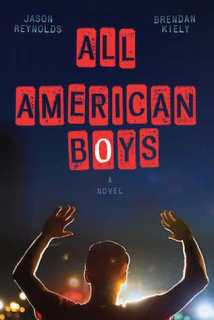
My heart hurt, and I am not sure about the timing, but I’m quite 25657130sure God told me to read the book All American Boys by Jason Reynolds and Brendan Kiely, the story of two American teens who attend the same high school:  one white, one black. Both with families who love them. Both caught in a situation that represents many we’ve heard over and over again:  “the repercussions of a single violent act that leaves their school, their community, and, ultimately, the country bitterly divided by racial tension.”

For the past couple of weeks my students and I have read some of the writing of Leonard Pitts, Jr. We read his work to learn to become better writers. Among others, we read “We need a better plan to probe police shootings,” and “We don’t want to watch police — but we have to.” We talked about Pitt’s message, and we analyzed his craft.

We questioned what we know has happened way too often, and we shared ideas and opinions about how the actions of some affect the lives of many.

We sat in a circle: Black and White and Chin and Mexican. We talked. And listened. We tried to understand.

All American Boys is a story for every classroom library. It’s a story for every classroom teacher. Every administrator. Every parent. Every police officer.

We must invite candid stories and candid conversations about race into our learning environments. How else will we ever learn to see past color into hearts and minds and hope?

Booklist Starred Review states: “. . .this hard-edged, ripped-from-the-headlines book is more than a problem novel; it’s a carefully plotted, psychologically acute, character-driven work of fiction that dramatizes an all-too-frequent occurrence. Police brutality and race relations in America are issues that demand debate and discussion, which this superb book powerfully enables.”

If you add one book to your reading list this fall, I hope it is All American Boys. It ranks right up there with Forgive Me, Leonard Peacock for books that will stay with me forever.

I need about 10 copies for my classroom library.

#3TTWorkshop — How to Hold Students (and Ourselves) Accountable for Reading

Three educators. Three states. Three demographics. All practicing Readers and Writers Workshop in our Secondary Classrooms. Read more about us here.

We are the Modern PLC, and every Wednesday, we share our behind-the-scenes collaboration as we talk about the most urgent moving parts of our classroom pedagogy.

Reading accountability and grading our students’ reading goes hand in hand. Both are parts of a workshop classroom that can seem daunting, and sometimes we have to be flexible until we figure out what works well for our students and for us. Let’s start the conversation with accountability.

How do you hold students accountable for their reading?

Amy:  More than any other year, holding students accountable for their reading is driving me crazy. I’ve tried passing a clipboard like I learned from Penny Kittle. Many of my students cannot get their heads wrapped around a simple “Write down the page number you are on” and then “tally your reading for the week.” I see my students for half a class period on Mondays and then every other day the rest of the week. Seems if they miss the chart at the first of the week they never get it caught up.

Last year I tried an online reading chart. Each student had a page in a spreadsheet that I asked them to keep updated. I gave them a couple of minutes in class right after independent reading time. That worked a little better, but it was more difficult for me to access at a glance. I really like to get a true state of the class.

The past few weeks, I’ve started walking around on Mondays and recording page numbers myself. I decided to try this since my students were moving into book club reading. I can see if they are on target with the reading goal for their groups. It’s worked better, but this is not the kind of accountability I want to inspire in my readers. I’ve made myself the accountable one, and I am outnumbered.

Jackie: I’ve had a love-hate relationship with accountability like you, Amy.  The initial passing-around-the-clipboard method did not work for me either.  I shifted to checking individually two years ago.  I have a spreadsheet in which I enter their page numbers and reading rates on Mondays.  The spreadsheet then immediately calculates the percentage they completed and whether they fulfilled their reading rate for the week.  It isn’t a perfect system and I would much rather be conferencing with students instead of checking page numbers, but there are both pros and cons.

On the bright side, I do like checking in with every student on Mondays, and with a class of 24, it takes me about 13-15 minutes to record pages for the entire class.  The other benefit is that I also immediately know when students didn’t complete the number of pages they were capable of reading for that week.  Instead of telling them they didn’t complete the assignment though, we have a conversation about their reading overall.

Honestly, for my freshmen, this form of accountability is key.  It is less important for my AP Literature students, but I enjoy walking through the class every Monday, touching base with every student, and ultimately starting my week off by acknowledging their reading successes.

Amy:  Like you, Jackie, I do enjoy checking in with every student on Monday morning. The time is a trade off though, since I try to hold reading conferences when students are silently reading. I just don’t feel like I have the time to really talk to my students who are not getting their reading time in (That might be the crux of my frustration — I have too many students still not doing enough reading), and now meeting with each student for a longer reading conference on a regular basis takes that much longer. Seems like time eats my lunch every day.

I ask my AP Language students to read three hours a week in their self-selected books each week. Some students read voraciously, and I find these readers don’t necessarily like keeping track of the pages they read each week. I love that they read because they want to — something I hope for all my students, so I do not want to penalize them for not marking an accountability chart.

Besides just noting how many pages students read each week, what other accountability structures do you have in place?

Amy:  In our writer’s notebooks, we keep track of the books we start, abandon, and finish. We also pull vocabulary words –5 words a week — from our independent reading to put in our personal dictionaries. I know you and Shana just discussed vocab last week.

This year as another accountability piece,  I started asking students to complete an occasional reading one-pager. I have mixed feelings about this because I know the value of reading for reading’s sake, but marking the reading chart wasn’t working, and I have a difficult time conferring as often as I’d like. I also need my students to practice writing about literature. All they want to do is summarize, and the one-pager is one way to help them move beyond that.

I hope to get my students to think about accountability as self-evaluation. We talk a lot about the reason for reading:  We build fluency, acquire vocabulary, gain empathy, and learn information. “How has your reading this week helped you do that?”

Jackie: We also keep track of the books we start, abandon, and finish.  Students add to their “Books Read” list at the beginning of their writer’s notebook and they check off the books they complete.  Students also pull four words per week from their independent reading and log them in their WNB dictionaries.

Like you, I tried one pagers from Kelly Gallagher two years ago, but they were difficult to track and my strongest readers oftentimes slowed down their reading to avoid the one pagers.  I believe they can work, but I haven’t found a perfect fit just yet.  My AP Literature students do keep a critical reading journal (CRJ), which I started using this year thanks to Sheridan Steelman’s help.  Sheri is a phenomenal AP Literature teacher I met at UNH Literacy Institute.  Her structuring of CRJs has helped me gain even further insight into my AP Lit students’ needs and successes.

At the end of the day, my greatest source of information comes from the conferences I have with my students.  Students want to talk about their books, and it is a pleasure to sit beside them and learn every day.

So how do you grade your students on their reading?  

Jackie:  My school has competency based grading, so I file reading initiative grades under “formative assessments.”  I look at reading time as purely formative in the sense that it is necessary practice time for students to explore their interests while also building reading stamina.

Students in my CP Freshman English class must read two hours in their independent reading books while students in my AP Literature class must read three hours.  Each student has an individual reading rate, which they calculate and recalculate throughout the year. I adjust their reading times based on whether or not students are completing whole class or literature circle novels.  Students then receive a weekly reading initiative grade out of 20 points.  At the end of the day though, this structure is in place to help students carve out time for reading.  

One of the greatest complaints from my AP Lit students at the beginning of the year was that they didn’t have time to read anymore.  They loved it but it had been a long time since they’d picked a book on their own.  After a quarter of independent reading, Jessica said, “I love independent reading.  It gives me a break from everything” while Claudia said, “I have read more this quarter than I have in the past year.”

Amy:  I wish I didn’t have to give a grade for reading. I wish I didn’t have to give a grade for a lot of the work we do in class, but that is a topic for another day. All my little reading checks equate to a reading grade, all formative, except for a self-evaluation of their reading lives students complete about every nine weeks — that’s a summative assessment I model after a reading ladders assignment I learned from Penny Kittle.

Really, when it comes to grades, if my students show me growth and improvement, the grading is easy. It’s all about moving as readers. Eventually, most students come to realize that — and they thank me for making reading matter again.

How do you handle reading accountability and reading grades in your workshop classroom? Please add to the conversation by making a comment.

Do you have topic ideas you would like us to discuss? Please leave your requests here.

I think reading may not be all that important — What?!

I am not often speechless. But it’s not often I hear statements like this — from teachers no less:

“There are so many other ways for students to get information. I think reading may not be all that important to students today.”

We were into the second hour of a three hour workshop on conferring. We had already brainstormed and charted what we believe are the needs of our students:

  • trust in authority
  • time and attention from adults
  • a caring teacher who is a listener and is consistent with discipline and classroom management
  • technology to learn and communicate
  • critical thinking skills
  • a context for what we want them to learn
  • positivity and discernment
  • a focus on what matters/ability to ignore “the noise” of unnecessary information
  • the opportunity to freely think and to take risks
  • the ability to communicate in ways that are socially acceptable and responsible

We had just read research on reading as detailed by Nancy Motley in the book Talk, Read, Talk, Write. I share it here:

Literacy skills for the twenty-first century are far more complex than in previous generations (Goldman, 2012). In addition to the basics of reading comprehension, today’s students must also know how to read with purpose, integrate new information, resolve conflicting content in different texts, and identify the writer’s perspective (Biancarosa & Snow, 2006). Students can only learn these skills by reading. Because many students enter the classroom with underdeveloped literacy skills, we often replace reading tasks with lecture and interactive activities to ensure that students stay engaged and learn the content, Hoyt (1999) explains.

“…expository reading for many students is often a listening experience. Well-meaning teachers, concerned about textbooks that are too difficult, often create situations where one student reads from the text and others listen or attempt to follow along in the book. This situation does little to build conceptual understandings, and it can actually deter from the learning process as the listeners are engaging in very little reading.”

When teachers “deliver” the curriculum to students, students lose the opportunity to construct meaning for themselves (Tovani, 2000). According to the Reading Next (2006) report (a meta-analysis of adolescent reading), three of the most statistically significant practices for increasing the academic achievement of middle and high school students included:

  1. direct, explicit comprehension instruction
  2. reading and writing skills embedded in content area classrooms
  3. text-based collaborative learning

Put simply,

“When we routinely model and make explicit the methods adults use to read, think, and make connections, students learn to do it, too. Furthermore, they will see that such close, insightful reading is within their reach — that they can do such reading and thinking, which is central to an education.” (Schmoker, 2011).

I am not often speechless. But this teacher’s comment left me chewing my lip. Did he read the research? Did he understand what it meant? Does he really believe that reading is not important?

“If I gave my students The Canterbury Tales and expected them to read it, that just wouldn’t happen. I read it to them, and they get a lot of information, and they come to like it,” this teacher continued.

And I countered, embracing my inner Penny Kittle, as I facilitated another hour of professional development:  “What is your purpose for ‘reading’ The Canterbury Tales — or other texts you choose for your students? What skills are you teaching with that book? How do you know your students are learning them? How are you helping your students develop as readers — because that is our job as English teachers. If we are not helping students become better readers than they were when they came to us, we are not doing our job.””

“Today’s students must … know how to read with purpose, integrate new information, resolve conflicting content in different texts, and identify the writer’s perspective.  Students can only learn these skills by reading.” 

They must also know how to discern viable information from the barrage of biased and unreliable information. And know how to understand a rental agreement when they sign a lease, a sales contract when they purchase a car, a speeding ticket when they get one, a ballot in a voting box when they are standing in line next to you and next to me.

Students can only learn to read by reading.

benefits of reading

What do you think? Is reading important to the students we teach? How would you have responded to my teacher friend?

Grateful November and a give-a-way for you

Sometimes thank you has to be enough.

Last evening I joined in #poetrychat and learned from 28 teachers from various parts of the U.S. and Canada about how to more effectively teach grammar by using poetry. Chats like this inspire me, and I want to be a better teacher. Tomorrow I will share this poem with my students as we begin argumentative writing:  The Joy of Writing by Wislawa Szymborska, my new-found favorite poet.

Thanks to all of you who’ve joined in our monthly chats about poetry. I am a better poet, and poetry teacher, than I was last May when TTT started hosting the monthly poetry chat.

Also, I am a better teacher because of you, the readers of this blog. I teach with more intention because I know I will write about the lessons, activities, books, and other resources I use with my students.

Audience matters to every writer, and I consider it a gift that my audience is also my muse. Thank you for your questions that inspire such deep thinking and so many posts.

May November bring a sense of gratitude and rich blessings in the lives of each of our readers. Thank you for your confidence in us as we share the experiences, lessons, and activities from our workshop classrooms.

So what’s the give-a-way already?

Shana, Jackie, and I met online last week to talk about our goals for this blog and how we can support you more fully. We might be able to help more if you give us some direction. So —

We know it’s not much, but it will buy a few books: We’re giving away one $25 Amazon gift card.

Just complete the short 3-5 minute survey, and you’ll be entered automatically. We’ll choose a winner randomly on November 10 and let the winner know via Twitter or email.


3 Lessons from Running a Spooky 5K

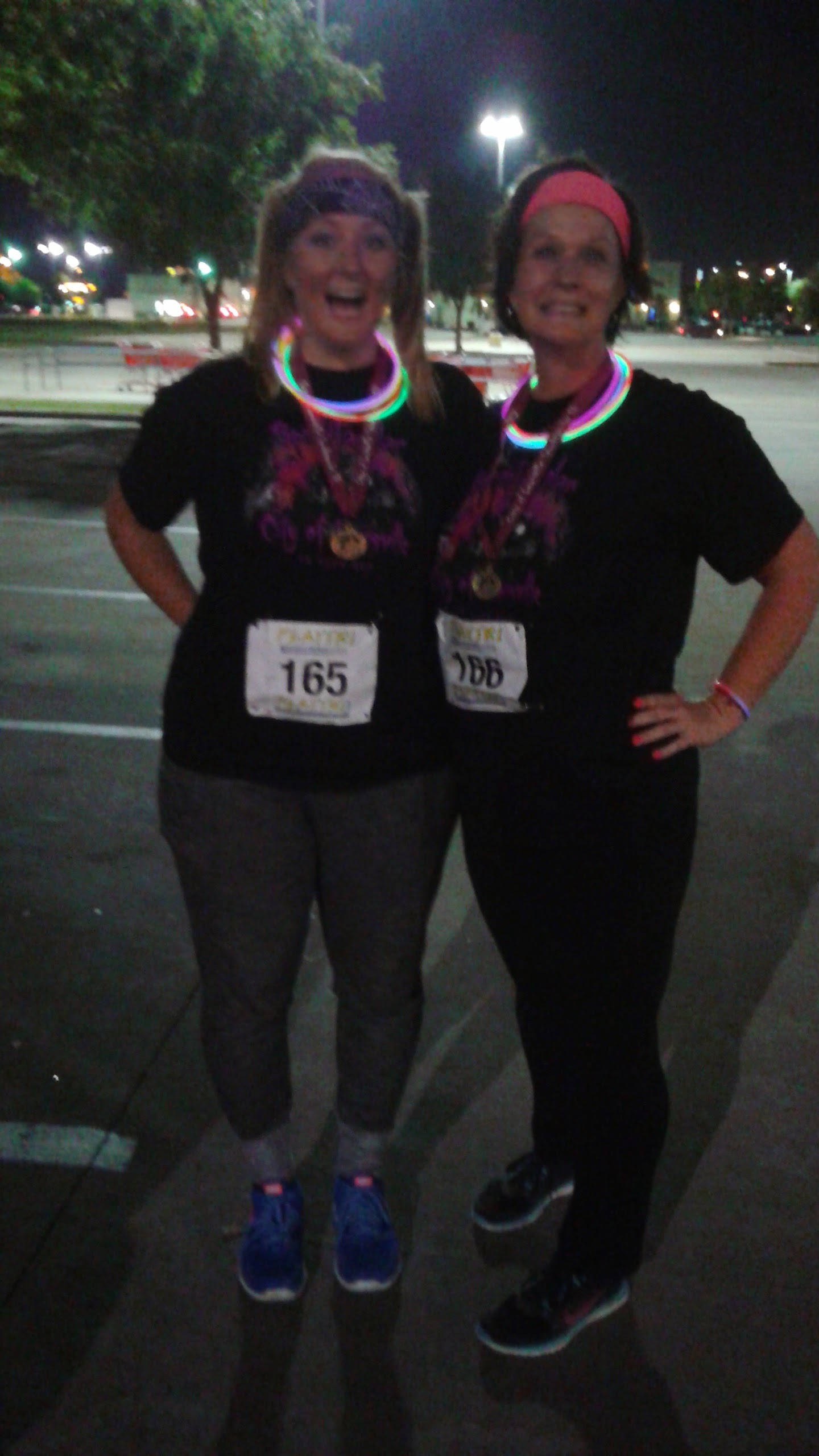
spooktacular runSaturday was the one-year anniversary of the race that changed my perspective about running — the “Spook-tacular 5K.”

I’d trained for about three months, getting up early for interval training before the hot TX sun demanded I go right back inside. Then at dusk going out again to run-a-little-walk-a-lot while my stamina claimed some courage.

Volunteers dressed up as ghouls and witches jumped from behind trees and fences along the pathway. Zombies roamed and groaned their way against the grain of runners. It was all fun and games until I lost sight of my daughter.

That’s when it got spooky. I could not see my daughter Jenna, my running partner who kept me from giving up.

Jenna’s a lot younger than me, so it’s no wonder she didn’t want to hang back and shuffle along. I even told her to run ahead.

But then the doubt started. What if I want to stop? Jenna won’t be here to tell me to power up. How will I keep going if Jenna’s not here to talk me through the sameness of a 3.1 mile jog? You know you hate running, why do you even try?

Two years before I’d tried to become a runner, but I could not make myself enjoy it. Jenna and I’d run one race back then, and I’d stationed myself behind an 70 year old man who ran with a walker. Really he ran with a nurse, but still, and there I was pacing myself behind him. He ran slowly, steady and sure, never stopping to catch a breath or break stride. A vacuum cleaner ate my lungs, but I kept moving. By the end, I thought my rubber legs would kill me.

Obviously, they didn’t.

Now, here I was in much better shape. Jenna and I worked out hard, and I knew I could run this whole race without stopping. I just needed to prove to myself that I could.

So I ran. I steadied my breathing, and I refused to stop. Booing ghosts and all.

I got about a hundred yards from the finish line, and I could hear “Monster Mash” blaring from the pavilion. I knew I’d almost made it when about eight little stick-figure-girls cut a corner and raced past me from behind.

Little cheaters.

I’d run the whole race, slow but steady, and these little adolescents with their long legs and glow sticks ran just long enough to “glisten” as they crossed the finish line right in front of me.

I crossed the finish line complaining. I didn’t even notice my time or relish the fun of finishing. I let them steal that from me.

And I learned some lessons that night:

1) I am stronger than I think I am.

2) I can do hard things, even by myself.

3) I shouldn’t let anyone at anytime steal my celebrations or my joy.

So what does this have to do with teaching? with readers and writers workshop and sharing what I know works? with conferring with my readers and teaching kids to write? with facing a room full of teens each day who need all the skill I’ve got?

Yeah, if you’re reading this post, I know you get it.

We train and practice and learn. We keep talking about books and conferring with our kids. We find joy when they light up about a book — or finally finish one. We focus on the skills we know our students need. We stay positive and hold fast to our pedagogy. We know workshop works. We revision our classrooms to meet the needs of our students — every single day. . . and sometimes every class period.

We keep moving, so our readers and writers will keep moving, too.

©Amy Rasmussen, 2011 – 2015

Mini-Lesson Monday: Learning Concrete Details with Independent Reading

More than any other writing, I love reading my students’ narratives. We start the year with narrative for many reasons, but my favorite is that I get to know my students faster than I can get to know them during one-on-one reading conferences or during group activities and discussions.

Here’s a short list of what I’ve learned from student stories just this week:

  • several of my male students wish they had a father who showed interest in their lives
  • a few of my girls live with their fathers because of their mothers’ poor choices
  • several boys and girls journeyed long and far, walking miles through jungles, so their families could escape oppression, rape, and murder
  • many of my teenagers have experienced heartache because of love interests, friends, and family members
  • a few are still grieving the loss of grandparents, aunts, uncles, and friends who died from suicide
  • at least one young woman still holds anger toward her mom because of the way she handled a brother’s addiction and abuse

Personal and powerful, all of these stories matter. My goal as a writing teacher is to help my writers harness the words so emotion reigns in the heart of the reader. The problem?

Abstract language.

Objectives — Using the language of the Depth of Knowledge Levels: Show understanding of the terms abstract vs. concrete; in your independent reading books, identify concrete details and figurative language; analyze the effectiveness of the author’s language; revise your writing to include fresh concrete details and figurative language as you create a text that evokes powerful emotions.


Lesson
— Before the mini-lesson, students have already drafted a few pieces, narratives or poems. I abstractconcreteusually do the mini-lesson after silent reading time, but for this lesson I begin before because I want to give students a specific purpose for reading.

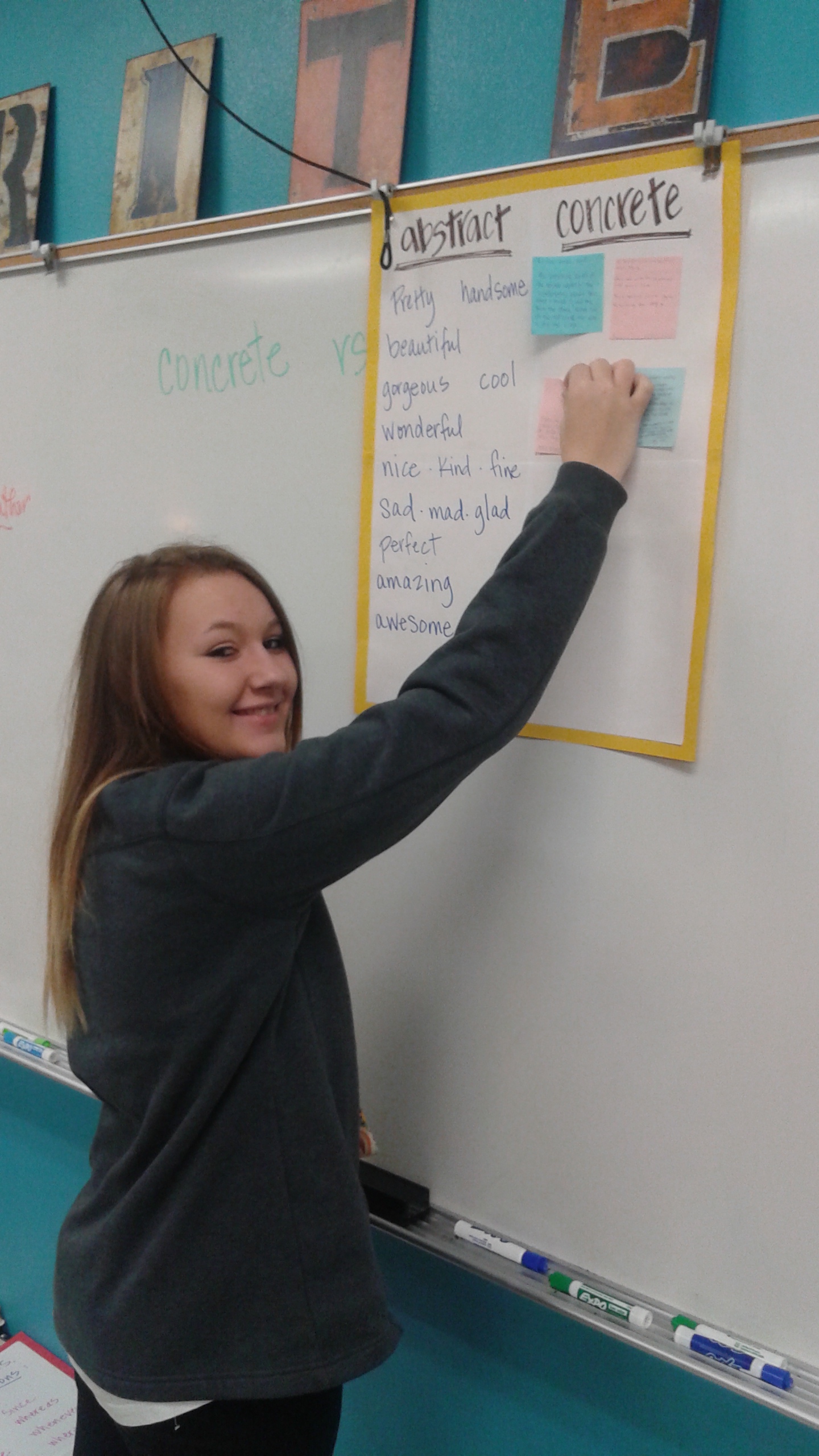
First, I write on the board ABSTRACT and CONCRETE and we review what these terms mean when it comes to writing. I try to use only abstract words as they begin to discuss this with me.

“Awesome, you might get it,”

“Wonderful, I think you know what I mean,”

“Hey, that’s pretty good…”

Eventually, they will pick up on what I’m doing, and we make a list of abstract words. Then I give each table-group a word and challenge them to come up with a concrete description that shows us that abstract word. They get 1-2 minutes, and then we share out as I write the concrete details on the board. We discuss the difference in how an author can create emotion.

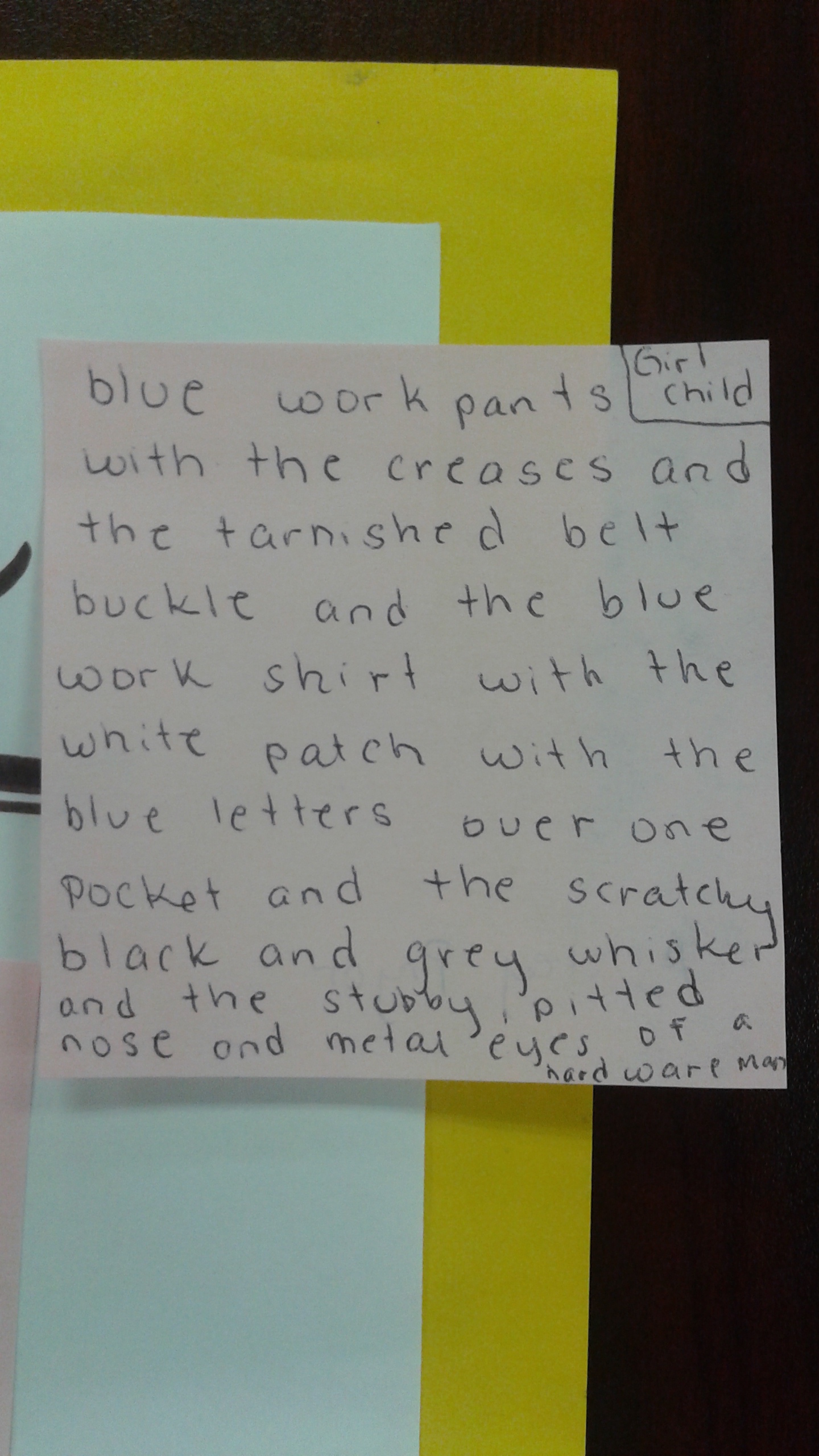
Next, I ask students to pay attention to the concrete details in the book they are reading, and I give them each a sticky note. “As you read today find at least one sentence where the author does something really clever with concrete details and/or figurative language,” I say.

Students read for 15 minutes, pen in hand, paying particular attention to the author’s craft. When time is up, I ask students to share their sentence in small groups and to analyze the effectiveness of the author’s word choice.

AllieTate“Think about what he’s trying to do there. Why did he mention the color of the sweater, or the smell of the breeze?” If they feel like the author’s accomplished creating emotion, they put the sticky on the board (or as in the photo here –poster).

Students need to not only recognize the details and know that they create some kind of imagery, they need to think about how effective the word choice is for what the author is doing at that moment in the story. If I can get them to start thinking about this, I can get them to begin making purposeful choices in their own writing.

Next, I ask students to search their own writing for concrete details that create images and to add a lot more. “Where can you add a phrase or line similar to what you found in the book you are reading? Is there somewhere you can add color or shape or texture?”

And we revise.

Follow-Up — When students immediately apply learning we’ve practiced using their personal reading materials, they begin to see the connections between becoming active readers and purposeful writers. This is the kind of lesson I do again and again with a different literary or grammar skills students to master. Next up:  subordinating conjunctions.

A few lines from students’ published narratives:

“Each body turned to watch as the green army, blurry, entered the gate. The ground only knew sadness and the sky transformed into a dark night, roaming like a lion.” –Tha Sung

“My first impression when I met Lucila:  petite, chunky, short red-velvet hair, wearing a sweater that covered her sins, mysterious face with a sealed silent mouth.” –Karina Rangel

“My brothers slept like angels with devilish grins.” –Geovanni Medina

#FridayReads: Hot Non-fiction for High School Readers

I still have non-readers. We are ending the ninth week of school, and usually by this time each fall, my Hold Outs experience a shift. They start reading. I haven’t pinpointed exact reasons for the resistance this year — I think I’m doing as many book talks, conferring sessions, and cheerleading-moments-about-books that I have in the past, but something is up with a good number of my students.. They just do not want to read.

I asked Bryan about his reading yesterday. He said, “I only read when I have to.”

“What can I do to help you want to read?” I asked.

“I don’t know.”

This is where it gets tough. I get to be a magician and a mind reader.

Or, I just need to know books and keep talking about them. I just need to keep encouraging my students to read and surround them with books they will find interesting.

A few weeks ago, Jackie wrote Top Books for Reluctant High School Readers, and I remembered Ready Player One, Gone Girl, and Perks of Being a Wallflower. I need to book talk those!

About two months ago, I wrote about the novels-in-verse I got for my classroom. Many of my students who had never read a book have read two, three, and four of those titles now.

I know many boys will read non-fiction when they won’t read “make believe.” Seems it’s time for an infusion of hot non-fiction books that might add some intrigue to my classroom bookshelves. I need books that students like Bryan will want to read.teen_school_boys_reading

I posed this question to my writing partners:

What are the hottest non-fiction titles in your classroom library?

Here’s our master list:

Jackie’s List

Ghost Soldiers by Hampton Sides

I’m Staying with my Boys by Jim Proser

Jarhead by Anthony Swofford

The Glass Castle by Jeannette Walls

Half-Broke Horses by Jeannette Walls

Sickened: The True Story of a Lost Childhood by Julie Gregory

The Devil’s Highway by Luis Alberto Urrea

Hellhound on His Trail by Hampton Sides

Kick Me by Paul Feig

Shana’s List

Pretty Little Killers by Daleen Berry (two girls murdered their best friend at the other high school in our county…kids cannot put this book down)

Columbine by Dave Cullen

Zeitoun by Dave Eggers

Five Days at Memorial by Sheri Fink (about Katrina; pairs well with Zeitoun)

Missoula by Jon Krakauer

…anything by the great sportswriter John Feinstein (The Punch, Next Man Up, A Season on the Brink)

Stiff by Mary Roach

Smoke Gets in Your Eyes by Caitlin Doughty (similar to Stiff; about working in a crematory)

…my War shelf, featuring Lone Survivor, American Sniper, Redeployment, or any other autobiography of a soldier

Erika’s List

Lucky by Alice Sebold (account of her rape and healing)

The Prisoner’s Wife &  Something Like Beautiful: One Single Mother’s Story  both by asha bandele

No Choirboy: Murder, Violence, and Teenagers on Death Row by Susan Kuklin

Inside: Life Behind Bars in America by Michael G. Santos

Orange is the New Black: My Year in a Woman’s Prison by Piper Kerman

Yummy by G.Neri (graphic novel based on a true story)

Shaq Talks Back by Shaquille O’Neal

Raising My Rainbow by Lori Duron

I Am Malala by Malala Yousafzai (Adult and YA)

A Child Called It, The Lost Boy, The Privilege of Youth, A Man Named Dave by Dave Pelzer (four part series, but each piece can be read independently)

Enrique’s Journey: The Story of a Boy’s Dangerous Journey to Reunite with his Mother  by Sonia Nazario

The Pact: Three Young Men Make a Promise & The Bond by Sampson Davis and George Jenkins

Destined to Witness: Growing up Black in Nazi Germany by Hans J. Massaquoi

Girlbomb: A Halfway Homeless Memoir & Have You Found Her by Janice Erlbaum

Amy’s List

A Stolen Life by Jaycee Dugard

Little Princes by Conor Grennan

Letters to My Young Brother by Harper Hill

The Sociopath Next Door by Martha Stout

Heaven is For Real by Todd Burpo

American Sniper by Chris Kyle

Just Mercy by Bryan Stevenson

The Glass Castle by Jeannette Walls

David and Goliath by Malcolm Gladwell

Exactly as I Am by Shaun Robinson

The Good Soldiers by David Finkel

Enrique’s Journey: The Story of a Boy’s Dangerous Journey to Reunite with his Mother  by Sonia Nazario

Life without Limits by Nick Vujicic

Do you know of any titles we left out?

©Amy Rasmussen, 2011 – 2015

Sharing Student Work — Making a Pledge to Do More

For some time now I’ve thought I needed to do more. I ask my students to write a lot. I ask them to take ownership of their process, practice their craft, take risks. I hope they will care about their audience, but unless it’s a post on their blogs (and sometimes even then) I don’t think they consider much about their readers.

My colleagues here at Three Teachers Talk and I had the idea a few years ago to publish student work on this site regularly. We planned it all out. We’d hope for student volunteers that might want to produce something like a mini-Nerdy Book Club but with student readers and student writers. Then I did a little research:

I found sites like Young Writers SocietyTeen Ink, Figment, Teen Lit, and of course, NaNoWriMo that publish the work of young writers and allow them to join online writing communities and learn about competitions, awards, scholarship, and more. This list of 40 of the Best Sites for Young Writers has even more resources.

I still want to do more, but what I need to do is introduce my writers to site like these and extend the invitation that they explore, discover, and get involved. I know a few will. Maybe many will.

In the meantime, here’s a sampling of the writing I’ve read this week. Not because I like the topic — it horrifies me on many levels — but because this writer shows heart, I want to share her work.  Read it. You’ll see why I know I need to do more to help my students write for audiences that will appreciate their craft.

Bruised-Knees by Alexia Alexander

It was a breaking point.

By the time my spoon scraped the bottom of the bowl, my face was wet with tears. I was sick, in part from eating, and in part from everything else. I had to cry quietly; I suffered silently in order to avoid questions, sometimes, even hidden behind smiles and laughter. The chocolate and caramel ice cream weighed my stomach down. I felt 200 lbs of milk, sugar, grief, loneliness, depression, cocoa, corn syrup, and artificial flavors. My entire 500 caloric intake itched in my throat. I felt heavy now. I felt worthless now. I felt defeated now. I ran as quickly up the stairs as I could, but voices, almost as loud as the screaming downstairs, followed me.

Why’d you eat that ice cream? You’ve already had enough. You’re just going to GAIN weight if you eat something like that. You can’t you even starve yourself right,” I told myself.

Staying up late reading about it, I prepared myself for chaos. Although I laid under two blankets and behind a locked door, I found little comfort. In fact, I hadn’t even kept the monsters out; they began to creep inside of my head. I spent the nights crying, reading pro-anamia blogs, drowning my ears out in Maria Mena, and looking up the most fabulous ways to destroy myself, self-esteem first.

Now getting a chance to test my research, I rushed to the bathroom, still crying. I looked at myself in the mirror; I cried even more. I was sobbing and choking, sounding like that one kid in elementary that always forgot his inhaler on mile-day. I dropped to my knees, as if I were about to pray, but I couldn’t remember what people were supposed to say to a divinity.I gripped the sides of bleach-white seats, as if my faith would be found there, and hung over the porcelain throne, like a sea-sick passenger. The bathroom became dizzy in my eyes, and the pink walls were a blur mixed in the leopard print bathroom curtain. The white tiles painted my knees black and blue and staring at them made the wave of sickness more intense. In the reflection of the toilet-bowl-water, I even looked green and sickly, but I can’t say my self-perception was quite accurate in those days.

I had screenshotted instructions on my cracked iPod screen on how to do it. I looked up everything. I needed all the how-to’s before I went through with anything. I knew I could use a toothbrush or two fingers. I knew I could make markers in my stomach. I knew how many seconds it would take. I knew that it would sting. I knew the long-term damage the acid could do to my teeth. I knew how deadly it was. I knew how sick I was.

But I continued, another event to add to my list of “First-Times.”

Slowly shoving a finger in between my lips, I danced it around trying to find the spot. I felt the tickling as I touched the dangling piece of skin. I added a finger, this time gagging slightly, but knowing no matter hard I cried, I couldn’t take my hand out. I gagged again,  bringing up the bile taste in my throat. I couldn’t choke. I had to keep going. I gagged another time, body split over the toilet as I heaved.

I had found the food that comes up almost as easily as it goes down. The ice cream coated my throat, for a second time, and it still felt cold. It masked the normal taste of vomit, gladly, and I finally felt lighter;I equated that to feeling better and didn’t think twice about why I was still crying.

Maybe you can be lovely now. See, you’re already feeling better,”  said the demons in my head, who told me things like this frequently. I tried to ignore them, but sometimes my own silent voice felt like a scream between my ears. I cried myself to sleep that night, still trying to convince myself I had done well.

I wish I had known then what I really was trying to rid myself of. I wish somewhere on that ground I really had some holy revelation, but wisdom like self-love and perseverance can only be taught from low moments like those. It took years to find what really weighed me down, more than food or fat. It took years to love myself and my body. It took years to get over the urge to skip a meal, and the shame after eating. It took years to face the demons and shut them up. But each moment that buckled me to my knees gave me strength, and brought me closer to where I am now. Moments I’d rather forget, have to remain real, so  I always remember my growth, and never repeat the past.


©Amy Rasmussen, 2011 – 2015

7 Reasons to Stop Asking about AP Test Scores

The question took me by surprise.

I’d just spent an hour or so sharing how I facilitate readers and writers workshop in my AP English Language classroom. I’d shared a video that showed my students testifying to how much they like having a choice in the books they read and why they feel like they will learn through choice reading this year. I’d shared a mini-lesson on how I teach skills using the books students choose to read, even when they are reading 30 different texts. I’d answered a variety of questions asked by pre-service teachers in Dr. Leavell-Carter’s master’s class at the University of North Texas and started to pack my things.

“What about your AP scores, did they go up?” one young woman asked, “I mean, I just think that would be a double benefit,” she said with a smile.

They say there are no bad questions, but I’ll go to the mat arguing that this is one we really need to stop asking.

I answered as honest as I could: “No. . .well, yes, when I began facilitating writer’s workshop, my scores increased double digits, but I don’t put much stock in AP scores, any standardized test scores, really, there are so many variables, you know; the students and their abilities differ from year to year, and since I’ve only taught in Title I schools where open enrollment is an invitation for all students to take AP classes with no prerequisites or even any preparation for the rigorous coursework, it’s difficult to prepare all students all the time at the same level of learning…”

Then I kicked myself all the way home. Why was I trying to justify my test scores? I’ve written about this before. I have much better proof that workshop works than any kind of testing data:

  1. Many of my students read more during the nine months they spend in my class than they do in

    from Joseph’s reading self-evaluation

    all of the 10 years of school they’ve had prior to coming to me.

  2. Almost all of my students read more books the year they spend with me than they read the year before.
  3. Many students read their first book cover to cover their junior year in my AP English class.
  4. Most students move into complex reading on their own because choice not only gets students reading; it gets them reading critically.
  5. Students tell me every year, “Thank you for allowing me to love reading again.”
  6. My readers learn to see themselves, and to see beyond themselves, by participating in book clubs with peers in non-threatening conversations about literature.
  7. My writers take ownership of their writing and compose beautifully and skillfully crafted texts.

There is no test that measures what my student come to appreciate as readers or what they come to realize as writers.

Sure, I want my students who choose to take the AP exam to do well, but I do not believe it shows what they come to understand about language. (And after scoring essays in Kansas City in June, I believe that even less.) Sure, I’ll keep encouraging my students to take the exam, but I believe most of them will benefit from taking freshman comp in college — even if they read and write well enough to score a 5. At least one English professor agrees with me:

“AP-credits are not always an accurate gauge of student learning. High AP scores in chemistry, for example, may indicate that students understand the basic concepts, but that doesn’t mean they know what to do at a laboratory bench.” (Bobby Fong, college dean and English professor).

I say what’s true for chemistry is also true for English. That doesn’t mean they know what to do when writing an essay for graduate school or a blog post for their employer or reading a report for their business or a decree in a divorce settlement.

Let’s focus on the skills our students need to be successful in the lives that lay before them.

For me, readers and writers workshop helps me do that.


©Amy Rasmussen, 2011 – 2015