Author Archives: adventuresinhighschoolworkshop

It’s better with Verse! Short and sweet book clubs encourage readers to try new format.

Student voice and student choice have been the priority this school year as we try to foster healthy, robust reading lives in our students. They have been introduced to many titles through plenty of book talks and book recommendations, so they know there are a ton of choices out there for them, but this level of choice also means we haven’t had too many shared texts.

This spring I thought it might be fun to squeeze in some shared texts and build up our reading community with deliberate talk about books. I wanted us to be able to finish in just a couple of weeks, so we are engaging in book clubs with books written in verse.

In keeping with the priorities of student voice and student choice, I provided many titles for students to choose from as they entered into this short unit. These are all books that we have multiple copies of and can be found in our classroom libraries.

Before spring break my students were given a little time to get to know a book they hadn’t seen before, and then share that book with a partner. It took just a couple of minutes for each exchange, and then both partners switched books and started again. After a few rounds of sharing books, I allowed students to flip through the remaining titles that had seemed interesting but they hadn’t had the chance to hear about yet.


They had handouts for note-taking during this activity, and when we were done, they put the notes in their readers/writers notebooks so they would have easy access after the break.
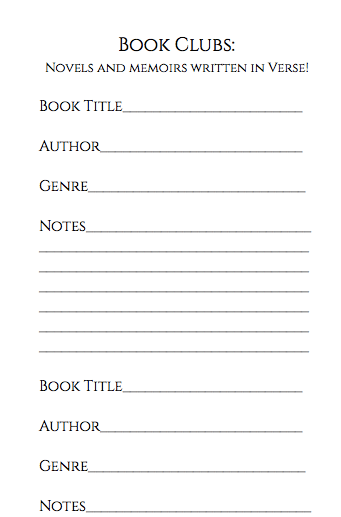
book club notes - verse

When we returned from spring break, students reviewed their notes and listed their top five choices. I assigned and handed out the books, putting between two and four students in each group.

IMG_6872

These are the titles students chose from.

The assignment was pretty straight-forward.Screen Shot 2018-04-17 at 3.37.17 PM

Students were directed to annotate for the fiction and/or nonfiction signposts found in Notice and Note and in Reading Nonfiction, (depending on their titles) the Book Head Heart framework and questions found in Disrupting Thinking, and some poetry vocabulary (listed below).


After they started reading, but before they were too many pages in, a few students had questions about how to annotate a book written in verse. They had annotated other texts before, but for some reason this type of text had some obstacles. IMG_7697 2

I decided to do a quick, fun example of annotating a narrative poem with a simple children’s poem by Shel Silverstein. Cloony the Clown has many of the fiction signposts, poetic devices, and we talked about the Book Head Heart framework. Finding the signposts and annotating together was fun. It took less than fifteen minutes to share the example in class, and my students seemed much more comfortable with annotating their book club books when we were done with the activity.

Students then used their annotations to spark discussion, and regularly use them during the week to practice their sustained conversation.

They will be assessed next week in the form of a video-discussion, where they will meet in their book groups. Using iPads, they will record their thoughtful discussions, referring to annotations, making connections with the text, and sustaining academic conversation for around twenty minutes.

What I’ve heard and seen so far has been encouraging. Students are sharing, referring to lines and stanzas, and feel accomplished that they have read a complete text in such a short amount of time. Some of them are on their second or third-draft reading, which I think is a great strategy and habit to reinforce. They are truly getting to know their books, and in the process learning about story, poetry, and close reading.


Some students were able to read their book club book in an hour or two, and then get right back to their other choice reading. Others are encouraged by the progress they are quickly making in a full-length book because it often takes them longer than a few days to read most of a book. That’s one of the many great things about books written in verse – it doesn’t take a long time to read them, but they are rich with language, story, character, and they hold student interest. With the variety of types and titles, there really is something for everyone.


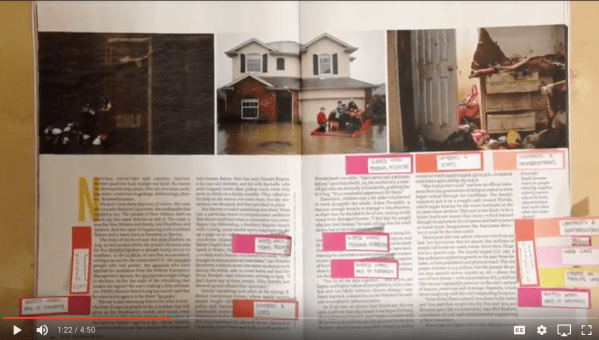
I borrowed an idea from this amazing post from Buffy J Hamilton regarding connecting text to the world around us. Next week, as one of the finishing activities in this short unit, students will each bring in a current event article which somehow relates to their books, and use these articles to launch new conversations about their books, connecting the text to themselves and to the world around us.

I’m pleased with the way these books clubs are progressing. My students don’t seem to feel intimidated by the length or weight of the books, and they tend to agree that the books are relevant and thought-provoking. While some of them have enjoyed books written in verse before their book clubs, for others this is one of their first experiences with a book written in verse. So for some students, this unit validates and supports their reading experience, and for others, it opens a door to a new form.

I encourage others to try some “unconventional” types of text for book clubs. Graphic novels, short stories, and poetry collections are all ideas I’m kicking around for future book club units, and I’m wondering how other teachers have incorporated different types of texts in their classes, and encouraged new conversation. Please leave your ideas and experiences in the comments below!

Julie has been teaching secondary language arts for nineteen years, spending the first fifteen in rural Central Oregon, and the last four in Amman, Jordan. She’s thrilled to report that she and her family will be moving across the agua to Managua, Nicaragua next year, where a new adventure will begin.

Follow her on twitter @SwinehartJulie

Five Ways Your Classroom Library will Sell Itself (Without taking up valuable class time!)

Classroom libraries are essential in the workshop model, as kids who have access to books will naturally read more books. I’m beyond thrilled that my school has invested so much into our classroom libraries. Now that the books are here, it’s time to get the students to read them!

classroom library fall 17

This is what my classroom library looked like in the fall of 2017.


Book talks are an essential way for teachers and students to discover new treasures hidden in classroom libraries, but they aren’t the only way.

Speed dating, student led book talks, and book tastings are all excellent methods for students to learn about books and develop healthy next reads lists, but they all take time.

Below are five ways to “book talk” without using valuable class time:

  1. These are quick, easy to photocopy book recommendations written by students. I keep a stack of them on a shelf with the books, and as students return books they read and loved, they can choose to fill in the recommendation form. I’m sure there are more beautiful recommendation forms out there, but this is what we have, and it works.

2. Mini-whiteboards are easily changed-out, and both students and teachers can quickly feature new and different titles. It takes moments, and the written “grab” can be copied from the inside flap or the back of the book.

  1. themed book display

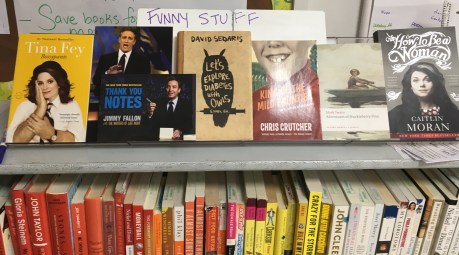
3. Themed book displays are easy to curate.  All that’s necessary are a few display stands and either some mini-white boards or some heavy paper that can be switched out. I rotate my display about once a week, and sometimes my students ask me to “do a theme” with the display. I try to oblige. This one focused on humor, but anything is possible. I’ve currently got a music theme going, and it’s fun to find themed collections based on other random ideas – animals, travel, even the color of the covers. Imagination is the only limitation with this one.


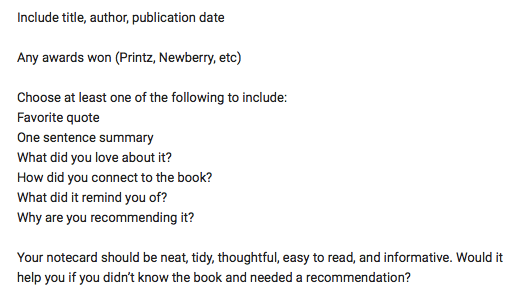
4. We reinvented the old-school card catalogue by filling an organizing bin with book recommendations. The categories in the bin match the ones on the library shelves, and students add their recommendations as they are motivated to do so, but only after reading the books, and if they liked the title. I gave them some basic guidelines for making the cards:Screen Shot 2018-03-20 at 5.29.43 PM

It takes students about five minutes to make a card, and they can even browse the “card catalog” at their desks.


5. The last method utilizes these frames from IKEA. They are double-sided, so on one side is a copy of the book cover, and on the other is the student recommendation.

I provided minimal guidelines for making the inserts to the frames:

Screen Shot 2018-03-20 at 5.29.23 PM

We are displaying them on our classroom conferring tables, on our book shelves, and in our school’s learning commons.

The common denominator with all of these ideas is that they are easily displayed, often student-created, and require minimal class time for students to create and use. They also get kids talking about books that they love, about their next reads lists, and about their reading lives. It’s win-win-win!

The gradual removal of scaffolding (like book talks) and the journey to independent reading lives are a couple of the major goals of workshop. Helping students build a community of readers means that they will depend on each other’s recommendations rather than those of their teachers’, and that helps us all reach the common goal of student independence. When students are encouraged to talk to each other about the books they read without the interference of the teacher, then true independence is closer than ever.

How do you encourage your students to build a reading community? I’d love to hear your ideas in the comments below.


Julie has been teaching secondary language arts for nineteen years, spending the first fifteen in rural Central Oregon, and the last four in Amman, Jordan. She’s thrilled to report that she and her family will be moving across the agua to Managua, Nicaragua next year, where a new adventure will begin.

Follow her on twitter @SwinehartJulie

Five Ways to Publicly Celebrate Student Reading

Once our students start reading, start setting personalized goals, and start to develop healthy reading lives, it’s important to acknowledge their progress. Big, culminating classroom celebrations are a fun way to do it, but there are also ways to celebrate that don’t take a ton of precious class time, and can mark the smaller moments worth celebrating along the way.

1. Penny Kittle encourages the book stack. Students gather the books they’ve read over the last semester, quarter, or other period of time that they’ve been reading. They stack the books up, which gives a visual representation of what they’ve accomplished with their reading. My ninth grade students recently did the book stack, and their smiles and pride were inspiring.

  1. While some students loved the book stacks, I had a couple of students who had done much of their reading on e-readers, so the book stack wasn’t such a great option for them. Our solution was the digital collage. Students gathered images of their book covers and collected them on a document, creating a digital quilt or collage. They then printed them on our color printer, and we made a patchwork mural in the hall with them.

This visual representation celebrates not only what individual students have been reading, but also serves as a hallway meeting place and inspiration for conversation about books. It’s a great way to build a reading community.

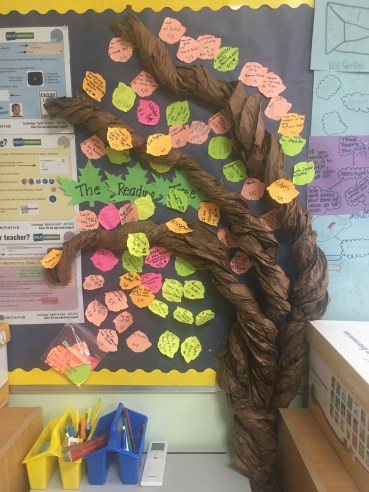
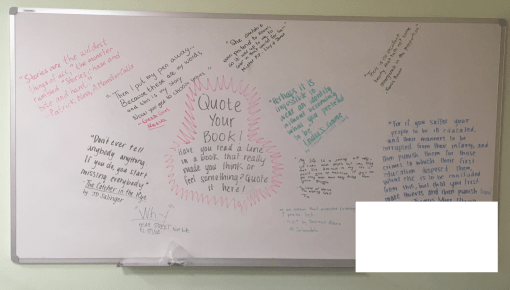
  1. Our learning support teacher encourages her readers with a creative, ongoing visual representation. She has a paper “tree” on a wall in her classroom, and as students read books, they add “leaves” to the tree. On each “leaf” the students write the title and author of the books, and it serves as both a reminder and inspiration for future reading. IMG_61004. That same teacher also keeps a quote wall on her white board. The words we read can reach us in beautiful ways, and when students experience that kind of moment, they are encouraged to share those lines on the white board. It’s another public display of a healthy reading life. It’s a conversation starter, and it helps build a sense of community within the classroom.


quote-wall.png5. Another teacher in our department keeps poster paper on her walls. Students add titles to the lists as they complete their books. Because names are attached, students can reach out to one another with questions or when they want to talk to each other about a book that they read, too. It’s another public acknowledgment and conversation starter, which is part of what we need when we build reading communities.

Books Read room 225

The common thread with all of these ideas is that they are public, they are deliberate conversation starters, and they help to build our precious reading communities.


I think it’s important to create opportunities for students to celebrate their reading accomplishments in a risk-free, nonthreatening way. Time is precious, so creating these opportunities in a relatively quick way within our classroom communities can be found time. Our classroom walls should reflect the needs and values of our classroom communities, and I find that these five strategies help move students forward with the development of their healthy reading lives.

How do you enable and encourage your students to publicly celebrate their reading lives and reading communities? I’d love to hear about it in the comments below.

Julie has been teaching secondary language arts for nineteen years, spending the first fifteen in rural Central Oregon, and the last four in Amman, Jordan. She’s thrilled to report that she and her family will be moving across the agua to Managua, Nicaragua next year, where a new adventure will begin.

Follow her on twitter @SwinehartJulie

Follow her blog https://adventuresinhighschoolworkshop.wordpress.com/

3 Ways to Utilize Audio and Visual Recording with our Readers and Writers

There is much debate regarding the use of digital technology in the classroom. For teachers, cell phones and other technology are both frustrating helpful when it comes to student use. They have the potential to be distracting and disruptive, as we all know, but tech is useful when it comes to some classroom activities, such as keeping a next reads list, or looking up word gaps. I love the idea of using them for the powers of good, so recently, I tried asking my students to use their mobile phones just for the purpose of recording, and to try to ignore the notifications that might come across as they used them.

I’m always looking for new strategies to help the readers and writers in my classroom, and in the past few weeks I’ve tried a couple of different applications. Using cell phones and iPads is simple, and it meets one of the simple rules I am trying to follow when it comes to working with students: meet them where they are.

Recently, while my grade nine students were in the thick of drafting informational essays, I asked them to read their essays aloud, and listen to the flow, the choppiness, the parts that sound great, and the parts that “just don’t sound right.” While I’ve asked students to read their own work aloud before, this time I asked them to record themselves, and then after, to listen to their voices while reading, keeping a pencil in their hands, pausing the audio and editing and revising as they go.

My students were reluctant at first, but once they got over the initial awkwardness of listening to their own voices, they indicated that it was a simple and useful strategy for revision. It’s one that can be used in other classes, and doesn’t require any other tools or even other people for help.

Another strategy we employed using recording technology was focused on the use of video recording. Before my students had started writing informational essays, we studied informational texts, using the Nonfiction Notice and Note signposts, along with the Book Head Heart strategy found in the works of Kylene Beers and Robert Probst.

IMG_4387

When students learn reading strategies and skills, it’s important to be able to see just where they are in the learning process, but it takes time to thoroughly check in with each and every one of them. So with this unit, our ninth grade English teacher team decided that it would be great if students could demonstrate their learning through a think-aloud. Doing this in class would take a lot of one-on-one time, so we asked students to demonstrate their thinking and reading skills on their own, and to use the video recording capabilities on their iPads and cell phones.

videothinkaloud

A screen shot from a video-think-aloud

Because we, as teachers, had modeled the think-aloud strategy in our classes many times, students knew exactly what we meant, and were able to demonstrate their understanding of the strategies and skills necessary when reading magazine articles. They annotated, exposed their initial confusion, shared their process of finding understanding, and demonstrated a multi-draft reading of the articles they had chosen. It was a successful method of assessment, and I plan to utilize it again. Students had a chance to showcase their thinking and understanding, and it wasn’t a one-off opportunity. They had the chance to try multiple takes with their recordings, so the pressure was off and they could easily share their thinking.

Our most current rationale for the utilization of video in class is with our new short novel unit, in which we formed book clubs. We are squeezing in a shared text at the beginning of second semester with Of Mice and Men. While all of my students are reading the same text, they are split up into groups of three and four so they can form their book clubs. One of the summative assessments with this unit is a small group discussion that they will record. They will need to demonstrate some academic, sustained, literary discussion in their videos, and are practicing in class, leading up to the recorded discussion. I’ll be able to have five small-group discussions going on at the same time in my class, which means precious class time isn’t frittered away with transition times between discussions, for example. Students will be thinking, reading, and discussing, and I’ll be able to watch the video later, when the pressure is off, and I can truly assess the conversation. I’ll try to remove the guess-work because I can slow down the speaking and listening assessment portion of it all.

annotation OMAM

One student has heavily annotated in preparation for the recorded small group discussion.

These are just a few ways to allow students to use the simple technology that is available to them. Kids know how to make movies and to splice audio, so there is little need to instruct regarding the technical details. They can use the audio and video to showcase their skills.

It’s also a timesaver as far as the classroom goes, and it takes some of the stress off of students who have test anxiety or who struggle when it comes to on-demand assessments.

While it’s not a student-recording, I will share one last recent use of video in class. I played the video in this NPR article about a murmuration of starlings as an inspiration for a quick write this week. I played it without sound, and hit replay several times. My students were fascinated and wrote some fun responses. One was even moved to write music: img_5972.jpg

I love how my students are constantly surprising and impressing me. They are unexpected and wonderful.

I’d love to hear more about how teachers and students are using laptops and cell phones for the power of good in the comments below!

Julie has been teaching secondary language arts for nineteen years, spending the first fifteen in rural Central Oregon, and the last four in Amman, Jordan. She’s thrilled to report that she and her family will be moving across the agua to Managua, Nicaragua next year, where a new adventure will begin.

Follow her on twitter @SwinehartJulie

Follow her blog https://adventuresinhighschoolworkshop.wordpress.com/