What is it you love about teaching? I have a few favorites.
More than anything I love to see the light bulb moments. You know what I mean — you see them, too. The thinking becomes almost visible like a thought bubble above a student’s head, then the thought spins a cartwheel, lands on both feet, and ignites some insightful murmur.
“Ohhh, I get it,” sighs the student.
I long for these moments.
I get them with my students, sure, but lately it’s teachers who have warmed my heart as they’ve come to embrace the philosophies of readers-writers workshop.
In December, I facilitated a workshop training in a district in my home state of TX. A little while later, I exchanged some messages with Candice Thibodeaux, an English department manager and English III teacher in Clear Creek ISD who attended that training. I asked if I could share her comments (although I am late in doing so) because I think they may speak to many of our readers who are new to implementing the moves of workshop in their classrooms.
Candice: I wanted to say once again that it was a pleasure to meet you. I think why it was so easy to hear your message is because there was no doubt you understood where we were because you are in the same trenches we are each day. I was already convinced that I wanted to move my department to the workshop method, but you cleared up some fuzzies and gave me a lot of confidence. I feel like I am in the infancy stages of implementing it, but you have me so excited. I am worried I may not implement my thematic idea well, but I am going to jump in and take note of what works and what doesn’t. I feel it has the possibility to ignite the students interest in their own learning.
Me: Your ideas for the thematic units are fantastic, and I think you will be so pleased with the responses you get from your students. And once your teachers see the kind of engagement and work your students produce, they will be more apt to want to join in the thinking and planning for workshop. Remember to be patient with yourself. There are just a few things that really matter: choice, time to read and time to write, lots of talk around books and writing, talking to kids one on one about all of it. I know we focus on the standards a lot in Texas, but really, good reading and writing requires skills that are reciprocal — and practice is what matters most.
Candice: Thanks so much for the response! I am so anxious to get back to school because I
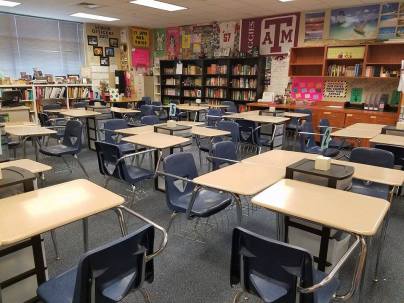
Ready for student talk. Candice’s new classroom set up invites collaboration.
did a whole lot over the break that will be so much fun to put into action. I changed my room so we can do group work easier. I cataloged all of my classroom library so students can check out online. I bought more books (which hubby was thrilled about and a little blown away as he helped me catalog almost 1,000 books, lol) and I created a quick PD for my teachers tomorrow based on my time with you and the reading I have done. I am very excited to see if I can light a fire with my teachers. My department is on board but for the most part is still very unsure what it all looks like.
Candice: The themes I picked [for my units] are war, race relations, technology, self image, and a catch all of society issues (depression, teen pregnancy, drug use, crime, violence). I expect to get a lot of discussion, reading, and writing out of all that; plus, students will do their own video PSA and print ad. I am very excited and have written letters to parents reminding them about free choice reading and telling them about thematic units, and encouraging them to discuss what their child is reading/writing/thinking. So we shall see….

photo by Jayden Yoon
Amy Rasmussen lives in north Texas and teaches AP English Language and English 3 to the Fighting Farmers at Lewisville High School. She adheres to the words of Emerson: “We aim above the mark to hit the mark,” and Jesus Christ: “Love one another.” Imagine a world if we all love more than we think we can. Follow Amy on Twitter @amyrass.

 Three Teachers Talk