Tag Archives: Structures and Non-Negotiables

Writing With Mentors: A Nonnegotiable of Writers Workshop

41dIMvzIynL._SX395_BO1,204,203,200_

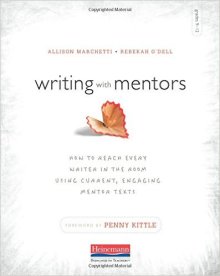
WRITING WITH MENTORS by Allison Marchetti & Rebekah O’Dell

Reading Allison Marchetti and Rebekah O’Dell‘s Writing With Mentors is reminding me of the summer, three years ago, that I committed to making the move to readers and writers workshop.  Like my new friends in Franklin, Wisconsin, I already had many of the structures of workshop in place–I just didn’t know how to fit them all together.

As I read and wrote and thought beside the likes of Penny Kittle, Amy, Jackie, Erika, and my other UNH friends, I learned quickly which parts of my instruction to keep and tweak, and which parts to flat-out jettison.  While I felt like my reading workshop practices were solid, I knew I needed to completely rethink the way I designed writing instruction.

I wish I’d had Writing With Mentors that summer.

That summer, I learned that I shouldn’t be designing lessons around a staid form like a persuasive essay or a literary analysis.  I needed to begin thinking about having my students write authentic, interesting pieces on topics of their choice–but I didn’t know how.
img_0791

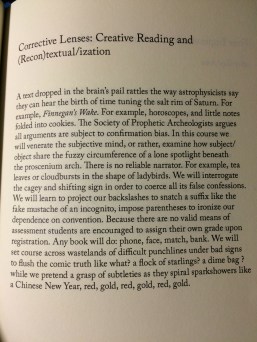
I immediately saw Gregory Pardlo’s DIGEST, full of prose poems, as a mentor text.

I learned how to read like a writer, how to look at the craft and structure of my favorite authors’ works.  I began to see mentor texts everywhere, and in fact too many places–I was exhausted by trying to keep track of everything I wanted to share with my students, and even resolved to read less as a teacher.  I wanted to offer a variety of rich mentor texts to my students without losing my mind–but I didn’t know how.

I learned that my writing process was as unique as my handwriting, and that process has value just as much as a written product does.  I wanted to restructure my unit planning, my gradebook, and my classroom routines to reflect that–but again, I didn’t know how.

Over three years, through trial and error, I’ve figured out how to reckon with a lot of those issues, but I would have known instantly had I read Writing With Mentors then.  This book succinctly showed me great writing units and products, how to plan for them, and how to select and organize current, engaging mentor texts.

img_0480

Books are at the center of my writing instruction–literally.

It reminded me that when we read–even to study the craft moves of a mentor author–we must read as readers first, for the “pleasures of story time” and to “hear the rhythms of good writing” (65).

It affirmed my habit of designing new units each year, complete with brand new mentor texts, to meet the needs of my current students and the sociopolitical climate in which we live and read and write.

It helped me cement mentor texts, alongside the writer’s notebook, conferring, and authenticity, as nonnegotiables of a successful writers workshop–because, in Allison and Rebekah’s words, “mentor texts enable complete creativity and individuality to emerge in student writing and writing instruction” (3).

And it reminded me that when students leave our classrooms, “mentor texts will always be present” (167).  When we teach students to write with mentors, they remain capable of reading like writers as they engage with print and media and other real-world texts.   Since getting my students to become lifelong readers and writers is my ultimate goal, this book is now an important mentor to me.

Writing With Mentors is the book to pick up when you put the textbook down, toss out your binders of writing rubrics, or throw up your hands when you read your 94th crappy plagiarized paper in a row.  If you’re seeking to rejuvenate, organize, and revamp your writing instruction, don’t undergo three years of trial and error like I did…let Allison and Rebekah help you write, more happily, successfully, and authentically, with mentors.

Have you read Writing With Mentors?  Share your feedback in the comments!


Mini-Lesson Monday: Setting Up New Notebooks

img_0966

Our first semester notebook sections

My students and I have filled up one notebook thus far this school year, and as the second quarter comes to a close, we’re going to buy new ones and decorate, personalize, and organize them together.

At the beginning of the year, I asked my students to create quite a few sections in our notebooks.  This helped us stay organized at first, but as the year went on and sections filled up, the variety of sections caused more stress than they relieved.

img_0959

Brand new notebook! I love this one by “Punctuate” from Barnes & Noble.

Over break, our friend Erika shared an excellent article about the health benefits of journaling.  Amy said this about the article: “I wish composition notebooks were cheap right now. I’d get new ones for my students, read this piece, and start over when we get back to school. We’ve got notebooks, but we are not as into them as I would like. Could be a jump start.”

I feel the same way Amy does.  Our notebooks have turned more into workspaces and less into journals.  I want to change that as we begin the second semester.

Objectives — Using the language of the Depth of Knowledge Levels:  Formulate ideas about topics during quickwrite time; Construct language that reflects beliefs and ideas. Or, from the Common Core: Write routinely over extended time frames (time for research, reflection, and revision) and shorter time frames (a single sitting or a day or two) for a range of tasks and purposes.

Lesson — I’ll begin by telling students this story:  “I read Tom Romano’s Write What Matters again over break, looking for ideas for meaningful notebook activities.  From his chapter titled “Notebook: Playground, Workshop, Repository,” Tom gives this advice about journals:

“Buy one. Write in it every day. You’ll strengthen your writing muscles and keep them supple. You’ll learn to accept words your mind offers. You’ll consolidate writing skills you’re developing. You’ll sharpen your perceptions, live more alertly. You’ll expand your vocabulary, too.

img_0961

My first page of all my notebooks–a photo and a tracing of my hand, inspired by Penny Kittle and Sarah Kay’s poem “Hands.”

“This quote resonates with me.  It reminds me why I write, and why we should all write often.  Why do you find value in writing?”

We’ll have a conversation about the meaningfulness of writing, then set up our notebooks together.

“Last semester felt hectic when all of our sections filled up.  This semester I want to keep it simple.”  I’ll put the following guidelines on the board:

  • What-to-read list goes on very last page
  • Vocab words go on the page before that (see our posts here and here to know how we “do” vocab)
  • Quotes go on the page before that (craft studies usually go here)
  • Small section for heart books at the very end

“And that’s it.  I want to just write in chronological order every day, keeping just a few pages in the back for our usual routines.”

We’ll spend the remainder of class setting up our sections and collage-ing our notebooks to personalize them, as Jackie describes here.  I’ll do this alongside my students, adding ultrasound pictures and magazine cutouts to represent the upcoming year of change that’s in store for me.

Over the coming weeks, we’ll focus on using mini-lessons from Write What Matters–ones that involve drawing, writing therapeutically, and telling the narratives of our writing places and experiences.  I’ll hope to jump start, in Amy’s words, my students’ passion for writing with new notebooks and new notebook routines.

What routines will you change as the first semester ends?  What elements of your teaching will you revise?  Please share in the comments.

10 Pedagogical Must-Reads for Workshop Teachers

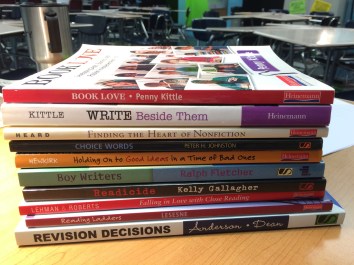
IMG_0650I met with my new student teacher a few weeks ago, and he asked me to borrow any books that might help him get going on the readers-writers workshop–the “theory” version of Jackie’s starter kit.  He’s been in my classroom before, so he knows the general routine and character of our work, but he wanted to know the ins and outs of how I thought and planned and conceptualized the whole thing.

I sat at my desk and looked at all of the titles I had on hand, remembering how influential reading them for the first time had been.  As a result, it was hard not to just dump my entire professional bookshelf onto a cart for him, but I managed to pick out a few titles that have guided me most adeptly in one aspect or another of my current classroom practice.

  1. Book Love by Penny Kittle – This was the book that helped to solidify my vision of an ideal classroom.  Before I read it, I had already been doing many of the best practices Penny mentions–writer’s notebooks, choice reading, personalized writing.  But I didn’t know how to bring it all together until Book Love.  As such, this is my #1 recommendation for any teacher looking to jump-start their individualized workshop curriculum.
  2. Write Beside Them by Penny Kittle – This book introduced me to the concepts of mentor texts, reading like a writer, and best draft/publication of writing.  I learned about quickwrites, constant revision, writing conferences, and a great deal more of what are now standard routines in my classroom.  This is the book for anyone curious about the big picture of writing instruction.
  3. Finding the Heart of Nonfiction by Georgia Heard – I was raised in the tradition of literature as containing mostly fiction and poetry, but Penny’s books helped me see the great value of nonfiction.  I wanted to know how to integrate it well into my thematic units, and this book helped me do that.  Georgia’s book is full of wisdom about finding the soul of good nonfiction writing and matching it to your students’ needs.
  4. Choice Words by Peter Johnston – This book taught me how to talk to students.  It is my #1 recommendation for anyone looking to address those pesky Speaking and Listening standards in the Common Core–this book teaches you about the delicate, volatile power of a few choice words between you and your students.  I re-read it every year, and it might be the most important book in this stack.
  5. Holding On to Good Ideas in a Time of Bad Ones by Tom Newkirk – This book is subtitled “Six Literacy Principles Worth Fighting For,” and Tom Newkirk certainly made me want to engage some of my former teachers in fisticuffs when I finished it.  This text is full of common-sense brilliance that will transform the way you think about why we teach reading and what kinds of texts we teach.
  6. Boy Writers by Ralph Fletcher – Why do my students keep writing about violent gun battles?  Why do they always ask if they can swear in their writing?  What’s up with the complete unwillingness of my boys to be vulnerable?  If you’ve asked yourself these questions…this book is for you.  Ralph writes about everything you ever wondered about boy writers and how to move them forward in their writing.
  7. Readicide by Kelly Gallagher – Schools have been killing reading for many years, Kelly argues, and then presents ways you can stop the slaughter.  He fires away at pop quizzes, assigned chapters, multiple-choice tests, and all the practices that steer our students toward SparkNotes.  Then he reveals ways to get students authentically engaging in literature in a way that doesn’t kill their love of reading.
  8. Falling in Love with Close Reading by Chris Lehman and Kate Roberts – After finishing Readicide and wanting to abandon the eight or so whole-class novels I once felt chained to, I wasn’t sure how to teach close reading skills.  This book answered that question for me, and more.  Chris and Kate reveal how to use poems, articles, short stories, and selections from novels to get kids interacting with the beauty and power of language in all kinds of texts.
  9. Reading Ladders by Teri Lesesne – When all of your students have finally found a book they will actually read–then what?  Teri Lesesne taught me how to help students climb a reading ladder of text complexity with this book.  It’s a tough battle to get all kids reading, but it’s even tougher to get them to all challenge themselves once they are.  Reading ladders are the solution to the increasing complexity question–now they’re a consistent part of my instruction.
  10. Revision Decisions by Jeff Anderson and Deborah Dean – After reading the first nine books on this list, I still wasn’t sure where grammar instruction fit in.  I knew to have students read like writers and learn from language and sentence structures that way, but I wasn’t sure how to structure my mini-lessons, until I read this book.  Jeff and Deborah helped me find strong craft study lessons and bring them into the classroom in a way that appealed to students and also benefited them immediately in their writing.

This is by no means an exhaustive list–That Workshop Book by Stephanie Harvey, Read Write Teach by Linda Rief, The Book Whisperer by Donalyn Miller, and many other integral titles were simply not on my shelf when I gave this stack to Mike.  But these top ten are ones I wouldn’t be the same teacher without.

What other titles are essential to your practice?  Please share in the comments!

Update:  Here are must-read folks that readers have suggested via Twitter and Facebook, as well as in the comments:

  1. Lucy Calkins
  2. Nancie Atwell
  3. Linda Rief
  4. Katie Wood Ray
  5. Donalyn Miller
  6. Don Graves
  7. Donald Murray
  8. Peter Elbow
  9. Ariel Sacks
  10. James Moffett
  11. Louise Rosenblatt

Five things you can do to guarantee your students will read

“Pull up a chair. Take a taste. Come join us. [Books are] so endlessly delicious.”
― Ruth Reichl

I’ve spent a lot of time with the love birds my children gave me for my birthday. They are beautiful. Marianne and Colonel Brandon And scared. I made the mistake of not reading enough about them before I tried my hand at training. Now, I am having to back track just to get them to like me. I knew better. Should have done my research.

It all starts with trust. Every day I put my hand inside the cage, hold it there, and just talk. I talk about the weather — it’s been quite tragic in north TX lately. I talk about the book their names come from — Sense and Sensibility. (My daughter dubbed them Marianne and Colonel Brandon.) I talk about how we will be the best of friends if they will just trust me.

Colonel Brandon bit my finger and held on so hard I stamped my feet for five full seconds hoping he would let go.

I’ve even tried speaking my limited Spanish. (The birds came from a Mexican vendor at an outdoor market.)

“Hola, buenos dias.”

Sitting on the floor near the cage is my school bag. In it is my conferring notebook. It holds a roster with check marks for books read and pages for each student where I record our conversations about books and reading.

This morning I was finally able to get Marianne to step up on to a perch and gently pull her from the cage. She sat on the top, eating happily on a millet twig. Progress.

I flipped through the notebook, remembering conversations I’ve had with students this fall.

“I used to love to read,” Henry told me, but then I didn’t like textbooks so I didn’t read anything again until 8th grade.

“What do you mean textbooks, you mean like an anthology of stories and poems and such?”

“Yes, those,” he said, “I hated those, so I just didn’t read anything in middle school. Then my teacher in 8th grade let us choose the books we wanted, and I read a ton. Hunger Games, Divergent, all those dystopian books. Then in 9th and 10th it was back to textbooks. I stopped reading.”

Henry was a hard sell at first. I’d already set up the routines in my reader’s workshop classroom. He missed the read arounds, the notebook set up, the initial book talks with the titles I know students love every year. And just like with my birds, I started wrong with Henry.

I expected him to step up without question into our reading world. He didn’t.

I had to back track and build some trust. I’d do a book talk and then set the book not far from him. I’d talk to other students about their reading near enough so Henry could hear. I’d ask Henry questions and I’d listen to his answers, so he would know I cared about him as a person more than as a reader.

And Henry started reading.

Henry has read four books since September when he joined my class:  Article 5, Friday Night Lights, Peace Like a River, and Labron James’ Dream Team.  Not bad for a young man who went two years without reading anything in 9th and 10th grade.

For any teacher who says independent reading just doesn’t work for you or your students, I issue this challenge:  Backtrack and try again.

Five things you can do to guarantee your students will read:

  1. Read. The more you read books you think your students will enjoy, the more you will be able to talk about books your students will enjoy. Don’t have a clue about YA? Read anything by Matthew Quick, A.S. King, Jandy Nelson, or John Green (my personal favorites). You’ll have a good start.
  2. Share book talks daily. Talk about books you know students love. If you don’t know titles, ask your librarian for help, read book lists like this one, read lists we’ve shared in previous posts.
  3. Show book trailers. I used to post book trailers on this blog. You’ll find many post with trailers, interviews, and other ideas here.
  4. Get students talking. The more students talk to one another about their reading the better your chances of getting all students to read. One favorite activity in my classroom is speed dating with a book.
  5. Give students time. I heard it first from Penny Kittle:  “If they aren’t reading with you, they are not reading without you.” We must give students time to read during class. Too many teachers and administrators think silent reading is not a good use of instruction time. FALSE. The only way to become a reader — or to become a better reader — is to read. If we want students to develop the habits of life-long readers, we must help them develop the habits in class where we can help them 1) stay focused, 2) learn what readers do when they get stuck, 3) practice choosing books for learning and for pleasure, 4) make plans for future reading.


What tips can you share for anyone who’s struggling with independent reading? Please leave your suggestions in the comments. Thanks!


5 Non-Negotiables When Designing Writing Instruction

IMG_0528

First draft of a unit plan in my notebook

I plan my units of instruction in three-week chunks, alternating between a reading-focused unit and a writing-focused unit.  In every unit, and in every class period, I keep some routines the same, much like Amy describes here.  While I do most of the big thinking about a unit up front, I do leave some holes in the plans to make space for mini-lessons that are responsive to what I discover students need during our conferences.  And every year, I design brand new units.

While each unit is unique, I was reminded while at the NCTE Annual Convention of five non-negotiables to keep in mind when designing writing instruction.

Writing should be low-stakes.  Students need to write a lot, and a lot of that writing should be ungraded, unread, or worth very few points.  I have felt liberated in terms of grading writing since I read Kelly Gallagher’s research-based statement that students should be reading and writing four times as much as a teacher could ever grade.

I think, since I embraced that philosophy, that my students also feel liberated.  Their notebooks are a “safe place for regular, ungraded practice,” as Penny Kittle described in her Ignite session.  While we write in our notebooks every day, and outside of class in one-pagers, I only collect notebooks every two weeks, and only carefully read and respond to one or two pieces my students have marked.  Indeed, 80% of the writing we do stays in our notebooks and never makes it to ‘published’ form.  This takes the pressure off writers to produce something perfect or error-free, because “our classrooms need to be a safe place to fail,” in the words of Taylor Mali.

IMG_0265

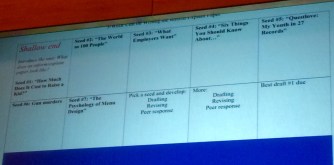
The first two weeks of Kelly Gallagher’s unit plan–week three is filled with revision and getting to best draft #3 at the ‘deep end’

Teaching writing is complex, layered, and nuanced.  In her session on revision, Georgia Heard shared the five things all students need in order to make authentic revision happen:  “opportunities for students to write, mini-lessons on craft and revision, choice in topics, mentor texts, one-on-one conferences with both teachers and students.”  Kelly Gallagher’s unit plan he walked us through adhered to those rules remarkably well.  “Assigning writing and teaching writing are two different things.  Grading writing and assessing writing are two different things,” he reminded us.  It is impossible for students to produce great writing if it is merely assigned.  Thus, when I plan a unit of writing instruction, I leave ample time for craft mini-lessons, modeling my own writing, and talk amongst students and myself.

When teachers are writers ourselves, and experience the process of topic choice, revision, and studying craft moves beside our students, we can become the most effective teachers of writing.  We have to walk the talk.  “Great, effective teachers must be informed AND inspired,” Kwame Alexander asserted.  To be a truly informed teacher of writing, a teacher must be a writer herself. I learned more about writing a strong narrative while participating in NaNoWriMo alongside my students than I ever did just trying to teach fiction before I wrote fiction.  I loved the experience six years ago during my first attempt, and I’ve continued to complete all assignments beside my students ever since.  When we write with our students, inspiration will spread through “the contagion of passion,” in Penny Kittle’s words.

Writing should be personal.  While I love to write about reading, and find it valuable for students to do so often, most of the writing in my classroom is personalized, choice-driven, and often remains private.  When we do a nonfiction writing unit, like the rhetorical analysis we’re in the midst of right now, our written products are focused on the students’ relationships to the texts they’re analyzing–in this case, the misleading rhetoric often found in American politics.  Mostly we write narratives, even in the midst of nonfiction, telling the stories of our connections to the topics we discuss in informative or argumentative genres.

“You can write yourself out of dark places. How much of the writing we do in school nurtures that?” Gary Anderson wondered in his session on reflection.  We have to honor the fact that students are not inherently motivated to write for their futures–for college, job applications, or resumes–but rather they are motivated to write for the here and now, and for themselves.  This is why choice is, and will remain, at the center of my writing instruction.

How do you design writing instruction?  Share your process in the comments!

I’m Teaching Writing to the Whole 5th Grade — Now What?!

I received this note in a Facebook message:  I had big changes in my classroom assignment this year… moved from 2nd grade to 5th… turns out… after getting there I got the assignment of teaching writing to the entire 5th grade…. not what I really signed up for…. I have not only NEVER formally taught writing (as a process) beyond complete sentences… and moving toward paragraphs…. but I never even had a class in in it in college….. any suggestions on where to start and where to go with it? I will have 4 units of 12 days each during the year with each of the 5th grade classes….. suggestions?

Say you had to analyze the tone, what adjective would you use? concerned? riled? desperate? beseeching?

Let’s look at the clues:  “big changes,” “turns out,” “entire,” “not what I really signed up for,” “NEVER,” and all those “…..”

I could write an entire post on why the kind of changes this teacher has had thrust upon her is so disrespectful to her as an educator, as a professional. But I won’t. I just needed to say that.

Of course, I answered, and I will offer support and help any way I can. You would, too.

Maybe others have similar experiences and are new at teaching writing. Here’s how I answered my friend:

Yes, I have suggestions! Haha. Tons of them. You know I teach AP Language and Composition, right? Just writeThat’s juniors in high school, but good writing is good writing. Your instruction with your 5th graders can look very similar to mine. (And I hope it will.)

Here’s the non-negotiables in my writing class:

Writer’s notebooks. I use the black composition notebooks. Students cover them, personalize them, and make them mean something other than just a notebook for school. We write in them every day as a way to explore our thinking. I might give a prompt, or read a poem, or watch a news clip…whatever, and then I ask students to think and respond. These quickwrites become places to mine for ideas for topics we might develop into more formal pieces. Writer’s notebooks are required and loved in writing classes where students have choice and autonomy, two important components of effective writing instruction.

Mentor Texts. Mentors are texts that look like the writing I want students to practice. For example, if we are writing narrative, I want students to read good narrative writing. If we are writing book reviews, we need to study the structure of book reviews, etc. The authors of these mentors become our “writing coaches.” We study the moves the writers make, and then we try to make those moves in our own writing. Students learn from good models. They do not learn from poor, fix-the-grammar-and-punctuation worksheets or anything of that ilk. Research on that is plentiful.

Choice. When students have choice in the topics they write about, they are more apt to take ownership and care about their writing. Just like you and me — we do not want told what books we have to read, TV shows we have to watch, or essays we must write that show we learned something from pd. Topics matter so much to the effort students will put into their writing. We have to let students choose what they want to spend their time focusing on. Sometimes we need to nudge them. Sometimes we need to help them narrow the topic. But they need to always have a choice if we want to really teach them anything about writing. Save the formal test-like prompts for practice after students learn how to mine for ideas and develop those ideas in writing they want to do. Test writing can serve as a genre in itself later.

Time. Schedule time within the school day for kids to write. Let them know you are there to help. When they write with us, 1) we know they are writing and not a friend or parent, 2) we see their process and know where the struggles are.

Conferences. Meet with writers throughout the writing process, beginning, middle, and end. Ask questions that provoke their thinking. Let them talk about their ideas. Avoid giving advice, rather validate the students’ ideas and speak to them as writers. (Focus on the writer and his needs over the writing and what it needs — avoid the red pen at all costs.)

Modeling. Write in front of your students. This is probably the most effective instructional tool you have. Students need to see the messiness of the writing process. They need to know it is hard — even for a teacher. I try to write every assignment I ask my students to write. I start writing in front of them and let them see my thinking, my errors, my revision, my re-organization, all of it. Too many student writers think they should be able to write well in a one shot in the dark deal. That’s why they refuse to revise. We have to show them that writing is difficult and confusing and time consuming. We have to give them opportunities to see the struggle, so we can convince them that the work is worth it when we’ve finally been able to say what we want and need to say in our writing.

Talking. “Writing floats on a sea of talk,” I heard Penny Kittle say. Talk with students about their ideas, their process, their everything concerning writing. Encourage them to talk with one another. Talk and Write. Read and Talk and Write. Talking works to stimulate thinking and provoke the pen to action.

Celebrating. Feedback matters, even at the sentence level. Invite students to share their writing. This can be a sentence or a complete piece. Celebrating good writing along the way is a more effective feedback tool than a grade at the end of publication. Whips Around the Room that invite all students to share a favorite sentence or passage, Author’s Chairs that invite students to read a best draft, Posting on Blogs and inviting students to read one another’s work and leave comments, are all ways to celebrate writing — and help students understand the importance of audience.
Some of my favorite RESOURCES:

National Writing Project — Resources page

Read Write Reflect — Katherine  Sokolowski’s blog — the reflective practices inside a 5th grade classroom

The Nerdy Book Club — a community of readers (and teachers of readers) — read about books, reading, writing, and more!

Two Writing Teachers blog — more tips on teaching young writers that you can digest in one sitting

Moving Writers blog — Rachel and Allison show they are the best mentor text finders on the planet

And of course, my own blog: Three Teachers Talk where we write about Readers and Writers Workshop

Lucy Calkins quoteBOOKS you will consider life savers:

In the Middle by Nancie Atwell

Read Write Teach by Linda Reif
Write Beside Them by Penny Kittle

And I haven’t read this one yet, but who doesn’t want to be unstoppable? The Unstoppable Writing Teacher by Colleen Cruz
I imagine you are overwhelmed. No, I cannot really imagine. I do know that you are smart though, and you love children and teaching. You will do a wonderful job inspiring students to write — that is half the battle.

The learning comes from doing. Get your students writing. The more they write the better they will write. I see it every year.

Best blessings,

Amy

Did I leave anything out? What advice do you have for this emerging writing teacher?

©Amy Rasmussen, 2011 – 2015