Tag Archives: Shana Karnes

#PoetryChat Tonight, 8ET

poetry-prompts-rantLet’s talk poetry.

A few months ago, a pre-service teacher I know asked me to give her some feedback on a poetry unit she’d written.  Her mini-unit, a 25-page document filled mostly by her professor’s formatting requirements, troubled me for a few reasons.

First, as Amy established, poetry is more than a unit–it’s a powerful way of teaching linguistic precision, the art of writing, and the freedom of expression.  It shouldn’t be a two-week item to scratch off a curricular checklist.

Further, pre-planning a unit in such a detailed way takes the power out of learning. “You’re doing too much of the thinking in this unit, and your students aren’t doing enough,” I wrote to her. She had selected every poem, every genre, and every skill for her students to learn–in doing so, she took away a valuable opportunity for her students to seek out, evaluate, and share found and original poetry.

Second, this teacher’s unit was full of contradictions.  I loved seeing her ideas about including slam poetry, spine poems, blackout poetry, and other engaging, unique poetry possibilities.  However, I was confused by what seemed to be an obligation she felt to teach every literary and poetry term ever.  “Focus on getting your students to learn how to WRITE poetry by studying other AUTHORS of poetry,” I advised. “When Dickinson was writing poems, it wasn’t because she was like ‘oooh I love metaphors’–it was because she had a broken heart.”

In teaching poetry, it seems like too many of us are yoked to an antiquated view of poetry–metaphors, dactyls, metric feet.  We are focused too much on the HOW of poetry, and not enough on the WHY.  As we teach our students, let’s focus on them as poets, not simple readers of poems.

Join us tonight at 8ET for a #poetrychat about ways to transform our students into poets by getting poetry off our shelves and into their hands, introducing them to mentor authors, and encouraging play with nontraditional poetry forms.

#PoetryChat Questions:

Warm-Up: Your favorite line or phrase from a loved poem

1. Why do you think many students find poetry intimidating or inaccessible?

2. When you teach poetry, how do you balance the students’ READING of poetry and WRITING of poetry?

3. What are your favorite genres of nontraditional poetry (prose poetry, spine poems, etc.)?

4. Who are your favorite mentor poets? How do you use them to teach your students?

5. What can our students gain from novels in verse? What are your favorite in-verse titles?

6. Let’s finish by sharing our most successful poetry teaching stories. What’s yours?

Before and After

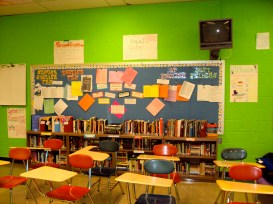
Our Compass Shifts 2-1Here in Wild and Wonderful West Virginia, we’ve been back to school for a little over a week.  I’ve managed to learn all of my students’ names, most of their reading interests, and a few of their writing hang-ups.  My students seem to be quickly figuring out that stubbornness or apathy are no match for the genuine obsession I have with reading and writing, and getting my students to do both well.  They sometimes look a little taken aback as they sit facing one another in my beautiful blue classroom, watching me do a booktalk or model a writing lesson with the zeal of a stage performer, but that’s okay with me.  I’ve worked hard to portray all of the passion and enthusiasm inside of me as we’ve framed our reading and writing workshop, and when I see all eyes in the classroom on mine, a book, or their own words on a page, I feel like I’m doing a good job.

But the thing is–I feel completely out of my element here.  I’ve only been teaching in this classroom for seven days.  I’ve only been in this state for two months.  And I’ve only been Mrs. Karnes since June first.  Combine that with the fact that this year, I’m giving myself over to the workshop model entirely, and everything about my life feels completely different.

Image

You see, I had a great teaching job in Cincinnati at a small school north of the city.  I taught wonderful classes–AP English, Honors English, a reading elective–and headed excellent activities–National Honor Society, Academic Team, ACT/SAT Class.  I had a gorgeous lime green classroom, a curriculum I could plan for in my sleep, and cooperative students who answered the questions I asked correctly.  I did a lot, but my job felt easy.  I had plenty of time to plan a wedding, finish my Masters degree, and work a second job outside of school.  All was comfortable and I was content.  But then, I was swept away by love to another state–away from the family, classroom, and colleagues I had all been so familiar with.  I got married and moved here without a job lined up, and quickly realized how frantic I was to teach again.

Image

I was fortunate enough to land a position at my new school thanks to a unique license type I had due to the Ohio-West Virginia transfer.  Here, I would be teaching general level English and one journalism class, plus advising the yearbook staff.  None of this seemed very glamorous–and my new classroom certainly wasn’t very exciting either–but hey, I was just glad to have a job.  I reasoned that the textbook series was the same, my classroom library held the same books, and I had two big crates full of sample writing prompts, essay questions, reading projects, and test-prep questions to get me through.

Then came the University of New Hampshire and its Summer Literacy Institute.  This worldview-altering learning experience completely revitalized me as a teacher.  I learned as much from my fellow students as I did from our teacher-leader, the amazing Penny Kittle (if you haven’t read her books, get with the program and READ THEM!).  After two weeks of ideas, inspiration, and insight, I decided to take the fact that I was in a new school with a flexible curriculum and use it as an opportunity to completely overhaul my teaching.  I threw most of the contents of those two big crates in the garbage and started fresh.

Image

So here I am, workshopping it up in West Virginia.  While I’m still getting used to planning and prepping for this model, I’m happy with the way things are going.  I spend much less time “teaching” than I’m used to, but much more time conferring one-on-one with students, helping them find good books, talking about their reading lives, and working with them on their writing.  I still get a jolt hearing “Mrs. Karnes!” instead of “Miss E!”, it still feels strange to bring my teacher bag home to a small apartment instead of my old house, and I don’t have a pile of worksheets to grade or a set of chapters to assign.  But my students are reading.  They’re writing.  And they’re doing both seriously.

I’m in a different state, with a different name, teaching in a different way.  I may not feel comfortable, but I do feel right at home.